How we make this list: we compare pricing pages, product documentation and public user reviews. Ratings come from G2, Capterra or Trustpilot, with the date we checked them.
Key takeaways
- NinjaOne is the most common destination for MSPs leaving an RMM, leading current satisfaction rankings with strong patching and automation.
- Atera and Syncro bundle RMM with PSA tools and price per technician, which suits small MSPs whose endpoint counts dwarf their headcount.
- Datto RMM and ConnectWise Automate serve larger MSP operations already inside the Kaseya and ConnectWise ecosystems.
- Naverisk's appeal is an all in one RMM and PSA at a simple price, so model per endpoint against per technician pricing on your real numbers before switching.
Quick comparison
| Tool | Best for | Starting price | Free plan |
|---|
 NinjaOne | Modern RMM with top rated usability | See website | No |
 Datto RMM | MSPs in the Kaseya and Datto ecosystem | See website | No |
 ConnectWise Automate | Large MSPs needing deep automation | See website | No |
 Atera | All in one RMM and PSA priced per technician | $129 per technician per month | No |
 Syncro | RMM, PSA and billing in one per user price | $139 per user per month | No |
 Pulseway | Mobile first monitoring and control | See website | No |
 SuperOps | A newer all in one built for modern MSPs | See website | No |
Is your product missing or out of date?
We review this list regularly. Vendors can request a listing, send updated pricing or ask about featured placement.
The best Naverisk alternatives
#1NinjaOne
Best for: Modern RMM with top rated usability4.7/5 on
G2 (5,037 reviews, checked Oct 2026)
Visit ninjaone.com
Starting priceSee website
Free planNo
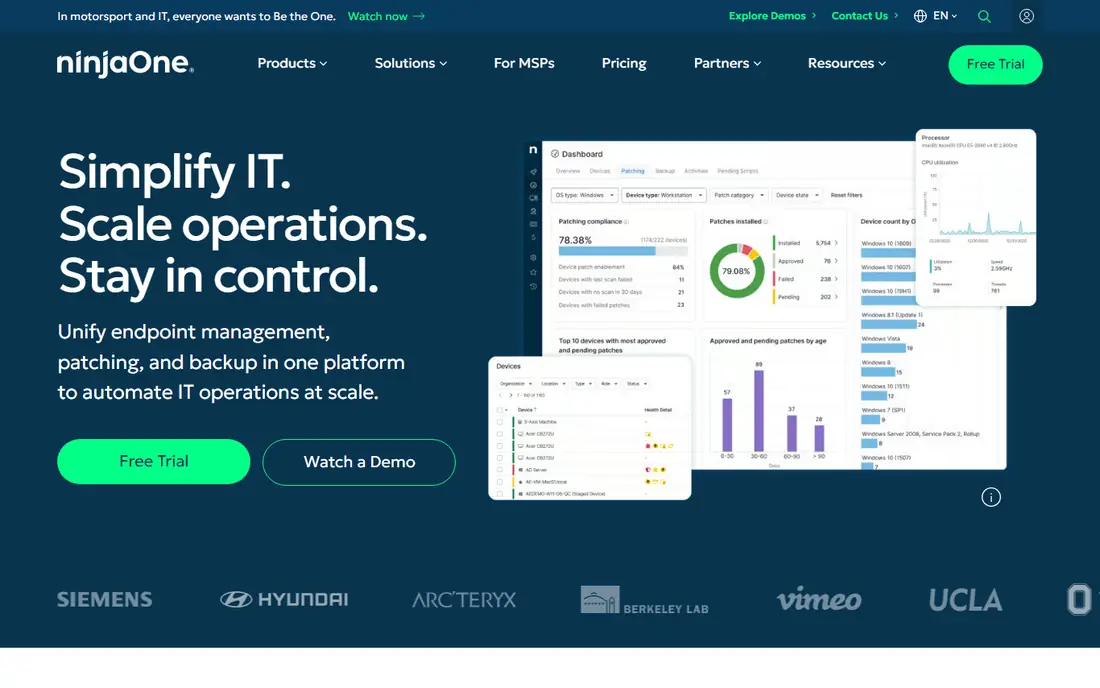
What we like- NinjaOne has become the RMM most MSPs name first: fast, clean interface, patching for operating systems and third party applications that reviewers consistently praise, scripting and automation that technicians actually use, and remote access and backup options inside the same platform. It repeatedly tops peer review rankings for RMM satisfaction and ease of use. Onboarding is measured in days rather than the projects older platforms demand. For a Naverisk user whose complaint is that the tool feels a step behind, NinjaOne is the modernisation candidate.
Watch out for- Pricing is quote based per endpoint and not published, so we list see website, and at large endpoint counts it is rarely the cheapest quote on the table. PSA is not its product
- You will pair it with a separate service desk, which some Naverisk users count as a step backwards from all in one. Backup and some extras price separately. Its very popularity means every rival bids against it, so negotiate rather than accepting the first number.
#2Datto RMM
Best for: MSPs in the Kaseya and Datto ecosystem4.5/5 on
G2 (803 reviews, checked Oct 2026)
Visit datto.com
Starting priceSee website
Free planNo
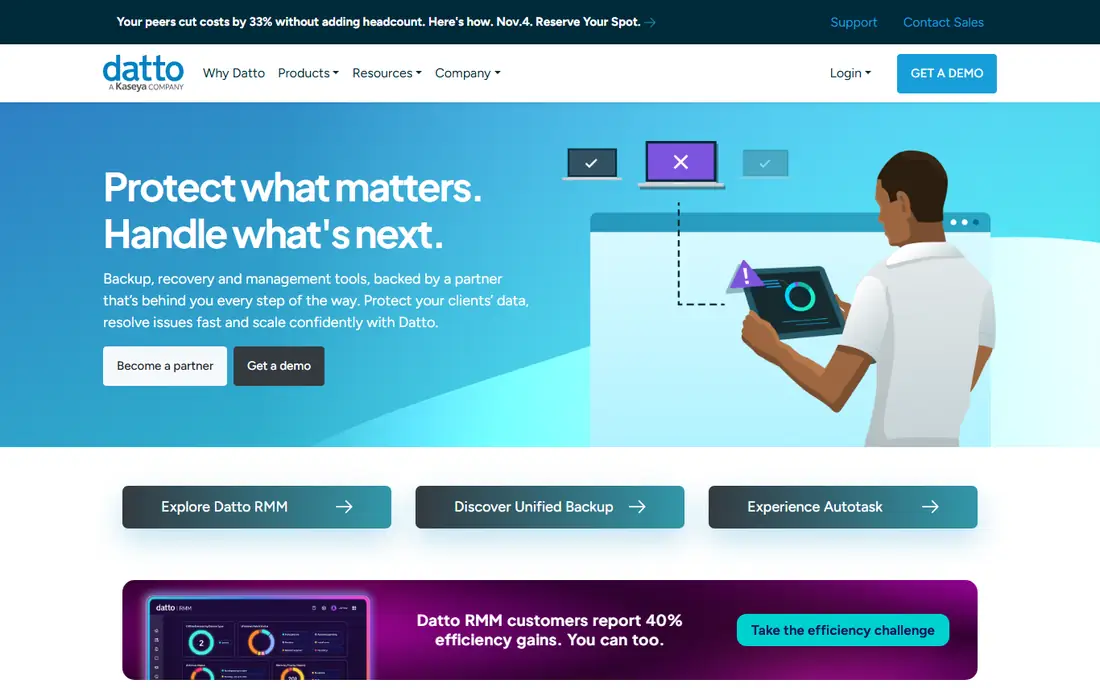
What we like- Datto RMM is a mature, cloud native RMM with strong policy based management, software deployment, patching and monitoring, now part of Kaseya alongside the Datto backup line many MSPs already sell. Its component based jobs and integrations with Autotask PSA make it a natural fit where the rest of the stack is Datto or Kaseya shaped. Security features such as ransomware detection on endpoints add value clients increasingly ask about. For MSPs consolidating vendors, one contract covering RMM and backup simplifies life.
Watch out for- Pricing is per endpoint by quote, hence see website, and Kaseya contracts have a reputation in MSP communities for long terms and firm renewals, so read the paperwork as carefully as the product. The platform rewards standardisation
- Casual users find its power comes with configuration depth. If your stack is not Kaseya shaped, the ecosystem argument weakens and NinjaOne or Atera usually win the comparison.
#3ConnectWise Automate
Best for: Large MSPs needing deep automation4.1/5 on
G2 (141 reviews, checked Oct 2026)
Visit connectwise.com
Starting priceSee website
Free planNo
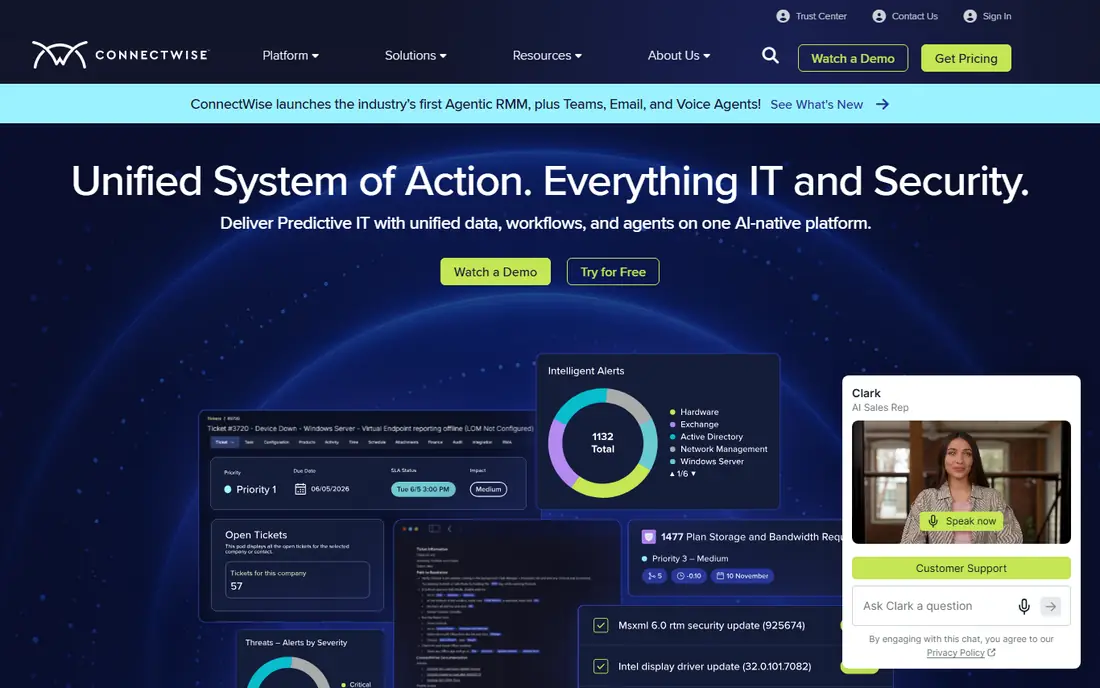
What we like- ConnectWise Automate, the platform long known as LabTech, is the heavy automation option: a scripting engine and monitor system deep enough that large MSPs build their service delivery on it, with hundreds of integrations and a marketplace of extensions. Paired with ConnectWise PSA, formerly Manage, it runs the operations of many of the biggest MSPs in the market. If your Naverisk ceiling is automation sophistication, Automate raises it further than anything else in this list, and experienced Automate engineers are a hireable specialism.
Watch out for- Depth is bought with complexity and administrators: Automate typically needs a dedicated owner to configure and maintain, which small MSPs cannot justify. Pricing is quote based, hence see website, and the platform's age shows in parts of the interface and in the learning curve. Implementation is a project with professional services attached. For a ten person MSP, it is usually power that costs more in attention than it returns.
#4Atera
Best for: All in one RMM and PSA priced per technician4.6/5 on
G2 (1,123 reviews, checked Oct 2026)
Visit atera.com
Starting price$129 per technician per month
Free planNo
What we like- Atera is the closest structural match to Naverisk's all in one idea, with a different meter: RMM, remote access, helpdesk, ticketing and billing in one platform priced per technician, from 129 dollars per technician per month on annual billing for the Pro tier, with unlimited endpoints under each technician. For a small MSP managing many devices with few people, that model can undercut per endpoint rivals dramatically. AI assistance for scripts and ticket summaries is built in, setup is quick, and the interface was designed for working technicians rather than platform administrators.
Watch out for- Unlimited endpoints per technician tempts sprawl: without discipline, monitoring and patching quality thins across a huge estate. Advanced automation and reporting sit on higher tiers, and very large MSPs find per endpoint platforms more configurable. Some integrations are shallower than the ConnectWise or Kaseya catalogues. The per technician model also flips against you as the team grows, so model the three year headcount before falling in love with year one pricing.
#5Syncro
Best for: RMM, PSA and billing in one per user price4.5/5 on
G2 (553 reviews, checked Oct 2026)
Visit syncromsp.com
Starting price$139 per user per month
Free planNo
What we like- Syncro bundles RMM with a genuinely complete PSA: ticketing, invoicing, inventory, customer management and integrated payments, at 139 dollars per user per month with unlimited endpoints in its published pricing. For a small MSP running its whole business on Naverisk style consolidation, Syncro is the one alternative that does not ask you to adopt a second platform for the business side. Scripting, policy management and Microsoft 365 management features are built in, and the company sells month to month flexibility as part of its pitch to small teams.
Watch out for- The RMM side, while capable, is not as deep as NinjaOne or Automate for patching edge cases and automation at serious scale. Integrations lean on its API and a smaller catalogue than the enterprise suites. Reporting is serviceable rather than rich. Like Atera, the per user model deserves a growth model run against it. Support is geared to small MSPs, which suits its market and limits its fit for larger operations.
#6Pulseway
Best for: Mobile first monitoring and control4.5/5 on
G2 (125 reviews, checked Oct 2026)
Visit pulseway.com
Starting priceSee website
Free planNo
What we like- Pulseway built its name on the phone in the technician's pocket: full monitoring and control of servers and workstations from a mobile app that came first rather than as an afterthought, with patching, automation and remote access following the same design. On call staff genuinely run incidents from it. Pricing is per endpoint and competitive at small scale, sold in tiers by quote and bundle, so we list see website. For an MSP whose service promise is response time, the mobile control is a feature rivals imitate rather than match.
Watch out for- The PSA and business side is thinner than Atera or Syncro, so it often pairs with a separate service desk. Desktop console depth, reporting and integrations trail the bigger platforms. Per endpoint pricing at thousands of devices needs the same negotiation discipline as Datto or NinjaOne. It suits responsive small teams best
- Large MSP operations usually standardise elsewhere.
#7SuperOps
Best for: A newer all in one built for modern MSPs4.4/5 on
G2 (205 reviews, checked Oct 2026)
Visit superops.com
Starting priceSee website
Free planNo
What we like- SuperOps is the newer all in one challenger: RMM and PSA designed together recently, with a clean interface, automation and asset management, and an active development pace that ships features its older rivals discuss. It targets the same small and mid sized MSPs as Naverisk and prices by technician based bundles sold through its site and sales team
- Current bundles were not published in a stable form we could quote, so we list see website. MSPs tired of legacy platforms' accumulated complexity find its coherence refreshing, and its onboarding is built for switching teams.
Watch out for- Newer means a smaller integration catalogue, a thinner community knowledge base and less evidence at very large endpoint counts. Feature depth in areas such as network monitoring is still catching up with incumbents. The company's roadmap velocity is a promise as well as a fact, and conservative MSPs may prefer a platform whose future is boring. Check references from MSPs of your size and shape during the trial, since published reviews skew toward smaller teams.
How we chose
We compared RMM platforms an MSP could move a live estate onto in 2026, judging monitoring, patching, automation, remote access and the business layer around them. Every entry is actively developed and sold to MSPs; pricing is published where vendors publish it and marked see website where the market runs on quotes, which is most of this category. We weighted the reason most Naverisk users shop, outgrowing an all in one without wanting an enterprise project, and flagged where per technician models such as Atera and Syncro answer that directly. Free plans do not exist in serious RMM, so trials and onboarding terms carry the evaluation.
How to choose the right RMM for your MSP
Model the money first, on your real estate: endpoints, technicians and a three year growth case, priced on both models. Per endpoint platforms, NinjaOne, Datto and Automate, reward operational maturity; per technician bundles, Atera and Syncro, reward lean teams with big estates. Then weigh the business layer: if Naverisk's built in PSA carries your ticketing and billing today, moving to a pure RMM means adopting a PSA too, and that second migration decides the timeline more than the agent rollout does.
Pilot on one client, ideally your most standardised one, and measure the work: patch compliance after one cycle, alert noise per endpoint, time to remote in, and a technician's honest verdict after a fortnight of tickets. Check contract terms with unusual care in this market, where auto renewal and multi year lock in complaints are common across several vendors. An RMM touches every client device you manage, so its security posture, MFA enforcement, role permissions and audit logs are part of your own security story to clients; ask for the documentation before the trial, not after the incident.
Frequently asked questions
What is the closest alternative to Naverisk?
Atera and Syncro match its shape most closely: RMM and PSA in one product aimed at small and mid sized MSPs. Atera prices per technician with unlimited endpoints; Syncro publishes a per user price with the full business suite attached. NinjaOne is the closer answer if the move is about RMM quality rather than consolidation, accepting a separate PSA. The right match depends on whether you are leaving Naverisk's tool or its pricing model.
Is per technician or per endpoint pricing cheaper?
It depends entirely on your ratio. Divide endpoints by technicians: a high ratio, hundreds of devices per person, favours per technician pricing such as Atera at 129 dollars per technician per month. A low ratio, a hands on team with modest estates, often prices better per endpoint, especially negotiated at volume. Recheck the answer at renewal with the new numbers, because growth changes the winner, and switching RMMs is painful enough that the model deserves a three year view.
How hard is it to migrate from one RMM to another?
The agents are the easy part: most platforms deploy the new agent through the old one, and a client estate moves in days. The real work is rebuilding policies, monitors, scripts, patch rules and integrations, then retraining technicians whose muscle memory runs the service desk. Budget weeks of parallel running for a careful migration, client by client, and keep the old platform until the new one has survived a full patch cycle everywhere. Rushed RMM migrations are a reliable way to meet your clients' out of hours numbers.
Do these platforms include remote access and patching?
Yes, both are core RMM functions across this list: remote desktop or background access, operating system patching and, increasingly, third party application patching, which is where they differ most in quality. Test third party patching against your actual software estate during the trial, since coverage lists differ, and check whether remote access is the platform's own tool or a bundled third party product, because that affects both performance and price at renewal.
What security questions should I ask an RMM vendor?
Ask how the platform itself is protected: MFA enforcement for technicians, role based permissions down to client level, audit logging of remote sessions and script runs, and the vendor's own security certifications and incident history. An RMM is the highest value target in an MSP's stack because it reaches every client device, and attackers know it. Also confirm what happens to your agents and data if you leave, and get exit terms in the contract, not in a sales call.
Sources we checked (0)
Is your product missing or out of date?
We review this list regularly. Vendors can request a listing, send updated pricing or ask about featured placement.

Shihab Mia · Founder, Rankite
Shihab has 5+ years in B2B and SaaS SEO. He writes Rankite's software buying guides from pricing pages, documentation and public user reviews. More about Shihab.