How we make this list: we compare pricing pages, product documentation and public user reviews. Ratings come from G2, Capterra or Trustpilot, with the date we checked them.
Key takeaways
- Eclipse Mosquitto is the cheapest way to start, and it runs on hardware as small as a single board computer.
- HiveMQ and EMQX are the picks for fleets that need millions of connections with clustering and enterprise support.
- AWS IoT Core and Azure IoT Hub remove server work entirely, but they tie your billing and tooling to one cloud.
- RabbitMQ fits teams that already use it for other messaging and want MQTT as one protocol among several.
- Cedalo gives Mosquitto users a supported path to production without changing brokers.
Quick comparison
| Tool | Best for | Starting price | Free plan |
|---|
 HiveMQ | Large industrial fleets | See website | Free trial |
 EMQX | High connection counts | See website | Free trial |
 Eclipse Mosquitto | Small projects and edge devices | Free | Yes |
 VerneMQ | Self hosted clustering | Free | Yes |
 RabbitMQ | Multi protocol teams | Free | Yes |
 AWS IoT Core | AWS based fleets | See website | Free trial |
 Azure IoT Hub | Azure based fleets | See website | Free trial |
 Cedalo | Mosquitto in production | See website | Free trial |
Is your product missing or out of date?
We review this list regularly. Vendors can request a listing, send updated pricing or ask about featured placement.
The best MQTT alternatives
Starting priceSee website
Free planFree trial

HiveMQ is built for factories, energy sites, and connected vehicle programs where downtime costs real money. Its homepage reports deployments with more than 200 million concurrent connections and uptime figures aimed at mission critical operations. The platform covers the full path from edge connectivity to governed data use, which suits teams that need context and control around raw device data, not just message delivery.
The trade-off is cost and complexity. Pricing is not published as a simple per device figure, so small teams cannot budget from the website alone. HiveMQ also offers a community edition for testing, which is a sensible way to try the broker before talking to sales. Pick HiveMQ when your fleet is large, your uptime bar is high, and you have engineers to run a serious deployment.
What we like- Handles very large connection counts
- Strong clustering and high availability
- Deep industrial and edge tooling
Watch out for- Commercial pricing is quote based
- Smaller teams may find the platform more than they need
Starting priceSee website
Free planFree trial
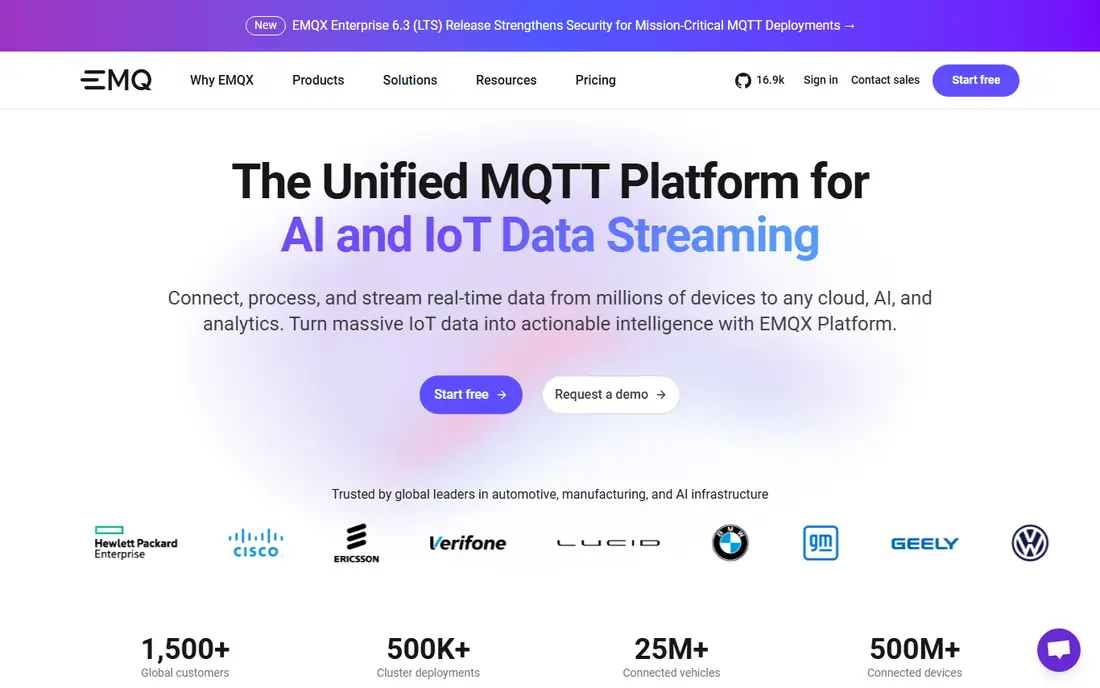
EMQX presents itself as a unified MQTT platform for AI and IoT data streaming, and its homepage cites more than 500 million connected devices across customer deployments. It supports MQTT over WebSocket and QUIC, plus NATS, CoAP, LwM2M, and many industrial protocols. That breadth matters when a fleet mixes device types and back end systems, since one platform can bridge them instead of running several brokers.
Deployment is flexible: fully managed cloud, bring your own cloud, or self managed enterprise. A free trial of the enterprise edition and a cloud start path let teams test before committing. The catch is that the most useful features, such as advanced clustering and support, sit behind paid plans. EMQX fits teams that expect fast growth in device counts and want a broker that scales without a rewrite.
What we like- Built on Erlang for very high concurrency
- Supports MQTT 3.1.1 and 5.0 plus other protocols
- Managed cloud option available
Watch out for- Enterprise features need paid plans
- Configuration can feel deep for beginners
Starting priceFree
Free planYes
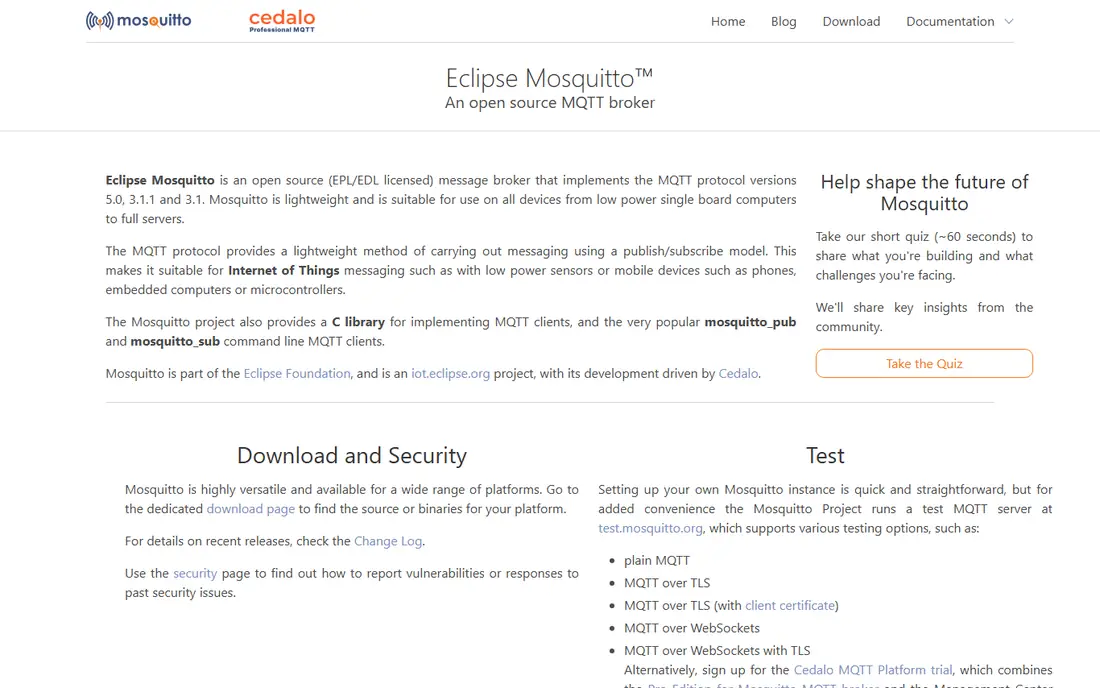
Mosquitto is the default starting point for most MQTT work, and for good reason. It implements MQTT 5.0, 3.1.1, and 3.1, runs on low power boards as well as full servers, and ships with the widely used mosquitto_pub and mosquitto_sub command line clients. The project is part of the Eclipse Foundation, and its development is driven by Cedalo, which gives it a stable home.
Mosquitto is honest about its limits. It is a single broker, not a clustered system, so very large fleets will outgrow it or need workarounds. Support comes from the community on a best effort basis. For home automation, prototypes, classrooms, and small commercial fleets, Mosquitto is hard to beat: free, simple, and well documented. Teams that later need high availability can move to Cedalo Pro Mosquitto without changing protocols.
What we like- Lightweight and free under an open source license
- Runs on tiny hardware
- Huge community and client library support
Watch out for- No built in clustering for large scale
- Enterprise features need a separate product
Starting priceFree
Free planYes
VerneMQ is an open source MQTT broker designed around clustering from the start. It scales horizontally and vertically, tolerates network failures, and resolves conflicts automatically after a netsplit. Its homepage stresses that you do not need to know Erlang to run it, since CLI tools, APIs, and plugins hide the runtime. A Lua scripting engine with database drivers covers many custom authentication and authorization needs without writing Erlang code.
The weak spot is documentation and community size. Compared with Mosquitto, fewer tutorials and fewer answered questions exist, so teams should expect more self reliance. VerneMQ suits engineering teams that want a free, clustered, self hosted broker and are comfortable operating Erlang based systems. It is a strong middle ground between a single Mosquitto node and a paid enterprise platform.
What we like- Open source with true clustering
- Built on Erlang OTP for fault tolerance
- Plugin system with Lua scripting
Watch out for- Documentation can feel thin in places
- Smaller community than Mosquitto
Starting priceFree
Free planYes
RabbitMQ is one of the most widely deployed message brokers in the world, and it speaks MQTT through a plugin alongside AMQP and other protocols. That makes it a natural pick for teams that already run RabbitMQ for microservices and want to add device messaging without a second broker to operate. Its routing, queuing, and streaming features are mature, and Broadcom offers a commercial edition with 24/7 support for mission critical use.
The honest catch is that MQTT is not RabbitMQ's native protocol. The plugin works well, but a dedicated MQTT broker may handle extreme device counts and MQTT 5 features more cleanly. RabbitMQ also needs careful tuning at IoT scale. Choose it when your organization already knows RabbitMQ, your device count is moderate, and you value one broker for many kinds of messages.
What we like- Mature, widely used, free under Mozilla Public License 2.0
- Supports AMQP, MQTT, and streaming
- Strong routing and queuing
Watch out for- MQTT arrives through a plugin, not as the native core
- Needs tuning for very large device fleets
Starting priceSee website
Free planFree trial
AWS IoT Core is the managed path for teams already building on Amazon Web Services. Its native MQTT broker supports persistent connections, message retention, and millions of devices and topics, with MQTT 5 support alongside backwards compatibility for MQTT 3. A rules engine filters, transforms, and routes messages to other AWS services, and Device Advisor offers pre built test suites for validating device behavior before onboarding.
The cost model is the main thing to watch. Billing follows messages, connections, and rules activity, so a chatty fleet can surprise you. IoT Core also works best inside the AWS ecosystem; teams on other clouds get less value. Pick it when your back end already lives on AWS, you want zero broker operations, and you can model usage based costs before launch.
What we like- Fully managed MQTT broker with no servers to run
- Supports MQTT 5 and MQTT 3
- Rules engine routes and transforms data
Watch out for- Pricing is usage based and can grow with scale
- Deepest value requires other AWS services
Starting priceSee website
Free planFree trial
Azure IoT Hub gives Azure teams a cloud hosted back end for device communication, with per device authentication, built in device management, and scaled provisioning. Device to cloud telemetry and cloud to device commands both work with delivery tracking, and messages can be resent to cover intermittent connectivity. Device Update for IoT Hub adds over the air updates from tiny sensors up to gateway devices, which matters for fleets that cannot be touched in person.
Like AWS IoT Core, IoT Hub rewards teams that already use its cloud. Pricing follows tiers and message volumes, so large fleets should read the tier limits before committing. It is a solid pick for enterprises standardized on Microsoft tooling, especially where device management and update workflows matter as much as raw message delivery.
What we like- Cloud hosted with per device identity and credentials
- Two way device communication
- Device provisioning and update tooling
Watch out for- Pricing tiers need care at scale
- Best value inside the Azure ecosystem
Starting priceSee website
Free planFree trial
Cedalo is the company behind the Mosquitto project, and its Pro Mosquitto platform takes the familiar broker into production. The homepage reports more than 600 million Docker pulls and over 200 enterprise customers, with clustering that keeps messages flowing when a node fails. Native bridges to Kafka, Snowflake, InfluxDB, PostgreSQL, and other systems move data without a middleware layer, and the Management Center covers monitoring, client management, audit trails, and a browser based MQTT client.
The appeal is continuity. Teams that prototyped on Mosquitto can upgrade in place, pointing Pro Mosquitto at an existing config, rather than learning a new broker. The cost is a commercial license with quote based pricing, and Cedalo is narrower than a full cloud IoT suite. Choose Cedalo when Mosquitto already fits your protocol needs and you need clustering, support, and operations tooling around it.
What we like- Built by the Mosquitto team
- Active active clustering with no message loss on node failure
- Browser based Management Center
Watch out for- Commercial pricing is quote based
- Smaller scope than full cloud IoT suites
How we chose
We started from the vendor homepages for each broker, confirming that each product exists today, supports MQTT, and fits the category of MQTT brokers or managed IoT messaging. We favored a mix of open source brokers, commercial platforms, and managed cloud services so readers at different scales can compare real options. Pricing figures come from vendor pricing pages where published; where pricing is quote based or usage based, we wrote See website rather than guessing. Public docs and community reports filled gaps on clustering, protocol versions, and limits, and we flagged weak spots instead of hiding them.
Picking the right broker for your fleet
Start with scale. If you run fewer than a few thousand devices, Mosquitto or VerneMQ will likely serve you well at low cost. If you expect hundreds of thousands of connections, look at HiveMQ, EMQX, or a managed cloud broker, and test clustering under realistic load before launch. Protocol details matter too: confirm MQTT 5 support if you need user properties, shared subscriptions, or session expiry, since older brokers may only offer MQTT 3.1.1.
Think about operations, not just features. A broker you cannot monitor, back up, and update will fail you at the worst time. Ask who is on call for it, how clients reconnect after an outage, and how you revoke a compromised device. Security basics include TLS in transit, per device credentials, and topic level access control; treat any broker without those as a prototype tool only. Finally, model total cost for one year at your expected message volume, including support and any cloud services the broker depends on, before you commit.
Frequently asked questions
Is MQTT the same as a message queue?
No. MQTT is a lightweight publish and subscribe protocol built for devices with limited bandwidth and unreliable networks. A message queue usually holds messages for specific consumers, while an MQTT broker routes published messages to every subscriber of a topic. Some brokers, such as RabbitMQ, do both, but the models differ.
Do I need a paid broker for a small project?
Usually not. Eclipse Mosquitto handles small fleets for free, and VerneMQ adds clustering at no license cost. Paid brokers earn their price at larger scale, where clustering, support, and management tooling reduce outage risk. Start free and pay when your fleet or uptime needs demand it.
What is the difference between MQTT 3 and MQTT 5?
MQTT 5 adds user properties, shared subscriptions, session expiry, topic aliases, and richer error reporting. MQTT 3.1.1 remains widely supported and is simpler to implement. If your devices and broker both support MQTT 5, use it; otherwise MQTT 3.1.1 still works fine for most telemetry.
Can I run an MQTT broker on a Raspberry Pi?
Yes. Mosquitto runs well on a Raspberry Pi and other single board computers, which makes it popular for home automation and edge gateways. Heavier clustered brokers need more memory and CPU, so check system requirements before installing them on small hardware.
How do I keep device connections secure?
Use TLS encryption in transit, give each device its own credentials, and restrict topics with access control lists so a device can only publish and subscribe where it should. Rotate credentials when a device is lost or decommissioned, and monitor connection logs for unusual patterns.
What happens if my broker goes down?
Devices with retry logic reconnect when the broker returns, but messages published during the outage may be lost unless you use persistent sessions or clustered brokers with message retention. For fleets where gaps are costly, use clustering or a managed service with high availability guarantees.
Sources we checked (8)
- https://www.hivemq.com
- https://www.emqx.com
- https://mosquitto.org
- https://vernemq.com
- https://www.rabbitmq.com
- https://aws.amazon.com/iot-core/
- https://azure.microsoft.com/en-us/products/iot-hub
- https://cedalo.com
Is your product missing or out of date?
We review this list regularly. Vendors can request a listing, send updated pricing or ask about featured placement.

Shihab Mia · Founder, Rankite
Shihab has 5+ years in B2B and SaaS SEO. He writes Rankite's software buying guides from pricing pages, documentation and public user reviews. More about Shihab.