How we make this list: we compare pricing pages, product documentation and public user reviews. Ratings come from G2, Capterra or Trustpilot, with the date we checked them.
Key takeaways
- Mem changed its pricing in late Aug 2026. The old $12 a month unlimited plan is gone. Free allows 25 notes and 25 messages a month, Plus costs $9 a month for 50 of each, and Pro costs $29 a month for 100 of each, with higher Pro tiers up to $199 a month.
- Notion Plus at $10 a member a month billed yearly is the best direct swap: notes, docs, wikis and databases in one workspace, with a free plan for solo use.
- Obsidian is free, with Sync at $4 a user a month billed yearly, and it stores notes as plain Markdown files on your own device.
- Roam Research Pro at $15 a month, or $165 a year, is the closest match for linked daily notes with block references.
- Capacities Pro at $9.99 a month billed yearly is the best pick for visual, object-based notes with a built-in daily page.
Why do people look for a Mem alternative?
Mem is an AI-first notes app from Mem Labs, now positioned as an AI chief of staff, with Mem Workspace for notes and Mem Agent for follow-through. People usually leave it for four reasons. First, the metered caps: since late Aug 2026, every plan caps how many notes and messages you get each month, and the old unlimited plan is gone, so heavy note takers hit the limit. Second, price: Pro now costs $29 a month for 100 notes and 100 messages, which is more than Notion Plus, Obsidian Sync and Roam Research combined. Third, platform: Mem has no Android app, and it is built for one person, with no team plan on its pricing page. Fourth, ownership: Mem stores notes in its own cloud, with no end-to-end encryption, so people who want local files or stronger privacy look elsewhere.
What should a Mem alternative do differently?
Match the alternative to the reason you are leaving. If the reason is the metered caps, Notion, Obsidian, Roam Research, Logseq and Evernote all have no per-note cap on paid plans, and Taskade Pro covers up to 10 seats with no note cap. If the reason is price, Obsidian is free with Sync at $4 a month, Logseq is free, and Notion Plus at $10 a month is a third of Mem Pro. If the reason is AI, Notion AI is included in Business at $20 a member a month, and Evernote and Capacities both have AI features on paid plans, while Obsidian needs a plugin and a separate AI key. If the reason is ownership, Obsidian and Logseq store notes as plain Markdown files on your device, and Roam Research exports to Markdown. If the reason is teams, Notion and Taskade both have real team plans, while Mem lists no team plan.
How much do Mem alternatives cost?
| Tool | Starting price | Free plan | Best for |
| Notion | $10 per member per month, billed yearly | Yes | Notes, docs and wikis in one workspace |
| Obsidian | Free, Sync $4 per user per month, billed yearly | Yes | Local Markdown notes you own |
| Roam Research | $15 per month, or $165 per year | No | Linked daily notes with block references |
| Logseq | Free, Sync $5 per month | Yes | A free open-source outliner |
| Evernote | $99 per year, or $14.99 per month | Yes | Web clips and document search |
| Reflect | $10 per month, reported | No | Fast daily notes with backlinks |
| Capacities | $9.99 per month, billed yearly | Yes | Visual object-based notes |
| Taskade | $10 per month, billed yearly | Yes | Notes, tasks and AI agents for teams |
A year of Mem Pro costs $348, a year of Notion Plus costs $120, and a year of Obsidian Sync costs $48. The gap is large, so the right pick depends on whether you want AI follow-through on every note or a plain workspace with no monthly cap.
Quick comparison
| Tool | Best for | Starting price | Free plan |
|---|
 Notion | People who want notes, docs, wikis and databases in one workspace | $10 per member per month, billed yearly (Plus; $12 billed monthly) | Yes. Free plan for solo use with unlimited pages. |
 Obsidian | People who want notes as plain files on their own device | Free (Sync $4 per user per month, billed yearly; $5 billed monthly) | Yes. The core app is free, including commercial use. |
 Roam Research | Researchers who live in linked daily notes with block references | $15 per month (Pro; $165 per year) | No free plan. 31-day free trial. |
 Logseq | People who want a free open-source outliner with local files | Free (Sync $5 per month) | Yes. The app is free and open source. |
 Evernote | Solo users who clip the web and scan paper into one searchable inbox | $99 per year (Starter; $14.99 per month) | Yes. Free plan capped at 50 notes and one notebook. |
 Reflect | People who want fast daily notes with backlinks and calendar context | $10 per month (reported; Reflect no longer lists a price on its site) | No free plan in the classic sense. Trial available. |
 Capacities | One person building a linked knowledge base with visual objects | $9.99 per month, billed yearly (Pro; $11.99 billed monthly) | Yes. Basic plan is free. |
 Taskade | People who want notes, tasks and AI agents in a team workspace | $10 per month, billed yearly (Pro, up to 10 seats; $20 billed monthly) | Yes. Free Forever plan with unlimited projects, two workspace members and three Taskade Genesis apps. |
Is your product missing or out of date?
We review this list regularly. Vendors can request a listing, send updated pricing or ask about featured placement.
The 8 best Mem alternatives
#1Notion
Best for: People who want notes, docs, wikis and databases in one workspace4.6/5 on
G2 (13,834 reviews, checked Oct 2026)
Visit notion.com
Starting price$10 per member per month, billed yearly (Plus; $12 billed monthly)
Free planYes. Free plan for solo use with unlimited pages.
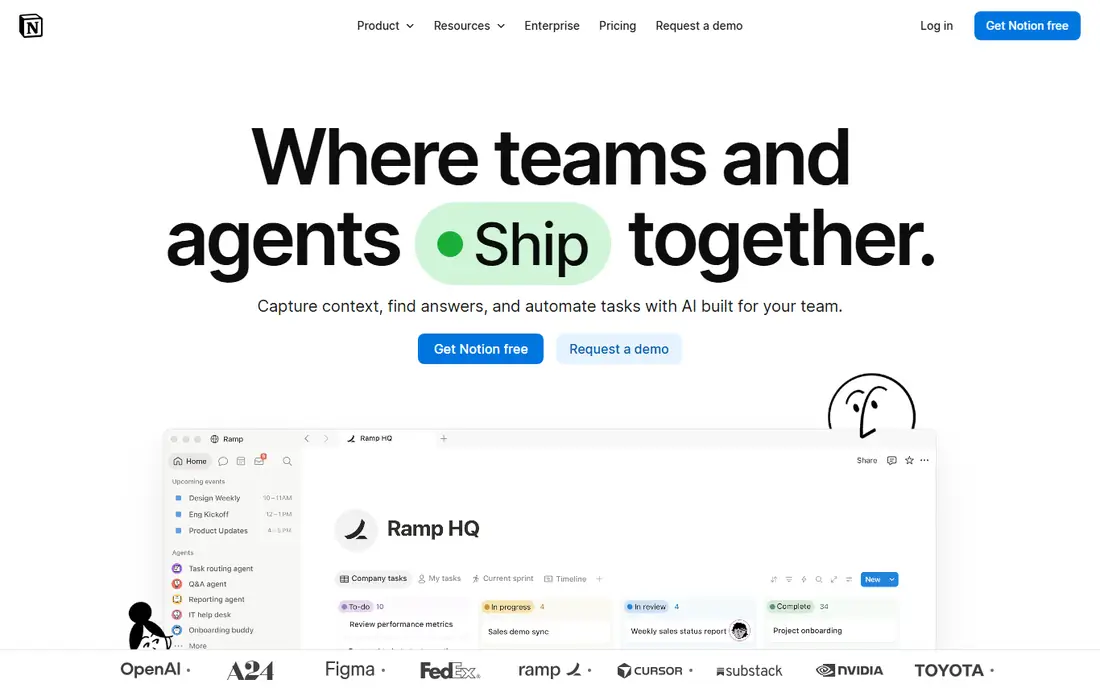
Notion is the most direct Mem replacement in this list. Plus at $10 a member a month billed yearly adds unlimited file uploads, 30-day page history, custom sites and forms, charts and unlimited guests. Business at $20 adds full Notion AI, including the Agent, AI Meeting Notes and Enterprise Search, plus SAML SSO and private teamspaces. The free plan covers solo use with unlimited pages, and there is no cap on how many notes you create. You can build a daily notes database with calendar and board views, and link notes to tasks and docs. The drawback is the AI: full Notion AI needs Business, and the Plus plan only includes a trial, so the AI costs twice the base plan. For a person who wants one workspace for notes and docs, Notion is the best replacement.
What we like- Flexible databases, docs and wikis in one place, strong templates, calendar and board views, no per-note cap
Watch out for- Full AI needs Business at $20 a member a month, it has no native habit tracking or Pomodoro, and the interface can feel heavy for quick notes
#2Obsidian
Best for: People who want notes as plain files on their own device4.5/5 on
G2 (13 reviews, checked Oct 2026)
Visit obsidian.md
Starting priceFree (Sync $4 per user per month, billed yearly; $5 billed monthly)
Free planYes. The core app is free, including commercial use.
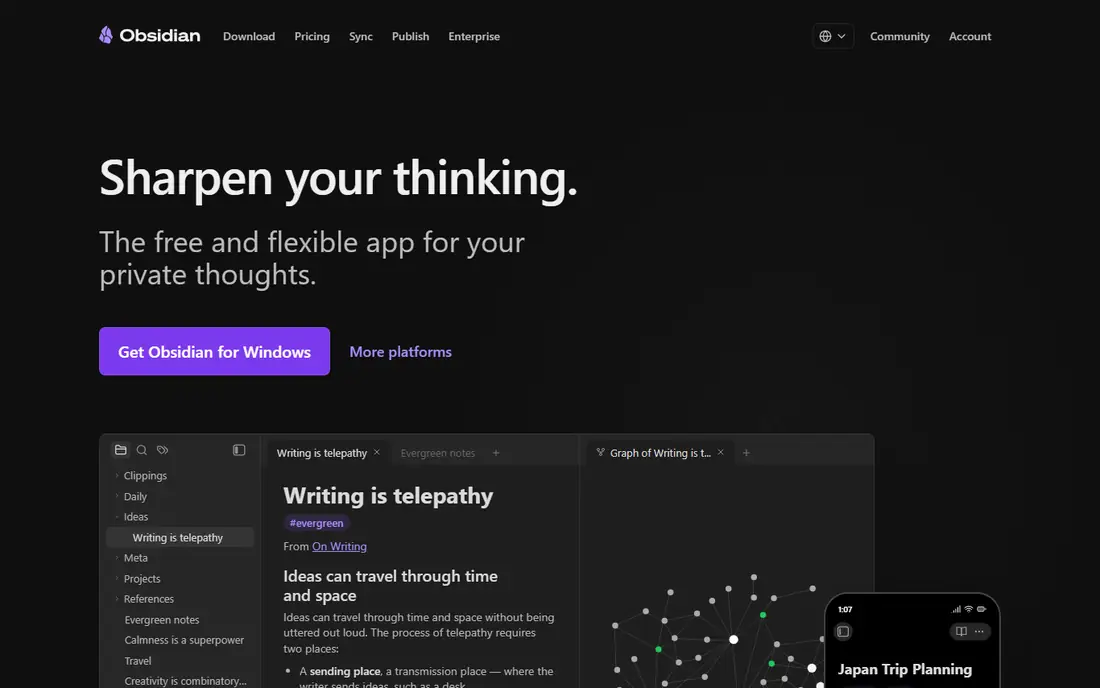
Obsidian is the ownership-first Mem alternative. The core app is free, with local Markdown vaults, backlinks, a graph view and a plugin library that adds calendars, tasks and AI through third-party plugins. Sync costs $4 a user a month billed yearly for one vault with 1 GB and encryption, and Publish costs $8 a site a month billed yearly. There is no cap on how many notes you create, and your files stay on your device. The drawback is the AI: Obsidian has no built-in assistant, so you must set up a plugin and pay for your own AI key, and the interface needs configuration before it feels finished. For a person who wants to own their notes and pay only for sync, Obsidian is the best pick.
What we like- Notes are plain Markdown files you own, fast local search, graph view, huge plugin library, no per-note cap
Watch out for- No built-in AI, sync and publish cost extra, and the interface takes setup work
#3
Roam Research
Best for: Researchers who live in linked daily notes with block references
Visit roamresearch.com
Starting price$15 per month (Pro; $165 per year)
Free planNo free plan. 31-day free trial.
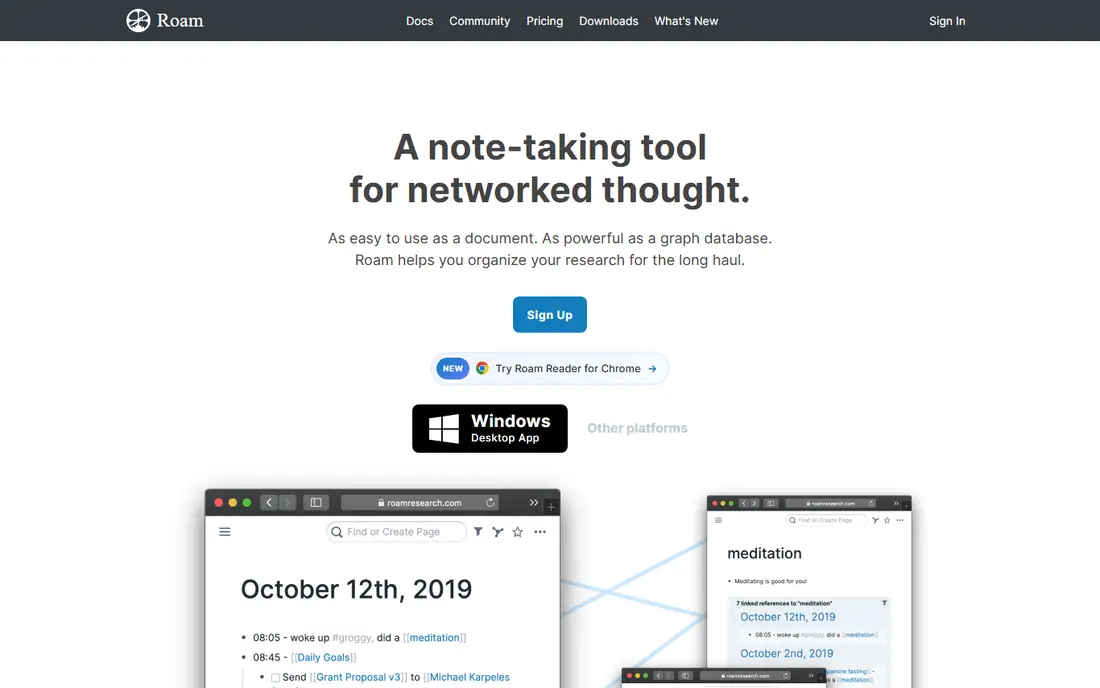
Roam Research invented much of the linked-note style that Mem later copied. Pro costs $15 a month or $165 a year, with a daily notes page, block references, bidirectional links and a graph view. Believer costs $500 for five years. You write each day on a daily page, link blocks into other pages, and build a network of ideas over time. The drawback is the price and the learning curve: there is no free plan beyond the trial, and the interface is plain, with a steep learning curve. Roam has no built-in AI assistant. For a researcher who lives in daily notes and wants block-level links, Roam is the best tool in this list.
What we like- Daily notes page, block references and bidirectional links, graph view, strong for research and long-form thinking
Watch out for- No free plan, the interface is plain and takes learning, and it is the most expensive tool in this list
#4
Logseq
Best for: People who want a free open-source outliner with local files
Visit logseq.com
Starting priceFree (Sync $5 per month)
Free planYes. The app is free and open source.
Logseq is the free Mem alternative. It is an open-source outliner that stores notes as local Markdown or org files, with a daily journal, block references, tags and a graph view. Sync costs $5 a month for encrypted sync across devices. There is no cap on how many notes you create, and your files stay on your device. The drawback is the AI: Logseq has no built-in assistant, and the interface is less polished than Mem, with a learning curve for new users. For a person who wants a free outliner with local files and no monthly cap, Logseq is the best pick.
What we like- Free, open source, local Markdown and org files, outliner with block references, graph view, no per-note cap
Watch out for- No built-in AI, sync is a separate paid service, and the interface is less polished than Mem
#5Evernote
Best for: Solo users who clip the web and scan paper into one searchable inbox4.3/5 on
G2 (2,034 reviews, checked Oct 2026)
Visit evernote.com
Starting price$99 per year (Starter; $14.99 per month)
Free planYes. Free plan capped at 50 notes and one notebook.
Evernote is the veteran Mem alternative. Starter costs $99 a year or $14.99 a month, and Advanced costs $249.99 a year or $24.99 a month. It has a web clipper, OCR search across documents and images, tasks, calendar and AI search on paid plans. You can clip a web page, scan a document and search the text inside it, which Mem does not do as well. The drawback is the free plan: it is capped at 50 notes and one notebook, so most users need a paid plan, and the interface feels dated next to Mem. For a person whose notes start as captures rather than writing, Evernote is the best pick.
What we like- Strong web clipper, OCR search across documents and images, tasks and calendar built in, AI search on paid plans
Watch out for- The free plan is capped at 50 notes, the interface feels dated, and Advanced costs $249.99 a year
#6
Reflect
Best for: People who want fast daily notes with backlinks and calendar context
Visit reflect.app
Starting price$10 per month (reported; Reflect no longer lists a price on its site)
Free planNo free plan in the classic sense. Trial available.
Reflect is the fast Mem alternative. It costs $10 a month according to Oct 2026 comparisons, although Reflect no longer shows a price on its own website, so confirm the current figure before you pay. It has daily notes, backlinks, calendar context and an AI assistant, with end-to-end encryption, which Mem does not offer. The interface is clean and fast, built for daily writers who want to capture a thought and link it to a date. The drawback is the price transparency: the vendor site does not currently publish a price, and there is no free tier. For a daily writer who wants encrypted notes with AI, Reflect is a good pick.
What we like- Fast daily notes, backlinks and calendar context, end-to-end encryption, AI assistant, clean interface
Watch out for- The price is hard to verify, there is no free tier, and it is built for one person, not teams
#7
Capacities
Best for: One person building a linked knowledge base with visual objects
Visit capacities.io
Starting price$9.99 per month, billed yearly (Pro; $11.99 billed monthly)
Free planYes. Basic plan is free.
Capacities is the visual Mem alternative. Pro costs $9.99 a month billed yearly, or $11.99 billed monthly, and it adds AI tools, calendar integration and more storage. It organises notes as typed objects, such as people, books, meetings and ideas, with a daily notes page and a graph view. The Basic plan is free. There is no cap on how many notes you create. The drawback is the scope: Capacities is built for one person, with no team plan, and it is cloud-based, so offline work is limited. For a visual thinker who likes linked notes with structure, Capacities is the best pick.
What we like- Visual object-based notes for people, books and meetings, daily notes page, calendar integration, AI tools on Pro
Watch out for- No team plan, cloud-based so offline work is limited, and the learning curve is steeper than Mem
#8Taskade
Best for: People who want notes, tasks and AI agents in a team workspace4.5/5 on
G2 (81 reviews, checked Oct 2026)
Visit taskade.com
Starting price$10 per month, billed yearly (Pro, up to 10 seats; $20 billed monthly)
Free planYes. Free Forever plan with unlimited projects, two workspace members and three Taskade Genesis apps.
Taskade is the team Mem alternative. Pro costs $10 a month billed yearly and covers up to 10 seats, with AI agents, automations and Taskade Genesis apps. Business at $25 a month billed yearly adds more seats and features, and Max at $100 a month billed yearly adds the highest limits. It combines notes, tasks, mind maps and AI agents in one workspace, with no cap on how many notes you create. The free plan covers unlimited projects with two workspace members. The drawback is the focus: Taskade is a team workspace, not a pure note app, so the interface is busier than Mem. For a person who wants notes and tasks together with AI agents, Taskade is the best pick.
What we like- Notes, tasks and AI agents in one workspace, Pro covers up to 10 seats, no per-note cap, works on every platform
Watch out for- The interface is busier than Mem, the AI features need a paid plan, and it is less focused on pure note taking
How we picked these alternatives
We checked each vendor pricing page on 15 Nov 2026, and we used the annual billing rate where the vendor lists one. Mem prices were read from get.mem.ai in Nov 2026: Free with 25 notes and 25 messages a month, Plus $9 a month, Pro $29 a month, and higher Pro tiers at $49, $99, $149 and $199 a month. The old Mem X plan at $14.99 a month and the $12 a month unlimited plan are gone, replaced in late Aug 2026. Notion Plus was read on 12 Oct 2026 at $10 a member a month billed yearly. Obsidian Sync, Evernote Starter, Roam Research Pro and Capacities Pro were read from vendor pricing pages in Oct 2026. Reflect costs $10 a month according to Oct 2026 comparisons, but Reflect no longer lists a price on its site. Prices change, so confirm the current figure on the vendor page before you pay. Last verified: 15 Nov 2026.
Frequently asked questions
Is there a free alternative to Mem?
Yes. Obsidian and Logseq are both free, with no per-note cap, and Notion, Evernote, Capacities and Taskade all have free plans. Roam Research and Reflect have no free plan, only trials. If you want a free note app with no monthly cap, Obsidian is the best pick.
Which Mem alternative has the best AI?
Notion Business at $20 a member a month has the strongest AI in this list, with an Agent, AI Meeting Notes and Enterprise Search. Evernote and Capacities both have AI features on paid plans. Obsidian, Logseq and Roam Research have no built-in AI, although Obsidian can add AI through plugins. Mem itself still has the most AI-native design, so any switch trades some AI depth for price or ownership.
Which Mem alternative is cheapest?
Obsidian and Logseq cost nothing for the core app, and Obsidian Sync is $48 a year. Notion Plus costs $120 a year, Capacities Pro costs $119.88 a year, and Taskade Pro costs $120 a year for up to 10 seats. Mem Pro costs $348 a year, so every tool in this list is cheaper than Mem Pro.
Can I import my Mem notes into another tool?
Mem exports notes as Markdown, and Notion, Obsidian, Logseq, Roam Research and Capacities all accept Markdown import. Map the folders and tags during import, and check that links and attachments carry over, because some importers flatten them. Test with a small batch first, and keep a copy of your Mem export until the import is checked.
Which Mem alternative works on Android?
Notion, Obsidian, Logseq, Evernote, Capacities and Taskade all have Android apps. Mem has no Android app. Roam Research works on Android through the web, and Reflect has an iOS app with a web app. If Android is a hard requirement, pick Notion or Obsidian.
Sources we checked (9)
- https://get.mem.ai/pricing
- https://www.notion.com/pricing
- https://obsidian.md/pricing
- https://roamresearch.com
- https://logseq.com
- https://evernote.com/compare-plans
- https://reflect.app
- https://capacities.io/pricing
- https://www.taskade.com/pricing
Is your product missing or out of date?
We review this list regularly. Vendors can request a listing, send updated pricing or ask about featured placement.

Shihab Mia · Founder, Rankite
Shihab has 5+ years in B2B and SaaS SEO. He writes Rankite's software buying guides from pricing pages, documentation and public user reviews. More about Shihab.