How we make this list: we compare pricing pages, product documentation and public user reviews. Ratings come from G2, Capterra or Trustpilot, with the date we checked them.
BigCommerce is cheaper for most stores, and its price is far clearer. Core is $29 per month, Growth is $79, Scale is $299, and Performance starts from $1,499. Those prices cover hosting, security updates and support. Gross merchandise value caps apply, with Core at $30,000 and Growth at $100,000 in trailing 12-month sales, and Scale capped at $33,333 per month with a 0.9 percent overage fee above that.
Magento Open Source is free to download, but the free download is only the start of the cost. You pay for hosting, development, testing, security and ongoing support, and an enterprise build usually needs an agency. Adobe Commerce, the current name for Magento Commerce, is quote only. Industry estimates put the on-premise licence from around $22,000 per year and the Cloud licence from around $40,000 per year for stores under $1 million in gross merchandise value, and the licence fee scales with sales. Total cost of ownership typically runs two to three times the licence fee.
For a small or mid-sized store, BigCommerce costs far less.
Magento gives you more control. You can download the code, change it, choose your own hosting, and build custom features for complex catalogues, customer-specific pricing, multi-store setups and B2B rules such as company accounts, quote workflows and requisition lists. You own the files and the database, and you can shape almost every part of the buying journey.
BigCommerce gives you more built-in control than most hosted platforms, without the code access of an open-source platform. Its plans include more built-in features than Shopify at the same tier, including product options, discounts and multi-currency tools, which can reduce the need for paid apps. You cannot change the core platform, and you work inside the limits of its themes, apps and checkout rules. In return, BigCommerce handles hosting, security, updates and uptime.
Choose Magento if control over code, pricing and B2B rules matters more than convenience. Choose BigCommerce if you want strong built-in features and a hosted platform that a small team can run.
BigCommerce is easier for most teams. Setup uses a guided flow, products, orders, discounts and taxes live in one admin area, and support is included when something goes wrong. The built-in features mean fewer paid apps to manage, and hosting, security and updates are handled for you.
Magento needs more hands-on work and more skill. A Magento store usually has a developer or an agency behind it, with a staging site for testing changes before they go live. Routine tasks such as updating the platform, fixing an extension conflict or improving page speed take longer and cost more than on BigCommerce. The admin area is powerful, but it takes longer to learn, and a mistake can affect a large catalogue.
For a team with no developer, BigCommerce is the clear choice.
Both platforms can handle growth, but they scale in different ways. BigCommerce scales by moving up a plan. Core suits a new store, Growth adds more features and a higher sales cap, Scale adds advanced features, and Performance adds dedicated support for large stores. Watch the caps: Core covers $30,000 and Growth covers $100,000 in trailing 12-month sales, while Scale caps at $33,333 per month with a 0.9 percent overage fee above that, so fast growth can push you to a higher plan.
Magento scales through its enterprise architecture. It is built for very large catalogues, high traffic and complex pricing, and it handles multi-store setups and B2B commerce in one installation. A large store can add caching, database tuning and dedicated infrastructure, and Adobe Commerce on Cloud adds managed hosting that grows with traffic.
BigCommerce scales far enough for most mid-market stores. Magento is the stronger choice when the catalogue runs into tens of thousands of products, when B2B rules drive the sale, or when several stores must run from one platform.
A mid-market store that wants strong built-in features on a hosted platform should pick BigCommerce. Core at $29 per month suits a new store, Growth at $79 suits a growing store, and Scale at $299 suits a larger store that needs advanced features. Check the sales cap for your plan before you sign up.
A large store with a complex catalogue, B2B customers, or several stores to run should pick Magento, in practice Adobe Commerce, and budget for the licence, the build and ongoing support. It is the only choice here built for that scale.
A store that wants the largest app ecosystem should compare Shopify first. WordPress users should compare WooCommerce first.
Quick comparison
| Tool | Best for | Starting price | Free plan |
|---|
 Magento (Adobe Commerce) | Enterprise stores with a large budget and complex commerce needs | Magento Open Source free to download; Adobe Commerce quote only, industry estimates from around $22,000 per year on-premise and around $40,000 per year on Cloud | Magento Open Source free to download |
 BigCommerce | Mid-market stores that want more built-in features on a hosted platform | Core $29, Growth $79, Scale $299 per month; Performance from $1,499 per month | No free plan; trial available |
 PrestaShop | Stores that want open-source control, code ownership and a free core platform | Classic free to download; Hosted 24 euros per month excluding VAT billed annually (290 euros per year invoiced) or 29 euros per month excluding VAT month to month; Enterprise quote only | PrestaShop Classic is free open-source software; Hosted has a 14-day trial |
 Shopify | Small and mid-sized stores that want a hosted platform that is quick to launch and easy to run | Basic $29 per month billed annually ($39 monthly); Grow $79 ($105); Advanced $299 ($399); Plus from $2,300 per month | No free plan; trial available |
 WooCommerce | WordPress site owners who want an ecommerce store inside WordPress | Free plugin; hosting typically $25 to $350 per month; WooPayments 2.9 percent plus $0.30 per transaction | Core plugin free |
 OpenCart | Small stores that want a free open-source platform with low software cost | Free open-source download; hosting, themes and extensions separate; typical first-year cost about $500 to $1,500 | Software free to download |
 Wix | Small stores and service businesses that want a simple website with ecommerce built in | Light $17, Core $29, Business $39, Business Elite $159 per month billed annually | Free plan with limits, no custom domain and Wix branding |
 Squarespace | Design-led small stores that want polished templates and simple ecommerce | Basic $19, Core $29, Plus $49, Advanced $99 per month billed annually | No free plan; trial available |
Is your product missing or out of date?
We review this list regularly. Vendors can request a listing, send updated pricing or ask about featured placement.
| Platform |
Starting price |
Free option |
Best for |
| Magento (Adobe Commerce) |
Open Source free; Adobe Commerce quote only |
Open Source free |
Enterprise commerce |
| BigCommerce |
$29 per month |
No free plan, trial available |
Mid-market stores |
| PrestaShop |
24 euros per month excluding VAT, annual billing, hosted; Classic free |
Classic software free |
Control and ownership |
| Shopify |
$29 per month, annual billing |
No free plan, trial available |
Fast launch and ease of use |
| WooCommerce |
Free plugin, hosting $25 to $350 per month |
Plugin free |
WordPress stores |
| OpenCart |
Free download, hosting separate |
Software free |
Low-cost open-source stores |
| Wix |
$17 per month, annual billing |
Free plan with limits |
Simple stores and websites |
| Squarespace |
$19 per month, annual billing |
No free plan, trial available |
Design-led small stores |
#1
Magento (Adobe Commerce)
Best for: Enterprise stores with a large budget and complex commerce needs
Visit business.adobe.com
Starting priceMagento Open Source free to download; Adobe Commerce quote only, industry estimates from around $22,000 per year on-premise and around $40,000 per year on Cloud
Free planMagento Open Source free to download
Magento Open Source is free to download, with hosting and development paid separately. Adobe Commerce, the current name for Magento Commerce, is quote based, and industry estimates start around $22,000 per year for an on-premise licence and around $40,000 per year on Cloud, scaling with gross merchandise value. Total cost of ownership typically runs two to three times the licence fee. Adobe also launched Adobe Commerce as a Cloud Service, a fully managed software-as-a-service version, in 2025. Magento suits large catalogues, complex pricing, multi-store setups and B2B commerce.
What we like- Very flexible for complex catalogues, pricing and B2B rules, strong enterprise features
Watch out for- Total cost of ownership typically runs two to three times the licence fee
#2BigCommerce
Best for: Mid-market stores that want more built-in features on a hosted platform4.2/5 on
G2 (580 reviews, checked Oct 2026)
Visit bigcommerce.com
Starting priceCore $29, Growth $79, Scale $299 per month; Performance from $1,499 per month
Free planNo free plan; trial available
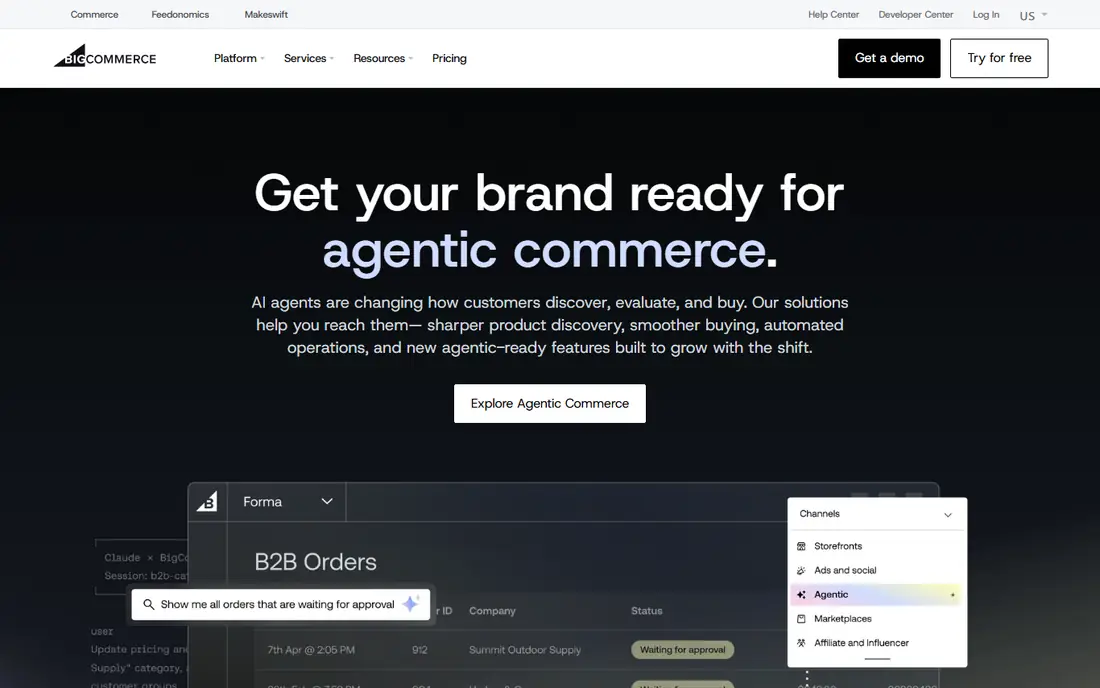
BigCommerce renamed its plans in June 2026. Core is $29 per month, Growth is $79, Scale is $299, and Performance starts from $1,499. The plans include more built-in features than Shopify at the same tier, which can reduce the need for paid apps. Gross merchandise value caps apply, with Core at $30,000 and Growth at $100,000 in trailing 12-month sales, and Scale capped at $33,333 per month with a 0.9 percent overage fee above that. BigCommerce suits mid-market stores, B2B sellers and brands that want a hosted platform with fewer add-ons than Shopify.
What we like- Strong built-in features, no extra transaction fee on most plans, hosted security and updates
Watch out for- Gross merchandise value caps apply: Core $30,000, Growth $100,000 trailing 12-month sales, Scale $33,333 per month with a 0.9 percent overage fee above that
#3PrestaShop
Best for: Stores that want open-source control, code ownership and a free core platform4.3/5 on
G2 (159 reviews, checked Oct 2026)
Visit prestashop.com
Starting priceClassic free to download; Hosted 24 euros per month excluding VAT billed annually (290 euros per year invoiced) or 29 euros per month excluding VAT month to month; Enterprise quote only
Free planPrestaShop Classic is free open-source software; Hosted has a 14-day trial
PrestaShop is an open-source ecommerce platform with a free Classic download and a hosted option. The current release is PrestaShop 9.2, released on 30 September 2026. Classic suits a store with a developer or an agency, because you can change the code, choose your host and add modules. Enterprise is quote only, and one source cites from about 2,115 euros per month with a 24-month commitment, so treat that figure as a single-source number. November 2026 reads still show the Hosted plan based on PrestaShop 8, so confirm the version before you sign up.
What we like- Full code access and data ownership, no licence fee for Classic, large module marketplace, strong fit for European sellers
Watch out for- Paid modules commonly cost 50 to 300 euros each, and updates can break modules if not tested first
#4Shopify
Best for: Small and mid-sized stores that want a hosted platform that is quick to launch and easy to run4.4/5 on
G2 (5,144 reviews, checked Oct 2026)
Visit shopify.com
Starting priceBasic $29 per month billed annually ($39 monthly); Grow $79 ($105); Advanced $299 ($399); Plus from $2,300 per month
Free planNo free plan; trial available
Shopify is a hosted ecommerce platform that covers hosting, security, updates and support in the monthly price. Basic at $29 per month on annual billing suits a new store, Grow at $79 adds staff accounts and reporting, and Advanced at $299 adds advanced reports and lower fees. Plus starts from $2,300 per month for larger stores. Confirm the price at checkout, because a 16 November 2026 read showed Grow at $89 and Advanced at $359 on yearly billing, and a non-US read showed Basic at $19 and Grow at $49.
What we like- Fast setup, hosted security and updates included, large app store, support included
Watch out for- Monthly fees rise as you add apps, and checkout customisation is limited unless you are on Plus
#5WooCommerce
Best for: WordPress site owners who want an ecommerce store inside WordPress4.4/5 on
G2 (1,283 reviews, checked Oct 2026)
Visit woocommerce.com
Starting priceFree plugin; hosting typically $25 to $350 per month; WooPayments 2.9 percent plus $0.30 per transaction
Free planCore plugin free
WooCommerce is a free WordPress plugin that turns a WordPress site into an online store. Hosting typically costs $25 to $350 per month, depending on traffic, catalogue size and the host you choose. WooPayments charges 2.9 percent plus $0.30 per transaction, and other payment providers have their own fees. It gives you strong control over design, content and data, and the extension library covers subscriptions, bookings, memberships and wholesale.
What we like- Free core plugin, full control over WordPress hosting and code, large extension library
Watch out for- You must manage hosting, updates, security and backups yourself, and paid extensions add to the cost
#6OpenCart
Best for: Small stores that want a free open-source platform with low software cost4.3/5 on
G2 (106 reviews, checked Oct 2026)
Visit opencart.com
Starting priceFree open-source download; hosting, themes and extensions separate; typical first-year cost about $500 to $1,500
Free planSoftware free to download
OpenCart is a free open-source ecommerce platform that suits a small store with a basic catalogue and a tight budget. You download the software, install it on your own hosting, and add themes and extensions for payment, shipping and marketing. The latest releases are 4.1.0.4 and 3.0.5.1, both published in August 2026, and the marketplace lists more than 13,000 extensions. A realistic first-year cost for a small store is about $500 to $1,500. Note that themes and extensions built for OpenCart 3 do not work on version 4 without rework, so check compatibility before you upgrade.
What we like- Free core software, simple admin area, low entry cost for a basic store
Watch out for- Fewer modern themes and extensions than WooCommerce or PrestaShop, and you must handle hosting, updates and security yourself
#7Wix
Best for: Small stores and service businesses that want a simple website with ecommerce built in4.2/5 on
G2 (1,888 reviews, checked Oct 2026)
Visit wix.com
Starting priceLight $17, Core $29, Business $39, Business Elite $159 per month billed annually
Free planFree plan with limits, no custom domain and Wix branding
Wix is a website builder with ecommerce plans for small stores. Light is $17 per month billed annually, Core is $29, Business is $39, and Business Elite is $159. The 50 percent first-year discounts renew at full price, so a buyer should budget for the full price from year two. Wix suits a small store, a service business, or a seller with a small catalogue who wants a good-looking site without technical work. The limit is depth: Wix is less suited to a large catalogue, complex product options, or advanced B2B rules than Shopify, BigCommerce or PrestaShop.
What we like- Very easy drag-and-drop builder, good templates, hosting and security included
Watch out for- Ecommerce features are more limited than Shopify or PrestaShop, and first-year discounts renew at full price
#8Squarespace
Best for: Design-led small stores that want polished templates and simple ecommerce4.4/5 on
G2 (1,133 reviews, checked Oct 2026)
Visit squarespace.com
Starting priceBasic $19, Core $29, Plus $49, Advanced $99 per month billed annually
Free planNo free plan; trial available
Squarespace renamed its plans in July 2026. Basic is $19 per month billed annually, Core is $29, Plus is $49, and Advanced is $99. Do not use the old $16, $23, $28 and $52 figures, which no longer match the current plan names and prices. Squarespace suits a design-led brand, a small store, or a seller who wants a polished site with simple ecommerce built in. Advanced selling features, such as subscriptions and advanced discounts, sit on the higher plans, so a growing store should check which plan covers the features it needs.
What we like- Strong design templates, easy editor, hosting and security included
Watch out for- Ecommerce tools are more limited than Shopify for large catalogues, and advanced selling features sit on the higher plans
Frequently asked questions
Is BigCommerce cheaper than Magento?
Yes, for most stores BigCommerce is far cheaper. Core is $29 per month, Growth is $79 and Scale is $299, with hosting and support included. Adobe Commerce is quote only, with industry estimates from around $22,000 per year on-premise and around $40,000 per year on Cloud, before hosting, development and support.
What does Adobe Commerce cost per year?
Adobe does not publish a price, so every Adobe Commerce licence is a quote based on gross merchandise value. Industry estimates put the on-premise licence from around $22,000 per year and the Cloud licence from around $40,000 per year for stores under $1 million in sales. Total cost of ownership typically runs two to three times the licence fee.
What are the BigCommerce sales caps?
BigCommerce caps gross merchandise value by plan. Core covers $30,000 and Growth covers $100,000 in trailing 12-month sales, while Scale caps at $33,333 per month with a 0.9 percent overage fee above that. A store that grows fast should check the cap for its plan before it signs up, because passing a cap can push you to a higher plan.
Is Magento better than BigCommerce for B2B?
Yes, for complex B2B Magento is the stronger choice. It ships company accounts, buyer roles, customer-specific catalogues and pricing, quote-to-order negotiation and requisition lists out of the box. BigCommerce covers simpler B2B needs well, but a buyer with deep B2B rules will need Magento and the developers to run it.
Which platform is best for a mid-sized store?
BigCommerce is the best choice for most mid-sized stores, because it combines a clear monthly price with more built-in features than Shopify at the same tier. Magento only wins when the catalogue, pricing rules, or B2B needs are complex enough to justify its licence fee, build cost and ongoing support.
Sources we checked (8)
- https://www.prestashop.com/en/pricing
- https://www.shopify.com/pricing
- https://woocommerce.com/pricing/
- https://www.bigcommerce.com/pricing/
- https://business.adobe.com/products/magento/magento-commerce.html
- https://www.opencart.com
- https://www.wix.com/plans
- https://www.squarespace.com/pricing
Is your product missing or out of date?
We review this list regularly. Vendors can request a listing, send updated pricing or ask about featured placement.

Shihab Mia · Founder, Rankite
Shihab has 5+ years in B2B and SaaS SEO. He writes Rankite's software buying guides from pricing pages, documentation and public user reviews. More about Shihab.