How we make this list: we compare pricing pages, product documentation and public user reviews. Ratings come from G2, Capterra or Trustpilot, with the date we checked them.
Key takeaways
- Shopify and BigCommerce suit merchants who want hosted infrastructure, fast launch, and less maintenance.
- WooCommerce, PrestaShop, Shopware, and Medusa suit merchants who want code ownership and deep customization.
- Wix and Squarespace fit small, design-led stores, not large catalogs or complex B2B rules.
- Ecwid fits merchants who already have a website and only need to add a store.
- Migration cost often exceeds the subscription cost, so budget for data, redirects, integrations, and testing.
Quick comparison
| Tool | Best for | Starting price | Free plan |
|---|
 Shopify | Fast-growing direct brands | $29 per month (billed annually) | Free trial |
 WooCommerce | WordPress content-led stores | Free | Free plan |
 BigCommerce | Mid-market and B2B sellers | $29 per month (billed annually) | Free trial |
 Wix | Small stores on a simple builder | See website | Free trial |
 Squarespace | Design-led small stores | See website | Free trial |
 PrestaShop | Self-hosted open source stores | Free | Free plan |
 Shopware | Open platform with B2B depth | See website | Free plan |
 Ecwid | Adding a store to an existing site | $19 per month | Yes |
 Medusa | Developer-led headless commerce | Free | Free plan |
Is your product missing or out of date?
We review this list regularly. Vendors can request a listing, send updated pricing or ask about featured placement.
The best Magento alternatives
#1Shopify
Best for: Fast-growing direct brands4.4/5 on
G2 (5,144 reviews, checked Oct 2026)
Visit shopify.com
Starting price$29 per month (billed annually)
Free planFree trial

Shopify is the default Magento alternative for merchants who want to stop managing servers. Hosting, security patching, and PCI compliance sit with Shopify, so a small team can launch and scale without a dedicated infrastructure role. The app store covers most common needs, from reviews to subscriptions to international selling, and the theme system lets a brand look polished without a full rebuild.
Control is the trade. Deep backend customization, complex B2B price logic, and checkout changes are harder than on Magento, especially below the Plus tier. App subscriptions also accumulate, so a store that starts at $29 per month can reach a much higher monthly total once essential apps are added. Model the full app stack, not only the platform fee, before migrating.
What we like- Hosted infrastructure included
- Huge app ecosystem
- Fast time to launch
Watch out for- Less backend control than Magento
- App costs add up
- Checkout customization limits on lower plans
#2WooCommerce
Best for: WordPress content-led stores4.4/5 on
G2 (1,283 reviews, checked Oct 2026)
Visit woocommerce.com
Starting priceFree
Free planFree plan
WooCommerce turns a WordPress site into a store, which makes it a natural fit for brands where content drives sales. Blog posts, landing pages, and product pages live in one system, and the merchant owns the code and the data. The plugin itself is free, and the ecosystem covers payments, shipping, subscriptions, and memberships in depth.
The free label needs context. Hosting, a theme, paid extensions, security, backups, and maintenance all cost money or time, and a poorly chosen plugin can slow the store or create conflicts. Merchants leaving Magento for freedom should expect a different kind of work, not no work. WooCommerce suits teams already comfortable with WordPress, or willing to hire that help.
What we like- Free open source plugin
- Full WordPress content control
- Huge plugin ecosystem
Watch out for- Hosting and security are your job
- Plugin quality varies
- Performance depends on setup
#3BigCommerce
Best for: Mid-market and B2B sellers4.2/5 on
G2 (580 reviews, checked Oct 2026)
Visit bigcommerce.com
Starting price$29 per month (billed annually)
Free planFree trial

BigCommerce sits between Shopify ease and Magento depth. Native features for large catalogs, multi-channel selling, and international stores reduce the need for apps, and B2B features on higher plans cover price lists, quotes, and customer groups that smaller platforms handle poorly. For mid-market merchants outgrowing a simple builder, that native depth matters.
The ecosystem is smaller than Shopify, so a niche integration may need custom work. Design flexibility also trails the most builder-friendly platforms, and the full B2B package adds cost beyond the entry plan. Compare BigCommerce against Shopify Plus on your specific B2B rules, not on headline price alone, since the cheaper entry plan may not include the features your Magento store relies on.
What we like- Strong native catalog features
- B2B tools on higher plans
- Hosted infrastructure
Watch out for- Theme and app ecosystem smaller than Shopify
- B2B Edition adds cost
#4Wix
Best for: Small stores on a simple builder4.2/5 on
G2 (1,888 reviews, checked Oct 2026)
Visit wix.com
Starting priceSee website
Free planFree trial

Wix works for a small store that needs to look good and sell soon. The drag-and-drop builder, templates, and hosted setup remove most technical barriers, and a solo founder can manage products, payments, and basic marketing without a developer. For a side business or a small brand with a focused catalog, that simplicity is a real advantage over Magento.
Scale is the limit. Large catalogs, complex product rules, multi-store setups, and B2B pricing stretch Wix past its strengths. Migration away from Wix later also takes more effort than merchants expect. Choose Wix when the store is small and likely to stay small, not as a direct replacement for a complex Magento build.
What we like- Very easy visual builder
- Fast setup for small catalogs
- Hosting included
Watch out for- Weak fit for large catalogs
- Limited B2B depth
- Harder to migrate away later
Starting priceSee website
Free planFree trial
Squarespace appeals to brands where design is part of the product. Templates look refined with little effort, and the all-in-one setup covers a website, a store, email marketing, and scheduling in one account. Creators, artists, and small boutiques often find that combination enough, and the learning curve stays low.
Ecommerce depth is thinner than Shopify or BigCommerce. Advanced shipping rules, large catalog management, marketplace integrations, and B2B features are limited or absent. A Magento merchant with complex operations will likely feel constrained quickly. Squarespace is a strong choice for a small, design-first store, and a weak choice for a catalog-heavy or B2B-heavy replacement.
What we like- Polished templates
- Simple all-in-one setup
- Good for creators and small brands
Watch out for- Limited ecommerce depth
- Fewer apps and integrations
- Weak B2B fit
#6PrestaShop
Best for: Self-hosted open source stores4.3/5 on
G2 (159 reviews, checked Oct 2026)
Visit prestashop.com
Starting priceFree
Free planFree plan

PrestaShop offers an open source path for merchants who want Magento-style ownership without Adobe Commerce licensing. The core is free, the merchant controls hosting and code, and a large module marketplace covers payments, shipping, and marketplace connections. European merchants in particular benefit from a mature local partner and module ecosystem.
Ownership brings responsibility. Hosting, upgrades, security, backups, and module compatibility all fall to the merchant or an agency, and paid modules can push total cost well above zero. PrestaShop suits teams with developer access, or an agency relationship, who value control and want to avoid a hosted platform lock-in. Solo merchants without technical help should weigh a hosted platform first.
What we like- Free open source core
- Strong European ecosystem
- Merchant owns code and data
Watch out for- Hosting and maintenance are your job
- Paid modules add up
- Support depends on partners
#7Shopware
Best for: Open platform with B2B depth4.2/5 on
G2 (197 reviews, checked Oct 2026)
Visit shopware.com
Starting priceSee website
Free planFree plan

Shopware gives merchants an open, flexible platform with serious B2B capability on its paid editions. Multi-channel selling, rule-based pricing, and B2B components cover use cases that simple hosted builders cannot, while the merchant keeps more control than on a fully closed platform. European agencies and mid-market brands use Shopware as a Magento replacement where EU market fit and data control matter.
Cost and ecosystem are the cautions. Paid editions start at a level that excludes very small stores, and the US partner and app ecosystem is smaller than Shopify or WooCommerce. Check current pricing on the vendor site, since Shopware editions and prices have changed. For a mid-market or B2B merchant with agency support, Shopware is a credible, modern alternative to Magento.
What we like- Flexible open platform
- Strong B2B components on paid plans
- Multi-channel selling
Watch out for- Paid plans are costly for small stores
- Smaller US ecosystem than Shopify
#8Ecwid
Best for: Adding a store to an existing site4.7/5 on
G2 (405 reviews, checked Oct 2026)
Visit ecwid.com
Starting price$19 per month
Free planYes
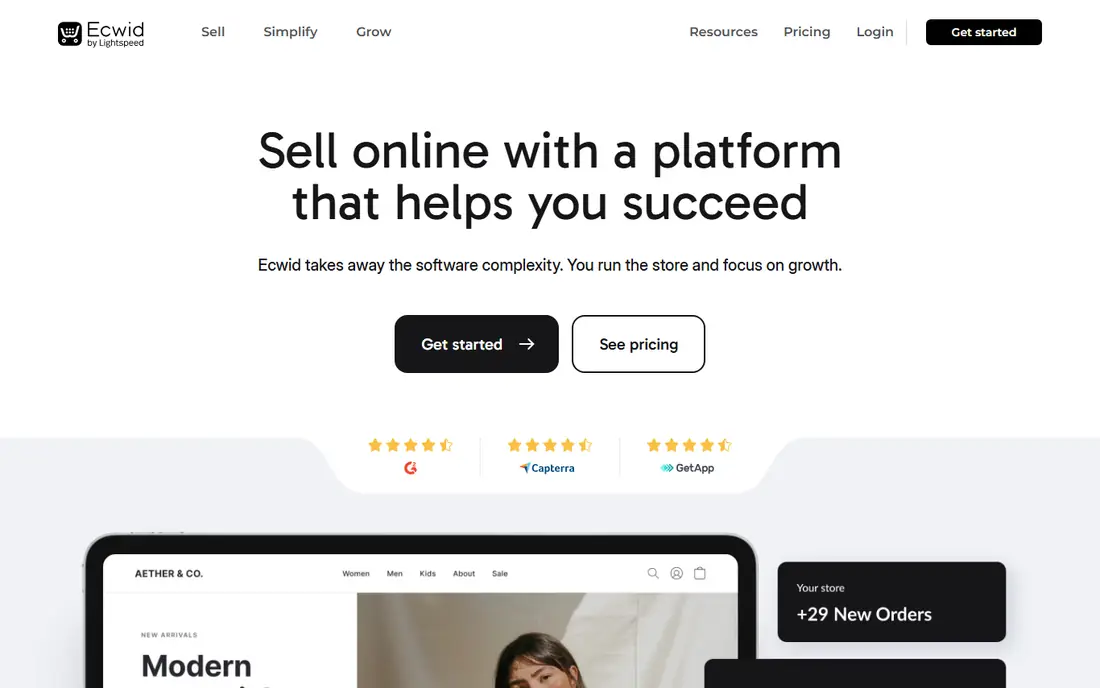
Ecwid takes a different approach from every other platform here. Instead of building a new site, it drops a store into an existing website, blog, or social page. That makes it ideal for creators, bloggers, and small businesses that already have traffic and only need checkout, product pages, and order management. The limited free plan lets a tiny catalog start without a subscription.
Ecwid is not a replacement for a full brand website. Design control is limited, and merchants who want a complete storefront experience will find a dedicated platform stronger. Use Ecwid when the site already exists and the store is an addition. Use Shopify, BigCommerce, or WooCommerce when the store itself is the brand home.
What we like- Embeds into an existing website
- Limited free plan for tiny catalogs
- Multi-channel selling
Watch out for- Not a full website builder
- Limited design control
- Weak fit as a standalone brand home
Starting priceFree
Free planFree plan
Medusa is an open source, headless commerce platform for teams that want to build a custom storefront and control the backend logic. Developers can shape pricing, promotions, fulfillment, and integrations to exact business rules, without paying a platform license for the core. That flexibility appeals to brands with unusual checkout, pricing, or ERP logic that hosted platforms force into workarounds.
The cost is developer time. Medusa is not a setup-and-sell product, and a merchant without engineering help will struggle. Hosting, maintenance, and feature development all sit with the merchant or an agency partner. For a developer-led team leaving Magento because the old codebase constrained them, Medusa offers a modern, open starting point. For a non-technical merchant, a hosted platform is the safer move.
What we like- Open source headless core
- Developer flexibility
- Merchant owns the build
Watch out for- Requires developer skills
- No hosted simplicity
- Ecosystem still maturing
How we chose
We compared pricing pages, product documentation, and public reviews on G2, Capterra, and Reddit, and we kept only platforms that exist today and can run a real online store. Each platform was judged on hosting model, catalog and B2B depth, design flexibility, app ecosystem, migration effort, and total cost beyond the headline price. We did not claim hands-on testing, and we left prices as See website where a vendor price could not be confirmed from a current public source at the time of writing.
Planning a Magento migration without surprises
Start with an audit of what Magento actually does for you today. List custom product rules, B2B price lists, integrations with ERP, CRM, and warehouse systems, and any checkout customization that customers depend on. That list, not the platform marketing page, decides whether a hosted platform can replace Magento or whether an open platform is required. A feature that looks minor in a demo can block a migration if it touches pricing or fulfillment.
Budget the full migration, not only the subscription. Data migration, URL redirects, SEO preservation, theme or storefront build, integration rebuilds, payment and shipping testing, and staff training all take time. Plan a parallel run where the new store handles real orders in a limited way before the old store closes, and keep the Magento store accessible as a fallback during cutover week. Rushing cutover to save a month of overlap often costs more in lost orders and support tickets.
Test with your hardest products first. Complex variants, bundles, tiered pricing, and international tax and shipping rules expose platform limits early, when changing direction is still cheap. If a platform handles your hardest ten products well, the rest of the catalog usually follows. If it struggles there, no amount of theme polish will fix the gap.
Shortlist by situation
- Hosted and fast: Shopify, BigCommerce
- Open and owned: WooCommerce, PrestaShop, Shopware, Medusa
- Small and simple: Wix, Squarespace, Ecwid
Frequently asked questions
Is Shopify a good Magento alternative?
Shopify suits merchants who want hosted infrastructure, fast launch, and a large app ecosystem. It fits less well for deep backend customization and complex B2B logic, where an open platform or Shopify Plus may be needed.
Can WooCommerce replace Magento for free?
The WooCommerce plugin is free, but hosting, themes, paid extensions, security, and maintenance are not. Total cost depends on catalog size, traffic, and how much help you hire, so budget the full stack before comparing headline prices.
Which Magento alternative is best for B2B?
BigCommerce and Shopware offer the strongest B2B features among the hosted and open options here, with price lists, customer groups, and quote workflows on higher plans. Check your exact B2B rules against the current plan, since B2B depth varies by tier.
How long does a Magento migration take?
A small store can migrate in weeks, while a large catalog with custom integrations can take several months. Data quality, integration rebuilds, and testing drive the timeline more than the platform choice itself.
Should I stay on Magento instead?
Staying makes sense if you have a large in-house Magento team, deep custom logic that fits Magento well, and a need for on-premise control. Moving makes sense when hosting, maintenance, and developer costs outweigh that fit, or when a hosted platform covers your rules.
Sources we checked (9)
- https://www.shopify.com/pricing
- https://www.woocommerce.com/pricing
- https://www.bigcommerce.com/pricing
- https://www.wix.com/pricing
- https://www.squarespace.com/pricing
- https://www.prestashop.com/pricing
- https://www.shopware.com/pricing
- https://www.ecwid.com/pricing
- https://www.medusajs.com/pricing
Is your product missing or out of date?
We review this list regularly. Vendors can request a listing, send updated pricing or ask about featured placement.

Shihab Mia · Founder, Rankite
Shihab has 5+ years in B2B and SaaS SEO. He writes Rankite's software buying guides from pricing pages, documentation and public user reviews. More about Shihab.