How we make this list: we compare pricing pages, product documentation and public user reviews. Ratings come from G2, Capterra or Trustpilot, with the date we checked them.
Ecwid or BigCommerce: which one should you choose?
Ecwid wins for a seller who already has a website and wants to add a store without rebuilding it, because the store plugs into WordPress, Wix, or a social page and starts at $5 a month with no transaction fee. BigCommerce wins for a brand that is building a store as the main business and wants strong built in features, because its Core plan costs $29 a month billed annually and includes the selling tools that Ecwid sells as add-ons. Shopify is the stronger alternative when selling becomes the business and the app ecosystem matters most.
Key takeaways
- Ecwid starts at $5 a month for up to 10 products and charges no transaction fee on any plan, but the free plan is gone for new sign-ups.
- BigCommerce Core costs $29 a month billed annually and caps trailing 12 month sales at $30,000 before it forces an upgrade.
- BigCommerce renamed its plans in June 2026, so older guides showing Standard, Plus, and Pro are stale.
- Ecwid caps products at 10 on Starter, 100 on Venture, and 2,500 on Business, so a growing catalog forces an upgrade.
- Shopify Basic costs $29 a month billed annually and is the stronger pick when the store needs the largest app ecosystem.
How do Ecwid and BigCommerce differ in how you sell?
Ecwid is a store you add to a site you already have, on WordPress, Wix, Joomla, or plain HTML, or you sell through Instagram, Facebook, and marketplaces from one catalog. BigCommerce is a full hosted store platform that handles hosting, security, and checkout. If you already have a site with traffic, Ecwid lets you start selling in an afternoon without moving anything. If you are starting from nothing and expect to grow, BigCommerce gives you a stronger foundation. Pick Ecwid when the site already exists.
How do Ecwid and BigCommerce prices compare?
Ecwid starts cheaper and charges no transaction fee, while BigCommerce starts higher and charges no transaction fee either, but caps sales by plan. Ecwid Starter costs $5 a month for up to 10 products, Venture costs $29 a month billed annually for up to 100 products, Business costs $49 billed annually for up to 2,500 products, and Unlimited costs $119 billed annually with no product limit. BigCommerce Core costs $29 a month billed annually, Growth costs $79, Scale costs $299, and Performance starts at $1,499. Ecwid prices rose on 2 March 2026, so review pages still showing $25, $45, or $105 are stale, and BigCommerce renamed its plans in June 2026, so the old Standard, Plus, and Pro names are stale too. The table below sets out all eight tools.
| Tool |
Starting price |
Free plan |
Best for |
| Ecwid |
$5 per month |
No free plan for new sign-ups |
Sellers adding a store to an existing site |
| BigCommerce |
$29 per month annual |
No free plan; 15-day free trial |
Growing brands that want strong built in features |
| Shopify |
$29 per month annual |
No free plan; 3-day free trial, then $1 per month for 3 months |
Stores where selling is the whole business |
| WooCommerce |
$0 core plugin |
Yes, the core plugin is free and open source |
WordPress site owners who want full control |
| Squarespace |
$19 per month annual |
No free plan; 14-day free trial |
Design led brands where the website comes first |
| Wix |
$17 per month annual |
Yes, a free plan with Wix branding |
Beginners who want a drag and drop site and store |
| Webflow |
$15 per month annual |
Yes, a free Starter plan for staging and learning |
Design led sites that need precise layout control |
| WordPress.com |
$4 per month annual |
Yes, a free plan on a wordpress.com subdomain |
Bloggers and content led stores that want managed hosting |
What will a store pay in a real month?
Take a store doing $10,000 a month across 200 orders at $50 each. Card fees at 2.9 percent plus 30 cents come to $350 on every platform here. On Ecwid Business billed annually, the plan costs $49 and Ecwid adds no transaction fee, so the total is $399. On BigCommerce Core, the plan costs $29 with no platform fee, so the total is $379, but the store must stay under the $30,000 trailing 12 month sales cap or upgrade to Growth at $79. On BigCommerce Scale, the plan costs $299, so the total is $649. On Shopify Basic, the total is also $379. On Squarespace Basic, the plan costs $19, the 2 percent store fee adds $200, and card fees add $350, so the total is $569. On WooCommerce, the platform fee is $0, so the total is $350 plus hosting, or $380 with $30 hosting.
What trade offs should a seller watch before choosing?
Watch five trade offs. First, add-on against all-in-one: Ecwid keeps your existing site, BigCommerce replaces site and store together. Second, limits: Ecwid caps products at 10 on Starter, 100 on Venture, and 2,500 on Business, while BigCommerce caps trailing sales at $30,000 on Core, $100,000 on Growth, and $33,333 a month on Scale with a 0.9 percent overage. Third, fees: both charge 0 percent in platform transaction fees, while Squarespace charges 2 percent on Basic. Fourth, the free plan: Ecwid has none for new sign-ups since 2025, so test on Wix, Webflow, or WordPress.com instead. Fifth, renewals: Wix discounts often double in year two and WordPress.com prices rise at renewal.
Quick comparison
| Tool | Best for | Starting price | Free plan |
|---|
 Ecwid | Sellers adding a store to an existing website or social channel | Starter $5 per month for up to 10 products; Venture $29 per month billed annually ($35 billed monthly) for up to 100 products; Business $49 ($65) for up to 2,500 products; Unlimited $119 ($149) for unlimited products | No free plan for new sign-ups; the free plan was discontinued in 2025 and existing free stores closed on 20 November 2025 unless they upgraded |
 BigCommerce | Growing brands that want strong built in features without many paid apps | Core $29 per month billed annually ($39 billed monthly); Growth $79 ($105); Scale $299 ($399); Performance from $1,499 per month | No free plan; 15-day free trial |
 Shopify | Stores where selling is the whole business and the app ecosystem matters | Basic $29 per month billed annually ($39 billed monthly); Grow $79 ($105); Advanced $299 ($399); Plus from $2,300 per month | No free plan; 3-day free trial, then $1 per month for 3 months |
 WooCommerce | WordPress site owners who want full control and no monthly platform fee | $0 for the core plugin; hosting typically $25 to $350 per month; WooPayments charges 2.9 percent plus $0.30 per transaction | Yes, the core plugin is free and open source |
 Squarespace | Design led brands where the website comes first and the store second | Basic $19 per month billed annually ($25 billed monthly); Core $29 ($39); Plus $49 ($65); Advanced $99 ($139) | No free plan; 14-day free trial |
 Wix | Beginners who want a drag and drop site and store in one place | Light $17 per month billed annually; Core $29; Business $39; Business Elite $159 | Yes, a free plan with Wix branding and a wixsite.com subdomain |
 Webflow | Design led sites that need precise layout control and a store on the side | Basic $15 per month billed annually for a site; Premium $25 billed annually ($39 billed monthly) adds ecommerce | Yes, a free Starter plan for staging and learning |
 WordPress.com | Bloggers and content led stores that want managed WordPress hosting | Personal $4 per month billed annually; Premium $8; Business $25; Commerce $45 | Yes, a free plan on a wordpress.com subdomain |
Is your product missing or out of date?
We review this list regularly. Vendors can request a listing, send updated pricing or ask about featured placement.
The eight tools below run from a $5 add-on store to premium hosted platforms. Read the starting price, the free plan, and the real con for each one before you shortlist. Prices were checked on 19 November 2026.
#1Ecwid
Best for: Sellers adding a store to an existing website or social channel4.7/5 on
G2 (405 reviews, checked Oct 2026)
Visit ecwid.com
Starting priceStarter $5 per month for up to 10 products; Venture $29 per month billed annually ($35 billed monthly) for up to 100 products; Business $49 ($65) for up to 2,500 products; Unlimited $119 ($149) for unlimited products
Free planNo free plan for new sign-ups; the free plan was discontinued in 2025 and existing free stores closed on 20 November 2025 unless they upgraded
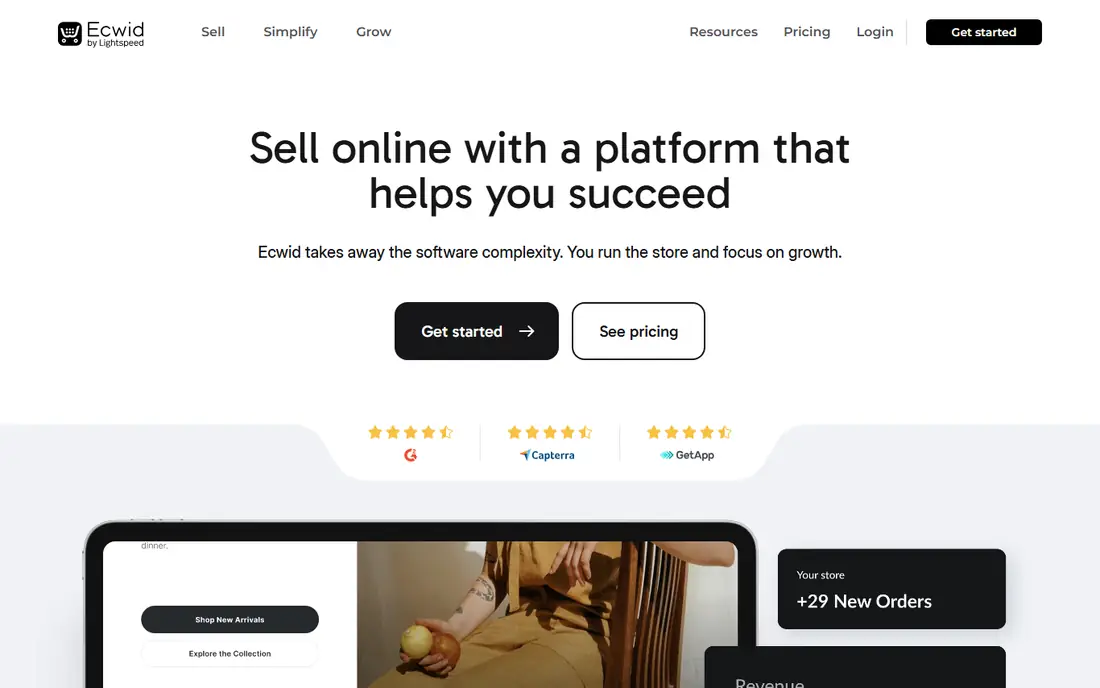
Ecwid is the add-on store in this set. Lightspeed owns Ecwid, and it is built for a seller who already has a website, a blog, or a social following and wants to start selling without moving anything. You add the store to WordPress, Wix, Joomla, or a plain HTML page, and the same catalog also sells through Instagram, Facebook, and marketplaces. The catch is the product cap, because Starter allows only 10 products and Venture allows 100. Pick Ecwid when the site already exists and the catalog is small.
What we like- No transaction fee on any plan, one catalog that sells on a website, social pages, and marketplaces, and a low $5 starting price
Watch out for- Product limits force upgrades as the catalog grows, the free plan is gone for new sign-ups, and the app market is smaller than Shopify
#2BigCommerce
Best for: Growing brands that want strong built in features without many paid apps4.2/5 on
G2 (580 reviews, checked Oct 2026)
Visit bigcommerce.com
Starting priceCore $29 per month billed annually ($39 billed monthly); Growth $79 ($105); Scale $299 ($399); Performance from $1,499 per month
Free planNo free plan; 15-day free trial
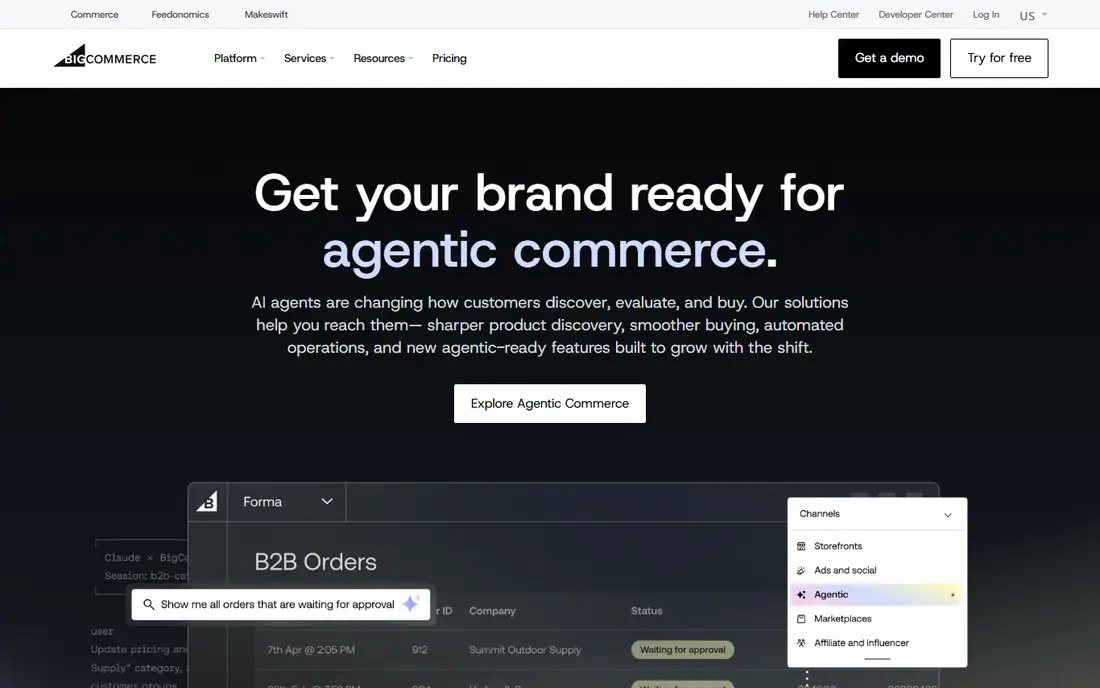
BigCommerce is the hosted platform for a brand that expects to grow. Core costs $29 a month billed annually and includes unlimited products, unlimited staff accounts, and no platform transaction fee, a stronger starting bundle than Shopify Basic. The catch is the sales cap: Core allows $30,000 in trailing 12 month sales, Growth allows $100,000, and Scale allows $33,333 a month with a 0.9 percent overage. BigCommerce renamed its plans on 1 June 2026, so older guides are stale. Pick BigCommerce when you want built in features and can live with the cap.
What we like- Strong built in features with no transaction fee, no product limits on paid plans, and multi storefront and B2B tools on higher plans
Watch out for- Sales caps force upgrades as revenue grows, the theme and app market is smaller than Shopify, and Scale adds a 0.9 percent fee on sales above $33,333 a month
#3Shopify
Best for: Stores where selling is the whole business and the app ecosystem matters4.4/5 on
G2 (5,144 reviews, checked Oct 2026)
Visit shopify.com
Starting priceBasic $29 per month billed annually ($39 billed monthly); Grow $79 ($105); Advanced $299 ($399); Plus from $2,300 per month
Free planNo free plan; 3-day free trial, then $1 per month for 3 months

Shopify is the default full commerce platform in this set, and the strongest alternative to both Ecwid and BigCommerce. Basic costs $29 a month billed annually and includes the store, checkout, and unlimited products, while the app store fills almost any gap. The catch is cost creep, because shipping, reviews, subscriptions, and reporting often need paid apps. Two price reads conflict: a 16 November 2026 read showed Grow at $89 and Advanced at $359 a year, against $79 and $299 on the plain pricing page, and a non-US read showed Basic $19 and Grow $49. Pick Shopify when selling is the business.
What we like- The largest app and theme ecosystem, the most polished checkout, and strong point of sale and multi channel tools
Watch out for- Many features need paid apps, a fee applies when you use a third party payment gateway, and Plus pricing starts high
#4WooCommerce
Best for: WordPress site owners who want full control and no monthly platform fee4.4/5 on
G2 (1,283 reviews, checked Oct 2026)
Visit woocommerce.com
Starting price$0 for the core plugin; hosting typically $25 to $350 per month; WooPayments charges 2.9 percent plus $0.30 per transaction
Free planYes, the core plugin is free and open source
WooCommerce is the free plugin that turns a WordPress site into a store, and the cheapest route in this set if you already run WordPress. The core plugin costs nothing, so the real cost is hosting at $25 to $350 a month plus paid extensions for subscriptions, bookings, or advanced shipping. WooPayments charges 2.9 percent plus 30 cents per transaction in the US. The catch is ownership, because you handle updates, backups, and security yourself, and a bad plugin can break checkout. Pick WooCommerce when you already run WordPress and want control.
What we like- No monthly platform fee, full control over the store and the data, and thousands of free and paid extensions
Watch out for- You pay for hosting, security, and maintenance yourself, many extensions cost extra, and there is no official support line on the free core
#5Squarespace
Best for: Design led brands where the website comes first and the store second4.4/5 on
G2 (1,133 reviews, checked Oct 2026)
Visit squarespace.com
Starting priceBasic $19 per month billed annually ($25 billed monthly); Core $29 ($39); Plus $49 ($65); Advanced $99 ($139)
Free planNo free plan; 14-day free trial
Squarespace is the website builder with a store built in, and it suits a brand that cares about how the site looks. Basic costs $19 a month billed annually and adds a 2 percent store transaction fee, while Core costs $29 and removes it. Squarespace renamed its plans in July 2026, so the old $16, $23, $28, and $52 figures in older guides are stale. The catch is depth, because inventory, discounting, and multi channel selling are thinner than on Shopify or BigCommerce. Pick Squarespace when the site is the brand and the store is secondary.
What we like- Polished templates, a single site for content and commerce, and no store transaction fee from Core up
Watch out for- Basic adds a 2 percent store transaction fee, the commerce features are thinner than Shopify, and the old plan names still appear in stale guides
#6Wix
Best for: Beginners who want a drag and drop site and store in one place4.2/5 on
G2 (1,888 reviews, checked Oct 2026)
Visit wix.com
Starting priceLight $17 per month billed annually; Core $29; Business $39; Business Elite $159
Free planYes, a free plan with Wix branding and a wixsite.com subdomain
Wix is the easiest builder in this set for a beginner. Light costs $17 a month billed annually and connects a custom domain, while Business costs $39 and adds the full store with no Wix transaction fee. The free plan lets you build and publish on a wixsite.com subdomain. The catch is renewal pricing, because first year discounts often double in year two. Pick Wix when you want the simplest route from nothing to a live store.
What we like- Easy drag and drop builder, a real free plan to start on, and hundreds of templates
Watch out for- First year discounts often double at renewal, the free plan shows Wix ads, and moving a store off Wix later is hard
#7Webflow
Best for: Design led sites that need precise layout control and a store on the side4.4/5 on
G2 (995 reviews, checked Oct 2026)
Visit webflow.com
Starting priceBasic $15 per month billed annually for a site; Premium $25 billed annually ($39 billed monthly) adds ecommerce
Free planYes, a free Starter plan for staging and learning
Webflow is the design tool in this set, and it suits a seller whose site must look exactly right. Basic costs $15 a month billed annually for a site, and Premium costs $25 billed annually and adds ecommerce. The free Starter plan lets you build and stage a site before paying. The catch is commerce depth, because Webflow sells well for a small catalog but lacks the inventory, discounting, and app depth of Shopify or BigCommerce. Bandwidth on Premium is reported as 50 GB in some sources and 200 GB in others, so no figure is stated here. Pick Webflow when design control matters more than commerce depth.
What we like- Precise visual design control, clean code output, and a free plan to learn on
Watch out for- Ecommerce is thinner than Shopify, the learning curve is steep, and bandwidth limits are reported differently across sources
#8WordPress.com
Best for: Bloggers and content led stores that want managed WordPress hosting4.4/5 on
G2 (2,717 reviews, checked Oct 2026)
Visit wordpress.com
Starting pricePersonal $4 per month billed annually; Premium $8; Business $25; Commerce $45
Free planYes, a free plan on a wordpress.com subdomain
WordPress.com is the managed WordPress host in this set, and it suits a seller whose content drives sales. Personal costs $4 a month billed annually, Premium costs $8, Business costs $25, and Commerce costs $45 and adds the full store with WooCommerce. The free plan runs on a wordpress.com subdomain and shows ads. The catch is renewal pricing, because the prices above are introductory and rise at renewal. Pick WordPress.com when the blog is the business and the store supports it.
What we like- Managed hosting with no maintenance, a free plan to start on, and the full WordPress content tools
Watch out for- Prices rise at renewal, the free plan shows WordPress.com ads, and the store needs the $45 Commerce plan
Frequently asked questions
Is Ecwid or BigCommerce cheaper for a small store?
Ecwid is cheaper at the start. Ecwid Starter costs $5 a month for up to 10 products, while BigCommerce Core costs $29 a month billed annually. Both charge no platform transaction fee, so the gap is the plan price alone. The gap closes as the catalog grows, because Ecwid Venture costs $29 and Business costs $49, and BigCommerce Core includes unlimited products from the start.
Does Ecwid still have a free plan?
No, not for new sign-ups. Ecwid discontinued the free plan in 2025, and existing free stores closed on 20 November 2025 unless they upgraded. The cheapest way in now is Starter at $5 a month for up to 10 products. A seller who wants a free start should look at Wix, Webflow, or WordPress.com instead.
What are the BigCommerce sales caps?
BigCommerce caps trailing 12 month sales at $30,000 on Core and $100,000 on Growth, and Scale caps monthly sales at $33,333 with a 0.9 percent fee on sales above that. When a store crosses a cap, BigCommerce moves it to the next plan. A store doing $10,000 a month crosses the Core cap in three months, so budget for Growth at $79 a month.
Can Ecwid sell on social media and marketplaces?
Yes. Ecwid sells from one catalog on a website, Instagram, Facebook, and marketplaces, and orders sit in one dashboard. That is the main reason to pick Ecwid over a hosted platform, because you keep the site and the audience you already have. BigCommerce also sells on marketplaces and social channels, but it expects the store to live on BigCommerce.
Should a growing brand pick Shopify instead?
Often yes. Shopify Basic costs $29 a month billed annually, the same as BigCommerce Core, and its app and theme ecosystem is larger than both Ecwid and BigCommerce. Shopify also has no sales cap on its standard plans. Pick Shopify when selling is the whole business and you expect to add apps for subscriptions, reviews, or advanced shipping.
Sources we checked (8)
- https://www.ecwid.com
- https://www.bigcommerce.com
- https://www.shopify.com
- https://woocommerce.com
- https://www.squarespace.com
- https://www.wix.com
- https://webflow.com
- https://wordpress.com
Is your product missing or out of date?
We review this list regularly. Vendors can request a listing, send updated pricing or ask about featured placement.

Shihab Mia · Founder, Rankite
Shihab has 5+ years in B2B and SaaS SEO. He writes Rankite's software buying guides from pricing pages, documentation and public user reviews. More about Shihab.