How we make this list: we compare pricing pages, product documentation and public user reviews. Ratings come from G2, Capterra or Trustpilot, with the date we checked them.
Key takeaways
- Bolt and Base44 are the closest swaps: full apps from a prompt, with Bolt handing developers the code and Base44 keeping non technical builders away from it.
- v0 is the front end specialist, Replit the full coding environment, and Cursor the professional's AI editor once the prototype becomes a product.
- Bubble, Glide and Softr answer a different need: predictable visual building on maintained parts, slower to start, calmer to run for years.
- Credits and tokens are the real price in the prompt builders. A month of heavy iteration costs several times the headline plan on any of them.
Quick comparison
| Tool | Best for | Starting price | Free plan |
|---|
 Bolt | Full stack apps with code ownership | $25 per month | Yes |
 Base44 | Non technical builders wanting a full app | $20 per month | Yes |
 v0 by Vercel | Polished interfaces and front ends | $30 per user per month | Yes |
 Replit | AI help inside a real code environment | $20 per month | Yes |
 Bubble | Complex apps with deep business logic | $29 per month | Yes |
 Glide | Apps built from spreadsheet data | $25 per month | Yes |
 Softr | Portals and directories on existing data | $25 per month | Yes |
 Cursor | Developers graduating to a real codebase | $20 per month | Yes |
Is your product missing or out of date?
We review this list regularly. Vendors can request a listing, send updated pricing or ask about featured placement.
The best Lovable AI alternatives
#1Bolt
Best for: Full stack apps with code ownership4.3/5 on
G2 (94 reviews, checked Oct 2026)
Visit bolt.new
Starting price$25 per month
Free planYes
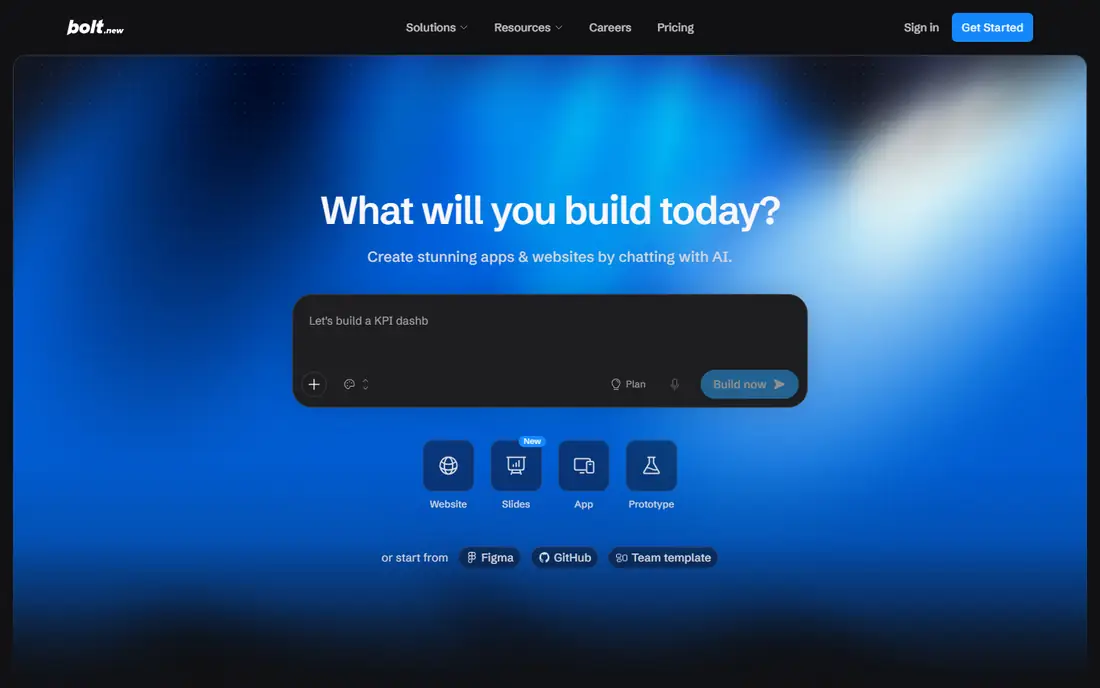
What we like- Bolt builds full stack applications in the browser from a prompt, front end, backend and database, and hands you the code, syncable to GitHub, which is the direct answer to the control complaint. Its free tier is comparatively generous with a monthly token allowance, and Pro at 25 dollars a month suits active building. Technical founders rate its output speed: prompt to deployed prototype in one sitting, with the codebase readable enough to take over.
Watch out for- Token metering makes heavy iteration costs spiky in the same way Lovable's credits do, and large projects test the browser based environment's limits. Generated code quality varies with prompt quality, and debugging an unfamiliar generated codebase is its own skill. Hosting and database through Bolt Cloud simplify the start and add a platform dependency to unwind later if you leave.
#2Base44
Best for: Non technical builders wanting a full app3.8/5 on
G2 (4 reviews, checked Oct 2026)
Visit base44.com
Starting price$20 per month
Free planYes
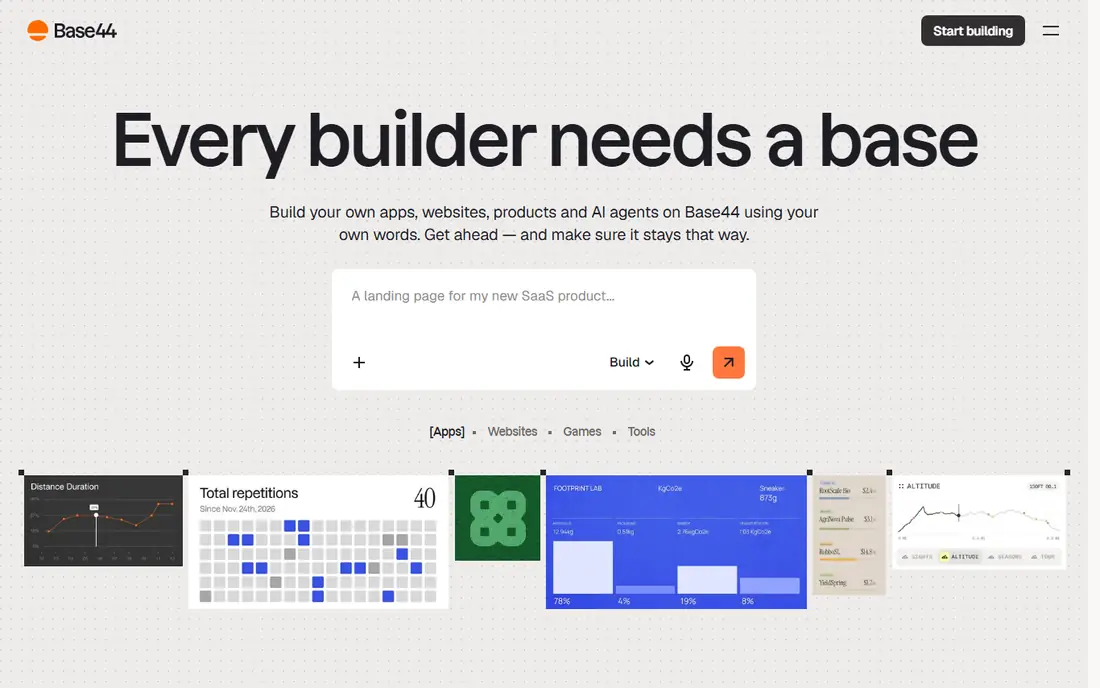
What we like- Base44, now part of Wix, is the no code end of prompt building: describe the app, and it assembles the whole hosted product, interface, built in database, logins and integrations, without showing you code unless you go looking. Starter is 20 dollars a month billed monthly, 16 on annual, with 25 free credits a month to test the model. For a founder whose alternative was hiring a developer for a first version, its completeness is the argument.
Watch out for- The managed model is the lock in: the app lives on Base44's infrastructure and database, and export options are limited compared with code generating rivals, so a breakout product eventually faces a rebuild decision. Ratings from its smaller review base run lower than the leaders, and message credit pricing still meters your iteration. Complex custom logic beyond its patterns is where the simplicity ends.
#3v0 by Vercel
Best for: Polished interfaces and front ends4.5/5 on
G2 (28 reviews, checked Oct 2026)
Visit v0.dev
Starting price$30 per user per month
Free planYes
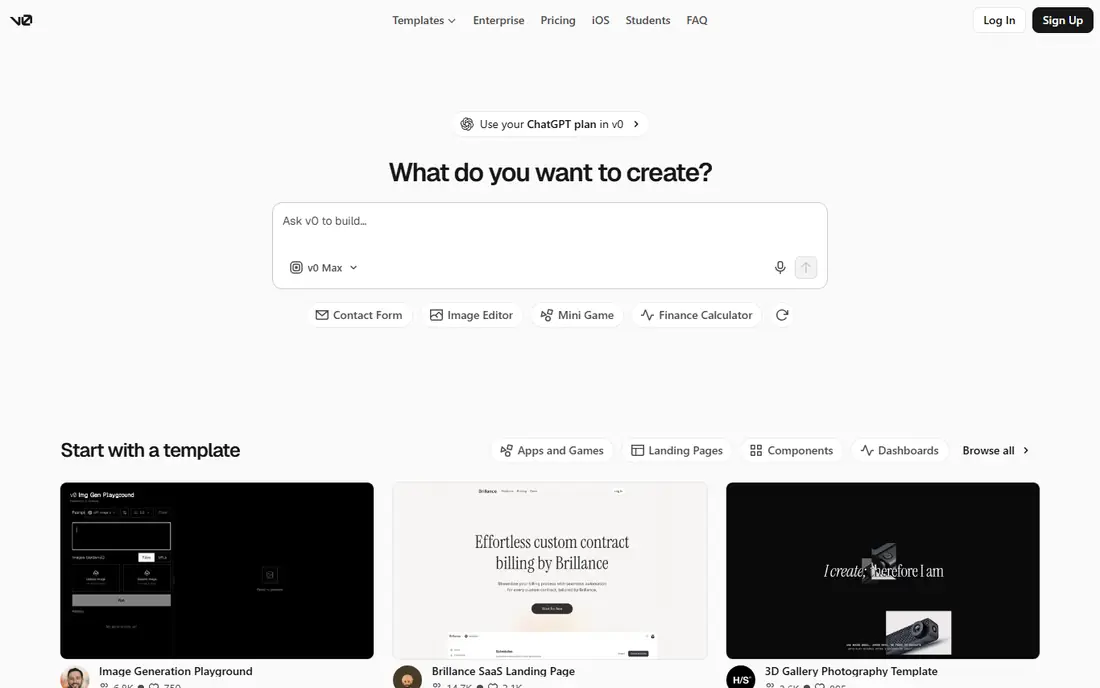
What we like- V0 generates the best looking front ends in this group: describe the interface and receive production React and Next.js components and pages with design quality that embarrasses most first drafts, plus a design mode for direct visual editing. It deploys to Vercel in a click and syncs to GitHub, so front end teams use it as the fastest path from idea to presentable interface. A free tier with monthly credits supports evaluation.
Watch out for- It is a front end tool: databases, auth and backend logic arrive through add ons and integrations rather than as one generated whole, so a full product needs assembly skills Lovable hides from you. Plus pricing at 30 dollars per user per month is the highest entry here. Non technical builders hit its developer assumptions quickly.
#4Replit
Best for: AI help inside a real code environment4.4/5 on
G2 (417 reviews, checked Oct 2026)
Visit replit.com
Starting price$20 per month
Free planYes
What we like- Replit surrounds its AI agent with a complete cloud development environment: editor, database, hosting, deployment and a codebase in real languages that you own outright and can take over line by line at any point. Core is 20 dollars a month billed monthly in current pricing. For builders who can read code, or intend to learn on a real project, the agent accelerates rather than replaces their judgement, which ages better than pure prompting as the app grows.
Watch out for- Usage based agent billing is the least legible pricing here, with effort based charges that surprise new users mid build. The environment's breadth intimidates true beginners, the exact users prompt builders serve best. Deployment and resource costs layer on top of the subscription at scale.
#5Bubble
Best for: Complex apps with deep business logic4.4/5 on
G2 (166 reviews, checked Oct 2026)
Visit bubble.io
Starting price$29 per month
Free planYes
What we like- Bubble is the established no code heavyweight: a visual editor and workflow engine deep enough to run real SaaS products, marketplaces with payments, roles and complex data rules, built by non programmers for over a decade. Its AI generation helps start, then the visual system carries the product as far as the business goes. Starter runs at 29 dollars a month billed annually for web apps, and the talent pool of Bubble developers and templates is the largest in no code.
Watch out for- The learning curve is the steepest of the visual builders, measured in weeks to competence, and workload unit pricing means a successful app pays for its own usage in ways that need monitoring. Native mobile runs on separate plans. You are building on a proprietary platform: the app cannot be exported as code, a lock in long accepted by its users in exchange for the depth.
#6Glide
Best for: Apps built from spreadsheet data4.7/5 on
G2 (796 reviews, checked Oct 2026)
Visit glideapps.com
Starting price$25 per month
Free planYes
What we like- Glide turns spreadsheets and business data into clean mobile first apps: field tools, directories, internal dashboards and customer facing trackers, with AI features added for generation and assistance. Its design output looks professional with minimal effort, and operations teams whose data already lives in Sheets or Airtable can publish in a day. Paid plans start around 25 dollars a month, with a free tier for building.
Watch out for- Glide apps are data shaped: free form consumer products, games or heavily custom interfaces do not fit its component model. Per user and usage pricing needs modelling once external audiences log in. It is a platform, not code, so the product's ceiling is Glide's roadmap.
#7Softr
Best for: Portals and directories on existing data4.7/5 on
Capterra (64 reviews, checked Oct 2026)
Visit softr.io
Starting price$25 per month
Free planYes
What we like- Softr builds client portals, directories, membership sites and internal tools on top of data you already hold, Airtable, Sheets, its own databases and more, with granular permissions as its signature strength: each user sees exactly their rows. AI generation now assembles the first version from a prompt on vendor maintained components. Basic is 25 dollars a month billed monthly, 19 on annual, and its free tier allows real publishing for small audiences.
Watch out for- No code export: the app is Softr hosted by design, which suits portals and internal tools and suits a future standalone product poorly. Per app user pricing shapes which audiences make economic sense. Custom behaviour beyond its blocks requires workarounds, and heavy transactional products outgrow it.
#8Cursor
Best for: Developers graduating to a real codebase4.6/5 on
G2 (326 reviews, checked Oct 2026)
Visit cursor.com
Starting price$20 per month
Free planYes
What we like- Cursor is where Lovable projects go to grow up: an AI code editor built on the VS Code foundation, with an agent that works across a real codebase, any language, any stack, under professional version control. Pro is 20 dollars a month. Developers migrating a prototype export the code, open it here, and gain the editing depth, extensions and debugging tools that browser builders cannot offer. Its free tier supports a genuine evaluation on your own repository.
Watch out for- It assumes you can code, or are ready to learn properly
- The safety rails of the prompt platforms are gone. AI usage beyond plan allowances is metered. For a non technical founder, Cursor is not an alternative at all, which is precisely the dividing line this list ends on.
How we chose
Lovable itself is excluded because this article covers its alternatives. We selected AI app building platforms in active sale in October 2026 across the real spectrum: prompt to code, prompt to hosted app, front end generation, visual no code with AI assistance, and the professional AI editor. Each publishes pricing and a free way to start. Metering models, credits, tokens, workload units, are described as the vendors define them, because comparing headline prices across metering systems without the units is meaningless. Nothing was hands on tested.
How to choose your Lovable alternative
Be honest about the code question. If you will never read code and never hire anyone who does, Base44, Bubble, Glide and Softr keep the machinery invisible; choose among them by product shape, portals to Softr, data apps to Glide, complex products to Bubble, full hosted apps to Base44. If code ownership matters now or soon, Bolt and Replit generate it with the least friction, v0 owns the front end, and Cursor waits when the project becomes engineering.
Then respect the meter. Every prompt builder here charges for iteration in credits, tokens or usage, so a month of serious building costs multiples of the sticker. Build your hardest screen first in the free tiers of two finalists, the checkout flow, the permission rule, the integration, and watch both the output quality and the credit burn. That single experiment predicts your year better than any feature table.
Frequently asked questions
Which alternative is most like Lovable?
Bolt for builders who want the same prompt to app speed with the code in hand, and Base44 for builders who want the same completeness with the code kept out of sight. Both start free and price their working tiers within a few dollars of Lovable's 25 dollars a month.
Can I move my Lovable app to one of these?
The code based tools make it plausible: Lovable projects sync to GitHub as React and Supabase code, which a developer can continue in Cursor or Replit. The hosted platforms, Base44, Bubble, Glide and Softr, cannot import that codebase; moving there means rebuilding the app in the new tool, which is sometimes still the right call for a simpler product.
Why do all the prompt builders use credits or tokens?
Because their costs scale with AI model usage, and a flat unlimited plan would be consumed by the heaviest builders. The metering is rational; the buyer's job is predicting their own usage. Prototyping burns little. Daily iteration on a live product burns a lot, and every vendor's higher tiers exist for exactly that pattern.
Are apps from these tools safe to run a business on?
Thousands of businesses do, with the usual conditions: use the platform's auth and database tooling rather than improvising, keep access rules reviewed, and understand what you can and cannot export. The larger risk for most young products is not security tooling but dependency: a hosted platform's pricing or policy change becomes your problem. Code generating tools retire that risk earlier.
What if my app outgrows all of these?
That is the success case, and the exit is a conventional rebuild or continuation in a professional stack: export the code where the tool allows it, or treat the no code version as the validated specification for a developed product. Cursor and Replit mark the middle of that path, where AI assistance continues inside a real codebase you fully own.
Sources we checked (0)
Is your product missing or out of date?
We review this list regularly. Vendors can request a listing, send updated pricing or ask about featured placement.

Shihab Mia · Founder, Rankite
Shihab has 5+ years in B2B and SaaS SEO. He writes Rankite's software buying guides from pricing pages, documentation and public user reviews. More about Shihab.