How we make this list: we compare pricing pages, product documentation and public user reviews. Ratings come from G2, Capterra or Trustpilot, with the date we checked them.
Key takeaways
- Arize AI covers both classic ML monitoring and LLM tracing, so the right alternative depends on whether you run traditional models, LLM apps, or both.
- Langfuse and LangSmith are the strongest LLM-first replacements, with tracing, prompt management, and evaluations built in from the start.
- WhyLabs and Evidently AI suit teams that want drift detection and data quality monitoring without sending raw data to a vendor.
- Fiddler AI fits regulated teams that need explainability and fairness checks with audit trails.
- Most tools in this space price by usage, seats, or predictions, so compare your monthly trace volume before you commit to a plan.
Quick comparison
| Tool | Best for | Starting price | Free plan |
|---|
 Langfuse | Self-hosted LLM tracing and evals | $29 per month | Yes |
 LangSmith | LangChain and LangGraph teams | $39 per seat per month | Yes |
 WhyLabs | Privacy-first drift monitoring | Free | Yes |
 Fiddler AI | Regulated model monitoring | See website | Yes |
 Evidently AI | Open source model reports | Free | Yes |
 Galileo | LLM evals and guardrails | $100 per month | Yes |
 Braintrust | Evals with CI gates | $249 per month | Yes |
 HoneyHive | Prompt testing and monitoring | See website | Yes |
Is your product missing or out of date?
We review this list regularly. Vendors can request a listing, send updated pricing or ask about featured placement.
The best Arize AI alternatives
Starting price$29 per month
Free planYes
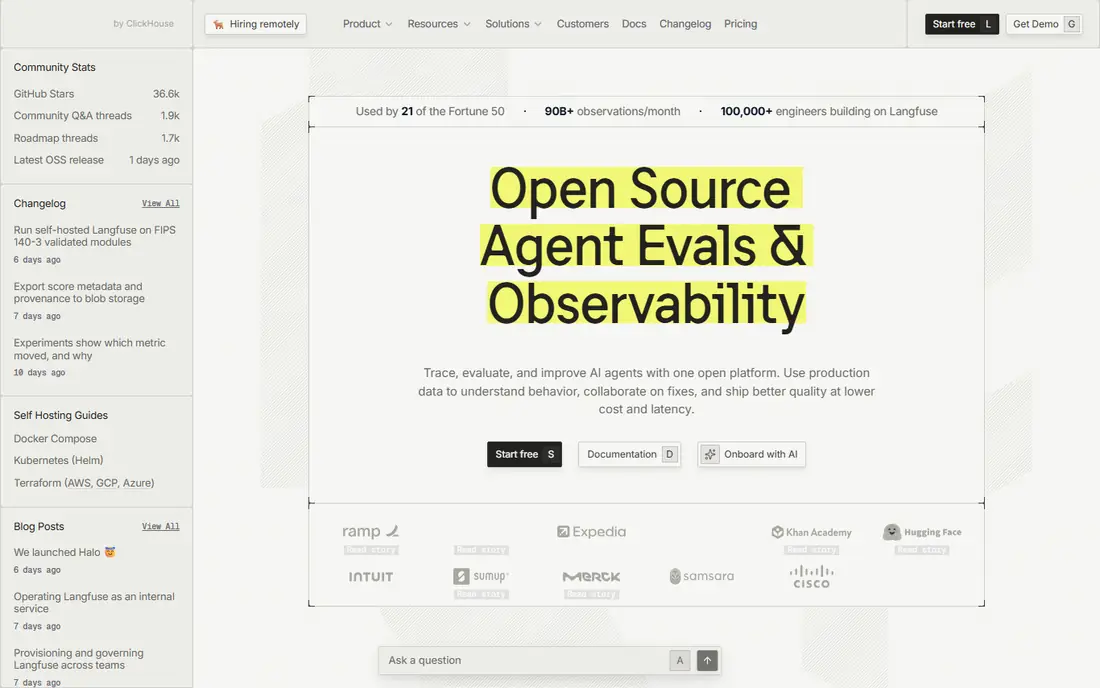
Langfuse is an open source LLM engineering platform that covers tracing, prompt management, evaluations, and cost tracking in one dashboard. When your app calls a model, Langfuse records the trace: which prompt ran, which model answered, how long it took, and what it cost. You can then score those traces with evaluations, compare prompt versions side by side, and spot regressions before users do. The open source core can run on your own servers, which matters for teams that cannot send prompts and outputs to a third-party cloud.
The trade-off is effort. Self-hosting gives you control, but you own upgrades, backups, and scaling, so small teams often start on the hosted cloud plan from $29 per month instead. Paid plans add higher trace limits and collaboration features that the free tier caps. For teams building LLM apps who want Arize style tracing without vendor lock-in, Langfuse is the most flexible option on this list, and its open source core means you can leave the cloud plan without losing your setup.
What we like- Open source core
- Self-hosting option
- Tracing, prompts, and evals in one place
Watch out for- Self-hosting needs engineering time
- Advanced features sit on paid plans
- Smaller enterprise footprint than Arize
Starting price$39 per seat per month
Free planYes
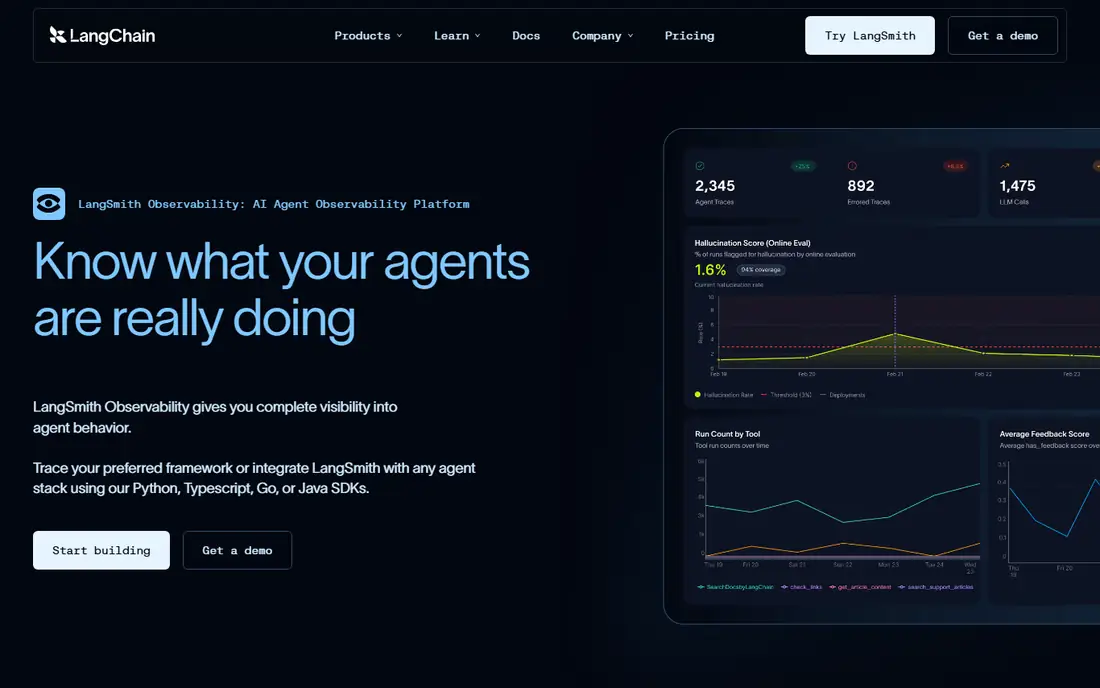
LangSmith is the observability and evaluation platform from the makers of LangChain, and it is the natural choice if your app already uses LangChain or LangGraph. Traces map directly to chains, agents, and tool calls, so debugging a failed agent run means opening one trace instead of stitching logs together from several services. You can build datasets from real production traces, run evaluations against them, and gate releases on evaluation scores, which turns ad hoc prompt tweaks into a repeatable process.
The limits follow from that focus. Teams outside the LangChain stack can still use LangSmith, but they get less of the automatic integration that makes it shine, and per-seat pricing from $39 per seat per month grows with team size rather than with usage alone. LangSmith also does not try to cover classic ML drift monitoring, so teams running tabular models alongside LLM apps need a second tool. If your stack is LangChain based, though, LangSmith is the closest match to Arize for LLM work, with better debugging for agent workflows.
What we like- Deep LangChain and LangGraph integration
- Strong debugging views
- Dataset-based evaluations
Watch out for- Best value only inside the LangChain stack
- Per-seat pricing adds up
- Less focus on classic ML models
Starting priceFree
Free planYes
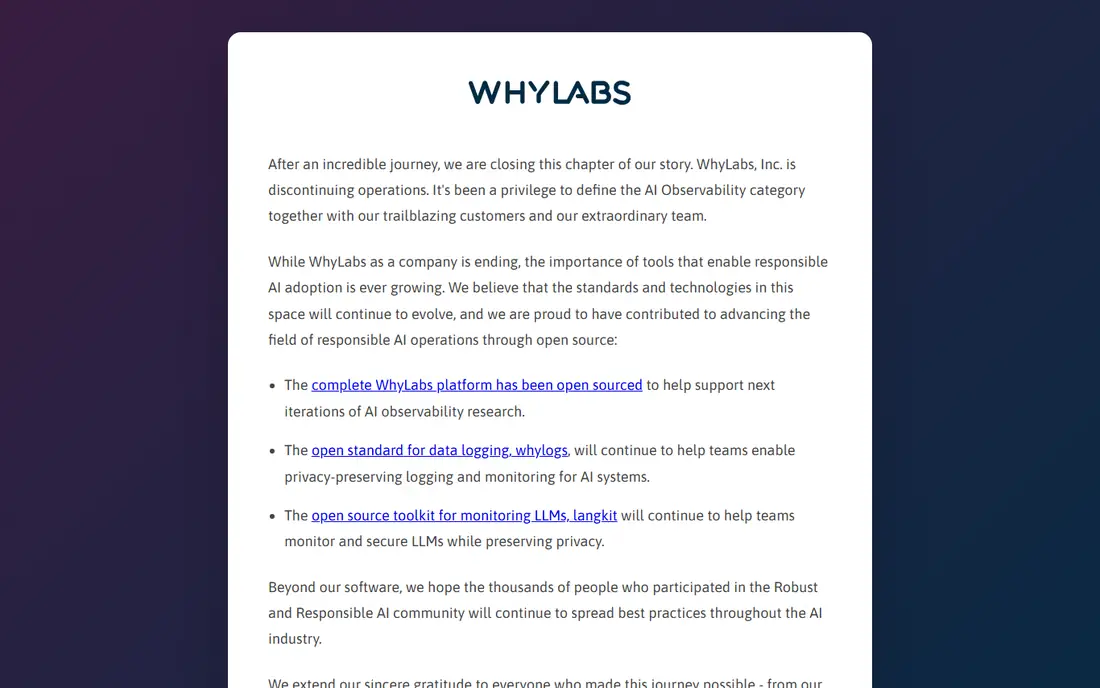
WhyLabs takes a different technical approach from most monitoring tools: instead of sending raw predictions to a vendor cloud, it profiles data locally and sends only compact statistical profiles. That design keeps sensitive data inside your own systems, which matters for regulated industries and for teams handling personal data, and it also cuts bandwidth and storage costs at high volume. The free tier covers one project with up to 10 million predictions per month, and the Expert plan from $125 per month raises that to 100 million predictions across three projects.
The trade-off is LLM depth. WhyLabs covers drift, data quality, and performance for classic models very well, and it has added LLM security and guardrail features, but its tracing and prompt management are not as deep as Langfuse or LangSmith. Teams whose main worry is drift in production models, or whose compliance team will not approve sending raw data to a vendor, should put WhyLabs first. Teams whose main worry is debugging LLM prompts should start with an LLM-first tool instead.
What we like- Local profiling keeps raw data private
- Free tier covers 10M predictions per month
- Strong data quality checks
Watch out for- Less LLM tracing depth than Langfuse
- Expert plan from $125 per month
- Smaller community than open source rivals
Starting priceSee website
Free planYes
Fiddler AI, now part of DataRobot, focuses on model performance monitoring with a strong emphasis on explainability and fairness. It tracks accuracy, latency, and drift, and it explains individual predictions with feature importance methods, so a regulated team can answer why a model declined a loan or flagged a transaction. Fairness monitoring across demographic groups and model risk management reports make it a fit for banks, insurers, and healthcare teams that face audits and regulator questions.
The cost is the main drawback. Enterprise contracts are custom priced and often start in the tens of thousands of dollars per year, which puts Fiddler out of reach for small teams. Setup also takes more engineering effort than the lighter tools on this list, since explainability and fairness checks need careful configuration for each model. For teams that must prove model behavior to a regulator, that cost buys exactly the audit trail they need. For teams that only need drift alerts, WhyLabs or Evidently AI gives most of the value at a fraction of the price.
What we like- Explainability and fairness monitoring
- Audit-ready reporting
- Now backed by DataRobot
Watch out for- Enterprise pricing is custom and often high
- Setup needs more engineering time
- Less LLM-native than newer tools
Starting priceFree
Free planYes
Evidently AI is an open source library for evaluating and monitoring machine learning models, and it is the cheapest serious alternative to Arize for classic ML work. You generate interactive reports on data drift, prediction drift, data quality, and model performance, and you can run those reports in notebooks during development or inside pipelines in production. Because it is open source, there is no per-prediction fee and no vendor lock-in, and teams can customize reports to their own metrics.
The cost is your own time. Evidently AI is a library, not a managed dashboard, so you build the scheduling, storage, and alerting around it yourself, or you pay for hosted features on top. That makes it a strong pick for data science teams that already run their own pipelines and want monitoring without a large contract. Teams that want alerts, user management, and a polished dashboard out of the box will be happier with WhyLabs or a commercial platform, but no other tool on this list matches Evidently AI on price.
What we like- Free open source core
- Interactive drift and data quality reports
- Works with notebooks and pipelines
Watch out for- Self-managed by default
- Hosted features cost extra
- Less polished than commercial dashboards
Starting price$100 per month
Free planYes
Galileo connects offline evaluation, production tracing, regression gates, and runtime guardrails for LLM apps. Its evaluators score outputs for quality, hallucinations, and policy issues at a lower cost than many rivals, which matters when you run evaluations on every release. Runtime guardrails can block harmful or off-policy outputs before they reach users, and regression gates stop a release when evaluation scores drop below a threshold you set.
Galileo is LLM-first, so it does not replace classic ML drift monitoring, and its ecosystem of integrations is smaller than LangSmith or Langfuse. The Pro plan starts at $100 per month, with a free tier for smaller workloads. For teams whose main risk is a bad LLM output reaching customers, Galileo gives you evaluation and guardrails in one place, and its evaluator pricing makes frequent evaluation affordable rather than a luxury.
What we like- Low-cost evaluators
- Runtime guardrails
- Regression gates for releases
Watch out for- Less classic ML coverage
- Pro plan from $100 per month
- Smaller ecosystem than LangSmith
Starting price$249 per month
Free planYes
Braintrust combines evaluations, tracing, and continuous integration gates for LLM apps, with a workflow that feels familiar to software engineers. You version datasets like code, run evaluations on every change, and block merges when scores regress, which brings LLM development closer to normal software practice. Tracing shows what happened in production, and failed traces feed back into datasets for the next round of evaluation, closing the loop between production problems and fixes.
The price is the main barrier. The Pro plan starts at $249 per month, which is higher than Langfuse or LangSmith for small teams, and Braintrust does not focus on classic ML drift monitoring. For engineering-led teams that already treat prompts and datasets as code, Braintrust is worth the price, because it replaces several separate tools with one workflow. For teams that only need basic tracing, a cheaper tool covers the job.
What we like- Evals, tracing, and CI gates in one platform
- Dataset versioning
- Strong for engineering-led teams
Watch out for- Pro plan from $249 per month
- Less drift monitoring
- Overkill for simple tracing needs
Starting priceSee website
Free planYes
HoneyHive covers the full prompt lifecycle: testing prompts in a playground, comparing versions, evaluating outputs, and monitoring production behavior. Product managers and engineers can work in the same tool, which helps teams where prompt changes come from product requirements rather than only from engineering. Production monitoring catches quality drops and cost spikes, and evaluation results feed back into the next prompt version.
The main drawback is transparency. HoneyHive does not publish pricing, so you need a sales conversation to learn what a plan costs, which makes budgeting harder than with Langfuse or LangSmith. It is also a smaller vendor, so its integration ecosystem is thinner. For teams that value a shared prompt workflow between product and engineering, HoneyHive is a strong option, and its free tier lets you test the playground before committing to a paid plan.
What we like- Prompt playground and testing
- Production monitoring
- Collaboration for product and engineering
Watch out for- Pricing not published
- Smaller vendor than rivals
- Less classic ML coverage
How we chose
We compared tools that replace the two jobs Arize AI covers: watching classic models in production and tracing LLM apps. We favored tools with a free tier or open source core, since that lets teams test real workloads before paying, and we weighted tracing depth for LLM tools and drift and explainability depth for classic ML tools. Prices come from vendor pricing pages and current guides, and where guides conflict we list the vendor figure or mark the price as See website. We did not test any tool hands-on, and we did not list Arize Phoenix, since it is an Arize product rather than an alternative.
Buying guide
Start from what you ship. If you run LLM apps, shortlist Langfuse, LangSmith, and Galileo first, and pick based on your stack: LangChain teams get the most from LangSmith, teams that want self-hosting get the most from Langfuse, and teams that care most about evaluation cost get the most from Galileo. If you run classic models, shortlist WhyLabs, Fiddler AI, and Evidently AI, and pick based on compliance needs: regulated teams need Fiddler audit trails, privacy-focused teams need WhyLabs local profiling, and budget teams get most of the value free from Evidently AI.
Before you commit, run a real workload through the free tier and check three things: how much of your monthly trace or prediction volume fits in the free limits, whether alerts reach your team fast enough to act on, and whether the tool covers both development and production or only one side. Pricing in this space is usage based, so a tool that looks cheap at trial volume can grow expensive at production volume. Ask for a usage estimate at your real scale before signing a yearly contract, and prefer monthly billing until you know your volume.
Frequently asked questions
Can one tool replace all of Arize AI?
It depends on your workload. LLM-first tools replace the tracing and evaluation side, while classic ML tools replace drift and data quality monitoring. Teams running both kinds of models often need one tool from each group, or a platform that explicitly covers both.
What is the difference between tracing and drift monitoring?
Tracing records individual requests through an LLM app, showing prompts, tool calls, and outputs, which helps you debug single failures. Drift monitoring compares production data and predictions against a baseline over time, which helps you catch slow degradation that no single request reveals.
Is self-hosting worth it for LLM observability?
Self-hosting keeps prompts and outputs inside your own systems, which matters for privacy and compliance, but it adds engineering work for upgrades and scaling. Start on a hosted plan if your team is small, and move to self-hosting when data rules or volume make it necessary.
How do these tools price their plans?
Most price by seats, monthly traces, predictions monitored, or evaluation runs, and enterprise plans are often custom. Compare your real monthly volume against each pricing page, and use the free tier to measure volume before you commit to a yearly plan.
Do I need evaluations if I already have tracing?
Yes, because tracing shows what happened while evaluations judge whether it was good. Tracing helps you debug a bad output, but only evaluations tell you whether a new prompt version is better or worse across hundreds of cases.
Which tool is best for a regulated industry?
Fiddler AI is the strongest fit for regulated teams, because it offers explainability, fairness monitoring, and audit-ready reporting. WhyLabs is a good second choice when data privacy rules prevent sending raw data to a vendor cloud.
Sources we checked (0)
Is your product missing or out of date?
We review this list regularly. Vendors can request a listing, send updated pricing or ask about featured placement.

Shihab Mia · Founder, Rankite
Shihab has 5+ years in B2B and SaaS SEO. He writes Rankite's software buying guides from pricing pages, documentation and public user reviews. More about Shihab.