How we make this list: we compare pricing pages, product documentation and public user reviews. Ratings come from G2, Capterra or Trustpilot, with the date we checked them.
Key takeaways
- Teams leave Looker mainly for price, since contracts start around $35,000 per year and routinely exceed $150,000 at enterprise scale, plus LookML lock-in.
- Holistics is the closest architectural match, with a code-based semantic layer, native Git, and pricing 65 to 80 percent lower than Looker for comparable teams.
- Metabase suits small teams that need fast SQL dashboards for free, while Lightdash suits dbt-first teams that want open source BI on existing models.
- Tableau leads on visualization quality, Power BI leads for Microsoft shops, and ThoughtSpot leads for non-technical users asking questions in plain language.
Quick comparison
| Tool | Best for | Starting price | Free plan |
|---|
 Holistics | Governed self-service at lower cost | $800 per month | No |
 Metabase | Small teams, fast deployment | Free | Yes |
 Tableau | Visualization quality | $75 per user per month | No |
 Power BI | Microsoft-centric enterprises | $14 per user per month | No |
 Sigma | Spreadsheet-style warehouse BI | See website | No |
 Lightdash | dbt-first open source BI | Free | Yes |
 ThoughtSpot | Natural language search | $1,250 per month | No |
 Looker Studio | Free Google reporting | Free | Yes |
Is your product missing or out of date?
We review this list regularly. Vendors can request a listing, send updated pricing or ask about featured placement.
The best Looker alternatives
#1Holistics
Best for: Governed self-service at lower cost4.3/5 on
G2 (15 reviews, checked Oct 2026)
Visit holistics.io
Starting price$800 per month
Free planNo
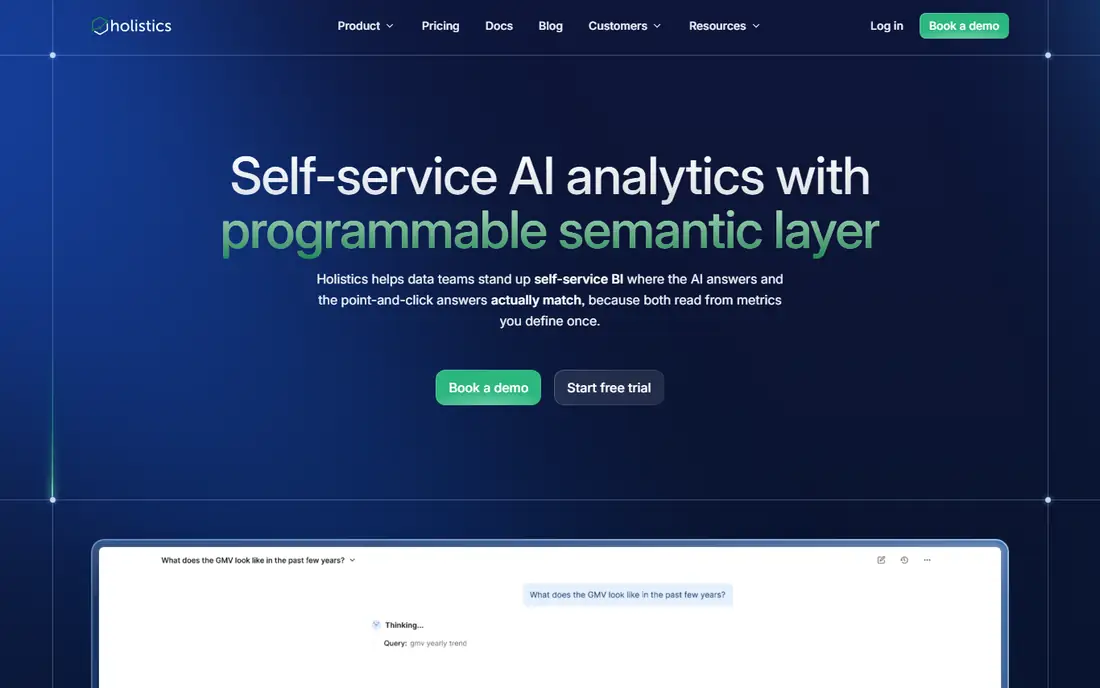
Holistics is the closest architectural match to Looker, with a centralized semantic layer written in code, native Git version control, and governed drag-and-drop self-service for business users. Its AML and AMQL modeling language handles complex calculations like running totals, percent-of-total, and period comparisons in the modeling layer, and guides cite pricing 65 to 80 percent lower than Looker for comparable team sizes. Plans start at $800 per month.
The ecosystem is smaller than Tableau or Power BI, so community templates and third-party guides are thinner. The $800 entry also rules out the smallest teams, who should start with Metabase or Lightdash. For teams that want Looker governance without Looker pricing, Holistics is the first tool to trial.
What we like- Code-based semantic layer with AML and AMQL
- Native Git and CI/CD
- Governed drag-and-drop self-service
Watch out for- Smaller ecosystem than Tableau
- $800 monthly entry is high for tiny teams
#2Metabase
Best for: Small teams, fast deployment4.4/5 on
G2 (147 reviews, checked Oct 2026)
Visit metabase.com
Starting priceFree
Free planYes
Metabase deploys in minutes and costs nothing to self-host, making it the fastest route to SQL dashboards for a small team. Its visual query builder suits non-technical users, while SQL mode covers analysts, and cloud plans start around $85 per month for teams that prefer hosting. For startups and small companies, Metabase answers most dashboard needs without a sales process.
Governance is the ceiling. Metabase has no centralized semantic layer, so metric definitions can drift across dashboards as teams grow, and AI features are basic compared with ThoughtSpot or Holistics. Teams that outgrow it usually move to Holistics or Lightdash for governed metrics. For small teams that need dashboards today, Metabase is unbeatable on speed and price.
What we like- Free open source self-hosting
- Visual query plus SQL
- Deploys in minutes
Watch out for- No centralized semantic layer
- Governance limits at scale
- AI features are basic
#3Tableau
Best for: Visualization quality4.4/5 on
G2 (3,787 reviews, checked Oct 2026)
Visit tableau.com
Starting price$75 per user per month
Free planNo
Tableau remains the enterprise visualization standard, with the deepest chart library, the most flexible dashboard formatting, and drag-and-drop exploration that reviewers consistently rate best in class. Creator seats list at $75 per user per month, with Viewer seats from $15, and Tableau Server allows self-hosting for enterprises that need it.
The pricing trap is the Creator-to-Viewer ratio. Teams often buy Viewers, then discover they need Creator seats to build, and a small team can reach $4,500 per month before anyone plans for it. Tableau also lacks native Git version control, and calculations live at workbook scope rather than in a centralized semantic layer. For visualization-led teams, Tableau still leads.
What we like- Deepest chart library and formatting
- Best-in-class drag-and-drop exploration
- Tableau Server self-hosting
Watch out for- Creator seats at $75 per user per month
- No native Git
- Workbook-scoped calculations, not a central semantic layer
#4Power BI
Best for: Microsoft-centric enterprises4.5/5 on
G2 (1,661 reviews, checked Oct 2026)
Visit microsoft.com
Starting price$14 per user per month
Free planNo
Power BI is the natural choice for Microsoft-centric enterprises, especially where Microsoft 365 licenses already cover part of the cost. Pro plans list at $14 per user per month, with capacity-based pricing from $735 per month for larger deployments, and Fabric integration ties Power BI into a broader Microsoft data platform with Copilot AI features.
DAX, the formula language, is a real learning curve for non-technical users, and PBIX files plus Windows dependence frustrate teams on other platforms. Semantic models are also model-specific rather than centralized across an organization. For Microsoft shops, Power BI offers the best value in this list, while other teams should weigh Holistics or Tableau first.
What we like- Pro at $14 per user per month
- Deep Microsoft 365 and Fabric integration
- Copilot AI features
Watch out for- DAX learning curve
- PBIX files and Windows dependence
- Semantic models are model-specific
#5Sigma
Best for: Spreadsheet-style warehouse BI4.5/5 on
G2 (602 reviews, checked Oct 2026)
Visit sigma.com
Starting priceSee website
Free planNo
Sigma Computing gives Excel-heavy organizations a spreadsheet-like interface directly on cloud warehouse data, which makes migration from Excel and Power BI Desktop feel natural. Analysts build with workbook formulas and data models, and AI analysis features help business users explore without writing SQL. Guides cite a base around $30,000 per year, with year-one costs for a 15-analyst team estimated at $40,000 to $80,000.
Pricing is quote-only, Git support is limited, and the semantic layer is still evolving compared with Looker or Holistics. Sigma suits organizations where spreadsheet fluency is widespread and warehouse data is already centralized. For Excel-led teams, it is the most comfortable Looker alternative.
What we like- Spreadsheet interface on live warehouse data
- Familiar for Excel-heavy teams
- AI analysis features
Watch out for- Quote-only pricing around $30,000 plus per year
- Limited Git support
- Evolving semantic layer
Starting priceFree
Free planYes
Lightdash extends an existing dbt workflow into BI without introducing a separate modeling paradigm, since metrics and dimensions live in dbt YAML files under Git version control. It is open source and self-hostable for free, with cloud plans from $600 per month, which suits data teams that already invest in dbt.
Teams without dbt get less value, since Lightdash assumes dbt models exist, and AI features are limited compared with ThoughtSpot or Holistics. For dbt-first data teams, Lightdash is the most natural Looker alternative, preserving existing modeling work instead of rewriting it in LookML or another language.
What we like- Dbt-native exploration
- Git version control via dbt
- Open source self-hosting
- No separate modeling language
Watch out for- Needs a dbt project to shine
- AI features limited
- Smaller vendor than Tableau or Power BI
Starting price$1,250 per month
Free planNo
ThoughtSpot lets non-technical users ask ad-hoc questions in plain language and get answers without training in SQL or DAX, with Spotter AI agents extending search into guided analysis. Worksheet-based models give analysts control over definitions, and enterprise guides list Pro pricing around $50 per user per month, with platform plans from $1,250 per month.
Enterprise pricing runs far higher, with guides citing around $140,000 per year at enterprise scale, and there is no native Git version control. For organizations whose bottleneck is business users waiting on analysts, ThoughtSpot removes the queue entirely. For governed metric definitions, Holistics or Looker still lead.
What we like- Natural language search plus AI agents
- Worksheet-based models
- Strong for non-technical users
Watch out for- Entry at $1,250 per month
- Enterprise pricing far higher
- No native Git
Starting priceFree
Free planYes
Looker Studio, formerly Google Data Studio, is the free Google reporting option for teams that need dashboards without a budget. It connects to Google Sheets, BigQuery, Analytics, and other sources, with easy sharing and embedding for internal reporting. Small teams and startups can build useful dashboards in hours at zero license cost.
It is not a Looker replacement for enterprises. There is no semantic layer, no governed metric definitions, and modeling is limited, so metric drift returns as teams grow. For free reporting on Google data, Looker Studio is the right starting point, with a migration path to Holistics or BigQuery-native BI when governance becomes necessary.
What we like- Completely free
- Google data source connectors
- Easy sharing and embedding
Watch out for- No semantic layer or governance
- Limited modeling
- Not a Looker replacement for enterprises
How we chose
We compared 2026 practitioner comparisons and pricing guides for each tool, checking semantic layer design, self-service strength, Git support, AI features, and starting prices. We favored tools with a distinct reason to switch from Looker, whether price, governance, simplicity, or ecosystem fit, and we flagged quote-only pricing where it applied. Where guides disagree on a price, we used the most recent figure. We did not claim hands-on testing.
Matching the alternative to your reason for leaving
Start from why Looker is not working, since each reason points to a different shortlist. If price is the problem, Holistics, Metabase, and Power BI publish prices you can model before a sales call. If LookML lock-in is the problem, Lightdash preserves dbt work, while Holistics offers a code-based layer at lower cost. If self-hosting or data residency is the problem, Metabase, Lightdash, and Tableau Server offer deployment control that Looker cloud does not.
Governance versus simplicity
Governed analytics needs a centralized semantic layer, which Holistics and Looker provide, while simple dashboards need only a query builder, which Metabase and Looker Studio provide. Teams that buy Tableau for visualization often discover they still need metric governance elsewhere, and teams that buy Metabase for speed often discover metric drift later. Decide which problem hurts more today, and pick the tool that solves it, with a migration path for the other.
Year-one cost reality
License prices understate year-one costs, since implementation, training, and modeling time often exceed the subscription. Guides estimate a 10-user Looker deployment at $66,600 per year in licenses plus $90,000 to $130,000 all-in with implementation and LookML development. Lock in Creator-to-Viewer ratios, confirm implementation fees, and budget for the analytics engineer time that any semantic layer requires.
Frequently asked questions
Why do teams switch from Looker?
Price is the top reason, with contracts starting around $35,000 per year and exceeding $150,000 at enterprise scale. LookML lock-in, cloud-only deployment, and specialized hiring for LookML developers are the other common reasons cited in 2026 buyer guides.
Is Looker Studio the same as Looker?
No. Looker Studio is a free Google reporting tool with no semantic layer or governance, while Looker is an enterprise BI platform built around LookML models. Looker Studio suits free dashboards, while Looker suits governed enterprise analytics.
What is a semantic layer in BI?
A semantic layer defines business metrics like revenue or churn once, centrally, so every dashboard uses the same definition. Without one, different teams define metrics differently, and reports disagree, a problem called metric drift.
Which Looker alternative is best for small teams?
Metabase is best for small teams that need dashboards fast and free, while Lightdash suits small data teams already using dbt. Both are open source and self-hostable, with cloud plans available when hosting becomes a burden.
Can I migrate LookML models to another tool?
Not directly. LookML models must be rewritten in the new tool modeling language, whether Holistics AML, dbt YAML for Lightdash, or another format. Budget migration time accordingly, and consider running both tools in parallel during transition.
Sources we checked (10)
- https://www.holistics.io
- https://www.metabase.com
- https://www.tableau.com
- https://www.microsoft.com
- https://www.sigma.com
- https://lightdash.com
- https://www.thoughtspot.com
- https://lookerstudio.google.com
- https://www.holistics.io/blog/best-looker-alternatives/
- https://analytify.ai/looker-alternatives/
Is your product missing or out of date?
We review this list regularly. Vendors can request a listing, send updated pricing or ask about featured placement.

Shihab Mia · Founder, Rankite
Shihab has 5+ years in B2B and SaaS SEO. He writes Rankite's software buying guides from pricing pages, documentation and public user reviews. More about Shihab.