How we make this list: we compare pricing pages, product documentation and public user reviews. Ratings come from G2, Capterra or Trustpilot, with the date we checked them.
Key takeaways
- OpenCost is the best free alternative, with container-level cost allocation as a CNCF open-source project.
- Cast AI automates the savings, with node provisioning, spot management and bin packing driven by observed usage.
- StormForge applies ML rightsizing automatically, tuning CPU and memory requests per workload from 28 plus days of data.
- ScaleOps automates pod rightsizing alongside autoscalers such as HPA, KEDA and Karpenter.
- Harness Cloud Cost Management adds AutoStopping for dev and test environments plus a free forever plan.
Quick comparison
| Tool | Best for | Starting price | Free plan |
|---|
 OpenCost | Free vendor-neutral allocation | $0 | Yes |
 Cast AI | Automated node and spot optimization | See website | Free trial |
 StormForge | ML workload rightsizing | See website | Free trial |
 ScaleOps | Automated pod rightsizing | See website | Free trial |
 Harness CCM | AutoStopping plus FinOps | $0 | Yes |
 Finout | Enterprise FinOps platform | See website | Free trial |
 PerfectScale | Workload optimization | See website | Free trial |
 Cloudability | FinOps governance | See website | Free trial |
Is your product missing or out of date?
We review this list regularly. Vendors can request a listing, send updated pricing or ask about featured placement.
The best Kubecost alternatives
Starting price$0
Free planYes
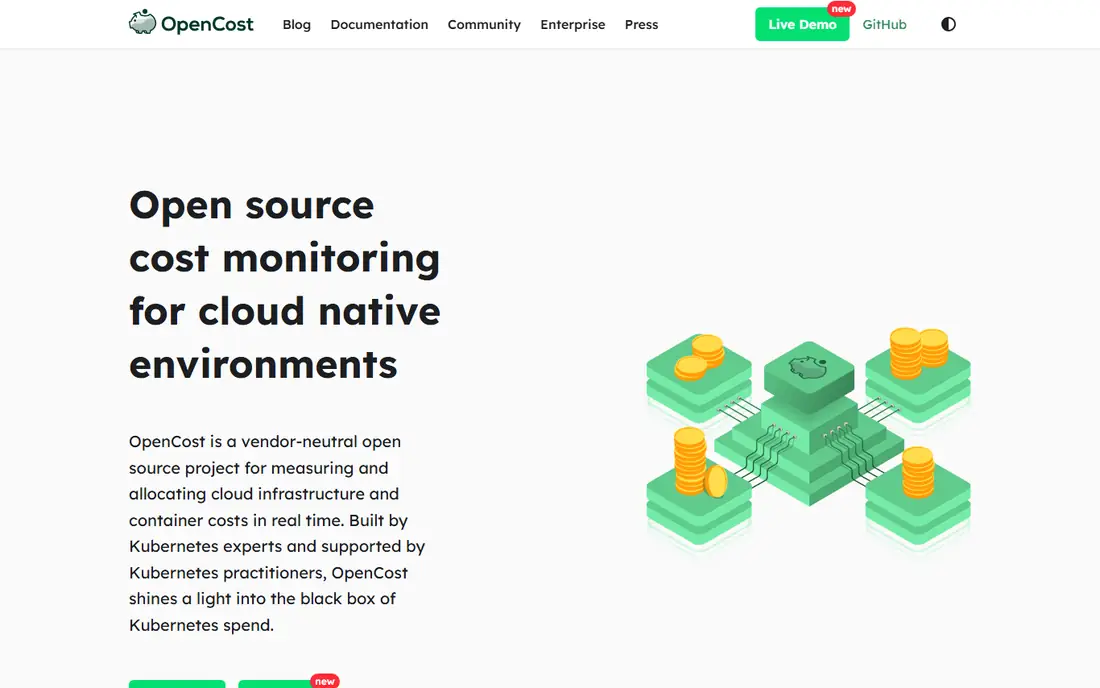
OpenCost is a free, open-source cost monitoring project and a CNCF incubating project that standardizes Kubernetes cost monitoring. It allocates cost down to the container, including GPU, persistent volumes and out-of-cluster costs, with pricing from AWS, Azure and GCP billing APIs and custom pricing for on-premises clusters. Prometheus export feeds existing Grafana dashboards, so teams keep their current observability stack.
OpenCost reports and allocates; savings come from the actions your team takes, since it has limited automation for optimization. There is no built-in UI out of the box, default data retention runs about 15 days without extra configuration, and engineering resources are needed to maintain and extend it. For a team that wants a vendor-neutral allocation layer without license costs, OpenCost is the best starting point.
What we like- Fully open source
- Prometheus integration
- Container-level allocation including GPU and volumes
Watch out for- No built-in UI out of the box
- Limited automation
- 15-day default data retention
#2
Cast AI
Best for: Automated node and spot optimization
Visit cast.ai
Starting priceSee website
Free planFree trial
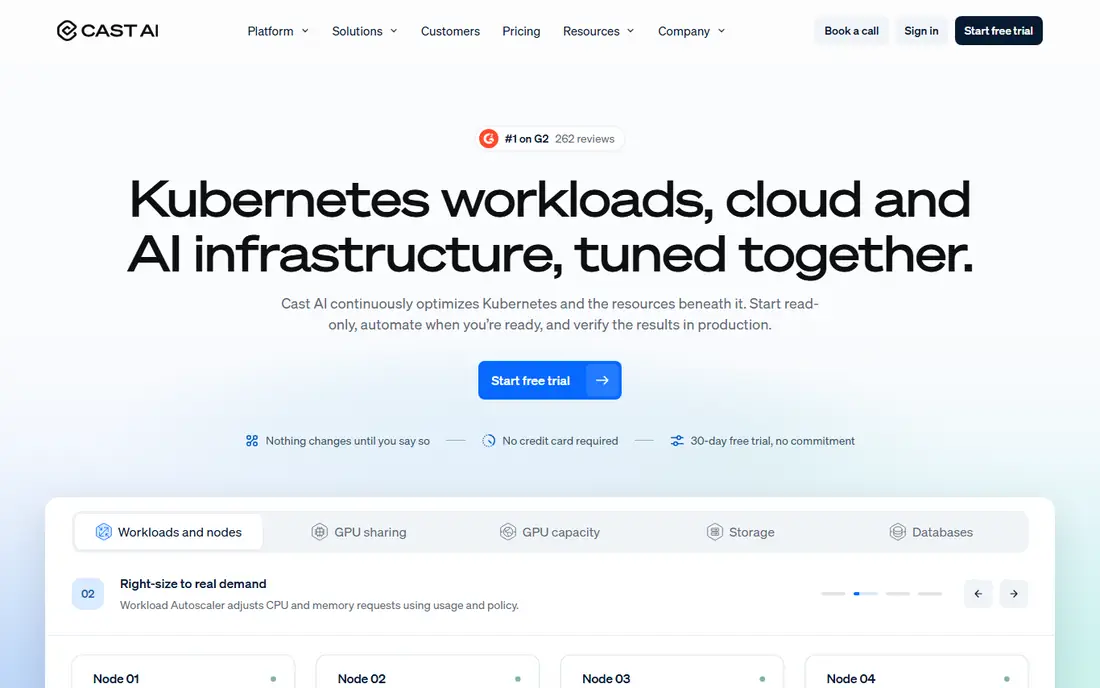
Cast AI is a Kubernetes automation platform that turns cost visibility into automatic savings. It sets CPU and memory requests from observed usage, bin-packs pods onto fewer nodes, and moves eligible workloads to spot instances within policies the team sets. It supports EKS, GKE, AKS, Oracle Cloud and on-premises clusters such as OpenShift and bare metal, so platform teams do not replace their clusters to use it.
Cast AI starts in read-only mode, and automation takes effect only once the team enables it, which is a safe design for production. Cost monitoring is free, while automation is priced by custom quote and no prices are listed publicly. For a Kubernetes-heavy team that wants automation without replacing its clusters, Cast AI is the most autonomous option.
What we like- Automated node provisioning
- Spot management
- Bin packing
- Workload autoscaling
Watch out for- Automation only once enabled
- Pricing by custom quote
- Starts in read-only mode
Starting priceSee website
Free planFree trial
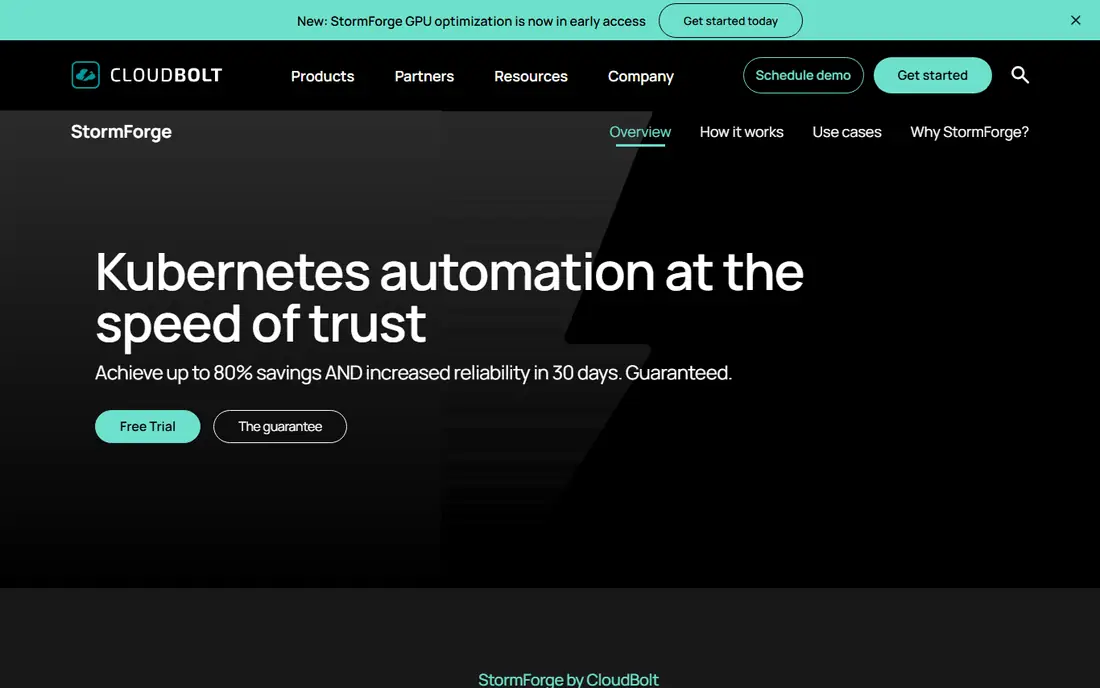
StormForge, now part of CloudBolt, automatically tunes CPU and memory requests for every workload using per-workload ML models trained on 28 plus days of observed data. Each workload gets its own model capturing weekly patterns, daily cycles and burst behavior, and the platform applies changes automatically with configurable approval workflows. The result is less overprovisioning, lower costs and fewer OOM kills, throttling events and latency spikes.
Pricing is quote-based, with a 30-day free trial on one cluster. StormForge focuses on workload rightsizing rather than full FinOps governance, so teams that need chargeback across VMs and SaaS should pair it with a broader platform. For a team whose main waste is overprovisioned requests, StormForge's ML approach is the most precise fix.
What we like- Per-workload ML models
- Automatic CPU and memory tuning
- Fewer OOM kills and throttling
Watch out for- Quote-based pricing
- 30-day trial limited to one cluster
Starting priceSee website
Free planFree trial
ScaleOps is a Kubernetes resource automation platform that automates pod rightsizing alongside HPA, KEDA and Karpenter, so rightsizing cooperates with autoscaling rather than fighting it. Costs break down by cluster, namespace, label, team and application using cloud billing exports, which gives platform teams the allocation view they need for showback. That combination of automation plus allocation covers both halves of the cost problem.
Pricing is custom quote with a free trial, and ScaleOps is newer than Cast AI or StormForge. For a team that wants automated rightsizing that respects its existing autoscalers, ScaleOps is the best fit.
What we like- Automated pod rightsizing
- Works with HPA, KEDA and Karpenter
- Costs by team and app
Watch out for- Custom quote pricing
- Newer than Cast AI or StormForge
Starting price$0
Free planYes
Harness Cloud Cost Management is the cost module in the Harness software delivery platform, splitting cluster-to-pod costs into utilized, idle and unallocated buckets. AutoStopping shuts down idle dev, staging and test environments automatically, which is often the fastest single saving for teams with large non-production footprints. ML recommendations and a Commitment Orchestrator add rightsizing and reservation guidance.
AutoStopping mainly suits dev, staging and test environments, so always-on production relies on rightsizing or commitments instead. A free forever plan covers basic use, with Enterprise plans for full features. For a team already using Harness for delivery, adding cost management is the lowest-friction option.
What we like- Free forever plan
- AutoStopping for dev and test
- Cluster-to-pod cost split
Watch out for- AutoStopping mainly suits non-production
- Full platform needs Enterprise plans
#6Finout
Best for: Enterprise FinOps platform4.5/5 on
G2 (70 reviews, checked Oct 2026)
Visit finout.io
Starting priceSee website
Free planFree trial
Finout is an enterprise-grade FinOps platform for cloud and AI spend, with pod-level costs across EKS, GKE and AKS and 100 percent allocation through virtual tags and shared cost distribution. CostGuard rightsizing covers EKS and GKE workloads, with FinOps agents routing follow-up through governed workflows. Fixed, transparent pricing with no savings fees avoids the percentage-of-savings charges some optimization tools apply.
Pricing is quote-based, and the broader scope covers cloud and AI spend beyond Kubernetes, which may be more than a Kubernetes-only team needs. For an enterprise FinOps team that wants Kubernetes costs inside a full cloud cost platform, Finout is the most complete option.
What we like- Pod-level costs across EKS, GKE and AKS
- 100 percent allocation via virtual tags
- No savings fees
Watch out for- Quote-based pricing
- Broader scope than Kubernetes-only teams need
Starting priceSee website
Free planFree trial
PerfectScale focuses on workload optimization, tuning resource requests and limits so workloads run efficiently without manual review. It works alongside existing autoscalers and reports savings clearly, which helps platform teams prove the value of optimization work to finance. That workload focus makes it a strong alternative for teams whose main problem is overprovisioned pods rather than allocation reporting.
Pricing is quote-based, and the scope is narrower than full FinOps platforms such as Finout or Cloudability. For a team that wants workload optimization without buying a whole FinOps suite, PerfectScale is a focused and effective pick.
What we like- Workload-focused optimization
- Rightsizing alongside autoscalers
- Clear savings reporting
Watch out for- Quote-based pricing
- Narrower scope than full FinOps platforms
#8Cloudability
Best for: FinOps governance4.2/5 on
G2 (215 reviews, checked Oct 2026)
Visit apptio.com
Starting priceSee website
Free planFree trial
Cloudability, part of Apptio, covers cost visibility, allocation and FinOps governance across the full cloud estate, with commitment management tools for reservations and savings plans. For organizations managing large storage footprints and multi-cloud spend, its governance features and predictive scaling capabilities add value beyond Kubernetes alone. That breadth is why enterprises pair it with a Kubernetes-native tool.
A broader scope may be unnecessary for teams focused only on Kubernetes, and platform complexity can increase operational overhead. For an enterprise that needs FinOps governance across cloud and Kubernetes together, Cloudability is the most established option.
What we like- Full FinOps governance
- Cost visibility and allocation
- Commitment management
Watch out for- Quote-based pricing
- Broader scope may be unnecessary for Kubernetes-only teams
How we chose
We compared Kubernetes cost tools on cost visibility, allocation granularity, optimization approach and pricing transparency. We used vendor pages and recent comparison guides for facts, and we favored tools with a free tier or published entry price. We did not claim hands-on testing. Instead we weighed what each tool measures, whether it acts automatically or only reports, and what it costs, so platform teams can match a tool to their main cost problem.
Visibility versus automation
The choice that matters most is whether your team needs visibility or automation. Visibility tools such as OpenCost isolate financial waste down to namespaces and pod labels, but savings come from engineers acting on the data. Automation tools such as Cast AI, StormForge and ScaleOps eliminate waste in real time by resizing requests, rebalancing pods and moving workloads to spot instances.
Uncontrolled node overprovisioning and inflated resource requests routinely inflate Kubernetes compute bills by 40 to 60 percent, so automation usually pays for itself quickly at scale. Start with visibility to measure the waste, then add automation for the largest waste categories first. Keep approval workflows on for production changes until the team trusts the automation, then relax them for lower-risk environments. Track savings weekly and share the numbers with engineering teams, since visible savings motivate the behavior changes that keep costs down.
Frequently asked questions
What is the best free Kubecost alternative?
OpenCost is the best free alternative, with container-level cost allocation as a CNCF open-source project. Harness also offers a free forever plan, and Kubecost itself offers a free Foundations tier up to 250 cores with 15-day retention.
Does Kubecost still exist?
Yes. Kubecost is now IBM Kubecost, offering Kubernetes-native cost monitoring with real-time costs by cluster, namespace and workload, reconciled with the cloud bill. Its free Foundations tier covers up to 250 cores.
Should I choose visibility or automation?
Choose visibility first if you do not yet know where waste sits, using OpenCost or Kubecost Foundations. Choose automation with Cast AI, StormForge or ScaleOps once you know overprovisioning is the main problem and want savings without manual work.
How much can Kubernetes cost optimization save?
Uncontrolled overprovisioning routinely inflates Kubernetes bills by 40 to 60 percent, so rightsizing and spot usage can cut compute costs substantially. Actual savings depend on workload patterns, current requests and how aggressively automation is enabled.
How do I start with Kubernetes cost management?
Install a visibility tool first, such as OpenCost or Kubecost Foundations, and let it collect two weeks of data before changing anything. Identify the top namespaces by cost, then rightsize the largest overprovisioned workloads. Only then evaluate automation tools for the remaining waste. Set a monthly cost review with engineering leads, so optimization becomes a habit rather than a one-time project. Assign each namespace an owner, since unowned costs are the ones that grow unchecked. Showback reports to each owner close the accountability loop. Teams that see their own costs optimize faster than teams that only see a total. Visibility drives accountability every time in practice for most teams.
What is the difference between Kubecost and OpenCost?
OpenCost is the open-source allocation standard that Kubecost helped create, focused on measurement and Prometheus export. Kubecost adds a UI, bill reconciliation, rightsizing insights and enterprise governance on top of that foundation.
Sources we checked (8)
- https://opencost.io
- https://cast.ai
- https://www.stormforge.io
- https://scaleops.com
- https://www.harness.io
- https://www.finout.io
- https://www.perfectscale.io
- https://www.apptio.com
Is your product missing or out of date?
We review this list regularly. Vendors can request a listing, send updated pricing or ask about featured placement.

Shihab Mia · Founder, Rankite
Shihab has 5+ years in B2B and SaaS SEO. He writes Rankite's software buying guides from pricing pages, documentation and public user reviews. More about Shihab.