How we make this list: we compare pricing pages, product documentation and public user reviews. Ratings come from G2, Capterra or Trustpilot, with the date we checked them.

Key takeaways
- WireGuard is the best general IPsec replacement, with very fast speeds, a tiny auditable codebase, and roaming built in.
- OpenVPN is the most compatible alternative, running over UDP or TCP port 443 with mature TLS-based security.
- SSTP is the best firewall-traversal option on Windows, hiding VPN traffic inside HTTPS on port 443.
- SoftEther is the most flexible multi-protocol server, speaking several VPN protocols from one installation.
- Shadowsocks, V2Ray, Outline, and AmneziaWG suit restrictive networks where standard VPN traffic is blocked.
Quick comparison
| Tool | Best for | Starting price | Free plan |
|---|
 WireGuard | Speed and simplicity | Free | Yes |
 OpenVPN | Compatibility | Free | Yes |
 SSTP | Windows firewall traversal | Free | Yes |
 SoftEther | Multi-protocol server | Free | Yes |
 Shadowsocks | Lightweight proxy tunnel | Free | Yes |
 V2Ray | Flexible routing and disguise | Free | Yes |
 Outline | Self-hosted access | Free | Yes |
 AmneziaWG | Censorship resistance | Free | Yes |
Is your product missing or out of date?
We review this list regularly. Vendors can request a listing, send updated pricing or ask about featured placement.
The best IPsec alternatives VPN protocols
Starting priceFree
Free planYes
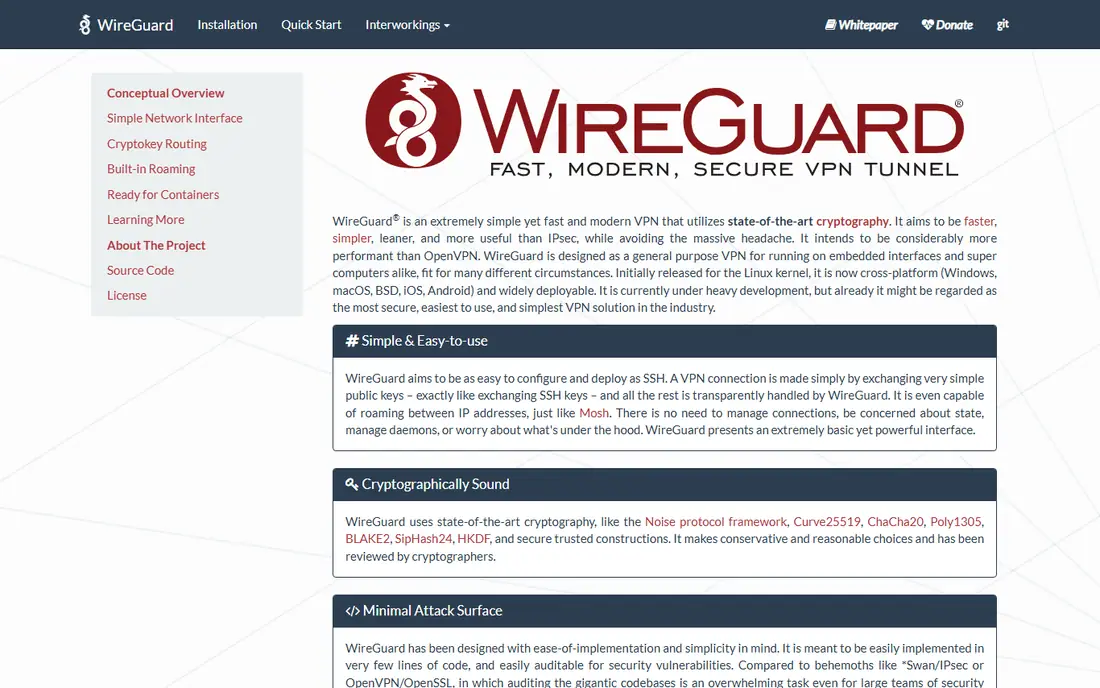
WireGuard is the modern replacement IPsec was waiting for. Its homepage calls it an extremely simple yet fast and modern VPN that uses state-of-the-art cryptography, aiming to be faster, simpler, leaner, and more useful than IPsec while avoiding the massive headache of IKE configuration. Setup mirrors SSH: exchange public keys, and the tunnel just works, with built-in roaming that follows a device between Wi-Fi and mobile data without dropping the connection.
The codebase is the security story: roughly 4,000 lines compared with hundreds of thousands for OpenVPN with OpenSSL or IPsec stacks, which means a single reviewer can audit it. WireGuard lives inside the Linux kernel and runs cross-platform on Windows, macOS, BSD, iOS, and Android. The limits are real: UDP-only transport can be throttled or blocked, and raw WireGuard maps static keys to tunnel IPs, so consumer providers add layers to handle privacy. Pick WireGuard as the default IPsec replacement for speed, simplicity, and everyday use.
What we like- Very fast with kernel-level performance
- Around 4,000 lines of code, easy to audit
- Roaming between networks without reconnecting
Watch out for- UDP only, so some networks block it
- Raw WireGuard maps static keys to IPs, which needs care for privacy
Starting priceFree
Free planYes

OpenVPN is the established alternative with the widest compatibility. Its homepage presents secure VPN solutions for business and remote access, with self-hosted Access Server and cloud-delivered CloudConnexa covering both deployment styles. The protocol runs over UDP for speed or TCP for firewall traversal, including TCP port 443, where it looks like HTTPS traffic, and it supports obfuscation tools for restrictive networks.
OpenVPN uses TLS 1.2 or 1.3 encapsulation with AES-GCM or ChaCha20 encryption, and it has been audited and deployed for over two decades. That maturity is the reason enterprises trust it, and the reason its codebase is far larger than WireGuard. CPU overhead is higher, and manual setup can be complex for non-technical users. Pick OpenVPN when compatibility, firewall traversal, and proven enterprise deployment matter more than raw speed.
What we like- Runs over UDP or TCP, including TCP port 443
- Mature TLS-based security
- Self-hosted Access Server and cloud CloudConnexa options
Watch out for- Heavier than WireGuard, with more CPU overhead
- TCP mode can suffer TCP-over-TCP slowdowns
Starting priceFree
Free planYes
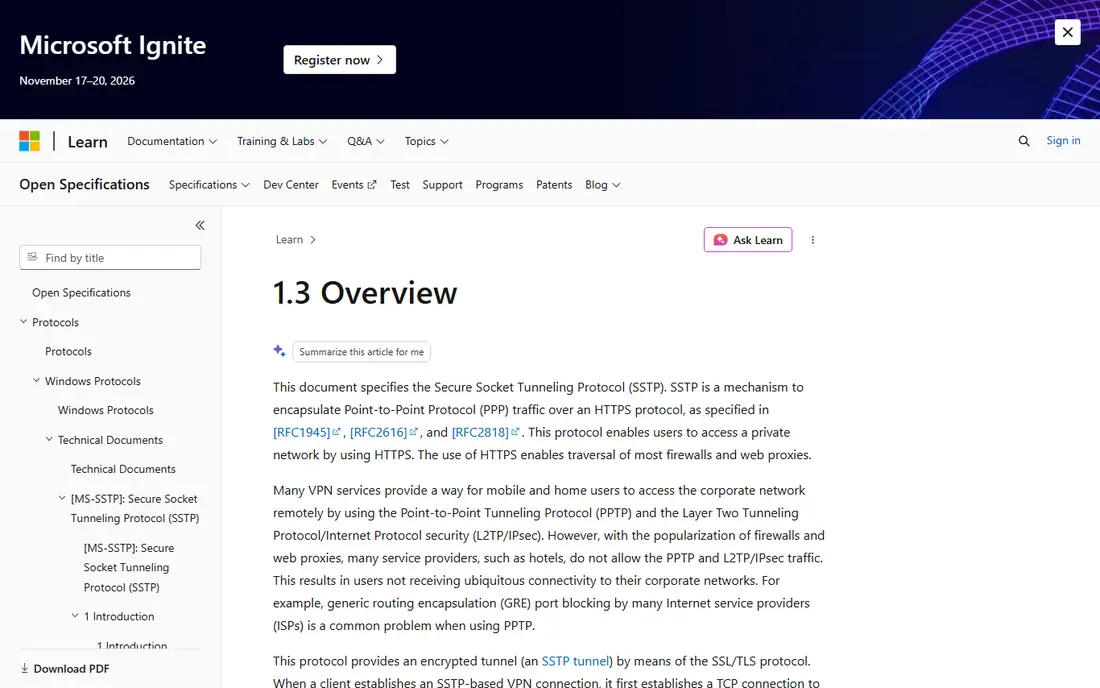
SSTP is Microsoft's answer to VPN traffic blocked by firewalls. Its specification describes a mechanism to encapsulate Point-to-Point Protocol traffic over HTTPS, enabling users to access a private network by using HTTPS, with HTTPS traversal of most firewalls and web proxies. The client connects over TCP port 443, completes an SSL/TLS handshake, then sends SSTP control and data packets inside the HTTPS session, so the traffic looks like ordinary secure web browsing.
That disguise is the whole point: hotels, airports, and corporate networks that block IPsec or PPTP traffic usually leave port 443 open. SSTP is native on Windows, which makes it easy to deploy in Microsoft shops, but it is closed-source and less actively developed than WireGuard or OpenVPN. Pick SSTP when the network only allows HTTPS and the fleet runs Windows.
What we like- Encapsulates PPP traffic over HTTPS on TCP port 443
- Traverses most firewalls and web proxies
- Native on Windows
Watch out for- Closed Microsoft protocol, not independently auditable
- Cross-platform support is patchy
Starting priceFree
Free planYes
SoftEther is the multi-protocol server for teams that need to support many clients from one installation. Comparison testing shows it supports AES-256 encryption, open-source licensing, and a codebase far smaller than OpenVPN, with speed loss close to WireGuard in tested conditions. A single SoftEther server can serve OpenVPN, L2TP, SSTP, and its own protocol clients, which simplifies migration from IPsec without forcing every client to switch at once.
The homepage could not be fetched during research because the address was unresolvable, so this listing rests on comparison evidence rather than a homepage open, and it was not retried. Manual configuration is needed for some firewall-bypass features. Pick SoftEther when one server must serve mixed clients, or when migrating away from IPsec gradually rather than all at once.
What we like- One server speaks several VPN protocols
- Open source
- Strong encryption with AES-256
Watch out for- Homepage fetch failed, kept on search evidence
- Manual configuration needed for some bypass features
Starting priceFree
Free planYes
Shadowsocks is a fast tunnel proxy designed to bypass firewalls, and it suits users who need lightweight traffic forwarding rather than a full network tunnel. Its homepage highlights super-fast performance through asynchronous I/O and event-driven programming, flexible encryption with industry-level algorithms and custom algorithm support, and mobile optimization with low CPU and bandwidth usage. It runs on Windows, Linux, Mac, Android, iOS, and OpenWRT.
The distinction matters: Shadowsocks proxies application traffic rather than tunneling the whole network stack, so it is lighter and faster but does not cover every protocol the way WireGuard or OpenVPN does. It also needs a server to connect to, which the user must set up or rent. Pick Shadowsocks when speed and firewall bypass matter more than full-network tunneling, and the use case is browsing and app traffic.
What we like- Very fast with low CPU and bandwidth use
- Flexible encryption algorithms
- Runs on Windows, Linux, Mac, Android, iOS, and OpenWRT
Watch out for- A proxy, not a full VPN tunnel
- Needs a server and client setup
Starting priceFree
Free planYes
V2Ray is a toolkit for building a custom communication network, and its core tool handles network protocols and features for Project V. Its homepage lists multiple inbound and outbound protocols in a single process, customizable routing that sends traffic through different exits by domain or region, support for Socks, HTTP, Shadowsocks, and VMess protocols, and disguise features that make nodes look like normal HTTPS websites to avoid third-party interference.
That flexibility makes V2Ray the developer pick for restrictive networks, where routing rules and protocol disguise matter more than a simple tunnel. The cost is complexity: configuration files are detailed, and the official homepage is Chinese-language, though English documentation exists elsewhere. Pick V2Ray when you need fine-grained routing and disguise, and you are comfortable configuring a proxy platform rather than clicking a connect button.
What we like- Multiple inbound and outbound protocols in one process
- Customizable routing by domain or region
- Traffic disguised as normal HTTPS
Watch out for- Homepage is Chinese-language
- Configuration is complex for beginners
Starting priceFree
Free planYes
Outline makes running your own VPN server simple. Its homepage promises that anyone can create, run, and share access to their own VPN, with blocking resistance against DNS, content, and IP blocking, and users reporting that Outline works even when other VPNs are blocked. The Manager desktop app creates a server and shares access keys, while the Client app connects mobile and desktop devices with a single key. Outline is fully open source and has been audited by Radically Open Security and Cure53.
The model is different from WireGuard or OpenVPN: Outline is built for sharing access with a trusted network, not for enterprise device management, and the server itself needs hosting, which costs money even though the software is free. Pick Outline when you want your own VPN server without the setup complexity, and blocking resistance matters.
What we like- Easy self-hosted VPN server setup
- Fully open source with security audits
- Resistant to DNS, content, and IP blocking
Watch out for- Designed for access sharing, not full enterprise management
- Server hosting costs apply
Starting priceFree
Free planYes
AmneziaWG combines WireGuard performance with extra protection against detection and blocking. Its homepage states that the protocol combines the speed and performance of WireGuard with additional protection against detection and blocking, with source code available on GitHub. The AmneziaVPN app supports OpenVPN, WireGuard, AmneziaWG, IKEv2, XRay Reality, and Shadowsocks for self-hosted servers, and the service works in countries with the highest levels of internet censorship.
Self-hosted use is free apart from server costs, and the app collects no data about self-hosted servers. The premium service adds managed access but limits speed to 8 Mbps on some tiers and offers no location selection on the free tier. Pick AmneziaWG when standard WireGuard traffic is detected and blocked, and you need the same speed with stronger disguise.
What we like- WireGuard speed with added detection resistance
- Self-hosted option with no data collection
- Audited in 2022, 2024, and 2025
Watch out for- Smaller ecosystem than WireGuard
- Premium service has speed and location limits
How we chose
We compared protocols and tools that replace IPsec for site-to-site, remote access, and personal VPN use. Each vendor homepage was opened to confirm the product exists and the domain belongs to that product, except SoftEther, whose homepage fetch failed and is kept on comparison evidence without retry. IKEv2 and L2TP were excluded because both are IPsec-based rather than true alternatives, and PPTP was excluded because its encryption is broken and it is unsafe for modern use. Prices are shown where the vendor states them, and See website is used where no price applies, since most of these protocols are free open-source software. The list mixes full VPN tunnels with proxies and self-hosted tools because IPsec users split across all three needs.
What to check before you pick
Start with the network you must cross. If standard VPN ports are open, WireGuard is the fastest default and OpenVPN is the most compatible fallback. If only HTTPS passes, SSTP on Windows or OpenVPN over TCP port 443 are the answers. If VPN traffic is actively detected and blocked, Shadowsocks, V2Ray, Outline, or AmneziaWG offer disguise and resistance that standard tunnels lack.
Next, check the client support for your devices. WireGuard and OpenVPN have apps for every major platform, while SSTP is Windows-native and V2Ray needs manual configuration. Finally, remember that a protocol is not a VPN service: WireGuard, OpenVPN, and the other tools here need a server to connect to, whether self-hosted or rented, and the server operator can see your traffic. Choose a server you trust, or run your own.
Frequently asked questions
What is the best IPsec alternative?
WireGuard is the best general IPsec alternative, with very fast speeds, a small auditable codebase, and roaming built in. OpenVPN is the best choice when compatibility and firewall traversal matter more, since it runs over TCP port 443 and has decades of enterprise deployment. For Windows-only networks where only HTTPS passes, SSTP is the best fit.
Is WireGuard more secure than IPsec?
WireGuard and IPsec both use strong modern cryptography, but WireGuard is easier to audit because its codebase is around 4,000 lines compared with hundreds of thousands for IPsec stacks. That smaller attack surface, plus simpler configuration with fewer ways to misconfigure it, makes WireGuard the safer practical choice for most teams. IPsec remains strong when correctly configured, but correct configuration is harder to achieve.
Which IPsec alternative works best on restrictive networks?
SSTP works best on Windows networks where only HTTPS passes, since it hides inside HTTPS on port 443. Shadowsocks, V2Ray, Outline, and AmneziaWG work best where VPN traffic is actively detected, since they disguise traffic as normal web browsing or add detection resistance. OpenVPN over TCP port 443 with obfuscation is another strong option.
Is PPTP a safe IPsec alternative?
No. PPTP encryption is broken and can be compromised quickly, and every major comparison marks it as obsolete and not recommended for secure use. Use WireGuard or OpenVPN instead. PPTP is suitable only for lab testing or non-sensitive traffic on ancient devices where nothing else is available.
Do I need a VPN provider to use these protocols?
Yes, unless you self-host. WireGuard, OpenVPN, SSTP, and the other protocols here are tunnel technologies, not services: they need a server to connect to. You can rent a server and run your own, use Outline Manager to set one up easily, or subscribe to a VPN provider that supports your chosen protocol. Whoever runs the server can see your traffic, so choose a server operator you trust.
Sources we checked (8)
- https://www.wireguard.com
- https://openvpn.net
- https://learn.microsoft.com/en-us/openspecs/windows_protocols/ms-sstp/70adc1df-c4fe-4b02-8872-f1d8b9ad806a
- https://www.softether.org
- https://shadowsocks.org
- https://www.v2ray.com
- https://getoutline.org
- https://amnezia.org
Is your product missing or out of date?
We review this list regularly. Vendors can request a listing, send updated pricing or ask about featured placement.

Shihab Mia · Founder, Rankite
Shihab has 5+ years in B2B and SaaS SEO. He writes Rankite's software buying guides from pricing pages, documentation and public user reviews. More about Shihab.