How we make this list: we compare pricing pages, product documentation and public user reviews. Ratings come from G2, Capterra or Trustpilot, with the date we checked them.
Key takeaways
- openHAB and Domoticz are the closest free open-source replacements, both running fully locally with no cloud required.
- Hubitat is the best local-first hub for people who want Home Assistant's local control without the DIY maintenance.
- SmartThings, Apple Home, and Google Home are the free ecosystem defaults, best when your devices already live in one brand's world.
- Homey suits households that want broad device support with friendly Flow automations and no tinkering.
- Ezlo targets security-minded homes and property managers, combining automation with professional monitoring options.
Quick comparison
Is your product missing or out of date?
We review this list regularly. Vendors can request a listing, send updated pricing or ask about featured placement.
The best Home Assistant alternatives
Starting priceFree
Free planYes
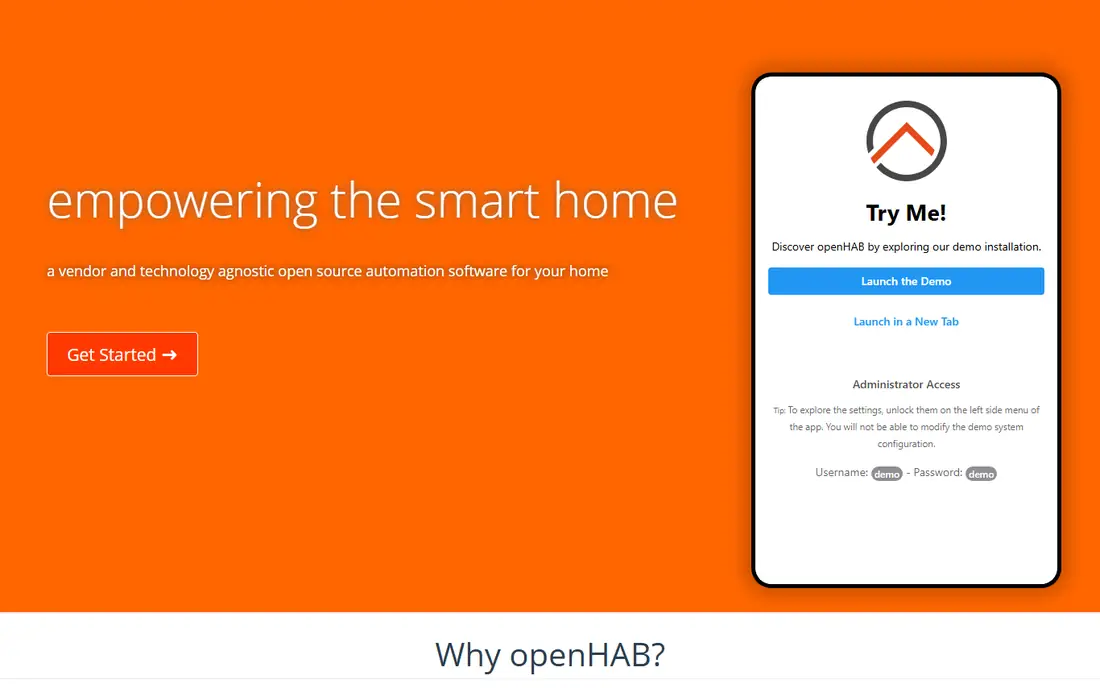
openHAB describes itself as vendor-neutral home automation that runs on your hardware, does not require any cloud service, keeps data privately at home, and talks directly to local devices whenever possible. Its setup path is friendly for a DIY platform: flash the openHABian image to a Raspberry Pi SD card, boot, and enjoy a pre-configured system.
For Home Assistant users who want the same local-first philosophy in a different project, openHAB is the closest match, with a foundation-backed guarantee against lock-in. Its Java runtime needs more resources than Domoticz, so budget hardware accordingly, but its community and device support are deep.
What we like- 100 percent open source and vendor-neutral, backed by a non-profit foundation
- Runs on your hardware with no cloud required
- Large community with 23,000-plus discussions
Watch out for- Java-based setup is heavier than Domoticz
- Interface polish trails commercial hubs
Starting priceFree
Free planYes
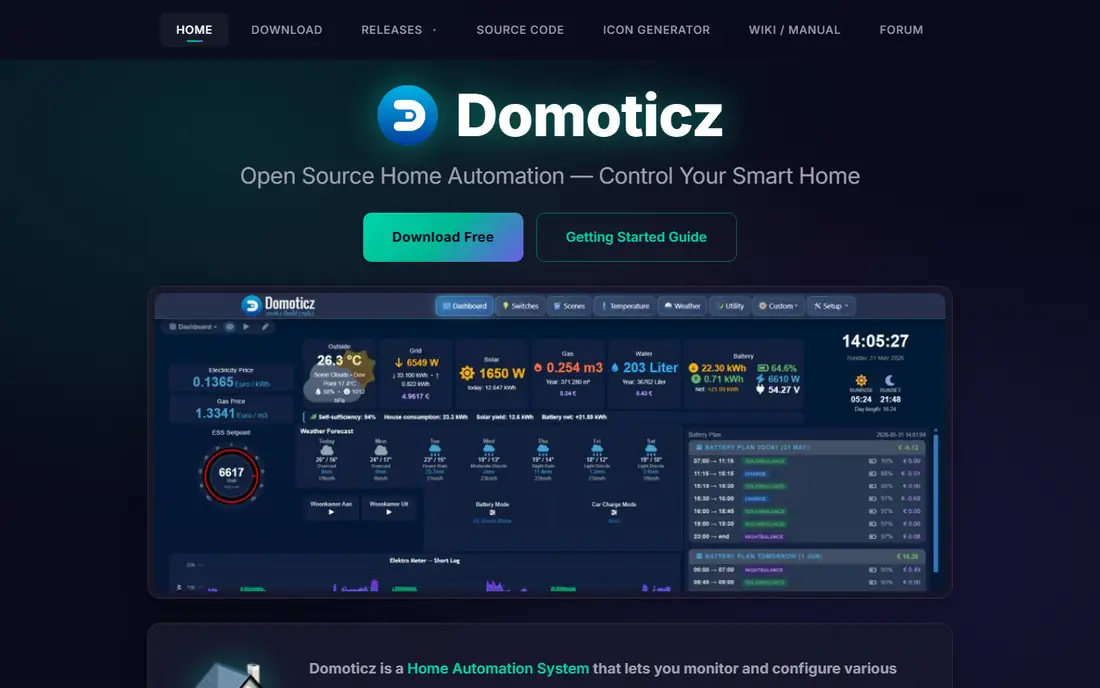
Domoticz calls itself the lightweight, stable, and privacy-first smart home platform, and its homepage makes the efficiency case sharply: built in C++ for maximum efficiency, using under 50 MB of RAM, a fraction of what Python or Java alternatives need, running from a Pi Zero to a full server. It supports Z-Wave, Zigbee, MQTT, Philips Hue, and 150-plus device types, with dzVents, Lua, Python, and Blockly scripting, and it has run reliably since 2012.
For users frustrated by Home Assistant's hardware demands or frequent breaking changes, Domoticz is the calm alternative: set it up once and it just works for years, with no cloud and no fees. Its trade-off is breadth: fewer integrations and a plainer interface than Home Assistant or openHAB.
What we like- Free forever under GPL-3.0 with no subscriptions
- C++ core uses under 50 MB of RAM and runs on a Pi Zero
- 150-plus supported device types with local-only operation
Watch out for- Interface feels dated next to modern hubs
- Fewer integrations than Home Assistant
Starting priceSee website
Free planSee website
Hubitat Elevation promises home automation the way it is meant to be, with local processing, customizable automations, easy dashboards, and wide compatibility. Its homepage emphasizes the local story: automations execute on your hub, not in the cloud, so there are no cloud delays, and device data stays local rather than going to a vendor cloud. The C-8 Pro is its most advanced hub, with external antennas improving Zigbee and Z-Wave range.
For Home Assistant users who want local control in a dedicated hub rather than a DIY server, Hubitat is the best pick, with strong device compatibility and a mobile app for remote access. Expect a hub purchase and some learning time for its rule engine, but no monthly fees for core automation.
What we like- Local processing with no cloud delays and strong privacy
- C-8 Pro hub with faster CPU, double the RAM, and external antennas
- Compatible with 1,000-plus devices from 100-plus brands
Watch out for- Hub purchase required
- Interface and rule engine have a learning curve for beginners
Starting priceFree
Free planYes
SmartThings lets you connect, control, and automate your smart home from one app, and its homepage shows the Samsung advantage: recent Samsung TVs include a built-in SmartThings Hub supporting Matter, Thread, and Zigbee, so many households need no separate hub at all. Its features span phone-as-remote control, 3D Map View of your home, AI Energy Mode saving up to 10 percent of refrigerator energy, and appliance care from washers to robot vacuums.
For Samsung-heavy households, SmartThings is the obvious free Home Assistant alternative, with the best appliance integration here. Its limits are ecosystem depth outside Samsung and the 300-device-per-location cap, which large smart homes may hit.
What we like- Free app connecting hundreds of devices and brands in one experience
- Samsung TVs from 2022 include a built-in hub, so no separate hub needed
- 3D Map View, AI Energy Mode, and appliance integrations
Watch out for- Samsung account and ecosystem focus
- Maximum 300 devices per location
- Some features vary by region
Starting priceFree
Free planYes
Apple's Home app promises a truly welcoming experience, with categories for Lights, Security, and Climate at the top, scenes that automate multiple accessories at once, and automations based on time of day, location, or sensor data. Its homepage emphasizes privacy: Home app data is stored so Apple cannot read it, accessories are controlled by your Apple devices, and communication is encrypted end to end. It also supports Matter accessories, the cross-platform standard.
For Apple households, Apple Home is the simplest free Home Assistant alternative, with the strongest privacy story here. Its limitation is ecosystem: it works best with Apple devices and a home hub, and Android users cannot use it at all.
What we like- Free and built into every Apple device
- End-to-end encrypted data Apple cannot read
- Matter support plus Siri voice control and HomeKit Secure Video
Watch out for- Apple-only, so Android and Windows households are excluded
- Needs a HomePod, Apple TV, or HomeView device as a home hub for remote access and automations
Starting priceFree
Free planYes
Google Home puts you in control, letting you connect thousands of devices to manage, monitor, and automate your entire home, now powered by Gemini so the system understands how you live. Its homepage highlights the Gemini redesign for more natural living, plus Google Home Premium with Gemini for the most advanced features, making homes smarter, safer, and more effortless.
For Google households with Nest devices and Android phones, Google Home is the natural free alternative, with the best voice and AI interaction here. Unlike openHAB, Domoticz, or Hubitat, it depends on the cloud and an internet connection, so local-first users should choose differently.
What we like- Free app connecting thousands of devices
- Gemini-powered natural interaction
- Google Home Premium adds advanced features for subscribers
Watch out for- Cloud-dependent, unlike local-first options
- Gemini features vary by country and language
Starting priceSee website
Free planSee website
Homey promises that smart home works better together, and its homepage shows why users switch: control all devices from one central place, pair and play with automatic detection for most brands, and automate anything with Flow cards, such as turning on a light when a door opens after sunset. Its 750-plus apps cover brands from Philips Hue and IKEA to Sonos and Netatmo, plus energy monitoring, battery tracking, and family sharing with manager, user, and guest roles.
For households that want Home Assistant's multi-brand reach without its tinkering, Homey is the friendliest hub here, with reviews praising its reliability at 125-plus devices. The cost is a hub purchase, and power users may miss Home Assistant's deeper customization, but most families will prefer Homey's simplicity.
What we like- Controls all devices from phone, tablet, or desktop in one place
- Flow automations mix and match cards without coding
- 750-plus apps and energy monitoring with Insights
Watch out for- Hub purchase required
- Smaller community than Home Assistant or openHAB
Starting priceSee website
Free planSee website
Ezlo Innovation promises smarter living with smooth home automation, and its homepage centers security: predictive automation, AI as the interface, local intelligence plus cloud, and a trusted control plane. Its platform combines smart devices, professional monitoring through Ezlo Protect, and property automation for homeowners, professionals, and managers, with bundles such as Aware at $179, Insight at $229, and Beacon at $299.
For homes where security matters as much as automation, or for property managers overseeing many units, Ezlo is the best Home Assistant alternative, blending protection and automation in one dashboard. DIY enthusiasts will find it less flexible than open-source options, but its monitoring and portfolio features fill a different need.
What we like- One platform for smart devices, professional monitoring, and property automation
- AI detection cameras with anomaly alerts
- Bundles from $179 for care, protection, and video packages
Watch out for- Security and property focus means less DIY flexibility than openHAB or Home Assistant
- Bundle pricing varies by package
How we chose
We compared smart home platforms on vendor homepages, weighing local versus cloud operation, device compatibility, automation depth, ecosystem fit, privacy, and pricing. We favored platforms with live homepages and current offerings, and we included both open-source projects and commercial hubs because Home Assistant buyers range from DIY enthusiasts to families seeking simplicity.
What to check before you commit
Start with your device list. Count your Zigbee, Z-Wave, Matter, Wi-Fi, and brand-specific devices, then check each platform's compatibility list. A platform that misses your most important device is a non-starter, no matter how good its interface is.
Next, decide local versus cloud. Local platforms such as openHAB, Domoticz, and Hubitat keep working without internet and protect privacy, while cloud platforms such as Google Home and SmartThings offer easier setup and better voice assistants. Your internet reliability and privacy priorities should drive this choice.
Finally, test automations with your real routines. Build your five most important automations on a trial hub or app before migrating everything, including presence detection, lighting scenes, and security alerts. A platform that handles your daily routines smoothly is worth more than one with a longer feature list.
Frequently asked questions
What is the best Home Assistant alternative overall?
openHAB for open-source local control, Hubitat for a local-first hub, and Domoticz for lightweight operation. For ecosystem households, SmartThings, Apple Home, and Google Home are the free defaults, while Homey leads for friendly multi-brand control.
Is there a free Home Assistant alternative?
Yes. openHAB and Domoticz are free and open source with no subscriptions, and SmartThings, Apple Home, and Google Home apps are free. Hubitat, Homey, and Ezlo require hub or bundle purchases.
Which alternative works without internet?
openHAB, Domoticz, and Hubitat all run automations locally, so your home keeps working without internet. Google Home and SmartThings depend more on cloud services, though Hubitat and local platforms still need internet for remote access and some integrations.
Which alternative is best for Apple users?
Apple Home, free and built into every Apple device, with end-to-end encryption, Matter support, and Siri control. It needs a HomePod, Apple TV, or HomeView device as a hub for remote access and automations.
Which alternative is best for Samsung users?
Samsung SmartThings, with a free app, hundreds of compatible devices, and built-in hubs in recent Samsung TVs. Its appliance integrations for washers, dryers, fridges, and robot vacuums are unmatched here.
Do I need a hub for these alternatives?
It depends. openHAB and Domoticz run on your own hardware such as a Raspberry Pi, Hubitat and Homey sell dedicated hubs, SmartThings often runs on a Samsung TV hub, and Apple Home needs an Apple hub device. Google Home works through the app and speakers without a separate hub.
Sources we checked (8)
- https://www.openhab.org
- https://www.domoticz.com
- https://hubitat.com
- https://www.smartthings.com
- https://www.apple.com/home-app/
- https://home.google.com
- https://homey.app
- https://ezlo.com
Is your product missing or out of date?
We review this list regularly. Vendors can request a listing, send updated pricing or ask about featured placement.

Shihab Mia · Founder, Rankite
Shihab has 5+ years in B2B and SaaS SEO. He writes Rankite's software buying guides from pricing pages, documentation and public user reviews. More about Shihab.
 openHAB
 Domoticz
 Hubitat Elevation
 Samsung SmartThings
 Apple Home
 Google Home
 Homey
 Ezlo