How we make this list: we compare pricing pages, product documentation and public user reviews. Ratings come from G2, Capterra or Trustpilot, with the date we checked them.
Key takeaways
- Crayon and Klue suit enterprise teams that need battlecards, sales enablement, and a governed competitive program, not just alerts.
- Kompyte suits mid-size teams that want automated tracking and battlecards without the heaviest enterprise setup.
- Similarweb suits strategy teams that need market traffic and audience data, while AlphaSense suits research teams that need premium documents and transcripts.
- Owler and Visualping suit small teams on a budget, since they cover news tracking and page changes at far lower cost.
Quick comparison
| Tool | Best for | Starting price | Free plan |
|---|
 Crayon | Enterprise battlecards | See website | No |
 Klue | Sales enablement CI | See website | No |
 Kompyte | Automated tracking | See website | No |
 Similarweb | Market traffic data | $199 per month | Yes |
 Contify | Market intelligence feeds | See website | No |
 AlphaSense | Premium research synthesis | See website | No |
 Owler | Affordable company news | $35 per month | Yes |
 Visualping | Page change alerts | $13 per month | Yes |
Is your product missing or out of date?
We review this list regularly. Vendors can request a listing, send updated pricing or ask about featured placement.
The best competitors alternatives AI
#1Crayon
Best for: Enterprise battlecards4.6/5 on
G2 (385 reviews, checked Oct 2026)
Visit crayon.co
Starting priceSee website
Free planNo
Crayon is built for companies that run competitive intelligence as a program, not as a side task. It tracks competitor websites, pricing pages, reviews, and messaging changes, then turns those signals into battlecards and updates that reach sales inside Salesforce or Slack. That distribution loop is the point: insights that sit in a dashboard help nobody, while battlecards that appear during a live deal change how reps sell.
The cost and weight are real. Crayon pricing is quote-based at enterprise levels, and setup takes weeks of defining competitors, sources, and battlecard templates. Small teams will find it oversized for occasional competitor checks. For companies with many reps facing the same rivals every week, Crayon turns scattered monitoring into a repeatable advantage.
What we like- Automated competitor monitoring
- Battlecard distribution
- Salesforce and Slack integrations
Watch out for- Enterprise pricing
- Heavy setup for small teams
#2Klue
Best for: Sales enablement CI4.7/5 on
G2 (443 reviews, checked Oct 2026)
Visit klue.com
Starting priceSee website
Free planNo
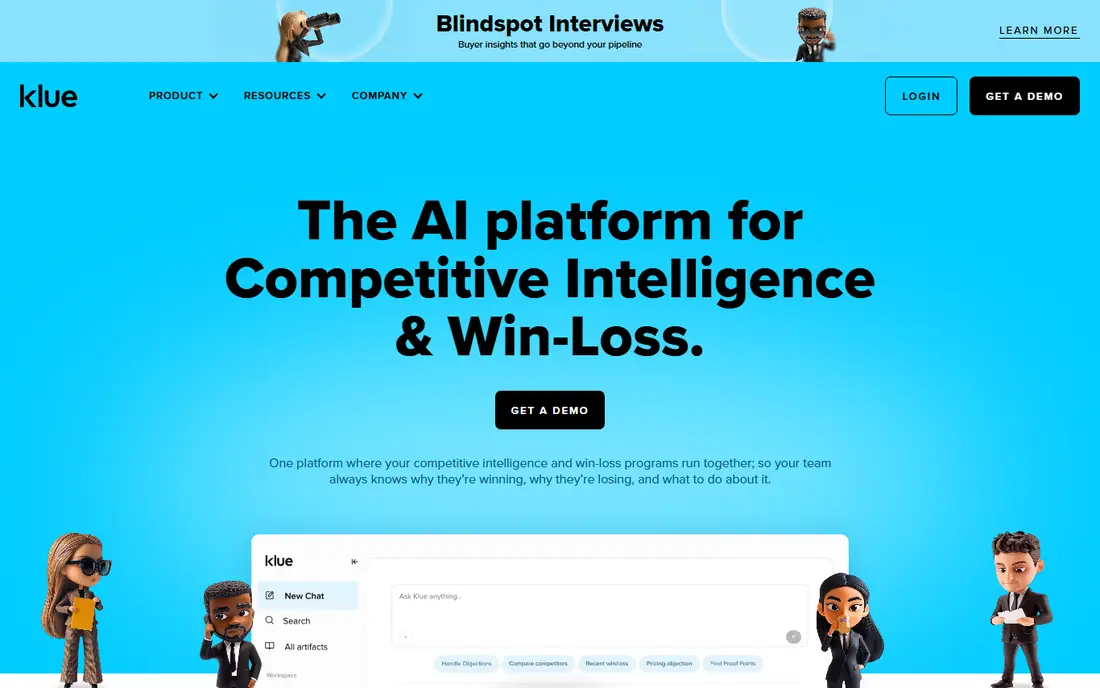
Klue combines competitive tracking with win-loss research, which gives it an edge for teams that want to know why deals are won and lost, not just what rivals changed. Its battlecards live where sales already works, and usage tracking shows which cards reps actually open, so product marketers can improve the material that matters instead of guessing. That feedback loop separates Klue from simple monitoring tools.
Setup demands buy-in. Klue works best when product marketing owns the program and sales agrees to use the cards, and that process takes time to build. Pricing is enterprise and demo-led, which puts it out of reach for small teams. For sales-led companies that want competitive enablement tied to real deal outcomes, Klue is a leading choice.
What we like- Win-loss research included
- Battlecards with usage tracking
- Strong sales workflow fit
Watch out for- Process-heavy setup
- Enterprise pricing
#3Kompyte
Best for: Automated tracking4.3/5 on
G2 (102 reviews, checked Oct 2026)
Visit kompyte.com
Starting priceSee website
Free planNo
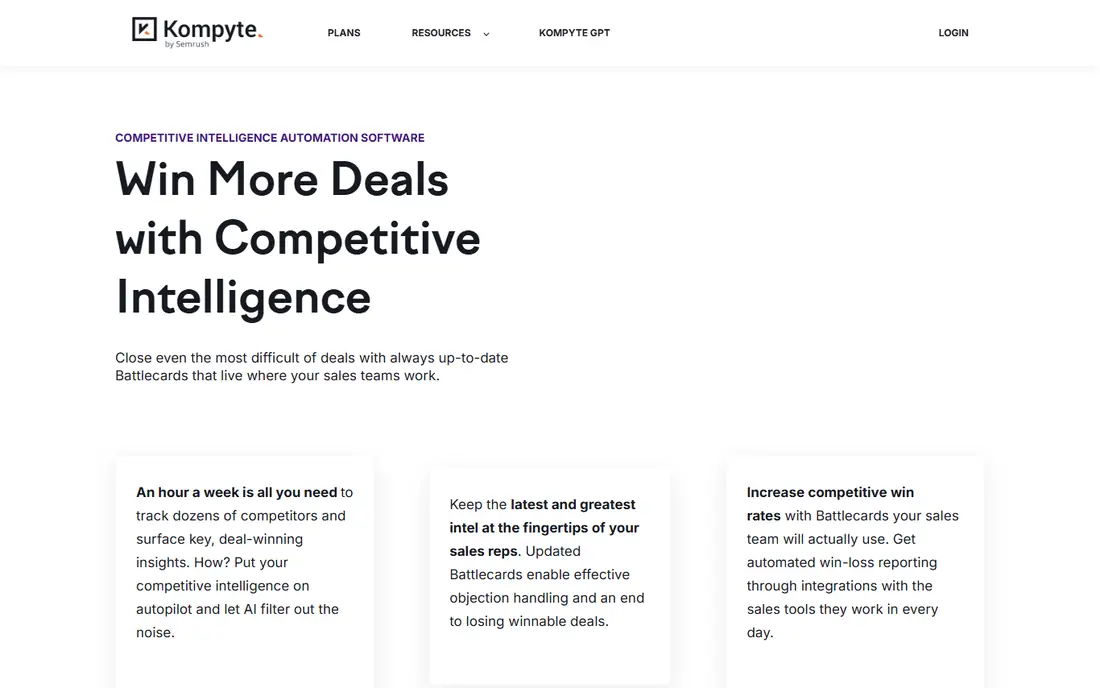
Kompyte, now part of the Semrush group, automates the tedious part of competitive tracking. It watches competitor sites, product pages, reviews, pricing, and hiring signals, then surfaces prioritized changes and keeps battlecards current without manual research. Teams that previously spent hours each week checking rival pages get that time back, and sales gets fresher material than a quarterly battlecard refresh ever delivered.
Pricing is sales-led and often bundled, so small teams cannot simply sign up and see a price. The interface also takes some learning before the signal-to-noise ratio feels right. For mid-size teams that want enterprise-style tracking without the heaviest implementation, Kompyte hits a practical middle ground.
What we like- Automated tracking across many sources
- Live battlecards
- Faster setup than rivals
Watch out for- Sales-led pricing
- Interface takes learning
Starting price$199 per month
Free planYes
Similarweb answers a different question from battlecard tools: how big is a rival, where does its traffic come from, and who is its audience. Its estimates cover website traffic, channel mix, keywords, and audience overlap across many markets, which helps strategy teams size competitors and spot channel shifts. A free tier gives a taste of the data, while paid plans add depth and segments.
Estimates are the caveat. Similarweb figures are modeled, not counted, so treat them as directional signals rather than exact traffic counts, especially for smaller sites. Paid depth also gets expensive quickly as segments and seats grow. For market sizing and benchmarking, Similarweb remains the standard reference, and it pairs well with a battlecard tool for deal-level detail.
What we like- Traffic and audience estimates
- Channel mix data
- Market segment benchmarks
Watch out for- Estimates, not exact counts
- Costs rise fast with depth
#5Contify
Best for: Market intelligence feeds4.5/5 on
G2 (116 reviews, checked Oct 2026)
Visit contify.com
Starting priceSee website
Free planNo
Contify suits organizations that need market and competitive intelligence across an entire company, not just a sales team. It aggregates over a million curated sources into role-based feeds, dashboards, and newsletters, with an AI assistant for on-demand research questions. That breadth helps strategy, product, and executive teams share one intelligence picture instead of each running separate tracking.
Enterprise scope brings enterprise cost and setup. Contify pricing is custom, implementation takes weeks, and small teams will find it oversized. It also focuses more on broad market intelligence than on sales battlecards, so deal-facing teams may still want Klue or Crayon alongside it. For company-wide intelligence programs, Contify is a strong foundation.
What we like- Broad curated source coverage
- Noise-filtered feeds
- AI research assistant
Watch out for- Enterprise pricing
- Setup takes weeks
Starting priceSee website
Free planNo
AlphaSense serves research-heavy teams that need primary documents, not just website changes. Its library covers filings, earnings transcripts, broker research, and expert interviews, with AI tools that summarize, compare, and track sentiment across those sources. Investment teams, corporate strategy groups, and product leaders use it to answer questions that public web monitoring cannot touch.
The audience is narrower than the rest of this list. Per-seat pricing is high, and sales teams looking for battlecards will find AlphaSense too research-oriented for daily deal work. It also requires training to use well, since its power lies in search and synthesis rather than alerts. For teams whose decisions rest on documents and transcripts, AlphaSense is in a class of its own.
What we like- Premium filings, transcripts, and research
- AI synthesis tools
- Sentiment tracking
Watch out for- Per-seat pricing is high
- Best for research teams, not sales floors
#7Owler
Best for: Affordable company news4.3/5 on
G2 (484 reviews, checked Oct 2026)
Visit owler.com
Starting price$35 per month
Free planYes
Owler is the budget pick for teams that mainly want to know when rivals raise money, hire, launch, or make news. Its crowdsourced profiles cover millions of companies, and alerts deliver a steady feed of competitor headlines without a large subscription. A limited free tier and a modest paid starting price make it accessible to startups and solo marketers.
Depth is limited. Owler tracks news and basic profiles, not pricing page changes, messaging shifts, or battlecard workflows, so it cannot replace Crayon or Klue for deal support. Data quality also varies by company size and contributor activity. As an affordable early-warning feed, Owler earns its place, especially when paired with a page monitor.
What we like- Low cost
- Crowdsourced company profiles
- News alerts
Watch out for- Data depth varies
- Not a full CI platform
Starting price$13 per month
Free planYes
Visualping does one job well: it watches web pages and alerts you when they change. Point it at a rival pricing page, homepage, or feature page, and it highlights visual differences so you catch updates without daily manual checks. A free tier covers a few checks per day, and paid plans scale the check frequency for teams tracking many pages.
It provides no analysis, so every alert needs human judgment about whether the change matters. Dynamic pages with rotating content also generate noise unless checks are tuned carefully. Visualping works best as a cheap tripwire alongside a smarter tool, giving small teams a practical way to watch key rival pages.
What we like- Simple page monitoring
- Visual change detection
- Low cost
Watch out for- No analysis or battlecards
- Noisy on dynamic pages
How we chose
We compared competitive intelligence tools on tracking breadth, analysis depth, sales workflow fit, and price, using vendor documentation and public buyer guides. The reference buyer was a team that needs to act on rival moves, so tools were judged on whether insights reach decision makers, not just on how much data they collect. Budget tools were included where they solve a real slice of the problem well. Price figures here come from published vendor and comparison sources, so confirm current pricing before buying, since enterprise plans are usually quote-based.
Start from who acts on the insight
Sales-facing teams should shortlist Crayon, Klue, and Kompyte for battlecards, while strategy teams should weigh Similarweb and AlphaSense for market and document research. Buying a research tool for a sales problem, or vice versa, wastes most of the subscription. Map each candidate to one named owner and one weekly decision before you sign anything.
Test signal quality on your own rivals
Track your top five competitors for two weeks and count how many alerts were actually useful. A tool that floods you with noise will be ignored, no matter how impressive its source count looks in a demo. Keep a simple log of useful versus noisy alerts, and let that ratio, not the sales demo, drive the renewal decision.
Layer cheap tools before buying enterprise
Owler plus Visualping covers news and page changes for a small monthly cost, and that combination reveals whether your team acts on intelligence at all. If alerts go unread, an enterprise platform will not fix the habit. Set a weekly review habit first, with one owner who turns alerts into actions, and only then consider a larger platform.
Frequently asked questions
What is the best AI competitor tracking tool?
There is no single best tool, since sales teams, strategy teams, and research teams need different outputs. Crayon and Klue lead for sales enablement, Similarweb leads for market data, and AlphaSense leads for document research. Start from the team that acts, not from the vendor list.
Do I need an enterprise CI platform?
Only if many reps face the same rivals weekly and someone owns the program. Small teams usually get more value from Owler, Visualping, and manual battlecards than from an enterprise subscription. Without an owner, even the best platform becomes an expensive dashboard nobody opens.
How is Similarweb data different from Crayon data?
Similarweb estimates traffic, channels, and audiences across a market, while Crayon tracks specific rival changes and turns them into sales material. The two complement each other rather than competing directly. Use both when budget allows, since each answers a question the other cannot.
Can small teams afford competitive intelligence?
Yes, Owler and Visualping start at low monthly prices with free tiers, and manual tracking in documents covers the rest. Start cheap, prove the team acts on alerts, then upgrade only when volume justifies it. That proof matters more than any vendor promise.
How often should competitor battlecards be updated?
Battlecards should update whenever a rival changes pricing, positioning, or product materially, not on a fixed quarterly schedule. Automated tracking tools update continuously, which is their main advantage over manual research. Assign one owner to review changes weekly so updates never stall.
Sources we checked (8)
- https://www.crayon.co
- https://klue.com
- https://www.kompyte.com
- https://www.similarweb.com
- https://www.contify.com
- https://www.alpha-sense.com
- https://www.owler.com
- https://visualping.io
Is your product missing or out of date?
We review this list regularly. Vendors can request a listing, send updated pricing or ask about featured placement.

Shihab Mia · Founder, Rankite
Shihab has 5+ years in B2B and SaaS SEO. He writes Rankite's software buying guides from pricing pages, documentation and public user reviews. More about Shihab.