How we make this list: we compare pricing pages, product documentation and public user reviews. Rankite is independent; if a vendor ever pays for a featured spot, that listing is clearly labeled Partner.
Key takeaways
- Zapier is the easiest starting point with 9,000+ integrations, but its per-task pricing punishes multi-step sales workflows; Make is usually cheaper at volume.
- If your team lives in HubSpot or Pipedrive, built-in automation may cover most of what you need before you buy another platform.
- Outreach and Salesloft are built for sales orgs with 20 or more reps and quote-only pricing; teams under that size usually get more value from Apollo or Clay.
- Watch the billing unit carefully. Tasks, operations, and credits all measure different things, and a five-step workflow can cost five times what the headline price suggests.
- Data quality decides whether any of these tools pay off, so budget for enrichment alongside the platform itself.
Quick comparison
| Tool | Best for | Starting price | Free plan |
|---|
 Zapier Zapier | Non-technical teams that want the widest app coverage | $19.99 per month (billed annually) | Yes (100 tasks per month) |
 Make Make | Visual builders who want more power per dollar | $9 per month (billed annually) | Yes (1,000 credits per month) |
 HubSpot Data Hub HubSpot Data Hub | HubSpot CRM users who need data sync and cleanup | $10 per seat per month (promotional; $20 regular) | Yes |
 Pipedrive Pipedrive | Sales teams that want CRM and automation in one purchase | $14 per user per month (billed annually) | Free trial (14 days) |
 Apollo.io Apollo.io | Teams that need prospecting data and outreach in one system | $49 per user per month (billed annually) | Yes |
 Clay Clay | Outbound teams that live on enrichment and AI research | $167 per month (billed annually) | Yes (100 data credits per month) |
 Outreach Outreach | Large sales orgs standardizing on engagement, coaching, and forecasting | See website | No |
 Bardeen Bardeen | Reps who do repetitive work inside browser tabs | $10 per month | Yes (100 credits per month) |
 ActiveCampaign ActiveCampaign | Small teams tying marketing automation to a real sales pipeline | $19 per month (1,000 contacts) | Free trial (14 days) |
 Salesloft Salesloft | Enterprise teams choosing between the two big engagement platforms | See website | No |
Is your product missing or out of date?
We review this list regularly. Vendors can request a listing, send updated pricing or ask about featured placement.
#1
Zapier
Best for: Non-technical teams that want the widest app coverage
Visit zapier.com
Starting price$19.99 per month (billed annually)
Free planYes (100 tasks per month)
Zapier is the default answer for a reason. When a sales team wants to connect a form, a CRM, a spreadsheet, and Slack without involving a developer, nothing else gets them from signup to a working workflow in fifteen minutes. The library of integrations is unmatched, so the obscure scheduling tool or niche dialer your team insists on is probably already supported.
The catch is the billing model. Zapier counts every action step as a task, so a five-step workflow that runs a thousand times a month consumes five thousand tasks. Teams automating lead routing and follow-up at real volume often land on plans far above the headline price. Zapier is the right pick when breadth and ease matter more than cost at scale.
What we like- 9,000+ app integrations
- Easiest builder for non-technical users
- AI agents and MCP support added in 2026
Watch out for- Task-based pricing gets expensive fast
- Linear workflow model handles complex branching poorly
- No self-hosting option
#2
Make
Best for: Visual builders who want more power per dollar
Visit make.com
Starting price$9 per month (billed annually)
Free planYes (1,000 credits per month)
If Zapier is the friendly assistant, Make is the workshop. Scenarios are built on a canvas where modules connect with lines, making conditional routing and data transformation easier to follow than a linear list of steps. For sales ops people building real pipelines, that visual model pays for itself.
Pricing is the other big argument. The Core plan costs $9 a month for 10,000 operations, and one operation covers what Zapier might count as several tasks. The tradeoff is a learning curve, and niche apps sometimes need a generic HTTP module instead of a polished connector. Teams with someone technical enough to own it usually prefer Make.
What we like- Canvas-based visual builder with native branching
- Operations pricing is far cheaper than Zapier at volume
- AI agents and prompt-based building
Watch out for- Steeper learning curve than Zapier
- Smaller app library (around 3,500 apps)
- Support on lower tiers can be slow
#3
HubSpot Data Hub
Best for: HubSpot CRM users who need data sync and cleanup
Visit hubspot.com
Starting price$10 per seat per month (promotional; $20 regular)
Free planYes
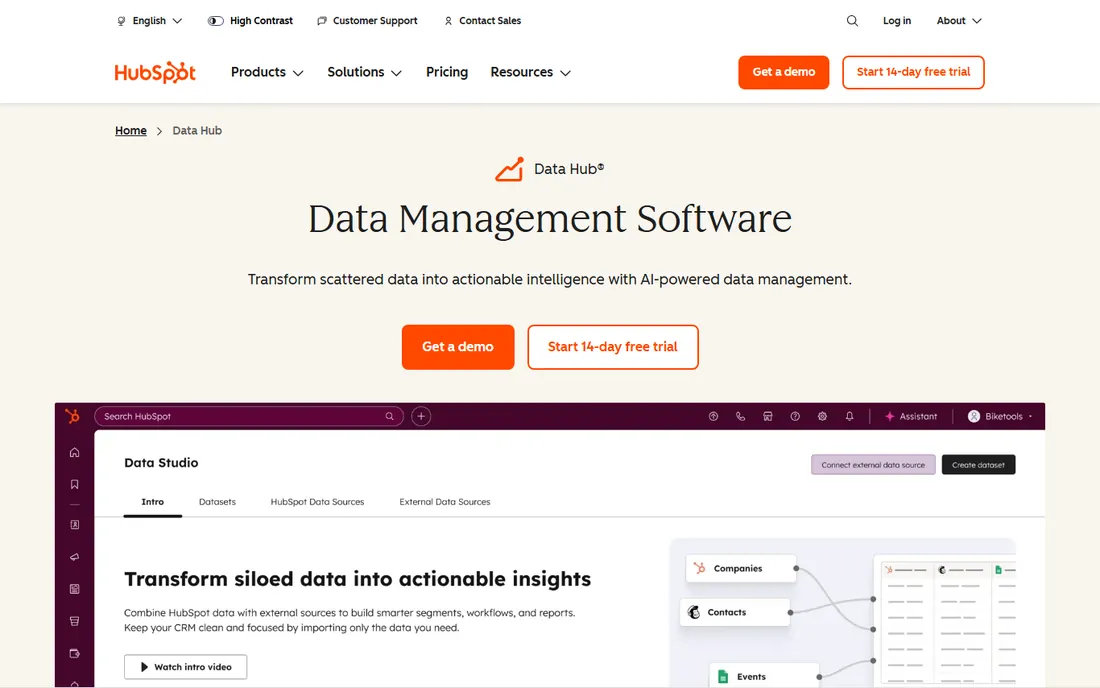
HubSpot renamed Operations Hub to Data Hub in 2026, which tells you where the product is going. It is the plumbing layer for companies that run on HubSpot: two-way sync with other apps, automatic formatting fixes, programmable automation, and a Data Studio for blending first and third-party data.
For a sales team already paying for HubSpot, the Starter tier is a cheap way to stop the manual spreadsheet cleanup between systems. The weakness is the cliff between Starter and Professional: at $800 a month, Professional targets companies with serious data operations, and credit consumption on syncs outside Data Studio adds a usage bill on top. If HubSpot is not your CRM, this is not your tool.
What we like- Two-way data sync across the tech stack
- Data quality automation built in
- Works natively with every HubSpot hub
Watch out for- Professional tier jumps to $800 per month
- Credits consumed on data sync outside Data Studio
- Only makes sense inside the HubSpot ecosystem
#4
Pipedrive
Best for: Sales teams that want CRM and automation in one purchase
Visit pipedrive.com
Starting price$14 per user per month (billed annually)
Free planFree trial (14 days)
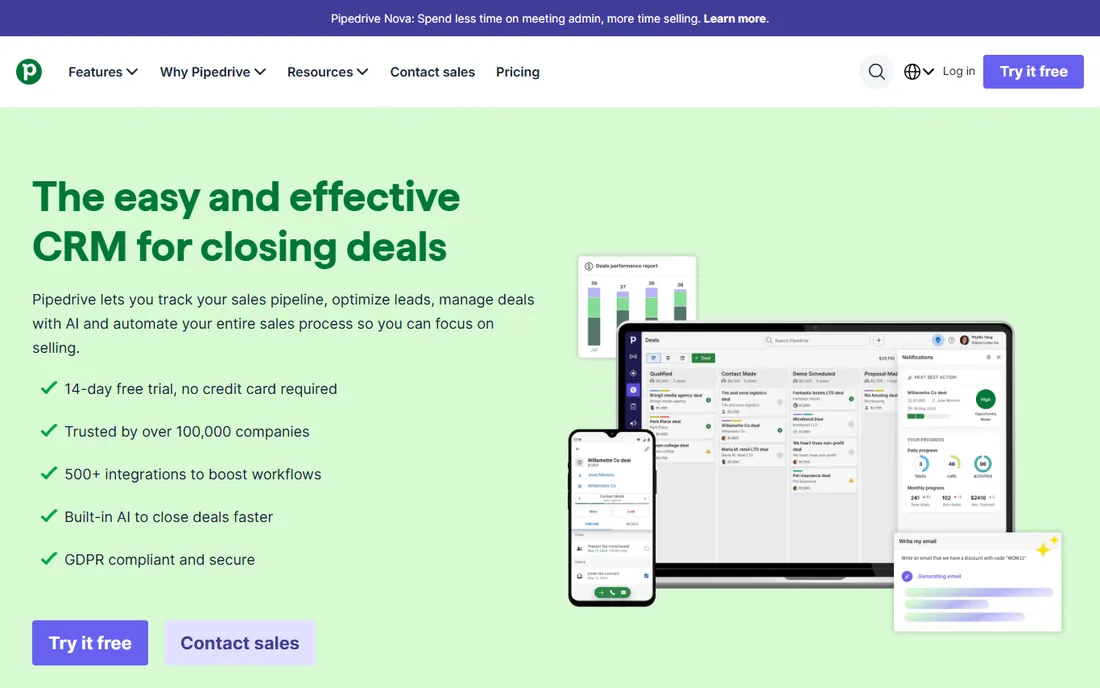
Most sales teams do not need another platform. They need their CRM to stop dropping follow-ups, and Pipedrive's automation builder handles that directly: deal-stage triggers, automatic task creation, email sequences, and lead assignment rules without a separate subscription. Setup takes days, not weeks, and the activity-based selling model keeps reps focused on the next action.
The pricing structure has a deliberate gap. The $14 Lite plan has no automations, no email sync, and no sequences, so the real starting price for automation is $39 per user per month on Growth. LeadBooster and Campaigns are extra. For a five-person team, Lite to Growth costs about $1,500 more a year, still cheaper than bolting Zapier onto a cheaper CRM once you count the second subscription.
What we like- Visual pipeline reps actually adopt
- Automation builder included from the Growth plan
- Fast setup with 500+ integrations
Watch out for- Automations, email sync, and sequences all require the $39 Growth plan
- Lead generation and campaign tools are paid add-ons
- No free plan
#5
Apollo.io
Best for: Teams that need prospecting data and outreach in one system
Visit apollo.io
Starting price$49 per user per month (billed annually)
Free planYes
Apollo earns its place because it fixes the step every sales workflow skips: finding the right people. Database, enrichment, sequences, and dialer live in one system, so a rep can build a list and start a sequence without exporting a CSV between three tools. The free plan is genuinely useful for evaluating it.
The pricing has two edges. Credits do not roll over, so a team that prospects in bursts pays for capacity it does not use every month. Independent tests put real-world accuracy below the marketing claims, so sample data quality in your own market before committing. For lean outbound teams, it remains the best value bundle in the category.
What we like- 240M+ contact database plus sequences and dialer in one login
- Generous free plan for testing
- Strong Chrome extension for LinkedIn prospecting
Watch out for- Credit rationing on paid plans with no rollover
- Contact accuracy is good but not perfect
- Per-seat pricing multiplies fast on bigger teams
#6
Clay
Best for: Outbound teams that live on enrichment and AI research
Visit clay.com
Starting price$167 per month (billed annually)
Free planYes (100 data credits per month)
Clay is where outbound teams go when list building becomes a full-time job. Instead of buying one data source and hoping it covers your market, Clay waterfalls across more than 150 providers: if the first source misses an email, it tries the next automatically. On top of that sits a table-based workflow builder with AI columns for research, qualification, and personalized message drafting.
Pricing splits into Data Credits and Actions, which is fairer than the old system but still hard to forecast. Enriching a few thousand contacts with phone numbers can burn through a month's credits quickly, and the free plan is a trial of the interface, not a production tool. Teams that run Clay well treat it as infrastructure with a real monthly budget, not a cheap add-on.
What we like- Waterfall enrichment across 150+ data providers
- AI agents for research and personalization
- Unlimited seats on every plan
Watch out for- Credit math is hard to predict before you run real volume
- The free tier excludes phone enrichment
- Total cost climbs fast with heavy use
#7
Outreach
Best for: Large sales orgs standardizing on engagement, coaching, and forecasting
Visit outreach.ai
Starting priceSee website
Free planNo
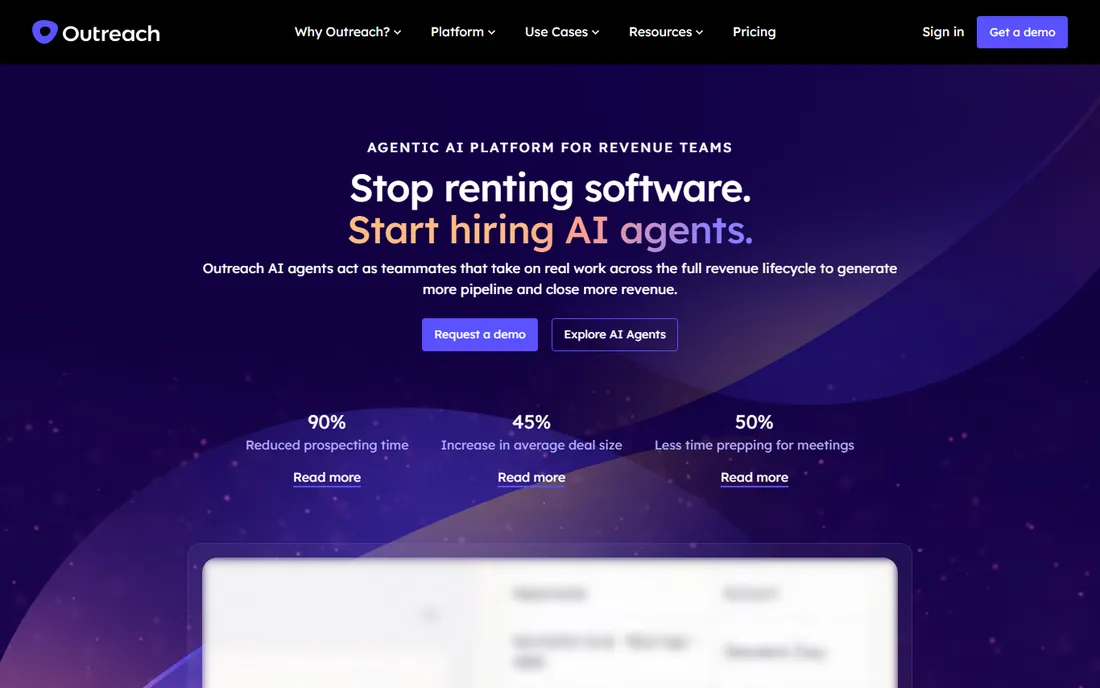
Outreach is the heavyweight. It started as a sales engagement platform and has grown into an agentic AI platform with meeting prep agents, conversation intelligence, deal management, and forecasting in one stack. Companies like Databricks and Siemens run their revenue process on it, and the Salesforce integration is the deepest in the category. Note that Outreach rebranded from outreach.io to outreach.ai in 2026.
There is no public pricing, reported contracts run roughly $100 to $160 per seat per month on annual terms, and implementation typically needs professional services. A two-rep startup should not be here. But for a 50-person org that needs governed playbooks, coaching workflows, and forecast discipline, Outreach is the standard everything else gets compared to.
What we like- Deepest sequencing and conversation intelligence in the category
- Deal management and forecasting in the same platform
- Strong Salesforce integration
Watch out for- Quote-only pricing with seat minimums
- Implementation is a real project with professional services costs
- Overkill for teams under 20 reps
#8
Bardeen
Best for: Reps who do repetitive work inside browser tabs
Visit bardeen.ai
Starting price$10 per month
Free planYes (100 credits per month)
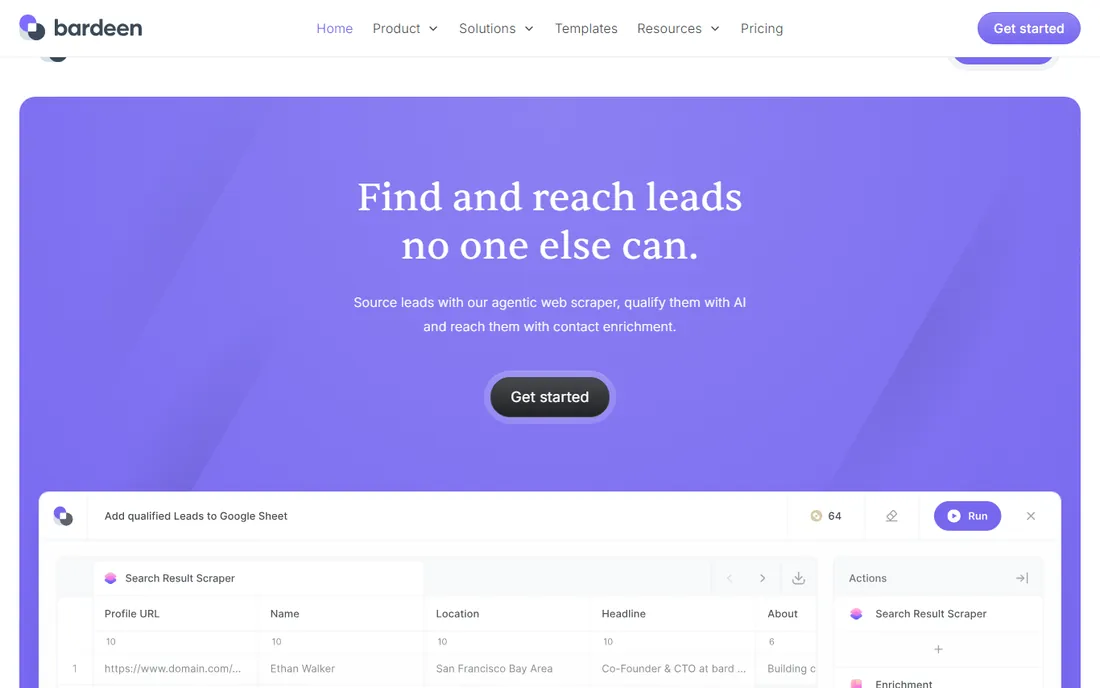
Bardeen lives in your browser, which sounds small until you realize how much sales work happens in tabs. Its playbooks scrape LinkedIn profiles, enrich contacts, qualify leads with AI, and push everything to a CRM or spreadsheet without API wrangling. The natural-language builder lets a rep describe the workflow in plain English and get a working starting point.
Scraping and web search cost one credit per row, enrichment costs three, and a workflow processing thousands of rows a month can exhaust the paid allowance fast. Browser automations are also inherently fragile: when a website changes its layout or adds bot protection, playbooks break. For scraping-heavy prospecting it is excellent; for backend system-to-system sync, pick Make or Zapier instead.
What we like- Runs inside the browser where sales work actually happens
- Strong scraping and enrichment playbooks
- Natural-language playbook builder
Watch out for- Credit costs multiply on multi-step row-based workflows
- Site layout changes can break automations
- Heavily optimized for GTM use cases
Starting price$19 per month (1,000 contacts)
Free planFree trial (14 days)
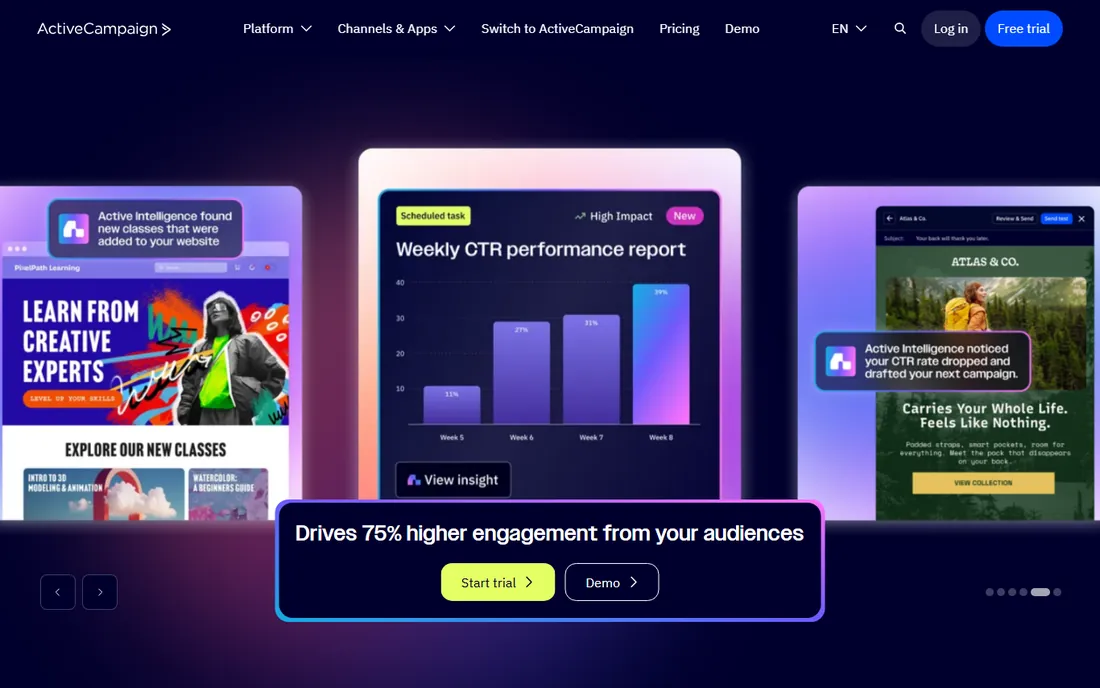
ActiveCampaign is the bridge between marketing automation and a working sales pipeline. The automation builder offers 950+ prebuilt recipes, conditional branching, predictive sending, and lead scoring that routes hot prospects to reps automatically. The built-in CRM means a small team can run campaigns and work deals without a second subscription.
Pricing scales by contact count: the $19 Starter plan for 1,000 contacts becomes $189 at 10,000, and since late 2025 new accounts pay for all contacts including unsubscribed ones. The Pipelines and Sales Engagement CRM add-ons cost extra on top. For teams under 5,000 contacts it is strong value; past that, compare carefully against a dedicated CRM plus a cheaper email tool.
What we like- 950+ automation recipes and a genuinely powerful visual builder
- Built-in CRM with deal pipelines
- Predictive sending and lead scoring
Watch out for- Contact-based pricing climbs steeply with list size
- The enhanced CRM pipeline features are paid add-ons
- No permanent free plan
#10
Salesloft
Best for: Enterprise teams choosing between the two big engagement platforms
Visit salesloft.com
Starting priceSee website
Free planNo
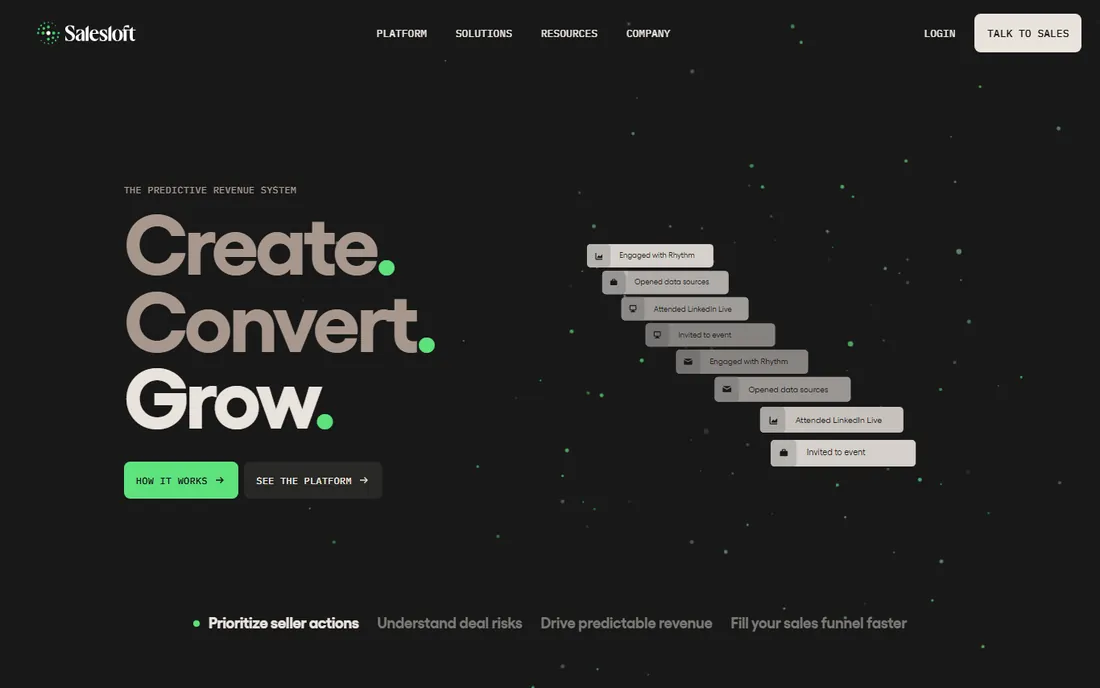
Salesloft is Outreach's mirror image, and choosing between them usually comes down to which vendor your security and procurement teams prefer rather than a dramatic feature gap. Cadences, conversation intelligence, deal management, and forecasting are all here, wrapped in a 2026 positioning as a revenue orchestration platform with agentic AI. Customers include Adobe, 3M, IBM, and Zoom.
Like Outreach, it is quote-only with reported contracts in the $125 to $200 per seat per month range, minimum seat counts, and an onboarding process rather than a signup form. One thing to watch is the merger with Clari announced in August 2025, which could reshape the product and packaging over time. If you are evaluating both, run the same pilot workflow in each and negotiate hard; neither vendor's list price is the final price.
What we like- Mature cadence management with strong conversation intelligence
- Revenue orchestration positioning with forecasting
- Trusted by 4,000+ organizations
Watch out for- No public pricing and no free trial
- List prices are high with minimum seat counts
- Future roadmap affected by the Clari merger
How we chose
We compared them the way a buyer should: current pricing pages on each vendor's site, product documentation, feature lists, integration counts, and public reviews on G2, Capterra, and Reddit. We favored tools with transparent pricing, a usable free or trial tier, and setup measured in days rather than quarters. Enterprise platforms made the list where they define the category.
What to check before you sign
A demo never shows you the invoice. Four things decide the real cost.
The billing unit
Every tool here meters something different: tasks, operations, credits, seats, or contacts. Map one real workflow end to end and count the units before comparing headline prices. A five-step workflow running a thousand times a month is 5,000 Zapier tasks but a fraction of that in Make operations.
Data quality is the real bottleneck
Automation multiplies whatever you feed it. If your contact data is stale, sequences just send bad emails faster. Before buying, sample data accuracy in your market and budget for enrichment as a separate line item instead of discovering it after signing.
Seat minimums and contract terms
Enterprise tools commonly require 3 to 25 seats on annual contracts with no mid-term reductions. Count only the people who will log in weekly, and get the seat floor and the credit allotment in writing before you sign.
Deliverability and compliance
Cold outreach lives or dies on deliverability. Ask how each platform handles domain warming, inbox rotation, and bounce handling, and confirm the compliance tooling matches where you sell. Apollo and Outreach both publish compliance features; with smaller tools, verify rather than assume.
The overlap trap: where sales teams double-pay
The most common waste is two tools doing the same job: a team buys Zapier for lead routing while paying for Pipedrive Growth, which already includes automation, or pays for both Clay and Apollo data and uses only one. Before adding a tool, list the workflows each subscription already covers and retire the overlap. One platform doing three jobs adequately usually beats three specialized ones, because every extra subscription adds admin overhead and another renewal to negotiate.
Frequently asked questions
What is the cheapest way to automate sales workflows?
Start with what you already pay for. Pipedrive's Growth plan ($39 per user per month) and HubSpot's free CRM tools cover follow-up automation for many small teams. For a standalone platform, Make's $9 Core plan delivers far more automation per dollar than Zapier, and Bardeen's free tier handles light browser scraping at no cost.
Do I need a separate automation tool if my CRM already has automations?
Not at first. CRM-native automation handles the core sales motions: follow-up tasks, deal-stage triggers, lead assignment, and basic sequences. A separate platform earns its place for cross-system workflows, complex branching, or data transformation the CRM builder cannot express.
What is the difference between Zapier and Make for sales teams?
Zapier is easier to learn and connects to more apps, which suits non-technical teams with simple workflows. Make handles complex branching better and charges per operation instead of per task, making it much cheaper at volume. Technical sales ops teams usually prefer Make; everyone else starts with Zapier.
Are AI SDR tools replacing email sequences?
Not yet. AI agents from Apollo, Outreach, and Clay now research accounts, draft personalization, and even book meetings, but human review still sits in the middle of most working setups. Treat AI as a way to make each rep more productive, not as a replacement for sequence infrastructure.
How many automation tools does a 5-person sales team actually need?
Two for most: a CRM with built-in automation (Pipedrive, HubSpot, or ActiveCampaign) plus one data source (Apollo or Clay). Add Make only for cross-system workflows the CRM cannot handle. Every tool beyond that should justify its subscription each renewal.
When does Outreach or Salesloft make sense over Apollo?
When the constraint is governance rather than speed. With 20 or more reps, dedicated RevOps, and a need for approved playbooks and forecast discipline, the enterprise platforms pay off. If the constraint is finding prospects and moving fast, Apollo delivers more per dollar.
Sources we checked (12)
- https://zapier.com/pricing
- https://www.make.com/en/pricing
- https://www.hubspot.com/products/data
- https://www.pipedrive.com/en-gb/pricing
- https://fullenrich.com/content/apollo-pricing
- https://salesmotion.io/blog/clay-pricing
- https://www.outreach.ai
- https://www.bardeen.ai
- https://www.activecampaign.com/pricing/
- https://www.salesloft.com
- https://prospeo.io/s/outreach-vs-salesloft
- https://www.g2.com/products/bardeen/pricing
Is your product missing or out of date?
We review this list regularly. Vendors can request a listing, send updated pricing or ask about featured placement.

Shihab Mia · Founder, Rankite
Shihab has spent more than a decade helping SaaS and e-commerce brands grow through search. He writes Rankite's software buying guides from pricing pages, documentation and public user reviews. More about Shihab.