How we make this list: we compare pricing pages, product documentation and public user reviews. Rankite is independent; if a vendor ever pays for a featured spot, that listing is clearly labeled Partner.
Key takeaways
- Google Analytics 4 remains the default: free, used by 47.2% of all websites, and the baseline every other tool is compared against.
- Plausible at $9 a month and Fathom at $15 a month are the privacy-first picks that skip cookies and consent banners.
- Microsoft Clarity is free with no traffic limits and adds heatmaps plus session recordings that GA4 does not have.
- PostHog, Mixpanel, and Amplitude all offer generous free event tiers, which makes them the best web analytics tool choice for product-led teams.
- Matomo is the only full GA replacement you can self-host, which matters for organizations with strict data residency rules.
Quick comparison
| Tool | Best for | Starting price | Free plan |
|---|
 Google Analytics 4 Google Analytics 4 | the free default for traffic analysis | Free | Yes |
 Plausible Plausible | privacy-first lightweight analytics | $9/month (billed annually) | Free trial |
 Fathom Fathom | simple privacy analytics for agencies | $15/month (billed annually) | Free trial |
 Matomo Matomo | self-hosted full GA replacement | Free self-hosted; Cloud from €23/month | Yes |
 PostHog PostHog | web plus product analytics in one | Free 1M events/month; usage-based after | Yes |
 Mixpanel Mixpanel | product funnels and retention analysis | Free 1M events/month; usage-based after | Yes |
 Amplitude Amplitude | enterprise-grade behavioral analytics | Free 2M events/month; usage-based after | Yes |
 Hotjar Hotjar | heatmaps, replays, and on-site surveys | Free plan; paid from $32/month | Yes |
 Microsoft Clarity Microsoft Clarity | free behavior analytics with no limits | Free | Yes |
 Heap Heap | autocapture analytics with minimal setup | Free 10K sessions/month; Growth from $3,600/year | Yes |
Is your product missing or out of date?
We review this list regularly. Vendors can request a listing, send updated pricing or ask about featured placement.
The best website analytics software
Google Analytics is used by 47.2% of all websites, which gives it a traffic analysis tool market share of 82.8% (W3Techs, September 2026). No other category in software is this dominated by one free product. That dominance shapes every buying decision here: the question is rarely whether to use GA4, but what to pair with it or replace it with, and why.
The best analytics tools for website owners in 2026 split into three jobs. Traffic analytics tools like GA4, Plausible, and Fathom answer "how many people came and what did they do." Product analytics tools like Mixpanel, Amplitude, and PostHog answer "how do users move through our funnels and where do they drop off." Behavior tools like Hotjar and Clarity answer "why," with recordings and heatmaps that show the struggle numbers alone cannot explain.
Privacy is the thread running through all three. Cookie banners, GDPR enforcement, and browser tracking restrictions have pushed a whole generation of tools toward cookieless measurement. The ten below cover every combination of those jobs.
Starting priceFree
Free planYes
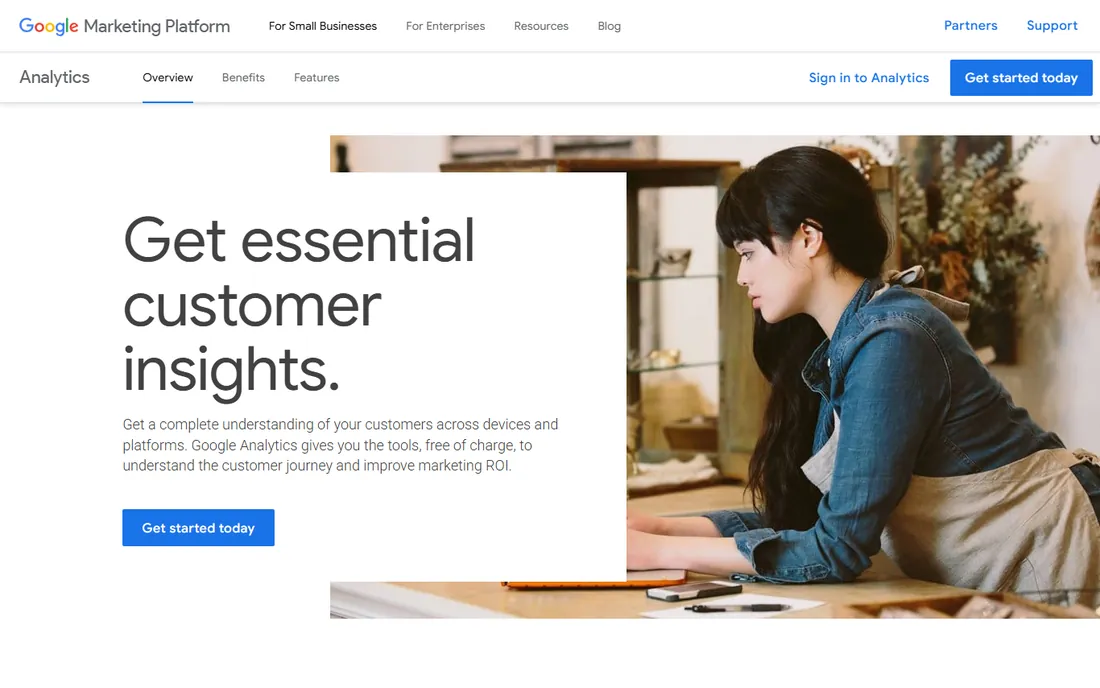
GA4 is the starting point for nearly every website analytics conversation, and for most small businesses it is also the ending point. It is free up to 10 million events a month, integrates natively with Google Ads and Search Console, and produces the acquisition, engagement, and conversion reports that agencies and stakeholders expect. Everyone you hire will already know it.
The honest complaints are well documented. The interface confuses teams migrating from Universal Analytics, exploration reports have a learning curve, and the free tier applies data thresholds that frustrate analysts. EU privacy regulators have challenged GA's data transfers to the US, which pushes some European companies toward Matomo or Plausible. None of that dethrones it. If you run one analytics tool and want the standard answer, this is it.
What we like- Free with enormous scale
- Deepest integration with Google Ads and Search Console
- Industry-standard reports
Watch out for- Complex interface many teams never master
- Sampling and data thresholds on free tier
- Privacy scrutiny in the EU
Starting price$9/month (billed annually)
Free planFree trial
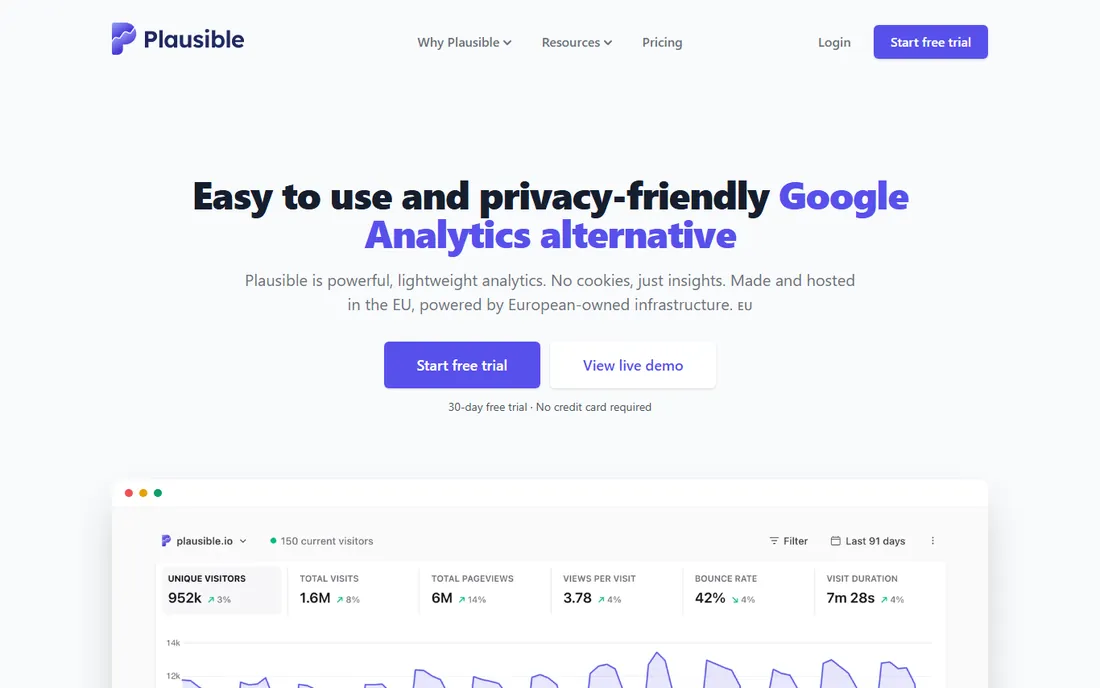
Plausible is the anti-GA4: a single dashboard with the numbers that matter, no cookies, no personal data collection, and a script so small it barely registers on page speed. EU-based and GDPR compliant by design, it lets many sites drop the consent banner entirely, which is a conversion improvement in itself.
Cloud pricing starts at $9 a month for 10,000 monthly pageviews and scales with traffic. Note the tier detail: funnels, user journeys, ecommerce revenue attribution, and the stats API live on the $19 Business plan, not the $9 entry tier. Plausible is open source and self-hostable for teams that want it free. It fits site owners who want clean traffic stats without surveillance machinery or complexity.
What we like- No cookies and no consent banner needed
- Under 1KB script keeps sites fast
- All features on every plan
Watch out for- No heatmaps or session recordings
- Advanced features like funnels need the $19 Business tier
Starting price$15/month (billed annually)
Free planFree trial
Fathom competes directly with Plausible on the privacy-first pitch and wins on price at scale. The $15-a-month plan covers up to 100,000 monthly pageviews with every feature included, and a site at a million pageviews pays around $60 a month, undercutting Plausible's equivalent tier. All data processing runs on Fathom's infrastructure with an EU data center option.
The product is deliberately minimal: pageviews, sources, devices, and goals in a clean dashboard. Agencies like managing many client sites under one account without per-site complexity. The 7-day trial is short for a real evaluation, and the integration ecosystem is thinner than Plausible's. For high-traffic sites that want simple private analytics, Fathom is the value leader.
What we like- Cheapest at high traffic volumes
- All features on every plan
- EU data center option
Watch out for- 7-day trial is short
- Fewer integrations than Plausible
Starting priceFree self-hosted; Cloud from €23/month
Free planYes

Matomo is the serious alternative for organizations that will not send visitor data to third parties. The On-Premise edition is open source and free with unlimited hits and users: you host it, you own the data, and France's data authority CNIL lists it among tools configurable to run without a consent banner. No other full analytics suite offers that combination.
Matomo Cloud starts around €23 a month for 50,000 hits with hosting in Frankfurt and premium features included. On self-hosted plans, heatmaps, session recordings, funnels, and A/B testing are paid plugins. The tradeoff is operational: upgrades, database growth, and backups are your responsibility. Regulated industries, governments, and privacy-conscious enterprises accept that burden for data sovereignty.
What we like- Only full-featured tool you can self-host
- CNIL-approved cookieless configuration
- No data sampling
Watch out for- Self-hosting needs technical maintenance
- Premium plugins cost extra on-premise
Starting priceFree 1M events/month; usage-based after
Free planYes
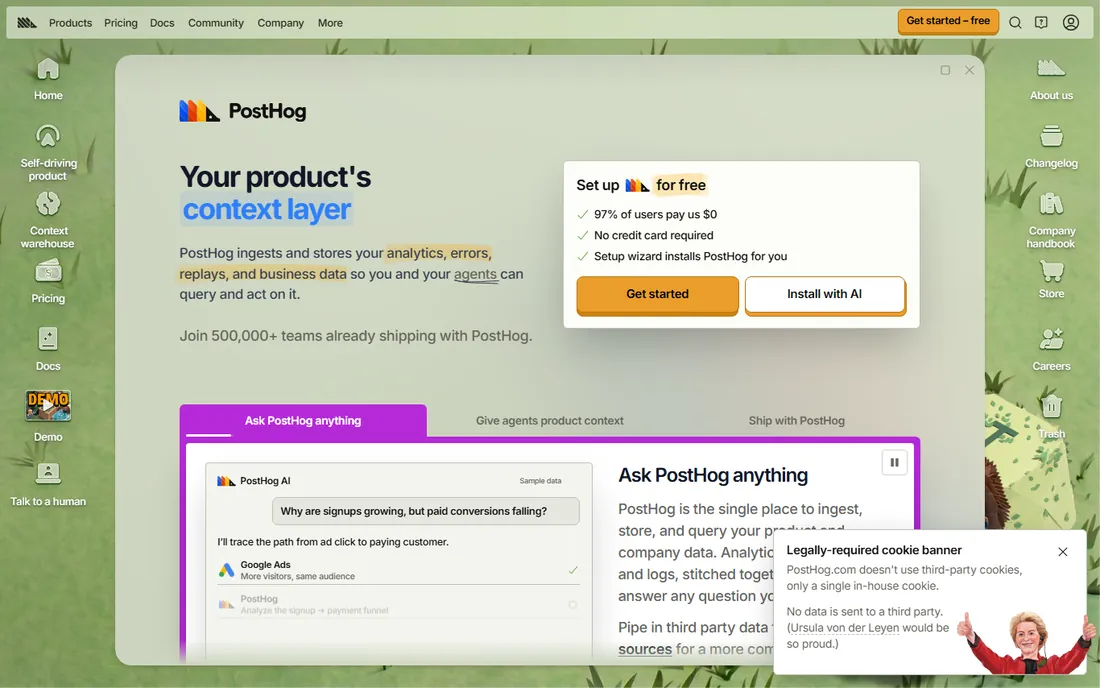
PostHog is the developer darling of product analytics: one platform covering product analytics, session replay, feature flags, A/B experiments, and surveys, with an open-source core you can self-host. The free tier covers 1 million events a month plus session recordings, which carries early-stage products a long way at zero cost.
Paid pricing is usage-based per product, with steep volume discounts at scale. That makes PostHog among the cheapest options at high volume but harder to forecast than Mixpanel's published rates. Autocapture records everything by default, which is convenient and inflates event counts, so teams need naming discipline. Product-led startups that want one suite instead of five tools should start here.
What we like- Analytics, replay, feature flags, and surveys in one platform
- Open-source core
- Generous free tier
Watch out for- Usage-based billing gets complex across products
- Event volume discipline required
Starting priceFree 1M events/month; usage-based after
Free planYes
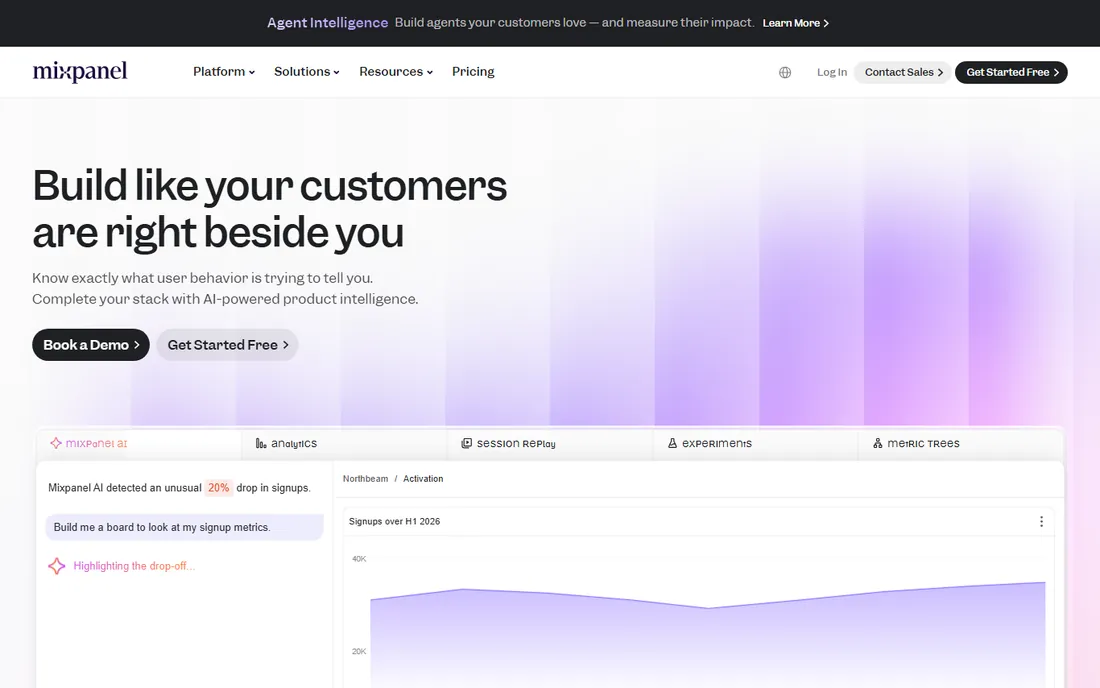
Mixpanel is the analyst's product analytics tool: deep funnel analysis, retention curves, and cohort reports with a polished interface. The free tier covers 1 million events a month, and the Growth plan's published rate of $0.28 per thousand events after that makes it the easiest product analytics bill to model in a spreadsheet.
That transparency cuts both ways: the per-event price is higher than PostHog's at volume, so high-traffic products pay more for the forecasting convenience. Mixpanel was acquired by ServiceNow in late 2024, which adds enterprise stability questions some buyers ask about. For B2B SaaS teams that live in funnel reports, Mixpanel remains the most mature option.
What we like- Most transparent pricing in product analytics
- Excellent funnel and cohort reports
- Strong B2B account analytics
Watch out for- Paid costs scale steeply with events
- Session replay allowance smaller than Amplitude's free tier
Starting priceFree 2M events/month; usage-based after
Free planYes
Amplitude's free tier is the most generous here: 2 million events a month forever, plus 10,000 session replays. The Plus plan is self-serve and usage-based, while Growth and Enterprise are quote-based. Behavioral cohorts, predictive analytics, and a customer data platform layer make it the choice for data teams at scale-ups and enterprises.
The depth is real and so is the learning curve. Teams without an analyst often use a fraction of the capability. Pricing beyond Plus cannot be modeled without a sales conversation, which frustrates procurement. Amplitude fits companies with dedicated data people who will exploit the behavioral graph. Smaller teams get further faster with PostHog or Mixpanel.
What we like- Most generous free tier at 2M events
- Deepest behavioral cohorts and predictions
- AI agents on all plans
Watch out for- Pricing past Plus is a sales conversation
- Learning curve for teams without analysts
Starting priceFree plan; paid from $32/month
Free planYes
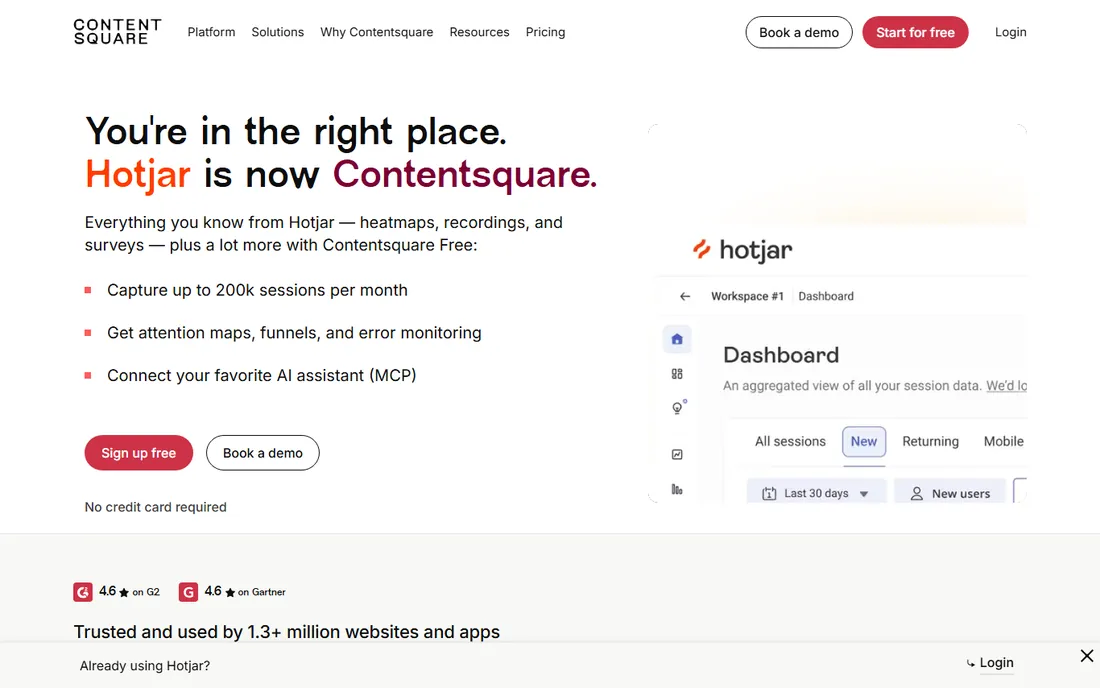
Hotjar answers the "why" behind analytics numbers. Heatmaps show where visitors click and scroll, session recordings reveal the rage-clicks and dead-ends, and on-site surveys capture feedback at the moment of experience. Setup is a single script, and marketers use it without engineering help.
The free plan covers basic usage, with paid plans from $32 a month raising session caps and adding features. Hotjar is now part of Contentsquare, and packaging continues to evolve toward the enterprise experience analytics suite. It pairs with GA4 or Plausible rather than replacing them: traffic tools count the visitors, Hotjar shows what they struggled with.
What we like- Heatmaps plus recordings plus surveys in one
- Easy setup non-technical teams manage
- Frustration signals
Watch out for- Session caps on lower tiers
- Now part of Contentsquare with evolving packaging
Starting priceFree
Free planYes
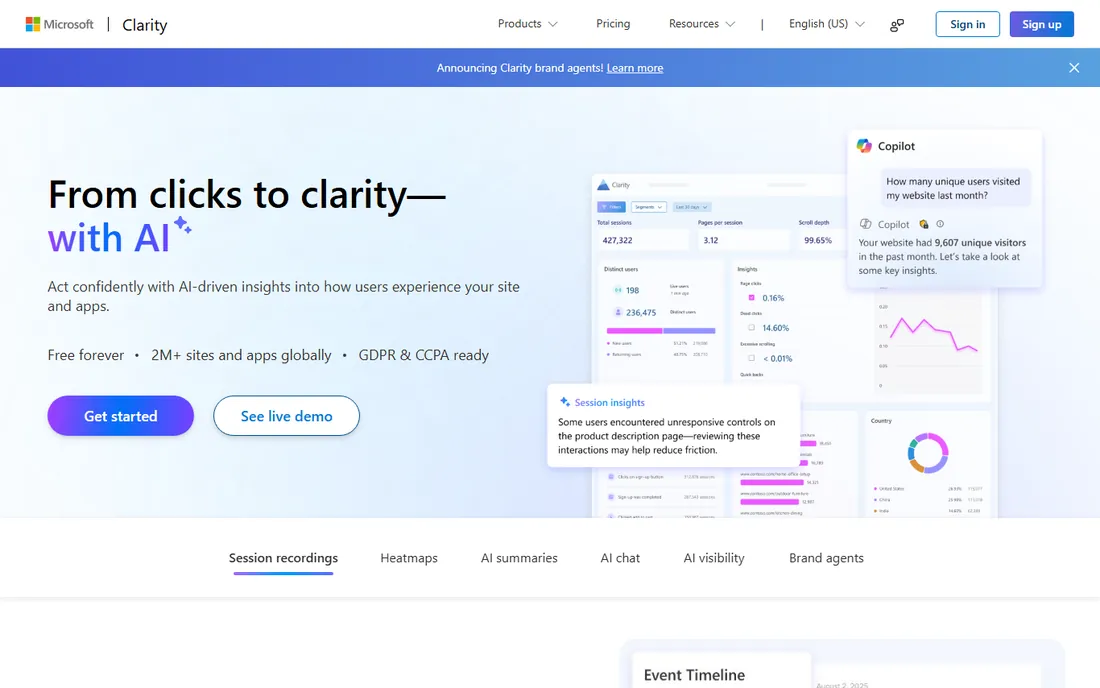
Clarity is the best free deal in analytics: unlimited heatmaps and session recordings at zero cost with no traffic limits. Microsoft funds it as an ecosystem play, and the product is surprisingly capable for the price. Dead clicks, rage clicks, and scroll depth come standard.
It does not replace traffic analytics or product analytics. There are no deep funnels, no custom event taxonomy like Mixpanel, and the data lives on Microsoft infrastructure, which matters to the strictly privacy-conscious. But as a behavior layer on top of GA4 or Plausible, Clarity costs nothing and regularly surfaces UX problems that numbers alone would never reveal. Every site should run it.
What we like- Completely free with no traffic caps
- Heatmaps and session recordings included
- Simple setup
Watch out for- No conversion funnels depth of paid tools
- Data lives in Microsoft's cloud
#10
Heap
Best for: autocapture analytics with minimal setup
Visit heap.io
Starting priceFree 10K sessions/month; Growth from $3,600/year
Free planYes
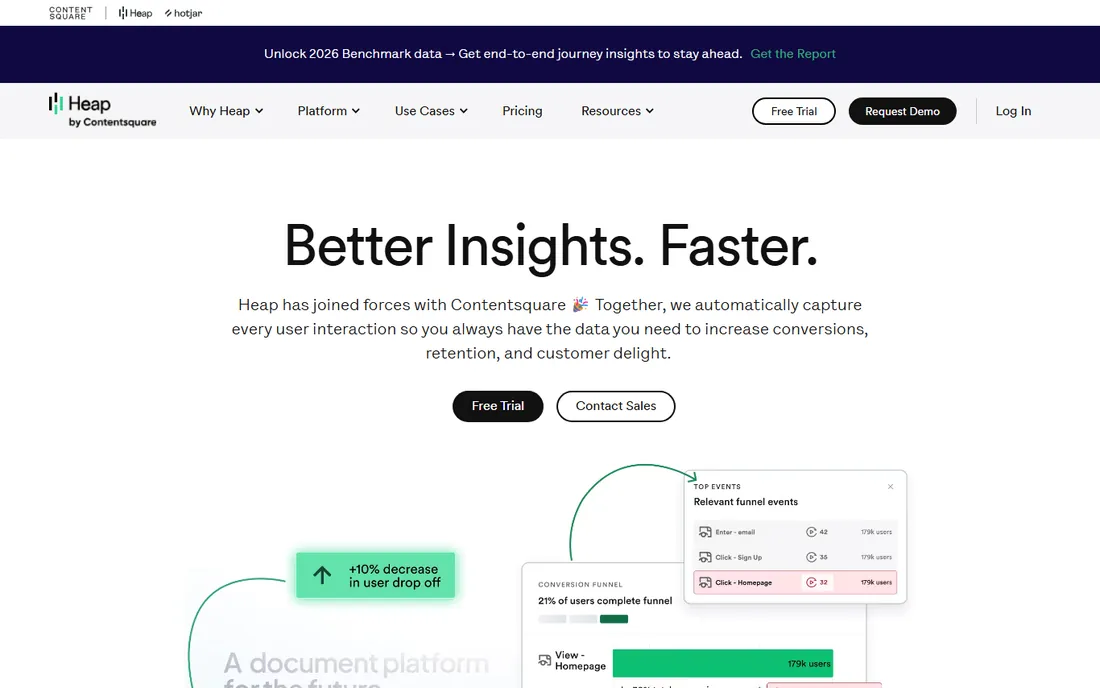
Heap's signature is autocapture: it records every click, tap, and form interaction automatically, so analysts can define events retroactively instead of waiting for engineering to instrument them. That removes the biggest bottleneck in product analytics adoption. Journey analysis and session replay round out the picture.
The free tier covers 10,000 sessions a month, but paid Growth plans start around $3,600 a year, which prices out small teams. Autocapture's convenience has a cost in data hygiene: without governance, the event stream gets noisy. Heap fits mid-market product teams that want analyst self-sufficiency without an instrumentation project.
What we like- Autocapture means no manual event tagging
- Retroactive analysis of past behavior
- Journey analysis
Watch out for- Paid plans start high for small teams
- Data can get noisy without governance
How we built this shortlist
We compared website analytics tools using vendor pricing pages, feature documentation, and review data from G2, Capterra, and analytics publications. We weighted measurement accuracy, privacy compliance posture, free tier generosity, pricing transparency, and fit for use case, from simple blogs to product-led SaaS. We did not run hands-on trials, so workflow details come from documentation and verified user reviews rather than our own use.
What to check before you install
Decide which of the three jobs you are hiring for. Traffic analytics, product analytics, and behavior analytics answer different questions, and most websites need at least two of them. A blog needs traffic stats plus Clarity. A SaaS product needs product analytics plus replays. Buying one tool to do all three usually means it does one well and two poorly.
Check the privacy configuration against your actual obligations. If you serve EU visitors, confirm whether the tool needs a consent banner in your setup and where data is stored. Plausible, Fathom, and a properly configured Matomo can run banner-free. GA4 cannot. Your legal exposure, not the marketing page, decides this.
Model the metering unit against your real traffic. Pageview-based tools like Plausible charge more as you grow. Event-based tools like Mixpanel punish chatty instrumentation. Session-based tools like Heap punish high-engagement products. Pull your last three months of traffic and event volume, then price each candidate at 2x growth. The cheapest tool today is not always the cheapest at scale.
Test page speed impact before committing. Analytics scripts affect Core Web Vitals, and slow scripts cost search rankings. Plausible's sub-1KB script is the benchmark. Heavier suites with tag managers deserve a before-and-after speed test on your actual pages, not the vendor's demo site.
Confirm data ownership and export terms. Analytics history is a business asset: year-over-year comparisons, funnel baselines, and attribution models all depend on it. Check retention limits on each tier, whether raw data exports are available, and what happens to historical data if you downgrade. Free tiers with short retention quietly delete the history you will want next year.
Privacy laws changed the game: cookies, consent, and GDPR
The analytics market of 2026 looks nothing like 2020 because the legal ground moved. GDPR enforcement, EU court rulings on US data transfers, and browser restrictions on third-party cookies dismantled the old model of tracking everyone by default. Consent banners became mandatory for tools like GA4 in Europe, and every banner costs a share of measured traffic plus user trust.
That shift created the privacy-first category. Plausible, Fathom, and Matomo collect no personal data and set no cookies, which removes the banner requirement in most configurations. For content sites and small businesses, dropping the banner while keeping clean stats is a genuine conversion win.
The practical advice is to match the tool to your risk profile. EU-facing businesses should default to cookieless tools or self-hosted Matomo. US-only small businesses can run GA4 without much worry. Enterprises need documented data processing agreements, EU data residency options, and retention policies regardless of vendor. Privacy is no longer a feature checkbox; it is the first filter in the buying process.
Frequently asked questions
What is the best web analytics tool for a small business?
Google Analytics 4 is free and the industry standard, so start there. If you want simpler reports without cookies or consent banners, Plausible at $9 a month is the popular upgrade. Add Microsoft Clarity, free, for heatmaps and recordings.
Is Google Analytics still the best website analysis tool?
For traffic analysis at zero cost, yes, and its 82.8% market share means every agency and hire already knows it. For privacy compliance, product funnels, or behavior analysis, specialized tools beat it. Most serious setups pair GA4 with one or two of the others.
Do I need a consent banner with these tools?
With GA4, Mixpanel, Amplitude, and similar cookie-based tools serving EU visitors, generally yes. Plausible, Fathom, and a properly configured Matomo can run without one. Confirm your specific setup with legal counsel rather than relying on vendor claims alone.
What is the difference between Plausible and Fathom?
Both are privacy-first, cookieless analytics with simple dashboards. Fathom is cheaper at high traffic volumes and includes all features on every plan. Plausible has a larger integration ecosystem and is open source. Either is a fine GA4 alternative for traffic stats.
How much does website analytics software cost?
Many of the best options are free: GA4, Clarity, and generous free tiers from PostHog, Mixpanel, and Amplitude. Paid privacy tools run $9 to $15 a month. Matomo Cloud starts around €23 a month. Product analytics bills scale with events and can reach hundreds monthly at high volume.
Can I use multiple analytics tools together?
Yes, and most serious sites do. A common stack is GA4 or Plausible for traffic, Clarity for behavior, and PostHog or Mixpanel for product funnels. Just watch total script weight on page speed and keep each tool's job distinct to avoid paying twice for the same data.
Sources we checked (6)
- https://w3techs.com/technologies/comparison/ta-ahrefs%2Cta-googleanalytics
- https://kukie.io/blog/plausible-vs-fathom-vs-matomo
- https://www.plerdy.com/blog/google-analytics-alternatives/
- https://brainforge.ai/resources/amplitude-vs-mixpanel-vs-posthog/
- https://appstackbuilder.com/blog/posthog-vs-mixpanel-vs-posthog-2026
- https://www.analyticsinsight.net/technology/9-best-privacy-first-analytics-platforms-2026
Is your product missing or out of date?
We review this list regularly. Vendors can request a listing, send updated pricing or ask about featured placement.

Shihab Mia · Founder, Rankite
Shihab has spent more than a decade helping SaaS and e-commerce brands grow through search. He writes Rankite's software buying guides from pricing pages, documentation and public user reviews. More about Shihab.