How we make this list: we compare pricing pages, product documentation and public user reviews. Ratings come from G2, Capterra or Trustpilot, with the date we checked them.
Key takeaways
- Pacer is the best phone-only step counter with community challenges.
- MapMyWalk suits outdoor routes with live location sharing on MVP.
- AllTrails is the best app for discovering trails with offline maps.
- Strava adds social competition for walkers who train seriously.
- Charity Miles turns walks into donations at no cost to the walker.
Quick comparison
| Tool | Best for | Starting price | Free plan |
|---|
 Pacer | Phone-only step counting | Free; Premium from $9.99 per month | Yes |
 MapMyWalk | Outdoor routes | Free; MVP from $5.99 per month | Yes |
 AllTrails | Trail discovery | Free; Plus from $35.99 per year | Yes |
 Strava | Social training | Free; Premium from $11.99 per month | Yes |
 Fitbit | Wearable step tracking | Free; Premium from $9.99 per month | Yes |
 StepsApp | Clean pedometer design | Free; Pro from $19.99 per year | Yes |
 Charity Miles | Walking for charity | Free | Yes |
 Walkmeter | Detailed walk metrics | Free | Yes |
Is your product missing or out of date?
We review this list regularly. Vendors can request a listing, send updated pricing or ask about featured placement.
The best walking apps
Starting priceFree; Premium from $9.99 per month
Free planYes

Pacer is the best phone-only step counter. It counts steps using only your phone, syncs with Apple Health, Fitbit, and Garmin, and runs community step challenges that keep motivation up. Premium costs $9.99 a month or $49.99 a year, but the free tier covers core step counting and challenges.
The free tier shows ads, and changing a custom step goal requires Premium. For a walker who wants step counting without buying a wearable, Pacer is the most popular and complete phone pedometer.
What we like- Counts steps using only your phone, no wearable required
- Syncs Apple Health, Fitbit, and Garmin
- Community step challenges
Watch out for- Free tier shows ads
- Changing a custom step goal requires Premium
- Background step counting drains battery more than a wearable
Starting priceFree; MVP from $5.99 per month
Free planYes
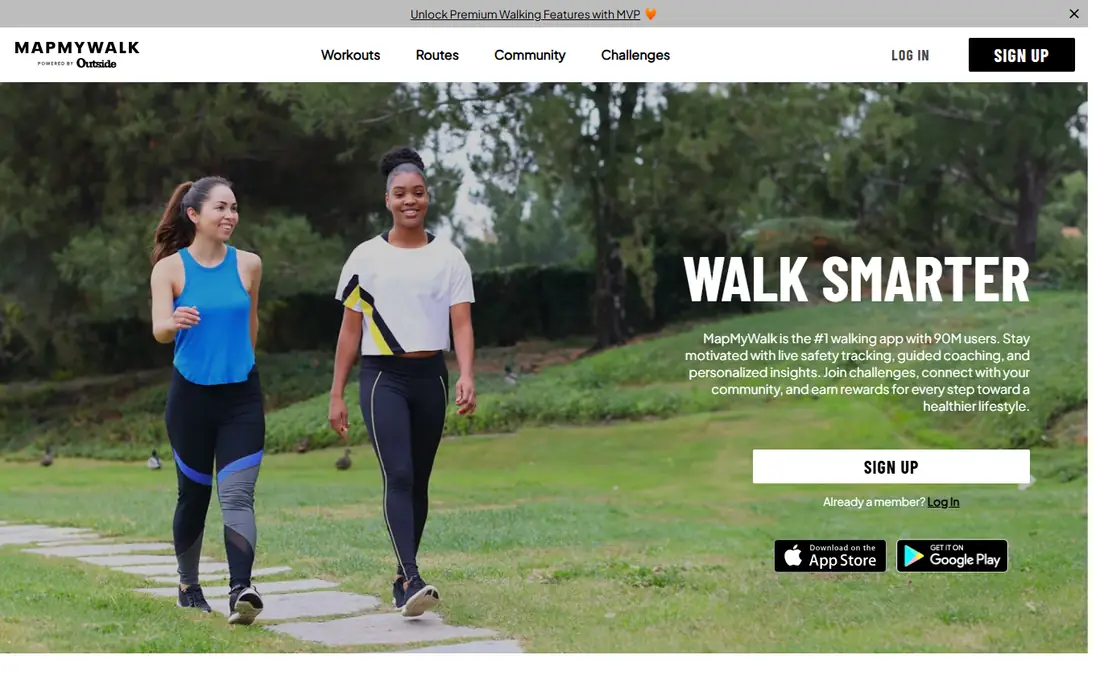
MapMyWalk is a community-based walking and fitness app that records activity, logs food intake, and connects walkers with friends. Outdoor routes with maps suit city walks and park loops, and live location sharing on MVP lets family follow a walk for safety. MVP costs $5.99 a month or $29.99 a year.
Live tracking sits behind the paid tier, and the app suits urban walks better than backcountry hiking. For a walker who wants routes, friends, and food logging in one app, MapMyWalk is the most social walking tracker.
What we like- Outdoor route tracking with maps
- Live location sharing on MVP
- Community of walkers
- Food and calorie logging
Watch out for- Live tracking sits behind the paid tier
- MVP prices rose for new subscribers
- Best for urban walks rather than backcountry
Starting priceFree; Plus from $35.99 per year
Free planYes
AllTrails is the best app for discovering trails. A massive database of over 400,000 trails with user reviews, photos, and difficulty scores helps walkers pick the right trip, and real user reports on trail status warn about closures and conditions. Plus at $35.99 a year adds offline maps, wrong-turn alerts, and live progress tracking.
Advanced features sit behind Plus, and trail data varies by region. For a walker moving from neighborhood loops to trails and hikes, AllTrails is the essential discovery app.
What we like- Massive database of over 400,000 trails
- User reviews, photos, and difficulty scores
- Offline maps on Plus
- Wrong-turn alerts
Watch out for- Advanced features locked behind Plus
- Limited customization for technical users
- Trail data varies by region
Starting priceFree; Premium from $11.99 per month
Free planYes
Strava suits walkers who train seriously and like competition. Segments turn local routes into leaderboards, clubs organize challenges, and friends give kudos on completed walks. Route planning on Premium helps walkers design new loops, and the app works with Garmin, Apple Watch, Fitbit, and most wearables.
Premium costs $11.99 a month or $79.99 a year, and continuous GPS drains battery faster than a pedometer. For a walker motivated by friends and segments, Strava turns daily walks into a social sport.
What we like- Best social layer for endurance activity
- Segments and leaderboards
- Route planning on Premium
- Works with most wearables
Watch out for- Premium at $11.99 a month or $79.99 a year
- GPS tracking drains battery
- Public heatmaps raise privacy questions
Starting priceFree; Premium from $9.99 per month
Free planYes
Fitbit tracks steps automatically around the clock from a wearable, which beats phone counting for accuracy and battery life. The free dashboard covers steps, sleep, and heart rate, while Premium at $9.99 a month or $79.99 a year adds guided programs and deeper insights. Community challenges add motivation.
Phone-only tracking is less accurate than wearable tracking, and the experience is best with Fitbit or Pixel Watch hardware. For a walker who wears a tracker daily, Fitbit is the most automatic step solution.
What we like- Steps tracked automatically 24/7 from a wearable
- Broad free health dashboard including sleep and heart rate
- Community challenges
Watch out for- Best with Fitbit or Pixel Watch hardware
- Phone-only tracking is less accurate
- Premium at $9.99 a month
Starting priceFree; Pro from $19.99 per year
Free planYes
StepsApp is a clean, design-forward pedometer with broad wearable sync. Daily and weekly views show steps at a glance, personal streaks and calendar trends motivate consistency, and sync covers Apple Health, Google Fit, Garmin, Oura, and Fitbit. Pro costs about $19.99 a year, with regional variation.
The Android free tier has ads, and social features trail Pacer. For a walker who wants a beautiful, simple pedometer without clutter, StepsApp is the best-designed option.
What we like- Clean daily and weekly views
- Syncs Apple Health, Google Fit, Garmin, Oura, and Fitbit
- Personal streaks and calendar trends
Watch out for- Android free tier has ads
- Pro costs about $19.99 to $32.99 a year by region
- Fewer social features than Pacer
Starting priceFree
Free planYes
Charity Miles turns every walk into a donation at no cost to the walker. Choose a charity, walk or run with the app tracking, and corporate sponsors donate per mile completed. The motivation of walking for a cause helps many users stay consistent, and the app itself is free.
Donation rates are small per mile, and training features trail dedicated fitness apps. For a walker who wants purpose behind daily steps, Charity Miles adds meaning to every mile.
What we like- Turns walks into donations at no cost to the walker
- Supports many charities
- Simple tracking
- Feel-good motivation
Watch out for- Donation rates are small per mile
- Corporate sponsors fund donations
- Fewer training features than rivals
Starting priceFree
Free planYes
Walkmeter suits walkers who want detailed metrics without a wearable. Pace, distance, elevation, and route maps cover each walk in depth, and history tracks progress over months. The app runs on a phone alone, so no extra hardware is needed.
The interface feels dated next to Pacer and StepsApp, and social features are thinner. For a data-minded walker who wants detailed walk stats free, Walkmeter is a solid choice.
What we like- Detailed pace, distance, and elevation metrics
- Route maps and history
- Works on phone without a wearable
Watch out for- Interface feels dated
- Fewer social features
- Elite features need a paid upgrade
How we chose
We compared apps on step accuracy, route features, social motivation, wearable support, and pricing, using vendor pages and published comparisons from 2026. We favored apps US walkers can use today with a distinct strength. We did not claim hands-on testing, and where prices varied by region we quoted the standard figure. Walking is low-impact exercise, but talk to a clinician before starting a new program if you have a health condition.
How to pick the right walking app
Start with how you track. Phone-only walkers should use Pacer or StepsApp, wearable owners should use Fitbit or Strava, and trail walkers should use AllTrails. Then check motivation style: community challenges suit Pacer and Strava users, charity motivation suits Charity Miles, and clean streaks suit StepsApp. Route walkers need MapMyWalk or AllTrails maps, while step counters need only a pedometer.
Then set a realistic goal. Ten thousand steps suits many adults, but a lower goal kept daily beats a high goal abandoned weekly. Increase by 500 steps a week rather than jumping to a big number at once. Also check privacy settings: Strava public heatmaps and segment data can reveal home locations, so set a privacy zone around your home and review what is shared publicly.
Also think about battery and accuracy. Phone pedometers drain more battery than wearables, and phone step counts vary with where you carry the phone. A wearable on the wrist counts more consistently, while a phone in a bag may miss steps. Test your chosen app for a week against your normal routine before judging its accuracy.
Common mistakes break walking habits. Walkers set a huge goal, miss it twice, and quit, so start small and build. Others buy a premium app before proving they will walk daily, so use the free tier for a month first. The best walking app is the one you open every day, not the one with the most features.
Walking with others multiplies consistency, and most apps here support it directly. Join a Pacer or Strava challenge with friends, schedule a weekly walk with a neighbor, or join a local walking group found through AllTrails or community boards. Social accountability turns a solo habit into a shared routine, and shared routines survive busy weeks far better than willpower alone.
Footwear and safety deserve a quick note for new walkers. Supportive shoes prevent the blisters and joint pain that end many walking routines early, so replace worn shoes before increasing distance. Walk facing traffic where no sidewalk exists, carry water on long or hot walks, and tell someone your route when walking trails alone, since safety basics matter as much as step counts.
Indoor walking counts too, and apps here track treadmill walks when GPS is unavailable. Phone pedometers count treadmill steps from motion, while wearables track them automatically, so winter and rainy-day walkers can keep streaks alive indoors. A walking pad or treadmill turns bad weather from an excuse into a non-issue for the daily goal.
Frequently asked questions
What is the best free walking app?
Pacer for phone step counting and Charity Miles for walking with purpose, both free. Google Fit and Apple Health also track steps free on their platforms.
Do I need a wearable for a walking app?
No. Pacer, StepsApp, and MapMyWalk count steps and track routes with a phone alone. Wearables improve accuracy and battery life but are not required.
Which walking app is best for trails?
AllTrails, with over 400,000 trails, user reviews, and offline maps on Plus at $35.99 a year. MapMyWalk suits urban routes better than backcountry trails.
How many steps should I walk per day?
Ten thousand steps suits many adults, but any increase helps. Start from your current average and add 500 steps a week rather than jumping to a big goal at once.
Does Charity Miles really donate money?
Yes. Corporate sponsors donate per mile you complete for your chosen charity, at no cost to you. Donation rates per mile are small.
Is Strava good for walkers or only runners?
Both. Strava tracks walks with segments, clubs, and challenges, though its culture leans toward runners and cyclists. Walkers who like competition enjoy it most.
Sources we checked (8)
- https://www.mypacer.com
- https://www.mapmywalk.com
- https://www.alltrails.com
- https://www.strava.com
- https://www.fitbit.com
- https://stepsapp.io
- https://charitymiles.org
- https://www.walkmeter.com
Is your product missing or out of date?
We review this list regularly. Vendors can request a listing, send updated pricing or ask about featured placement.

Shihab Mia · Founder, Rankite
Shihab has 5+ years in B2B and SaaS SEO. He writes Rankite's software buying guides from pricing pages, documentation and public user reviews. More about Shihab.