How we make this list: we compare pricing pages, product documentation and public user reviews. Rankite is independent; if a vendor ever pays for a featured spot, that listing is clearly labeled Partner.
Key takeaways
- Marketing teams that live on lead capture and viewer analytics should shortlist Wistia ($79/month billed annually) and Vidyard ($59 per seat/month billed annually); both publish prices and both are built around turning viewers into pipeline.
- The cheapest credible entry points with published pricing are SproutVideo ($10/month) and Vimeo Starter ($12/month billed annually), though Vimeo is the only one here with a usable free plan for public videos.
- If live streaming or paywalled events are the job, Dacast ($39/month billed annually) is the only platform on this list priced around bandwidth and live channels rather than marketing features.
- Brightcove, Kaltura and JWP Connatix (the renamed JW Player) are enterprise plays: no public prices, demos and quotes only, and real value only once video is a core revenue channel.
Quick comparison
| Tool | Best for | Starting price | Free plan |
|---|
 Wistia Wistia | B2B marketing teams that want video to generate leads | $79/month (Business plan, billed annually; $99 month-to-month) | Yes (free tier) |
 Vimeo Vimeo | Businesses wanting one platform for hosting, live and monetization | $12/month (Starter, billed annually; $20 month-to-month) | Yes (free plan with unlimited public videos) |
 Vidyard Vidyard | Sales teams using personalized video to book meetings | $59/seat/month (Plus, billed annually; $89 month-to-month) | Yes (free tier) |
 SproutVideo SproutVideo | Small businesses that need private, secure video sharing | $10/month (Seed plan) | No (30-day free trial) |
 Dacast Dacast | Organizations streaming live events and paywalled video | $39/month (Starter, billed annually) | No (free trial offered) |
 Brightcove Brightcove | Enterprises streaming at global scale with strict reliability needs | See website (custom quote only) | No |
 Kaltura Kaltura | Universities and enterprises running branded video portals and virtual events | See website (custom quote only) | No |
 Cincopa Cincopa | Teams turning training and support video libraries into searchable knowledge | $99/month (Starter plan) | No |
 JWP Connatix JWP Connatix | Media companies and publishers monetizing large video catalogs | See website (custom quote only) | No |
Is your product missing or out of date?
We review this list regularly. Vendors can request a listing, send updated pricing or ask about featured placement.
Upload your product demos to YouTube and you get two billion potential viewers plus a row of competitor videos sitting next to yours, pre-roll ads you cannot control, and analytics that tell you almost nothing about the people who matter. Business video hosting exists for the opposite trade: fewer random viewers, more control. These nine platforms cover the real market, from $10-a-month private hosting to enterprise streaming stacks, with the published prices and the honest catches spelled out for each.
#1
Wistia
Best for: B2B marketing teams that want video to generate leads
Visit wistia.com
Starting price$79/month (Business plan, billed annually; $99 month-to-month)
Free planYes (free tier)
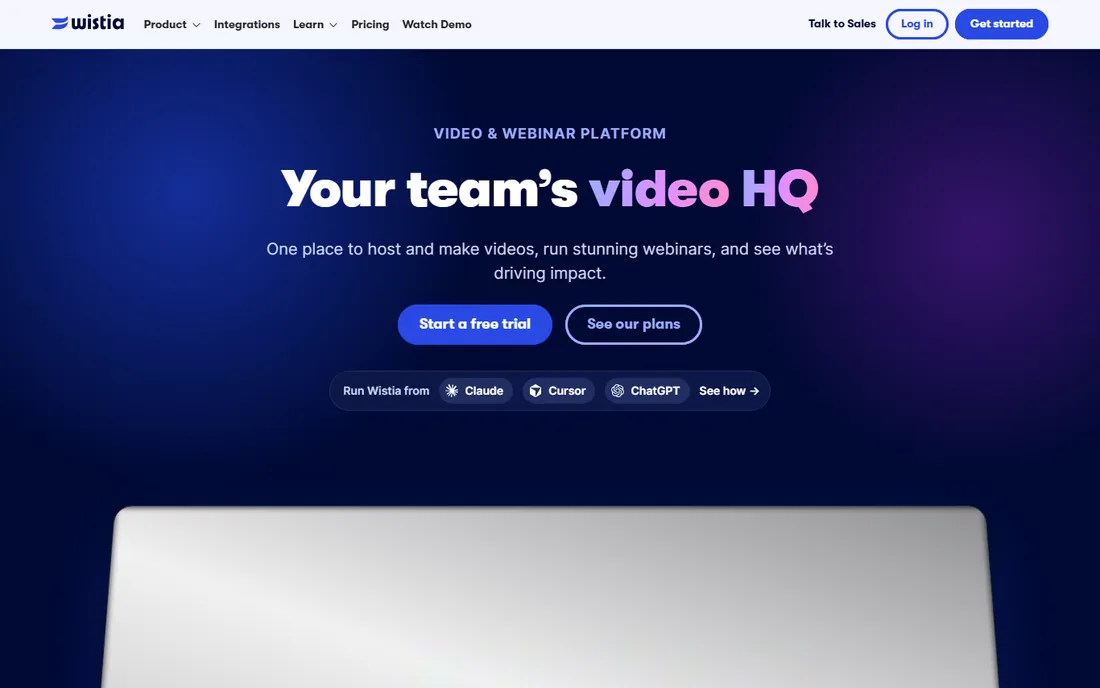
Wistia is the marketer's video host, and it has been for years. The product pairs clean, ad-free hosting with the tools a demand-gen team actually uses: turnstile email capture inside the player, calls to action, A/B testing, video heatmaps that show exactly where viewers drop off, and engagement data that flows into the CRM contact record. The free tier exists for testing, but Business at $79 a month billed annually is where the real product starts, with 250 GB of storage and 1 TB of bandwidth.
The catch is that Wistia prices by plan tiers and usage caps, not by simple per-video math the way it used to. Teams that add webinars pay extra (the Webinars add-on starts around $350 a month), and heavy libraries eventually hit the Enterprise conversation. If your primary metric is marketing pipeline rather than raw video count, it is still the most focused option here.
What we like- Ad-free customizable player with video SEO baked in
- Lead capture forms, CTAs and heatmap analytics built for marketers
- Deep integrations with HubSpot, Marketo, Pardot and Salesforce
Watch out for- Business is the first plan that removes Wistia branding and adds marketing features
- Bandwidth and storage caps can push growing libraries into Enterprise
#2
Vimeo
Best for: Businesses wanting one platform for hosting, live and monetization
Visit vimeo.com
Starting price$12/month (Starter, billed annually; $20 month-to-month)
Free planYes (free plan with unlimited public videos)
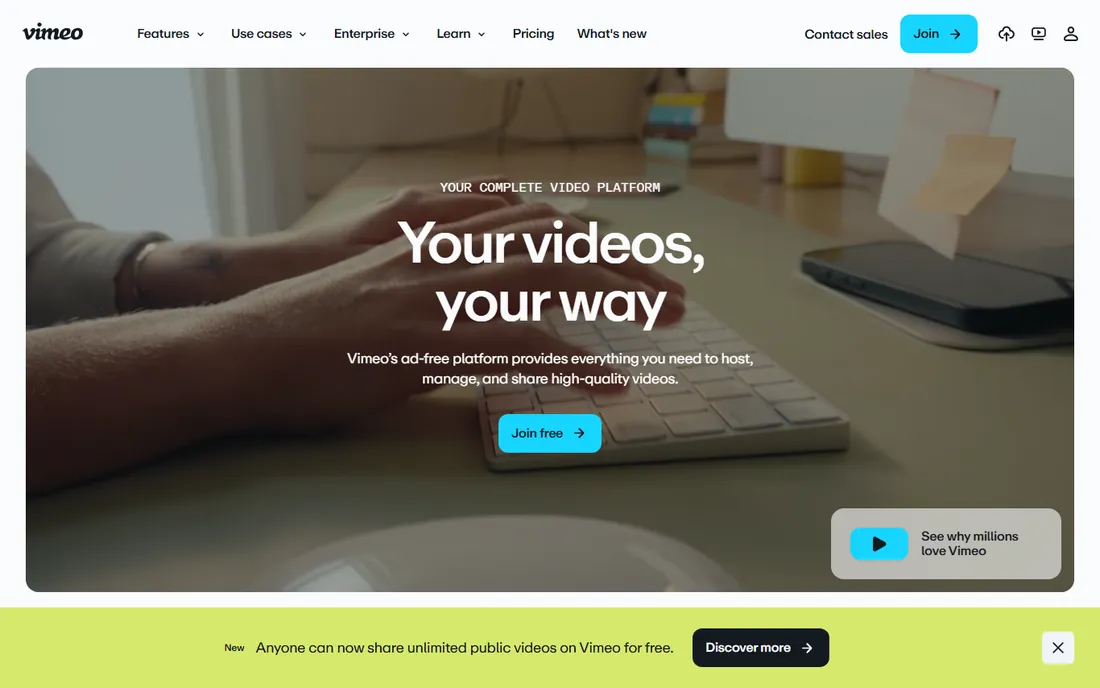
Vimeo rebuilt itself from a creator community into an all-in-one video platform for businesses, and the breadth shows. Starter at $12 a month billed annually buys privacy controls, player customization and auto captions; Standard at $25 adds branding, lead capture and CTAs; Advanced at $75 adds live broadcasts, webinars and multi-destination streaming. Enterprise covers SSO, eCDN and dedicated support. The player quality and the review-and-collaboration tools are genuinely good.
Watch the bandwidth line item. All self-serve plans cap at 2 TB of viewing bandwidth per month, and overage is where the bill surprises people. For a company hosting a few dozen marketing videos with moderate traffic, that cap rarely bites; for course creators or high-traffic libraries, price the overage before committing. The free plan is the most generous free tier on this list.
What we like- Full stack in one account: hosting, live streaming, webinars and OTT monetization
- Strong privacy controls and a polished embeddable player
- Free plan allows unlimited public videos
Watch out for- Every self-serve plan shares a 2 TB monthly bandwidth cap, which catches growing audiences
- Advanced marketing features sit on Standard and Advanced tiers
#3
Vidyard
Best for: Sales teams using personalized video to book meetings
Visit vidyard.com
Starting price$59/seat/month (Plus, billed annually; $89 month-to-month)
Free planYes (free tier)
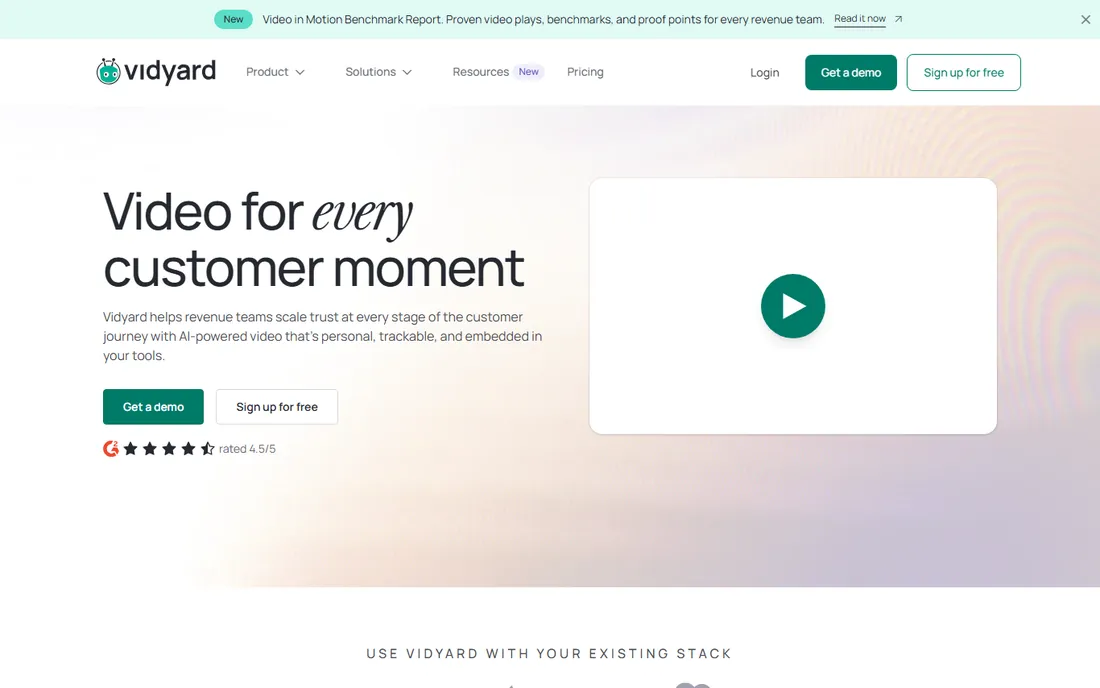
Nobody buys Vidyard to host a marketing library, though it can. People buy it because a rep records a 90-second personal video, drops it in a prospecting email, and sees exactly who watched and for how long. The free tier covers individuals testing the workflow; Starter at $59 per seat per month billed annually adds full analytics, branded sharing pages, password-protected videos and team reporting. A Video Agent add-on automates personalized outreach at $24 per seat per month.
The honest math is headcount. Five reps on Starter run $295 a month before add-ons, which is fine when one closed deal pays for a year of it and painful when the team only records the occasional internal update. If the use case is async sales communication rather than a public video library, the per-seat cost is easy to justify against pipeline.
What we like- Built for one-to-one video messaging with viewer notifications and engagement tracking
- AI avatars and automated video workflows for scaling outreach
- CRM integrations that tie views to pipeline
Watch out for- Pricing is per seat, so costs scale with headcount rather than video count
- Teams and Enterprise tiers are quote-only with no public numbers
Starting price$10/month (Seed plan)
Free planNo (30-day free trial)
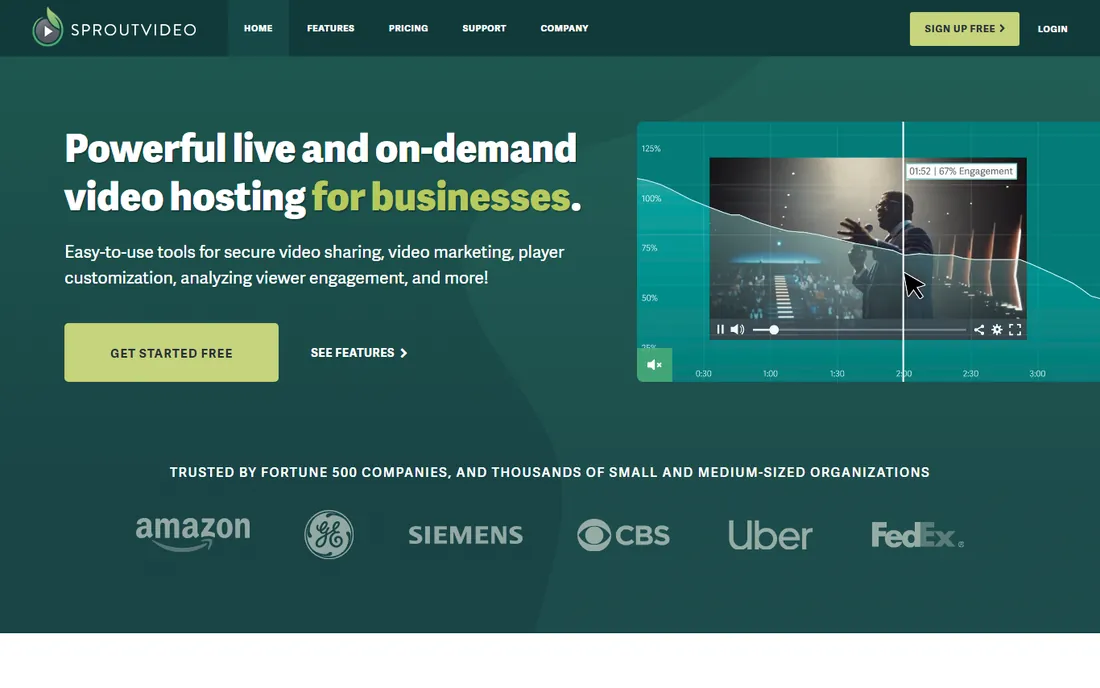
SproutVideo is the quiet workhorse of this list. It does not chase the marketing-automation crowd; it sells dependable, private video hosting to businesses that share training videos, client deliverables and internal communications. Seed at $10 a month covers 2 team members with analytics and custom players; Sprout at $35 adds viewer login protection and video websites; Tree at $75 adds geo restriction and signed embeds; Forest at $295 adds SSO and IP restriction. Overage is a flat per-GB rate, which keeps bills predictable.
The trade is scope. You get fewer native marketing integrations than Wistia and no per-seat sales tooling like Vidyard. What you get instead is a small team that answers support tickets fast and a platform reviewers consistently rate highly for ease of use. For agencies sharing client work or companies hosting private training libraries, that is the right trade.
What we like- Strong privacy toolkit: password protection, login-protected viewers, geo restriction and signed embeds on higher tiers
- Flat per-GB overage pricing instead of hard caps
- Human support with a strong reputation
Watch out for- No permanent free plan, trial only
- Marketing integrations are thinner than Wistia or Vidyard
#5
Dacast
Best for: Organizations streaming live events and paywalled video
Visit dacast.com
Starting price$39/month (Starter, billed annually)
Free planNo (free trial offered)
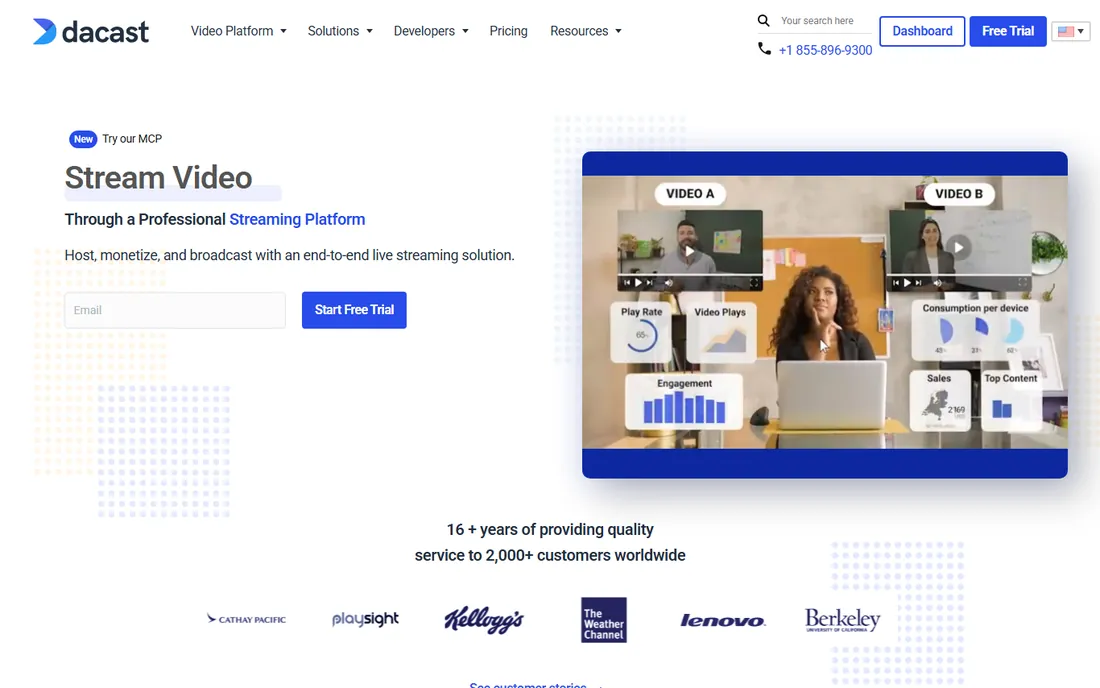
Dacast is the only platform here built live-first rather than library-first. Starter at $39 a month billed annually includes 2.4 TB of yearly bandwidth and 500 GB of storage with live streaming and VOD hosting; Event at $63 suits one-off paywalled events with 6 TB upfront; Scale at $165 billed annually ($250 month-to-month) adds 24 TB of bandwidth, phone support, DRM and API access. The monetization toolkit, paywall, ad insertion and subscription options, is the reason broadcasters, churches, sports leagues and auction houses pick it.
Read the billing terms before signing. Starter and Event are annual-upfront only, and if you exhaust bandwidth without overage protection your streams can stop mid-event. With overage protection on, extra data bills at a steep per-GB rate, so heavy streamers should buy prepaid data packs. For scheduled live events with real audiences, the live-specific tooling is worth the quirks.
What we like- Live-first platform with monetization paywall (SVOD, TVOD, AVOD) built in
- China delivery and multi-CDN options for global audiences
- White-label player with no Dacast branding
Watch out for- Starter and Event plans are billed annually upfront, no month-to-month option
- Bandwidth overage can get expensive without overage protection enabled
#6
Brightcove
Best for: Enterprises streaming at global scale with strict reliability needs
Visit brightcove.com
Starting priceSee website (custom quote only)
Free planNo
Brightcove is the incumbent enterprise video platform, and it sells like one: demos, scoping calls and custom quotes. The product covers the full pipeline, cloud encoding, live and on-demand streaming, DRM, monetization and analytics, with the uptime record and security certifications that media companies and large enterprises require. Two Technology and Engineering Emmy awards sit on the shelf, which tells you the heritage.
For a small or mid-size business this is the wrong list entry to click first. There is no self-serve signup and no price to compare, and the platform assumes a team that thinks about streaming infrastructure. It belongs on the shortlist when video is a revenue line and reliability is a board-level concern, not when you need to host fifty product videos.
What we like- Enterprise-grade reliability with a long track record in media and corporate streaming
- Full stack from encoding to monetization with strong DRM and security
- Dedicated support and SLAs
Watch out for- No public pricing at all, every deal goes through sales
- Overkill in both cost and complexity for teams under a few hundred videos
#7
Kaltura
Best for: Universities and enterprises running branded video portals and virtual events
Visit kaltura.com
Starting priceSee website (custom quote only)
Free planNo
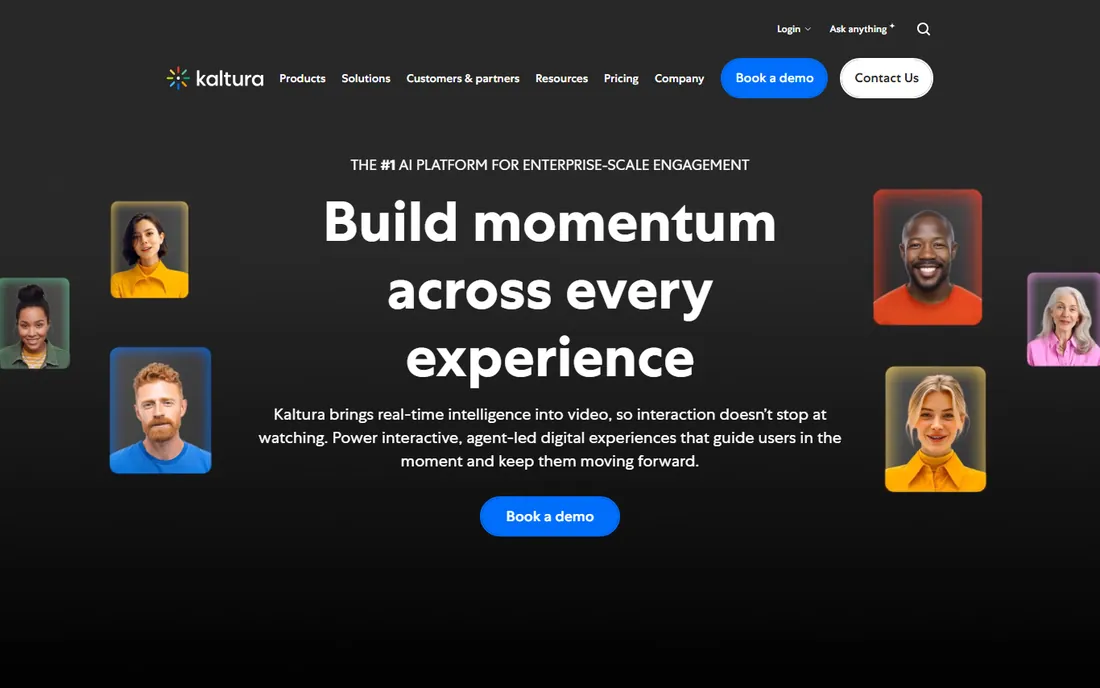
Kaltura sits between a product and a platform. Universities run entire lecture-capture and LMS video systems on it; enterprises build branded video portals, town-hall webcasting and training hubs. The current pitch leans into AI: agentic avatars, AI-powered video hubs and event platforms with real-time engagement. It is genuinely flexible, which is why institutions with complex requirements keep choosing it.
Flexibility has a price beyond the quote. Kaltura deals involve scoping, demos and implementation work, and the platform assumes more technical involvement than the self-serve tools above. If you are a 50-person company that needs webinar software, look at Wistia or Vimeo Advanced instead. If you are building a video portal for 10,000 employees or students, Kaltura is built for exactly that.
What we like- Flexible platform spanning video portals, virtual events, webinars and LMS integrations
- Strong footprint in higher education and corporate learning
- Open-source roots with deep customization options
Watch out for- Quote-only pricing with no public numbers
- Implementations skew toward larger organizations with IT involvement
#8
Cincopa
Best for: Teams turning training and support video libraries into searchable knowledge
Visit cincopa.com
Starting price$99/month (Starter plan)
Free planNo
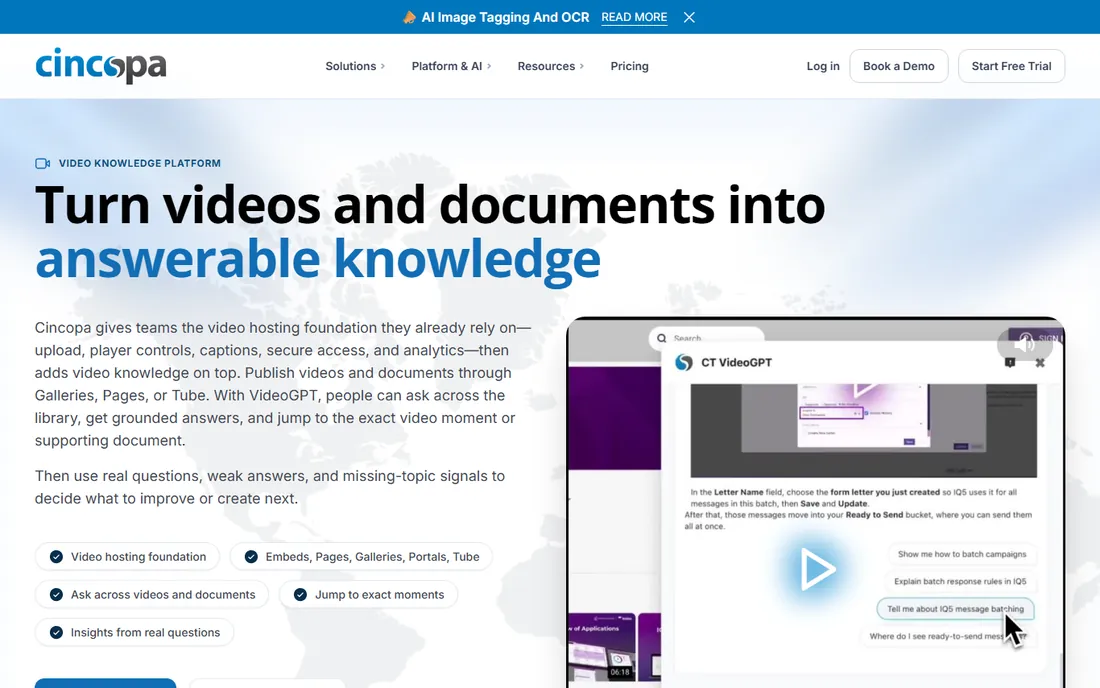
Cincopa spent years as a mid-market video host and recently reinvented itself as a video knowledge platform. The hosting foundation is still there, upload, player controls, captions, access control, analytics, but the pitch is now about what happens after upload: VideoGPT answers questions across your library with grounded answers and links to the exact video moment, and galleries, pages and tube portals organize content into structured knowledge hubs. Starter at $99 a month covers 200 videos with VideoGPT included; Growth at $349 expands limits and adds integrations.
That repositioning is either the reason to buy or the reason to skip. If your problem is a training library nobody can search, the AI layer is genuinely differentiated. If you just need branded hosting for a marketing site, Wistia or SproutVideo give you more of what you need for less. Check current plan limits on a demo before assuming the old hosting-only pricing still applies.
What we like- VideoGPT lets viewers ask questions across the video library and jump to exact moments
- Galleries, pages and tube portals structure content beyond flat playlists
- Strong fit for product education and customer training
Watch out for- Repositioned around AI knowledge features, so pure hosting buyers pay for scope they may not need
- No free plan and trial terms are unclear
#9
JWP Connatix
Best for: Media companies and publishers monetizing large video catalogs
Visit jwpconnatix.com
Starting priceSee website (custom quote only)
Free planNo
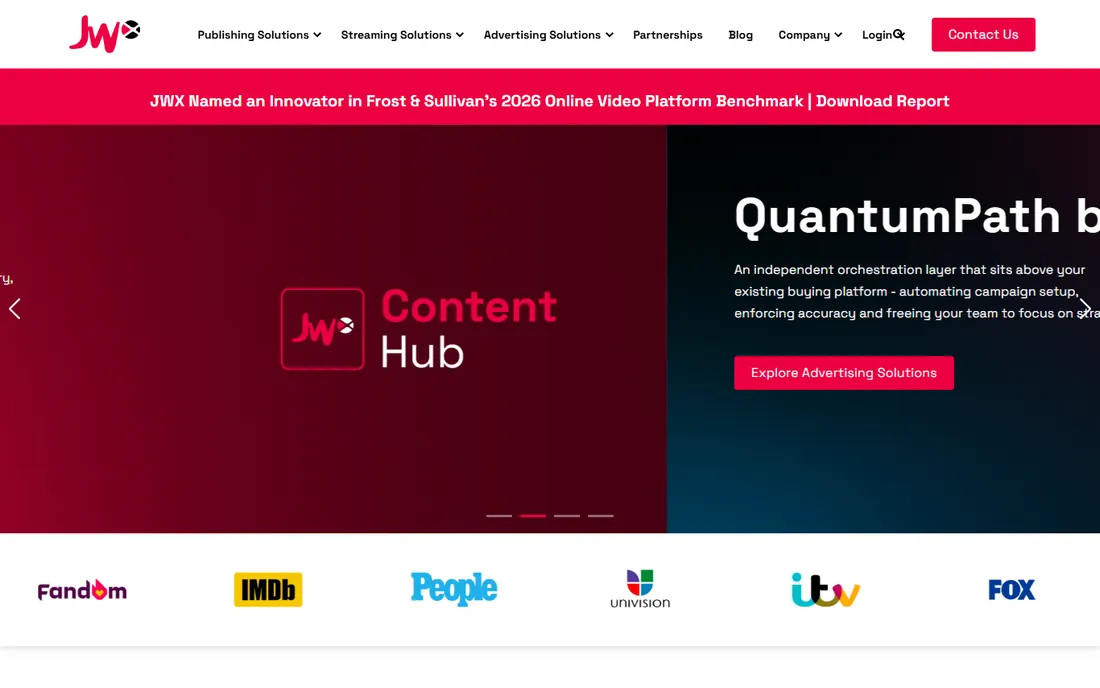
JW Player merged with Connatix in 2024, and the combined company now trades as JWP Connatix, pitched as a unified platform for publisher video: media management, VOD and live delivery, monetization and data intelligence in one stack. The heritage is the player that powered a meaningful share of web video, and the current strength is monetization, flexible ad insertion, premium demand access and reporting that shows where revenue comes from. Broadcasters and large publishers are the core audience.
Like Brightcove, this is a sales-led purchase with no public prices and no self-serve tier worth evaluating. It makes sense when advertising revenue funds the video operation and you need yield optimization, not when you need to host a company video library. Note the name change when searching for reviews: older JW Player write-ups describe the same company.
What we like- Purpose-built for publisher monetization with ad insertion, premium demand and transparent reporting
- Strong data and contextual targeting story for ad-supported video
- Deep broadcast and OTT feature set
Watch out for- Enterprise sales motion with no public pricing
- The JW Player to JWP Connatix name change can confuse buyers researching the company
Bandwidth, storage and seats: the three numbers that decide your bill
Video hosting pricing looks simple until the second invoice. Three variables drive almost every bill on this list, and vendors define them differently.
Bandwidth is the cost of people watching. Vimeo caps every self-serve plan at 2 TB of viewing bandwidth per month. Dacast bundles yearly bandwidth pools (2.4 TB on Starter, 24 TB on Scale) and charges steeply for overage. Wistia includes 1 TB on Business. Before choosing, estimate monthly viewing hours: a 10-minute 1080p video watched 5,000 times can burn through several hundred gigabytes.
Storage is the cost of the library sitting on their servers. Vimeo Standard includes 4 TB, SproutVideo Seed is far leaner, and Cincopa counts videos rather than gigabytes. If your library grows by dozens of videos a month, favor platforms that price storage generously or count assets instead.
Seats are the cost of your team. Vidyard charges per seat, so five reps cost five times one. Wistia Business includes 3 users and charges per extra. Vimeo Standard includes 5. Model the team you will have in a year, not the team you have today, then compare totals.
What to check before you sign up
Start with the job, not the feature list. A marketing team needs lead capture and CRM data; a sales team needs per-seat recording with notifications; an events team needs live reliability and a paywall; a training team needs privacy controls and search. Most buyers pick wrong by comparing players instead of comparing workflows.
Then verify four things on the pricing page. First, whether the advertised monthly price requires annual billing; Dacast's Starter and Event are annual-upfront only, and month-to-month elsewhere often costs 40 to 65 percent more. Second, what happens at the bandwidth limit: hard cap, overage fees or throttling. Third, whether the plan removes vendor branding from the player, which usually starts one tier above the cheapest. Fourth, the export story: can you download your videos and viewer data if you leave, and does the contract auto-renew.
Finally, run the free tier or trial with a real video, not a test clip. Upload something representative, embed it on a staging page, check load speed on mobile, test the privacy settings, and confirm the analytics show what you need. An hour of real testing beats a week of feature-matrix comparisons.
How we chose
We started with the categories buyers search: video hosting platform, business video hosting and enterprise video platform. For each candidate we opened the vendor's homepage to confirm the current product name and URL, checked prices against the vendor's own pricing page or vendor-supplied pricing data, and compared features, bandwidth and storage terms and company-size fit against public reviews on G2 and Capterra. Where a price could not be verified we wrote "See website" rather than guessing. Two homepage opens were blocked by the vendor's bot protection, so those URLs rest on official search-result evidence and are flagged in our notes.
Frequently asked questions
What is the cheapest business video hosting platform?
SproutVideo Seed at $10 a month and Vimeo Starter at $12 a month billed annually are the cheapest paid plans with published pricing on this list. Vimeo also has the most generous free tier. The real cheapest option depends on your bandwidth: a cheap plan with expensive overage can cost more than a pricier plan with bundled bandwidth.
Should my business just use YouTube instead?
YouTube is free and has the biggest audience, but you give up control: competitor videos appear next to yours, you cannot fully remove branding, and viewer data stays with Google. Businesses use dedicated hosting when the video sits on their own site, feeds their CRM, or needs privacy controls. Many companies do both: YouTube for reach, a hosted platform for the website.
How much bandwidth does business video hosting need?
A rough rule: one hour of 1080p viewing uses 4 to 8 GB of bandwidth. A 10-minute product video watched 1,000 times a month uses roughly 100 to 130 GB. Vimeo's 2 TB monthly cap covers about 250 to 500 hours of HD viewing; Dacast's Starter pool of 2.4 TB per year covers far less per month. Estimate your monthly viewing hours before comparing plans.
Do I need live streaming, or is on-demand enough?
On-demand covers marketing videos, demos, training and testimonials, which is most business video. You need live streaming for webinars, virtual events, town halls, classes and anything time-sensitive. Vimeo Advanced, Dacast and Kaltura cover live well; Wistia sells webinars as a separate add-on. Do not pay for live features you will use twice a year.
What is the difference between Wistia and Vidyard?
Wistia is built for marketing teams: hosted video libraries with lead capture, CTAs and CRM analytics, priced per plan. Vidyard is built for sales teams: one-to-one video messages with viewer tracking, priced per seat. Marketing library goes to Wistia; prospecting videos go to Vidyard.
Sources we checked (8)
- https://wistia.com/pricing
- https://vimeo.com
- https://www.vidyard.com/blog/loom-alternatives/
- https://sproutvideo.com
- https://www.dacast.com/wowza-alternative/
- https://www.g2.com/products/sproutvideo/pricing
- https://www.g2.com/products/wistia/pricing
- https://jwpconnatix.com
Is your product missing or out of date?
We review this list regularly. Vendors can request a listing, send updated pricing or ask about featured placement.

Shihab Mia · Founder, Rankite
Shihab has spent more than a decade helping SaaS and e-commerce brands grow through search. He writes Rankite's software buying guides from pricing pages, documentation and public user reviews. More about Shihab.