How we make this list: we compare pricing pages, product documentation and public user reviews. Ratings come from G2, Capterra or Trustpilot, with the date we checked them.
Key takeaways
- Most enterprise vendor risk management vendors quote custom pricing based on vendor count and modules, so budget from guide figures and request quotes on the same scope.
- ProcessUnity offers the deepest lifecycle automation, with a Global Risk Exchange of 370,000 vendor profiles and 18,000 completed assessments covering 87 percent of the most requested vendors.
- BitSight offers objective, real-time security ratings, while UpGuard publishes the clearest entry pricing: $1,750 per month billed annually for 50 vendors, plus $79 per additional vendor.
- Match the platform to your vendor portfolio size and to whether you need outside-in ratings, an assessment workflow, or both, since no single tool owns every need.
Quick comparison
| Tool | Best for | Starting price | Free plan |
|---|
 ProcessUnity | End-to-end lifecycle automation | $25,000 per year | No |
 BitSight | Continuous monitoring and scoring | See website | No |
 OneTrust | Enterprise governance and privacy | See website | No |
 Prevalent | Dedicated, mature TPRM programs | See website | No |
 ServiceNow | Workflow-embedded vendor risk | See website | No |
 Vanta | AI-assisted evidence review | See website | No |
 UpGuard | Transparent risk categorization | $1,750 per month | No |
 Panorays | Fast external risk visibility | See website | Yes |
Is your product missing or out of date?
We review this list regularly. Vendors can request a listing, send updated pricing or ask about featured placement.
The best vendor risk management software
Starting price$25,000 per year
Free planNo
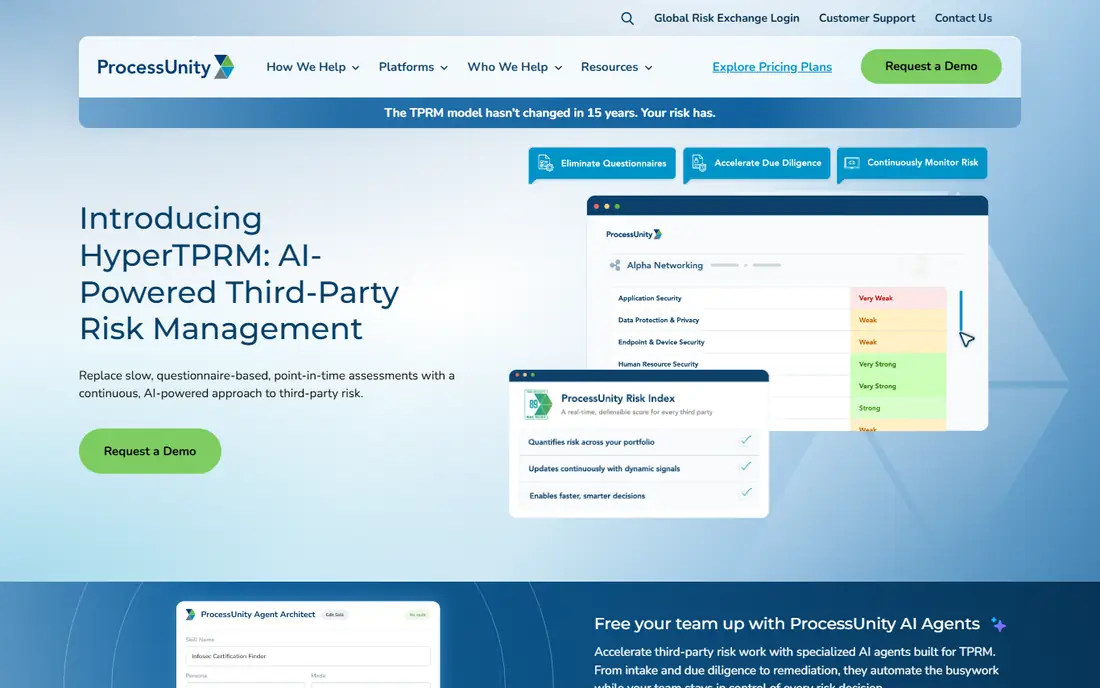
ProcessUnity offers end-to-end lifecycle automation, with a Global Risk Exchange containing 370,000 curated vendor profiles and 18,000 completed assessments, covering 87 percent of the world's most requested vendors as of September 2026. Its configurable workflows support rules-based tiering, residual-risk scoring, and exception aging for complex regulatory maps such as DORA and NIS2, while AI helpers draft questionnaire responses and flag missing controls before submission. Forrester's Q1 2026 TPRM Wave lists ProcessUnity as a Leader, citing configurability and lifecycle depth.
Pricing is quote-only beyond an SMB entry from $25,000 in guides, and high configurability extends setup time, with most enterprises engaging a partner for the initial build. For organizations whose regulators or audit committees insist on a complete audit trail from tiering to off-boarding, ProcessUnity offers the deepest lifecycle platform here.
What we like- Global Risk Exchange plus configurable workflows
- Forrester Q1 2026 TPRM Wave Leader
- AI autofill and evidence evaluation
Watch out for- Quote-only beyond SMB entry
- High configurability extends setup time
- Continuous monitoring depends on external feeds
#2BitSight
Best for: Continuous monitoring and scoring4.5/5 on
G2 (76 reviews, checked Oct 2026)
Visit bitsight.com
Starting priceSee website
Free planNo
BitSight offers continuous monitoring and scoring through objective, real-time security ratings, with vendor risk management covering more than 75,000 vendor profiles and AI-powered onboarding. Its Bitsight AI delivers automated insights, risk prioritization, and executive-ready reporting, while continuous monitoring covers third- and fourth-party ecosystem networks and vulnerability detection for critical CVEs. Its TPRM integrations span ServiceNow, ProcessUnity, Prevalent, OneTrust, Archer, and more.
All pricing is custom based on company size and usage, with no published entry price, so budget requires a sales conversation. For global enterprises, financial services, healthcare, and government contractors that need ratings tied to board-level governance, BitSight offers the strongest scoring platform here.
What we like- Objective, real-time security ratings
- 75,000 plus vendor profiles
- Bitsight AI for insights and reporting
Watch out for- All pricing custom by company size and usage
- Ratings focus means less assessment workflow depth
#3OneTrust
Best for: Enterprise governance and privacy4.3/5 on
G2 (155 reviews, checked Oct 2026)
Visit onetrust.com
Starting priceSee website
Free planNo
OneTrust suits multinational, multi-domain governance, since the same platform that handles privacy, ESG, and AI compliance also manages third-party oversight, letting global teams trace a single policy from data collection through downstream supplier controls. Its third-party risk management covers vendor questionnaire distribution and tracking, risk scoring on configurable frameworks, and continuous monitoring add-ons, while Gartner's inaugural 2026 Magic Quadrant for TPRM Tools lists OneTrust as a Leader, citing breadth and AI-powered automation.
Pricing is custom and usage-based across module tiers, so total cost depends on product selection and organizational scale. For organizations that manage privacy, compliance, and vendor risk within a single governance platform, OneTrust offers the broadest suite here.
What we like- Unified privacy, risk, and third-party management
- Gartner 2026 Magic Quadrant Leader for TPRM
- AI-powered automation
Watch out for- Custom usage-based pricing
- Module tiers add cost
- Privacy-adjacent scope means less ratings depth
#4Prevalent
Best for: Dedicated, mature TPRM programs4.5/5 on
G2 (21 reviews, checked Oct 2026)
Visit prevalent.net
Starting priceSee website
Free planNo
Prevalent, now part of Mitratech, suits complex vendor portfolios with dedicated, mature third-party risk management programs, offering full-lifecycle assessment and remediation depth. Its assessment network lets organizations reuse pre-completed assessments, reducing questionnaire burden for common vendors, while its workflow covers onboarding, assessment, remediation, and off-boarding in one platform. Its G2 rating of 4.5 reflects strong satisfaction among mature program buyers.
Pricing is custom only, and continuous monitoring is partner-fed rather than native ratings, so organizations that need real-time scoring should pair it with BitSight or UpGuard. For mature programs that prioritize assessment depth over ratings, Prevalent offers the most complete lifecycle workflow here.
What we like- Full-lifecycle assessment and remediation depth
- Mature TPRM programs
- Assessment network reuse
Watch out for- Custom pricing only
- Partner-fed continuous monitoring rather than native ratings
- Complex for small teams
Starting priceSee website
Free planNo
ServiceNow Vendor Risk Management suits enterprises already running ServiceNow for ITSM or GRC that want to extend existing workflows to vendor risk without adopting a separate platform. Its automated vendor assessments use custom workflows, risk scoring ties to enterprise controls, and reporting covers evidence documentation for regulatory compliance, while AI-powered dashboards support compliance and reporting across the platform. Its native workflow integration means vendor risk lives alongside incident, change, and security operations.
Pricing is custom by platform licensing and module selection, and it is a workflow integrator rather than a ratings specialist, so outside-in scoring comes via feeds. For ServiceNow shops that want vendor risk embedded in existing operations, ServiceNow offers the most integrated option here.
What we like- Vendor risk inside a broader operations platform
- AI-powered dashboards
- ITSM and security operations integration
Watch out for- Custom quote by platform licensing and module selection
- Workflow integrator rather than ratings specialist
#6Vanta
Best for: AI-assisted evidence review4.5/5 on
G2 (2,742 reviews, checked Oct 2026)
Visit vanta.com
Starting priceSee website
Free planNo
Vanta suits lean teams managing smaller vendor lists that need fast setup, self-serve onboarding, and compliance evidence for frameworks like SOC 2 and ISO 27001. Its AI-assisted evidence review automates evidence collection, while its Trust Center lets organizations share audit-ready evidence with customers and vendors without manual requests. Its G2 rating of 4.6 is the highest in this list, reflecting strong satisfaction among compliance-focused buyers.
Pricing is request-only, and its vendor module sits on top of a compliance base, so dedicated TPRM depth trails ProcessUnity and Prevalent. For early-stage buyers who need defensible coverage in days rather than months, Vanta offers the fastest compliance-plus-vendor path here.
What we like- AI-assisted evidence review
- Automated evidence collection
- Trust Center for sharing evidence
Watch out for- Request pricing only
- Vendor module added onto a compliance base
- Less TPRM depth than dedicated platforms
#7UpGuard
Best for: Transparent risk categorization4.5/5 on
G2 (765 reviews, checked Oct 2026)
Visit upguard.com
Starting price$1,750 per month
Free planNo
UpGuard states its entry pricing openly, unlike most rivals: the Standard Vendor Risk plan starts at $1,750 per month billed annually and covers 50 vendors, with each additional vendor at $79 per month and a free trial to start. Its transparent risk categorization and comprehensive insights into posture changes suit organizations that want clear scoring without a sales call to learn the price, and it scales across large vendor portfolios with responsive customer support praised by users.
It lacks risk management workflows, so assessment and remediation need separate tooling, and some users report alerts that lack specificity, leading to alert fatigue. For organizations that prioritize transparent pricing and ratings over workflow depth, UpGuard offers the clearest entry point here.
What we like- Clearest entry pricing published
- Transparent risk categorization
- Scales across large portfolios
Watch out for- Lacks risk management workflows
- Alerts can lack specificity, causing alert fatigue
- Per-vendor cost adds up
#8Panorays
Best for: Fast external risk visibility4.3/5 on
G2 (52 reviews, checked Oct 2026)
Visit panorays.com
Starting priceSee website
Free planYes
Panorays suits teams that want fast external risk visibility, combining AI assessments with attack surface monitoring to show vendor risk from the outside in without lengthy onboarding. Its free tier lets small teams test external visibility before committing, while paid tiers add deeper assessments and monitoring for larger portfolios. Its G2 rating of 4.3 reflects solid satisfaction among buyers who prioritize speed.
Pricing beyond the free tier is request-only, and its lifecycle depth trails ProcessUnity and Prevalent for mature programs. For teams that need quick external visibility and a free starting point, Panorays offers the fastest entry here.
What we like- Fast external risk visibility
- AI assessments plus attack surface monitoring
- Free tier available
Watch out for- Request pricing beyond free tier
- G2 rating of 4.3 trails leaders
- Less lifecycle depth than ProcessUnity
How we chose
We compared 2026 vendor risk management guides, checking workflow fit, scoring approach, reporting strength, pricing shape, and G2 ratings. We favored tools with clear lifecycle or ratings strengths and published pricing signals where available, and we flagged where pricing is quote-only rather than inventing figures. We did not claim hands-on testing, and most enterprise pricing here is custom, so request quotes on the same vendor count and module scope before budgeting.
Early-stage and startup buyers with lean teams and smaller vendor lists should prioritize fast setup, self-serve onboarding, and compliance evidence, choosing Vanta or Panorays for defensible coverage in days. Mid-market buyers with growing portfolios should compare UpGuard for transparent ratings and ProcessUnity SMB entry for lifecycle depth. Enterprise buyers with large, complex ecosystems and regulatory obligations under DORA, NIS2, or SEC rules should compare ProcessUnity, BitSight, OneTrust, and Prevalent on the same scope, since each covers a different strength.
Pricing reality for vendor risk management
Pricing varies by vendor portfolio size, monitoring scope, and whether the platform includes managed assessment services, with most platforms quote-based on annual contracts. UpGuard is the exception with published entry pricing, while LogicGate starts from $25,000 per year and ProcessUnity from $25,000 for SMB entry. When requesting quotes, ask how price scales with vendor count, since that variable drives total cost more than the base fee, and confirm whether implementation and professional services are included.
Ratings versus workflow: the core trade-off
Outside-in ratings tools like BitSight and UpGuard show vendor risk from external data in real time, while assessment workflow tools like ProcessUnity and Prevalent collect questionnaires, evidence, and remediation through the vendor lifecycle. Most mature programs need both, so shortlist one ratings tool and one workflow tool rather than expecting a single platform to own both jobs. Pairing a ratings feed with a workflow platform, such as BitSight plus ProcessUnity, covers the full picture better than either alone.
Frequently asked questions
What is vendor risk management software?
Vendor risk management software helps organizations assess, monitor, and manage risks from third-party vendors, covering onboarding, questionnaires, security ratings, continuous monitoring, remediation, and off-boarding. It replaces spreadsheets and email workflows with a structured, auditable program.
How much does vendor risk management software cost?
Most enterprise tools are quote-based, with guide entries from $25,000 per year for ProcessUnity SMB and LogicGate, while UpGuard publishes $1,750 per month for 50 vendors plus $79 per additional vendor. Total cost depends on vendor count, modules, and implementation services, so request quotes on the same scope.
Do I need ratings, workflow, or both?
Most mature programs need both: ratings show external risk in real time, while workflows collect questionnaires and evidence through the vendor lifecycle. Start with the job that hurts most, ratings for visibility or workflow for audit readiness, then add the other as the program matures.
What is the difference between TPRM and VRM?
Third-party risk management and vendor risk management are used interchangeably in most guides, with TPRM covering the broader third-party ecosystem including fourth parties, while VRM focuses on direct vendors. The distinction matters less than whether the tool covers your portfolio size and regulatory needs.
Can small companies use vendor risk management software?
Yes, with lean tools like Vanta for compliance evidence or Panorays for free external visibility, since enterprise platforms like ProcessUnity and Prevalent suit larger portfolios. Small teams should prioritize fast setup and self-serve onboarding over deep configurability.
Sources we checked (10)
- https://www.processunity.com
- https://www.bitsight.com
- https://www.onetrust.com
- https://www.prevalent.net
- https://www.servicenow.com
- https://www.vanta.com
- https://www.upguard.com
- https://panorays.com
- https://www.guideflow.com/blog/vendor-risk-management-software
- https://expertinsights.com/compliance/top-it-vendor-risk-management-solutions
Is your product missing or out of date?
We review this list regularly. Vendors can request a listing, send updated pricing or ask about featured placement.

Shihab Mia · Founder, Rankite
Shihab has 5+ years in B2B and SaaS SEO. He writes Rankite's software buying guides from pricing pages, documentation and public user reviews. More about Shihab.