How we make this list: we compare pricing pages, product documentation and public user reviews. Rankite is independent; if a vendor ever pays for a featured spot, that listing is clearly labeled Partner.
Key takeaways
- project44 and FourKites lead on shipment visibility scale: project44 tracks 1.5B+ shipments a year across 282K carriers, while FourKites counts 1,600+ brands and 500K+ carriers.
- Everstream, Resilinc and Interos sell risk visibility rather than dots on a map: multi-tier supplier mapping, predictive risk scores and AI-monitored disruption alerts.
- Overhaul is the specialist pick for high-value freight, pairing SKU-level tracking with cargo-theft prevention, a 24/7 monitoring center and recovery support.
- Every platform on this list is quote-based enterprise software; budget for implementation and carrier onboarding, not just the license.
Quick comparison
| Tool | Best for | Starting price | Free plan |
|---|
 project44 project44 | Large shippers wanting visibility plus AI-driven execution | See website | No |
 FourKites FourKites | Companies that want outcomes, not dashboards | See website | No |
 Everstream Analytics Everstream Analytics | Risk teams that need predictive disruption intelligence | See website | No |
 Resilinc Resilinc | Multi-tier mapping with AI that acts, not just alerts | See website | No |
 Interos Interos | Continuous, automated supplier risk scoring | See website | No |
 Overhaul Overhaul | High-value, high-consequence freight that cannot go missing | See website | No |
 Descartes MacroPoint Descartes MacroPoint | Shippers already in the Descartes ecosystem | See website | No |
 E2open E2open | End-to-end supply chain on a single platform | See website | No |
 Altana Altana | Trade compliance, tariffs and value-chain transparency | See website | No |
Is your product missing or out of date?
We review this list regularly. Vendors can request a listing, send updated pricing or ask about featured placement.
The best supply chain visibility software
Most visibility platforms show you dots on a map. Dots do not prevent stockouts, they do not catch a supplier three tiers down going bankrupt, and they do not stop a container of pharmaceuticals from walking out of a truck stop. Real visibility means knowing something is about to go wrong early enough to do something about it. The nine platforms below span both halves of the category: real-time shipment tracking and the newer world of predictive risk monitoring.
#1
project44
Best for: Large shippers wanting visibility plus AI-driven execution
Visit project44.com
Starting priceSee website
Free planNo
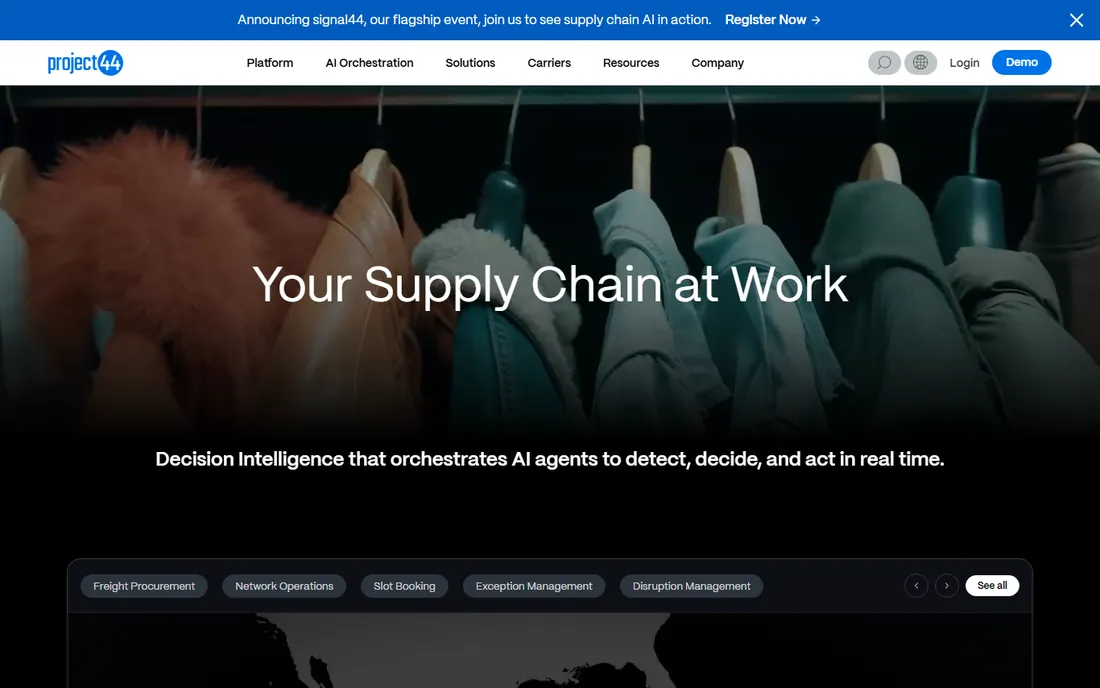
project44 has grown from a visibility provider into what it calls a decision intelligence platform. The scale numbers are the argument: more than 1.5 billion shipments a year, 282,000 connected carriers and over a million logistics facilities feeding a data graph the company uses to power predictive ETAs and AI agents. Its Movement platform covers shipment and inventory visibility, while the MO assistant helps teams work through exceptions conversationally instead of digging through dashboards.
The newer bets are worth noting for 2026 buyers. Tariff analytics addresses the cost-exposure questions every global shipper is asking, and the Intelligent TMS, yard management and e-commerce logistics products mean project44 now competes across execution, not just visibility. The catch is the enterprise reality: quote-based pricing, a real implementation project and carrier onboarding work. If you run a complex global network and want one platform to grow into, project44 is the default shortlist entry.
What we like- Massive network: 1.5B+ shipments a year, 282K carriers, 1M+ facilities
- Movement platform plus MO AI assistant for exception handling
- Tariff analytics and Intelligent TMS extend beyond tracking
Watch out for- Enterprise pricing and implementation are quote-only
- Breadth of the suite can mean a longer rollout
Starting priceSee website
Free planNo
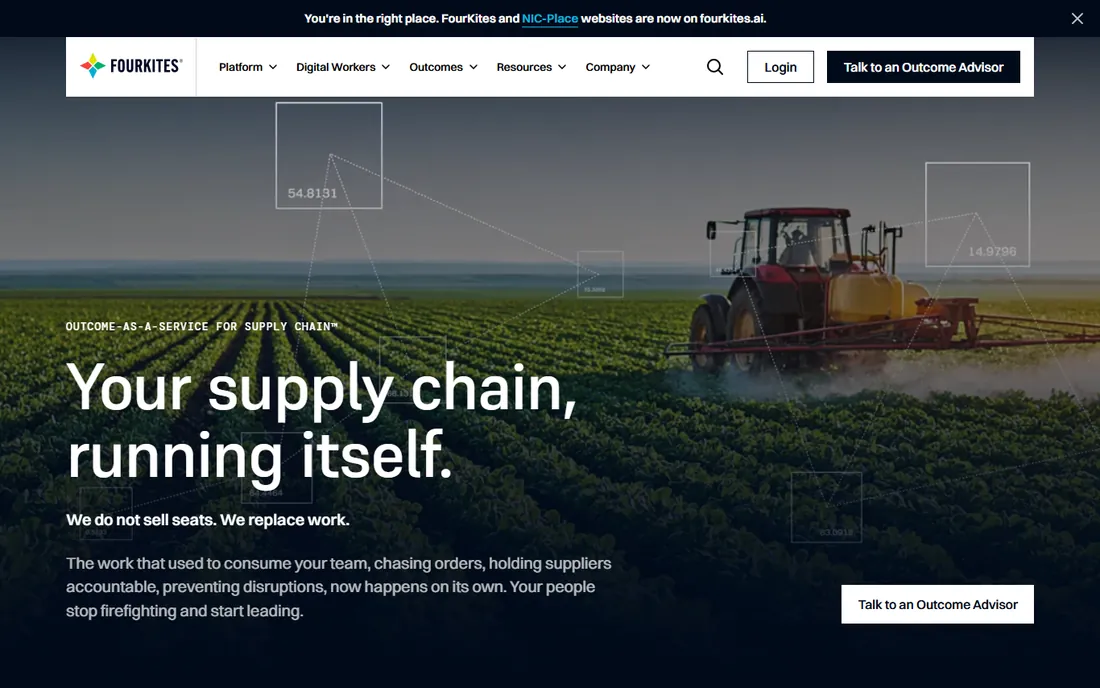
FourKites spent a decade building one of the largest visibility networks in the industry, then pivoted its pitch: instead of selling seats and dashboards, it sells outcomes delivered by AI agents. Tracy handles carrier operations, Alan runs facility appointments, Sam processes supplier documents, Cassie answers customer tracking questions and Polly manages compliance paperwork. The company reports 2.5 million autonomous actions a month and 3.2 million tracked events a day.
That positioning is either the future or marketing, and buyers should verify which by asking for live customer references using the agents in production. What is not in doubt is the network underneath: 1,600+ brands, nine of the top ten CPG companies and deep EDI, GPS and milestone data. If your team spends its days chasing carriers and updating customers, FourKites' promise to replace that work rather than instrument it is worth a serious evaluation.
What we like- 1,600+ brands and 500K+ carriers on the network
- AI agents (Tracy, Alan, Sam, Cassie, Polly, Sophie) take autonomous action
- Outcome-as-a-Service model replaces per-seat licensing
Watch out for- Quote-only enterprise pricing
- The agentic positioning is new, so diligence the actual autonomy
#3
Everstream Analytics
Best for: Risk teams that need predictive disruption intelligence
Visit everstream.ai
Starting priceSee website
Free planNo
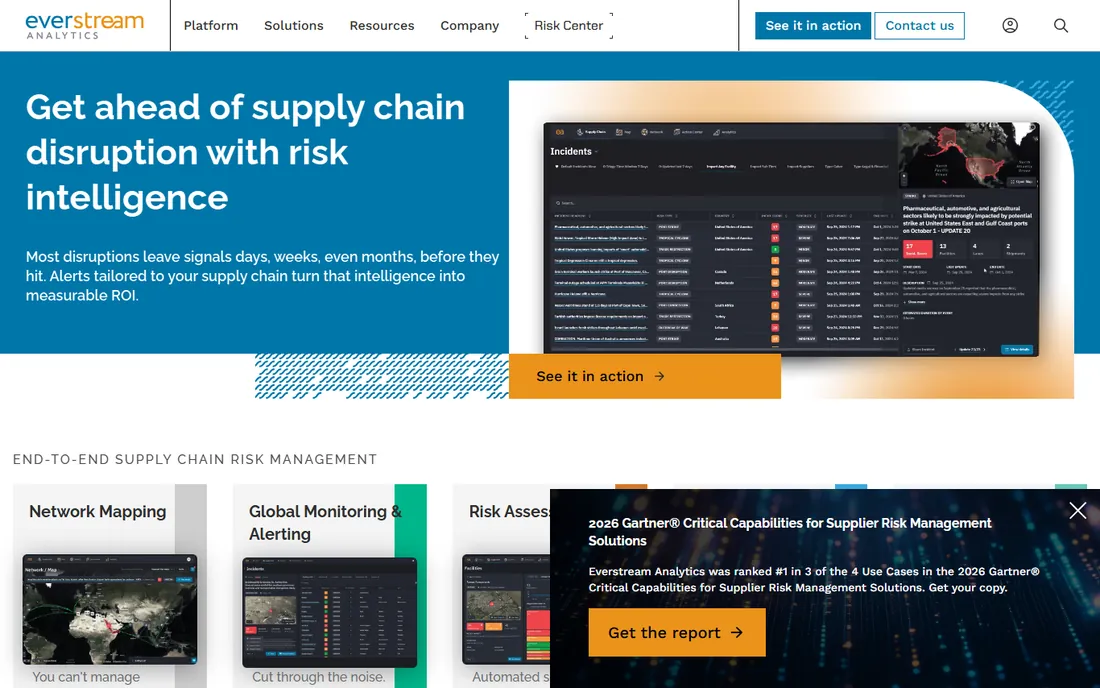
Everstream answers a different question than the tracking platforms: not "where is my freight" but "what is about to disrupt my supply chain." Its platform builds a digital twin of your supplier network, maps sub-tier suppliers most companies cannot see, and monitors for weather, geopolitical, financial and ESG risks around the clock. Alerts are AI-generated but human-validated, which cuts the false-positive noise that kills risk tools.
The trade-off is scope. If you need container-level tracking and carrier ETAs, pair Everstream with a visibility network rather than expecting it to do both. Pricing is enterprise and quote-based, and value depends on having someone on your team who acts on risk intelligence; alerts nobody reads are just expensive emails. For companies where a single disruption costs millions, Everstream's predictive lens earns its keep fast.
What we like- Digital-twin network mapping down to sub-tier suppliers
- 24/7 AI-driven monitoring with human-validated alerts
- Predictive risk scores plus automated assessment
Watch out for- Focused on risk rather than day-to-day shipment tracking
- Enterprise pricing with no public entry point
#4
Resilinc
Best for: Multi-tier mapping with AI that acts, not just alerts
Visit resilinc.com
Starting priceSee website
Free planNo
Resilinc has spent 15+ years building one of the deepest supplier-mapping datasets in the industry, and its current platform layers agentic AI on top. Multi-tier mapping shows exactly which parts are made at which supplier sites, EventWatch AI monitors more than 100 million sources for disruptions, and the AI agents go beyond alerting: they evaluate impact severity, reach out to suppliers and generate alternative sourcing options. One-click WarRooms pull stakeholders into coordinated response.
The honest requirement is data. Mapping is only as good as the supplier information you feed it, and the first few months involve real work validating sites, parts and relationships. Companies that invest in that foundation get a genuinely differentiated risk capability; companies that want plug-and-play tracking should look at project44 or FourKites instead. Resilinc was named a Leader in Gartner's 2025 Magic Quadrant for supplier risk management, which matches its enterprise positioning and pricing.
What we like- Maps suppliers down to part and site level with AI enrichment
- EventWatch AI tracks global events against your network
- Agentic AI generates mitigation options and sourcing alternatives
Watch out for- Implementation needs real supplier data to be valuable
- Quote-based pricing for enterprise budgets
#5
Interos
Best for: Continuous, automated supplier risk scoring
Visit interos.ai
Starting priceSee website
Free planNo
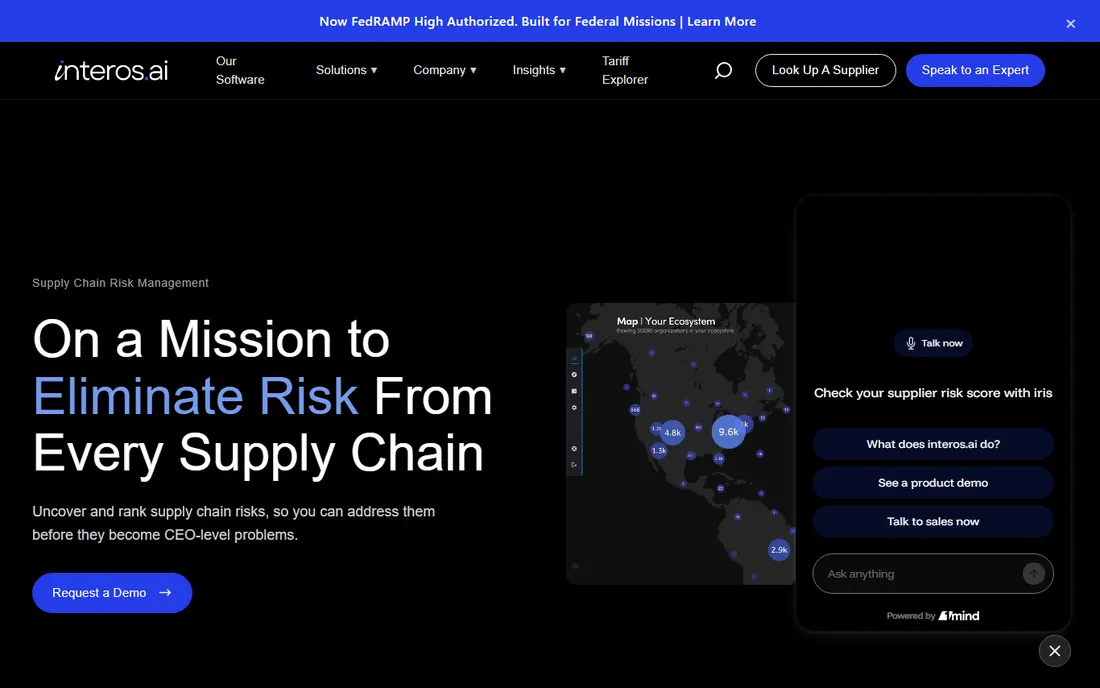
Interos built its name on the iScore, an AI-powered rating that scores extended supply chains against multiple risk factors using thousands of proprietary data points. The pitch is "resilient by design": instead of annual supplier assessments, you get continuous monitoring that spots financial weakness, cyber exposure, sanctions risk and geopolitical threats, framed as getting ahead of disruption "five days sooner, five moves earlier, five layers deeper."
For buyers, the key question is how the scores map to decisions. A risk score is only useful if it changes sourcing, contracting or inventory policy, so ask for examples of customers who restructured suppliers based on iScore output. Interos cites $2.5 trillion in annual disruption losses as the cost of opaque supply chains, which sets the stakes correctly. It is a strong fit for large enterprises that want risk monitoring as an always-on capability rather than a consulting project.
What we like- IScore benchmarks resilience across financial, cyber, ESG and geopolitical factors
- Automated mapping and monitoring at large scale
- Positions resilience as continuous, not a one-time assessment
Watch out for- Scoring models need calibration to your risk appetite
- Enterprise-only pricing and sales motion
#6
Overhaul
Best for: High-value, high-consequence freight that cannot go missing
Visit over-haul.com
Starting priceSee website
Free planNo
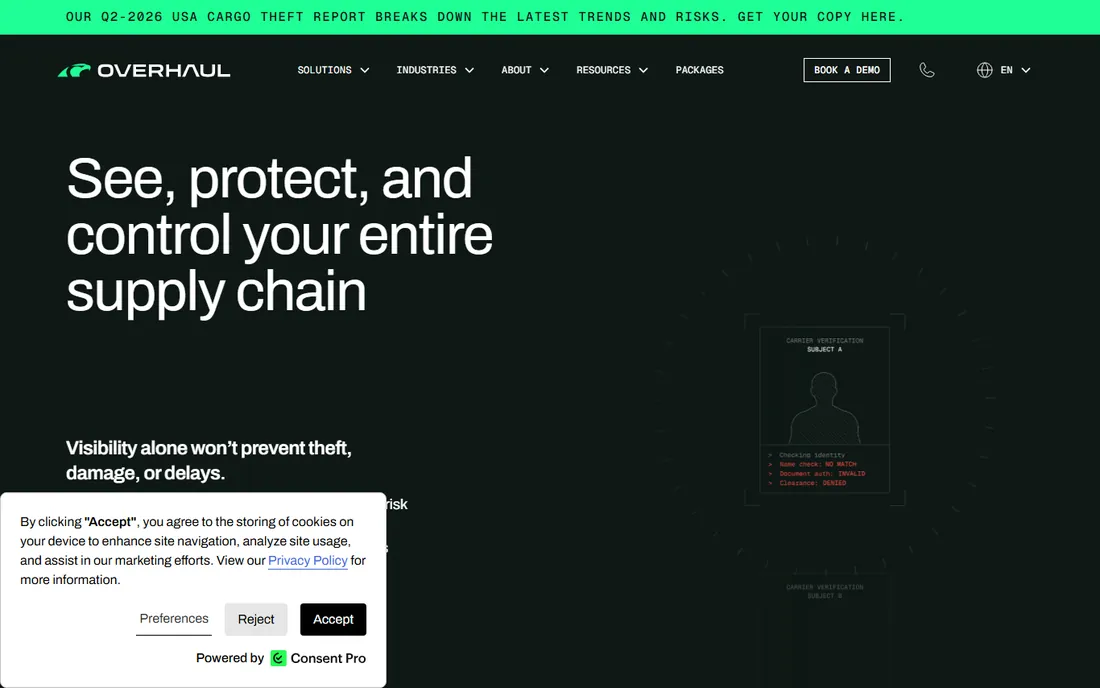
Overhaul owns a specific, expensive problem: cargo theft, spoilage and in-transit loss. Its platform combines SKU-level visibility with predictive risk intelligence, and when something goes wrong, a 24/7 security operations center coordinates response with law enforcement partners. The tiered model is sensible: run Essential coverage across routine freight, Advanced where your team wants live risk scoring, and Premium on the shipments that cannot fail. Features like FraudWatch carrier verification and SecureBOL document authentication target the fraud vectors shippers actually face.
The specialization is the point and the limit. Overhaul will not do your demand planning or supplier mapping; it protects freight in motion. For pharmaceutical, high-tech and automotive shippers moving valuable goods through high-risk lanes, that focus is exactly right, and case studies cite recoveries worth millions. Everyone else should treat it as a complement to a broader visibility platform, not a replacement.
What we like- SKU-level visibility with device-agnostic tracking
- 24/7 monitoring center plus coordinated theft response and recovery
- Tiered coverage (Essential, Advanced, Premium) matches protection to risk
Watch out for- Specialized for in-transit risk, not general supply chain planning
- Premium protection tiers add meaningful cost per shipment
#7
Descartes MacroPoint
Best for: Shippers already in the Descartes ecosystem
Visit descartes.com
Starting priceSee website
Free planNo
MacroPoint is Descartes' answer to real-time freight visibility, and its strength is context: it sits inside the Descartes Global Logistics Network alongside transportation management, customs filing, denied-party screening and global trade intelligence. For shippers already running Descartes software, adding MacroPoint visibility is a natural extension with shared data and one vendor relationship.
Evaluated purely as a visibility tool, it faces strong competition from project44 and FourKites on network size and AI features. The buying logic is ecosystem: if your customs, TMS and visibility all live in Descartes, the integration value is real and the total cost may beat best-of-breed stitching. If you are starting from scratch and visibility is the priority, compare the specialists first.
What we like- Real-time freight visibility backed by the Descartes Global Logistics Network
- Tight integration with Descartes TMS, customs and compliance products
- Long-established carrier connectivity
Watch out for- Visibility is one module in a huge suite, not the flagship
- Best value requires buying into the broader Descartes stack
#8
E2open
Best for: End-to-end supply chain on a single platform
Visit e2open.com
Starting priceSee website
Free planNo
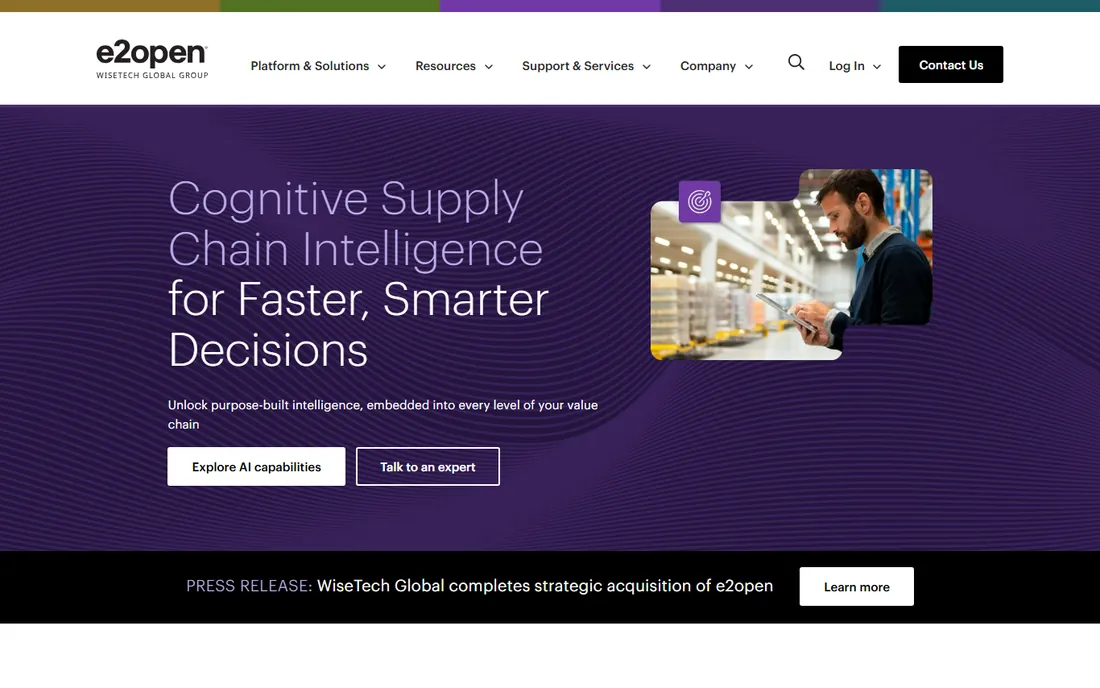
E2open is the "replace five systems" option. Its cloud-native platform covers demand and supply planning, multi-tier supplier collaboration, global trade compliance, logistics execution and channel management, all tied together with a common user experience. The thesis is that visibility is most valuable when it feeds planning and execution directly, without integration middleware between separate tools.
That thesis costs money and time. E2open implementations are enterprise projects measured in quarters, and companies that only need shipment tracking will find it heavy. The fit is for large organizations standardizing their supply chain technology stack, where the alternative is a patchwork of point solutions. If that is your mandate, E2open's breadth is unmatched; if it is not, buy a specialist.
What we like- One platform spanning planning, supply, global trade, logistics and channel
- Network of interconnected manufacturing and logistics partners
- Harmony UX unifies workflows across suites
Watch out for- Suite breadth means long, complex implementations
- Visibility alone is not its strongest module versus specialists
#9
Altana
Best for: Trade compliance, tariffs and value-chain transparency
Visit altana.ai
Starting priceSee website
Free planNo
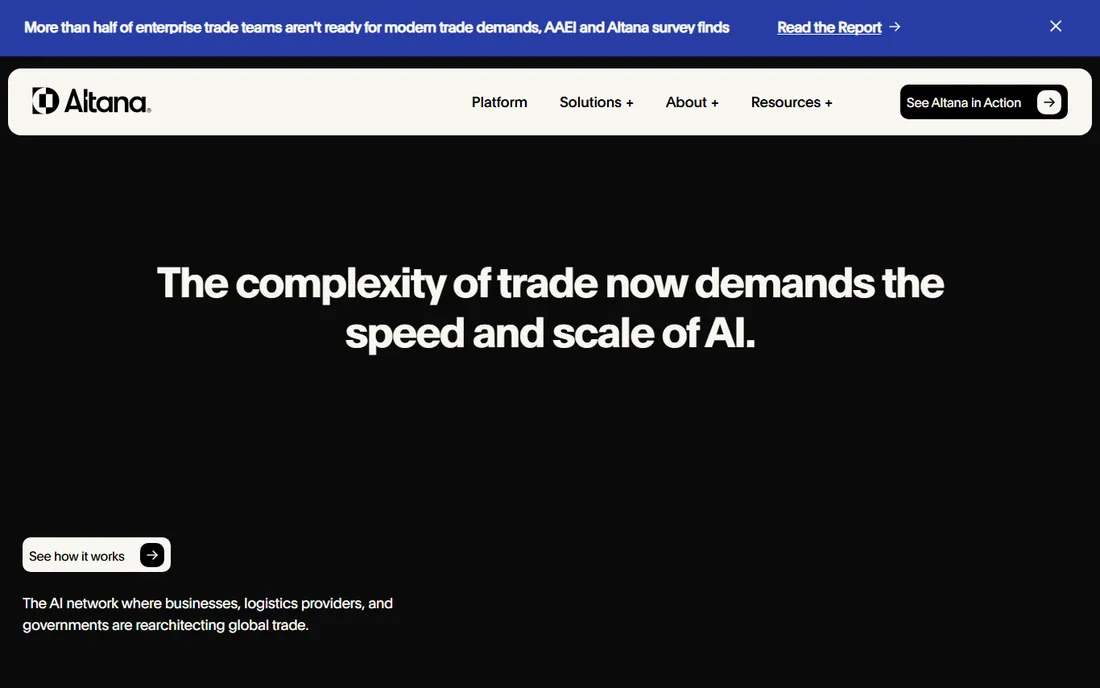
Altana plays in the part of visibility that has become urgent: knowing your product's true value chain for tariffs, sanctions and compliance. Its AI network maps where products come from across tiers, lets businesses prove compliance before goods ship, and quantifies tariff exposure. The company cites concrete outcomes, like $19 million in identified duty overpayments for one manufacturer, and works with US customs authorities on enforcement. Its acquisition of Cervo AI added automated customs-entry capabilities.
This is not a track-and-trace tool. If your problem is late trucks, look elsewhere. But if your problem is answering "what is our tariff exposure if policy X changes" or "prove this shipment has no forced labor in its chain," Altana is purpose-built for it. As trade policy keeps shifting, that capability is moving from nice-to-have to board-level requirement.
What we like- AI-mapped product value chains show where goods actually come from
- Pre-shipment compliance validation and tariff exposure analysis
- Trusted by governments including US customs agencies
Watch out for- Trade-focused scope, not a general logistics visibility tool
- Newer category with evolving pricing and packaging
Shipment tracking is not supply chain visibility
Buyers routinely conflate the two, and vendors encourage it. Shipment tracking tells you where freight is and when it arrives. Supply chain visibility tells you which supplier sites make your critical parts, which of them sit in a flood zone, whose financials are deteriorating, and what happens to your revenue if a port closes. The first is table stakes in 2026; the second is where competitive advantage lives.
Map your purchase to the risk you actually carry. If late deliveries and detention fees are the pain, a tracking network like project44, FourKites or MacroPoint pays back fast. If a single supplier failure stops your production line, you need mapping and risk monitoring from Everstream, Resilinc or Interos. If cargo walks away, you need Overhaul. If tariffs and compliance keep your general counsel up at night, you need Altana. Most large companies end up with two of these, not one, and that is fine: they solve different problems.
How to scope a visibility rollout without boiling the ocean
Start with one lane, one product family or one supplier tier, and define the decision the system must improve. "Reduce expedite spend on the Asia-US lane by 20 percent" beats "achieve end-to-end visibility" as a project goal, because it tells you which data to connect and which alerts matter. Run a 90-day pilot, measure against the baseline, then expand to the next lane with the playbook you just wrote.
Budget the unglamorous parts. Carrier onboarding, EDI and API connections, TMS integration, data cleansing and training usually cost as much as the first year of licenses. Ask every vendor for a reference customer with a similar carrier mix and a similar TMS, and ask that reference how long onboarding really took. Also confirm data export and contract exit terms before you sign; your shipment history is valuable, and you should own it. The platforms that win are the ones your team actually opens every morning, so put user adoption in the contract as a shared success metric.
How we chose
We separated the category into its two real jobs, real-time shipment visibility and predictive supply chain risk monitoring, and picked leaders and credible specialists in each. We read each vendor's own site for current product scope, network claims, AI features and integrations, and marked pricing "See website" throughout because every vendor here sells quote-based enterprise contracts. We cross-checked positioning against analyst coverage and public reviews on G2, and favored platforms with verifiable network scale or differentiated risk capabilities over generic feature lists. No vendor paid for placement, and we made no hands-on testing claims.
Frequently asked questions
What is the difference between shipment visibility and supply chain risk management?
Shipment visibility tracks freight in motion: location, ETAs, delays. Supply chain risk management maps your supplier network across tiers and monitors for disruptions like weather, financial distress, cyber incidents and geopolitics. project44 and FourKites lead the first; Everstream, Resilinc and Interos lead the second. Many enterprises buy one of each.
How much does supply chain visibility software cost?
All nine platforms here use quote-based enterprise pricing, and total cost depends on shipment volume, carrier count, users and modules. Expect implementation, carrier onboarding and integration work on top of licenses. Get at least three quotes and ask each vendor for total first-year cost including services, not just the license fee.
How long does implementation take?
A focused pilot on one lane or product family typically runs 60 to 90 days. Full rollouts across modes, regions and supplier tiers take two to four quarters, with carrier onboarding usually the longest pole. Ask references how long their onboarding took with a similar carrier mix; vendor estimates tend to be optimistic.
Do I need EDI connections for visibility software?
Not necessarily anymore. Modern platforms combine EDI, GPS/telematics, AIS for ocean, carrier APIs and milestone data. EDI still gives the richest status data from large carriers, but API and telematics-based tracking now cover most small and mid-size carriers. Ask each vendor how they cover your specific carrier base.
Can visibility software prevent cargo theft?
It helps, but prevention needs a specialist. General visibility platforms show you where freight is; Overhaul adds risk scoring, geofencing, a 24/7 monitoring center and coordinated recovery with law enforcement. If you ship high-value goods through high-risk lanes, pair a visibility platform with a dedicated cargo-security solution.
What is multi-tier supplier mapping?
It means mapping not just your direct suppliers but their suppliers, down to the site and part level. Everstream, Resilinc, Interos and Altana all do versions of this. It matters because most disruptions originate below tier one, where companies typically have zero visibility. Building the map takes real data effort, but it is the foundation of every serious risk program.
Sources we checked (0)
Is your product missing or out of date?
We review this list regularly. Vendors can request a listing, send updated pricing or ask about featured placement.

Shihab Mia · Founder, Rankite
Shihab has spent more than a decade helping SaaS and e-commerce brands grow through search. He writes Rankite's software buying guides from pricing pages, documentation and public user reviews. More about Shihab.