How we make this list: we compare pricing pages, product documentation and public user reviews. Rankite is independent; if a vendor ever pays for a featured spot, that listing is clearly labeled Partner.
Key takeaways
- Maxio is the strongest all-rounder for B2B SaaS finance teams, combining billing, revenue recognition and SaaS metrics in one system.
- Stripe Billing is the obvious pick if you already process payments on Stripe, with pay-as-you-go pricing at 0.7% of billing volume.
- Zuora and Ordway serve the enterprise end: complex contracts, multi-entity billing and global monetization that smaller tools cannot model.
- Sage Intacct, Xero and QuickBooks are accounting systems first, so pair them with a billing tool unless your subscription model is simple.
- Chargebee and Recurly sit in the flexible middle, with strong dunning and multi-gateway support for growing subscription businesses.
Quick comparison
| Tool | Best for | Starting price | Free plan |
|---|
 Maxio Maxio | B2B SaaS finance teams that want billing, rev rec and metrics together | See website | No |
 Chargebee Chargebee | teams running complex plan trees across multiple gateways | See website | No |
 Ordway Ordway | contract-heavy businesses automating quote-to-cash | See website | No |
 Zuora Zuora | global enterprises with complex monetization programs | See website | No |
 Recurly Recurly | subscription businesses that prioritize retention and recovery | See website | No |
 Stripe Billing Stripe Billing | self-serve SaaS companies already processing on Stripe | 0.7% of billing volume | No |
 Sage Intacct Sage Intacct | finance teams that want recurring revenue close to the general ledger | See website | No |
 Xero Xero | small SaaS businesses that need clean, affordable accounting | $25/month | Free trial (30 days) |
 QuickBooks QuickBooks | small businesses that want accounting, payroll and payments in one place | See website | Free trial (30 days) |
Is your product missing or out of date?
We review this list regularly. Vendors can request a listing, send updated pricing or ask about featured placement.
The best subscription and saas accounting software
#1
Maxio
Best for: B2B SaaS finance teams that want billing, rev rec and metrics together
Visit maxio.com
Starting priceSee website
Free planNo

Maxio was built for the exact problem this category exists to solve: connecting how a SaaS company bills with how it recognizes revenue and reports to the board. It handles subscription, usage-based and hybrid pricing, automates invoicing and dunning, applies GAAP and IFRS revenue recognition rules, and produces ARR, churn and DSO reports without spreadsheet gymnastics. Integrations with NetSuite, Salesforce, Xero and QuickBooks keep it connected to the rest of the stack.
The trade-off is that Maxio is a finance-led platform, not a developer tool. Pricing is quote-based, and rolling it out requires finance ownership rather than a weekend API project. For a B2B SaaS company past the early stage, that depth is exactly what you need. For a tiny startup on simple monthly plans, it is more than necessary.
What we like- Native billing, revenue recognition and SaaS reporting in one platform
- Strong usage-based billing support
- 20+ payment gateway integrations
Watch out for- Quote-only pricing
- Implementation needs real finance involvement
#2
Chargebee
Best for: teams running complex plan trees across multiple gateways
Visit chargebee.com
Starting priceSee website
Free planNo
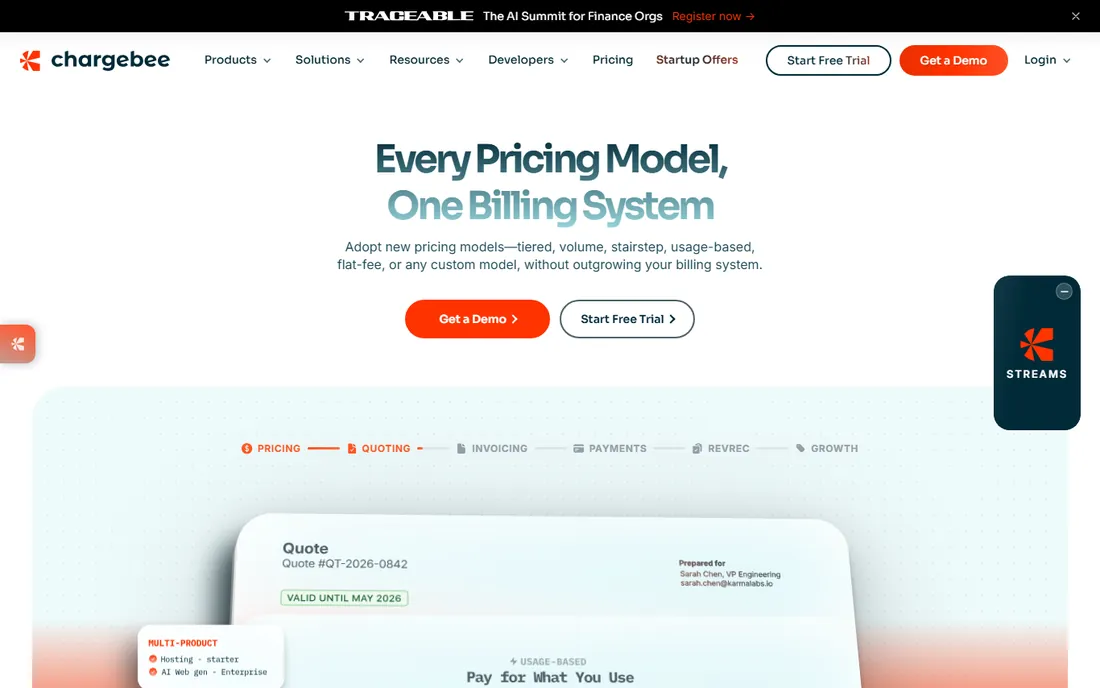
Chargebee shines when your pricing model is the complicated part of your business. Tiered plans, prorations, add-ons, coupons and trials are all first-class concepts, and it connects to more payment gateways than most competitors, which matters for international SaaS. Built-in revenue recognition and integrations with HubSpot, Salesforce and Stripe keep sales and finance aligned.
The honest catch is packaging. Pricing is not published, and the features you need may sit in higher editions or separate products, so the quote can surprise you. For a company with straightforward monthly billing, simpler tools cost less. For a company with a genuinely complex catalog, Chargebee's flexibility is hard to match.
What we like- Flexible subscription logic with tiered, per-seat and usage models
- Broad payment gateway options
- Built-in revenue recognition
Watch out for- Pricing not published
- Advanced features spread across editions and add-ons
Starting priceSee website
Free planNo
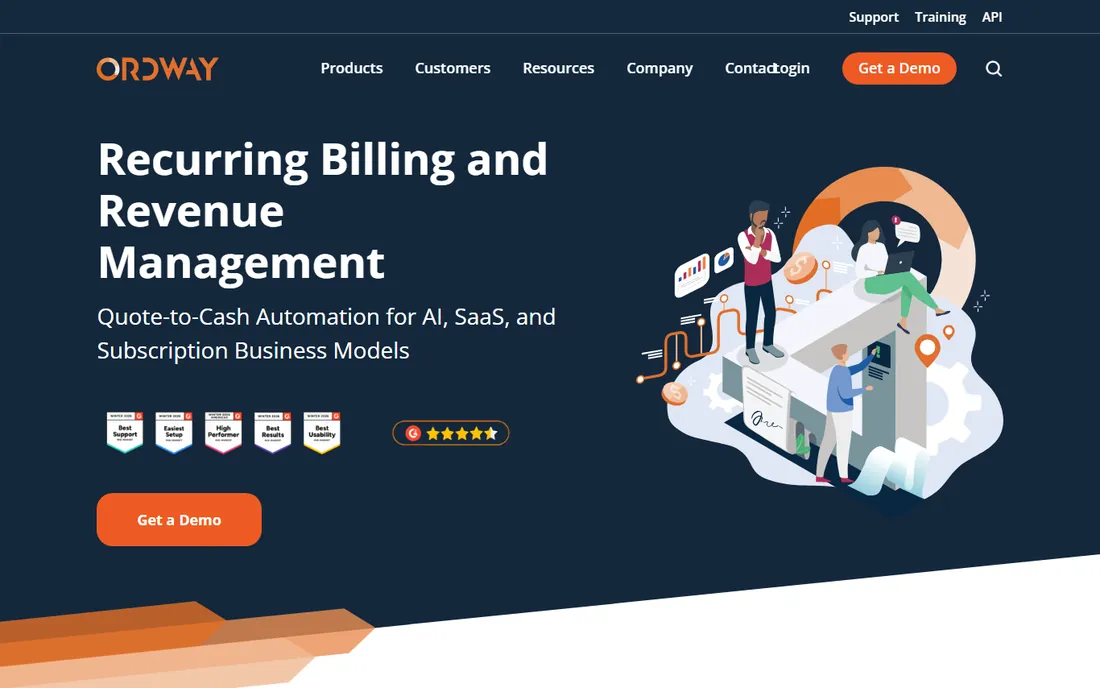
Ordway targets the messy middle of B2B SaaS: negotiated contracts, custom terms, usage overages and amendments that break simpler billing tools. It captures sales orders from your CRM, automates invoicing and revenue schedules, and reports on MRR, ARR, churn and renewals. The pitch is replacing spreadsheet-driven billing with automated workflows that scale.
As a smaller vendor than Zuora or Chargebee, its integration ecosystem and community resources are thinner, which can matter during implementation. Pricing is quote-based with a demo-led sales process. For a SaaS company whose contracts are too complex for basic billing tools but not large enough for Zuora, Ordway is a strong fit.
What we like- Flexible billing engine for subscriptions, usage and transactions
- Automates sales orders into cash and revenue
- SaaS metrics reporting built in
Watch out for- Quote-only pricing
- Smaller ecosystem than Chargebee or Zuora
#4
Zuora
Best for: global enterprises with complex monetization programs
Visit zuora.com
Starting priceSee website
Free planNo
Zuora is the enterprise standard for subscription monetization. Its platform covers the full quote-to-cash cycle: CPQ, billing for recurring, usage and one-time charges, payments, collections and revenue recognition with order-to-revenue controls. Multi-entity billing, global payment connectivity and contract amendments are all handled natively, which is why large global SaaS companies standardize on it.
Everything about Zuora is enterprise: quote-only pricing, months-long implementations and a feature set that assumes a revenue operations team. A company doing under a few million in ARR will find it expensive and heavy. For a global business with hybrid pricing across many entities, it remains the benchmark.
What we like- Mature quote-to-revenue platform for subscriptions, usage and hybrid models
- Multi-entity billing and contract amendments
- Strong revenue recognition automation
Watch out for- Enterprise pricing and long implementations
- Overkill for simple subscription businesses
#5
Recurly
Best for: subscription businesses that prioritize retention and recovery
Visit recurly.com
Starting priceSee website
Free planNo
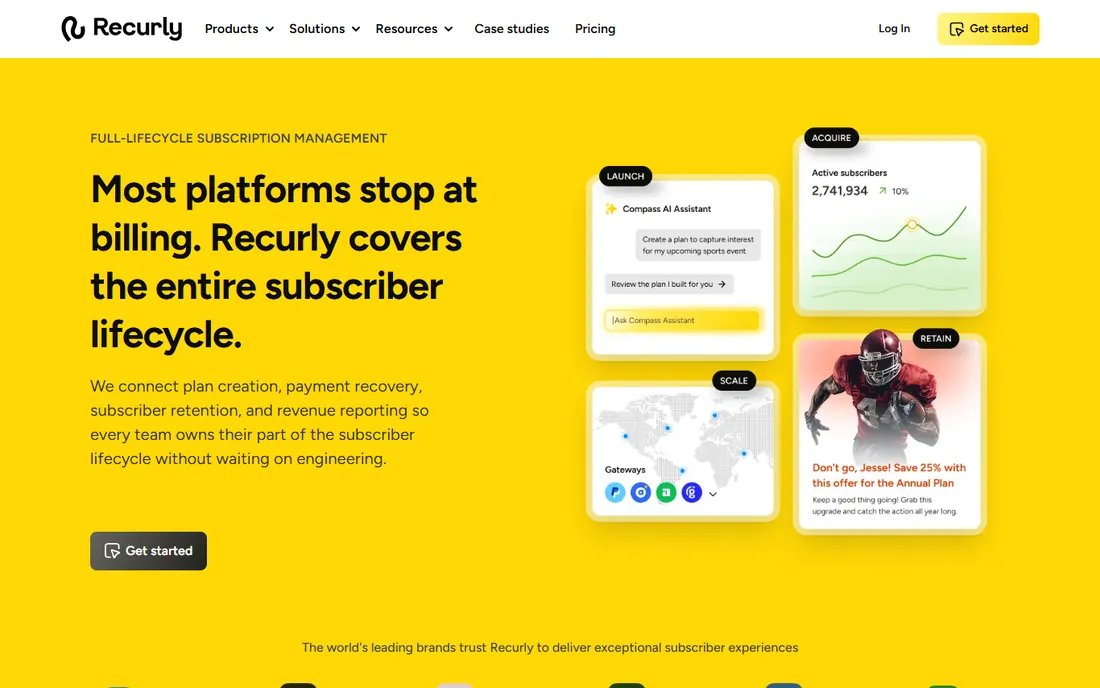
Recurly's differentiator is getting paid. Its configurable dunning strategies, smart retry logic and churn management tools recover failed payments better than most competitors, which directly protects MRR. The platform automates recurring invoices, prorations and usage billing, and its analytics focus on the metrics subscription operators watch daily: churn, recovery rates and subscriber growth.
The limitation is on the B2B side. Complex negotiated contracts and multi-entity quote-to-cash workflows are not Recurly's strength compared with Maxio, Ordway or Zuora. Pricing is not published. For a B2C or prosumer subscription business where involuntary churn is the enemy, Recurly is one of the best choices available.
What we like- Best-in-class dunning and failed-payment recovery
- Subscriber lifecycle management
- Strong analytics on churn and retention
Watch out for- Pricing not published
- B2B contract billing less deep than Maxio or Ordway
#6
Stripe Billing
Best for: self-serve SaaS companies already processing on Stripe
Visit stripe.com
Starting price0.7% of billing volume
Free planNo
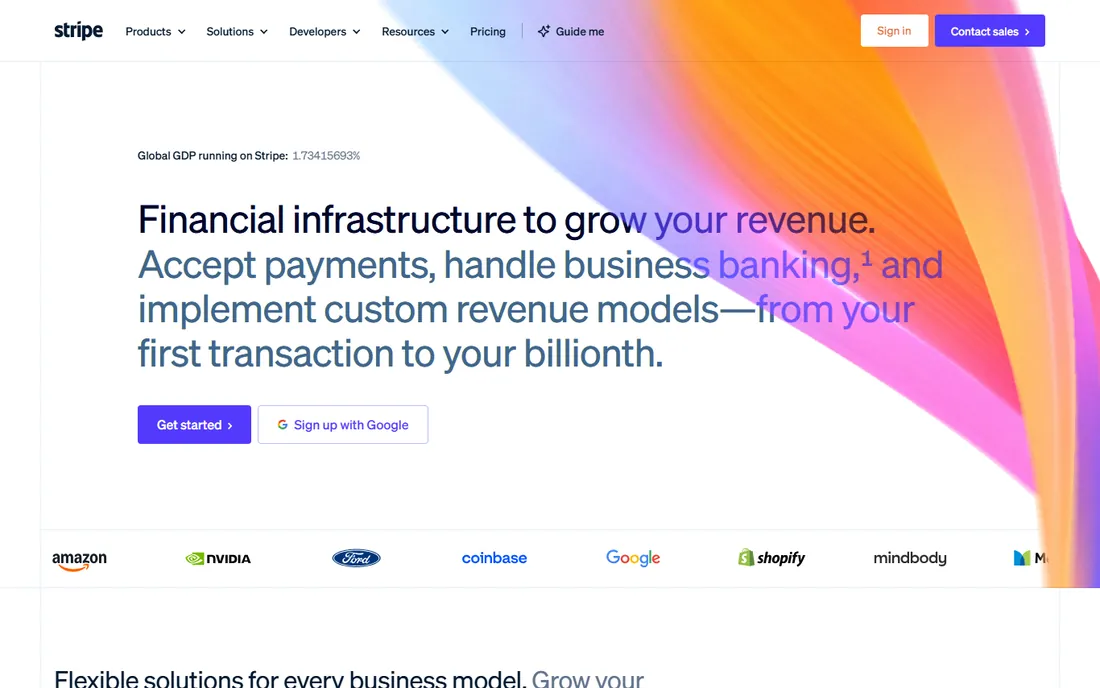
If you already take payments through Stripe, Stripe Billing is the path of least resistance. Its API handles subscriptions, trials, prorations, metered billing and coupons with the flexibility developers expect, and the pay-as-you-go price of 0.7% of billing volume means no fixed subscription cost. An annual plan starting at $620 per month suits higher volumes. With over 200 million active subscriptions on the platform, the infrastructure is proven at scale.
The gap is finance depth. Revenue recognition, sophisticated dunning and SaaS metrics live in add-ons or separate tools, and Stripe Billing is not an accounting system: you still need Xero, QuickBooks or NetSuite for the books. For a developer-led SaaS team, that combination is ideal. For a finance-led team that wants billing and accounting close together, Maxio or Sage Intacct fit better.
What we like- API-first billing for any pricing model
- Pay-as-you-go pricing with no base fee
- 200M+ subscriptions managed on the platform
Watch out for- Revenue recognition and advanced dunning need add-ons
- You will still need a separate accounting system
#7
Sage Intacct
Best for: finance teams that want recurring revenue close to the general ledger
Visit sageintacct.com
Starting priceSee website
Free planNo
Sage Intacct is an accounting system first, which is exactly why finance teams choose it. It handles multi-entity consolidations, multi-currency, project accounting and GAAP-compliant revenue recognition with the controls auditors expect. Built-in AI agents now help with the close, AP automation and anomaly detection. For a scaling SaaS company, having subscription revenue flow straight into a proper general ledger simplifies the audit and the board reporting.
The commitment is real: annual subscriptions are quote-based, and implementations typically run three to six months. Sage Intacct does not replace a billing platform; it pairs with one, since it is not built for self-serve subscription checkout. Use it as the accounting core and connect Maxio, Chargebee or Stripe Billing for the billing side.
What we like- True cloud accounting with multi-entity and multi-currency support
- Strong revenue recognition and close management
- AI agents for close, AP and anomaly detection
Watch out for- Quote-only annual pricing
- Implementation typically takes 3 to 6 months
#8
Xero
Best for: small SaaS businesses that need clean, affordable accounting
Visit xero.com
Starting price$25/month
Free planFree trial (30 days)

Xero is the small-business accounting standard for good reason: it is affordable, easy to use and connects to over a thousand apps. The Early plan at $25 per month covers invoicing, quotes, bill tracking and sales tax, with Growing at $55 and Established at $90 adding automation and multi-currency. For a small SaaS company with simple monthly billing, Xero plus a billing add-on is a legitimate stack.
It is not subscription billing software. Recurring billing logic, usage metering, dunning and SaaS revenue recognition all require integrations or add-ons. Xero's role in this list is as the accounting layer: pair it with Stripe Billing or Chargebee for billing, and let Xero handle the books, tax and financial reporting.
What we like- Early plan at $25 per month with invoicing and sales tax
- 1,000+ app integrations
- Simple, well-designed interface
Watch out for- Not built for complex subscription billing
- Revenue recognition needs add-ons
Starting priceSee website
Free planFree trial (30 days)
QuickBooks Online is the default accounting choice for millions of small businesses, and its ecosystem is unmatched: over 800 integrations, built-in payroll, payments, invoicing and sales tax, all in one login. For a small SaaS or services business, it handles the core accounting job reliably, and your accountant almost certainly knows it.
Like Xero, QuickBooks is not a subscription billing platform. Recurring billing exists but is basic, and serious SaaS metrics, usage billing and revenue recognition need dedicated tools or add-ons. Its place in your stack is the general ledger and financial hub. Connect a real billing tool for subscriptions, and let QuickBooks do what it does best.
What we like- Most widely used small-business accounting platform
- 800+ integrations
- Built-in payroll, payments and sales tax
Watch out for- Pricing not published on the homepage
- Recurring revenue features are basic compared with dedicated billing tools
How we chose
We selected tools that exist today and are actively used by subscription and SaaS businesses for billing, revenue recognition or accounting. We verified each vendor's homepage, checked published pricing on the vendors' own pricing pages, and marked quote-based tools as "see website" rather than guessing. We cross-referenced public comparisons and review data from G2 and similar sources, and we included both billing-first platforms and accounting systems because real SaaS stacks combine the two. We did not hands-on test these products; the write-ups reflect documented features, published pricing and public buyer feedback.
Pricing explained: what you will actually pay
Billing tools and accounting tools price differently, and the total stack matters more than any single number. Stripe Billing charges 0.7% of billing volume with no base fee, which is cheap at $10,000 MRR and meaningful at $1 million. Xero starts at $25 per month and QuickBooks offers a 30-day trial, so the accounting layer is the cheapest part of the stack.
The expensive layer is the mid-market billing platform. Maxio, Chargebee, Ordway, Zuora and Recurly all keep prices behind sales conversations, which usually means several hundred to several thousand dollars per month depending on volume and modules. Budget for implementation too: a finance-led rollout of Maxio or Sage Intacct takes weeks to months, while Stripe Billing can be live in days with developer time. Always model the three-year cost, including the accounting system, the billing platform and any revenue recognition add-ons, before you choose.
What to look for before you buy
Start by separating billing from accounting in your head. Billing tools (Maxio, Chargebee, Stripe Billing, Zuora, Recurly, Ordway) charge customers, handle trials and dunning, and model your pricing. Accounting systems (Sage Intacct, Xero, QuickBooks) keep the general ledger, handle the close and satisfy auditors. Most SaaS companies need one of each, connected by an integration.
Second, match the tool to your pricing model. Simple per-seat monthly billing works on almost anything, including Stripe Billing or even Xero with an add-on. Usage-based pricing needs real metering: Maxio, Stripe Billing and Zuora handle it natively. Negotiated B2B contracts with amendments point to Maxio, Ordway or Zuora. Failed-payment recovery as a priority points to Recurly.
Third, check revenue recognition requirements early. If you are audited or approaching one, you need automated rev rec that follows GAAP or IFRS rules, not spreadsheet schedules. Maxio, Zuora and Sage Intacct handle this natively; Stripe Billing and Chargebee cover it through their own modules or add-ons; Xero and QuickBooks need help. Ask each vendor how contract modifications and usage overages flow into recognized revenue before you sign.
Frequently asked questions
What is the difference between subscription billing software and accounting software?
Billing software manages the customer-facing side: plans, subscriptions, invoicing, dunning and payment collection. Accounting software manages the books: the general ledger, financial statements, tax and the month-end close. SaaS companies typically run both, with the billing tool feeding recognized revenue into the accounting system.
Do I need revenue recognition software for my SaaS?
If you sell annual contracts paid upfront, yes, eventually. GAAP and IFRS require spreading that revenue over the service period, and doing it in spreadsheets breaks down as contract volume grows. Tools like Maxio, Zuora and Sage Intacct automate it; Stripe Billing and Chargebee offer it as modules.
How much does SaaS billing software cost?
Stripe Billing costs 0.7% of billing volume with no base fee. Xero starts at $25 per month. Mid-market platforms like Maxio, Chargebee, Ordway and Recurly are quote-based and typically run several hundred to several thousand dollars per month. Enterprise tools like Zuora and Sage Intacct start higher with annual contracts.
Can QuickBooks or Xero handle subscription billing alone?
For very simple monthly billing, yes, with their recurring invoice features. For trials, usage-based pricing, dunning, prorations and SaaS metrics, no. Pair them with a dedicated billing platform like Stripe Billing or Chargebee and let the accounting system handle the ledger.
What is dunning and why does it matter?
Dunning is the automated process of retrying failed payments and notifying customers before canceling their subscription. Involuntary churn from failed cards quietly eats 2 to 5 percent of MRR for many SaaS businesses. Recurly specializes in this, and most billing platforms include configurable dunning workflows.
How long does implementation take?
Developer-led tools like Stripe Billing can be live in days. Finance-led platforms like Maxio or Chargebee typically take four to twelve weeks. Enterprise systems like Zuora and Sage Intacct often take three to six months. Plan your timeline around your next audit or fundraising milestone, not around the vendor's sales cycle.
Sources we checked (12)
- https://maxio.com/
- https://www.chargebee.com
- https://ordwaylabs.com/
- https://zuora.com/
- https://www.recurly.com
- https://stripe.com/pricing
- https://sageintacct.com/
- https://www.xero.com
- https://quickbooks.intuit.com
- https://unibee.dev/blog/best-subscription-management-software-review/
- https://www.guideflow.com/blog/recurring-revenue-finance-software
- https://bunny.com/blog/best-subscription-billing-platform-for-saas-companies/
Is your product missing or out of date?
We review this list regularly. Vendors can request a listing, send updated pricing or ask about featured placement.

Shihab Mia · Founder, Rankite
Shihab has spent more than a decade helping SaaS and e-commerce brands grow through search. He writes Rankite's software buying guides from pricing pages, documentation and public user reviews. More about Shihab.