How we make this list: we compare pricing pages, product documentation and public user reviews. Rankite is independent; if a vendor ever pays for a featured spot, that listing is clearly labeled Partner.
Key takeaways
- Anrok and Kintsugi are built for SaaS and ecommerce teams that need full-cycle compliance without hiring a tax department, while Avalara and Vertex suit enterprises with ERP-heavy finance stacks.
- TaxJar remains the most approachable option for small ecommerce sellers, with Starter plans from $39 per month and a 30-day free trial.
- Zamp and Kintsugi both bundle human tax experts with the software, which matters when a state sends a notice and code alone cannot answer it.
- Quaderno is the budget pick for digital businesses that sell across borders, starting at €29 per month with a 7-day free trial.
- Avalara, Vertex, Sovos and Zamp do not publish prices, so budget at least a few thousand dollars per year and get a quote early.
Quick comparison
| Tool | Best for | Starting price | Free plan |
|---|
 Avalara AvaTax Avalara AvaTax | large enterprises with complex, multi-entity compliance | See website | No |
 TaxJar TaxJar | small ecommerce sellers that need filings done for them | $39/month | Free trial (30 days) |
 Vertex Vertex | global enterprises running SAP, Oracle or other major ERPs | See website | No |
 Anrok Anrok | SaaS and digital companies with US and global exposure | See website | No |
 Kintsugi Kintsugi | SMBs that want flat-rate pricing and human support | See website | No |
 TaxCloud TaxCloud | mid-market ecommerce sellers that want human support | See website | Free trial (30 days) |
 Sovos Sovos | global enterprises with VAT, e-invoicing and US sales tax needs | See website | No |
 Zamp Zamp | growing businesses that want a done-for-you service | See website | No |
 Quaderno Quaderno | digital businesses and SaaS startups selling across borders | From €29/month | Free trial (7 days) |
Is your product missing or out of date?
We review this list regularly. Vendors can request a listing, send updated pricing or ask about featured placement.
The best accounting software for sales tax management
#1
Avalara AvaTax
Best for: large enterprises with complex, multi-entity compliance
Visit avalara.com
Starting priceSee website
Free planNo

Avalara is the default choice most enterprise buyers evaluate first, and for good reason. AvaTax calculates sales tax, VAT and other transaction taxes in real time across a huge coverage footprint, and the company files millions of returns a year. If your finance stack runs on NetSuite, SAP or Dynamics, Avalara almost certainly has a signed integration for it. The platform also bundles nexus monitoring, exemption certificate management and automated returns filing, which is what finance teams actually pay for at scale.
The honest catch is cost and complexity. There is no public pricing, and enterprise contracts typically start in the low thousands per year and climb with transaction volume and add-on modules. Onboarding a multi-entity business takes real project management. Small sellers will find simpler and cheaper tools on this list that cover their needs without the enterprise overhead.
What we like- Covers 190+ countries and 12,000+ US jurisdictions
- Deep ERP and ecommerce integrations
- Automated returns and exemption certificate management
Watch out for- No public pricing
- Implementation can take months for complex setups
#2
TaxJar
Best for: small ecommerce sellers that need filings done for them
Visit taxjar.com
Starting price$39/month
Free planFree trial (30 days)
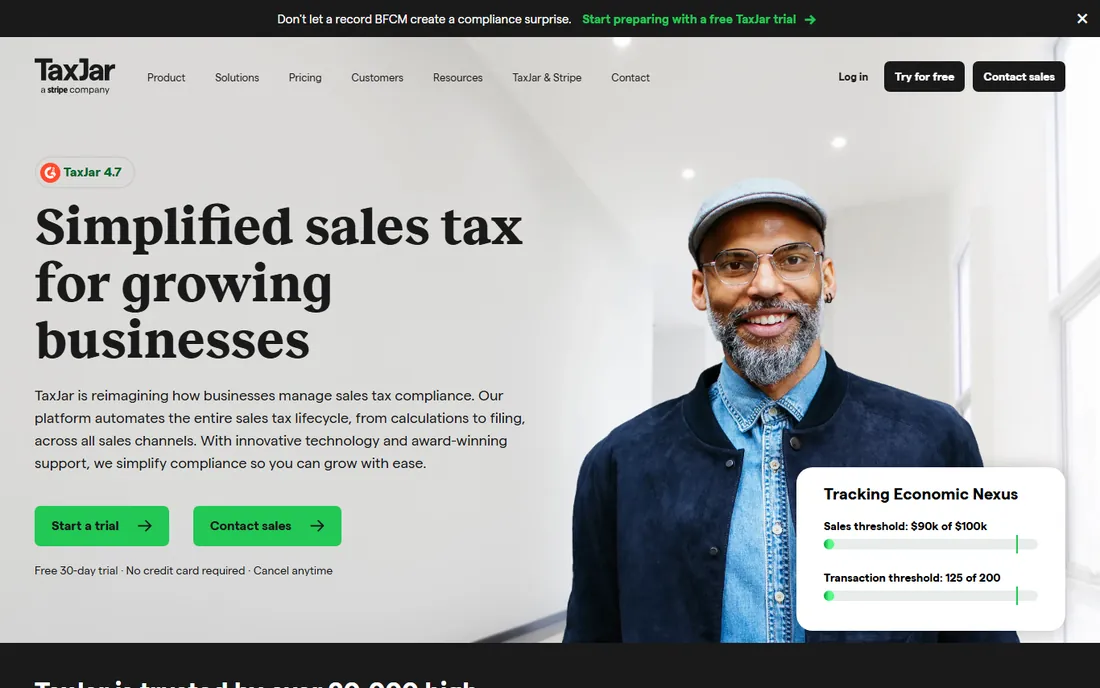
TaxJar focuses on doing one thing well for growing online sellers: calculate the right rate, track where you owe tax, and file the returns. The Starter plan begins at $39 per month, and the Professional plan adds API access, more integrations and more free AutoFile credits per year. Setup is genuinely quick compared with enterprise platforms, and the integrations with major ecommerce platforms are well maintained.
Where TaxJar shows its limits is at the top end. Multi-entity businesses, complex product taxability and global VAT are outside its sweet spot. If you sell physical goods in a handful of states and want someone to file for you, it is one of the best values available. If your tax picture spans continents, look at Avalara, Vertex or Sovos instead.
What we like- Simple plans with a free trial
- AutoFile submits returns in many states
- Strong Shopify, Amazon and WooCommerce integrations
Watch out for- Advanced API and notice management sit on the higher Professional plan
- Not built for complex enterprise tax scenarios
#3
Vertex
Best for: global enterprises running SAP, Oracle or other major ERPs
Visit vertexinc.com
Starting priceSee website
Free planNo
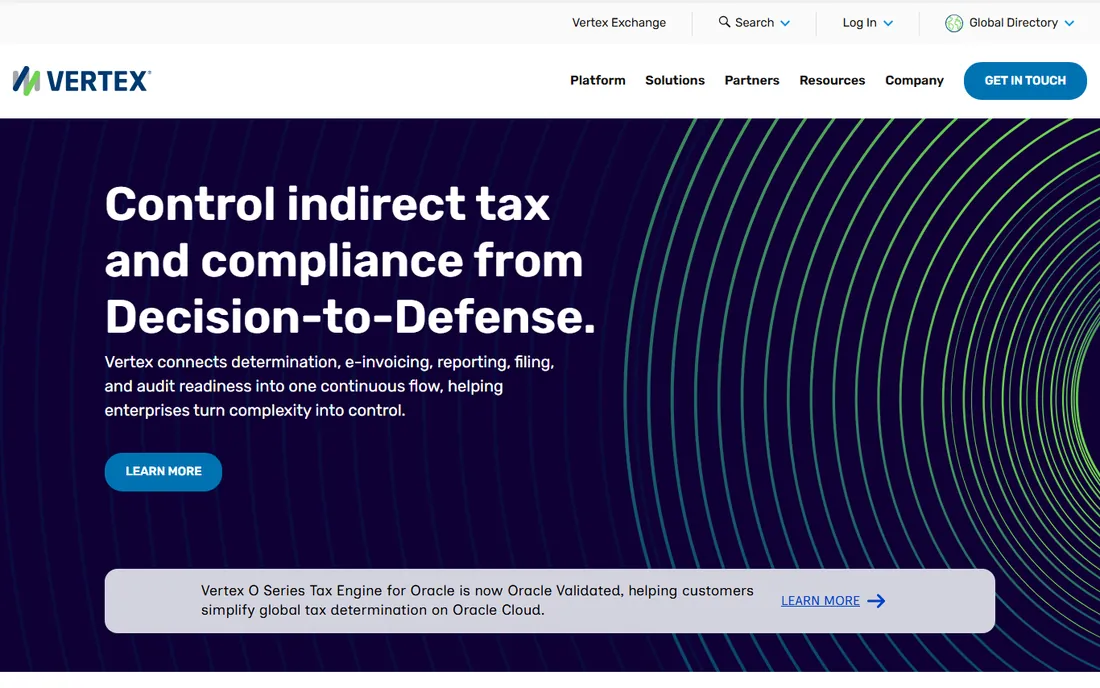
Vertex has served enterprise tax departments for decades, and it shows in the product's depth. Its tax engine handles determination, filing and audit readiness for indirect tax worldwide, with native integrations into the ERP systems large companies actually run. Walmart, Siemens and Ford are among the customers featured on its site, which tells you the target buyer clearly enough.
This is not software a small business buys. Pricing is quote-only, implementations are projects rather than sign-ups, and the feature set assumes a tax team will operate it. For a mid-market company outgrowing a simpler tool, Vertex is the natural next step up. For a startup, it is far more than you need.
What we like- Enterprise-grade tax determination with deep ERP integration
- Global VAT coverage across dozens of countries
- Strong audit and reporting controls
Watch out for- Quote-only pricing
- Overkill for small sellers
#4
Anrok
Best for: SaaS and digital companies with US and global exposure
Visit anrok.com
Starting priceSee website
Free planNo
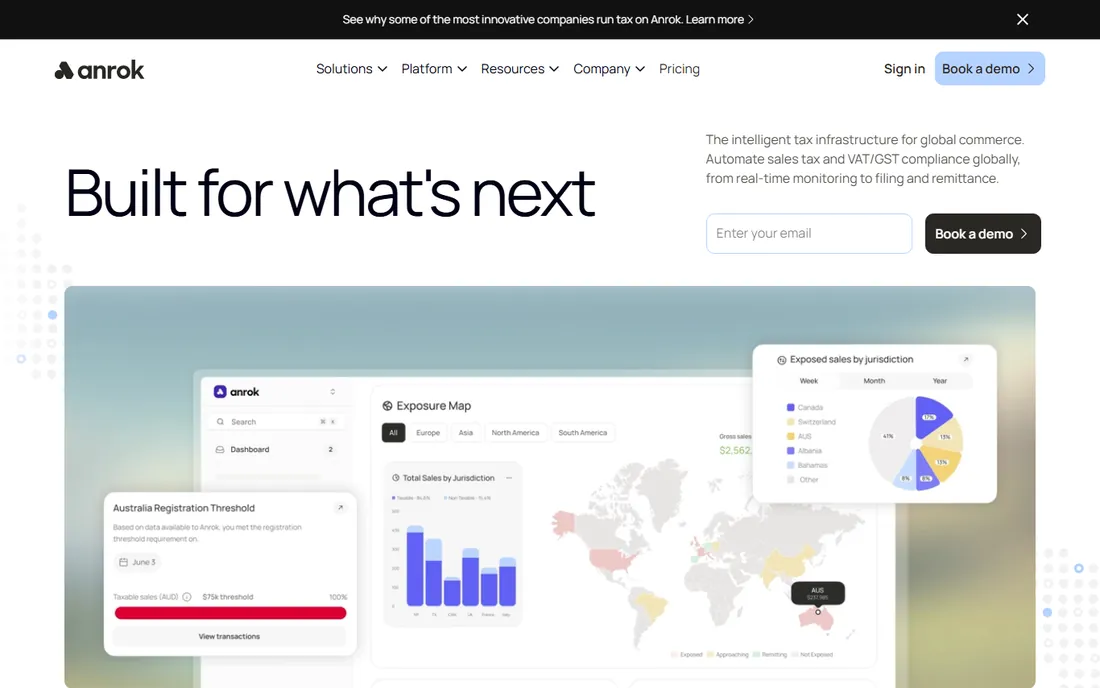
Anrok was built for the kind of company that outgrows spreadsheets but dreads enterprise software. It handles the full compliance chain: detecting nexus, registering you with the state, calculating tax at checkout, filing returns and remitting payment. Integrations with Stripe, NetSuite, Salesforce, Zuora and QuickBooks are native, and the company claims implementation takes one to four weeks, which is fast for this category.
The trade-off is pricing transparency. Like Avalara, Anrok keeps its prices behind a sales conversation, with per-market monthly pricing reported in the $50 to $100 range. Physical-goods support has been expanding but remains newer than its digital-goods core. For a SaaS company selling into many states, it is one of the strongest fits on this list.
What we like- End-to-end lifecycle from nexus monitoring to filing and remittance
- Built for modern billing stacks like Stripe and Chargebee
- Live in one to four weeks
Watch out for- No public pricing
- Physical-goods coverage is newer than its SaaS roots
Starting priceSee website
Free planNo
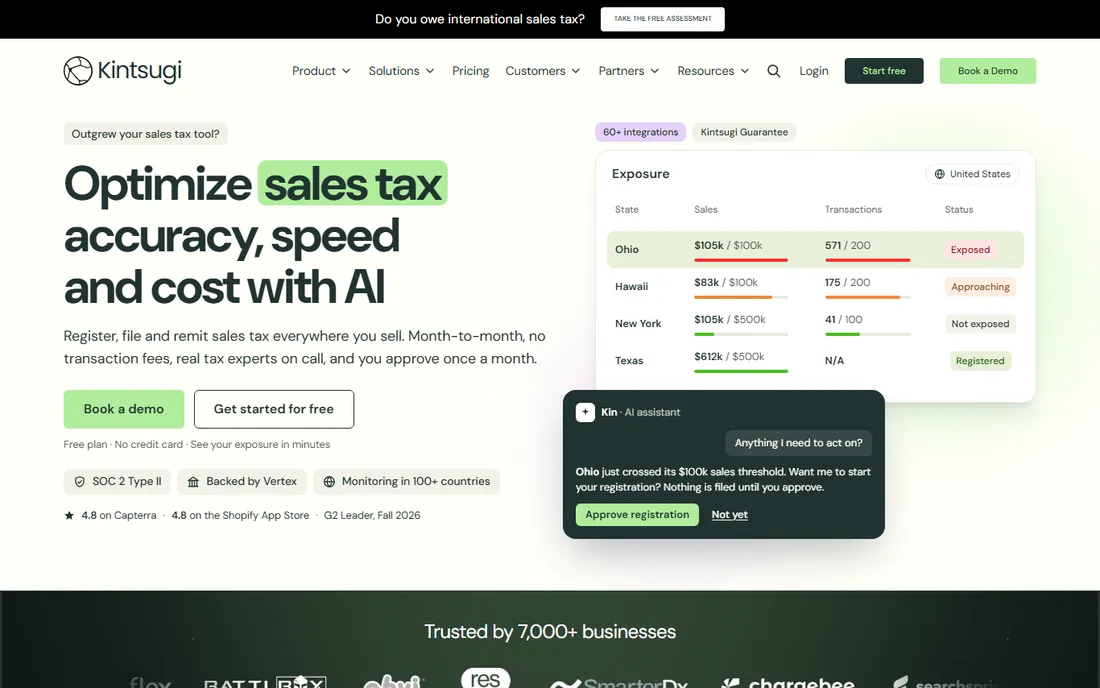
Kintsugi positions itself as the middle path between DIY software and expensive enterprise contracts. It monitors your exposure across every US state and 100+ countries, registers you where needed, files returns on every cadence and backs it all with real human support. For NetSuite customers, it runs Vertex's enterprise tax engine inside its own workflows, which is an unusual and genuinely interesting architecture.
The company does not publish its prices, though it advertises flat-rate monthly billing with no per-transaction fees. As a newer vendor, it has a shorter track record than the incumbents, which matters for something as unforgiving as tax filings. If predictable pricing and responsive support matter more to you than brand history, it deserves a demo.
What we like- Flat-rate monthly pricing with no per-transaction fees
- Exposure monitoring and exemption management included
- Vertex's enterprise tax engine under the hood
Watch out for- Pricing not published on the site
- Newer brand than Avalara or Vertex
#6
TaxCloud
Best for: mid-market ecommerce sellers that want human support
Visit taxcloud.com
Starting priceSee website
Free planFree trial (30 days)
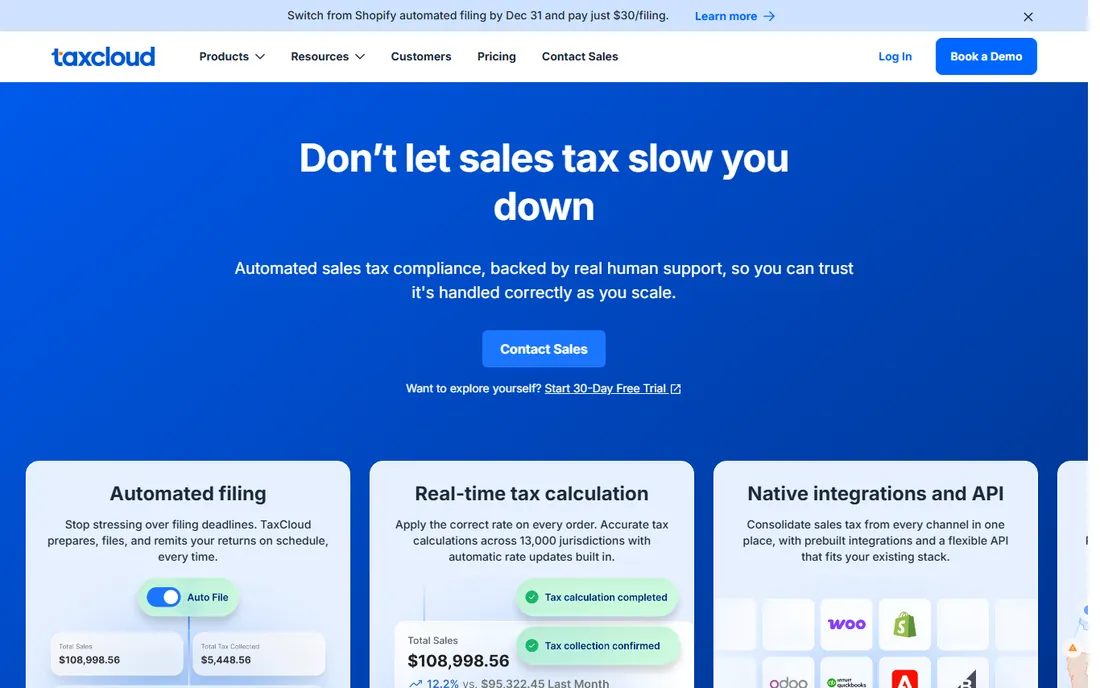
TaxCloud is a certified service provider in the Streamlined Sales Tax program, which means member-state filings can be heavily discounted or free, a real cost advantage for sellers with nexus in many SST states. The company leans hard on its US-based human support team as a differentiator, and its reviews on Shopify and G2 consistently mention onboarding quality.
The limitation is geographic. TaxCloud covers US states and Canada, so businesses with serious EU or UK VAT exposure need a different tool. Pricing is described as flexible and transparent but the actual numbers live behind a sales process. For a US ecommerce brand doing a few million in revenue, the combination of SST discounts and human support is compelling.
What we like- US-based human support team
- Streamlined Sales Tax certified provider with SST discounts
- 30-day free trial
Watch out for- US-focused, limited international coverage
- Pricing details require a sales conversation
#7
Sovos
Best for: global enterprises with VAT, e-invoicing and US sales tax needs
Visit sovos.com
Starting priceSee website
Free planNo

Sovos plays at the top of the market, combining tax determination, global e-invoicing mandates, VAT compliance in roughly 200 countries and information reporting like 1099s. Half the Fortune 500 reportedly use it, and the company backs its software with managed services teams that prepare and file returns on your behalf. If your compliance spans US sales tax, EU VAT and Latin American e-invoicing mandates, few vendors can cover all three.
Everything about Sovos signals enterprise: quote-only pricing, sales-led onboarding and a feature set built for tax departments, not founders. Small and mid-market buyers will find the engagement model too heavy. For a global finance team consolidating vendors, though, it is a serious contender against Avalara and Vertex.
What we like- One platform for indirect tax, e-invoicing and information reporting
- ~200 countries covered
- Managed filing services available
Watch out for- Enterprise-only pricing and sales process
- Too heavy for small businesses
#8
Zamp
Best for: growing businesses that want a done-for-you service
Visit zamp.com
Starting priceSee website
Free planNo
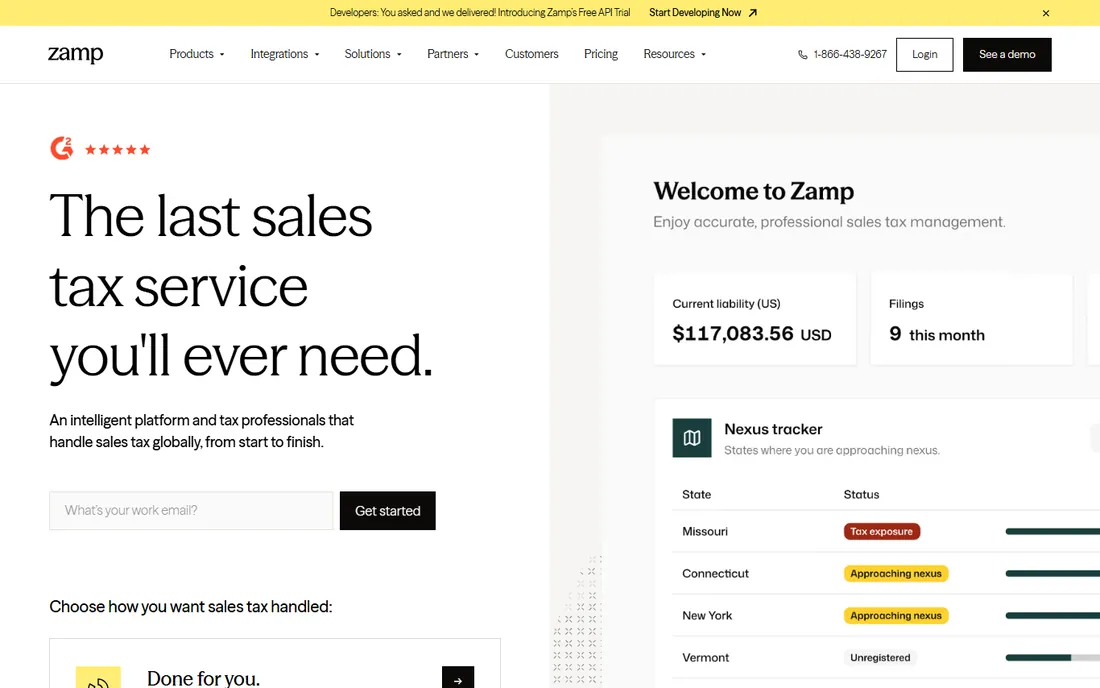
Zamp deliberately positions against DIY tax software: you hand over sales tax entirely, and a dedicated team of specialists handles nexus monitoring, registrations, calculations, filings, remittance and even state notices. The platform calculates rates down to the exact address using geospatial data, and pricing is a flat monthly fee with no per-transaction charges.
The catch is the model itself. A managed service costs more than pure software, and you give up the self-service control that some finance teams prefer. For a lean ecommerce or SaaS team that would rather never think about sales tax again, that trade is exactly the point. For finance teams that want to keep compliance in-house, the other tools on this list fit better.
What we like- Dedicated tax experts handle the whole lifecycle
- Rooftop-accurate calculations
- No per-transaction fees
Watch out for- Premium managed-service pricing
- Less self-service control than pure software tools
#9
Quaderno
Best for: digital businesses and SaaS startups selling across borders
Visit quaderno.io
Starting priceFrom €29/month
Free planFree trial (7 days)
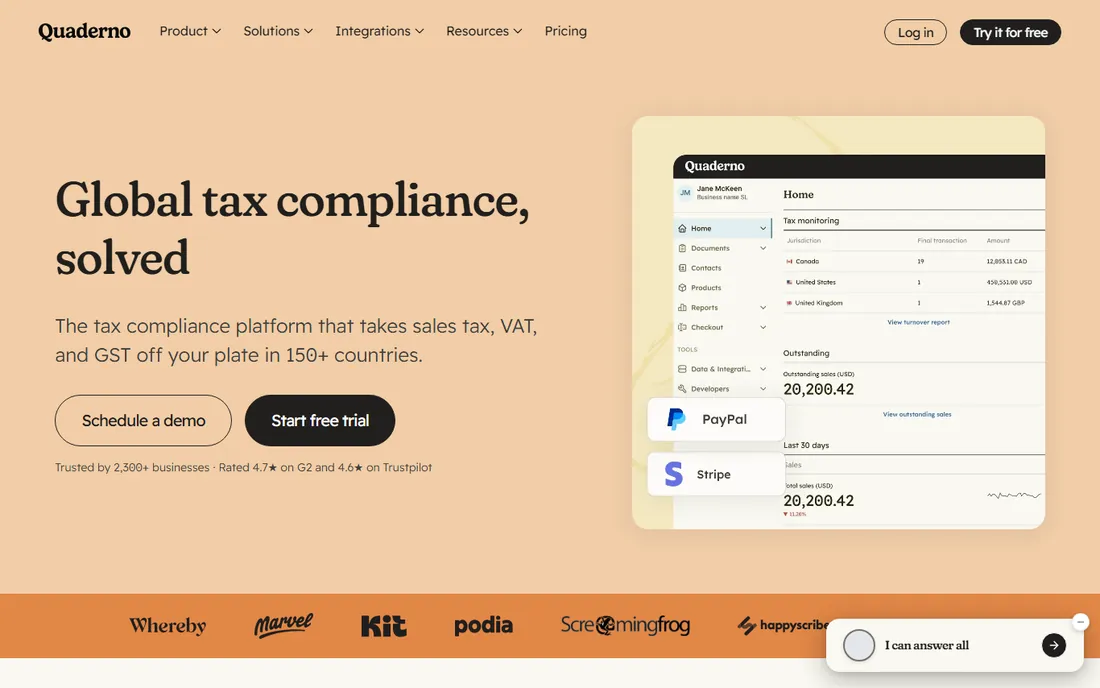
Quaderno is the most affordable way to get genuine global coverage. Plans start at €29 per month based on monthly transaction volume, and every plan covers sales tax, VAT and GST calculations, threshold monitoring, compliant invoicing and e-invoicing mandates. A 7-day free trial requires no credit card, which makes evaluation painless.
The compromise is depth. Automated filing in some jurisdictions costs extra, and the feature set is lighter than Avalara or Anrok for complex US multi-state scenarios. For a SaaS startup or digital creator selling worldwide from a small team, Quaderno's price-to-coverage ratio is hard to beat. For a company with nexus in 30 states, budget for the higher tiers or a managed alternative.
What we like- Cheapest entry point on this list
- Covers sales tax, VAT and GST in 150+ countries
- E-invoicing compliance built in
Watch out for- Filing is partly a paid add-on
- 7-day trial is short
How we chose
We evaluated tools that exist today and are actively sold for sales tax compliance in the US, then ranked them for small and mid-size buyers rather than enterprise procurement teams. We checked each vendor's own website and pricing page for current plans, free trials and coverage claims, cross-referenced public comparisons and review sites including G2 and Capterra, and noted where vendors hide pricing behind sales calls. We did not test-drive every product; the recommendations below reflect published features, documented pricing, review sentiment and fit for common buyer profiles.
What to check before you buy
Start with nexus, not features. List the states and countries where you have physical or economic nexus today, and estimate how many you will add in the next two years. A tool that is perfect for five states becomes expensive or inadequate at thirty, and migration between tax vendors mid-year is painful because of registration and filing history.
Second, decide who files. Some tools calculate rates and hand you reports; others, like TaxJar's AutoFile, Zamp and Kintsugi, actually submit returns and remit payment. Filing responsibility is the single biggest cost driver in this category. If your team has no one who wants to own deadlines, pay for managed filing.
Third, check the integrations that matter to you. A tax tool that syncs cleanly with your billing system (Stripe, Chargebee, NetSuite, Shopify) will save more money than a cheaper tool that needs CSV uploads. Ask for a sandbox or trial with your own transaction data before signing, and confirm how the vendor handles exemption certificates if you sell B2B.
Managed service vs. software-only: which model fits
Pure software tools like Avalara, TaxJar and Quaderno give you automation and reports, but your team still owns the compliance outcome. Managed or hybrid providers like Zamp, Kintsugi and Sovos's managed services put a human team between you and the state revenue department. The price gap between the two models is real, often several times the software cost.
The right choice depends on your internal capacity. A company with a controller or tax manager can run software-only tools effectively and keep costs down. A lean team without tax expertise should treat managed service as insurance: when a state sends a notice or audits a filing, a specialist who has seen it a hundred times is worth more than any feature list. Watch out for contracts that lock you into annual terms before you have validated accuracy against your own data.
Frequently asked questions
Do I need sales tax software if I only sell in a few states?
Probably, once you cross economic nexus thresholds, which are typically $100,000 in sales or 200 transactions per state. Tracking thresholds manually works for a while, but most businesses cross a new state's threshold months before anyone notices. Nexus monitoring is the feature that pays for itself first.
What is the difference between calculation and filing?
Calculation determines the correct tax rate at checkout. Filing means preparing the return, submitting it to the state and remitting the money by the deadline. Many tools do both, but some only calculate and leave filing to you, so confirm which model a vendor uses before you buy.
How much does sales tax software cost?
Small-business tools like TaxJar and Quaderno start around $29 to $39 per month. Mid-market platforms like Anrok and Kintsugi typically run a few hundred dollars per month. Enterprise tools like Avalara, Vertex and Sovos are quote-based and usually start in the low thousands per year.
Can these tools handle VAT and GST too?
Several can. Avalara, Vertex, Sovos, Anrok, Kintsugi and Quaderno all cover VAT, GST or both to varying degrees. TaxJar and TaxCloud are primarily US-focused. If you sell into the EU or UK, confirm filing support specifically, since some tools calculate VAT but do not file returns.
What happens if I switch providers mid-year?
Expect a data migration project. Your new vendor needs historical transaction data, existing state registrations, filing frequencies and exemption certificates. Reputable vendors offer white-glove onboarding for exactly this reason. Plan the switch during a quiet filing period, not in January.
Do I still need an accountant if I use sales tax software?
Yes, for strategy. Software handles calculation, filing and deadline tracking, but it does not decide your nexus exposure strategy, handle audits or advise on voluntary disclosure agreements for back taxes. Use the software for execution and a tax professional for judgment.
Sources we checked (13)
- https://www.avalara.com
- https://taxjar.com/pricing
- https://vertexinc.com/
- https://anrok.com/
- https://trykintsugi.com/
- https://taxcloud.com/
- https://sovos.com/
- https://zamp.com/
- https://quaderno.io/pricing
- https://www.itechguides.com/best/sales-tax-software/
- https://www.techrepublic.com/article/best-sales-tax-software/
- https://www.galvix.com/article/best-sales-tax-software/
- https://avask.com/blog/sales-tax-and-vat-compliance-software/
Is your product missing or out of date?
We review this list regularly. Vendors can request a listing, send updated pricing or ask about featured placement.

Shihab Mia · Founder, Rankite
Shihab has spent more than a decade helping SaaS and e-commerce brands grow through search. He writes Rankite's software buying guides from pricing pages, documentation and public user reviews. More about Shihab.