How we make this list: we compare pricing pages, product documentation and public user reviews. Ratings come from G2, Capterra or Trustpilot, with the date we checked them.
Key takeaways
- Fidelity is the strongest all-round app for long-term investors, with $0 commissions on US stocks and ETFs, fractional shares from $1, and broad retirement accounts.
- Robinhood and Webull suit mobile-first traders, while Schwab and E*TRADE offer deeper research and active trading platforms.
- Vanguard suits investors who mainly buy index funds and hold them, rather than traders who want advanced charting.
- Public stands out for multi-asset investing, AI research summaries, and earnings coverage in one app.
- This is not financial advice. Investing can lose money, so check fees, account protection, and whether an app is available in your country before opening an account.
Quick comparison
| Tool | Best for | Starting price | Free plan |
|---|
 Fidelity Investments | Long-term investors and retirement savers | Free ($0 commissions on US stocks and ETFs) | Yes |
 Charles Schwab | Investors who want research, education, and human support | Free ($0 commissions on US stocks and ETFs) | Yes |
 Robinhood | Mobile-first beginners who want a simple app | Free ($0 commissions on US stocks and ETFs) | Yes |
 Webull | Active traders who want charts, data, and practice trading | Free ($0 commissions on US stocks and ETFs) | Yes |
 Vanguard | Index fund investors who plan to hold for years | Free ($0 commissions on most US stocks and ETFs) | Yes |
 E*TRADE | Traders who want research and a strong web platform | Free ($0 commissions on US stocks and ETFs) | Yes |
 Interactive Brokers | Advanced and international traders | Free (IBKR Lite with $0 US stock and ETF commissions) | Yes |
 Public | Multi-asset investors who want news and research summaries | Free ($0 commissions on stocks and ETFs) | Yes |
Is your product missing or out of date?
We review this list regularly. Vendors can request a listing, send updated pricing or ask about featured placement.
The best stock apps
#1Fidelity Investments
Best for: Long-term investors and retirement savers3.9/5 on
G2 (7 reviews, checked Oct 2026)
Visit fidelity.com
Starting priceFree ($0 commissions on US stocks and ETFs)
Free planYes
Fidelity works best as a single home for investing and retirement. The app covers stocks, ETFs, mutual funds, and bonds, with $0 commissions on online US stock and ETF trades and no account minimum for core brokerage accounts. Fractional shares from $1 let a new investor start with a broad ETF or a high-priced stock without waiting to save a full share price.
Research is where Fidelity pulls ahead of simpler apps. Company profiles, analyst views, market news, screeners, and retirement planning tools sit alongside the trading screen, which helps an investor check a holding before buying more. The trade-off is density: a beginner may need time to find the right screen, and active traders often move to the separate Active Trader Pro platform on desktop. For a buy-and-hold investor, that depth is a benefit, not a burden.
What we like- Fractional shares from $1
- Strong research and education
- IRAs, HSAs, and 529 accounts in one place
Watch out for- App can feel dense for a first-time trader
- Advanced active trading tools sit on a separate platform
- Crypto access is narrower than on crypto-first apps
#2Charles Schwab
Best for: Investors who want research, education, and human support1.5/5 on
Trustpilot (786 reviews, checked Oct 2026)
Visit schwab.com
Starting priceFree ($0 commissions on US stocks and ETFs)
Free planYes
Schwab pairs a straightforward investing app with one of the best-known active trading platforms, thinkorswim, which came with the TD Ameritrade acquisition. A long-term investor can buy stocks and ETFs with $0 online commissions, set up recurring investments, and open IRA accounts, while a more active trader can switch to thinkorswim for charting, options strategies, and screening.
Support is a real difference here. Schwab offers branches in the US, phone help, and education material aimed at new investors, which suits people who want to ask a question before placing a larger trade. The main costs to watch are options contracts at $0.65 each and a $50 fee for a full account transfer out, which matters if a move to another broker is likely. For most stock and ETF investors, the core app stays free to use.
What we like- $0 online US stock and ETF commissions
- Thinkorswim for active traders
- US branch network and phone support
Watch out for- Options cost $0.65 per contract
- App navigation can feel layered
- Some advanced tools take time to learn
Starting priceFree ($0 commissions on US stocks and ETFs)
Free planYes
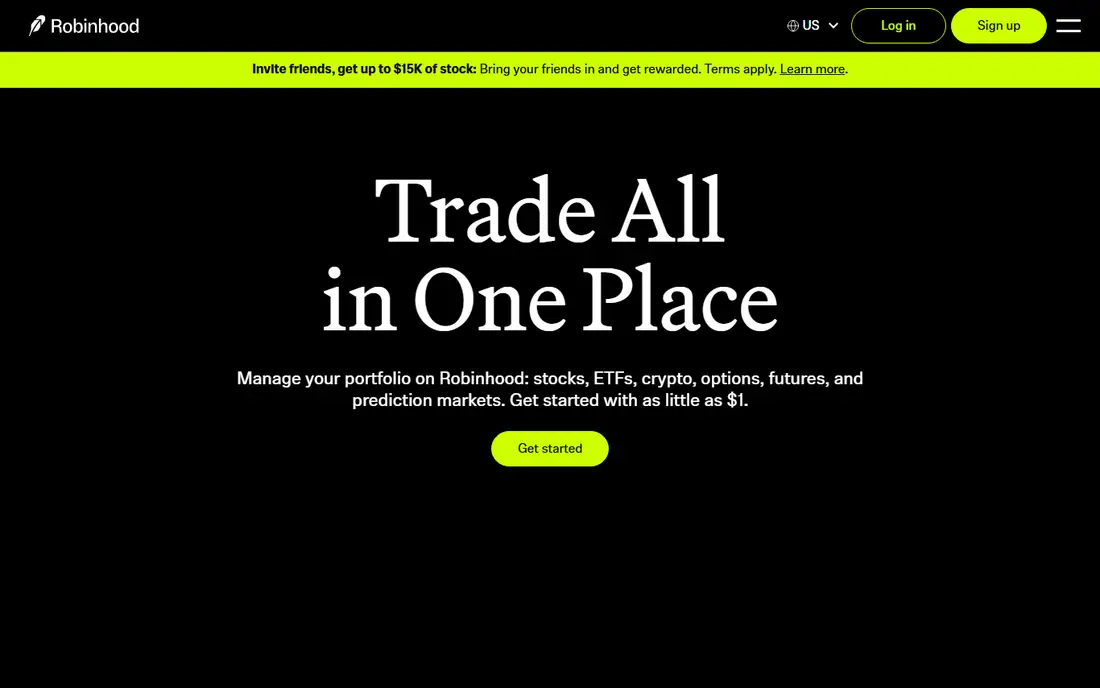
Robinhood remains the easiest app to start with. Opening an account, buying a fractional share, and setting a recurring investment take only a few taps, and $0 commissions on stock and ETF trades keep small, frequent purchases cheap. The app also covers options with no per-contract fee, plus crypto and futures for investors who want those markets in the same account.
Simplicity has a cost in research depth. News, analyst coverage, and screening tools are lighter than at full-service brokers, so an investor who wants deep company research will need a second source. Robinhood Gold, at $5 per month, adds features such as larger instant deposits and professional research, but the free app already covers the basics well. Beginners who value a clean app over a research library will find Robinhood a good first step.
What we like- Very simple mobile design
- Fractional shares from $1
- Stocks, options, crypto, and futures in one app
Watch out for- Research is thinner than at Fidelity or Schwab
- $100 full transfer-out fee
- Gold subscription at $5 per month adds features some rivals include free
#4Webull
Best for: Active traders who want charts, data, and practice trading1.2/5 on
Trustpilot (427 reviews, checked Oct 2026)
Visit webull.com
Starting priceFree ($0 commissions on US stocks and ETFs)
Free planYes
Webull is built for people who look at charts before they trade. The app offers detailed indicators, drawing tools, Level 2 quotes, and a screener, plus extended-hours trading from 4 AM to 8 PM Eastern Time for stocks. Paper trading with real-time quotes lets a new trader test a strategy without risking cash, which is a useful step before trading with real money.
The app also includes a community feed where users share ideas, and that feed can push a beginner toward short-term trades that do not match a long-term plan. Retirement planning, education, and account types are present, including IRAs, but they are not as developed as at Fidelity or Schwab. For an active trader who wants professional data at no commission, Webull offers more screen depth than Robinhood at the same headline price.
What we like- Advanced charting and Level 2 data
- Paper trading with real-time quotes
- Extended-hours trading
Watch out for- Community features can distract new traders
- Retirement and planning tools are thinner than at Fidelity
- $75 full transfer-out fee
Starting priceFree ($0 commissions on most US stocks and ETFs)
Free planYes
Vanguard suits a clear plan: buy broad index funds, add money regularly, and leave the portfolio alone. The app covers stocks, ETFs, mutual funds, and retirement accounts, with $0 commissions on most online US stock and ETF trades. Its own index funds and ETFs are the main draw, since low fund fees matter more over decades than any single trading feature.
Traders should look elsewhere. Charting, screening, and news tools are basic, and the app is not designed for frequent trading or complex options work. Account minimums for some mutual funds can also surprise a new investor, even though ETFs have no such barrier. For an investor whose main job is steady, diversified saving, Vanguard keeps costs low and distractions few.
What we like- Low-cost index funds and ETFs
- Simple retirement accounts
- $0 commissions on most US stocks and ETFs
Watch out for- Trading tools are basic
- App design is plainer than rivals
- Customer service hours and response times draw complaints
#6E*TRADE
Best for: Traders who want research and a strong web platform4.0/5 on
G2 (24 reviews, checked Oct 2026)
Visit etrade.com
Starting priceFree ($0 commissions on US stocks and ETFs)
Free planYes
ETRADE, now part of Morgan Stanley, balances a clean mobile app with a capable web platform. Power ETRADE offers charting, screening, and options tools that go beyond a basic app, while the mobile app handles everyday buying, selling, and account checks. Research coverage, including Morgan Stanley insights, helps an investor read company news and analyst views before acting.
Fees follow the standard pattern for full-service brokers: $0 commissions on online US stocks, ETFs, and mutual funds, with options at $0.65 per contract, falling to $0.50 per contract for traders who place 30 or more trades per quarter. A full account transfer out costs $75. For an investor who wants research depth without moving to a professional platform, E*TRADE is a solid middle ground between a simple app and Interactive Brokers.
What we like- Strong research from Morgan Stanley
- Power E*TRADE web platform
- $0 stock, ETF, and mutual fund commissions
Watch out for- Options cost $0.65 per contract, or $0.50 for frequent traders
- $75 full transfer-out fee
- Crypto trading is limited
Starting priceFree (IBKR Lite with $0 US stock and ETF commissions)
Free planYes
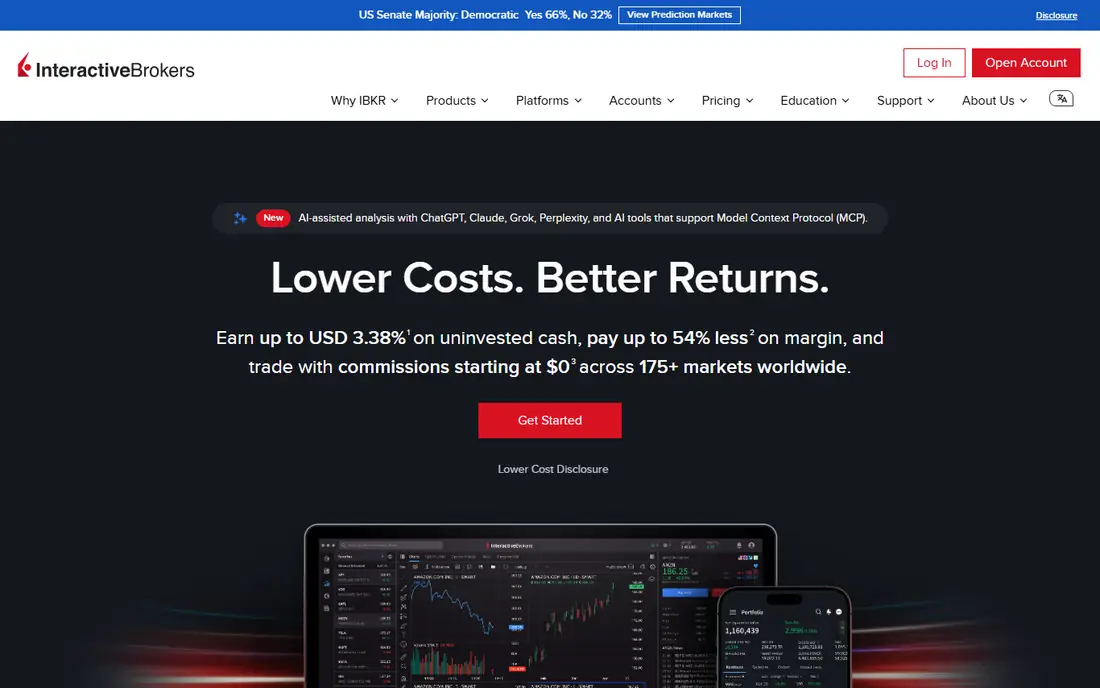
Interactive Brokers is the choice when a US-only app is too narrow. IBKR Lite offers $0 commissions on US exchange-listed stocks and ETFs, while IBKR Pro uses per-share pricing and suits high-volume traders. The platform covers stocks, options, futures, forex, bonds, and funds across many countries, with currency conversion built in for international trades.
That breadth makes the learning curve steep. The desktop platform, Trader Workstation, packs in order types, risk tools, and market data that a beginner may not need, and the mobile app, while capable, still reflects that professional focus. Margin rates are among the lowest in the industry, which matters for traders who borrow, but borrowing adds risk and interest cost. Beginners can start on Lite and grow into Pro tools, rather than starting with the full professional setup.
What we like- Access to 175 or more markets worldwide
- Low margin rates
- Professional desktop and mobile platforms
Watch out for- Platform can overwhelm beginners
- Pro pricing charges per share
- Account setup and funding options are more complex
#8
Public
Best for: Multi-asset investors who want news and research summaries
Visit public.com
Starting priceFree ($0 commissions on stocks and ETFs)
Free planYes
Public is the best fit in this list for an investor who reads market news as part of the daily routine. The app combines stocks, ETFs, bonds, treasuries, crypto, and options, and it adds a daily market briefing, earnings call summaries, and explanations for major price moves on each asset page. That news layer helps a beginner understand why a stock moved, rather than only seeing a price change.
Trading itself is commission-free for stocks and ETFs, with fractional shares and investment plans for recurring purchases. Public also offers IRAs, including a 1 percent match on IRA contributions under its stated terms, plus a high-yield cash account. The catch is scope: Public does not match Fidelity or Schwab on retirement planning, branch support, or fund choice. For a news-focused investor who wants several asset types in one app, it is a strong option.
What we like- Stocks, bonds, crypto, options, and treasuries in one app
- AI market briefings and earnings summaries
- Fractional investing
Watch out for- Research summaries are not a substitute for primary filings
- Options rebates depend on volume
- Smaller broker with fewer account types than Fidelity
How we chose
We compared vendor pricing and fee schedules, account types, research and news features, fractional share rules, and transfer fees, and we checked each vendor homepage to confirm the app still exists and matches the category. We favored apps with $0 commissions on US stocks and ETFs, no account minimum for core accounts, and a clear strength, such as research, charting, index funds, or international access. Where a broker offers both a free plan and a paid tier, we used the free tier as the starting price and noted paid extras separately.
Choosing the right stock app
Match the app to how often you trade
A buy-and-hold investor needs low fund fees, retirement accounts, and simple recurring purchases. A frequent trader needs charting, extended hours, and low options costs. Paying for professional tools that stay unused wastes money, while a simple app can frustrate a trader who needs Level 2 data or complex orders. Write down how many trades a month are realistic, then choose for that pattern, not for an ideal one.
Check the fees behind $0 commissions
Commission-free trading does not mean cost-free investing. Options contracts, transfer-out fees, margin interest, crypto spreads, and fund expense ratios all affect returns. A broker with $0 stock commissions but a $100 transfer fee may cost more in the long run than a broker with a free transfer. Read the fee schedule for the exact trades planned, and check fund fees for any ETF or mutual fund bought regularly.
News, research, and country availability
For a stock news app, check whether news, earnings coverage, and analyst views sit inside the app or require a separate subscription. Fidelity, Schwab, E*TRADE, and Public all include news and research in the app, while Webull leans on charts and data. UK readers should note that several apps in this list serve US customers first, so availability, tax rules, and account protection differ by country. Confirm eligibility before funding an account, and keep a separate news source if the chosen app has thin coverage.
Frequently asked questions
What is the best stock app for beginners?
Fidelity is the strongest all-round starting point, with $0 commissions, fractional shares from $1, and retirement accounts. Robinhood is simpler on mobile, and Schwab adds branch and phone support. A beginner should pick the app whose layout feels clear, then learn position sizing and diversification before trading frequently.
Which stock app has the best news?
Public stands out for daily market briefings and earnings summaries inside the app, while Fidelity, Schwab, and E*TRADE offer broader research libraries and analyst coverage. Webull suits traders who want market data and charts more than written news. The best news app is the one whose coverage matches the stocks held, so test the news tab during a trial period.
Are stock apps free to use?
Most apps in this list charge $0 commissions on online US stock and ETF trades and have no account minimum for core accounts. Options, transfers, margin, and crypto spreads can still cost money, and fund expense ratios apply to ETFs and mutual funds. Check the full fee schedule before opening an account.
Can I buy fractional shares on a stock app?
Yes, Fidelity, Robinhood, Webull, Schwab, and Public all support fractional shares, with Fidelity and Robinhood starting from $1. Schwab and Fidelity limit some fractional trading to S&P 500 stocks, so check the exact rule for a stock that is not in that index. Fractional shares help a small investor diversify without waiting for a full share price.
What is the best investment app in the UK?
This list focuses on US brokers, and several do not serve UK residents in the same way. UK investors should check local brokers that offer UK tax wrappers such as ISAs, FCA regulation, and sterling funding, and compare fund fees and foreign exchange charges. The features that matter stay the same: low fees, clear research, and easy recurring investing. This is not financial advice.
Is my money safe in a stock app?
US brokers in this list are generally members of SIPC, which protects securities up to $500,000, including a $250,000 cash limit, if a broker fails. SIPC does not protect against market losses. Check the broker's SIPC membership, use strong passwords and two-factor authentication, and keep records of deposits and trades.
Sources we checked (8)
- https://www.fidelity.com
- https://www.schwab.com
- https://www.robinhood.com
- https://www.webull.com
- https://www.vanguard.com
- https://www.etrade.com
- https://www.interactivebrokers.com
- https://www.public.com
Is your product missing or out of date?
We review this list regularly. Vendors can request a listing, send updated pricing or ask about featured placement.

Shihab Mia · Founder, Rankite
Shihab has 5+ years in B2B and SaaS SEO. He writes Rankite's software buying guides from pricing pages, documentation and public user reviews. More about Shihab.