How we make this list: we compare pricing pages, product documentation and public user reviews. Ratings come from G2, Capterra or Trustpilot, with the date we checked them.
Key takeaways
- Easyship is the best all round starting point for most stores, with discounted labels for 250 plus couriers, duties estimated at checkout and a free plan to begin.
- Zonos specialises in the landed cost problem itself, calculating duties and taxes accurately and handling the compliance paperwork behind cross border sales.
- Passport and FlavorCloud take the whole job off your hands as merchant facing services, at a price that suits stores already selling abroad at volume.
- The decision that matters is DDP versus DDU: whether your customer pays duties at checkout or faces a surprise bill on delivery, and it decides conversion and complaints more than any label discount.
Quick comparison
| Tool | Best for | Starting price | Free plan |
|---|
 Easyship | Labels, rates and duty estimates for most stores | Free | Yes |
 Zonos | Accurate landed cost and cross border compliance | See website | No |
 Passport | A managed international growth service | See website | No |
 FlavorCloud | Fully managed global shipping and returns | See website | No |
 Shippo | Simple multi carrier labels including exports | Free | Yes |
 Sendcloud | European stores shipping worldwide | See website | No |
 Shopify Markets | Built in cross border selling controls | Free | Yes |
Is your product missing or out of date?
We review this list regularly. Vendors can request a listing, send updated pricing or ask about featured placement.
The best Shopify apps for international shipping
#1Easyship
Best for: Labels, rates and duty estimates for most stores4.4/5 on
G2 (182 reviews, checked Oct 2026)
Visit easyship.com
Starting priceFree
Free planYes
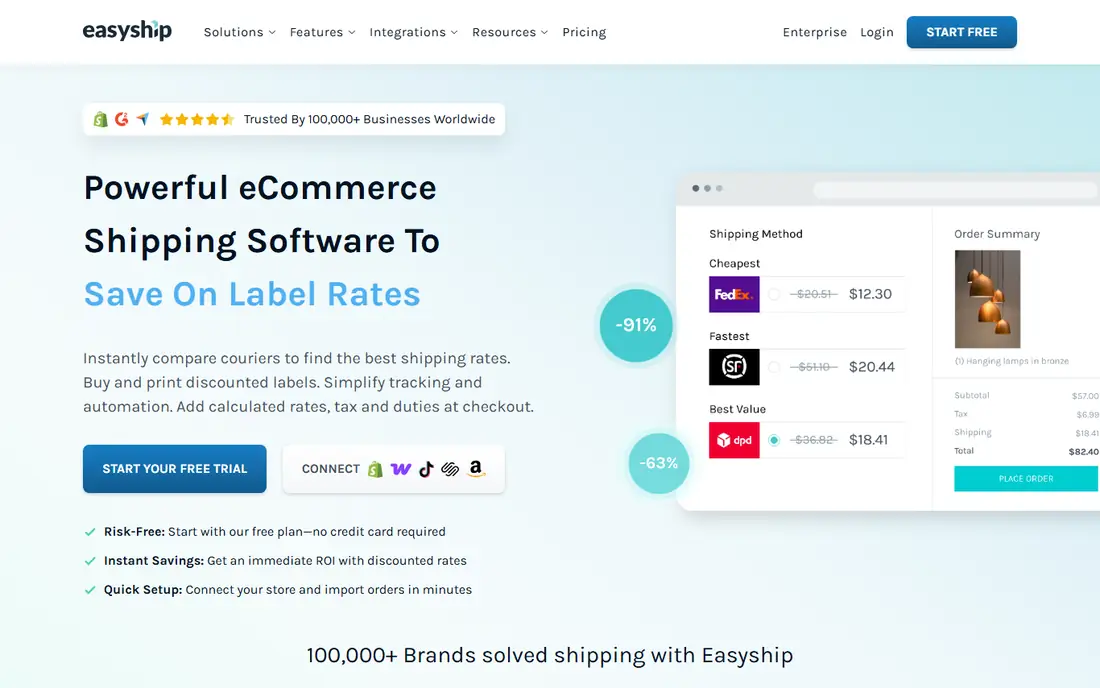
What we like- Easyship connects a Shopify store to more than 250 couriers with discounted rates, compares delivery speed and price per order, generates labels and customs documents, and shows taxes and duties estimates at checkout so customers can prepay under DDP rather than meet a bill at the door. A free plan covers a small monthly label volume, which makes it the natural first install for a store testing international demand, and paid tiers add automation rules, branding and volume. Its courier breadth is the widest here, which matters because the best route to Toronto and the best route to Sydney are never the same carrier.
Watch out for- Discounted rates vary by lane and account history, so the savings on your main routes need checking against your own carrier quotes rather than trusting the average claims. The duties shown are estimates on standard flows
- Complicated products, restricted goods and unusual classifications still need human judgement. Support quality at free and low tiers is thinner than the enterprise services below. Stores with serious volume should compare its total cost, labels plus plan, against Shippo and a direct carrier contract.
#2
Zonos
Best for: Accurate landed cost and cross border compliance
Visit zonos.com
Starting priceSee website
Free planNo
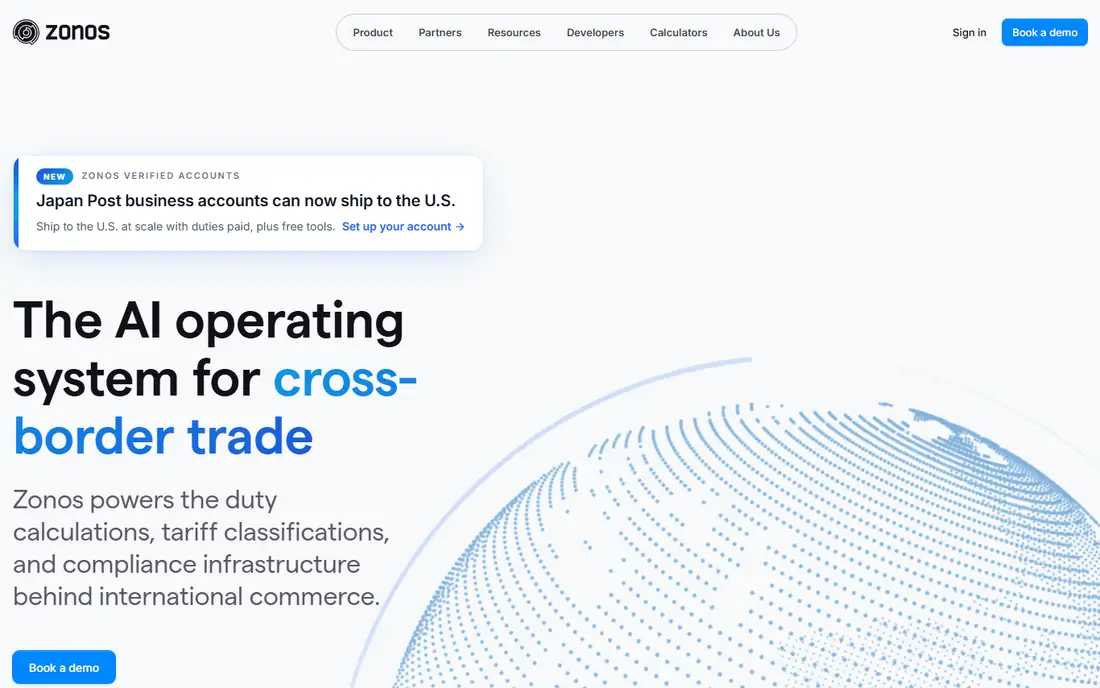
What we like- Zonos does the hardest part of cross border commerce as its whole job: calculating the true landed cost, product price plus shipping plus duties plus taxes, for more than 200 countries, displaying it at checkout so DDP selling is accurate rather than estimated, and generating the harmonised codes and data customs needs. Its classification tools and restricted item screening address the compliance failures that get parcels seized or accounts flagged, and integrations carry the data into whichever shipping flow you use. For stores whose products attract duty complexity, electronics, textiles, food adjacent goods, Zonos is the specialist the others are not.
Watch out for- Zonos calculates and enables
- You still need labels and fulfilment from Easyship, Shippo or a carrier, so it is an addition to a stack, priced by quote, rather than a whole solution at one price, hence see website. Small stores with simple products may be paying for accuracy they do not need. The checkout experience it creates, honest totals including tax, can look expensive beside competitors hiding the same costs until delivery, which is an honesty problem the market rewards solving slowly.
Starting priceSee website
Free planNo
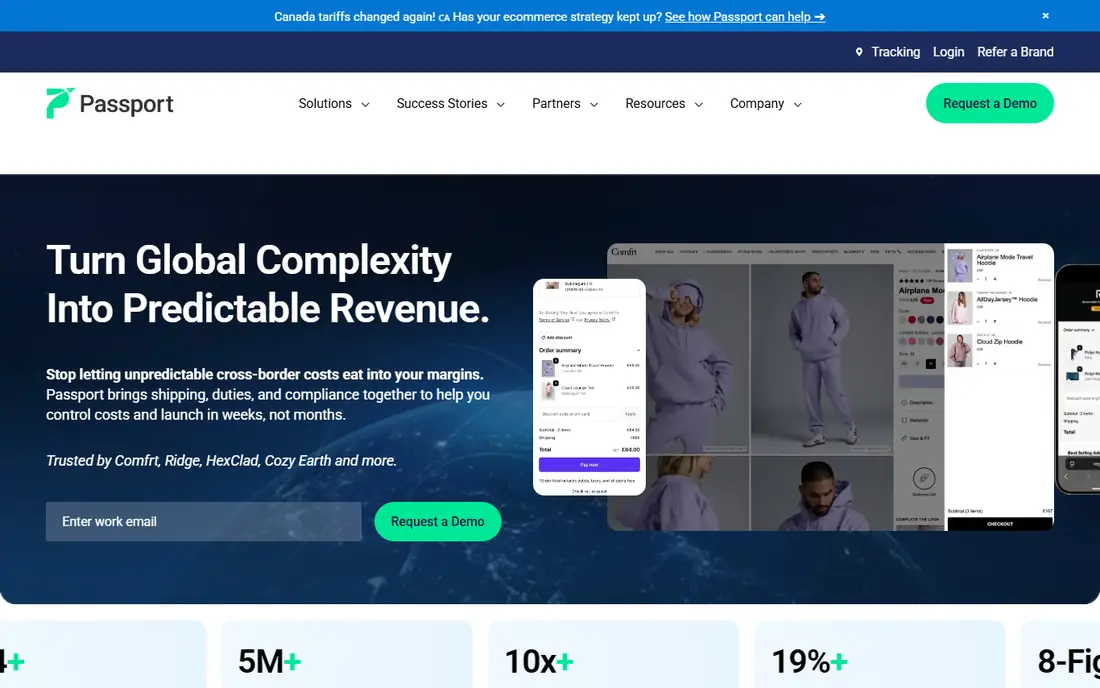
What we like- Passport sells international expansion as a service: it becomes the seller facing infrastructure for cross border orders, handling DDP checkout in many markets, customs clearance, international fulfilment routing, tracking and returns, with a growth team advising on which markets to open next. Brands doing real volume abroad use it to run dozens of countries without building a logistics department, and its parcel tracking and customer communication are designed to protect the brand experience end to end. Pricing is custom and volume based, hence see website.
Watch out for- A managed service costs managed service money, and per parcel economics only work once international volume is meaningful
- A store testing three orders a week belongs on Easyship. Handing the customer relationship around delivery to a partner needs trust and a careful contract. Coverage and service levels vary by market. Passport is the right answer at a scale most readers of a first international shipping guide have not reached yet, and it is included so you know what the grown up version looks like.
Starting priceSee website
Free planNo
What we like- FlavorCloud takes the cross border operation end to end in a similar spirit to Passport: guaranteed landed cost at checkout, meaning the duty and tax figure shown is the figure charged, with FlavorCloud absorbing the variance, plus international shipping through its carrier network, customs handling and global returns. The guaranteed part is its distinction: DDP's conversion benefit without the merchant's estimation risk. Its app installs into Shopify directly and the service pitches four day style delivery windows to major markets at rates it negotiates at network scale.
Watch out for- Again, service economics: pricing is custom, see website, and suits established stores. Network shipping means their carriers and their routing, not your negotiated accounts, so stores with strong direct rates may do worse per label in exchange for the guarantee and the operations team. Returns across borders remain slow physics whatever the software says. Compare its guaranteed cost per parcel against running Easyship plus Zonos yourself once your volumes let you price both honestly.
#5Shippo
Best for: Simple multi carrier labels including exports4.2/5 on
G2 (77 reviews, checked Oct 2026)
Visit goshippo.com
Starting priceFree
Free planYes
What we like- Shippo is the friendly label platform: connect USPS, UPS, DHL and many more, print domestic and international labels at discounted rates, generate customs forms from the order data, and track everything in one dashboard, free to start with a per label model and paid plans for volume and features. For a store whose international orders are a modest share, Shippo covers the export basics without new machinery, and its address validation and return labels are quietly excellent. Many stores run Shippo as the label layer beside Zonos for cost accuracy.
Watch out for- Shippo is a label and tracking platform, not a cross border consultancy: duties at checkout, DDP storefront display and classification help are limited beside Zonos and the managed services, so a store selling heavily into tax strict markets outgrows its native tools. Per label economics at high volume need comparing against plan based rivals. International returns handling is basic. It is the right size for getting started and the wrong size for a store whose growth market is the European Union's rulebook.
Starting priceSee website
Free planNo
What we like- Sendcloud is Europe's large shipping platform for online stores: carrier connections across European and global networks, label automation, checkout delivery options, tracking pages and a returns portal that European customers increasingly expect, with customs documentation for exports beyond the EU handled in the flow. A Shopify store based in Europe, or a US store with a European warehouse, will find its carrier map and returns experience stronger than the US centred tools. Plans are tiered by volume and published in euros on its site, which we mark see website rather than converting at a rate that will age.
Watch out for- For a purely US based store shipping out, the US platforms cover the need with less currency and support timezone friction. Duty and tax calculation at checkout is present through partners and features but is not the singular specialism it is at Zonos. Pricing by tier and add on can take a careful read. Returns portals shine when customers use them
- Building the habit takes a season of orders.
Starting priceFree
Free planYes
What we like- Shopify Markets is not really an app but the platform's own layer for selling abroad, included with Shopify: per market pricing and currency, domains and languages, duties and import taxes collectable at checkout on eligible plans and products, and product availability controls by country. Every store in this guide's audience should set Markets up first, because it governs what the other apps then ship. Its catalogue and pricing controls solve problems no shipping app touches, such as not selling a product where it cannot legally go. Markets Pro, powered by Global-e, extends this into a merchant of record model for stores that want taxes and compliance fully outsourced.
Watch out for- Markets organises selling
- It does not print a label, negotiate a rate or run a return, so it answers a third of the problem and is sometimes mistaken for the whole. Duties collection features vary by plan and country eligibility, and the details matter enough to read Shopify's current documentation rather than any summary. Markets Pro's merchant of record model takes a percentage and changes who the seller legally is, a decision with tax and brand implications beyond a shipping choice. Treat Markets as the control panel, and one of the apps above as the engine.
How we chose
We compared the Shopify connected tools stores actually use to sell and ship internationally in October 2026, and required each to be installable from the Shopify ecosystem or a documented integration, with duties handling described honestly rather than implied. Because the category splits into label platforms, cost calculation specialists and managed services, entries are labelled by type and compared within their job as much as across the list. Pricing is published where vendors publish it and see website where the model is quote or volume based, which is most of the serious end of this market. Nothing here replaces customs advice for regulated goods; food, cosmetics, electronics with batteries and similar categories carry rules no app can waive.
How to choose the right international shipping setup
Sequence it. Turn on Shopify Markets and decide your markets, currencies and which products can legally travel. Decide DDP or DDU per market with eyes open: DDP's checkout honesty generally wins conversion and kills the refused parcel problem, and into the UK and EU, tax collection at checkout is close to mandatory in practice for smooth delivery. Then choose the machinery by scale: labels and duty estimates from Easyship or Shippo at test volume, Zonos added when the duty maths or product complexity starts costing real money, and a managed service, Passport or FlavorCloud, when international orders justify paying to make the whole problem someone else's department.
Test with real orders before the marketing push: place test orders to your top three destination countries, time them, photograph what the customer receives and what paperwork arrives, and read the tracking experience as a stranger. International shipping fails in the gaps between systems, the address format a carrier rejects, the customs code that invites inspection, and you only find those gaps by shipping. Finally, write the international delivery page on your store in plain language: who pays duties, how long it really takes, how returns work. Stores that say it plainly get fewer angry emails than stores with faster planes.
Frequently asked questions
What is the difference between DDP and DDU, and which should I choose?
Under DDP, Delivered Duty Paid, duties and taxes are calculated and collected at checkout, usually by you or your app, and the customer receives the parcel with nothing more to pay. Under the unpaid model the carrier collects from the customer before releasing the parcel. DDP converts better and produces far fewer refused parcels and complaints, at the cost of needing accurate calculation, which is Zonos's whole business and a feature of Easyship and the managed services. Most consumer stores should sell DDP into their main markets wherever the app support exists.
Do I need a separate app if I have Shopify Markets?
Very likely yes, for the physical half. Markets controls pricing, currency, duties collection settings and where you sell; it does not buy postage, choose carriers, print labels or run returns. The standard setup is Markets plus a shipping app such as Easyship or Shippo, with Zonos added when tax accuracy becomes the bottleneck, or a managed service replacing the shipping app at volume. Stores that believe Markets alone shipped their orders learn otherwise at the first international checkout.
How do duties and taxes get calculated for my products?
From the product's customs classification, its harmonised system code, the destination's duty rates for that code, and the tax rules of the destination applied to the order value and shipping. Apps automate this from product data, which is why accurate weights, values and country of origin in your catalogue matter: garbage in, seized parcel out. Zonos specialises in classification help; other apps estimate from the data given. For regulated or high value goods, a customs broker's review of your top products is cheap insurance that no app subscription replaces.
Can these apps handle international returns?
To different depths. Sendcloud's returns portal is a headline feature; FlavorCloud and Passport build returns into their managed service; Easyship and Shippo generate return labels and workflows that work but feel more manual. Physics applies to everyone: a return from Australia can cost more than the product, so many stores adopt policies the apps support, local return addresses through partners, refund without return for low value items, or return fees stated plainly at purchase. Decide the policy first, then check the app can execute it, because the software follows the strategy, not the reverse.
When does a managed service like Passport or FlavorCloud pay off?
When international orders are a meaningful share of revenue, when your team is spending real hours on customs problems and delivery emails, and when entering new markets is a growth plan rather than an accident. Their per parcel cost buys out the estimation risk, the carrier relationships and the operational tail. Below that scale, the same money is better spent on the label and calculation stack plus one careful afternoon a week. The crossover is visible in your support inbox before it shows in any calculator: count the international delivery tickets, and price your hours honestly.
Sources we checked (0)
Is your product missing or out of date?
We review this list regularly. Vendors can request a listing, send updated pricing or ask about featured placement.

Shihab Mia · Founder, Rankite
Shihab has 5+ years in B2B and SaaS SEO. He writes Rankite's software buying guides from pricing pages, documentation and public user reviews. More about Shihab.