How we make this list: we compare pricing pages, product documentation and public user reviews. Ratings come from G2, Capterra or Trustpilot, with the date we checked them.
Key takeaways
- WooCommerce and PrestaShop cost nothing for the software itself, but hosting, themes and maintenance fall on the store owner.
- BigCommerce is the closest hosted rival to Shopify for growing stores, with no platform transaction fee when using an approved payment provider.
- Wix and Squarespace suit small catalogs and design-led brands, while Square Online is the natural pick for businesses that already sell in person.
- Ecwid is the cheapest way to add selling to an existing website, with a free plan for up to five products.
- Watch for sales limits and transaction fees, because both can quietly raise the bill as a store grows.
Quick comparison
| Tool | Best for | Starting price | Free plan |
|---|
 WooCommerce | Full control on WordPress | $0 (free plugin; hosting extra) | Yes |
 BigCommerce | Growing hosted stores | $39 per month | Free trial (15 days) |
 Wix | Small design-led stores | $29 per month | Yes |
 Squarespace | Beautiful simple storefronts | $19 per month | Free trial (14 days) |
 PrestaShop | Self-hosted open-source stores | $0 (free software; hosting extra) | Yes |
 Shift4Shop | Feature-rich hosted stores | $41 per month | Yes |
 Ecwid | Adding a store to an existing site | $25 per month | Yes |
 Square Online | In-person sellers going online | $49 per month | Yes |
Is your product missing or out of date?
We review this list regularly. Vendors can request a listing, send updated pricing or ask about featured placement.
The best Shopify alternatives
#1WooCommerce
Best for: Full control on WordPress4.4/5 on
G2 (1,283 reviews, checked Oct 2026)
Visit woocommerce.com
Starting price$0 (free plugin; hosting extra)
Free planYes
WooCommerce turns a WordPress site into a full store, and it remains the most flexible alternative to Shopify. The plugin itself is free, products and orders are unlimited, and store owners keep full control of their data and checkout. Thousands of extensions cover subscriptions, bookings, memberships and marketplace selling, and the owner can pick any payment processor without a platform penalty.
That freedom has a price in effort. Hosting for a real store typically runs $20 to $100 per month for managed WooCommerce hosting, and premium themes and extensions add one-time or yearly costs. Updates, security and backups are the owner's responsibility, or the job of a hired developer. For a business that already runs on WordPress, or one that wants total control over design and checkout, WooCommerce is hard to beat. For a founder who wants everything handled, a hosted platform is the easier choice.
What we like- Free open-source plugin with unlimited products and full data ownership
- Huge extension and theme library
- Works with any payment gateway
Watch out for- Hosting, security, backups and updates are the owner's job
- Costs rise with paid extensions
- Needs more technical skill than hosted platforms
Starting price$39 per month
Free planFree trial (15 days)

BigCommerce is the hosted platform most often compared with Shopify, and for good reason. It covers hosting, security and PCI compliance in the subscription, and its plans include features that Shopify charges extra for through apps, such as customer groups, advanced product filtering and, on higher tiers, Google customer reviews. Its B2B tools and multi-storefront support make it a strong pick for brands selling to both consumers and wholesale buyers.
The billing model needs a careful read. Plans renamed in June 2026 run from Core at $39 per month ($29 billed annually) through Growth at $105 and Scale at $399, and each tier carries an annual sales limit. Crossing the limit triggers an automatic upgrade, so a fast-growing store can see its bill jump without warning. Orders processed through gateways outside the approved embedded list also attract a fee of 2% on Core, 1% on Growth and 0.6% on Scale. Stores using BigCommerce Payments or another approved provider avoid that fee entirely.
What we like- Hosted with unlimited staff accounts and no platform fee on approved payment providers
- Strong native B2B and multi-storefront features
- Open API for custom work
Watch out for- Plans carry annual sales limits that trigger automatic upgrades
- A fee applies on orders through non-approved gateways
- Premium themes cost $150 to $300
#3Wix
Best for: Small design-led stores4.2/5 on
G2 (1,888 reviews, checked Oct 2026)
Visit wix.com
Starting price$29 per month
Free planYes

Wix is a website builder first and a store second, which is exactly why many small sellers choose it. The drag-and-drop editor gives precise control over how pages look, the template library is large, and selling, bookings, subscriptions and marketing tools all live in one dashboard without plugins. A small store can be live in a weekend, and the owner never touches a server.
The cheapest plan that sells is Core at $29 per month on annual billing, with basic ecommerce and 50 GB of storage. Business at $39 per month adds standard ecommerce, customer accounts and multiple currencies, while Business Elite at $159 adds advanced features and unlimited storage. Wix adds no platform transaction fee, so the store pays only the payment processor's rate, commonly 2.9% plus 30 cents through Wix Payments. Catalog size is capped at 50,000 products on Core, which is plenty for most small stores but worth noting for large ones.
What we like- Drag-and-drop builder with 2,000 plus templates
- Selling starts on the $29 Core plan
- No platform transaction fee on store orders
Watch out for- Free plan cannot sell
- Advanced shipping and tax tools need the Business plan
- Less suited to very large catalogs
#4Squarespace
Best for: Beautiful simple storefronts4.4/5 on
G2 (1,133 reviews, checked Oct 2026)
Visit squarespace.com
Starting price$19 per month
Free planFree trial (14 days)

Squarespace is the pick for sellers who care as much about how the store looks as how it sells. Its templates are consistently the most polished in this category, the editor is simple, and every plan now includes ecommerce with unlimited products, which removes the old need for a separate Commerce tier. Hosting, SSL, a free domain for the first year on annual plans and built-in marketing tools all come in the subscription.
Pricing runs from Basic at $19 per month on annual billing, which charges a 2% transaction fee on store sales, through Core at $29 with no store transaction fee, Plus at $49 and Advanced at $99. Card processing is extra on every plan. The app and extension ecosystem is smaller than Shopify's, so stores that need unusual integrations should check availability first. For a small catalog with a strong visual brand, Squarespace is a pleasure to run.
What we like- Best-looking templates in this list
- Every plan includes unlimited products and selling tools
- Hosting, SSL and domain tools included
Watch out for- No free plan, only a 14-day trial
- Basic plan charges a 2% transaction fee
- Fewer ecommerce apps than Shopify or WooCommerce
#5PrestaShop
Best for: Self-hosted open-source stores4.3/5 on
G2 (159 reviews, checked Oct 2026)
Visit prestashop.com
Starting price$0 (free software; hosting extra)
Free planYes

PrestaShop is the open-source alternative for sellers who want self-hosting without WordPress. The software is free, the store owner keeps full control of data and code, and the module marketplace covers payments, shipping, marketing and marketplace connections. It has a particularly strong base in Europe, where its local payment, carrier and tax options are deep.
Like WooCommerce, the real costs sit outside the software: hosting, a theme, paid modules and either the owner's time or a developer's fee for updates and security. Stores that outgrow shared hosting need a VPS or managed hosting, which pushes the monthly cost up. PrestaShop suits sellers who want open-source freedom, plan to customize heavily, and are comfortable running their own infrastructure or paying someone who is.
What we like- Free open-source software with full ownership of store and data
- Thousands of modules and themes
- Strong in European markets with many payment and shipping options
Watch out for- Hosting, maintenance and security are the owner's responsibility
- Many modules are paid
- Smaller English-language community than WooCommerce
#6Shift4Shop
Best for: Feature-rich hosted stores3.9/5 on
G2 (39 reviews, checked Oct 2026)
Visit shift4shop.com
Starting price$41 per month
Free planYes

Shift4Shop, formerly 3dcart, packs an unusual amount of functionality into its core software. Features that other platforms sell as apps, such as stackable promotions, a one-page checkout option, real-time shipping rates, an affiliate program and detailed SEO controls, are built in. Its homepage currently quotes an unlimited enterprise-grade plan at $41 per month, and an End-to-End plan is available with Shift4 payments.
The platform's history makes careful checking worthwhile. Its pricing and free-plan terms have changed more than once, and older guides quote different figures. The interface also looks older than Wix or Squarespace, though it is fully functional. For a US-based store that wants deep built-in features, live carrier rates and no revenue cap without paying for an enterprise tier, and that is happy to process through Shift4, Shift4Shop remains a legitimate value pick.
What we like- Very deep built-in feature set with little need for paid apps
- Strong native SEO tools
- Real-time shipping rates included
Watch out for- Interface feels dated next to newer rivals
- Pricing has changed several times, so confirm the current plan page
- Best value is tied to Shift4 payments
#7Ecwid
Best for: Adding a store to an existing site4.7/5 on
G2 (405 reviews, checked Oct 2026)
Visit ecwid.com
Starting price$25 per month
Free planYes
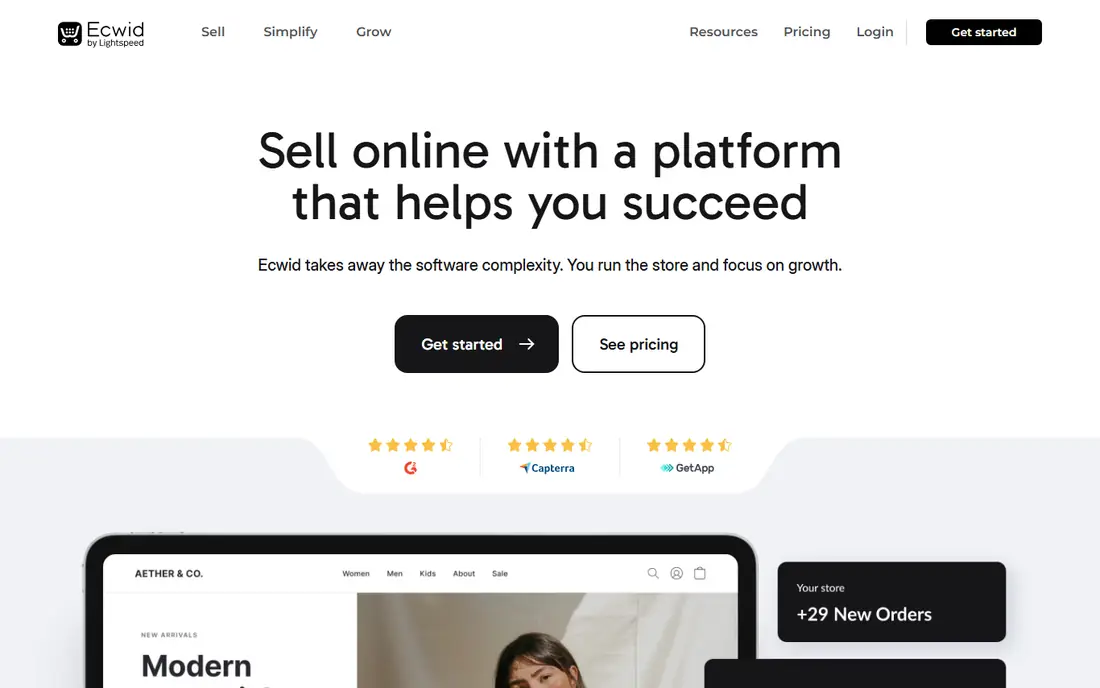
Ecwid solves a different problem from the rest of this list. Instead of building a whole new website, a business adds a few lines of code to an existing WordPress, Wix, Squarespace or custom site, and a working store appears inside it. Customers never leave the domain, inventory stays in one place, and the same store can also sell on Facebook, Instagram, Amazon and eBay on higher plans.
The free plan covers five products, which is enough to test an idea or sell a handful of items. Venture at $25 per month ($21 billed annually) raises the limit to 100 products and adds digital goods, discount coupons and inventory tracking. Business at $45 per month covers 2,500 products with abandoned cart emails and marketplace selling, and Unlimited at $105 removes product limits. Ecwid charges no platform transaction fee, so only the payment processor takes a cut. For a business with a website it likes, Ecwid is the fastest route to selling.
What we like- Embeds into any existing website
- Free plan for up to five products
- No platform transaction fees on any plan
Watch out for- Product limits on lower tiers
- Design control is limited compared with a full storefront
- Smaller app ecosystem
#8Square Online
Best for: In-person sellers going online4.2/5 on
G2 (482 reviews, checked Oct 2026)
Visit squareup.com
Starting price$49 per month
Free planYes

Square Online is the obvious alternative for any business that already takes payments through Square. The online store shares products, inventory, customers and orders with Square's point-of-sale system, so a sale at the counter and a sale online update the same stock count. The free plan includes unlimited products, a basic store on a Square subdomain, pickup and delivery options and POS integration, with no monthly fee.
Paid plans add the pieces a serious store needs. Plus at $49 per month adds a custom domain, expanded design control, QR code ordering, SEO tools and customer accounts. Premium at $149 per month adds lower processing rates, real-time shipping rates, abandoned cart recovery and loyalty programs. The free plan's online card rate of 3.3% plus 30 cents is higher than the 2.9% plus 30 cents on paid plans, so a store with real volume should compare the plan cost against the processing savings.
What we like- Inventory, customers and orders sync with Square POS
- Free plan with unlimited products
- No extra platform fee beyond card processing
Watch out for- Online card rate on the free plan is 3.3% plus 30 cents
- Custom domain needs a paid plan
- Weaker marketplace selling than Shopify
How we chose
We compared platforms that exist today, genuinely replace Shopify for a real store, and cover the main reasons sellers leave: cost, control, design and in-person selling. Prices and free tiers were checked against vendor pricing pages and recent pricing guides in October 2026, and every homepage in this list was opened to confirm it loads and belongs to the product named. We weighed total cost including transaction fees and sales limits, ease of setup, design quality, app and integration depth, and how each platform handles growth.
What to check before you switch
Start with the real monthly cost, not the headline price. Add the plan fee, the payment processor's rate, any platform transaction fee, and the cost of apps, themes or hosting the platform does not include. On Shopify, the comparable figures are $39 per month for Basic with a 2% transaction fee outside Shopify Payments, so an alternative only saves money if its total is lower at the store's actual sales volume.
Next, check the limits that force upgrades: BigCommerce sales caps, Ecwid product limits, and Wix storage tiers all raise the bill as the store grows. Finally, plan the migration itself. Product data, customer records, order history and URL redirects all need a tested move, and the store should keep its old site running until the new checkout has processed real orders. A platform switch is cheap to start and expensive to undo, so a trial store with real products is worth the afternoon it takes.
Frequently asked questions
What is the best free Shopify alternative?
WooCommerce and PrestaShop are free as software, but both need paid hosting. For a hosted store with no monthly fee, Ecwid's free plan covers five products and Square Online's free plan covers unlimited products on a Square subdomain. Shift4Shop also offers an End-to-End plan with Shift4 payments. The right free option depends on whether the store already has a website.
Is WooCommerce cheaper than Shopify?
The plugin is free, but total cost depends on hosting and extensions. A small store on shared or managed WooCommerce hosting can run for $20 to $50 per month all in, which undercuts Shopify Basic at $39 per month once apps are counted. A large store with premium hosting, paid extensions and developer help can cost more than Shopify, so the answer depends on the store's size and needs.
Does BigCommerce charge transaction fees?
BigCommerce charges no platform fee on orders through its approved embedded payment providers. Orders through other gateways attract a fee of 2% on Core, 1% on Growth and 0.6% on Scale. Payment processing fees from the gateway itself apply on every plan.
Can I migrate my store from Shopify to another platform?
Yes. All eight platforms here offer import tools or migration services for products, customers and orders, and several have apps or partners that handle the move. URL redirects deserve special attention, since old product links need to point to the new pages to protect search rankings. Keep the Shopify store live until the new store has processed orders without problems.
Which Shopify alternative is best for a small business?
For a small catalog with a strong visual brand, Squarespace or Wix is the simplest choice. For the lowest cost, WooCommerce or Ecwid wins. For a business that also sells in person, Square Online is the natural fit because inventory and customers stay in sync with the counter. The best choice follows the business model, not the feature list.
Do I need technical skills to use WooCommerce or PrestaShop?
Basic setup is possible without coding, but both platforms reward some technical comfort. Hosting setup, security updates, backups and troubleshooting fall on the owner unless a managed host or developer handles them. Sellers who want nothing to maintain should choose a hosted platform like BigCommerce, Wix or Square Online instead.
Sources we checked (8)
- https://woocommerce.com/pricing/
- https://www.bigcommerce.com/pricing/
- https://www.wix.com/pricing
- https://www.squarespace.com/pricing
- https://www.prestashop.com/en
- https://www.shift4shop.com/pricing.html
- https://www.ecwid.com/pricing
- https://squareup.com/us/en/online-store/pricing
Is your product missing or out of date?
We review this list regularly. Vendors can request a listing, send updated pricing or ask about featured placement.

Shihab Mia · Founder, Rankite
Shihab has 5+ years in B2B and SaaS SEO. He writes Rankite's software buying guides from pricing pages, documentation and public user reviews. More about Shihab.