How we make this list: we compare pricing pages, product documentation and public user reviews. Ratings come from G2, Capterra or Trustpilot, with the date we checked them.
Key takeaways
- Algolia is the hosted default for product and content search; Elastic and OpenSearch are the engines teams self host when scale, control or data rules demand it.
- Typesense and Meilisearch give smaller teams fast, typo tolerant search without per query billing surprises, and both are open source at the core.
- AddSearch is the packaged website search for organisations that want live in days with no search team, and Coveo is the enterprise platform with generative answers on top.
- Decide build versus buy first. Hosted services rent you relevance tooling and uptime; self hosted engines rent you nothing and invoice you in engineering time instead.
Quick comparison
| Tool | Best for | Starting price | Free plan |
|---|
 Algolia | Hosted search for products and content | See website | Yes |
 Elastic | Self hosted and cloud search at scale | See website | No |
 Coveo | Enterprise search with generative answers | See website | No |
 Typesense | Fast open source search for apps | Free | Yes |
 Meilisearch | Developer friendly search, cloud or self hosted | $20 per month | Yes |
 OpenSearch | Open source search and analytics engine | Free | Yes |
 AddSearch | Packaged website search for organisations | $119 per month | No |
 Microsoft Azure AI Search | Search inside the Azure estate | See website | Yes |
Is your product missing or out of date?
We review this list regularly. Vendors can request a listing, send updated pricing or ask about featured placement.
The best search engine software
#1Algolia
Best for: Hosted search for products and content4.5/5 on
G2 (454 reviews, checked Oct 2026)
Visit algolia.com
Starting priceSee website
Free planYes
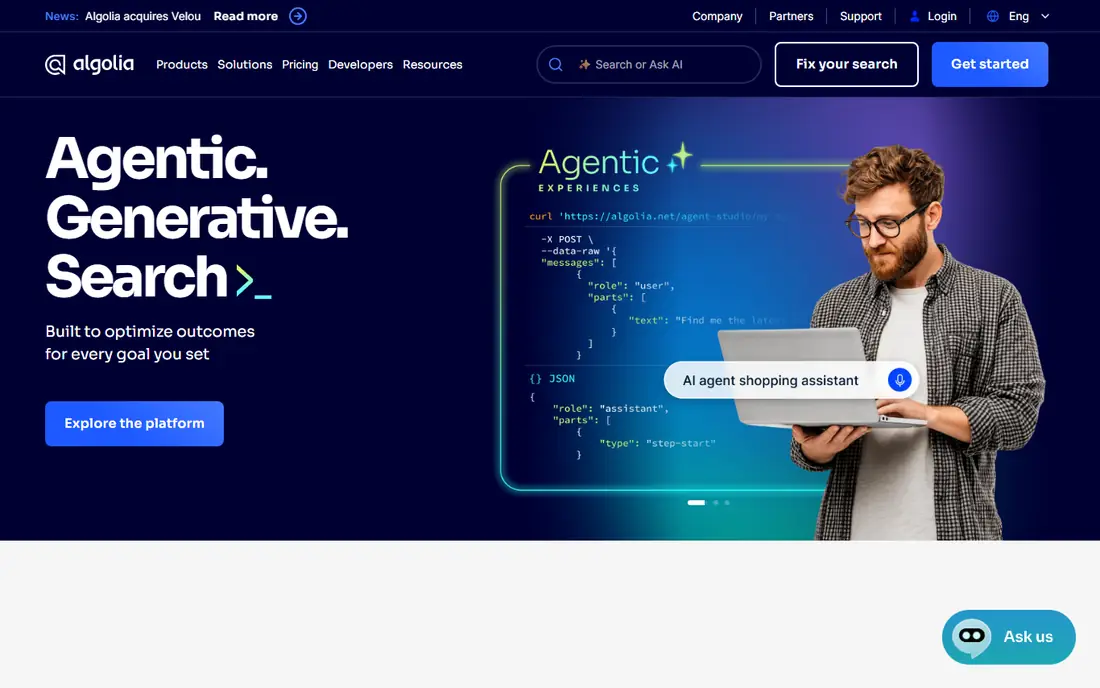
What we like- Algolia is the search as a service benchmark: millisecond responses, typo tolerance, ranking tools a merchandiser or content lead can adjust without engineering tickets, analytics that show what visitors searched and failed to find, and an ecosystem of front end libraries that gets a polished search interface live quickly. Its AI features layer recommendations and personalisation onto the core. The free Build tier lets a team prototype properly before usage billing starts.
Watch out for- Usage pricing is the known trap: costs scale with searches and records, and busy sites routinely report bills that outgrow the early estimates, a complaint that fills its reviews. Deep relevance tuning still needs developer understanding despite the friendly dashboard. At very high query volumes, the maths of per search billing versus self hosting turns decisively against it.
#2Elastic
Best for: Self hosted and cloud search at scale4.5/5 on
G2 (109 reviews, checked Oct 2026)
Visit elastic.co
Starting priceSee website
Free planNo
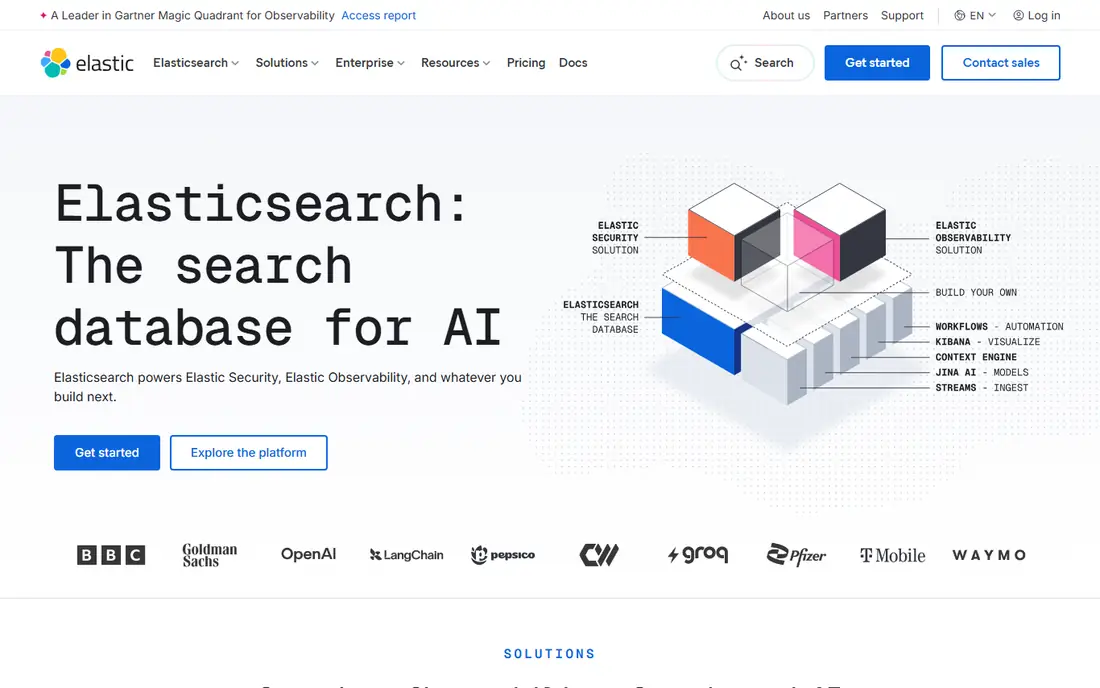
What we like- Elastic, built on Elasticsearch, is the heavyweight engine: full text search, vector search, log and observability data and security analytics on one stack, deployable self hosted, on Elastic Cloud or inside marketplaces. Its relevance tooling, query language and scaling behaviour are proven at volumes few products ever see, and the ecosystem of integrations is unmatched. Resource based cloud pricing replaces per query metering, which makes very large query loads predictable.
Watch out for- Elastic is infrastructure, and it behaves like it: cluster sizing, upgrades, index lifecycle and relevance tuning are engineering work, and a small team buying Elastic for a website search box has bought a second job. Licensing has shifted over the years, with the stack under Elastic's own licences rather than pure open source, which matters to some buyers. Cloud pricing by resources still needs modelling before it stops surprising finance.
#3Coveo
Best for: Enterprise search with generative answers4.3/5 on
G2 (142 reviews, checked Oct 2026)
Visit coveo.com
Starting priceSee website
Free planNo
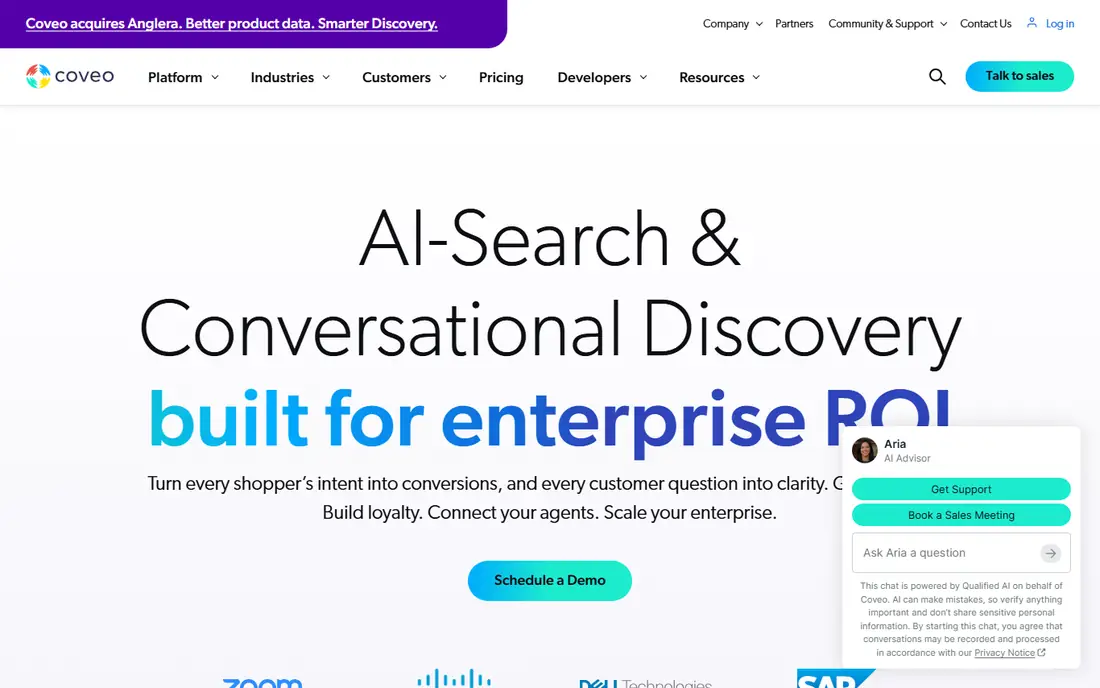
What we like- Coveo targets the enterprise end: unified search across commerce, service, workplace and website content, relevance tuned by machine learning models trained on usage, and generative answering that drafts responses from indexed content with citations. It sells into organisations where search quality measurably moves revenue or support costs, and its commerce and service specialisations carry integrations into the platforms those teams already run.
Watch out for- Pricing is quote only and enterprise scaled, putting it out of reach for mid sized sites. Implementation is a project with Coveo or a partner, not a weekend. For a single public website, its depth is mostly wasted
- Its value case needs multiple content sources or a commerce catalogue where ranking quality pays directly.
Starting priceFree
Free planYes
What we like- Typesense is the developer favourite among open source engines: an in memory design returning results in under 50 milliseconds, typo tolerance that handles real users, vector and hybrid search built in, and an API that feels familiar to anyone who has used hosted search. Self hosting is free under its open source licence, and Typesense Cloud bills hourly for provisioned capacity with no per search fee, so a viral weekend does not produce a billing incident. Migration guides and InstantSearch adapters ease the move from hosted rivals.
Watch out for- In memory indexing means RAM sizing drives both performance and cloud cost, and under provisioned clusters fail ungracefully on large datasets. The ecosystem, integrations and enterprise features are younger than Elastic's or Algolia's. Self hosting still means owning upgrades, backups and availability, and the GPL licence deserves a legal read if you plan to embed it in a distributed product.
Starting price$20 per month
Free planYes
What we like- Meilisearch pairs an open source core with a polished hosted cloud: typo tolerant keyword search, semantic and hybrid modes with a dial between them, facets, filters and geo search, and setup measured in minutes rather than days. Cloud starts at 20 dollars a month in its published pricing with a 14 day trial, and usage based or resource based billing options let a team choose its meter. For product search at small and mid scale, it delivers most of the hosted experience at a fraction of the established names' cost.
Watch out for- Its analytics, merchandising tools and enterprise features trail Algolia, and large index, low query patterns need careful cloud sizing or the resource meter wastes money. The cloud runs on its enterprise edition licensing rather than the open source community edition, a distinction worth understanding before standardising on it. Support and SLA depth at the top end are quote territory.
#6OpenSearch
Best for: Open source search and analytics engine4.4/5 on
G2 (15 reviews, checked Oct 2026)
Visit opensearch.org
Starting priceFree
Free planYes
What we like- OpenSearch, the community fork of Elasticsearch maintained under the Linux Foundation with AWS as the largest backer, offers search, vector search and observability under a permissive Apache licence with no feature gating by licence tier. It scales to the same classes of workload as Elastic, ships with dashboards, and runs anywhere from a laptop to a managed AWS service. For teams with licence concerns about Elastic or existing OpenSearch estates, it is the default self hosted engine.
Watch out for- It demands the same operational maturity as any distributed engine: cluster design, tuning and upgrades are yours. Managed offerings soften that at cloud prices. Its AI and vector features move fast, and documentation and tooling polish vary by area, so a team evaluates the specific features it needs rather than trusting the category label.
#7AddSearch
Best for: Packaged website search for organisations4.6/5 on
G2 (105 reviews, checked Oct 2026)
Visit addsearch.com
Starting price$119 per month
Free planNo
What we like- AddSearch is website search as a finished product: it crawls and indexes your site, including gated content, and provides the search interface, analytics and now grounded AI answers and conversational search, live in days without a search team. Pricing is published and predictable, from 119 dollars a month billed annually for its Core keyword search tier, with SOC 2 and GDPR credentials that procurement teams ask about. For universities, public sector bodies and content rich organisations, it replaces a legacy site search with the least internal effort on this list.
Watch out for- The attractive sticker covers keyword search
- The AI answers layer starts at a further 8,400 dollars a year, and conversational search is quoted, so the full modern package costs materially more. Crawled indexing gives less control than an API fed index for product catalogues with fast changing data. Image indexing is still on its roadmap.
Starting priceSee website
Free planYes
What we like- Azure AI Search gives Microsoft centred teams a managed engine inside their existing cloud: keyword, vector and hybrid retrieval, semantic ranking, indexers that pull from Azure data sources, and security and compliance inherited from the Azure platform. It is the retrieval layer many organisations use beneath their own AI applications, because the data, the models and the search service all sit inside one tenant and one bill. A free tier supports development and small workloads.
Watch out for- Pay as you go pricing by tier and capacity still needs modelling at scale, and the tool is a platform service, not a finished website search: interfaces, relevance tuning and analytics are your project. Outside a Microsoft estate its advantages thin quickly. Feature naming and packaging change with Azure's release cadence, so quotes age faster than rivals'.
How we chose
We selected search software in active sale or active open source release in October 2026 across the three real buying categories: hosted search services, self hosted engines and packaged website or enterprise search. Each entry had to power production search for real customers today, not an announced product. Pricing models were stated exactly as vendors publish them, and where a model resists a single number, per query, per resource or quote only, we wrote see website rather than invent a figure. Vendor comparison pages were treated as advocacy and cross checked. Nothing was benchmarked by us, and performance figures quoted are the vendors' own claims.
How to choose search engine software
Run the build versus buy decision honestly. If your team has no one who wants to own a search cluster, the self hosted engines are not cheaper; they are unpaid engineering. Hosted services and packaged products convert that labour into a subscription, and for most websites that trade is correct. If your query volume is enormous, your data cannot leave your infrastructure, or search is your product's core, the equation reverses and Elastic, OpenSearch or Typesense deserve the investment.
Then test with your real queries. Take the fifty searches your users actually run, including the misspelled and the hopeless ones, and run them on free tiers and trials. Relevance quality on your content beats every feature matrix. Finally, model the meter: per search pricing punishes success, capacity pricing punishes overprovisioning, and quote pricing punishes weak negotiation. Knowing which punishment you can manage is most of this purchase.
Frequently asked questions
What is the difference between a search engine and a hosted search service?
The engine is the software that indexes documents and answers queries: Elastic, OpenSearch, Typesense and Meilisearch's core. A hosted service, such as Algolia or Meilisearch Cloud, runs that machinery for you behind an API and adds dashboards, analytics and support. You pay the hosted route for operations and tooling, and accept its metering.
How much does search software cost?
Open source engines cost nothing to license and something real to run. Hosted services range from free tiers to usage bills in the thousands per month at scale. Packaged website search starts around 119 dollars a month in AddSearch's published pricing, and enterprise platforms such as Coveo are quote only. The honest comparison is total cost over three years, including the engineering time self hosting consumes.
Can these tools power AI answers as well as search?
Increasingly, yes. Vector and hybrid retrieval in Elastic, Typesense, Meilisearch, OpenSearch and Azure AI Search is the layer that grounds chatbots and answer features in your content, and packaged products such as AddSearch and Coveo sell the answer layer directly. The retrieval choice you make for search will likely become your AI answer foundation, which is a reason to choose carefully now.
Is open source search really free?
The licence is free; the running is not. Servers or cloud capacity, upgrades, backups, monitoring and the engineer hours to tune relevance all cost money, and at small scale they exceed a hosted subscription. Open source wins on control, data residency and very large query volumes, and on avoiding per search meters, not on a zero budget line.
What should I check in a search trial?
Your hardest real queries first: misspellings, product codes, synonyms your customers use, and searches that currently return nothing on your site. Then check the analytics the tool exposes, because the zero results report is where ongoing value lives, and finally the exit terms: can you export your index configuration and data if you leave?
Sources we checked (0)
Is your product missing or out of date?
We review this list regularly. Vendors can request a listing, send updated pricing or ask about featured placement.

Shihab Mia · Founder, Rankite
Shihab has 5+ years in B2B and SaaS SEO. He writes Rankite's software buying guides from pricing pages, documentation and public user reviews. More about Shihab.