How we make this list: we compare pricing pages, product documentation and public user reviews. Ratings come from G2, Capterra or Trustpilot, with the date we checked them.
Key takeaways
- OpenTable still offers the largest diner discovery network, but its per-cover fees make it the most expensive option for busy rooms.
- Resy suits upscale city restaurants that want flat-rate pricing with no per-cover fees and a strong waitlist.
- SevenRooms leads on guest data depth, giving groups and hotels a single view of diners across venues.
- Eat App is the value pick for independents, with a free tier and flat monthly pricing that includes a point of sale add-on.
- Tock, Yelp Guest Manager, Toast Tables, and ResDiary each win a specific niche, from prepaid dining to point of sale integration.
Quick comparison
| Tool | Best for | Starting price | Free plan |
|---|
 OpenTable | Diner discovery volume | $149 per month | No |
 Resy | Upscale city restaurants | $289 per month | No |
 SevenRooms | Guest data and groups | See website | No |
 Eat App | Independents on a budget | $69 per month (billed annually) | Yes |
 Tock | Prepaid and ticketed dining | $289 per month | No |
 Yelp Guest Manager | Yelp-driven discovery | $129 per month (billed annually) | No |
 Toast Tables | Restaurants already on Toast | See website | No |
 ResDiary | White-label bookings | See website | No |
Is your product missing or out of date?
We review this list regularly. Vendors can request a listing, send updated pricing or ask about featured placement.
The best restaurant reservation software
#1OpenTable
Best for: Diner discovery volume4.4/5 on
G2 (375 reviews, checked Oct 2026)
Visit opentable.com
Starting price$149 per month
Free planNo
OpenTable remains the default choice for restaurants that need new diners, not just a booking widget. Its consumer site and app list more than 70,000 restaurants worldwide, and diners in competitive markets start their search there. For a new opening or a room in a tourist district, that discovery volume is hard to replace, and verified reviews from past diners add trust that a standalone widget cannot offer.
The cost model is the catch. Basic starts at 149 dollars per month, with 1.50 dollars per cover for diners who book through the OpenTable network and 25 cents per cover for website bookings, or a 49 dollar monthly flat fee for website covers. Core at 299 dollars and Pro at 499 dollars cut the network fee to 1 dollar per cover. A busy room can therefore pay thousands per month in cover fees on top of the subscription. Restaurants that already fill seats from their own phone, site, and regulars often do better on a flat-rate system.
What we like- Largest diner network in the US
- Verified diner reviews
- Deep table management tools
Watch out for- Per-cover fees add up fast
- Network diner data stays with OpenTable
- One-year contracts
#2Resy
Best for: Upscale city restaurants4.1/5 on
G2 (8 reviews, checked Oct 2026)
Visit resy.com
Starting price$289 per month
Free planNo
Resy has built its name on the restaurants diners talk about. Its marketplace leans upscale and urban, with curated lists, insider guides, and a waitlist that alerts diners when a table opens. For a fine dining room or a trendy neighborhood spot, that positioning brings the right crowd, and the American Express connection adds cardholder offers that drive bookings.
Pricing is flat-rate rather than per-cover, starting around 289 dollars per month for the platform tier, with no per-cover fees on bookings. That model favors busy rooms, since costs stay predictable as covers grow. The trade-off is geography: Resy is strongest in major metros, and restaurants in smaller markets will find less marketplace demand. Tock, which Resy now owns, covers the prepaid side of the business, and the two products are increasingly sold together.
What we like- No per-cover fees
- Strong waitlist and notify features
- American Express cardholder reach
Watch out for- Pricing not published on a single public page
- Marketplace strongest in major cities
Starting priceSee website
Free planNo
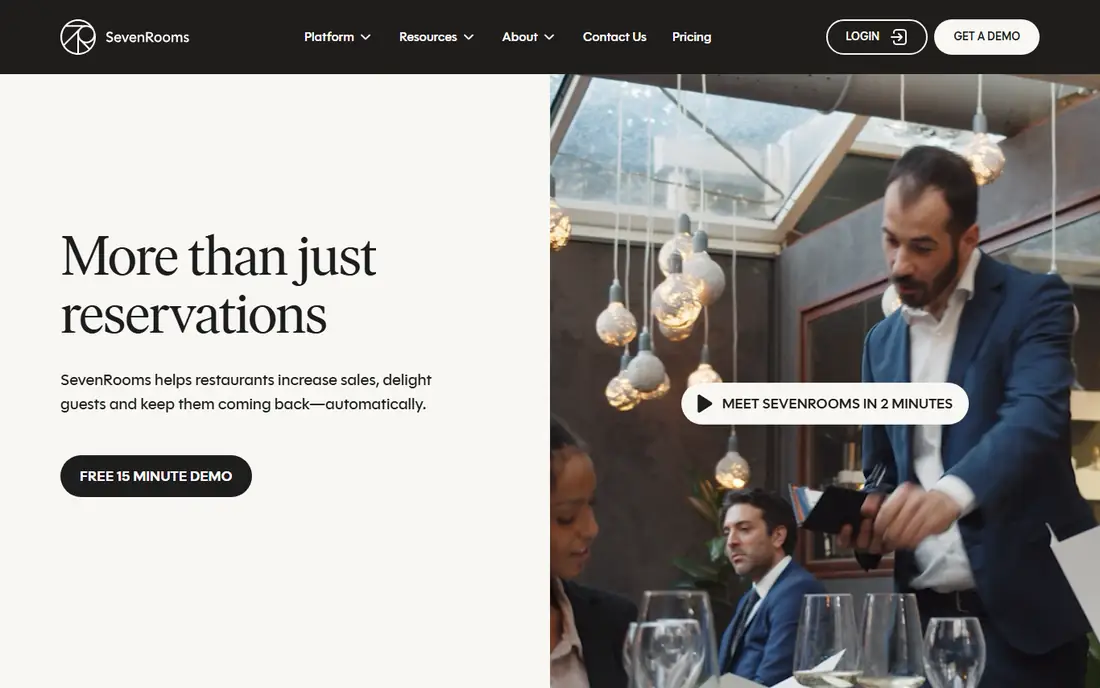
SevenRooms is less a booking widget and more a guest system. It captures and unifies guest data across every booking, visit, and order, building profiles with preferences, spend, and visit history that staff can use before a guest arrives. Automated email and SMS campaigns then turn one-time visitors into repeat guests, and table management tools with pacing controls help the floor turn tables on busy nights.
The platform now sits inside DoorDash, which acquired it in 2025, and bookings can flow from DoorDash Reservations, Google, Instagram, and Yelp alongside the restaurant's own site. Pricing is quote-based, which means a sales conversation is required, and smaller single venues may find the process heavy. For groups, hotels, and multi-unit operators who live in their guest data, SevenRooms is the strongest option on this list.
What we like- Deepest guest profiles in the category
- No per-cover fees
- Strong marketing automation
Watch out for- Quote-based pricing
- Demo-gated onboarding
- DoorDash ownership may concern some operators
#4Eat App
Best for: Independents on a budget4.7/5 on
G2 (57 reviews, checked Oct 2026)
Visit eatapp.co
Starting price$69 per month (billed annually)
Free planYes
Eat App is the value pick for independent restaurants. Its Lite plan runs 69 dollars per month when billed annually, or 99 dollars month to month, and a free tier covers up to 100 covers per month for the smallest venues. Bookings are commission-free, with no per-cover fees, and the restaurant owns its guest data rather than sharing it with a marketplace.
The platform covers reservations, table management, waitlists, and guest profiles, with a point of sale integration available as a paid add-on on lower tiers and included on Pro. The consumer marketplace is smaller than OpenTable, so restaurants that depend on discovery traffic will still want a marketplace presence. For venues that fill seats from their own channels, Eat App keeps costs low and predictable.
What we like- Free tier for small venues
- Flat pricing with no cover fees
- Restaurant owns its guest data
Watch out for- Smaller consumer marketplace than OpenTable
- Point of sale integration costs extra on lower tiers
#5Tock
Best for: Prepaid and ticketed dining4.2/5 on
G2 (96 reviews, checked Oct 2026)
Visit tock.com
Starting price$289 per month
Free planNo
Tock built its reputation on prepaid dining. Guests pay when they book, which cuts no-shows sharply for tasting menus, ticketed events, and wineries where an empty seat cannot be resold. The platform also handles experiences, deposits, and multi-course events that standard reservation books handle poorly.
Tock is now part of Resy, and its Essential tier starts around 289 dollars per month with a 3 percent fee on prepayments, or 2 percent on the Premium tier. Restaurants that already use Resy for standard bookings can add Tock for prepaid experiences without a second system. The main question for buyers is roadmap: as the two products merge, features may shift, so confirm the prepaid tools you need are in the tier you buy.
What we like- Prepaid reservations cut no-shows
- Ticketed experiences and tasting menus
- Strong winery presence
Watch out for- Now part of Resy, so roadmaps may merge
- Prepayment fees apply
Starting price$129 per month (billed annually)
Free planNo
Yelp Guest Manager turns Yelp searchers into seated guests. Restaurants join more than 11,000 venues seating reservation and waitlist parties from Yelp, Google, and Apple Maps, and the system charges no per-cover fees. A new AI answering service, Yelp Host, can handle reservations, waitlists, and takeout calls after hours, paired with Guest Manager.
Pricing starts around 129 dollars per month billed annually for Basic, or 159 dollars month to month. The value of the product tracks closely with Yelp strength in a market: a restaurant with strong Yelp traffic and reviews gains more than one with little Yelp presence. Guest data ownership is mixed, since marketplace guests remain Yelp users, so restaurants should confirm what data they can export before signing.
What we like- Converts Yelp search traffic into bookings
- No per-cover fees
- Waitlist included
Watch out for- Value depends on Yelp presence in your market
- Guest data ownership is mixed
Starting priceSee website
Free planNo
Toast Tables is the reservation add-on for restaurants already running Toast point of sale, which now serves around 180,000 locations. Reservations, guest profiles, and waitlists live inside the same system as orders and payments, so staff work from one screen and guest history follows the diner across visits. There are no per-cover fees, and pricing is bundled into the Toast agreement.
The limitation is obvious: Toast Tables only makes sense for Toast operators. A restaurant on another point of sale would need to switch systems to use it, which is a large decision for a reservation tool alone. For existing Toast restaurants, though, it is usually the cheapest and simplest reservation option available, since the integration work is already done.
What we like- Native Toast point of sale integration
- Guest profiles inside Toast
- No per-cover fees
Watch out for- Requires an active Toast account
- Pricing not published
#8ResDiary
Best for: White-label bookings4.8/5 on
G2 (5 reviews, checked Oct 2026)
Visit resdiary.com
Starting priceSee website
Free planNo
ResDiary suits restaurants that want bookings under their own brand rather than a marketplace badge. Its white-label pages, guest tagging, no-show alerts, and review summaries give single venues a professional booking flow, while group tools compare site performance and flag problems across locations. An AI assistant summarizes guest feedback and service metrics for managers.
Pricing is quote-based, with UK pricing around 109 pounds per month for the Evo Connect tier, and US pricing confirmed through sales. The platform is strongest in the UK and Asia Pacific, so US restaurants should confirm local support and payment options. For venues that care about brand control and own their booking pages outright, ResDiary is a solid alternative to the marketplace-led systems.
What we like- White-label booking pages
- Guest tagging and no-show alerts
- Group-level reporting
Watch out for- Pricing not published
- Strongest in the UK and Asia Pacific
How we chose
We compared reservation systems on pricing model, per-cover fees, discovery reach, guest data ownership, table management, and point of sale integration, using vendor homepages and published pricing comparisons from October 2026. Every homepage on this list was opened and confirmed, except Hostme, whose domain could not be resolved and which was replaced by ResDiary. Prices change often in this category, so confirm the current plan and fees with the vendor before signing.
What to check before you sign
Start with your demand mix. If most bookings come from your own phone, website, and regulars, a flat-rate system like Resy, Eat App, or SevenRooms keeps costs predictable. If new diners drive your business, OpenTable or Yelp Guest Manager may pay for themselves through discovery, even with fees. Count your monthly covers and model the per-cover fees honestly: a 1.50 dollar fee on 2,000 network covers is 3,000 dollars per month on top of the subscription.
Next, ask who owns the guest data. Marketplace systems keep their own diner records, while direct-booking systems hand the restaurant its guest list. That distinction matters when you switch systems or run your own marketing. Ask what fields export, in what format, and whether you keep the data if you cancel.
Finally, test the floor tools, not just the booking page. Table management, pacing, waitlists, and no-show handling decide whether the system helps on a busy Saturday or just collects reservations. Ask for a trial on a real service, check the point of sale integration your venue uses, and read the contract term: several vendors use one-year terms with auto-renewal.
Frequently asked questions
What is the cheapest restaurant reservation software?
Eat App is the cheapest option on this list, with a free tier up to 100 covers per month and a Lite plan at 69 dollars per month billed annually. OpenTable starts at 149 dollars per month plus per-cover fees, which makes it more expensive for busy rooms. The cheapest choice depends on cover volume, since per-cover fees can outweigh a low subscription.
Does OpenTable charge per cover?
Yes. OpenTable charges 1.50 dollars per cover for diners who book through its network on Basic, or 1 dollar on Core and Pro. Website bookings cost 25 cents per cover on Basic, or a 49 dollar monthly flat fee, and are included on Core and Pro. Phone and walk-in reservations are free on all plans.
Do I own my guest data with these systems?
It depends on the system and the booking channel. Eat App and SevenRooms hand the restaurant its guest data on direct bookings, while OpenTable and Yelp keep their marketplace diner records. Ask each vendor what exports, in what format, and whether data survives cancellation.
What is the difference between Resy and Tock?
Resy handles standard reservations and waitlists for upscale city restaurants, while Tock handles prepaid reservations, ticketed experiences, and tasting menus. Tock is now part of Resy, and the two are increasingly sold together. Restaurants with tasting menus or high no-show rates often use Tock alongside Resy.
Can I switch reservation systems without losing bookings?
Yes, but plan the move carefully. Export guest lists, future reservations, and waitlist data before cancelling, and run both systems briefly during the changeover. Confirm the new system imports future bookings, since re-entering them by hand is slow and error-prone.
Is a free reservation system enough for a busy restaurant?
A free tier suits low-volume venues, but busy rooms usually need paid tiers for table management, pacing, waitlists, and guest CRM. Check the free plan cover limit before committing, since outgrowing it mid-season forces a rushed upgrade. Eat App free tier covers up to 100 covers per month.
Sources we checked (10)
- https://www.opentable.com
- https://resy.com
- https://www.sevenrooms.com
- https://www.eatapp.co
- https://www.tock.com
- https://business.yelp.com
- https://pos.toasttab.com
- https://www.resdiary.com
- https://restaurant.eatapp.co/blog/online-restaurant-reservation-systems
- https://restauranttools.ai/blog/best-restaurant-reservation-systems-opentable-resy-sevenrooms
Is your product missing or out of date?
We review this list regularly. Vendors can request a listing, send updated pricing or ask about featured placement.

Shihab Mia · Founder, Rankite
Shihab has 5+ years in B2B and SaaS SEO. He writes Rankite's software buying guides from pricing pages, documentation and public user reviews. More about Shihab.