How we make this list: we compare pricing pages, product documentation and public user reviews. Rankite is independent; if a vendor ever pays for a featured spot, that listing is clearly labeled Partner.
Key takeaways
- ReferralCandy is the most complete pick for Shopify and DTC brands, but its success fee means a busy program can cost far more than the $39 sticker price.
- GrowSurf is the strongest fit for SaaS and tech companies that want referrals living inside the product, with setup measured in days rather than weeks.
- Enterprise options like Talkable, Extole, and Mention Me keep pricing behind sales calls and only make sense once referral volume justifies a contract.
- Fraud controls matter more than feature lists. Self-referrals and leaked coupon codes quietly eat margins on any platform that lacks them.
Quick comparison
| Tool | Best for | Starting price | Free plan |
|---|
 ReferralCandy ReferralCandy | Shopify and DTC brands running referrals plus affiliates | $39/mo + 10.5% success fee | Free trial (7 days) |
 GrowSurf GrowSurf | SaaS and tech startups embedding referrals in-product | $179/mo ($125/mo billed annually) | Free trial (14 days) |
 Referral Factory Referral Factory | Service and B2B businesses launching no-code programs | $200/mo | Free trial (15 days) |
 Talkable Talkable | Mid-market ecommerce running campaign-based referrals | See website | See website |
 Friendbuy Friendbuy | DTC brands needing fraud-proof referral attribution | See website | See website |
 Extole Extole | Enterprises running referral at high volume | See website | See website |
 Yotpo Yotpo | Ecommerce brands bundling loyalty, reviews, and referrals | See website | See website |
 Mention Me Mention Me | Retailers using name-sharing to capture offline word of mouth | See website | See website |
 InviteReferrals (NVECTA) InviteReferrals (NVECTA) | Mobile apps running multi-channel referral contests | See website | See website |
 ReferralHero ReferralHero | Startups running waitlists, giveaways, and viral contests | See website | See website |
Is your product missing or out of date?
We review this list regularly. Vendors can request a listing, send updated pricing or ask about featured placement.
The best referral marketing software
A store owner watches a first-time buyer check out, love the product, and tell three friends about it. Those friends buy. Nobody tracks it, nobody rewards it, and the loop dies there. Referral software exists to catch that exact moment and turn it into a repeatable channel. The ten tools below cover every shape of that job, from a $39 Shopify app to enterprise platforms that run referral like a media budget.
Starting price$39/mo + 10.5% success fee
Free planFree trial (7 days)
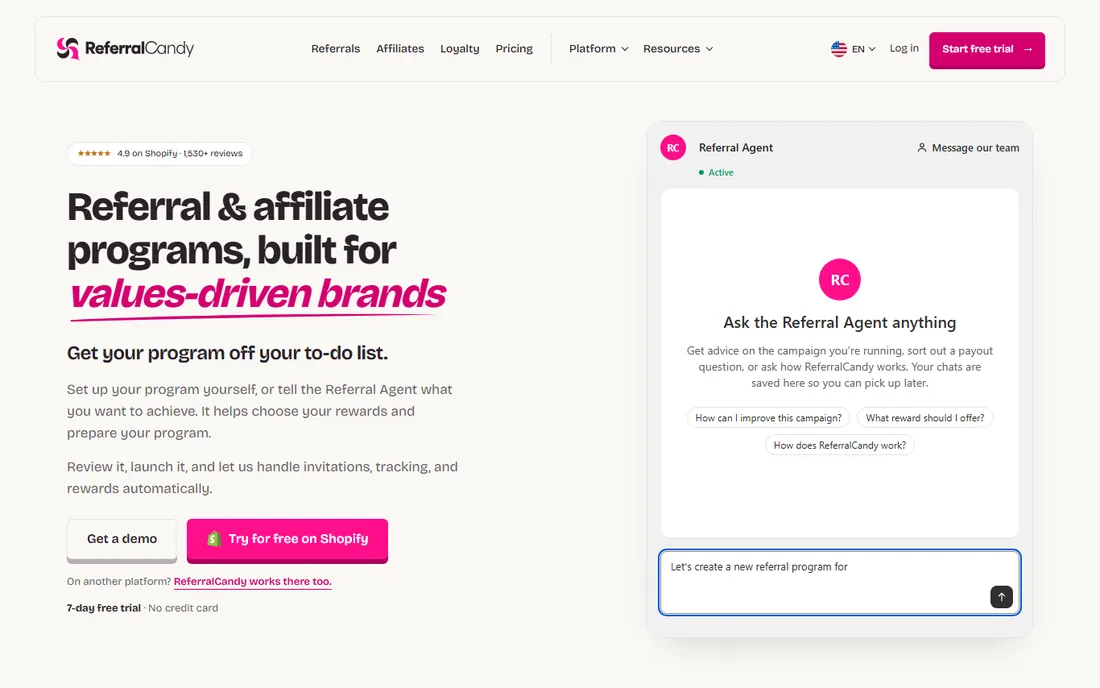
ReferralCandy has been around since 2010 and it shows in the polish. A merchant installs from the Shopify App Store, picks two-sided rewards (coupons, store credit, cash, gift cards), and the post-purchase prompt starts inviting buyers to share. WooCommerce gets a plugin, BigCommerce gets a one-click install, and custom stores connect through email, JavaScript, or API.
The affiliate side is what separates it from simpler refer-a-friend widgets. Partners get custom coupon codes, commissions can be flat, percentage, or tiered, and payouts go out through PayPal, Venmo, Tremendous virtual Visa, or bank transfer. Fraud detection flags self-referrals, suspicious spikes, and leaked codes before money moves.
The catch is the pricing model. The $39 Basic plan adds a 10.5% success fee on referral sales, so a store driving real volume will outgrow it fast. Model your total cost at projected referral revenue before you commit.
What we like- One-click Shopify install with deep ecommerce integrations
- Runs referral and affiliate programs side by side
- Every plan includes all features and unlimited campaigns
Watch out for- Success fee scales with your revenue, so costs climb as the program works
- No permanent free plan
#2
GrowSurf
Best for: SaaS and tech startups embedding referrals in-product
Visit growsurf.com
Starting price$179/mo ($125/mo billed annually)
Free planFree trial (14 days)
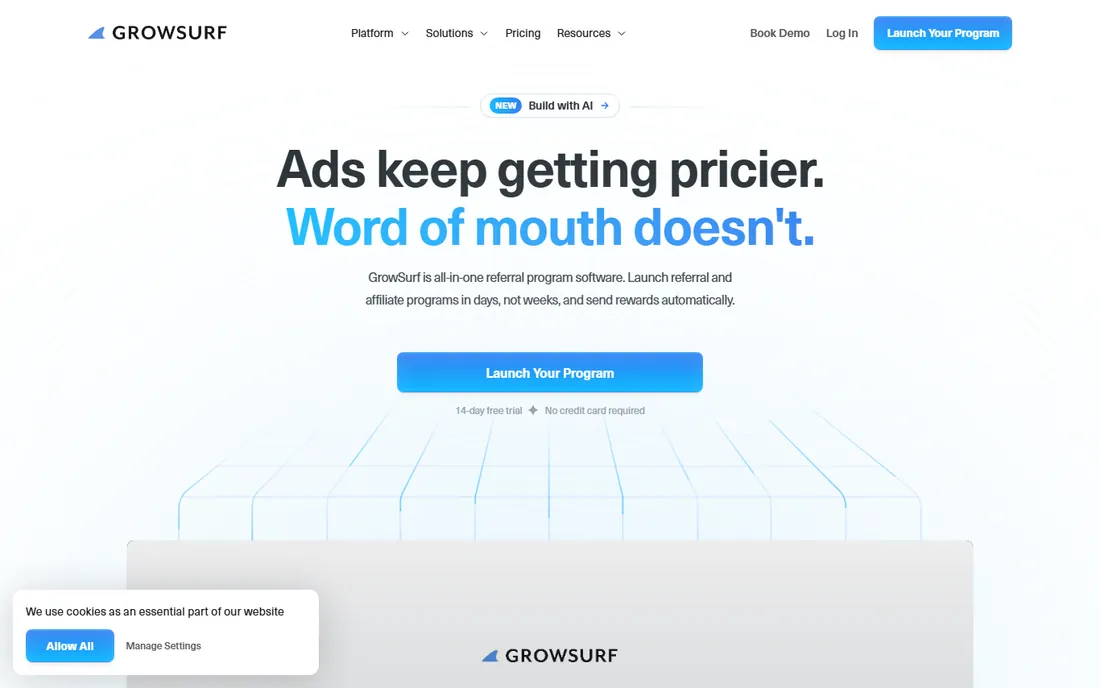
GrowSurf is built for product teams rather than store owners. You paste one code snippet into your app and every signed-in user automatically gets a referral link. The program lives inside your product under your brand, which is exactly how SaaS, fintech, and telehealth companies want it.
Reward automation is the core strength. Gift cards, cash payouts, and account credits go out on their own, or you can hold each one for manual review. Startup covers up to 2,500 participants at $179 per month ($125 billed annually), and Business starts at $449 per month for 10,000 participants. A separate affiliate product costs $0 per month plus a 3% success fee on referral revenue.
Integration coverage is wide for the price: more than 60 native integrations including Stripe, Recurly, Chargebee, and Salesforce, plus Zapier, a REST API, a JavaScript library, and webhooks. An AI assistant suggests reward structures and writes share copy. Most teams launch within a day. The catch is that participant-based pricing punishes large free-user bases, so count your eligible audience before you sign.
What we like- Copy-paste install with automatic link generation for every user
- Fully white-labeled
- Rewards fulfilled automatically
Watch out for- Priced by participant count, so costs rise with your audience
- No free plan for referral programs
Starting price$200/mo
Free planFree trial (15 days)
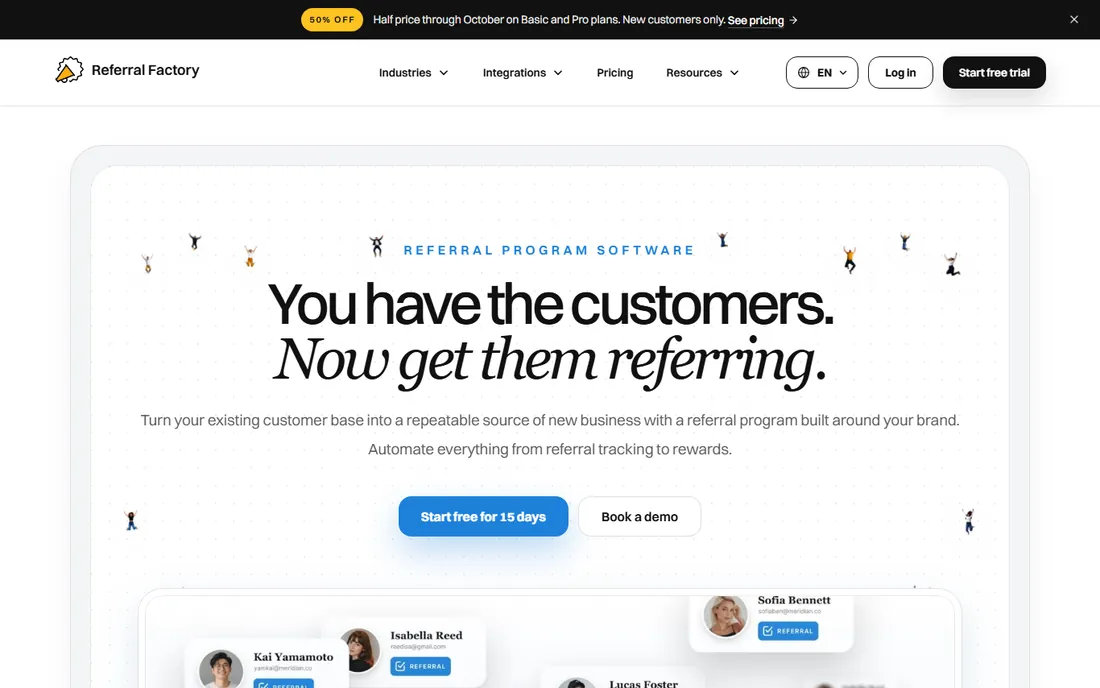
Most referral tools assume a checkout page. Referral Factory assumes a plumber, a law firm, a SaaS sales team, or a multi-location home services brand. Its no-code builder creates branded referral pages, tracks introductions through long sales cycles, and pushes referred leads straight into HubSpot, Salesforce, or Pipedrive. That makes it one of the few tools here that works when there is no shopping cart to hang a discount code on.
Every plan includes unlimited campaigns, referral links and codes, fraud alerts, and the full integration set including webhooks and API. Rewards cover cash via PayPal, gift cards in multiple currencies, account credits, coupons, and custom options, issued automatically or held for review. Pro at $400 per month removes all Referral Factory branding, adds a custom domain and SAML single sign-on. Enterprise starts at $1,000 per month with a managed rollout, invoice billing, and self-hosted data options.
Annual billing saves 20%, and there is a startup program worth asking about. The 15-day trial on Basic and Pro is enough to build a program end to end. The catch is the floor: $200 per month before you have proven the channel. If your average customer value is high the math still works, but hobby-size projects should look elsewhere.
What we like- No-code builder with 200+ reward types and unlimited campaigns on every plan
- Strong CRM integrations
- White-label and SSO on Pro
Watch out for- $200 entry price is steep for very small businesses
- No permanent free plan
#4
Talkable
Best for: Mid-market ecommerce running campaign-based referrals
Visit talkable.com
Starting priceSee website
Free planSee website
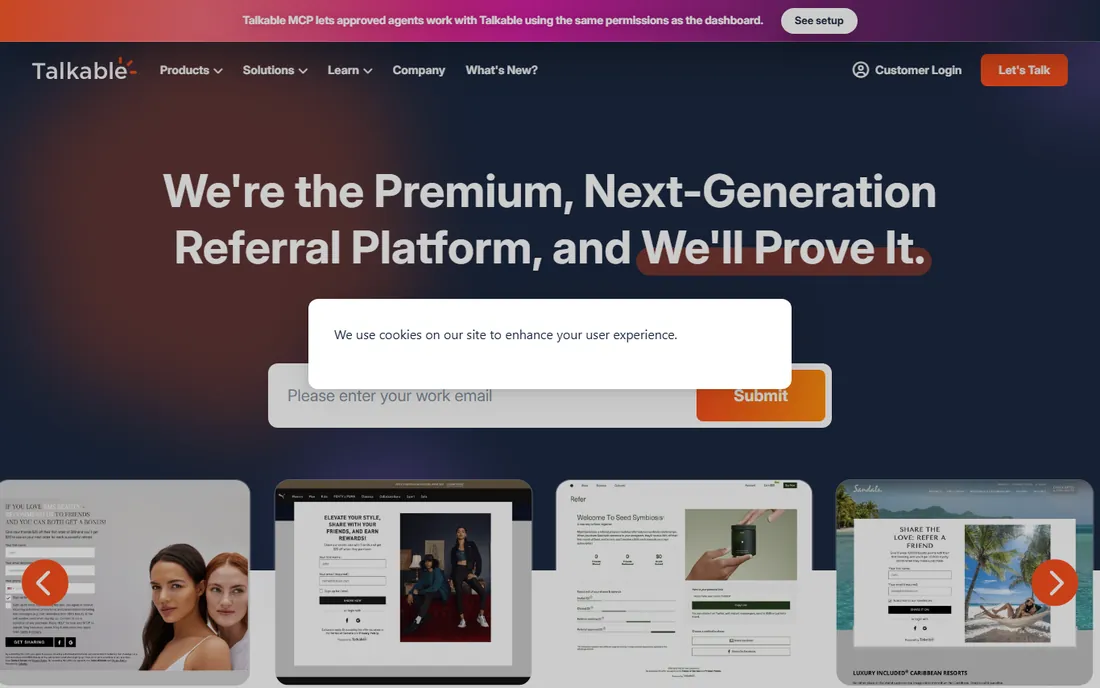
Talkable does not sell a static refer-a-friend box. It sells campaigns: targeted offers matched to audience, placement, and moment, with A/B tests running continuously. On-site widgets cover the home page, product pages, cart, and post-purchase, while standalone landing pages handle email, SMS, and influencer launches. The platform also bundles loyalty programs, video referral collection, and Apple and Google Wallet passes.
The managed service is the real product for many buyers. Their team handles the launch, then keeps testing placements, rewards, and creative after go-live. Fraud gets serious attention: real-time checks, phone verification, and a custom rules engine. The homepage states flat-fee pricing with no percentage of revenue, a deliberate contrast to success-fee competitors.
The catch is access. Pricing is quote-based, there is no self-serve trial, and the whole apparatus assumes meaningful order volume. Talkable suits brands that already spend on paid acquisition and want referral run with the same discipline.
What we like- Campaign-based referrals with A/B testing and segmentation
- Loyalty, video referrals, and wallet passes in one platform
- Managed launch with a dedicated team
Watch out for- Quote-based pricing with no public numbers
- Overkill for small stores
Starting priceSee website
Free planSee website
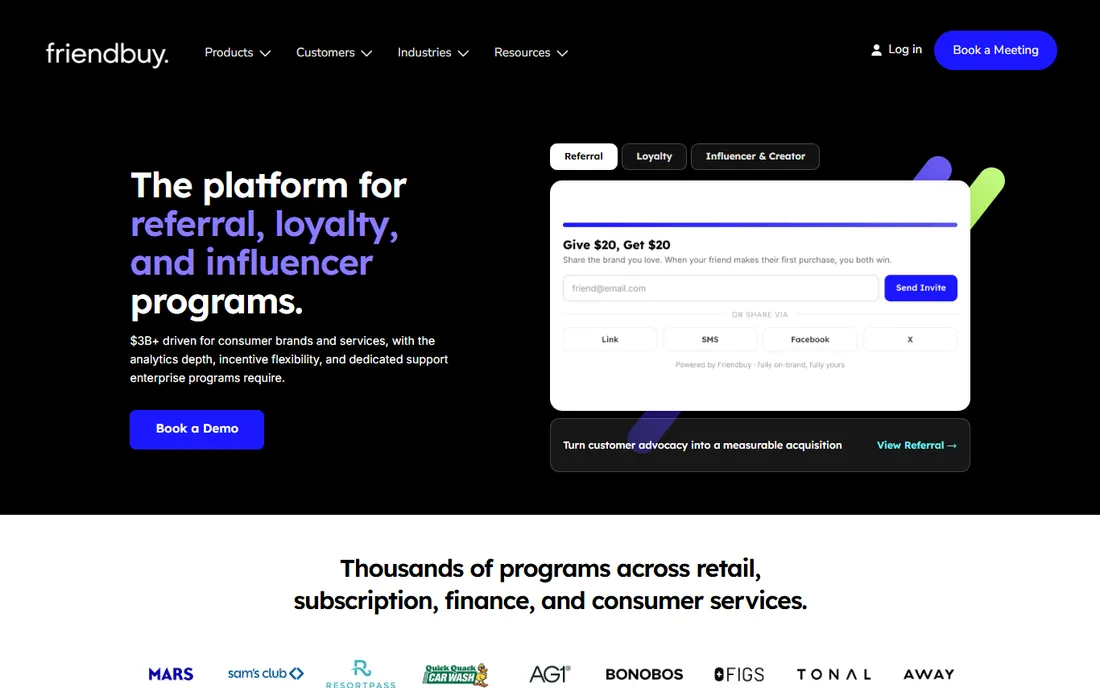
Friendbuy positions itself as infrastructure for referral as a performance channel, and its fraud stack backs that up. New customer validation blocks self-referrals. Device fingerprinting, velocity controls, configurable blacklists, and email similarity detection catch abuse patterns. Rewards sit in pending states until validated, and returns and cancellations feed back into attribution.
The platform covers the full funnel from advocate activation to friend purchase, with placements across web, email, and SMS. Rewards flex across discounts, store credit, gift cards, cash, loyalty points, and subscription credits. A/B testing runs across incentives, placements, and creative, and Klaviyo and Shopify integrations (including one-click Shopify install) keep it inside the standard DTC stack.
The catch is that everything runs through sales. There is no public pricing page and no self-serve plan, so expect a discovery call and a quote tied to your volume. That is normal at this tier, but it rules out quick experiments. Friendbuy fits brands where referral is already a line item worth defending with clean data.
What we like- Serious fraud governance built for scale
- Referral, loyalty, and influencer in one platform
- Strong experimentation across incentives and placements
Watch out for- No public pricing, sales-led buying process
- Aimed at mid-market and up
Starting priceSee website
Free planSee website
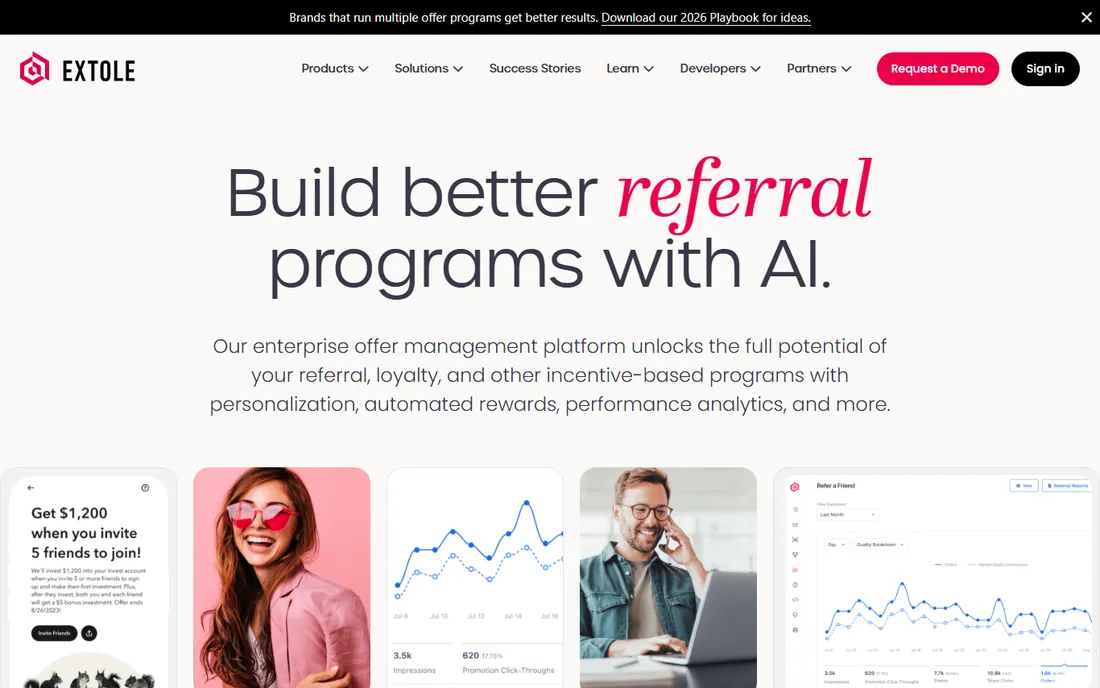
Extole is the enterprise end of this list. It powers referral, reward, and loyalty programs for large consumer brands in retail, financial services, and telecom, where programs need eligibility controls, fraud prevention, and audit trails that satisfy compliance teams.
The platform leans technical, with a documented API surface for share links, referrals, profiles, and rewards, plus integrations across the enterprise marketing stack. If your program needs to clear legal review, Extole is built for that conversation.
The catch is everything that comes with enterprise software: custom pricing, a sales-led process, and implementation measured in weeks or months. There is no trial and no published starting price. Extole belongs on the shortlist when referral volume is large enough to need governance, and nowhere near it when a $200-per-month tool would do.
What we like- Enterprise-grade fraud prevention, eligibility controls, and auditability
- Multi-channel campaigns across referral, rewards, and loyalty
- Developer-friendly APIs
Watch out for- Custom enterprise pricing with no self-serve option
- Long sales and implementation cycles
#7
Yotpo
Best for: Ecommerce brands bundling loyalty, reviews, and referrals
Visit yotpo.com
Starting priceSee website
Free planSee website
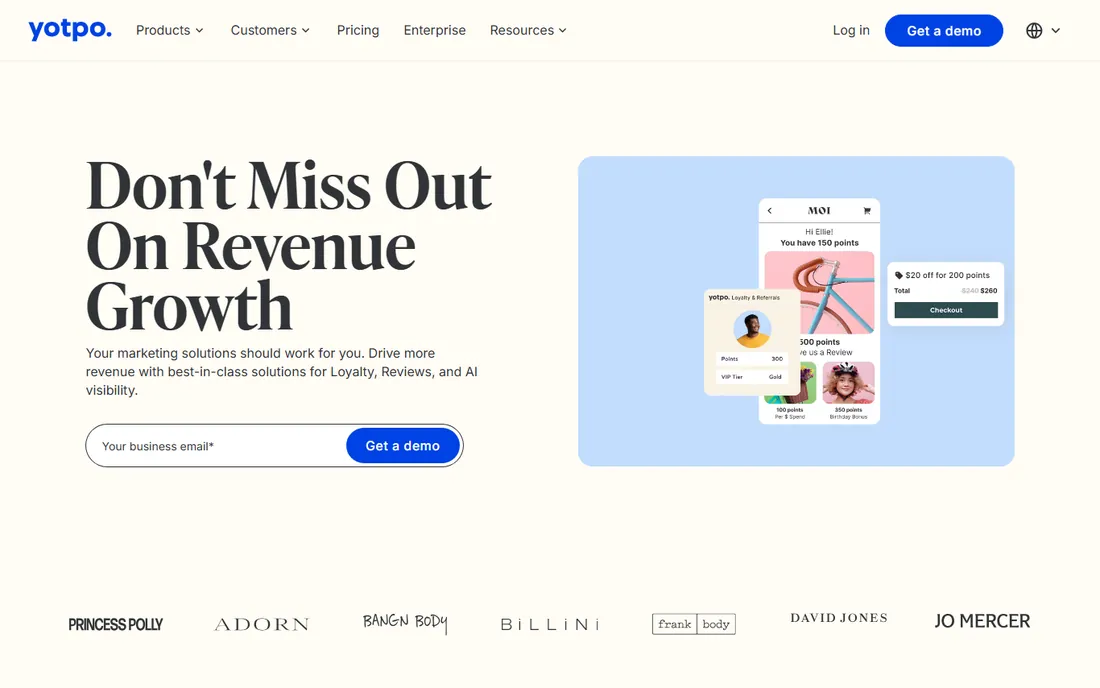
Yotpo is a retention suite first and a referral tool second. Loyalty and Referrals sits alongside Reviews and UGC, and the shared data is the selling point: a five-star review can award points, a points milestone can trigger a message, and VIP tiers show up inside review widgets. For a lean team, one login and one vendor relationship is a genuine operational win.
The loyalty product includes points, tiers, referral campaigns, birthday rewards, and social sharing rewards, with conditional earning rules and checkout redemptions on paid tiers. Shopify integration runs deep, including POS and customer account pages. Third-party pricing trackers list a free tier for basic points and referrals, with paid plans starting around $199 per month and scaling with monthly order volume.
Two cautions. Each module is purchased separately, so a store running reviews plus loyalty pays for both. Yotpo also discontinued its SMS and Email products at the end of 2025, so verify the current bundle. Past a few thousand monthly orders, per-order overage fees can quietly outgrow the base subscription.
What we like- Loyalty, reviews, and UGC share one platform and one dataset
- Free tier covers basic points and referrals
- Deep Shopify integration
Watch out for- Modules are priced separately so the total bill adds up fast
- Costs scale with order volume
#8
Mention Me
Best for: Retailers using name-sharing to capture offline word of mouth
Visit mention-me.com
Starting priceSee website
Free planSee website
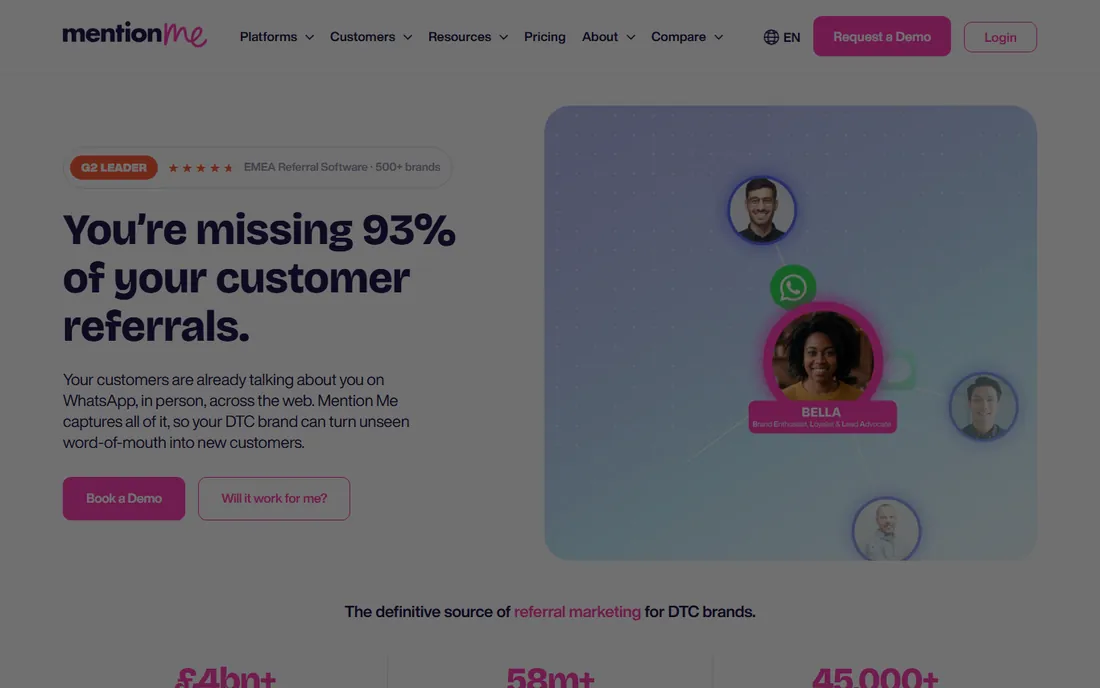
Mention Me owns one clever idea: refer by name. Instead of a link or code, the friend just types the referrer's name at checkout, which captures the word-of-mouth conversations that happen in person, on the phone, or over text. The company says this drives up to 35% more referrals than link-only sharing, and it is the reason retailers with strong offline word of mouth pick it.
The platform supports referral programs in 16 languages, bakes in A/B testing to optimize campaigns by cohort, and prices on a cost-per-acquisition model so you pay for acquired customers rather than software seats. Implementation comes with a client success team that brings benchmarks from similar retailers.
The catch is fit. Mention Me targets brands doing thousands of orders a month; a small store will not clear the bar for attention or economics. Pricing is bespoke and revenue-based, quoted after a sales conversation. If your customers already recommend you in real life and you cannot track it, this is the most direct way to put a number on it.
What we like- Unique name-sharing technology captures real-world conversations
- A/B testing built in
- CPA-style pricing means you pay for results
Watch out for- Built for higher-volume retailers, not small stores
- No self-serve pricing or trial
Starting priceSee website
Free planSee website
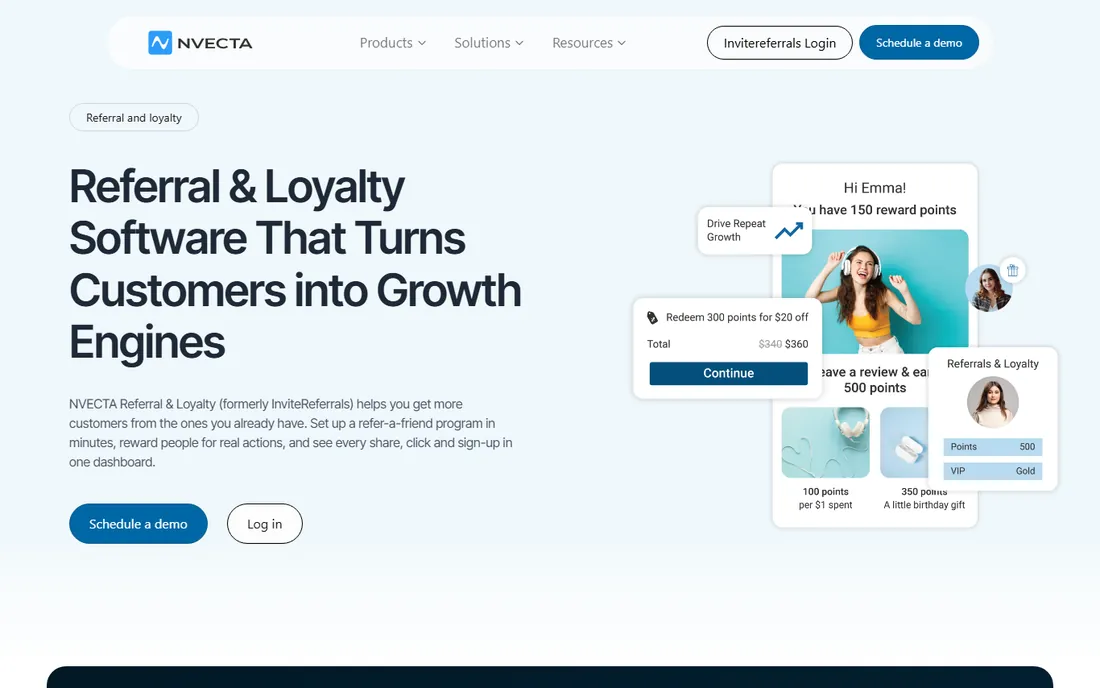
InviteReferrals recently joined NVECTA and now operates as NVECTA Referral and Loyalty, so expect both names during the transition. The product is a flexible referral engine: three campaign types (instant rewards, top-referrer contests, goal-based rewards), multiple widget styles, and sharing across email, social, chat, and SMS from one integration.
Mobile is the differentiator. Native SDKs cover Android, iOS, Flutter, and Xamarin, which matters if your growth happens in an app rather than a browser. Fraud prevention includes spam-proof notifications, suspicious participant detection, and manual conversion review, and email templates are editable in a WYSIWYG editor.
The catch is the moving target. The NVECTA rebrand reshuffled the site, the pricing page, and the packaging, so confirm exactly which product and plan you are buying. It is a capable platform for app-driven and contest-style programs, but buyers who want a stable, simple Shopify app will be happier elsewhere.
What we like- Three campaign types including contests and goal-based rewards
- Mobile SDKs for Android, iOS, and Flutter
- Built-in fraud prevention
Watch out for- Brand transition to NVECTA can confuse new buyers
- Pricing and packaging keep changing
Starting priceSee website
Free planSee website
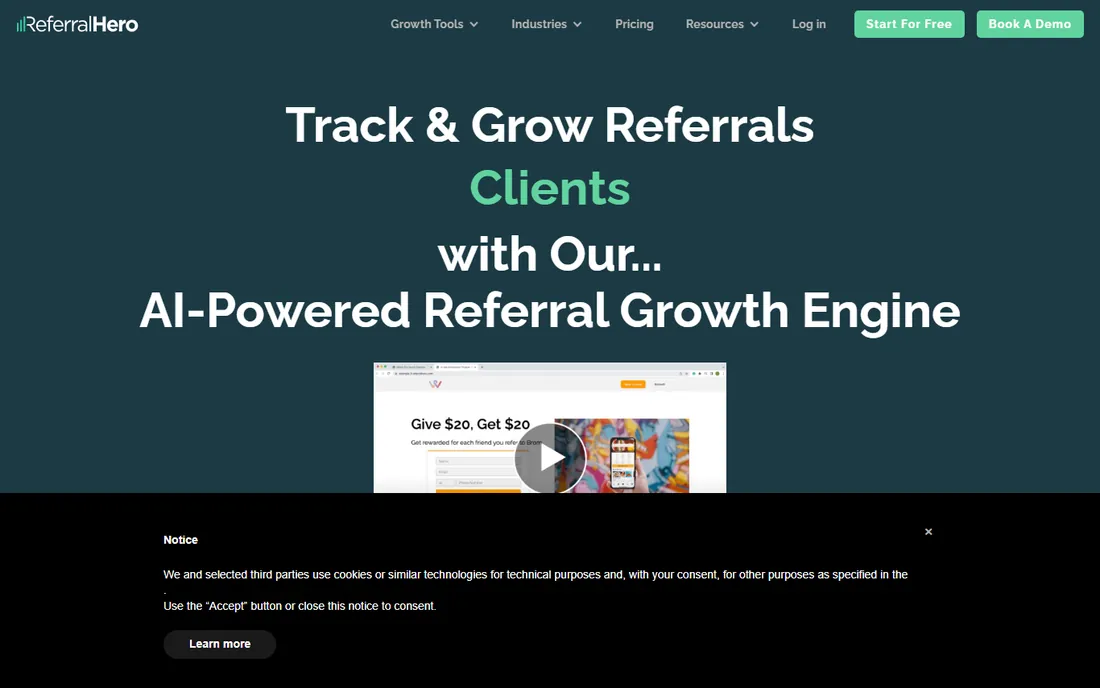
ReferralHero grew out of the viral-waitlist playbook: give people a signup form, a shareable link, and milestone rewards for hitting referral counts. Campaigns support referral links and coupon codes, rewards cover cash, gift cards, and coupons, and the anti-fraud algorithm plus reCAPTCHA and SMS verification keep contests clean. Attribution windows stretch to 90 days on some setups.
Setup is genuinely simple, and integrations cover the usual startup stack: Mailchimp, Shopify, HubSpot, Klaviyo, Zapier, WordPress, and WooCommerce. API access opens on paid plans. Third-party trackers list paid plans from around $49 to $199 per month with a free trial available, though you should confirm current packaging on the vendor site since tiers have shifted over time.
The honest catch is scope. ReferralHero is a contest and waitlist engine first. If you need post-purchase referral prompts, two-sided ecommerce rewards, and affiliate management, the Shopify-native tools above fit better. For launching a product with a viral waiting list, few tools get you live faster.
What we like- Purpose-built for waitlists and milestone contests
- Memorable referral links
- Simple setup with broad integrations
Watch out for- Geared to list-building contests more than post-purchase ecommerce referrals
- Advanced features sit on higher tiers
How we chose
We started from the vendors themselves. Each homepage was opened and confirmed, and pricing, plan limits, and free-trial terms were taken from the vendor's own pricing page wherever one is published. Where vendors keep pricing behind sales (Talkable, Extole, Friendbuy, Yotpo, Mention Me), we say so instead of repeating third-party guesses.
From there we cross-checked feature claims against public documentation, help centers, and developer docs, and compared buyer sentiment across G2, Capterra, GetApp, TrustRadius, and Slashdot listings plus independent review sites. We weighted fit for small and mid-size US businesses: setup effort, contract flexibility, pricing model, integration depth with Shopify, CRMs, and email tools, and whether fraud controls and data export are real or marketing copy. Tools without a verifiable official site did not make the list.
How to pick without overpaying
Match the program to your checkout
A Shopify store wants post-purchase prompts and two-sided discount rewards, which points to ReferralCandy or Yotpo. A SaaS product wants in-product links and automated credits, which points to GrowSurf. A services business wants tracked introductions that land in the CRM, which points to Referral Factory. Buying the wrong shape and forcing it to fit is the most expensive mistake in this category.
Count the true cost, not the sticker price
Success fees and participant-based pricing change the math completely. A $39 plan with a 10.5% success fee can cost more than a $200 flat plan once referral revenue scales. Participant-based plans charge for everyone who receives a link, not just buyers. Build a simple model at your current volume and at 3x volume before you sign anything.
Check the fraud controls before the feature list
Self-referrals, duplicate accounts, and codes leaked to coupon sites are the quiet margin killers. Ask every vendor how they detect self-referrals, whether rewards can sit in a pending state for review, and how returns and cancellations feed back into attribution. A platform with weak answers here will cost you more than its subscription.
Ask about data, contracts, and exit
Confirm month-to-month billing or the annual lock-in, who owns the referral and customer data, and how you export it. Check support hours and whether onboarding is self-serve or guided. Enterprise plans often include a dedicated manager; entry plans often mean email support and documentation.
Referral, affiliate, or loyalty: which program do you actually need?
These get bundled together, but they solve different problems. A referral program rewards your existing customers for bringing friends. It works when you have happy buyers and a product people talk about. An affiliate program pays creators, publishers, and partners for driving sales. It works when you need reach beyond your customer base. A loyalty program rewards repeat purchases with points, tiers, and perks. It works when retention, not acquisition, is the leak.
Many of the tools above cover two or three of these. ReferralCandy and Friendbuy run referrals and affiliates side by side. Yotpo and Talkable add loyalty to the mix. Do not pay for all three if you only need one. Start with the program that matches your biggest gap and expand when the numbers justify it.
Frequently asked questions
How much does referral marketing software cost?
Entry-level plans run from about $39 to $200 per month, while mid-market and enterprise platforms are quote-based and can reach four figures monthly. Watch the pricing model as closely as the number: success fees take a cut of referral revenue and participant-based plans charge per eligible user. Always model total cost at your projected volume.
Do I need a developer to launch a referral program?
Usually not for the basics. Shopify apps install in one click, and tools like GrowSurf and Referral Factory need a single snippet or no code at all. Developers become necessary for deep customization or tight integration with internal systems. Enterprise platforms typically include implementation help in the contract.
How do rewards actually get paid out?
It depends on the reward type. Discounts and store credit are issued as codes or account balances automatically. Cash and gift cards go through PayPal, bank transfer, or gift card providers like Tremendous, often with a manual review step before release. Most platforms let you hold every reward for approval or automate the whole flow.
Will my referral codes leak onto coupon sites?
They can, and on popular programs they will. This is why fraud controls matter: look for leaked-code detection, self-referral flags, new-customer validation, and pending reward states. Unique single-use codes leak less than generic ones.
Can I run referrals and affiliates in one tool?
Yes, several tools on this list do both. ReferralCandy, Friendbuy, and GrowSurf each combine customer referrals with partner or affiliate tracking in one dashboard. The tradeoff is depth: a dedicated affiliate network offers more partner recruitment features, while an all-in-one keeps your reporting and payouts in one place.
How long does it take to see results?
Most programs need 60 to 90 days to show a real trend. The first weeks go to launch, email invites, and initial sharing. Referral behavior compounds as more customers enter the program, so judge performance after a full buying cycle.
Sources we checked (16)
- https://www.referralcandy.com/
- http://www.referralcandy.com/pricing/
- https://growsurf.com/
- https://referral-factory.com/pricing
- https://talkable.com/
- https://www.friendbuy.com/products/referral-program-software
- https://invitereferrals.com/
- https://www.extole.com/
- https://www.yotpo.com/
- https://www.mention-me.com/
- https://referralhero.com/
- https://www.getapp.com/marketing/friendbuy-reviews/
- https://www.saasworthy.com/product/friendbuy/pricing
- https://techcrunch.com/2018/07/17/mention-me/
- https://www.eu-startups.com/directory/mention-me/
- https://github.com/ishandutta2007/awesome-referral-marketing-platform/blob/HEAD/README.md
Is your product missing or out of date?
We review this list regularly. Vendors can request a listing, send updated pricing or ask about featured placement.

Shihab Mia · Founder, Rankite
Shihab has spent more than a decade helping SaaS and e-commerce brands grow through search. He writes Rankite's software buying guides from pricing pages, documentation and public user reviews. More about Shihab.