How we make this list: we compare pricing pages, product documentation and public user reviews. Rankite is independent; if a vendor ever pays for a featured spot, that listing is clearly labeled Partner.
Key takeaways
- Numeric ($30/user/month Essentials, published) is the only close-management vendor with transparent pricing: the honest starting point for growth-stage teams.
- FloQast, BlackLine and Trintech Adra publish no pricing (third-party data puts them at $12K-$40K+/year): expect sales-led quotes and multi-year contracts.
- If your needs are just bank reconciliation, QuickBooks Online ($38/month) or Xero ($27/month) already include it: no separate purchase needed.
- SolveXia (no-code matching for messy data) and ReconArt (every reconciliation type in one platform) serve specialized matching needs.
The best reconciliation software
Month-end close should take days, not weeks. If your accountants live in spreadsheets the first week of every month, account reconciliation software pays for itself in the first close: automated matching clears the routine accounts, and the team spends its hours on exceptions instead of tie-outs. These eight cover the real market, from built-in bank reconciliation to enterprise close platforms, with honest notes on the opaque pricing that defines this category.

#1
FloQast
Best for: Mid-market accounting teams (10 to a few hundred employees) on NetSuite or Sage Intacct
Visit floqast.com
Starting priceSee website (no published pricing; third-party data suggests ~$12K/year entry)
Free planNo (demo by booking; no self-serve trial)
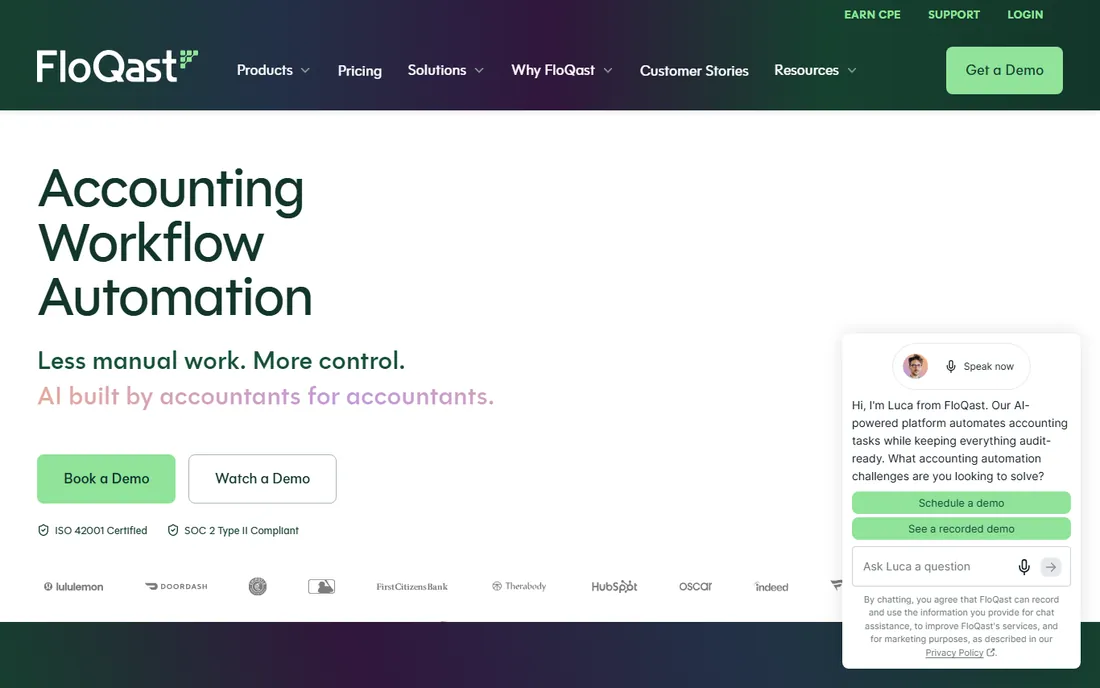
FloQast is the close-management leader for the mid-market: checklist-driven close management with automated TB tie-outs and task sign-offs that reviewers follow without spreadsheet chaos. Auto-matching exists for reconciliations, but the product's identity is close coordination, not deep transaction matching.
The honest catch is opacity. Pricing is custom and scales with entity count, modules and ERP complexity; third-party buyer data (early 2026) suggests roughly $12,000 per year entry for smaller teams with a median near $24,000 per year, per-user estimates of $125-$150 per month (though FloQast markets no per-user fees), typical 2-3 year annual contracts, and renewal uplifts of 3-7 percent. For the NetSuite or Intacct shop whose bottleneck is close coordination, the breadth of integrations is the argument.
What we like- Close management built around familiar Excel-style checklists, so accounting teams adopt it fast
- Automated reconciliations with close-task tracking, review notes and variance analysis in one workspace
- Strong ERP connectivity (NetSuite, Sage Intacct, QuickBooks, SAP, Oracle, Dynamics 365, Workday)
Watch out for- No published pricing and no self-serve path: everything goes through a sales call
- Pricing floor and multi-year annual contracts put it out of reach for true small businesses

#2
BlackLine
Best for: Large enterprises and public companies with high reconciliation volumes and audit requirements
Visit blackline.com
Starting priceSee website (module-based custom pricing only)
Free planNo (sales-led demos only)

BlackLine automates tens of thousands of reconciliations per month: auto-certification of clean accounts, exception-based review, intercompany matching and elimination, plus journal entry automation. Third-party data suggests median contracts near $40,560 per year, with larger deployments at $77K-$340K per year and implementation often $50K-$200K-plus via partners.
The honest catch is cost and complexity: five- to six-figure annual contracts, partner-led implementation measured in months, and tiered support where some services cost extra. Matching is rules-plus-AI covering bank, intercompany and PO-to-invoice without per-account rule configuration. For the public company with real SOX requirements, this is the standard. For everyone else, it is the price ceiling that makes Numeric and FloQast look reasonable.
What we like- Deepest enterprise close automation: auto-certification, high-volume transaction matching, journal entry automation and intercompany hub
- SAP-endorsed with the strongest SAP and Oracle integration story
- AI (Verity AI) for anomaly detection and audit-ready controls
Watch out for- Enterprise price point and 4-6 month implementation make it a poor fit for SMB budgets
- No self-serve tier or transparent pricing

#3
Trintech (Adra Suite)
Best for: Control-heavy mid-market finance teams with high reconciliation volume and audit burden
Visit trintech.com
Starting priceSee website (no public pricing; third-party estimates put Adra at ~$30K-$100K/year)
Free planNo (no publicly offered trial)
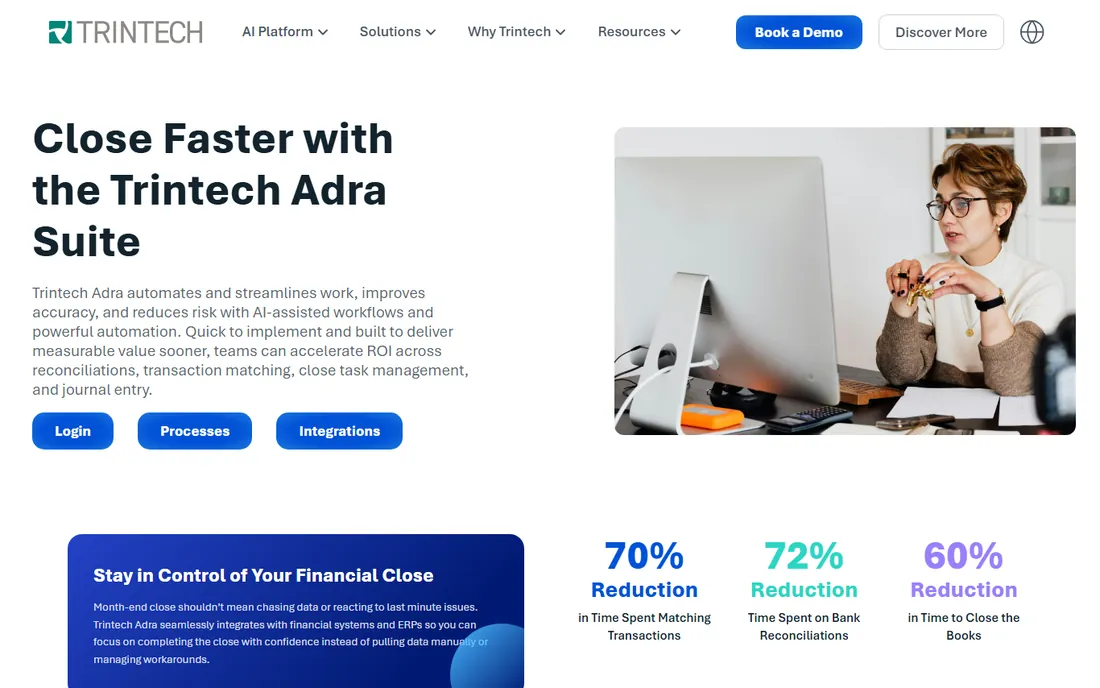
Adra's concrete strength is deciding which reconciliations deserve attention: risk-based scheduling and review workflows rather than simply cutting the reconciliation count. Matching is the star: multi-way matching with tolerance handling and exception management across bank, intercompany and GL accounts. ERP integrations cover SAP, Oracle, NetSuite, Dynamics and Sage Intacct.
The honest catch is flexibility: configuration can feel rigid, and the interface shows its age against newer tools. Enterprise Cadency runs $300K-$1M-plus per year with $100K-$500K-plus implementation, so confirm which product a quote covers. For the control-heavy finance team that wants matching depth with risk-based review, Adra competes directly with ReconArt.
What we like- Modular suite: buy only what you need (Balancer for balance-sheet recs, Matcher for transaction matching, Task Manager, Analytics)
- Sophisticated 3-way and 4-way matching for intercompany, bank and interim accounts
- Selling reconciliation software since 1987 with broad mid-market deployment
Watch out for- Reviewers report rigid configuration and interface friction
- Moving from Adra to Cadency is a reimplementation, not an upgrade

#4
Numeric
Best for: Growth-stage and mid-market teams ($10M-$500M revenue) on NetSuite, Sage Intacct, QuickBooks or Xero
Visit numeric.io
Starting price$30/user/month (Essentials plan, published)
Free planNo (demo by booking; no public trial)
Numeric is the transparent pick in an opaque category: Essentials at $30 per user per month, published, with Growth and Enterprise custom-quoted. Its AI does first-pass close work, not just checklist management: live ERP data, transaction-level visibility, real-time monitors that catch errors before month-end, and free view-only auditor licenses.
The honest catch is the tier line: Essentials is close organization and task visibility, not full automation; the AI reconciliation agent and bank-statement parsing need Growth. For the QuickBooks or Xero graduate not ready for BlackLine pricing, the Essentials-to-Growth ladder is the natural path. Newer than BlackLine and FloQast, so the enterprise track record is shorter, but the value per dollar is strong.
What we like- Only published starting price among the close-management vendors, with per-user billing on Essentials
- AI-forward: AI flux analysis drafts variance explanations and an AI reconciliation agent does first-pass balance-sheet matching
- Fast implementation, often under a week to 30 days
Watch out for- Focused on four ERPs (NetSuite, Sage Intacct, QuickBooks, Xero), so other-ERP teams are out
- Auto-reconciliation and AI bank-statement parsing live on the custom-priced Growth tier

#5
ReconArt
Best for: Mid-market companies with diverse reconciliation needs across many account types
Visit reconart.com
Starting priceSee website (quote-based; third-party directories cite ~$300/user/month, directional only)
Free planNo (free trial offered per Capterra)
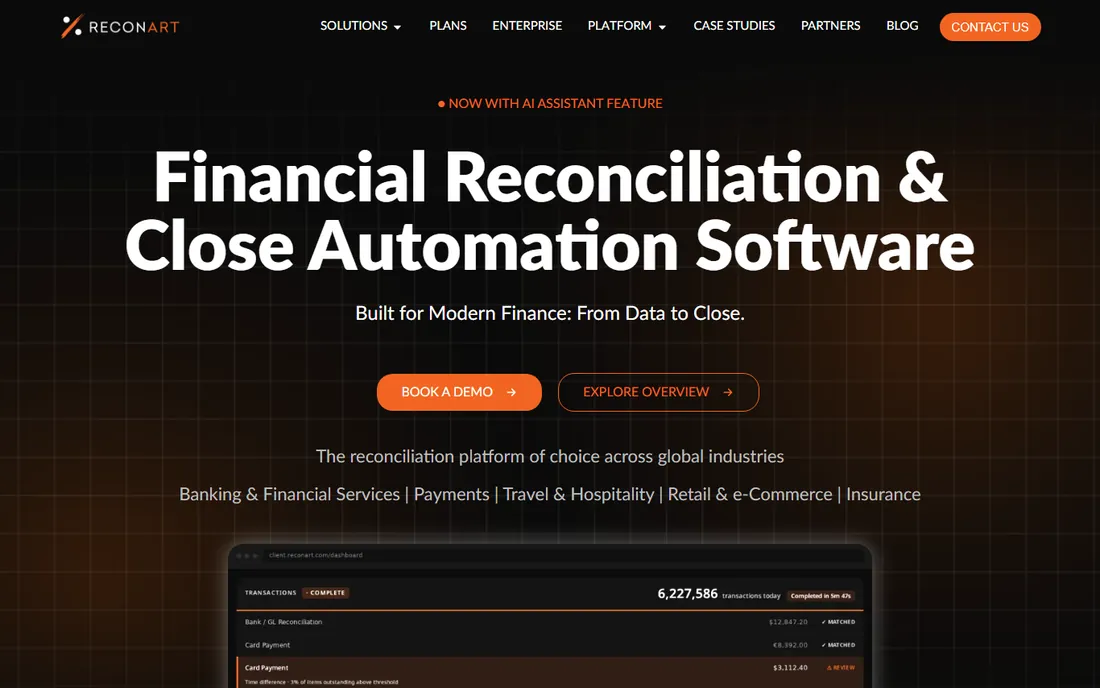
ReconArt's pitch is breadth: instead of buying separate tools for bank rec, intercompany and balance-sheet recs, one configurable engine handles them all with strong exception workflows. Finance teams maintain the rules themselves, and the platform covers the full period-end with journal approvals and reconciliation lifecycle management.
The price model needs tight control: at a cited $300 per user per month, a 10-person team faces six-figure annual cost before implementation, so insist on a real quote before budgeting. Integrations include NetSuite, Sage Intacct and QuickBooks Online. For the mid-market team that wants matching depth without enterprise price tags, evaluate against Adra Matcher and demand the quote early.
What we like- Covers every reconciliation type in one platform: bank, credit card, payments, GL/suspense, AR/AP, intercompany and positions
- User-owned configurable matching rules with tolerance handling
- Full audit trail with variance analysis and journal approvals
Watch out for- Steep per-user price (cited $300/user/month) makes it expensive for larger teams
- Smaller vendor footprint with a narrower partner ecosystem

#6
SolveXia
Best for: Finance teams with messy, high-volume reconciliation across fragmented data sources
Visit solvexia.com
Starting priceSee website (custom quote-based, "pay as you go")
Free planNo (free trial not publicly advertised)
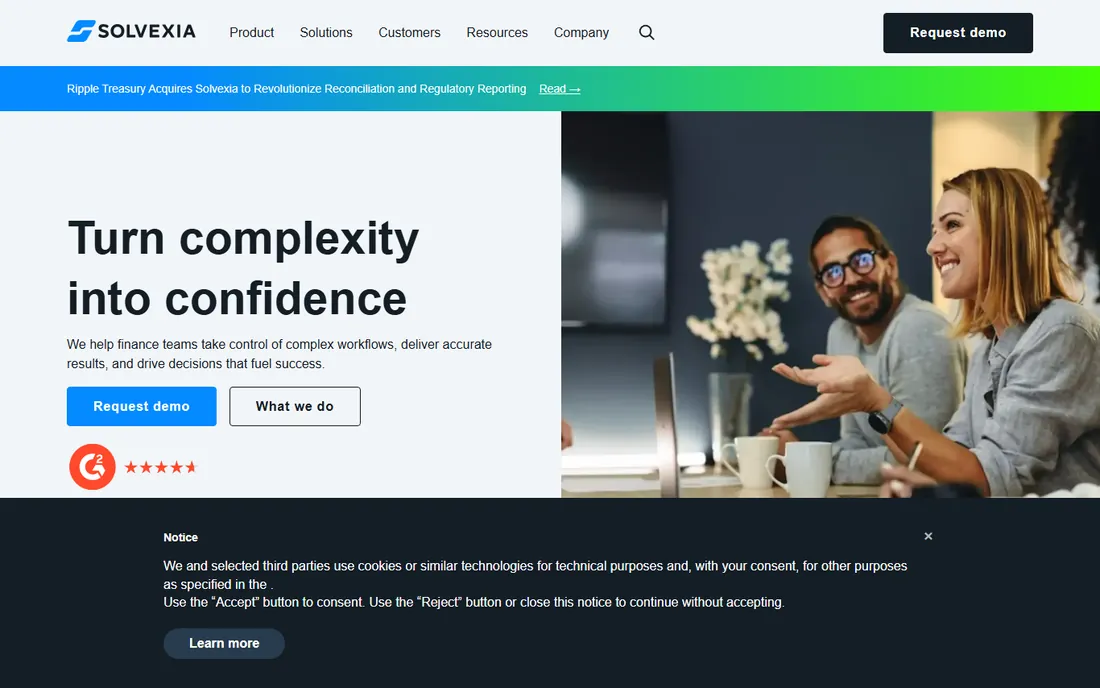
SolveXia is for reconciliation as a daily grind, not a month-end event: multiple data sources, fragmented formats, matching logic standard tools cannot handle. The no-code workflow builder connects ERPs, bank files, payment processors, Excel exports and APIs into one automated workflow without pre-formatting data, with AI-assisted matching on timing differences and vendor-claimed ~99 percent auto-match rates in high-volume environments.
The buying is enterprise-style: ~90-day typical implementations, quote-based pricing, and an acquisition that clouds the long-term roadmap, so confirm direction before a multi-year commitment. For operations-heavy teams in payments, retail and financial services, the workflow builder is the differentiator.
What we like- No-code/low-code platform: finance teams build reconciliation workflows with drag-and-drop blocks, no IT dependency
- Handles hard matching cases (one-to-many, many-to-many, partial matches, timing differences)
- Extends beyond reconciliation into regulatory reporting and rebate management
Watch out for- Custom quote-only pricing with no self-serve path
- Acquired by GTreasury (reported 2026), which may shift the product roadmap

#7
QuickBooks Online
Best for: US small businesses (solopreneurs to ~25-person teams) whose needs are bank-feed matching
Visit quickbooks.intuit.com
Starting price$38/month (Simple Start; Essentials $85, Plus $140, Advanced $340)
Free planYes ($0 Free plan: 1 user, limited invoices); paid plans carry rotating promo discounts
QuickBooks Online is the honest starting point for true SMBs: if reconciliation means matching the bank feed to the books, it is already included in your accounting subscription. Connect bank and card accounts, let feeds import daily, and categorization rules clear most transactions. Intuit raised prices in August 2026: Simple Start stayed $38, Essentials went $75 to $85, Plus $115 to $140, Advanced $275 to $340.
The ceiling is the point: no true account reconciliation module, no close checklist, no preparer/reviewer control framework, so growing teams graduate to Numeric or FloQast on top. For the 5-person business, the built-in rec is all you need. For the 50-person business with a real close process, it is the GL under a dedicated tool.
What we like- Bank reconciliation built in on every plan: bank feeds connect automatically with AI-assisted auto-categorization
- Zero extra cost if you already run your books in QuickBooks
- Massive integration ecosystem and the deepest US accountant network
Watch out for- Bank rec only: no account-reconciliation workpapers, auto-certification, intercompany matching or close-task management
- Per-seat pricing gets expensive as teams grow
#8
Xero
Best for: Small businesses and growing teams (2-50 people) wanting clean bank rec with unlimited users
Visit xero.com
Starting price$27/month (Early plan; Growing $55, Established $90)
Free plan30-day free trial, no credit card (no permanent free plan)
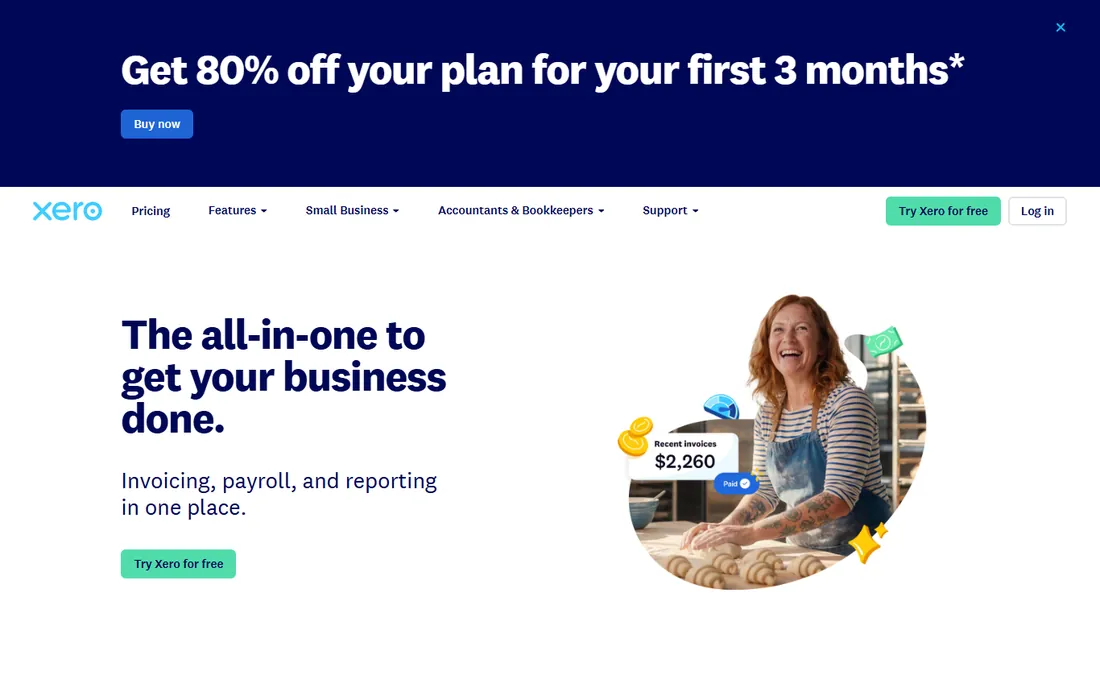
Xero's reconcile screen is one of the best workflows in small-business accounting: automatic bank feeds, one-click suggested matches, find-and-match for tricky items, and bank rules that learn your categorization. Xero raised US prices effective October 1, 2026: Early $25 to $27, Growing $55 to $59, Established $90 to $97. Unlimited users on every plan often makes it cheaper than QuickBooks for teams of 3-15.
The same ceiling applies: when month-end close becomes a team process with preparer/reviewer controls, you outgrow built-in rec and add Numeric, FloQast or Adra. As the GL itself, it integrates via its app marketplace rather than syncing to another ERP. For the service business or agency with a bookkeeper plus an accountant, the unlimited-users model is the value story.
What we like- Bank reconciliation built into every plan with daily feeds, suggested matches and bulk reconciliation
- Unlimited users on every plan at no extra seat cost
- 1,000-plus app integrations with thousands of financial institutions
Watch out for- Bank rec only, like QuickBooks: no close-management checklists, auto-certification or intercompany matching
- Multi-currency and projects need the top tier
Frequently asked questions
How much does reconciliation software cost?
Two markets. Built-in bank reconciliation: QuickBooks Online $38-$340/month, Xero $27-$97/month. Dedicated tools: Numeric $30/user/month (published); FloQast, BlackLine, Trintech Adra, ReconArt and SolveXia publish no pricing (third-party data suggests roughly $12K-$40K+/year entry points, directional only). Get written quotes for everything quote-based.
What is the difference between bank reconciliation and account reconciliation?
Bank reconciliation matches the bank feed to the books: every deposit and withdrawal accounted for. Account reconciliation is broader: balance-sheet accounts (accruals, prepaids, intercompany) tied to supporting detail with preparer/reviewer sign-offs. QuickBooks and Xero do bank rec; FloQast, BlackLine, Adra, Numeric and ReconArt do full account reconciliation with controls.
Do I need dedicated reconciliation software or is my accounting tool enough?
If your close is one person matching bank feeds, your accounting tool is enough. If month-end involves multiple preparers and reviewers, dozens of balance-sheet accounts, intercompany activity or audit scrutiny, dedicated software pays for itself in the first close. The trigger is usually headcount: past 2-3 people touching the close, the spreadsheet process breaks.
What is auto-certification?
Auto-certification (BlackLine's signature feature) automatically certifies clean, low-risk reconciliations that meet defined rules, so accountants review only exceptions. It is the main lever that cuts close time at enterprise scale. Mid-market tools offer auto-matching with reviewer sign-off; true auto-certification with audit controls is an enterprise-tier feature.
How long does implementation take?
Numeric: often under a week to 30 days. FloQast: weeks. BlackLine: 4-6 months with partner implementation. Trintech Adra: ~5 months typical. ReconArt and SolveXia: weeks to ~90 days depending on data complexity. QuickBooks and Xero: days, since the rec is built in. Budget data-cleanup time proportional to how messy your current close is.
Which integrates with NetSuite or Sage Intacct?
FloQast, BlackLine, Adra, Numeric and ReconArt all integrate with NetSuite and Sage Intacct (Numeric's are transaction-level). SolveXia connects via its workflow builder plus API. QuickBooks and Xero are themselves the GL, so the question reverses: dedicated tools sit on top of them. Confirm your exact ERP version with the vendor before signing.
Bank rec vs. close management: buy the right layer
Two different products share this category. Bank-reconciliation tools (QuickBooks, Xero) match transactions to the ledger: cheap, built in, sufficient for simple books. Close-management tools (FloQast, BlackLine, Numeric, Adra) run the month-end process: task checklists, preparer/reviewer controls, variance analysis, auto-certification. Matching engines (ReconArt, SolveXia, Orb-style transaction matching) handle high-volume, multi-way matching across account types.
Most SMBs need only the first layer. The second layer earns its keep when close coordination, not matching, is the bottleneck: FloQast's checklist customers buy it for coordination. The third layer is for volume and complexity: intercompany, payments, fragmented data. Buy the layer that matches your actual pain, and do not pay enterprise prices for a bank-feed problem.
Quick comparison
| Tool | Best for | Starting price | Free plan |
|---|
| FloQast | Mid-market accounting teams (10 to a few hundred employees) on NetSuite or Sage Intacct | See website (no published pricing; third-party data suggests ~$12K/year entry) | No (demo by booking; no self-serve trial) |
| BlackLine | Large enterprises and public companies with high reconciliation volumes and audit requirements | See website (module-based custom pricing only) | No (sales-led demos only) |
| Trintech (Adra Suite) | Control-heavy mid-market finance teams with high reconciliation volume and audit burden | See website (no public pricing; third-party estimates put Adra at ~$30K-$100K/year) | No (no publicly offered trial) |
| Numeric | Growth-stage and mid-market teams ($10M-$500M revenue) on NetSuite, Sage Intacct, QuickBooks or Xero | $30/user/month (Essentials plan, published) | No (demo by booking; no public trial) |
| ReconArt | Mid-market companies with diverse reconciliation needs across many account types | See website (quote-based; third-party directories cite ~$300/user/month, directional only) | No (free trial offered per Capterra) |
| SolveXia | Finance teams with messy, high-volume reconciliation across fragmented data sources | See website (custom quote-based, "pay as you go") | No (free trial not publicly advertised) |
| QuickBooks Online | US small businesses (solopreneurs to ~25-person teams) whose needs are bank-feed matching | $38/month (Simple Start; Essentials $85, Plus $140, Advanced $340) | Yes ($0 Free plan: 1 user, limited invoices); paid plans carry rotating promo discounts |
| Xero | Small businesses and growing teams (2-50 people) wanting clean bank rec with unlimited users | $27/month (Early plan; Growing $55, Established $90) | 30-day free trial, no credit card (no permanent free plan) |
Is your product missing or out of date?
We review this list regularly. Vendors can request a listing, send updated pricing or ask about featured placement.
How we chose
We started with the categories buyers search: reconciliation software and account reconciliation software. For each candidate we opened the vendor's own pricing page, checked plan names and prices against public reviews on G2 and Capterra and practitioner discussion on Reddit, and compared feature lists, matching depth, close-management controls, ERP integrations and company-size fit. Where a price could not be verified on the vendor's page we wrote "See website" rather than guessing, and labeled third-party figures as estimates.
Sources we checked (10)
- https://floqast.com/pricing/
- https://www.blackline.com/pricing/
- https://www.trintech.com/adra/pricing/
- https://www.numeric.io/pricing/
- https://www.reconart.com/pricing/
- https://www.solvexia.com/pricing/
- https://quickbooks.intuit.com/pricing/
- https://www.xero.com/pricing/
- https://www.g2.com/categories/account-reconciliation
- https://www.capterra.com/accounting-software/
Is your product missing or out of date?
We review this list regularly. Vendors can request a listing, send updated pricing or ask about featured placement.

Shihab Mia · Founder, Rankite
Shihab has spent more than a decade helping SaaS and e-commerce brands grow through search. He writes Rankite's software buying guides from pricing pages, documentation and public user reviews. More about Shihab.