How we make this list: we compare pricing pages, product documentation and public user reviews. Ratings come from G2, Capterra or Trustpilot, with the date we checked them.

Key takeaways
- Fundrise and Groundfloor have the lowest entry points at $10, which makes them the easiest starting points for a small first allocation.
- Arrived focuses on individual single-family rental homes, while RealtyMogul and CrowdStreet lean more toward commercial property and larger deals.
- Accreditation matters: CrowdStreet and EquityMultiple are built for accredited investors, while Fundrise, Arrived, and Groundfloor are open to non-accredited investors for at least some products.
- Liquidity is limited across this category, with quarterly redemption windows, multi-year holds, or no exit until a property or loan is sold or repaid.
- Fees, lockups, and sponsor quality matter more than any advertised return figure, so read the offering documents before committing money.
Quick comparison
| Tool | Best for | Starting price | Free plan |
|---|
 Fundrise | Diversified real estate funds for beginners | $10 | No |
 RealtyMogul | Commercial real estate REITs and private placements | $5,000 | No |
 Arrived | Fractional shares in single-family rental homes | $100 | No |
 CrowdStreet | Accredited investors choosing individual commercial deals | $5,000 | No |
 Groundfloor | Short-term real estate debt with small tickets | $10 | No |
 EquityMultiple | Accredited investors seeking curated commercial deals | $5,000 | No |
 Roofstock | Buying whole single-family rental homes | See website | No |
Is your product missing or out of date?
We review this list regularly. Vendors can request a listing, send updated pricing or ask about featured placement.
Starting price$10
Free planNo
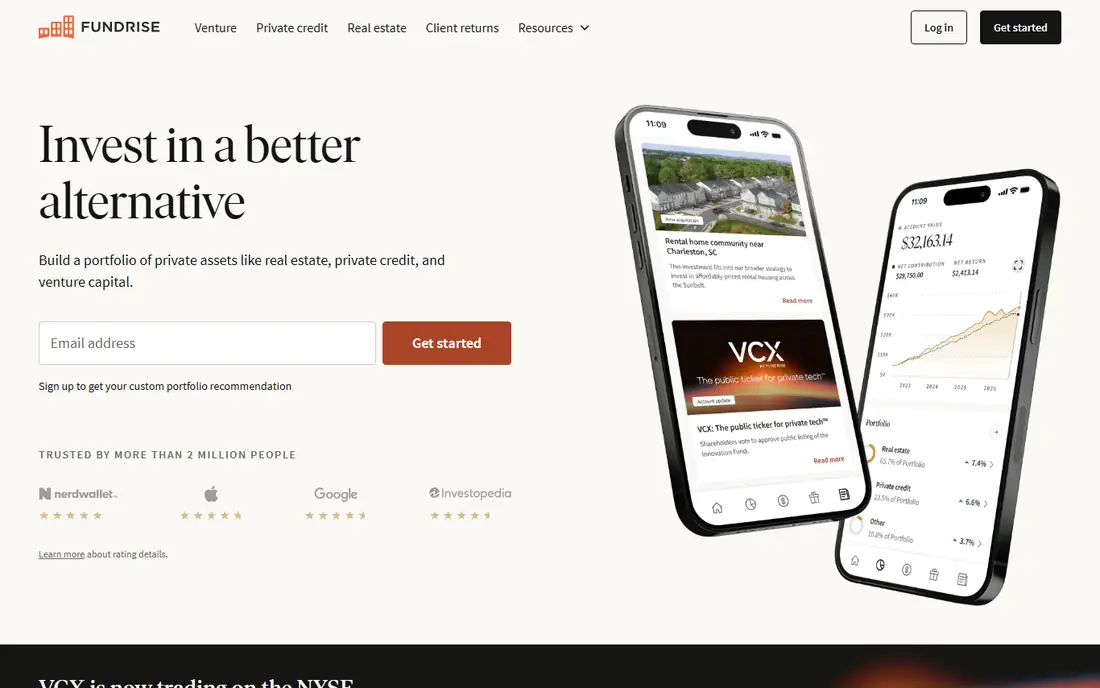
Fundrise is the simplest entry point on this list, and that simplicity is the main reason it ranks first for most new investors. You choose a goal, such as supplemental income, balanced growth, or long-term growth, and Fundrise allocates your money across a portfolio of residential and commercial properties. The $10 minimum also means you can start small, learn how distributions and statements work, and add money over time if the fit feels right.
The fee picture is comparatively straightforward, at around 1% per year in published comparisons, covering advisory and management costs. That does not remove risk. Real estate values can fall, distributions are not guaranteed, and quarterly redemptions are conditional, with penalties possible before five years. Past returns in any given year are history, not a promise about the next year. For a beginner who wants diversified exposure without picking deals, Fundrise offers a clear and low-friction route, provided the money can stay invested for several years.
What we like- Very low minimum
- Diversified portfolios
- Quarterly redemption windows
- Clear income, balanced, and growth strategies
Watch out for- Redemptions can carry penalties in the early years
- Returns vary by year and strategy
- You do not pick individual properties in the core funds
Starting price$5,000
Free planNo

RealtyMogul splits its offering into two tracks, and understanding that split is essential before you sign up. Non-accredited investors can buy into its REIT products, which provide exposure to commercial and multifamily property without needing accreditation. Accredited investors get a second menu, including individual private placements and 1031 exchange properties, with minimums that are typically higher than the REIT minimum. That two-track design makes RealtyMogul a platform you can grow with, rather than one you outgrow after a first investment.
The trade-off is commitment. REIT investments generally carry a lockup period before quarterly repurchase windows open, and private placements are illiquid until the underlying deal exits. Fees also differ by product, with annual management fees for REITs in published comparisons and offering costs on some placements. Investors who want commercial exposure, who have at least $5,000 they do not need for several years, and who are comfortable reading offering documents will find RealtyMogul a serious option. Investors with only a few hundred dollars to test the category should start elsewhere.
What we like- Two REIT options for non-accredited investors
- Private placements and 1031 exchange options for accredited investors
- Commercial and multifamily focus
Watch out for- $5,000 REIT minimum is high for a first test
- Private placements lock money up for years
- Fees vary by product
#3
Arrived
Best for: Fractional shares in single-family rental homes
Visit arrived.com
Starting price$100
Free planNo
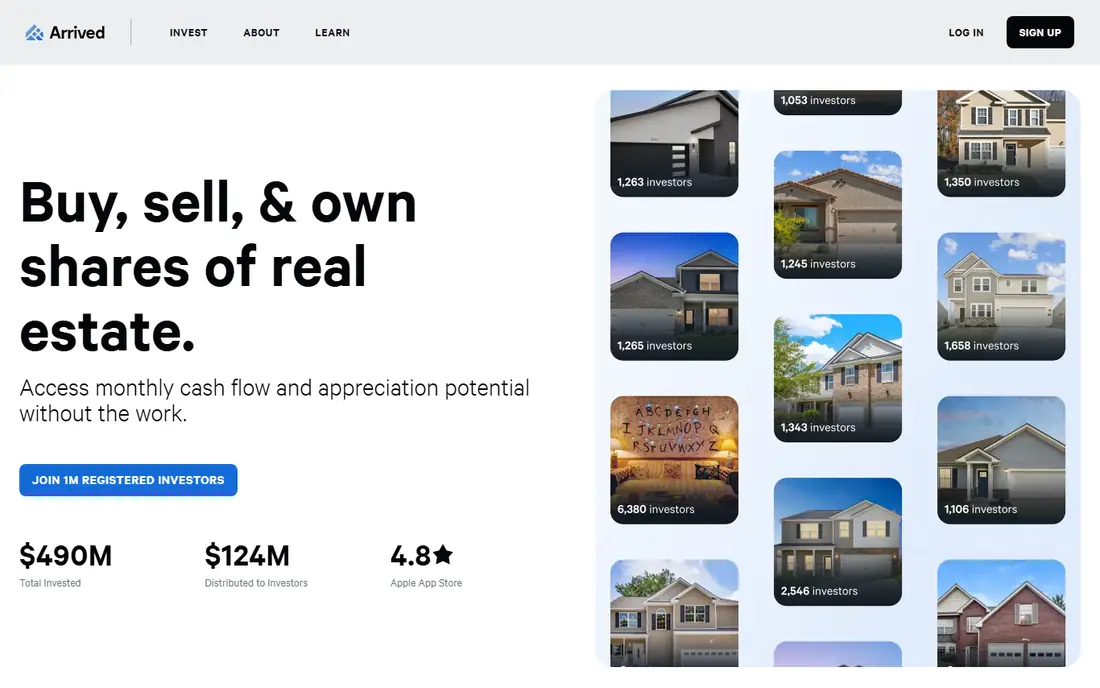
Arrived gives you something the fund-style platforms do not: a specific house to evaluate. You browse single-family rental properties, review the rent, the purchase price, and the projected income, and buy shares in that property rather than in a broad portfolio. Arrived handles property management, tenants, and maintenance, so you are an investor, not a landlord. Quarterly dividends come from rental income, and you share in appreciation when the property eventually sells. For investors who like residential property and want to see exactly what they own, that transparency is appealing.
The limits are just as clear. Rental yields alone have been modest in recent reporting, and the larger return depends on a sale that may be years away. Redemption windows are quarterly, subject to approval, and only become available after your first six months invested. Arrived suits a patient investor who wants residential exposure in small slices and who accepts that the money is tied up for a long hold.
What we like- Pick individual rental homes
- $100 minimum
- No accreditation needed for its rental shares
- Quarterly redemption windows after an initial period
Watch out for- Dividend yields have been modest in recent reports
- Appreciation is only realized on sale
- Holds are typically five to seven years
Starting price$5,000
Free planNo

CrowdStreet is built for a different kind of investor than Fundrise or Arrived. It is a marketplace where accredited investors review individual commercial real estate deals, funds, and other private market offerings, and choose the ones that fit their goals. Each deal has its own sponsor, business plan, fee structure, and timeline, so the work of comparing deals falls on you. That control is the attraction. An investor who understands commercial property, or who wants to build a portfolio deal by deal rather than through a single fund, will value the depth of information CrowdStreet provides on each offering.
Its own homepage states that its minimum investment is typically $5,000 but may be higher for certain offerings, and that it does not charge investors account fees, with revenue coming from sales loads and servicing fees on registered offerings. That does not make deals cheap. Funds and sponsors charge their own management and performance fees, and those costs sit inside each offering. Holds are typically several years, with no secondary market until a deal exits. CrowdStreet is a strong fit for accredited investors who can underwrite sponsors, tolerate illiquidity, and spread money across several deals. It is not a beginner platform, and it should not hold money you may need soon.
What we like- Direct access to individual commercial deals and funds
- Detailed sponsor and deal information
- No account fees charged to investors on its own platform
Watch out for- Accredited investors only
- Long holds with no exit until deal exit
- Sponsor risk is real and deal-specific
Starting price$10
Free planNo
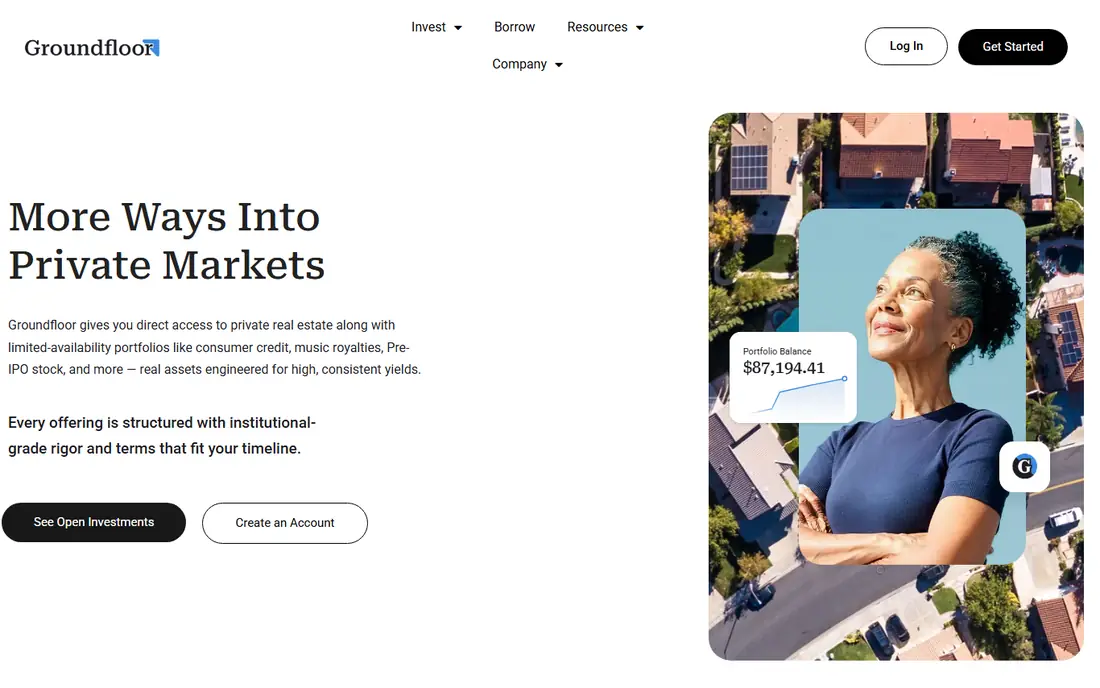
Groundfloor works differently from the equity platforms above, because you are lending rather than buying a share of a property. Investors fund short-term real estate loans, often for renovation or new construction projects, and earn interest as borrowers repay. Terms on many individual loans run around six to twelve months, which is far shorter than the multi-year holds on equity deals. That shorter timeline, combined with a $10 minimum on individual loans, makes Groundfloor useful for investors who want real estate exposure without locking money away for five years or more.
The risk is also different, and it should not be understated. A loan can be delayed, extended, or default, and a lien on a property does not guarantee a fast or full recovery. Groundfloor also offers fixed-rate notes and other products with higher minimums, so check the terms of each product rather than assuming every option starts at $10. For an investor who understands debt risk, who can spread small amounts across many loans, and who wants shorter durations, Groundfloor fills a clear gap. For an investor who wants ownership upside from rising property values, an equity platform will fit better.
What we like- $10 minimum on individual loans
- Short terms of around six to twelve months on many loans
- Loans secured by real property
Watch out for- Debt investing carries borrower and project risk
- Money is locked until a loan is repaid
- Returns vary by loan grade and outcome
Starting price$5,000
Free planNo

EquityMultiple focuses on private commercial real estate for accredited investors, with a mix of equity, preferred equity, and debt offerings. Its homepage positions the platform around starting with $5,000 and building a more diversified portfolio beyond stocks and bonds. The pitch is curation: EquityMultiple states that it accepts only around 5% of the investments it considers, after due diligence, and that its asset management team works through the life of each investment. Even with that curation, the core risks of private commercial deals remain. Most investments are illiquid for the term of the deal, returns depend on the property and the sponsor executing the business plan, and fees are embedded in each offering. Short-term notes, where offered, have different terms from long-term equity deals, so do not treat every product on the platform as the same investment. EquityMultiple suits an accredited investor who wants a curated commercial menu, who can commit at least $5,000 per deal, and who will diversify across several offerings rather than placing a single large bet.
What we like- Curated commercial equity and debt deals
- $5,000 starting point on its homepage
- Asset management through the life of an investment
Watch out for- Accredited investors only
- Most deals are illiquid until exit
- Deal quality and terms vary from offering to offering
Starting priceSee website
Free planNo
Roofstock is the outlier on this list, and it earns its place for a specific reader: the investor who has outgrown fractional shares and wants to own a whole rental home. Rather than buying a slice of a property, you buy the property itself through a marketplace built for single-family and build-to-rent portfolios, with data on rents, yields, and local markets to support the decision. You receive the rent, you carry the costs, and you decide when to sell, refinance, or hold.
That control also brings responsibilities and capital needs that fractional platforms avoid. A whole-home purchase requires a down payment, financing, insurance, maintenance reserves, and a plan for vacancies and repairs. Roofstock provides tools and services around the purchase, but it does not remove property risk. Include Roofstock here only if you are comparing the full range of ways to invest in rental real estate online. If your budget is a few hundred dollars and you want fractional exposure, Arrived or Fundrise will fit better than a whole-home purchase.
What we like- Buy whole rental properties rather than fractional shares
- Property data and portfolio tools
- Useful for investors scaling a rental portfolio
Watch out for- Requires whole-home purchase capital, not a small fractional ticket
- You take on landlord economics and property risk
- Not a pure crowdfunding model
How we chose
We compared pricing pages, product descriptions, and offering structures on the platforms themselves, then checked those details against public reviews and comparisons on G2, Capterra, Reddit, and independent review sites. We favored platforms that are operating today, that state their minimums and accreditation rules clearly, and that offer a distinct structure, whether that is a diversified fund, a single-property share, a commercial deal, or a short-term loan. We excluded platforms whose homepages no longer matched their original brand or product, and we used "See website" where a starting price varies by property or deal and cannot be stated as a single verified figure.
This is not financial advice. Real estate crowdfunding investments can lose value, distributions are not guaranteed, and many products are illiquid for years. Treat any money you allocate here as long-term capital, and read the offering documents, fee disclosures, and risk sections before investing.
Start with structure, not advertised returns
The first decision is what you are actually buying. A diversified fund spreads risk across many properties but gives you no control over individual deals. A fractional rental share ties you to one house and one local market. A commercial deal ties you to one sponsor and one business plan. A short-term loan gives you interest income but no ownership upside. Match the structure to your goal first, then compare returns within that structure. Comparing a fund return to a single-deal return without noting the different risks will mislead you.
Match the minimum and the hold period to your cash
Minimums on this list run from $10 to $5,000 and higher for some deals, and hold periods run from months to many years. Write down two numbers before you choose: how much you can invest without needing it back, and how long you can leave it invested. If either number is small, favor Groundfloor for shorter loan terms or Fundrise for a low minimum fund. If both numbers are large and you are accredited, CrowdStreet and EquityMultiple open a wider commercial menu. Never stretch a minimum by using money set aside for an emergency fund or a near-term expense.
Check accreditation, fees, and exit options in writing
Accreditation rules decide which doors are open to you, so confirm your status before shortlisting platforms. Fees also hide in different places: annual management fees, offering costs, sales loads, sponsor fees, and servicing fees can all apply, depending on the product. Exit options matter just as much. Ask whether redemptions are quarterly, whether they need approval, whether early exits carry a penalty, and whether there is a secondary market at all. A platform with a slightly lower advertised return but a clearer exit may be the better choice for your situation.
Diversify, and keep crowdfunding a limited slice
Private real estate should sit alongside more liquid investments, not replace them. Spreading money across several properties, sponsors, or loan grades reduces the damage from any single failure. Keep the total allocation to a level where a poor outcome would be disappointing rather than damaging. Review statements regularly, track distributions against the offering documents, and reassess each year whether the illiquidity still fits your plans.
Frequently asked questions
What is real estate crowdfunding?
Real estate crowdfunding pools money from many investors to fund properties, portfolios, or real estate loans through an online platform. Investors earn returns from rental income, interest payments, or property appreciation, depending on the product. The exact rights, fees, and risks depend on the structure, so a fund share, a fractional rental share, and a loan note are not interchangeable investments.
How much money do I need to start?
Minimums vary widely. Fundrise and Groundfloor start at $10 for some products, Arrived starts at $100 for rental shares, and RealtyMogul, CrowdStreet, and EquityMultiple start at $5,000 for many products, with some deals requiring more. Check the minimum for the specific product you want, not just the platform homepage, because funds, deals, and notes on the same platform can have different entry points.
Do I need to be an accredited investor?
It depends on the product. Fundrise, Arrived, and Groundfloor offer products open to non-accredited investors, while CrowdStreet and EquityMultiple are built for accredited investors. RealtyMogul splits the difference, with REITs open to non-accredited investors and private placements limited to accredited investors. Accreditation in the United States generally means meeting income or net worth thresholds, so confirm the platform rules before applying.
Can I withdraw my money whenever I want?
In most cases, no. Many equity products are illiquid for years, with quarterly redemption windows that are conditional, subject to approval, or subject to penalties for early exit. Short-term loans on Groundfloor are locked until the loan is repaid, which is typically months rather than years. Treat crowdfunding money as long-term capital, and keep an emergency fund in a liquid account instead.
Are returns on these platforms guaranteed?
No. Returns depend on rents, property values, borrower repayment, sponsor execution, and market conditions, and distributions can fall or stop. Advertised figures often reflect past performance, target ranges, or selected deals, none of which guarantee future results. Read the offering documents for fee details and risk factors, and be wary of any platform or deal that presents returns as certain.
Which platform is best for a beginner?
Fundrise is the most beginner-friendly starting point for most readers, because of its $10 minimum, diversified funds, and simple goal-based setup. Arrived is a good second option for beginners who want to pick individual rental homes with $100. Groundfloor suits beginners who prefer shorter loan terms and small tickets. Start with one platform, a small amount, and a product you understand, then expand only after you have reviewed statements and distributions over several months.
Sources we checked (10)
- https://fundrise.com
- https://www.realtymogul.com
- https://arrived.com
- https://crowdstreet.com
- https://groundfloor.com
- https://www.equitymultiple.com
- https://www.roofstock.com
- https://www.chicwealthbuilder.com/blog/best-real-estate-crowdfunding-platforms/
- https://financeforbeginner.com/real-estate-crowdfunding-platforms/
- https://www.lofty.ai/compare
Is your product missing or out of date?
We review this list regularly. Vendors can request a listing, send updated pricing or ask about featured placement.

Shihab Mia · Founder, Rankite
Shihab has 5+ years in B2B and SaaS SEO. He writes Rankite's software buying guides from pricing pages, documentation and public user reviews. More about Shihab.