How we make this list: we compare pricing pages, product documentation and public user reviews. Rankite is independent; if a vendor ever pays for a featured spot, that listing is clearly labeled Partner.
Key takeaways
- ModMed and Compulink Advantage are the two genuinely podiatry-first EHRs here, with ModMed starting around $500 per provider per month and Compulink at $149 per user per month, but both require a sales conversation before you see real pricing.
- TRAKnet is the long-standing podiatry specialist that small foot clinics keep returning to, though its quote-only pricing and older interface mean you should demo it against a modern alternative.
- Carepatron is the cheapest way to run a practice digitally, with a real free plan and paid tiers from $31 per user per month, making it the natural pick for solo podiatrists starting out.
- Cliniko and Zanda are the simplest all-rounders, at $45 and $19 per month respectively, best for cash-pay and allied-health style practices that do not need deep insurance billing.
- eClinicalWorks and NextGen Office bring hospital-grade billing depth at $449 per provider per month and up, which only makes sense for high-volume practices with dedicated billing staff.
Quick comparison
| Tool | Best for | Starting price | Free plan |
|---|
 ModMed ModMed | Single-specialty podiatry practices | $500/provider/month | No |
 Compulink Advantage Compulink Advantage | Deep specialty templates and all-in-one billing | $149/user/month | No |
 TRAKnet TRAKnet | Small podiatry clinics wanting a specialist EHR | See website | No |
 NextGen Office NextGen Office | Practices needing strong billing and reporting | See website | No |
 eClinicalWorks eClinicalWorks | High-volume practices with billing staff | $449/month per provider | No |
 Pabau Pabau | Multi-specialty clinics that include podiatry | $65/month | No |
 Cliniko Cliniko | Simple scheduling, notes and invoicing | $45/month | Free trial (30 days) |
 Carepatron Carepatron | Solo podiatrists on a tight budget | $31/user/month (paid plans; free plan available) | Yes |
 Zanda Zanda | Small practices going paperless fast | $19/month | Free trial (14 days) |
Is your product missing or out of date?
We review this list regularly. Vendors can request a listing, send updated pricing or ask about featured placement.
The best podiatry software
Starting price$500/provider/month
Free planNo
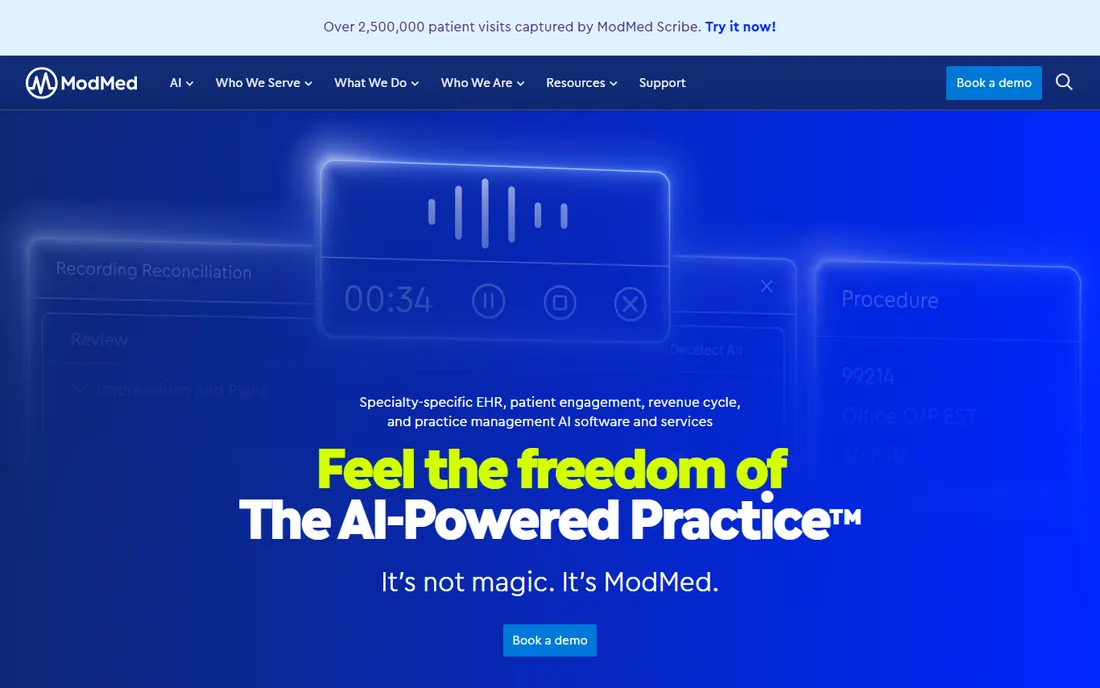
ModMed built its reputation on EMA, an EHR designed around how specialists actually document, and podiatry is one of the specialties it serves well. The platform suggests ICD-10 codes from charting data, carries an interactive anatomical drawing board, and its AI scribe transcribes visits in real time to draft SOAP notes. Billing, practice management and analytics sit in the same system, so a practice does not need a separate analytics tool to see provider productivity.
The price is the reality check. At around $500 per provider per month, it costs several times what the simpler tools here charge, and upgrades have a reputation for occasionally breaking existing workflows. That is easier to accept in a five-provider surgical practice than in a solo office. Podiatry-only practices that bill insurance heavily and want charting tuned to feet will find it worth the money. Everyone else should look further down this list.
What we like- Specialty-specific EMA platform with suggested ICD-10 coding
- AI scribe that drafts SOAP notes from visits
- Analytics covering admin, provider and financial views
Watch out for- Among the priciest options here
- Some workflows need too many clicks
- No free trial
Starting price$149/user/month
Free planNo

Compulink has been building specialty EHRs for decades, and Advantage is its all-in-one platform covering podiatry alongside fields like orthopedics and dermatology. The draw is depth: specialty-specific charting templates, revenue cycle management, inventory, telehealth and patient engagement in one database, plus an AI documentation layer that learns how each provider charts. Practices that want one vendor for everything clinical and financial usually shortlist it.
The friction points are practical rather than clinical. Pricing is not published, so budgeting means a sales call, and reviews describe a system that can feel slow, with updates occasionally introducing new glitches. Completing routine tasks can take more clicks than on newer interfaces. It remains a strong pick for practices that value specialty depth over interface polish, and the $149 per user per month starting figure is more approachable than ModMed for mid-size offices.
What we like- Podiatry-specific templates and workflows out of the box
- All-in-one EHR, billing, inventory and engagement
- AI note generation that adapts to the provider
Watch out for- Quote-based sales process makes budgeting slow
- Some users report slowness and occasional freezes
Starting priceSee website
Free planNo
TRAKnet is the veteran of this list for podiatry specifically, serving small and mid-size foot practices since 2013. It consolidates charting, billing and scheduling into one system built on Microsoft SQL Server, with the unusual option of on-premise deployment for practices that want their data on their own servers. Coding assistance, a patient portal with online intake and prescription refill requests, and MIPS support are all part of the package.
The honest catch is that TRAKnet shows its age. The interface is functional rather than modern, and pricing is entirely quote-based, which makes comparing it against the published prices of competitors slower than it should be. Clinics that stay with it tend to do so because their workflows are already built around it and the podiatry-specific logic still serves them well. New practices should demo it back to back with a modern option like Pabau or Cliniko before committing.
What we like- Built only for podiatry, so workflows match foot clinics
- Choice of on-premise or cloud deployment
- Coding assistance and patient portal included
Watch out for- No published pricing
- Interface feels dated next to modern alternatives
#4
NextGen Office
Best for: Practices needing strong billing and reporting
Visit nextgen.com
Starting priceSee website
Free planNo

NextGen Office carries a meaningful credential in this space: it is the preferred EHR of the American Podiatric Medical Association, which tells you the podiatry workflows were built with actual podiatrists in the room. The platform combines patient data, billing and reporting in a web-based EHR with e-prescribing, lab connections and an ambient listening tool that drafts notes from the visit. The coding support is genuinely strong, with E&M suggestions that catch billing errors before submission.
Everything about NextGen Office signals enterprise. Pricing is custom and quote-based, implementation is a real project rather than a signup, and the feature depth exceeds what a two-provider office needs. It fits established multi-provider podiatry groups with dedicated billing staff and complex payer mixes. Smaller practices will pay for capability they never use.
What we like- Preferred EHR relationship with the podiatry association
- Ambient AI documentation
- Deep coding support with CPT, ICD and HCPCS tools
Watch out for- Enterprise pricing with no public numbers
- Implementation takes real time and resources
Starting price$449/month per provider
Free planNo
eClinicalWorks is one of the largest EHR vendors in the country, and it deserves credit for publishing its pricing: $449 per month per provider, which lets a buyer actually compare it against the quote-only vendors above. The platform covers the full cycle from scheduling and charting to billing and patient engagement, with an AI scribe, telehealth visits and a patient portal that supports check-in and online payments.
The tradeoff is scale mismatch. This is a system designed for practices with real patient volume and staff to run it. A solo podiatrist will spend more time learning the system than the system saves them, and the implementation effort is closer to NextGen than to Cliniko. Where it earns its place is in busy practices doing hundreds of visits a week, where the billing automation and engagement tools translate directly into collected revenue.
What we like- Published pricing, rare among enterprise EHRs
- AI medical scribe included
- Broad telehealth and patient engagement tools
Watch out for- Learning curve is real for front-office staff
- Smaller practices find it more system than they need
#6
Pabau
Best for: Multi-specialty clinics that include podiatry
Visit pabau.com
Starting price$65/month
Free planNo
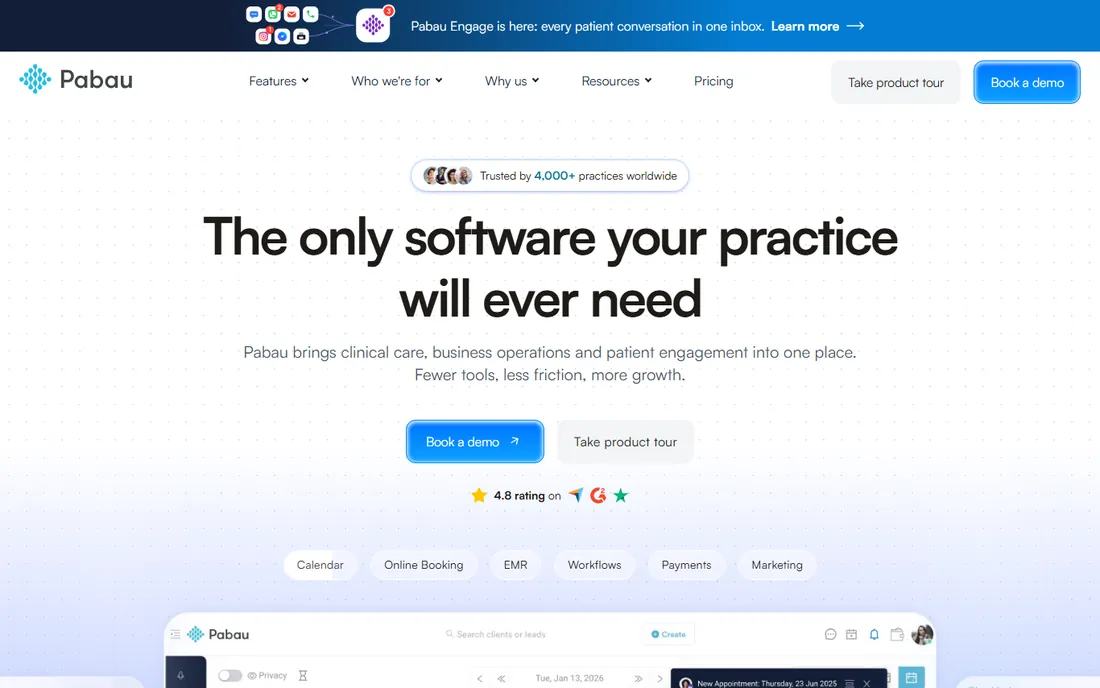
Pabau is the pick for clinics where podiatry shares the building with physiotherapy, dermatology or sports medicine. It handles scheduling, clinical documentation, billing and patient engagement from one platform starting at $65 per month, without the per-module pricing that enterprise vendors use. The customizable SOAP note templates and body charting adapt well to podiatry documentation, and the automated recall campaigns are genuinely useful for orthotics reviews and routine foot assessments that otherwise leak out of the schedule.
The compromise is specialization. This is a multi-specialty platform, so the podiatry workflows are adaptable rather than purpose-built, and a podiatry-only surgical practice will find the depth of ModMed or Compulink missing. For mixed clinics, though, running one system instead of two is worth more than specialty depth, and the price is a fraction of the enterprise options.
What we like- Scheduling, billing, notes and marketing in one subscription
- Customizable SOAP templates with body charting
- Automated recall campaigns for orthotics reviews
Watch out for- Not podiatry-exclusive, so some workflows are generic
- Add-on costs can accumulate as the clinic grows
Starting price$45/month
Free planFree trial (30 days)
Cliniko is the simplest honest software on this list. One practitioner costs $45 per month, two to five cost $95, and every tier includes the full feature set: scheduling, treatment notes, invoicing, online bookings, telehealth and unlimited file storage. Admin and reception staff are unlimited and free, and the 30-day trial requires no credit card. Prices have not changed since 2011, which is almost unheard of in this industry.
The limitation is billing depth. Cliniko suits cash-pay practices, sports podiatry clinics and allied-health style offices where invoicing is straightforward. Practices that live and die by insurance claims, prior authorizations and complex payer rules will outgrow it. For everyone else, it is the rare tool that does exactly what it promises at a price that never surprises.
What we like- Every feature on every plan with no gated add-ons
- Per-practitioner pricing with unlimited admin users and locations
- Generous 30-day free trial with no card required
Watch out for- SMS reminders cost extra at 10 cents a message
- Not built for insurance-heavy billing workflows
Starting price$31/user/month (paid plans; free plan available)
Free planYes

Carepatron is the only tool here with a free plan worth using: full EHR, integrated telehealth, unlimited clients, AI note generation, client portal and invoicing, limited mainly by 1GB of storage. The Plus plan at $31 per user per month adds unlimited storage and AI tokens, and Advanced at $39 adds roles, permissions and white labelling. There is no minimum contract, and a 50 percent introductory discount for the first six months softens the start further.
The honest gap is insurance billing, which runs as a per-claim add-on with a less mature workflow than the enterprise tools. Podiatrists running cash-pay, concierge or direct-care models will never notice. For a new solo practice watching every dollar, Carepatron delivers more usable software per dollar than anything else on this list.
What we like- Genuine free plan with EHR, telehealth and AI notes
- Paid plans from $31 per user per month
- No minimum contract
Watch out for- Insurance billing is a per-claim add-on and less mature
- Free plan limited to 1GB storage
Starting price$19/month
Free planFree trial (14 days)
Zanda, formerly known as Power Diary, is built for allied health practices that want to stop using paper this week rather than this quarter. The Starter plan at $19 per month covers a solo practitioner, Growth at $49 adds multi-clinic features, and a 14-day free trial needs no credit card. Online intake forms, treatment note templates, invoicing, online bookings, two-way SMS chat and telehealth are all included, and the vendor imports existing data for free with a 12-month money-back guarantee.
Watch the SMS costs, since appointment reminders run about 9 cents per outbound message, which adds up in a busy clinic. And the per-seat model means a growing team should model the cost before committing. For a small podiatry office that mostly needs scheduling, notes and payments handled cleanly, Zanda is the fastest path from paper to digital on this list.
What we like- Lowest paid price on this list
- Online forms and EHR in one place
- 12-month money-back guarantee and free data import
Watch out for- Per-practitioner pricing scales with headcount
- SMS reminders add roughly 9 cents per message
How we chose
We compared these nine tools using published pricing, plan details, documentation and public reviews on G2, Capterra, GetApp and SelectHub. We prioritized podiatry-specific charting and billing workflows, verified every price against a published source, and favored tools that fit small and mid-size US practices over hospital systems. Vendors that do not publish pricing are marked clearly. No vendor paid for placement, and we did not claim hands-on testing.
What actually drives the cost of podiatry software
The sticker price of a podiatry EHR is only the first number. Insurance billing depth is what separates a $45 tool from a $500 one: claim scrubbing, denial management, eligibility checks and payer-specific rules are expensive to build and maintain, and vendors charge for them. A cash-pay sports podiatry clinic gains nothing from that machinery, while an insurance-heavy surgical practice cannot function without it.
The second cost driver is headcount. Per-provider pricing at $500 a month is a different proposition for a solo doctor than for a five-provider group, and even the cheaper per-seat tools scale linearly with staff. Before signing, model the cost with your actual provider and staff count, add SMS reminder costs if you send them, and ask each vendor what implementation, training and data migration really cost. Those three line items are where EHR budgets most often break.
It is tempting to assume a podiatry-only EHR is always the right answer. It is not. If your practice mixes podiatry with physiotherapy or dermatology, a multi-specialty platform like Pabau keeps the whole clinic on one schedule and one bill. If you are cash-pay or concierge, Cliniko or Zanda will run the practice for a tenth of what ModMed costs.
The specialist tools earn their premium in exactly one situation: insurance-heavy podiatry with surgical volume, where specialty templates, coding assistance and denial workflows convert directly into collected dollars. Be honest about which practice you run. Paying for billing machinery you never use is the most common way podiatrists overspend on software.
Frequently asked questions
What is the best podiatry software for a solo practitioner?
Carepatron is the strongest budget pick, with a real free plan and paid tiers from $31 per user per month. Cliniko at $45 per month and Zanda at $19 per month are also excellent for solo offices that want simple scheduling, notes and invoicing without enterprise complexity.
How much does podiatry EHR software cost?
It ranges widely. Simple practice tools like Zanda start at $19 per month and Cliniko at $45 per month. Mid-range options like Pabau start at $65 per month and Compulink at $149 per user per month. Enterprise podiatry EHRs like ModMed start around $500 per provider per month and eClinicalWorks at $449 per month per provider.
Do I need podiatry-specific software, or will a general EHR work?
It depends on your billing model. Insurance-heavy practices with surgical volume benefit from podiatry-specific templates and coding tools in ModMed, Compulink or TRAKnet. Cash-pay, sports or multi-specialty practices usually do better with a general tool like Cliniko, Zanda or Pabau at a much lower price.
Which podiatry software has the best billing features?
ModMed, Compulink Advantage, NextGen Office and eClinicalWorks have the deepest billing and revenue cycle features, including claim scrubbing and denial management. They also cost the most. Practices should only pay for that depth if insurance collections are a major part of revenue.
Can I try podiatry software before buying?
Yes for the simpler tools. Carepatron has a free plan, Cliniko offers a 30-day free trial with no credit card, and Zanda offers a 14-day free trial. The enterprise vendors, ModMed, Compulink, TRAKnet, NextGen and eClinicalWorks, typically require a demo and sales conversation instead.
Is my patient data safe in cloud podiatry software?
Reputable vendors on this list maintain HIPAA-compliant infrastructure with encrypted data storage and access controls. TRAKnet also offers on-premise deployment for practices that prefer to keep data on their own servers. Always confirm the vendor signs a Business Associate Agreement before you migrate patient records.
Sources we checked (9)
- https://www.selecthub.com/ehr-software/modmed-vs-curemd/
- https://www.selecthub.com/ehr-software/compulink-vs-nextgen-enterprise/
- https://www.findemr.com/traknet
- https://pabau.com/blog/practice-management-software-podiatry/
- https://www.flozic.ai/blog/reviews/cliniko-review
- https://softwarefinder.com/emr-software/cliniko
- https://createdigitaltools.com/carepatron-review-2026/
- https://www.medesk.net/en/blog/zanda-review/
- http://softwarefinder.com/resources/streamline-podiatry-practice-right-emr-system
Is your product missing or out of date?
We review this list regularly. Vendors can request a listing, send updated pricing or ask about featured placement.

Shihab Mia · Founder, Rankite
Shihab has spent more than a decade helping SaaS and e-commerce brands grow through search. He writes Rankite's software buying guides from pricing pages, documentation and public user reviews. More about Shihab.