How we make this list: we compare pricing pages, product documentation and public user reviews. Rankite is independent; if a vendor ever pays for a featured spot, that listing is clearly labeled Partner.
Key takeaways
- TalentCards is the cheapest way to start with mobile microlearning, with a free tier for up to 5 users and paid plans from $50 a month.
- Axonify is the enterprise standard for frontline reinforcement, but it is sold by quote and priced for large organizations.
- 7taps and SC Training remove the app-download barrier, which matters for deskless teams with high turnover.
- Most platforms in this category hide real pricing behind sales calls, so the free tiers and trial paths matter more than usual.
Quick comparison
| Tool | Best for | Starting price | Free plan |
|---|
 TalentCards TalentCards | small teams starting with mobile learning | $50 per month (Standard, up to 50 users) | Yes (free for up to 5 users) |
 Axonify Axonify | large frontline workforces needing daily reinforcement | See website | No |
 7taps 7taps | fast mobile-first course creation | See website | Yes |
 eduMe eduMe | deskless onboarding and compliance training | See website | Free trial |
 Qstream Qstream | sales teams needing spaced reinforcement | See website | No |
 Wranx Wranx | simple daily knowledge drills | $3 per user/month | No |
 OttoLearn OttoLearn | gamified adaptive microlearning | $250 per month | Free trial |
 5Mins.ai 5Mins.ai | TikTok-style AI-generated lessons | $5 per user/month (Essentials) | Free trial |
 SC Training SC Training | budget-friendly mobile learning | $1.95 per user/month | Yes (free tier for small teams) |
Is your product missing or out of date?
We review this list regularly. Vendors can request a listing, send updated pricing or ask about featured placement.
Picture a district manager who needs 400 store associates trained on a new returns policy by Friday. Nobody reads the 40-page PDF. The training webinar gets 30 attendees. This is the gap microlearning platforms fill: short, phone-friendly lessons that take minutes, repeat the important parts, and track who actually learned something. These nine are the strongest options in 2026.
Starting price$50 per month (Standard, up to 50 users)
Free planYes (free for up to 5 users)
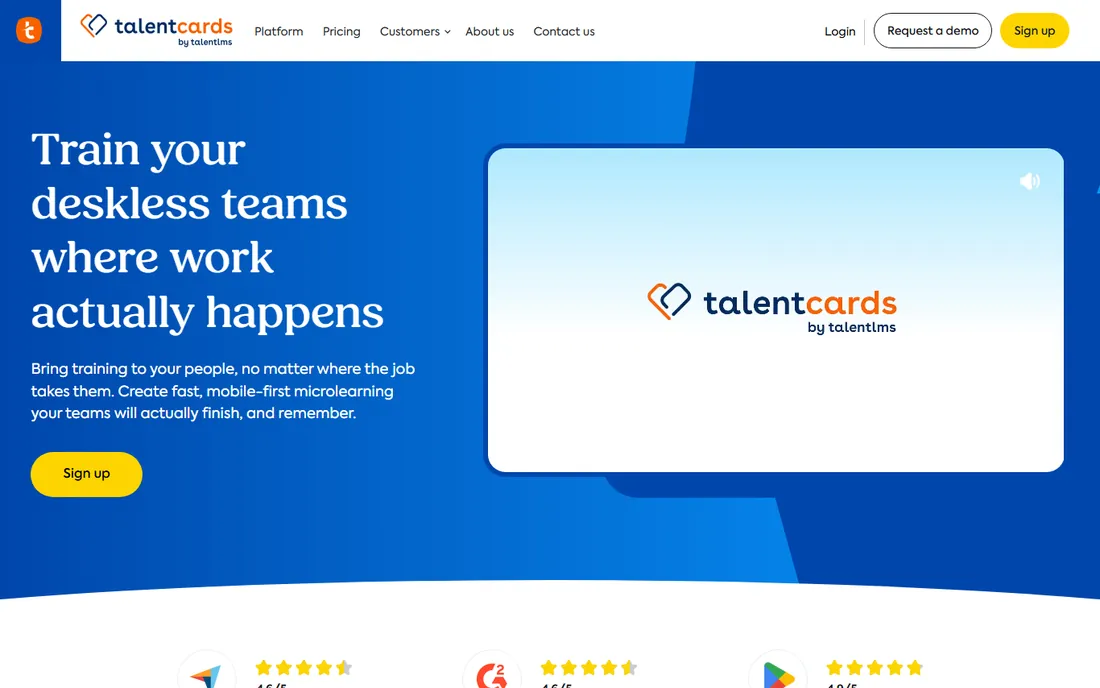
TalentCards is the flashcard-style microlearning app from Epignosis, and it wins on simplicity. Admins build learning cards with text, video, audio and quizzes in minutes, then push them to learners' phones. The free tier covers up to 5 users, Standard runs $50 a month for 50 users, and Premium at $75 a month adds AI course and assessment creation.
The tradeoff is depth. This is a refresher and compliance tool, not a place to teach a full technical curriculum. For safety procedures, product knowledge and onboarding refreshers, it is one of the fastest options to get live. Just know that every learner needs the app installed, which is friction for high-turnover hourly teams.
What we like- Genuinely usable free tier for tiny teams
- Card creation takes minutes
- Works on any phone
Watch out for- Shallow for complex topics
- Limited reporting depth
- App download still required
#2
Axonify
Best for: large frontline workforces needing daily reinforcement
Visit axonify.com
Starting priceSee website
Free planNo
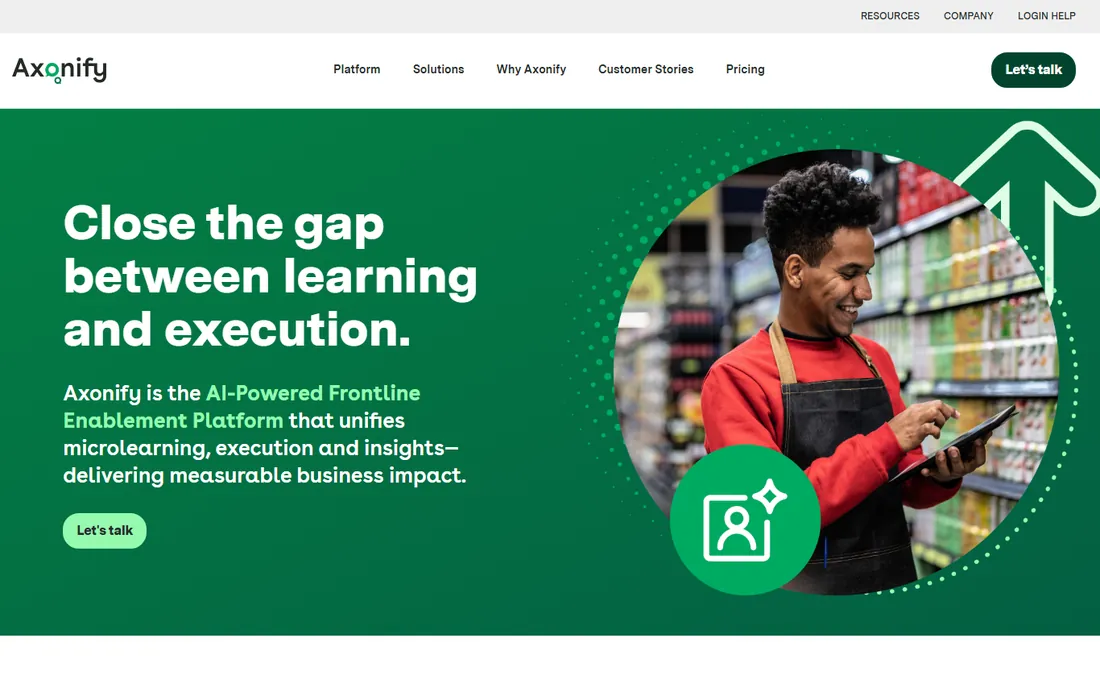
Axonify is the heavyweight of frontline microlearning. Employees get short adaptive daily sessions of three to five minutes, the platform measures what each person knows and targets the gaps, and managers get task communication tools in the same app. It serves retail, grocery, logistics and healthcare operations with thousands of associates.
Everything about Axonify is enterprise-grade, including the sales process. There is no published price; you get a custom quote based on headcount, locations and modules, and implementations typically take months with services attached. If you run 20 stores, this is above your range. If you run 2,000, few competitors can match its measurement of actual knowledge change.
What we like- Adaptive daily bursts built on learning science
- Strong HCM and workforce integrations
- Proven at millions of learners
Watch out for- Quote-only pricing aimed at enterprises
- Multi-month rollouts
- Overkill under a few hundred learners
Starting priceSee website
Free planYes
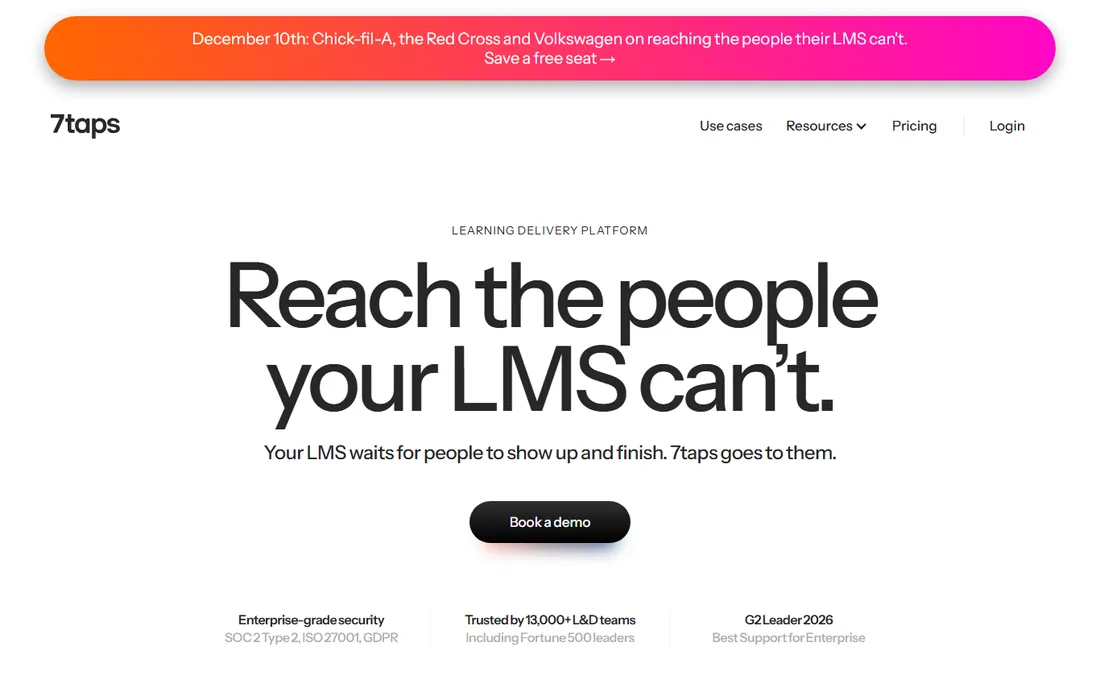
7taps takes the opposite approach from TalentCards: learners open a web link, no app required. That single decision removes the biggest adoption barrier for deskless and high-turnover teams. Creators build mobile-first micro-courses with text, audio and visuals, share them by link, and can connect through LTI or SCORM to an existing LMS.
The free plan exists but details are thin, and paid pricing is not published, so expect a sales conversation. Analytics are more basic than Axonify or Qstream. Where 7taps wins is speed: a team can go from idea to delivered training in an afternoon.
What we like- No app download needed for learners
- Very fast authoring
- Used by 12,000-plus organizations
Watch out for- No public pricing
- Basic analytics
- Limited depth for advanced topics
#4
eduMe
Best for: deskless onboarding and compliance training
Visit edume.com
Starting priceSee website
Free planFree trial
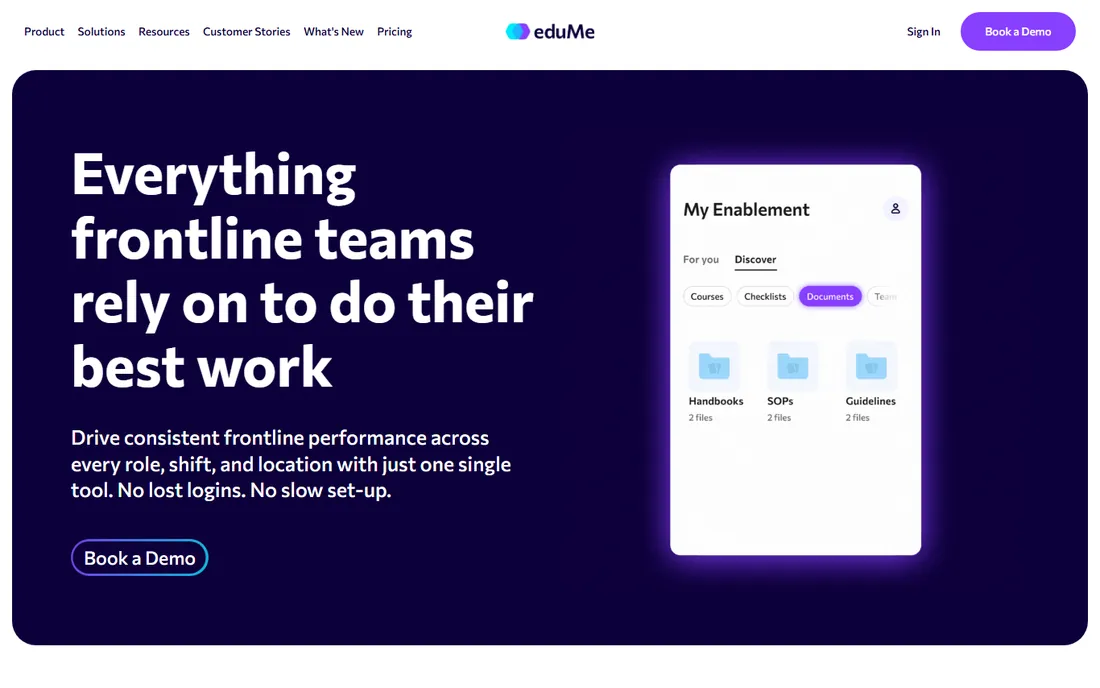
eduMe targets the deskless workforce: retail, hospitality, logistics and gig workers who never sit at a desk. Lessons are mobile-first, onboarding paths are structured, and integrations cover Workday, UKG, BambooHR, Slack and Microsoft Teams. The vendor cites $3.49 per user with a 100-user minimum in its own comparison content, but billing terms are not published, so treat that as directional.
Watch the contract mechanics. Core platform plus add-on modules are sold by quote, and the license agreement requires 90 days' written notice before renewal to exit. The product itself is well regarded for ease of use; just go in with procurement eyes open.
What we like- Built for shift and frontline workers
- Deep HRIS and communication integrations
- Strong onboarding workflows
Watch out for- Quote-only pricing with add-on modules
- 90-day non-renewal notice
- No permanent free tier
Starting priceSee website
Free planNo
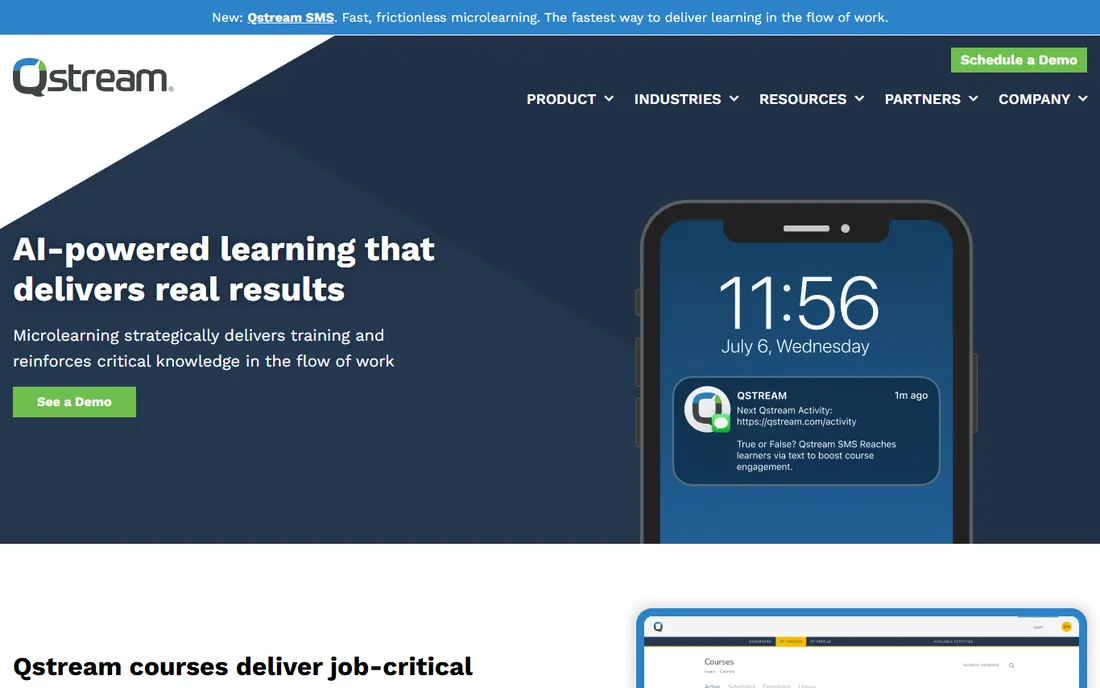
Qstream is the specialist pick for sales organizations. It uses spaced repetition and scenario-based challenges to keep product knowledge and sales techniques fresh, with coaching dashboards for managers and an AI author assistant that generates questions in multiple languages. Integrations include Salesforce and HubSpot.
There is no self-serve path at all: no free plan, no trial, no published price. Estimates run $10 to $100 per user with implementation costs from $15,000 upward. That makes Qstream a considered enterprise purchase, but for sales teams where one lost deal costs more than the platform, the math often works.
What we like- Science-backed spaced repetition for sales
- AI question generation in multiple languages
- Salesforce and HubSpot integrations
Watch out for- Enterprise pricing by quote only
- Implementation can reach five figures
- No free plan or trial
Starting price$3 per user/month
Free planNo
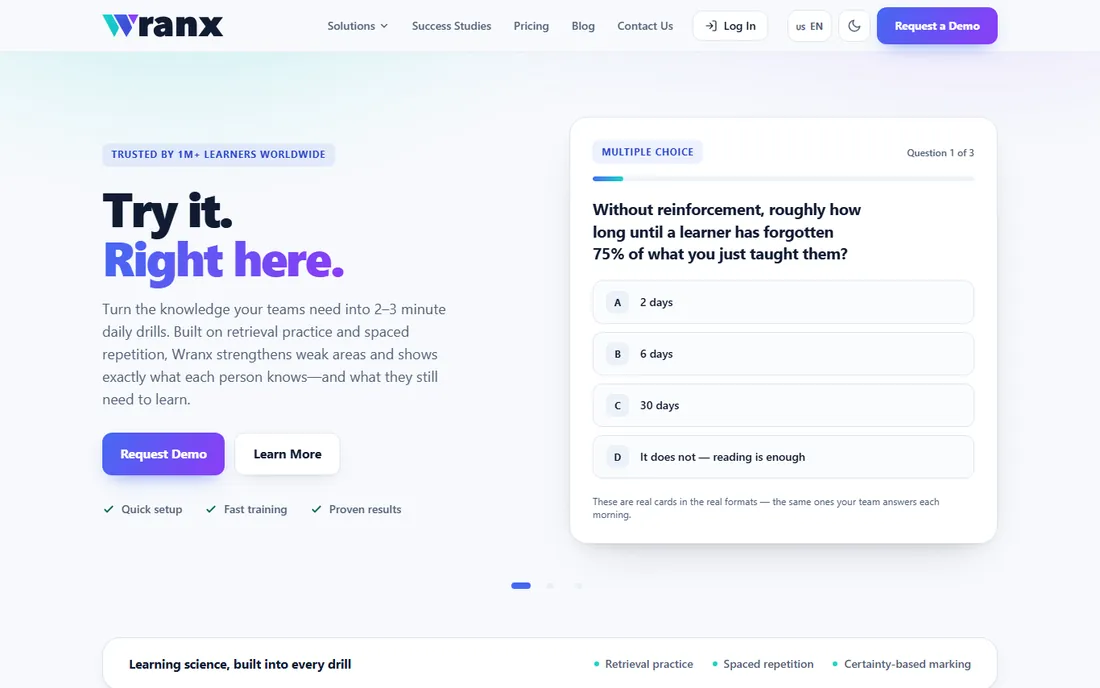
Wranx does one thing: short daily knowledge drills that build retention over time. At $3 per user per month it is one of the cheapest paid options on this list, and teams can be running in days rather than months. The vendor reports strong ease-of-use scores and knowledge gains among its customers.
The narrow focus is both the appeal and the limit. There is no deep course authoring, no content library to speak of, and no free tier to test with. Wranx fits teams that want a lightweight daily reinforcement habit on top of existing training, not a full learning platform.
What we like- Dead-simple daily drill format
- Low per-user price
- Quick to deploy
Watch out for- Narrow feature set
- No free plan
- Weak for structured curricula
Starting price$250 per month
Free planFree trial
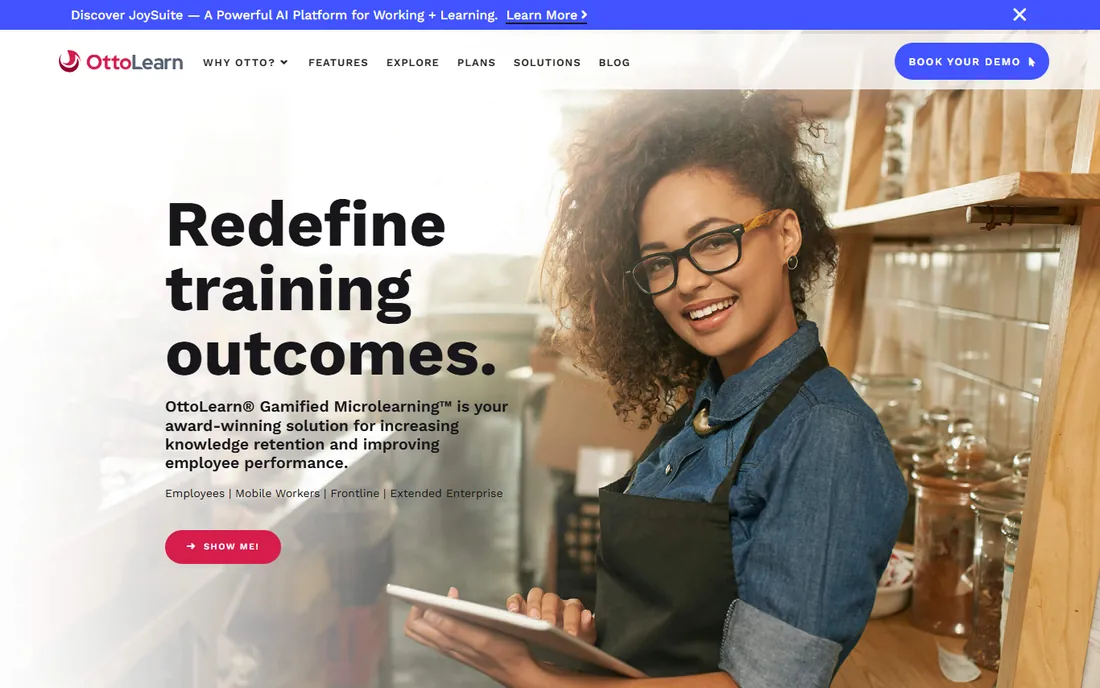
OttoLearn, from Canada's Neovation Learning Solutions, combines microlearning with adaptive algorithms and heavy gamification. The platform adjusts each learner's path based on performance, aiming to close knowledge gaps automatically. Pricing starts at $250 a month, with pay-per-use options at $15 per person per course and annual unlimited plans scaling down with headcount.
The gamified approach drives engagement for competitive teams, but $250 a month is real money for a small business, and there is no free tier beyond a trial. It sits between TalentCards' simplicity and Axonify's enterprise weight: more serious than flashcard apps, more accessible than the enterprise giants.
What we like- Adaptive learning paths per employee
- Strong gamification
- Unlimited-use annual plans
Watch out for- $250 a month entry is steep for small teams
- No free tier
- Canadian vendor with smaller partner ecosystem
Starting price$5 per user/month (Essentials)
Free planFree trial
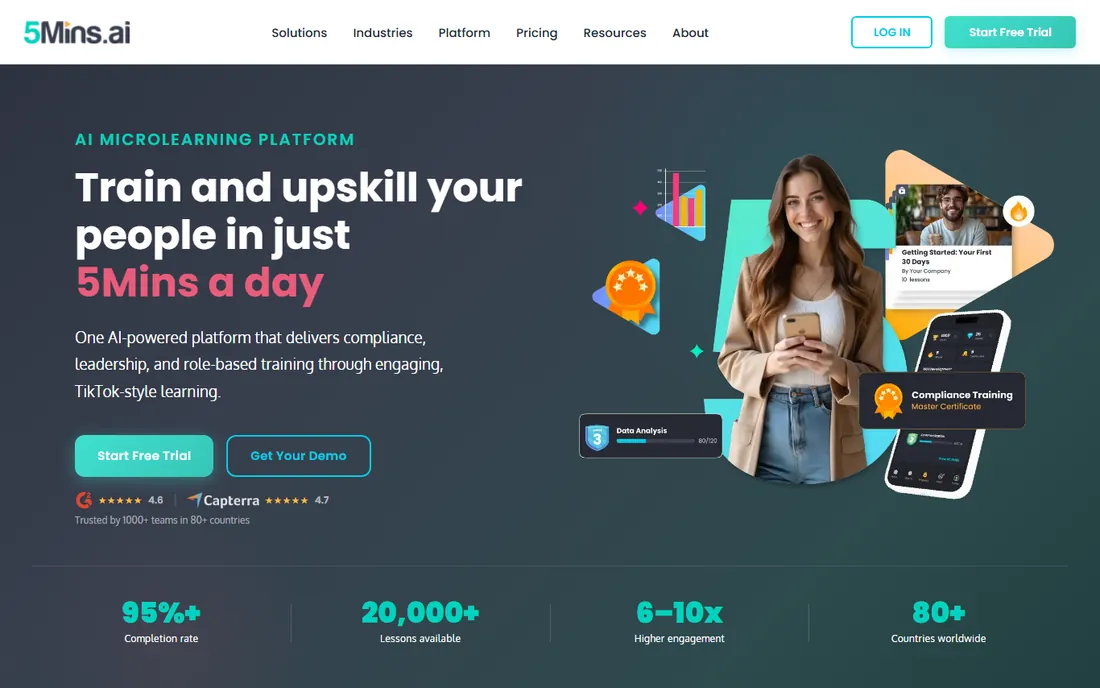
5Mins.ai turns training into short, TikTok-style lessons of about five minutes a day, with AI that converts handbooks and manuals into bite-sized content. Pricing is refreshingly public: Essentials from $5 per user per month (or $125 a month flat), Advance $7.50 per user, Accelerate $250 a month with the full 20,000-lesson library. There is a free trial but no permanent free tier.
Completion rates are the selling point; short video lessons get finished in a way hour-long courses do not. The honest catch is maturity: the content library is deep in compliance and soft skills but thinner in specialized topics, and enterprise buyers should verify the analytics depth before committing.
What we like- Short video-style lessons employees actually finish
- AI course creation from existing documents
- Transparent published pricing
Watch out for- No permanent free tier
- Library depth varies by topic
- Newer vendor with less enterprise track record
Starting price$1.95 per user/month
Free planYes (free tier for small teams)
SC Training, formerly EdApp by SafetyCulture, is the value pick. A free tier covers small teams, paid plans start at $1.95 per user per month, and the template library includes ready-made courses for warehouse safety, food handling and equipment basics. Gamification features keep completion rates respectable.
The catch is the usual one: learners must download the app, which creates friction for high-turnover operations, and template courses need real customization before they match your procedures. For teams that want a mobile LMS without an enterprise budget, though, the free tier makes it nearly risk-free to try.
What we like- Free tier for small teams
- Huge template library
- Part of the SafetyCulture ecosystem
Watch out for- App download required
- Templates need customization
- Analytics lighter than enterprise tools
Match the platform to your learners, not your L&D team. Deskless and high-turnover teams need no-app delivery or a free tier, because every install step costs you learners. Sales organizations should weight spaced repetition and CRM integration over course authoring. Enterprises with thousands of frontline workers should weight measurement: can the platform prove knowledge actually changed, not just that courses were completed?
Then check the contract. Quote-only enterprise pricing, 90-day exit notices and add-on modules are common in this category. Ask what happens to your content if you leave, and whether courses export to SCORM. A platform that holds your content hostage is not a platform, it is a subscription trap.
How we chose
We compared the microlearning platforms that show up repeatedly in buyer shortlists and review sites, focusing on tools built for short-form training rather than general LMS products. We checked current pricing pages and vendor documentation, read public reviews on G2, Capterra, SourceForge and Reddit, and weighed mobile delivery, authoring speed, analytics depth and contract terms for small and mid-size companies. No vendor paid for placement, and we did not run hands-on trials.
What microlearning software costs in 2026
Pricing splits into three bands. Self-serve tools publish prices: TalentCards at $50 a month, Wranx at $3 per user, 5Mins.ai from $5 per user, SC Training from $1.95 per user. Mid-market tools like OttoLearn start around $250 a month. Enterprise platforms, Axonify, Qstream and eduMe, sell by quote with implementation budgets that can exceed the first year's subscription.
The free tiers are genuinely useful here. TalentCards covers 5 users free, 7taps has a free plan, and SC Training's free tier suits small teams. Use them to test learner adoption before you sign anything; the platform employees ignore is the most expensive one regardless of price.
Frequently asked questions
What is the best microlearning app for a small business?
TalentCards or SC Training. TalentCards is free for up to 5 users with paid plans from $50 a month, and SC Training has a free tier plus paid plans from $1.95 per user per month.
Do microlearning platforms require an app download?
Some do and some do not. TalentCards, Axonify, eduMe and SC Training need their apps installed. 7taps delivers through web links with no app required, which helps adoption with deskless teams.
How much does Axonify cost?
Axonify does not publish pricing. It is sold by quote based on headcount, locations and modules, with implementation typically costing $5,000 to $50,000 or more. Budget for an enterprise purchase, not a self-serve subscription.
What is the difference between microlearning and an LMS?
An LMS manages full courses, compliance records and certifications. A microlearning platform delivers short daily lessons focused on retention and behavior change. Many companies run both: the LMS for records, microlearning for actual learning.
Can I create microlearning content with AI?
Yes. 5Mins.ai converts existing documents into short lessons, OttoLearn adapts paths automatically, and Qstream's AI assistant generates quiz questions in multiple languages. AI speeds up first drafts, but plan on human review for accuracy.
Sources we checked (12)
- https://www.itechguides.com/best/microlearning-platforms/
- https://cloudassess.com/blog/microlearning-apps/
- https://slashdot.org/software/comparison/TalentCards-vs-WestNetLMS/
- https://slashdot.org/software/comparison/7taps-vs-eSkilled-AI-Course-Creator/
- https://slashdot.org/software/comparison/OttoLearn-Microlearning-vs-Wranx/
- https://slashdot.org/software/comparison/EduMe-vs-OttoLearn-Microlearning/
- https://slashdot.org/software/comparison/Qstream-vs-Wranx/
- https://softwarefinder.com/lms/qstream
- https://www.g2.com/products/5mins-ai/pricing
- https://www.goodfirms.co/software/5mins-ai
- https://minicoursegenerator.com/blog/edume-alternatives/
- https://sourceforge.net/software/compare/7taps-vs-EdApp/
Is your product missing or out of date?
We review this list regularly. Vendors can request a listing, send updated pricing or ask about featured placement.

Shihab Mia · Founder, Rankite
Shihab has spent more than a decade helping SaaS and e-commerce brands grow through search. He writes Rankite's software buying guides from pricing pages, documentation and public user reviews. More about Shihab.