How we make this list: we compare pricing pages, product documentation and public user reviews. Ratings come from G2, Capterra or Trustpilot, with the date we checked them.
Key takeaways
- Most pharmacy inventory lives inside the pharmacy management system: PioneerRx, PrimeRx, and QS/1 track stock at the level of each dispensing event, lot, and expiration date.
- Compliance drives the feature list: DEA controlled substance records, state board audit trails, and DSCSA package level traceability for prescription drugs are the tests that matter.
- Datarithm is the specialist layer: it sits on top of an existing system and optimises ordering, returns, and dead stock without a platform migration.
- Omnicell and EnterpriseRx serve hospitals and chains, where inventory lives in cabinets and central fills rather than on store shelves.
- Nobody publishes a price. This market is quote based, so every entry reads See website, and the guide focuses on fit and compliance instead.
Quick comparison
| Tool | Best for | Starting price | Free plan |
|---|
 PioneerRx | Independent pharmacy all round | See website | No |
 PrimeRx | Multi specialty pharmacies | See website | No |
 QS/1 | Controlled substance accounting | See website | No |
 Liberty Software | Counter speed and POS depth | See website | No |
 BestRx | Small independents on a budget | See website | No |
 Datarithm | Inventory optimisation as an add on | See website | No |
 EnterpriseRx | Retail chains and central fill | See website | No |
 Omnicell | Hospitals and health systems | See website | No |
Is your product missing or out of date?
We review this list regularly. Vendors can request a listing, send updated pricing or ask about featured placement.
The best pharmacy inventory software
#1PioneerRx
Best for: Independent pharmacy all round4.0/5 on
G2 (21 reviews, checked Oct 2026)
Visit pioneerrx.com
Starting priceSee website
Free planNo
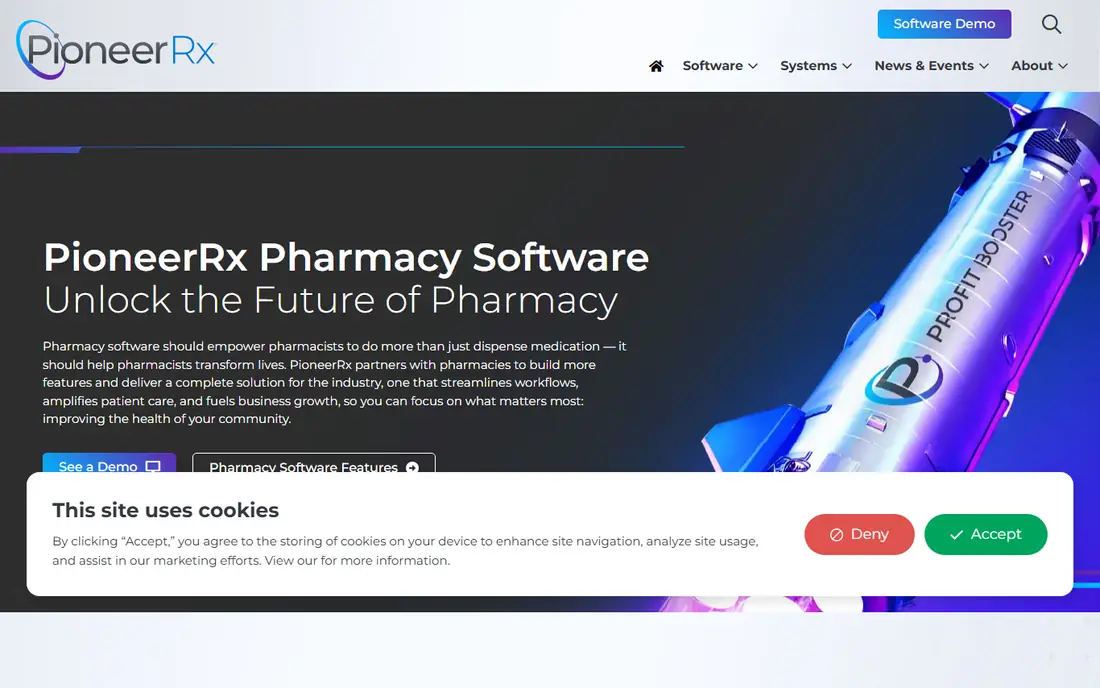
PioneerRx is the independent pharmacy benchmark, and its inventory model explains why: stock is not a number updated nightly but a live record moved by each dispensing event, with batch detail and adjustments traceable for reconciliation. Its mobile inventory application, described on its own site, lets staff log counts, check wholesale shipments, and manage bins from a phone, which is how cycle counts actually get done in a working pharmacy.
Gitnux's 2026 medication inventory review ranks PioneerRx first overall on the same logic, event based tracking and traceable adjustments, with particular strength in expiration aware rotation. The controlled substance workflows, queue driven verification and shift level reconciliation, meet the audit standard independents actually face. If you run one to five stores and want one system to be the record, start the evaluation here.
What we like- Event based perpetual inventory: every fill, return, and adjustment updates stock with a traceable record
- A mobile inventory app lets staff count, receive shipments, and organise bins from a phone
- Controlled substance workflows with verification steps and reconciliation across shifts
- The most installed system among US independents, with an active user community shaping development
Watch out for- Windows heritage and on premises roots show in deployment choices
- Inventory is one module in a broad system, so you buy the platform, not a plug in
- Quote based pricing with implementation on top
- Depth can overwhelm a very small store's staffing
#2PrimeRx
Best for: Multi specialty pharmacies4.1/5 on
G2 (61 reviews, checked Oct 2026)
Visit primerx.io
Starting priceSee website
Free planNo

PrimeRx, from Micro Merchant Systems, is the breadth play. A pharmacy that is also a compounding lab, a long term care provider, and a 340B contract pharmacy needs inventory that understands all four worlds, different lots, different billing, different compliance, and PrimeRx's modules cover them in one system. Gitnux's review singles out its per transaction lineage: each dispensing outcome traceable back through configurable workflow rules, with API driven sync across locations.
Its inventory discipline matches that reach, lot and expiration data captured at the scan, not reconstructed later. The caution is fit and ownership: simple stores will use a tenth of it, and PrimeRx became a RedSail affiliate in 2026, joining the same family as QS/1 below, which makes questions about long term product direction fair and necessary in negotiation.
What we like- Per transaction inventory lineage, lot and expiration visibility tied to each dispensing event
- Module breadth across retail, specialty, long term care, compounding, mail order, and 340B
- Wholesaler EDI ordering with automatic reordering
- Cloud or on premises deployment, increasingly rare flexibility
Watch out for- Breadth means configuration complexity for a simple retail store
- Now part of the RedSail family following a 2026 acquisition, so roadmap questions belong in the sales process
- Quote based pricing
- Some specialty modules price separately
Starting priceSee website
Free planNo

QS/1 is the compliance clerk's choice. Gitnux's inventory review highlights what its users have valued for years: controlled substance records kept the way the DEA expects to read them, logs, reconciliation, and audit trails that repeat identically across every location a small chain runs. When a board inspector or a DEA auditor asks for the trail, QS/1's structure is the answer already formatted.
That focus defines its audience. QS/1 serves independent and small chain pharmacies that want a proven, regulation centred system from RedSail, the consolidator that now owns several platforms on this list. It will not win a beauty contest against newer software, and its buyers do not ask it to; they ask whether the records reconcile, and on that question it has decades of receipts.
What we like- Controlled substance inventory log workflows in the DEA style, with reconciliation oriented audit trails, are its signature
- A long serving RedSail platform for independents and small chains
- Multi location posting standardisation keeps counts consistent across stores
- Deep roots in US community pharmacy practice
Watch out for- A heritage platform whose interface reflects its years
- Inventory strength sits inside a full system purchase
- Quote based pricing through RedSail channels
- Newer pharmacies may prefer the mobile first feel of PioneerRx
Starting priceSee website
Free planNo
Liberty Software treats the register as the centre of the pharmacy, and its inventory follows: scan the medication at the counter and the stock, the record, and the audit trail move together. Gitnux's POS review calls it the best pick for independents wanting a POS first dispensing lane, and its dispensing review notes the governance detail, role based administration and audit logging of who changed what across store operations.
For a store whose day is a queue at the counter, that coupling prevents the classic inventory failure, product handed over while the system was not looking. Liberty's forecasting and analytics are more basic than Datarithm's specialism or Pioneer's breadth, so inventory led buyers should test its reporting against their ordering habits. Counter led buyers will find its priorities match theirs.
What we like- Register driven dispensing: barcode medication lookup ties the counter transaction to the inventory movement in one step
- Role based access with administrative audit logging across prescription and retail operations
- Configurable queue sequencing for batch versus walk in volume
- Serves independents and small chains with cloud or on premises options
Watch out for- A smaller user base than PioneerRx or the RedSail platforms
- Inventory analytics and forecasting are less developed than the optimisation specialists
- Quote based pricing
- Its POS first design suits retail heavy stores more than clinical service models
#5BestRx
Best for: Small independents on a budget3.0/5 on
G2 (4 reviews, checked Oct 2026)
Visit bestrx.com
Starting priceSee website
Free planNo
BestRx is the small store's system: an independent pharmacy with one location and a small team gets dispensing, point of sale, and inventory in a package sized to its reality. HealthcareReaders' 2026 comparison places it exactly there, basic to moderate inventory capability inside an affordable all in one, which for many single stores is not a criticism but a correct specification.
Its limits arrive with ambition. Forecasting is light, specialty and multi site needs strain it, and a pharmacy planning clinical services or a second location should price the migration it is deferring. None of that changes its role: the first real system for a small pharmacy, with inventory records good enough to satisfy boards and wholesalers while the business grows into bigger questions.
What we like- Built and priced for small independent pharmacies
- The core bundle, dispensing, billing, and inventory, without enterprise ceremony
- A reputation for approachable onboarding and support for first time system buyers
- Cloud deployment keeps hardware simple
Watch out for- Inventory depth is basic to moderate by HealthcareReaders' assessment, with fewer advanced forecasting features
- Multi location and specialty capabilities are limited
- Quote based pricing despite the budget positioning
- Growing pharmacies may outgrow it into PioneerRx or PrimeRx
Starting priceSee website
Free planNo
Datarithm is the different shape on this list: not a pharmacy system but an inventory brain for the one you have. Pharmacies carry tens of thousands of dollars of stock, much of it expiring quietly, and Datarithm's tools attack that balance sheet problem: demand forecasting for ordering, structured cycle counts, identification of dead stock for return, and transfers between locations so one store's surplus fills another's gap.
The appeal is surgical. A store happy with PioneerRx or QS/1 for dispensing and compliance, but bleeding money on overstock, can add Datarithm without touching the workflow its staff know. Demo it against your own numbers: ask what it would have ordered differently last quarter, and what it would send back. If the answers are not obviously money, the main system's tools may already be enough.
What we like- A dedicated inventory optimisation layer that works with your existing pharmacy system rather than replacing it
- Forecasting, cycle counting, and return and dead stock tools aimed at freeing shelf capital
- Balancing and transfer suggestions across locations for small chains
- No platform migration, the lowest risk change on this list
Watch out for- It optimises inventory
- Dispensing, POS, and compliance records stay in your main system
- Value depends on the quality of the data your current system feeds it
- Another subscription on top of the platform you already pay for
- Less relevant where a modern system already forecasts well
Starting priceSee website
Free planNo
EnterpriseRx is inventory at chain altitude: one view of stock across hundreds of stores, central fill operations feeding them, and the governance, role based permissions and audit trails, that a corporate pharmacy office requires. HealthcareReaders' comparison places it where it belongs, large retail chains, and notes the natural pairing with McKesson's own distribution business, which can make the inventory and supply chain one conversation.
No independent should price it, and no chain evaluating it should price it as software alone: the distribution relationship, the implementation, and the central fill strategy are the purchase.
What we like- McKesson's chain scale platform: centralised inventory visibility across many locations at once
- Governance for multi site administration with role based access and operational audit trails
- Pairs with McKesson distribution, so ordering and inventory share one supplier relationship
- Built for central fill and high volume operations
Watch out for- Geared to chain scale, priced and implemented accordingly
- Best value arrives with a McKesson distribution contract, which is a bigger decision than software
- Independent pharmacies are not its audience
- Implementation timelines run in quarters, not weeks
Starting priceSee website
Free planNo
Omnicell closes the list at the hospital end, where pharmacy inventory is a logistics network: a central pharmacy, satellite pharmacies, and automated dispensing cabinets on every floor, each transaction credentialed and recorded. Its software and cabinets together give health systems the controlled substance chain of custody that regulators and accreditors demand, from vault to patient floor.
HealthcareReaders' comparison is blunt about the trade: high automation, higher cost, complex implementation, and an ecosystem commitment. A hospital choosing Omnicell is choosing infrastructure for a decade.
What we like- The hospital standard: inventory integrated with automated dispensing cabinets on the wards
- Controlled substance tracking tied to cabinet transactions and user credentials
- Central pharmacy automation and analytics across a health system
- High automation level for high acuity environments
Watch out for- Higher cost and complex implementation by every comparison's account
- Value concentrates inside the Omnicell hardware ecosystem
- Far beyond a community pharmacy's needs or budget
- Deployment measured in project phases with clinical IT involved
How we chose
We split the category by pharmacy type, independent, multi specialty, small chain, chain, and hospital, and by approach, full systems versus Datarithm's optimisation layer, using Gitnux's 2026 medication inventory and dispensing reviews and HealthcareReaders' pharmacy inventory comparison, checked in October 2026. Compliance features were weighted first, controlled substance records, audit trails, lot and expiration tracking, because that is what pharmacy inventory is for. Pricing in this market is entirely quote based, so no entry invents a figure. Wholesaler portals and general retail inventory tools with no pharmacy workflow were excluded.
What to look for in pharmacy inventory software
Run the audit test first. Pick your most regulated product, a Schedule II controlled substance, and ask the vendor to show its complete trail: received, shelved, dispensed, wasted or returned, with names, dates, and counts that reconcile to the physical bottle. Then do the same for a recalled lot and an expiring short dated product. Software that answers all three in minutes is built for pharmacy; software that exports spreadsheets and shrugs is retail software in a white coat.
Check the DSCSA workflow explicitly. Prescription drugs now move under package level electronic traceability rules, phased into enforcement through 2024 to 2026, and your system must receive, store, and produce that transaction data, as well as handle suspect product investigations. Ask how EPCIS data flows from your wholesaler and what an inspector gets. Then test the money features: expiration aware picking, dead stock and return reporting, and order suggestions you can audit, because inventory is usually a pharmacy's second largest cost after labour. Finally, count the migration honestly: your current stock, lots, and expirations must arrive intact on day one, or your first quarter on the new system is a recount.
Frequently asked questions
How much does pharmacy inventory software cost?
Vendors in this market do not publish prices; PioneerRx, PrimeRx, QS/1, and the rest are quoted per pharmacy based on locations, workstations, modules, and services, with implementation charged on top. That is why every entry here reads See website. Budget for the whole project: licences or subscription, data conversion, hardware such as scanners and label printers, training, and the wholesaler interface fees that sometimes sit outside the quote. Get the five year total, not the monthly figure, before comparing vendors.
What is DSCSA and does my pharmacy software handle it?
The Drug Supply Chain Security Act is the US law that requires prescription drugs to be traceable at package level through the supply chain, with trading partners exchanging electronic transaction data. Its requirements phased in over a decade, with the electronic traceability stage enforced from late 2024 and exemptions for some smaller dispensers running into 2025 and 2026. Your pharmacy system needs to receive and keep that data from wholesalers, connect it to the product you dispense, and produce it during an investigation or recall. Every platform here addresses DSCSA within its workflow, but ask each vendor to demonstrate your wholesaler's data flowing in, not just to claim compliance.
How should controlled substances be tracked?
To the standard a DEA audit will apply: a perpetual, reconcilable record of every controlled substance from receipt to dispensing, return, waste, or destruction, with the biennial inventory and power of attorney and corresponding responsibility records around it, under 21 CFR Part 1300 rules. In software terms that means lot and count accuracy at each transaction, role based access so only authorised staff adjust records, and an audit trail that cannot be quietly edited. QS/1's DEA style log workflows and Omnicell's cabinet level tracking are the list's extremes of the same idea; whichever system you choose, reconcile physical counts to the system on a schedule, because software records a discrepancy, it does not prevent one.
Should I replace my pharmacy system or add an inventory tool?
Replace when the system's records themselves are the problem: counts you cannot trust, audit trails you cannot produce, or a platform your wholesaler and board reporting have outgrown. Add when the records are sound but the decisions are weak, overordering, dead stock, expirations written off, which is Datarithm's exact case. A useful test: if a full physical inventory today would match your system within a percent or two, optimise; if it would embarrass you, the platform conversation comes first.
Sources we checked (0)
Is your product missing or out of date?
We review this list regularly. Vendors can request a listing, send updated pricing or ask about featured placement.

Shihab Mia · Founder, Rankite
Shihab has 5+ years in B2B and SaaS SEO. He writes Rankite's software buying guides from pricing pages, documentation and public user reviews. More about Shihab.