How we make this list: we compare pricing pages, product documentation and public user reviews. Ratings come from G2, Capterra or Trustpilot, with the date we checked them.
What is OTA firmware update software
OTA firmware update software sends new firmware to devices in the field over the air, without anyone touching the hardware. It packages the update, delivers it to the right devices, installs it safely, verifies the result and rolls back when something fails. Teams use it for connected products, industrial equipment, vehicles and medical devices, where a recall or a site visit costs far more than a remote update. The trade off is risk: a bad update can brick thousands of devices at once, so the tools that win are the ones with staged rollouts, rollback and fleet visibility built in.
Direct answer: Mender is the top pick for most teams because its open source core is free, its hosted Basic plan starts at $34 a month, and it ships delta updates, phased rollouts and automatic rollback. Balena is the best pick for container based Linux fleets, with the first 10 devices free. Memfault is the best pick for teams that need crash diagnostics and observability alongside updates, though its Growth plan starts at $3,495 a month.
Key takeaways
- Mender is free as open source, and its hosted Basic plan starts at $34 a month, with Professional at $291 a month.
- Balena gives the first 10 devices free, and the Prototype plan starts at $159 a month for 30 devices.
- Memfault gives a free Developer tier for up to 10 development devices, and Growth starts at $3,495 a month for 1,000 devices.
- Golioth charges $0.25 per active connection per month, with a free Individual plan and Teams at $299 a month.
- Particle gives a free plan for 100 devices, and its Basic plan costs $299 a month per block of 100 devices.
How we picked
We compared eight tools on five points: update mechanism and rollback, rollout controls, device and fleet management, observability, and pricing transparency. A tool scored well when it updated firmware safely at scale rather than only pushing files. Prices come from vendor pricing pages and vendor published comparisons, checked 21 November 2026. Where sources disagree on a price, both figures are printed and the conflict is flagged. Prices are search verified; vendor homepages were not individually opened in the browser for this guide.
Comparison table
| Tool | Best for | Starting price | Free plan |
| Mender | Most Linux fleets | Free; hosted Basic $34 per month | Open source free |
| JFrog Connect | JFrog and Artifactory shops | Quote only | No free tier |
| Balena | Container fleets on Linux boards | Free; Prototype $159 per month | First 10 devices free |
| Memfault | Diagnostics plus OTA | Free; Growth $3,495 per month | Developer, 10 devices |
| Golioth | Zephyr microcontrollers | Free; Teams $299 per month | Individual free |
| Particle | Connected products with cellular | Free; Basic $299 per month per block | 100 devices free |
| Eclipse hawkBit | Free open source update server | Free | Free, open source |
| Emteria | Android device fleets | Free; Flex from 80 euros per month | Workspace Free |
Which OTA firmware update software is best for a small team
A small team should start with Mender or Golioth. Mender's open source edition is free and covers core updates, and the hosted Basic plan at $34 a month adds the hosted secure server, full disk image updates and device filtering. Golioth's Individual plan is free and now includes OTA updates, logging and remote procedure calls across any number of devices, with 1 GB of data transfer and 200 MB of logging a month. Balena is also cheap at small scale, with the first 10 devices free and Prototype at $159 a month for 30 devices. Avoid Memfault at this size: Growth starts at $3,495 a month for 1,000 devices, which is an enterprise price for a small fleet. Particle is generous too, with 100 devices free, but its Basic plan jumps to $299 a month per block.
Do you need a paid OTA update plan
A paid plan earns its price when the fleet grows or when updates must be safe. The paid features that matter are delta updates, phased rollouts, scheduled deployments, automatic retries and rollback. Mender holds delta updates, scheduled deployments and automatic retries for Professional at $291 a month, while Basic at $34 a month covers the core hosted updates. Memfault's Growth plan at $3,495 a month buys 1,000 monthly active devices and observability, not just updates. Golioth bills usage: $0.25 per active connection a month, $0.0095 per MB of OTA bandwidth and $0.0080 per MB of pipeline data, so a small fleet stays cheap and a large one needs a model.
How to choose OTA firmware update software for your stack
Choose by hardware first. Mender, Balena and Eclipse hawkBit fit Linux devices and gateways, while Golioth and Memfault fit microcontrollers, with Golioth built for Zephyr and Memfault strong on Nordic chips. Particle fits teams that also need the hardware and cellular connectivity, because it sells its own modules with Device OS. Emteria fits Android fleets only. Next, check the rollback model: Mender, Balena and JFrog Connect all roll back automatically when an update fails, which is the feature that prevents a bricked fleet.
Quick comparison
| Tool | Best for | Starting price | Free plan |
|---|
 Mender | Most Linux fleets that need safe, staged updates | Free open source; hosted Basic $34 per month, Professional $291 per month | Open source edition free for core updates |
 JFrog Connect | Teams already running JFrog Artifactory | Quote only | No free tier |
 Balena | Teams running Docker containers on fleets of Linux boards | Free; Prototype $159 per month | First 10 devices free |
 Memfault | Teams that need crash diagnostics and observability with OTA | Free Developer tier; Growth $3,495 per month | Developer tier free for up to 10 development devices |
 Golioth | Firmware teams on Zephyr that want per-connection billing | Free Individual plan; Teams $299 per month | Individual plan free, with OTA updates included |
 Particle | Connected products that need hardware, cellular and cloud together | Free; Basic $299 per month per block | Free plan with 100 devices, 100,000 data operations and 100 MB of cellular data a month |
 Eclipse hawkBit | Teams that want a free open source update server | Free | Free under Eclipse Public Licence, no paid tier |
 Emteria | Android device fleets that need managed OS updates | Free Workspace; Flex from 80 euros per month | Workspace Free plan |
Is your product missing or out of date?
We review this list regularly. Vendors can request a listing, send updated pricing or ask about featured placement.
These eight tools cover the main ways teams update firmware over the air in 2026, from free open source servers to enterprise platforms.
#1
Mender
Best for: Most Linux fleets that need safe, staged updates
Visit mender.io
Starting priceFree open source; hosted Basic $34 per month, Professional $291 per month
Free planOpen source edition free for core updates
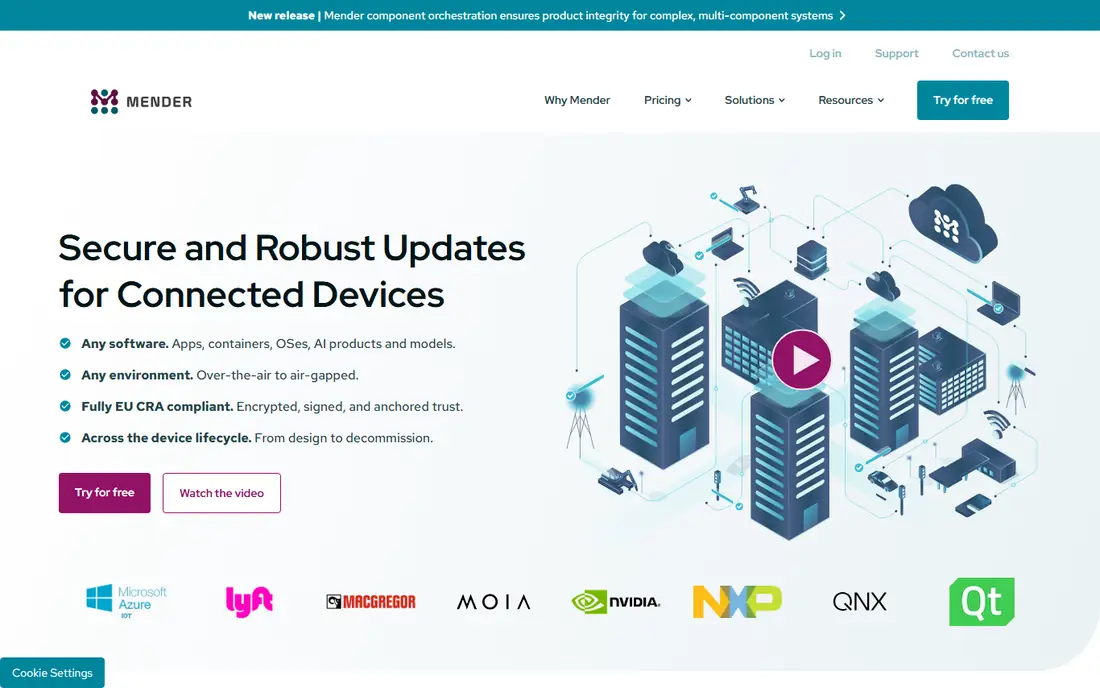
Mender is the most widely used open source OTA update platform for Linux devices. The open source edition is free and covers core updates, with a self-hosted server the team runs itself. The hosted Basic plan starts at $34 a month and adds the hosted secure server, full disk image and application updates, update extensibility and device filtering. Professional starts at $291 a month and adds delta updates, scheduled deployments, automatic deployment retries and best-effort support. The pricing page lists monthly prices but does not state whether they are per seat, per device or flat rate, so confirm the billing basis before budgeting. Enterprise is custom priced.
What we like- Free open source core, delta updates and phased rollouts on paid tiers, automatic rollback, hosted and self-hosted options
Watch out for- Delta updates, scheduled deployments and retries are paid only, pricing page does not state the billing basis, Enterprise pricing is custom
#2
JFrog Connect
Best for: Teams already running JFrog Artifactory
Visit jfrog.com
Starting priceQuote only
Free planNo free tier
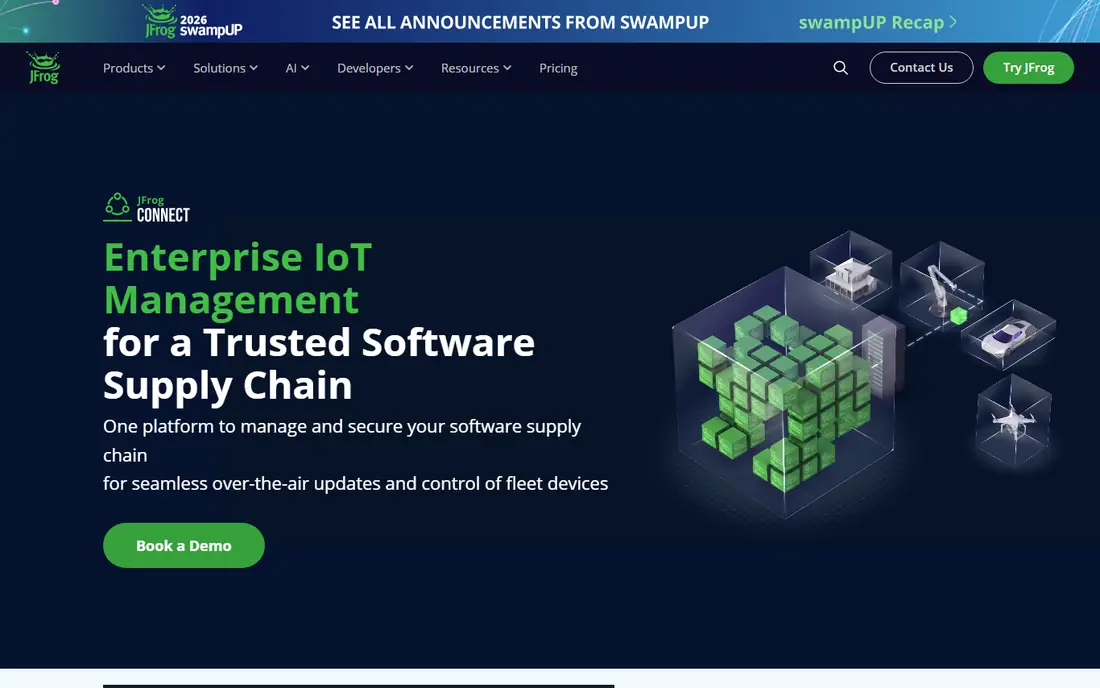
JFrog Connect is the IoT device management and update platform from JFrog, built for teams that already store artifacts in Artifactory. It manages remote Linux devices, delivers updates securely, monitors device health and applies patches across the fleet from one console. The Artifactory integration is the decisive feature: firmware artifacts move from build to device through the same repository and access controls the team already uses. Pricing is quote only, with no published entry price and no free tier, which puts it out of reach for small teams.
What we like- Deep Artifactory integration, remote device management and monitoring, secure update delivery, suits regulated industries
Watch out for- Quote only pricing with no published entry price, JFrog centric by design, no free tier, enterprise focus
#3
Balena
Best for: Teams running Docker containers on fleets of Linux boards
Visit balena.io
Starting priceFree; Prototype $159 per month
Free planFirst 10 devices free
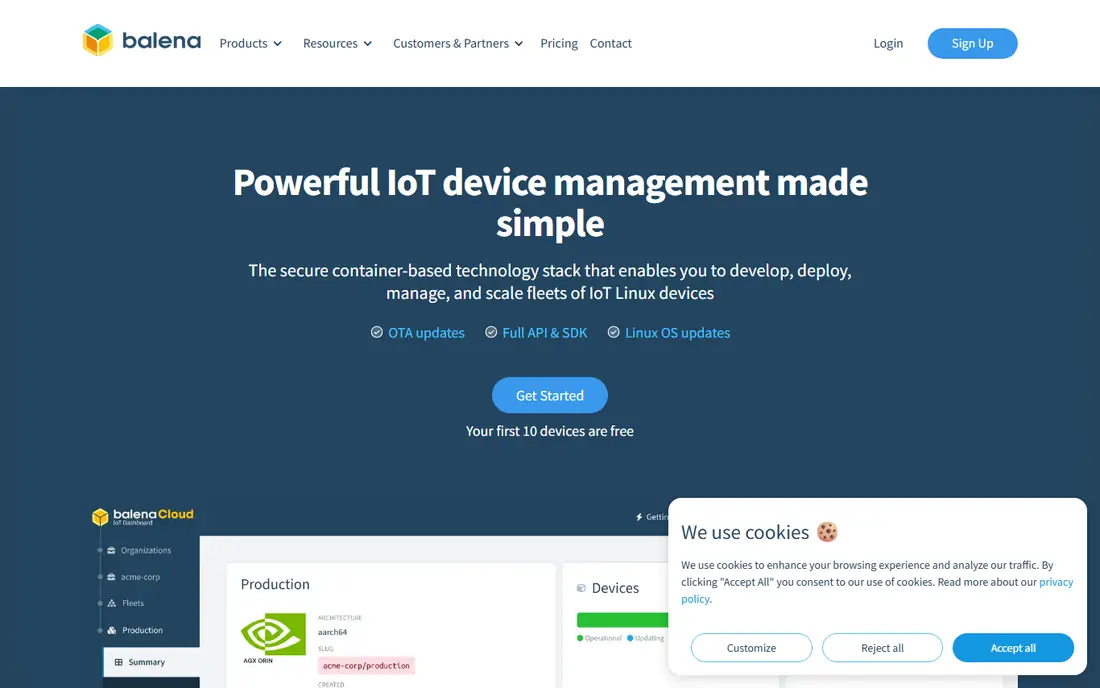
Balena deploys and updates Docker containers on remote embedded devices through balenaCloud, balenaOS and a command line interface. A release is a set of container images rather than a system image, and updates are pulled with binary deltas and applied per service, which makes them small and quick. It supports more than 80 device types, from Raspberry Pi to Jetson Orin. The first 10 devices are free permanently with community forum support. The Prototype plan costs $159 a month, includes 30 devices and 1 user, with extra devices at $3 a month. Pilot costs $329 a month for 60 devices, and Production costs $1,439 a month for 110 devices, with extra devices at $2 a month.
What we like- First 10 devices free permanently, Docker based releases with binary deltas, supports more than 80 device types, open source balenaOS and openBalena
Watch out for- Per device pricing climbs steeply past prototyping, Prototype plan allows only 1 user, Production plan costs $1,439 a month, container runtime on every device
#4
Memfault
Best for: Teams that need crash diagnostics and observability with OTA
Visit memfault.com
Starting priceFree Developer tier; Growth $3,495 per month
Free planDeveloper tier free for up to 10 development devices
Memfault pairs firmware updates with embedded observability: crash dumps, fleet monitoring and analytics alongside OTA delivery. The Developer tier is free for up to 10 development devices, for teams building on Nordic low-power wireless solutions, with pay-as-you-go pricing beyond that. Growth costs $3,495 a month and includes 1,000 monthly active devices with 15 sessions per device per day. Scale costs $6,695 a month, and Enterprise is custom. Through nRF Cloud, Nordic customers get 10 devices free and scale from $0.10 per device per month. The price is the honest problem: Growth is an enterprise tier for a team that only needs updates, and the paid plans require a sales call.
What we like- Best in class crash diagnostics, fleet monitoring and analytics, OTA with progressive rollouts, Nordic integration through nRF Cloud
Watch out for- Growth starts at $3,495 a month, paid plans need a sales call, Growth covers only 2 chips and 1 device architecture, enterprise priced
#5
Golioth
Best for: Firmware teams on Zephyr that want per-connection billing
Visit golioth.io
Starting priceFree Individual plan; Teams $299 per month
Free planIndividual plan free, with OTA updates included
Golioth is an IoT device management cloud and firmware SDK for connected hardware, now part of Canonical. Its Individual plan is free and includes OTA updates, device logging, remote procedure calls and real-time settings management across any number of devices, with 1 GB of data transfer and 200 MB of logging a month. Usage bills as $0.25 per active connection per month, $0.0095 per MB of OTA update bandwidth and $0.0080 per MB of pipeline data. Teams costs $299 a month for up to 20 users and five projects plus dedicated support, and Enterprise starts at $2,799 a month. Golioth suits Zephyr firmware teams that want one API for connections, updates and data routing.
What we like- Free tier includes OTA updates, per-connection pricing keeps small fleets cheap, Zephyr focused, $50 in free credits for new users
Watch out for- Several per-megabyte meters make bills hard to forecast, Teams plan costs $299 a month for support and user management, Enterprise starts at $2,799 a month
#6Particle
Best for: Connected products that need hardware, cellular and cloud together4.5/5 on
G2 (195 reviews, checked Oct 2026)
Visit particle.io
Starting priceFree; Basic $299 per month per block
Free planFree plan with 100 devices, 100,000 data operations and 100 MB of cellular data a month
Particle is an IoT platform for connected hardware that combines cellular and Wi-Fi modules, a Device OS, a cloud with a web IDE and command line, over-the-air updates and Edge ML deployment. It sells its own hardware, so a small team can move from prototype to production without stitching together five vendors. The free plan covers 100 devices, 100,000 data operations a month and 100 MB of cellular data a month, pooled across all devices. Growth plans are sold in blocks of 100 devices with 720,000 data operations and 540 MB of cellular data per block, and Rankite's own IoT connectivity guide lists the Basic block at $299 a month. Particle has been acquired by Digi.
What we like- Free plan covers 100 devices, own hardware and cellular modules, Device OS and cloud in one product, Edge ML deployment
Watch out for- Paid prices are not published on the vendor pages, Basic plan jumps to $299 a month per block, acquired by Digi with unclear plan changes
#7
Eclipse hawkBit
Best for: Teams that want a free open source update server
Visit eclipse.dev
Starting priceFree
Free planFree under Eclipse Public Licence, no paid tier
Eclipse hawkBit is a free open source domain server for rolling out software updates to constrained edge devices, licensed under the Eclipse Public Licence with no paid tier. It manages rollout campaigns, device groups, update artifacts and deployment states, and it is used in production by large manufacturers. The team runs the server itself and integrates it with its own build and device infrastructure, which is the trade off for a zero licence cost. There is no vendor to call when something breaks, and no hosted option for teams that want someone else to run it.
What we like- Free at any fleet size, open source with no vendor lock in, rollout management with groups and campaigns, used in production by large manufacturers
Watch out for- No commercial support contract, needs a team to run and integrate it, interface is functional rather than polished, no hosted option
#8
Emteria
Best for: Android device fleets that need managed OS updates
Visit emteria.com
Starting priceFree Workspace; Flex from 80 euros per month
Free planWorkspace Free plan
Emteria provides a managed version of Android, extended for industrial use cases, plus device management and web services to build, scale and operate fleets of Android IoT devices. Its Device Hub enrolls devices, configures them at first boot, and delivers over-the-air updates to keep products updated, with kiosk mode, remote access and device monitoring built in. The vendor pricing page lists a free Workspace plan, with Small to Large and Enterprise plans by request. Third-party listings report Flex S at 80 euros a month, Flex M at 360 euros and Flex L at 890 euros, but those figures are not on the vendor page and should be confirmed with Emteria. Emteria provides at least 5 years of security updates for each Android version.
What we like- Managed Android OS with long-term support, OTA updates built in, kiosk mode and remote management, on-premise management option
Watch out for- Android only, Flex prices are third-party listings, Small to Large and Enterprise plans are quote only, per device pricing varies by fleet size
Frequently asked questions
What happens if an OTA firmware update fails
A good OTA platform rolls back automatically. Mender, Balena and JFrog Connect all verify the new firmware after install and revert to the previous version when the check fails, so a bad update does not brick the fleet. The safe pattern is a staged rollout: update 10 devices first, watch them for a day, then expand to 100, then to the whole fleet. Never push an update to every device at once, and never ship an update without a tested rollback path.
How much does OTA firmware update software cost
The range is wide. Mender is free as open source and its hosted Basic plan starts at $34 a month. Balena gives 10 devices free and starts at $159 a month. Golioth is free for individuals and charges $0.25 per active connection a month. Particle is free for 100 devices and $299 a month per block after that. Memfault is the expensive one, at $3,495 a month for Growth.
Can I update firmware on devices with no internet
Most OTA platforms need connectivity to deliver the update, but the devices do not need to be online all the time. Mender, Balena and Greengrass style tools queue updates and apply them when the device next connects. For fully offline sites, the update must be delivered another way, such as a local server, a USB drive or a technician visit. Eclipse hawkBit can run on a local server inside the site, which suits factories with no outside connectivity. Check the offline story before choosing, because a device that never connects cannot be updated over the air.
Do OTA updates work on microcontrollers
Yes, but the tool must fit the hardware. Golioth is built for Zephyr microcontrollers and Memfault fits Nordic chips, with crash diagnostics and OTA through nRF Cloud. Mender and Balena fit Linux devices and gateways, not bare metal microcontrollers. The difference is resources: a microcontroller has kilobytes of memory and a small flash, so the update mechanism must use delta updates and A/B partitions carefully. Check the chip support list before committing, because a tool that does not support your microcontroller cannot be made to fit.
How do I choose between Mender and Balena
Choose Mender when the fleet runs Linux and the team wants system level firmware updates with A/B partitions and rollback. Choose Balena when the fleet runs Docker containers on Linux boards and the team thinks in containers. Mender updates the whole system image, while Balena updates container images per service, which is faster and smaller for app level changes.
Sources we checked (9)
- https://mender.io
- https://jfrog.com/connect/
- https://www.balena.io/pricing
- https://memfault.com/pricing/
- https://golioth.io/pricing
- https://www.particle.io/pricing
- https://eclipse.dev/hawkbit/
- https://emteria.com/pricing
- https://rankite.com/blog/best-iot-connectivity-platforms
Is your product missing or out of date?
We review this list regularly. Vendors can request a listing, send updated pricing or ask about featured placement.

Shihab Mia · Founder, Rankite
Shihab has 5+ years in B2B and SaaS SEO. He writes Rankite's software buying guides from pricing pages, documentation and public user reviews. More about Shihab.