How we make this list: we compare pricing pages, product documentation and public user reviews. Rankite is independent; if a vendor ever pays for a featured spot, that listing is clearly labeled Partner.
Key takeaways
- RevolutionEHR and Eyefinity Encompass lead for cloud-based, optometry-first EHR with AI documentation built in.
- MaximEyes suits practices that want deep customization plus AI scribing, voice, and billing assistance.
- Crystal PM is the independent-practice favorite: 8,000+ providers, 55+ integrations, and same-day support.
- Compulink fits larger or multi-specialty operations with its all-in-one EHR, optical POS, and revenue cycle services.
- My Vision Express (Sightview) and LiquidEHR give smaller practices simpler, budget-friendlier paths.
- Pricing is quote-based across the category and usually tied to provider count; budget for data migration and training on top.
Quick comparison
| Tool | Best for | Starting price | Free plan |
|---|
 RevolutionEHR RevolutionEHR | Cloud EHR with AI scribe and payments | Contact sales | No |
 Eyefinity Encompass Eyefinity Encompass | VSP-integrated all-in-one platform | Contact sales | No |
 Crystal PM Crystal PM | Independent practices wanting customization | Contact sales | No |
 MaximEyes MaximEyes | Customizable exams with AI assistance | Contact sales | No |
 Compulink Advantage Compulink Advantage | Large and multi-specialty practices | Contact sales | No |
 My Vision Express My Vision Express | Simpler EHR plus practice management | Contact sales | No |
 LiquidEHR LiquidEHR | Budget-friendly optometry EHR | Contact sales | No |
Is your product missing or out of date?
We review this list regularly. Vendors can request a listing, send updated pricing or ask about featured placement.
The best optometry software
Starting priceContact sales
Free planNo
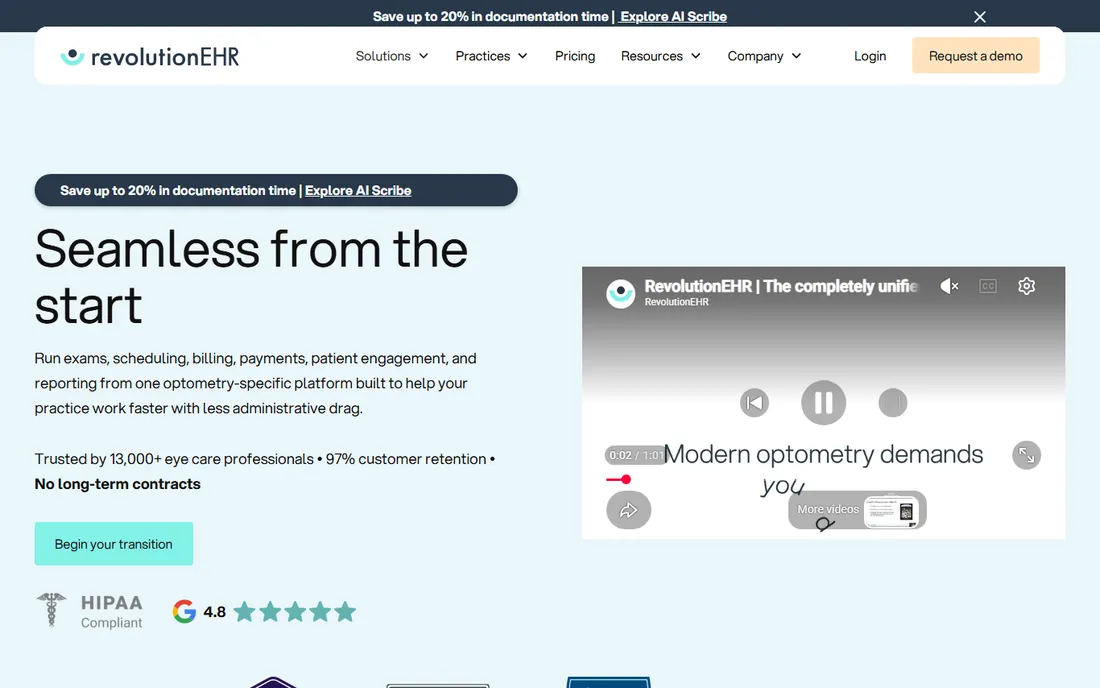
RevolutionEHR is the market-leading cloud platform built exclusively for optometry, and it shows in the details. Exam workflows, optical inventory, billing, and patient engagement live in one connected system instead of four logins. The newer AI Scribe captures exam notes as you speak and structures them for review, cutting charting time without adding another subscription.
The financial tooling is unusually complete. RevPay embeds payment processing directly in the workflow, and RevClear handles electronic claims with rejection review and resubmission in one place. Pricing is based on the number of doctors, billed month to month with no long-term contract, which lowers the commitment risk for new practices.
The honest catch is that costs grow with each provider, so multi-doctor practices should model the per-doctor math carefully. And as a pure cloud system, it needs reliable internet; the vendor specifies modest minimum speeds, but rural practices should confirm connectivity first.
What we like- AI Scribe documentation built in at no extra cost
- Integrated payments and clearinghouse
- Month-to-month billing with no long-term contract
Watch out for- Pricing scales with doctor count
- Internet-dependent like all cloud EHRs
Starting priceContact sales
Free planNo
Eyefinity, a VSP Vision company, consolidated its products into Eyefinity Encompass: practice management, EHR, patient engagement, and analytics in one cloud platform. The headline advantage is the VSP integration, which pulls insurance eligibility and authorizations up to seven days before the visit, removing a daily front-desk bottleneck for practices with heavy VSP volume.
Scale is the other argument. The platform supports over 20 million exams a year across a footprint of 9,300+, and it was the first optometry software to earn SOC 2 Type 2 certification, which matters for data security reviews. EncompassScribe adds AI-assisted documentation to the exam workflow.
Practices with little VSP business get less of the signature benefit, though the core platform stands on its own. Practices already on older Eyefinity products get a managed transition path, but any EHR switch deserves a realistic timeline and a data migration plan in writing.
What we like- Deep VSP insurance integration
- Practice management, EHR, engagement and analytics unified
- First SOC 2 Type 2 certified optometry software
Watch out for- VSP-centric design matters less for non-VSP practices
- Migration from legacy Eyefinity products takes planning
Starting priceContact sales
Free planNo
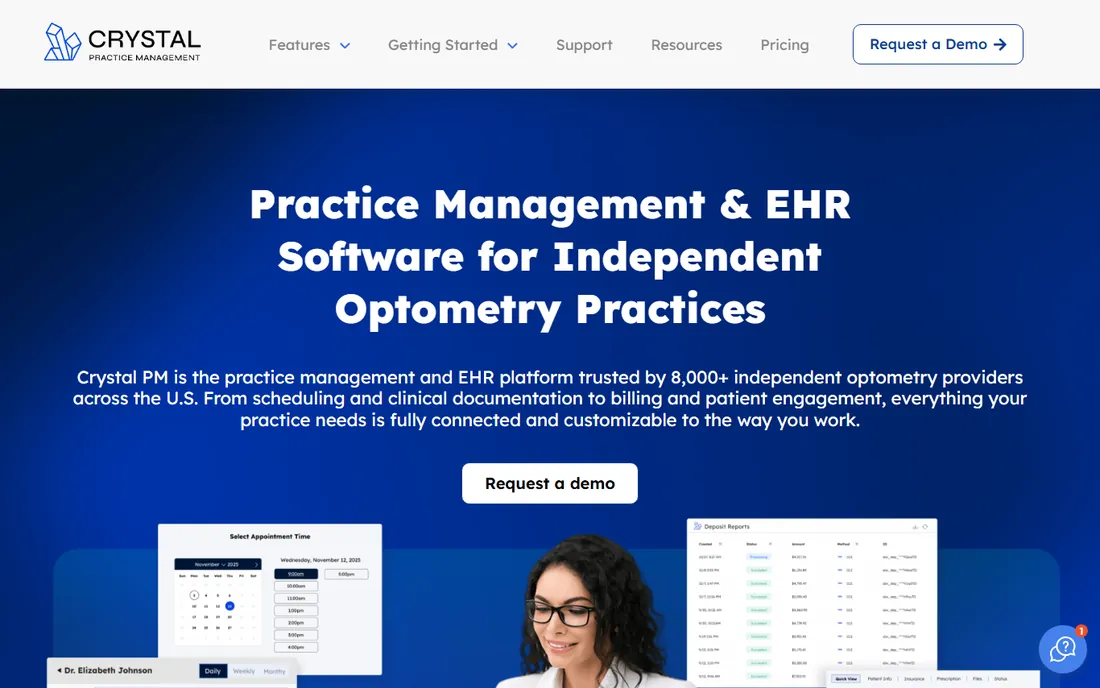
Crystal PM has built its reputation the old-fashioned way: deep customization and support that answers the same day. More than 8,000 independent optometry providers use it for scheduling, clinical documentation, billing, inventory, and patient communication in one connected system.
The flexibility is the selling point. Templates, workflows, and integrations adapt to how a specific office actually runs rather than forcing a standard process, and the 55+ integration network covers diagnostic equipment, labs, and payment partners. Solo ODs, multi-location groups, and specialty practices each get a configured setup rather than a template.
It lacks the AI scribe fanfare of the bigger platforms, and as a smaller company it cannot match their R&D budgets. But for independent practices that value being able to reach a knowledgeable human quickly, Crystal PM consistently earns its loyalty.
What we like- Trusted by 8,000+ independent providers
- 55+ integrations
- Same-day support from an optometry-knowledgeable team
Watch out for- Smaller vendor than RevolutionEHR or Eyefinity
- Fewer native AI features
Starting priceContact sales
Free planNo
MaximEyes, from First Insight, pairs old-school customizability with a new AI layer. Exam templates are fully customizable, charting happens on a single screen, and the EVAA suite adds an AI scribe that drafts notes, a voice assistant for overflow calls, and a billing assistant that checks codes.
The integration catalog is one of the deepest here: more than 270 integrations covering OCT, fundus cameras, visual fields, autorefractors, and lensmeters, with instant data and image import. Practice operations get optical inventory and dispensing, a VSP benefit calculator, and lab and contact lens ordering, while the revenue cycle side includes claims, eligibility, denial management, and Fast Pay Health services.
All that capability comes with a learning curve, and practices should budget real onboarding time. But for offices that want their EHR to mirror their exact exam flow and their equipment to feed data automatically, few systems go as deep.
What we like- 100% customizable exam templates
- EVAA AI suite for scribe, voice and billing
- 270+ integrations including diagnostic equipment
Watch out for- Feature depth means longer onboarding
- Pricing is quote-based
Starting priceContact sales
Free planNo
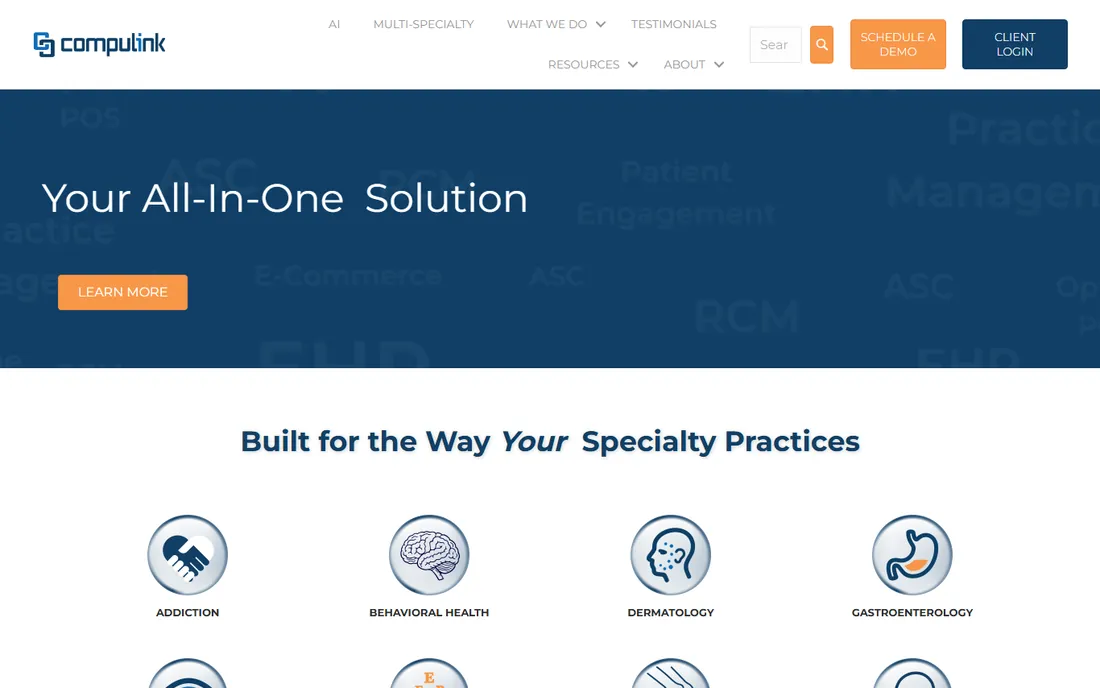
Compulink's Advantage is the heavyweight all-in-one: EHR, practice management, optical POS and inventory, patient engagement, analytics, and even an ambulatory surgery center module, all on one database. More than 26,000 providers across 4,700 locations use it, spanning optometry, ophthalmology, and other specialties.
The single-database design eliminates the sync problems that plague multi-system setups, and the Advantage SMART workflow engine automates billing tasks the company says cut claim generation time dramatically. MyEyeStore adds patient e-commerce for contact lens reorders, creating revenue with minimal staff effort. Practices that want billing fully handled can add the expert revenue cycle management service.
This is more system than a one-doctor practice needs, and implementation demands commitment. But for growing groups, multi-specialty organizations, and practices with surgery centers, the breadth is the point.
What we like- True all-in-one on a single database
- Optical POS and eCommerce included
- Expert revenue cycle management service available
Watch out for- Built for scale, more than a solo practice needs
- Implementation is a serious project
Starting priceContact sales
Free planNo
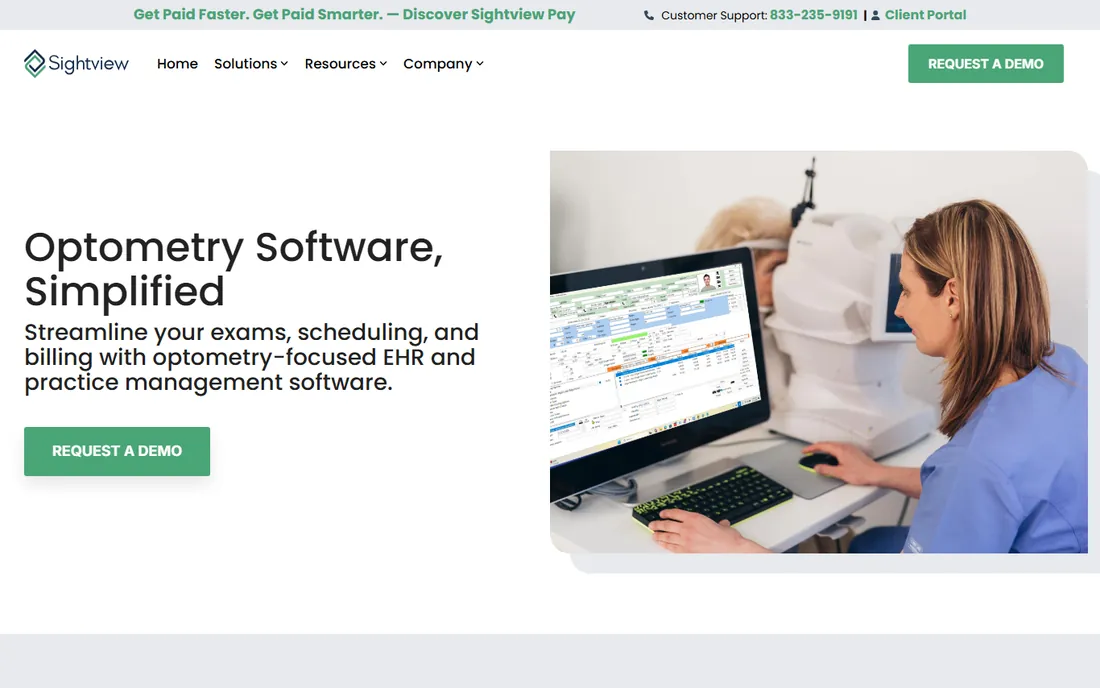
My Vision Express, now under the Sightview umbrella, positions itself as optometry software simplified. The pitch is straightforward: exams, scheduling, and billing handled in an optometry-specific EHR with customizable templates and image integration, without the sprawling module lists of bigger platforms.
Compliance support is a quiet strength, with built-in handling for MIPS reporting and ePrescribing standards. Scheduling and billing workflows are designed to reduce front-office friction, and Sightview Pay adds integrated payment processing.
The acquisition means buyers should ask about the product roadmap during the demo: what stays, what merges into the broader Sightview platform, and how support is structured now. For practices that want capable software without enterprise complexity, it remains a sensible shortlist candidate.
What we like- Optometry-specific EHR with fast documentation
- Scheduling and billing simplified
- MIPS and ePrescribing compliance built in
Watch out for- Now part of Sightview, so evaluate the current roadmap
- Smaller feature set than the giants
Starting priceContact sales
Free planNo
LiquidEHR is the value option for practices that need a real optometry EHR without enterprise pricing. The system combines electronic health records with practice management, multi-user and multi-office access, and online invoicing that reaches patients by text and email.
The company's emphasis is service over flash. Support is available by phone, email, and in-app chat, with after-hours emergency coverage, and client reviews consistently praise the responsiveness. For a small practice, that relationship often matters more than a longer feature list.
The interface will not impress anyone coming from a modern cloud platform, and the integration catalog is thinner. But if the budget is tight and the requirements are exams, scheduling, billing, and reliable support, LiquidEHR covers the fundamentals at a price smaller practices can absorb.
What we like- Straightforward pricing aimed at smaller practices
- Online invoicing by text and email
- Responsive support with after-hours emergency coverage
Watch out for- Interface is functional rather than modern
- Smaller integration ecosystem
How we chose
We reviewed vendor product pages, documentation, and current platform announcements, then checked how each system is received by practicing optometrists through G2, Capterra, and industry publications like Vision Monday. We weighted optometry-specific workflows, billing and optical integration, support quality, and fit for different practice sizes over generic EHR checklists. We did not claim hands-on testing of any system.
Cloud vs. server: the decision that shapes everything
The deepest split in optometry software is deployment. Cloud systems like RevolutionEHR and Eyefinity Encompass need no servers, update automatically, and let doctors check charts from anywhere. The price is ongoing subscription cost and total dependence on internet connectivity.
Server-based or hybrid systems keep data in the office and keep working if the internet drops, which still matters in some locations. The price is hardware, backups, IT support, and upgrade projects every few years.
Most new practices choose cloud for the simplicity, and the market is clearly moving that way. But the decision should follow the practice's reality: unreliable internet, strict data-control policies, or an existing server investment can all justify staying on-premise. Decide deployment first, then shortlist within it.
How to choose optometry software without regret
Start with the exam room. The EHR is where doctors live all day, so demo the actual exam workflow with your most common visit types, not a scripted happy path. If charting feels slow or awkward in the demo, it will feel worse at 4 p.m. on a busy Tuesday.
Next, follow the money. Billing, claims, eligibility, and optical POS handling vary enormously between systems, and revenue cycle problems are the most expensive kind. Ask each vendor to walk through a denied claim from discovery to resubmission, and get the clearinghouse and payment processing costs in writing.
Then check the equipment handshake. List every diagnostic device in the office and confirm each one integrates with data flowing automatically into the chart. Manual entry from a $50,000 OCT is a daily tax nobody should pay in 2026.
Finally, plan the human side. Ask for the implementation timeline, the training format, and the data migration scope in the contract, and talk to two reference practices of similar size. The software decision is really a change-management decision wearing a software costume.
A note on pricing
Vendors in this category price by quote, usually tied to provider count, locations, and modules. Treat any number you see on a review site as a rough signal, not a quote, and get implementation, training, data migration, and payment processing fees itemized before signing.
Frequently asked questions
How much does optometry software cost?
Most vendors quote based on the number of doctors, locations, and modules selected, so there is no standard sticker price. Expect monthly per-provider subscriptions for cloud systems, plus one-time implementation and data migration fees. Always get the full first-year cost itemized, including clearinghouse and payment processing.
Should I choose cloud or server-based optometry software?
Cloud suits most new and growing practices: no servers to maintain, automatic updates, and access from anywhere. Server-based systems suit practices with unreliable internet or strict on-premise data policies. The industry trend is firmly toward cloud, but the right answer depends on your connectivity and compliance needs.
How long does it take to switch EHR systems?
For a single-location practice with clean data, six to twelve weeks from contract to go-live is typical. Multi-location groups and practices with years of scanned documents should plan three to six months. Data migration quality varies by vendor, so get the migration scope and timeline in writing.
Do these systems integrate with VSP and other vision plans?
Yes, with varying depth. Eyefinity's VSP integration is the deepest since it is a VSP Vision company. MaximEyes includes a VSP benefit calculator, and all the major systems handle eligibility checks and claims for VSP, EyeMed, Davis Vision, and Spectera. Confirm your specific plans during the demo.
What about AI scribes in optometry software?
AI documentation is now standard at the top end: RevolutionEHR's AI Scribe, Eyefinity's EncompassScribe, and MaximEyes' EVAA Scribe all draft exam notes from the encounter. They reduce charting time but still require clinician review. Ask vendors whether the scribe is included or an add-on, and how it handles optometry-specific terminology.
How important is the optical POS module?
Very, if the practice sells glasses and contacts. The optical shop is often the profit engine, so inventory management, lab ordering, frame data, and insurance benefit calculation directly affect revenue. Compulink and MaximEyes have particularly deep optical tooling; confirm lab integrations for the labs you actually use.
Sources we checked (7)
- https://revolutionehr.com/
- https://eyefinity.com/
- https://www.crystalpm.com
- https://maximeyes.com/
- https://compulinkadvantage.com/
- https://sightview.com/my-vision-express
- https://www.liquidehr.com/
Is your product missing or out of date?
We review this list regularly. Vendors can request a listing, send updated pricing or ask about featured placement.

Shihab Mia · Founder, Rankite
Shihab has spent more than a decade helping SaaS and e-commerce brands grow through search. He writes Rankite's software buying guides from pricing pages, documentation and public user reviews. More about Shihab.