How we make this list: we compare pricing pages, product documentation and public user reviews. Ratings come from G2, Capterra or Trustpilot, with the date we checked them.
Key takeaways
- tastytrade has the most trader-friendly commission cap for large spreads, at $1 per contract to open, $0 to close, capped at $10 per leg.
- Robinhood and Webull charge $0 commission on options, which suits small, simple trades, but their analytics are thinner than desktop-first platforms.
- Charles Schwab, Fidelity, E*TRADE, and Interactive Brokers all charge around $0.65 per contract for standard online orders, so tools and support decide between them.
- Paper trading is available at Schwab, Interactive Brokers, Webull, and TradeStation, and it is the safest way to learn multi-leg orders before risking real money.
- Check exercise, assignment, and index-option fees before you commit, because those charges sit outside the headline per-contract rate.
Quick comparison
| Tool | Best for | Starting price | Free plan |
|---|
 tastytrade | Frequent options traders | $1 per contract to open, $0 to close, capped at $10 per leg | No |
 Charles Schwab | All-round traders who want thinkorswim | $0.65 per contract | No |
 Fidelity | Investors who also trade options | $0.65 per contract | No |
 Interactive Brokers | Professional and global traders | $0.15 to $0.65 per contract (tiered pricing) | No |
 E*TRADE | Active traders who want Power E*TRADE | $0.65 per contract | No |
 Robinhood | Simple, low-cost options trades | $0 commission on options | No |
 Webull | Mobile-first active traders | $0 commission on options | No |
 TradeStation | Strategy testing and automation | $0.60 per contract | No |
Is your product missing or out of date?
We review this list regularly. Vendors can request a listing, send updated pricing or ask about featured placement.
Starting price$1 per contract to open, $0 to close, capped at $10 per leg
Free planNo
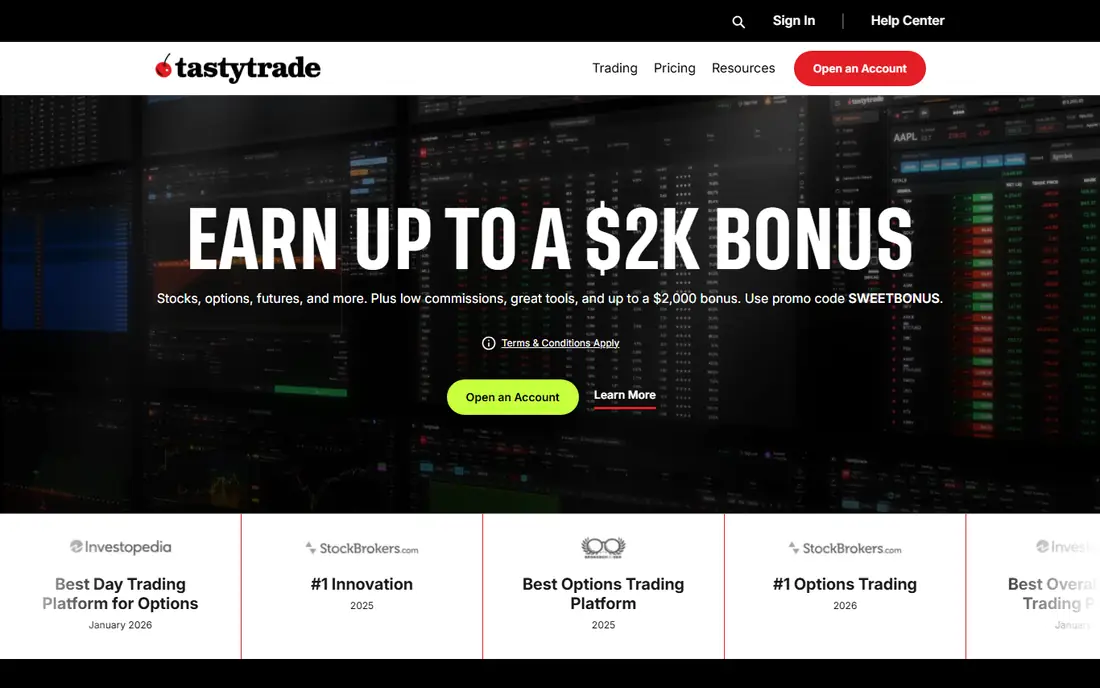
tastytrade was built around options first, and that focus shows in the order ticket. You can build spreads, iron condors, and other multi-leg strategies in one place, see the probability of profit, and adjust a leg without rebuilding the whole trade from scratch. The commission cap matters most for traders who place large orders. A 20-contract leg costs $10 to open rather than $20 at a $1 rate, and closing costs nothing in commission, which changes the math on managing a trade early.
The trade-off is that tastytrade is less of a general investing home than Schwab or Fidelity. Retirement planning tools, banking features, and broad research coverage are thinner, and new traders may need time to learn the layout. Education content is strong, with live shows and strategy explainers, but education does not replace practice. Start small, trade defined-risk spreads first, and read the fee schedule for index products, which carry their own surcharges.
What we like- Capped commission per leg
- $0 to close trades
- Options-first design with probability and volatility tools
Watch out for- No paper trading for options in the same way as some rivals
- Interface can feel busy for a first-time trader
#2Charles Schwab
Best for: All-round traders who want thinkorswim1.5/5 on
Trustpilot (786 reviews, checked Oct 2026)
Visit schwab.com
Starting price$0.65 per contract
Free planNo
Schwab pairs a full-service brokerage with thinkorswim, one of the deepest retail trading platforms available. Traders get advanced charting, options analytics, strategy builders, and a paperMoney account for practice without real money at stake. That combination suits someone who wants one account for long-term investing, retirement accounts, and active options trading, rather than a separate app for each job.
The $0.65 per-contract fee is standard for a full-service broker, but it is not the cheapest choice for a trader placing hundreds of contracts a month. thinkorswim can also overwhelm a beginner, with dozens of studies, order types, and settings on screen at once. Schwab softens that with education, customer support, and branches, yet the platform still rewards a trader who takes time to set up layouts and learn the risk tools before trading size.
What we like- Thinkorswim charting and analysis
- PaperMoney practice account
- Broad research and branch support
Watch out for- Per-contract fee adds up for high-volume traders
- Thinkorswim has a steep learning curve
Starting price$0.65 per contract
Free planNo
Fidelity is the sensible pick for an investor who trades options a few times a month rather than every day. The core brokerage is strong, with $0 commissions on US stocks and ETFs, fractional shares, deep research, and retirement planning tools that many active-only platforms lack. Options orders cost $0.65 per contract online, and Fidelity waives the commission on buy-to-close orders for contracts priced at $0.65 or less, which helps when closing a losing short option cheaply.
Active Trader Pro, the desktop platform, covers charting and options chains well enough, but it does not match thinkorswim for depth or polish. There is also no full paper trading account, so a beginner cannot rehearse multi-leg orders in a simulated account in the same way. For a buy-and-hold investor who sells covered calls or buys protective puts, those limits matter less than low costs, reliable execution, and support when a question comes up.
What we like- $0 stock and ETF commissions
- Strong research and retirement tools
- $0 buy-to-close on options priced at $0.65 or less
Watch out for- No dedicated paper trading account
- Active Trader Pro feels dated next to thinkorswim
Starting price$0.15 to $0.65 per contract (tiered pricing)
Free planNo
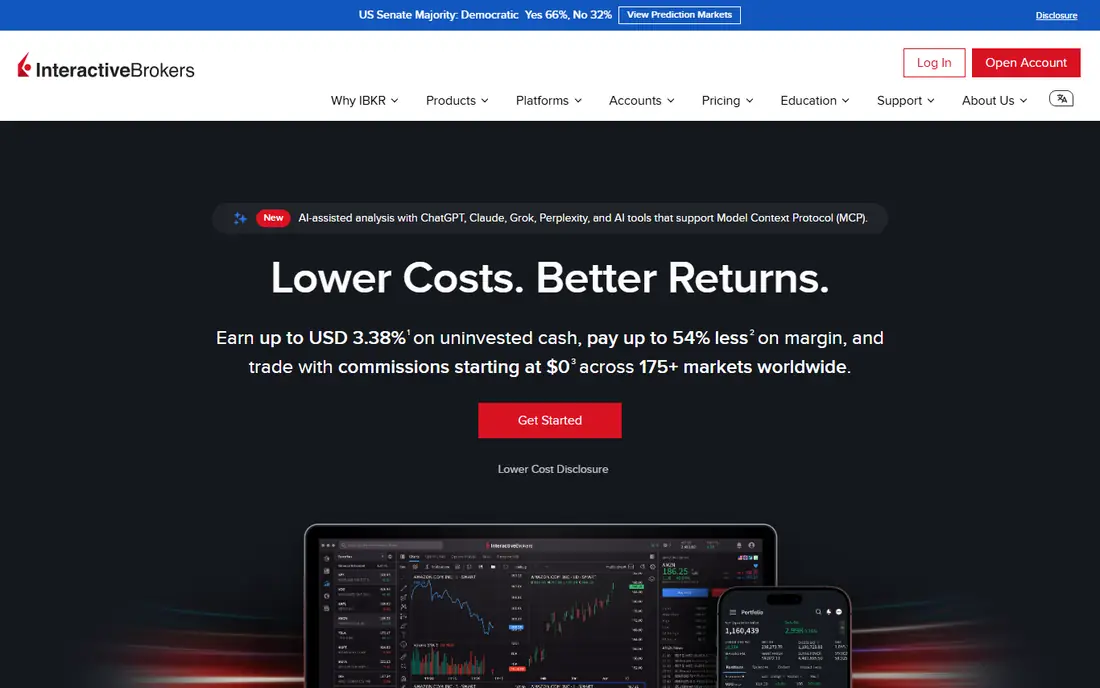
Interactive Brokers, often called IBKR, is the platform serious traders graduate to when they need more than US markets. It covers stocks, options, futures, forex, and bonds across many countries, and its tiered options pricing can fall to $0.15 per contract for high-volume traders, with a minimum per order. A paper trading account lets you test strategies and learn Trader Workstation without risking capital, which matters because the platform is not designed for casual use.
The weakness is the learning curve. Trader Workstation is powerful, but its menus, order types, and fee tiers take time to master, and customer support can feel slower than at a retail-first broker. IBKR Lite offers commission-free US stock and ETF trades for casual investors, while IBKR Pro suits active traders who value the wider market access and lower margin rates. Choose Pro if you trade often or trade outside the US, and choose Lite only if options are a small side activity.
What we like- Access to global markets
- Tiered pricing can cut costs for high volume
- Low margin rates compared with many rivals
Watch out for- Trader Workstation is complex
- Fee schedule takes careful reading
#5E*TRADE
Best for: Active traders who want Power E*TRADE4.0/5 on
G2 (24 reviews, checked Oct 2026)
Visit us.etrade.com
Starting price$0.65 per contract
Free planNo
ETRADE sits in a comfortable middle ground between a simple app and a professional desktop terminal. Power ETRADE gives active traders charting, risk analysis, and strategy tools in a layout that is easier to learn than thinkorswim or Trader Workstation. The mobile app is also solid, so a trader can check a position, adjust an order, or close a spread away from a desk without losing key information.
Pricing is straightforward at $0.65 per contract for standard online options orders, with lower rates for traders who meet active volume thresholds. That is fair, but it does not beat $0 commission apps for small trades, and E*TRADE lacks some of the research depth found at Fidelity or Schwab. It fits a trader who wants a capable platform, a usable app, and access to banking and retirement accounts under one roof, without paying for tools they will never open.
What we like- Power E*TRADE platform with strategy tools
- Clean mobile app
- Active trader pricing tiers
Watch out for- Standard $0.65 fee without volume discounts
- No fractional shares for individual stocks in the same way as some rivals
Starting price$0 commission on options
Free planNo
Robinhood changed expectations for retail trading by removing commissions, and options remain $0 commission on the platform, with only regulatory and clearing fees passed through. Opening an account is quick, the app is easy to use, and a beginner can place a single-leg call or put in a few taps. For a trader who makes occasional, simple options trades and watches cost above all else, that simplicity is a real advantage.
The limits appear as soon as a strategy gets more complex. Analytics, probability tools, and multi-leg order handling are thinner than on tastytrade, Schwab, or TradeStation, and there is no paper trading account for practice. Robinhood Gold adds features such as larger instant deposits and professional research, but it is a paid subscription and does not turn the app into a professional terminal. Use Robinhood for straightforward trades you already understand, and move to a deeper platform before trading complex spreads.
What we like- $0 commission on options
- Very easy order entry
- No account minimum
Watch out for- Thinner options analytics
- No paper trading
- Support is mainly digital
Starting price$0 commission on options
Free planNo
Webull is the strongest choice for a trader who lives on a phone and still wants real charting tools. Options trades carry $0 commission, the mobile app offers advanced charts, technical indicators, and options chain data, and a paper trading mode lets new traders practise without real money. That mix is hard to find elsewhere at this price, and it explains why many active traders keep Webull alongside a full-service broker.
The catch is depth outside trading itself. Research, retirement planning, and education do not match Fidelity or Schwab, and support is digital rather than in person. Webull also earns money from payment for order flow and premium subscriptions, so a trader should read the disclosures and check execution quality for their order sizes. For mobile-first trading with $0 options commissions, Webull is a strong pick. For a full financial home, pair it with a traditional broker.
What we like- $0 commission on options
- Strong mobile charting
- Paper trading included
Watch out for- Research and education are thinner than at Schwab or Fidelity
- No branch support
Starting price$0.60 per contract
Free planNo
TradeStation has long appealed to traders who want to test an idea before they trade it. Its desktop platform supports backtesting, custom indicators, and automated strategies through its EasyLanguage scripting tool, so a trader can check how a rules-based approach would have behaved in past market conditions. Options cost $0.60 per contract for standard online orders, which undercuts the $0.65 standard at several large brokers, and stock and ETF trades are $0 commission.
The platform is less welcoming to a beginner than Robinhood or Webull, and some parts of the interface feel older than newer rivals. TradeStation also works best for a trader who will use its testing and automation features. If you only place a few simple options trades a month, the extra depth adds little, and a simpler or cheaper platform may serve you better. If you build, test, and automate strategies, TradeStation earns its place on the shortlist.
What we like- Backtesting and automation tools
- $0.60 per contract
- Strong desktop charting
Watch out for- Platform can feel dated in places
- Less suited to a casual investor
How we chose
We compared pricing pages, platform documentation, and public reviews on sites such as G2, Capterra, and Reddit, and we checked which tools each platform actually offers for options rather than for stocks alone. Commissions, paper trading, multi-leg order handling, mobile apps, and support all counted, because a cheap platform that hides risk is a poor deal. We also weighed fit by trader type, since a beginner, a frequent spread trader, and a global professional need different tools. No platform paid for placement, and prices here reflect the standard online rates shown by each broker, which can change.
What to check before you open an account
Start with your trading style, not with a headline commission. A trader who places two contracts a month saves little by chasing the lowest per-contract fee, while a trader who places 200 contracts a month should compare caps, tiers, and volume discounts carefully. Write down how many legs your usual strategy uses, how often you adjust a trade early, and whether you trade index options, which often carry extra exchange fees.
Next, test the order ticket. Place a paper trade for a spread, check the estimated risk and profit, and confirm you can close one leg without closing the whole position if that is your plan. Ask about exercise and assignment fees, margin requirements for spreads, and what happens if an option expires in the money. Finally, check support hours and how you reach a human during market hours, because an options question at 3 p.m. cannot wait for an email reply the next day.
A simple shortlist by trader type
Beginners who want practice should start with Schwab or Webull for paper trading, then move to real money only after they can explain the maximum loss on a trade. Frequent spread traders should compare tastytrade and TradeStation on total monthly cost, including caps and index surcharges. Investors who trade options occasionally should pick the broker they already trust for the rest of their money, which is often Fidelity, Schwab, or E*TRADE, and accept the $0.65 fee in return for research and support.
Frequently asked questions
What is the cheapest options trading platform?
There is no single cheapest platform for every trader, because cost depends on order size and strategy. Robinhood and Webull charge $0 commission on options, which is cheapest for small, simple trades. tastytrade can be cheaper for large multi-leg orders because its fee is capped at $10 per leg to open and $0 to close.
Do I need a lot of money to trade options?
No, but you need enough to cover the premium and any margin requirement, and you should only risk money you can afford to lose. Many brokers have no account minimum, though margin accounts often require at least $2,000. Start with defined-risk trades and small position sizes while you learn how time decay and volatility affect prices.
What is paper trading, and should I use it?
Paper trading is simulated trading with virtual money on real market prices. It lets you practise order entry, multi-leg spreads, and risk management without losing capital. Use it until you can place, adjust, and close a trade confidently, and treat the results as practice, not as proof that a strategy will profit with real money.
Are $0 commission options trades really free?
They carry $0 commission, but regulatory and clearing fees may still apply, and the broker may earn money from payment for order flow. Those extra fees are usually small for a retail order, but they are not zero. Read the fee schedule and check the total cost shown on the order preview before you submit a trade.
Can I lose more than I invest with options?
Yes, depending on the strategy. Buying a call or put limits your loss to the premium paid, plus fees. Selling uncovered options can expose you to large or, in theory, unlimited losses if the market moves sharply against you. Use defined-risk spreads, set position limits, and avoid selling uncovered contracts until you fully understand the risk.
Which platform is best for beginners?
Schwab is a strong beginner choice because thinkorswim includes paper trading, education, and risk tools in one account. Webull is another good option for a mobile-first beginner who wants $0 commissions and paper trading. Either way, start with education and small, defined-risk trades rather than with borrowed money or complex spreads.
Sources we checked (8)
- https://www.tastytrade.com
- https://www.schwab.com
- https://www.fidelity.com
- https://www.interactivebrokers.com
- https://us.etrade.com
- https://robinhood.com
- https://www.webull.com
- https://www.tradestation.com
Is your product missing or out of date?
We review this list regularly. Vendors can request a listing, send updated pricing or ask about featured placement.

Shihab Mia · Founder, Rankite
Shihab has 5+ years in B2B and SaaS SEO. He writes Rankite's software buying guides from pricing pages, documentation and public user reviews. More about Shihab.