How we make this list: we compare pricing pages, product documentation and public user reviews. Rankite is independent; if a vendor ever pays for a featured spot, that listing is clearly labeled Partner.
Key takeaways
- OptionNet Explorer and ORATS are the two most serious dedicated options backtesting tools, with historical options data and strategy modeling built in.
- TradeStation and thinkorswim include powerful options backtesting with a brokerage account, which means the backtesting itself costs nothing extra.
- QuantConnect and OptionStack serve programmers and automation-focused traders who want to test systematic options strategies at scale.
- OptionStrat is the friendliest visual starting point, with a free tier and strategy builder that backtests multi-leg trades.
- Options data is expensive, so dedicated tools cost more than stock screeners: expect $99/month and up for professional-grade backtesting.
Quick comparison
| Tool | Best for | Starting price | Free plan |
|---|
 OptionNet Explorer OptionNet Explorer | dedicated options strategy backtesting | £165/3 months (£535/year) | Free trial (10 days) |
 ORATS ORATS | data-driven backtesting at scale | $99/month (Trading Tools) | Free trial (24-hour refund) |
 TradeStation TradeStation | EasyLanguage-coded strategy automation | $0.60 per options contract | Free trial (simulator) |
 thinkorswim thinkorswim | free options analysis with thinkScript | Free with Schwab account | Free trial (paperMoney) |
 QuantConnect QuantConnect | programmatic quants (Python/C#) | Free for research | Yes |
 OptionStack OptionStack | automated options backtesting without coding | See website | Free trial |
 OptionStrat OptionStrat | visual strategy building with backtesting | $25/month (paid plans) | Yes |
Is your product missing or out of date?
We review this list regularly. Vendors can request a listing, send updated pricing or ask about featured placement.
The best backtesting software for options
Starting price£165/3 months (£535/year)
Free planFree trial (10 days)
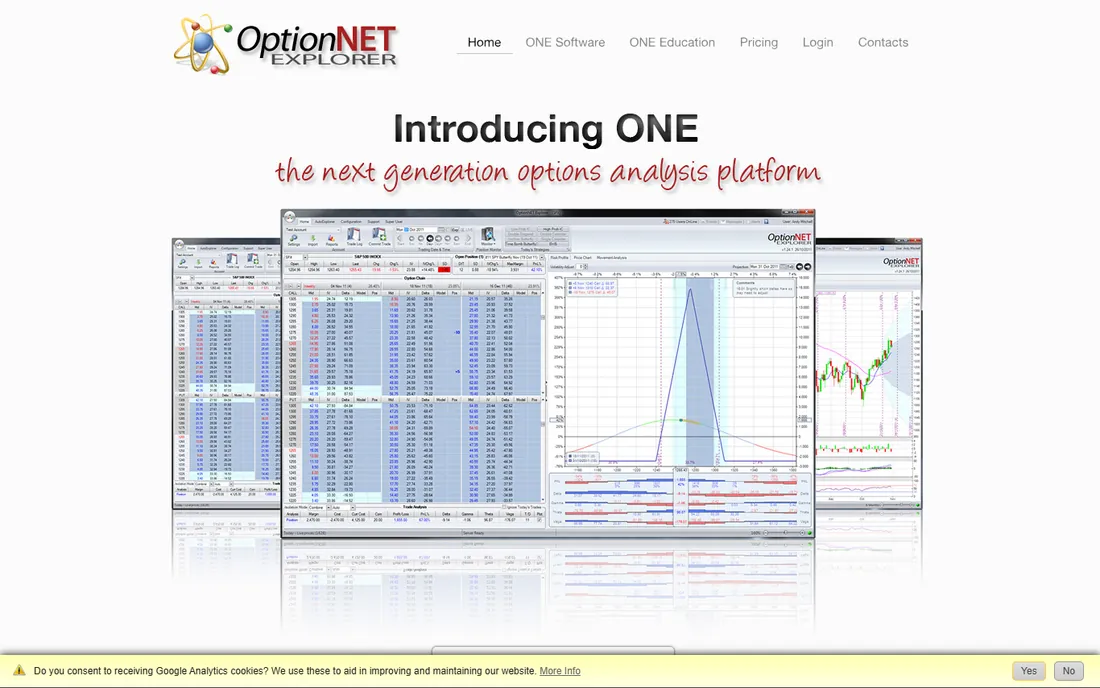
OptionNet Explorer, often shortened to ONE, is built specifically for backtesting options strategies. You can model complex multi-leg trades, replay them against historical data for every optionable US equity and index, and then monitor the live position in the same environment. That continuity between backtest and live trade is the feature that keeps serious options traders loyal.
Every subscription includes historical market data at five-minute intervals with no separate data charges, which is rare and valuable given how expensive options data usually is. Pricing on the vendor's own payment page runs £165 for three months or £535 for a year, with a 10-day trial for £10. The honest catch is that it is a UK company, so US subscribers deal with GBP billing and potential extra fees, and the desktop-first design shows its age. For manual strategy backtesting with real options chains, it remains the benchmark.
What we like- Historical options data included with every subscription
- Backtest and monitor live trades in one platform
- No extra data fees
Watch out for- Priced in GBP with VAT complications for US users
- Windows-focused desktop software
- Learning curve for beginners
Starting price$99/month (Trading Tools)
Free planFree trial (24-hour refund)
ORATS takes a different approach: instead of running one backtest at a time, it gives you a searchable library of more than 300 million precomputed options backtests, plus a custom backtester that lets you run 2,000 of your own per month. The Options Backtester is included in the $99/month Trading Tools subscription for individuals, alongside scanners, an optimizer, and real-time data.
The depth of the data is the selling point. Options history stretches back to 2007 with hundreds of proprietary indicators, and the Backtest Finder and Intraday Backtester APIs let quants pull results programmatically. The catch is cost creep: a professional license is $199/month, and the data API is a separate subscription starting at $199/month. Casual traders will find it overwhelming. For traders who think in datasets and want their options research quantified, ORATS is the strongest platform here.
What we like- Over 300 million precomputed backtests to browse
- Options data back to 2007
- APIs for programmatic backtesting
Watch out for- Professional licenses double the cost
- API access starts at $199/month
- Most value requires comfort with data
Starting price$0.60 per options contract
Free planFree trial (simulator)
TradeStation has been the backtesting broker of choice since the 1990s, and its EasyLanguage scripting language remains the most accessible way to code, backtest, and optimize trading strategies. For options traders, OptionStation Pro provides options chains, position graphs, and strategy analysis, while the simulator lets you test ideas in real time without risking capital.
The backtesting itself costs nothing beyond the brokerage relationship: platform access is included, with standard options pricing at $0.60 per contract and occasional promotions for new accounts. Watch the fine print, though. TradeStation still charges $14.95 to exercise an option and $5.95 for assignment, which punishes strategies that hold through expiration. For coders who want to automate and backtest options logic in one place, the EasyLanguage ecosystem is hard to beat.
What we like- EasyLanguage makes custom strategies easy to code and backtest
- OptionStation Pro for options analysis
- Decades of historical data
Watch out for- Options exercise and assignment fees ($14.95/$5.95) add up
- Platform depth can overwhelm
- $10/month inactivity fee in some cases
Starting priceFree with Schwab account
Free planFree trial (paperMoney)
Now part of Charles Schwab, thinkorswim gives self-directed traders one of the most complete options toolkits available at no software cost. The platform includes hundreds of studies and strategies for backtesting decisions, a full options analytics suite, and paperMoney, a virtual trading environment that simulates live markets so you can test strategies before committing funds.
thinkScript, the platform's scripting language, lets you write custom indicators and backtest logic against historical data. Everything is free for Schwab clients; standard trade pricing applies only when you place real orders. The trade-off is the account requirement and a desktop application that can feel heavy on older machines. For options traders who want professional-grade backtesting without a separate software bill, thinkorswim is the best free option in this lineup.
What we like- Completely free with a Schwab account
- ThinkScript for custom studies and backtests
- PaperMoney virtual trading built in
Watch out for- Requires a Schwab brokerage account
- Desktop app is resource-heavy
- Advanced options backtesting is manual
Starting priceFree for research
Free planYes
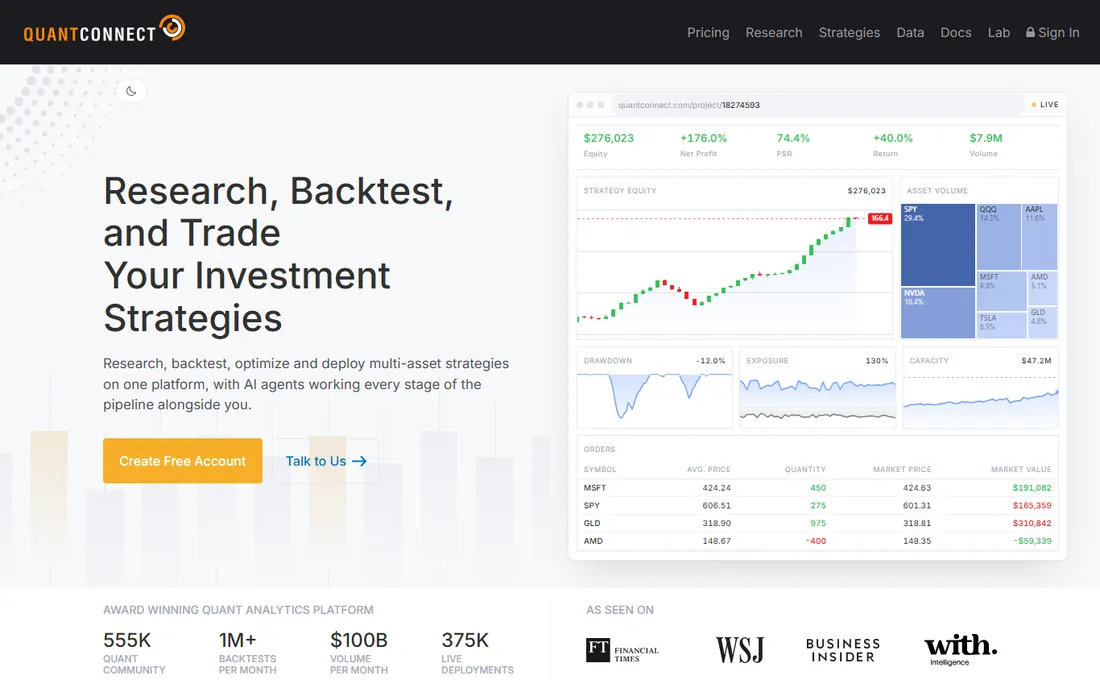
QuantConnect is the quant's backtesting platform: an open-source LEAN engine, a cloud research environment, and terabytes of financial data including options, all scripted in Python or C#. You write the strategy, backtest it against realistic fee and slippage models, and deploy the identical code to paper or live trading through supported brokers.
The free tier covers unlimited research backtesting, which makes it the cheapest way to test systematic options ideas at scale. Paid plans add live trading nodes and higher-resolution data, starting at $8 per user per month on annual billing. The catch is absolute: if you do not code, this tool is not for you. For programmers building algorithmic options strategies, the fidelity of the backtesting engine and the research-to-live pipeline justify the effort.
What we like- Open-source LEAN engine with real options backtesting
- Free tier includes unlimited research backtests
- Same code deploys to live trading
Watch out for- Requires Python or C# programming
- Live trading needs a paid plan
- Steep learning curve for non-programmers
Starting priceSee website
Free planFree trial
OptionStack automates what OptionNet Explorer does manually: define your options strategy rules, and the platform runs automated backtests against historical options data, including intraday data from the CBOE on institutional tiers. It handles rolling strategies, portfolio rebalancing logic, and strategy optimization without requiring a single line of code.
The no-code automation angle is what sets it apart from the manual simulators. You can test systematic ideas, like rolling short puts or earnings calendars, across years of data in minutes. The honest catch is transparency: pricing lives behind a contact form rather than a public page, and intraday backtesting is gated to higher tiers. For non-programmers who want automated options backtesting with institutional-grade data, it is worth a trial and a pricing conversation.
What we like- Backtest options strategies automatically with no coding
- Supports intraday CBOE options data
- Easy rolling-strategy testing
Watch out for- Pricing details not published on the site
- Intraday data requires higher tiers
- Less recognized than older tools
Starting price$25/month (paid plans)
Free planYes
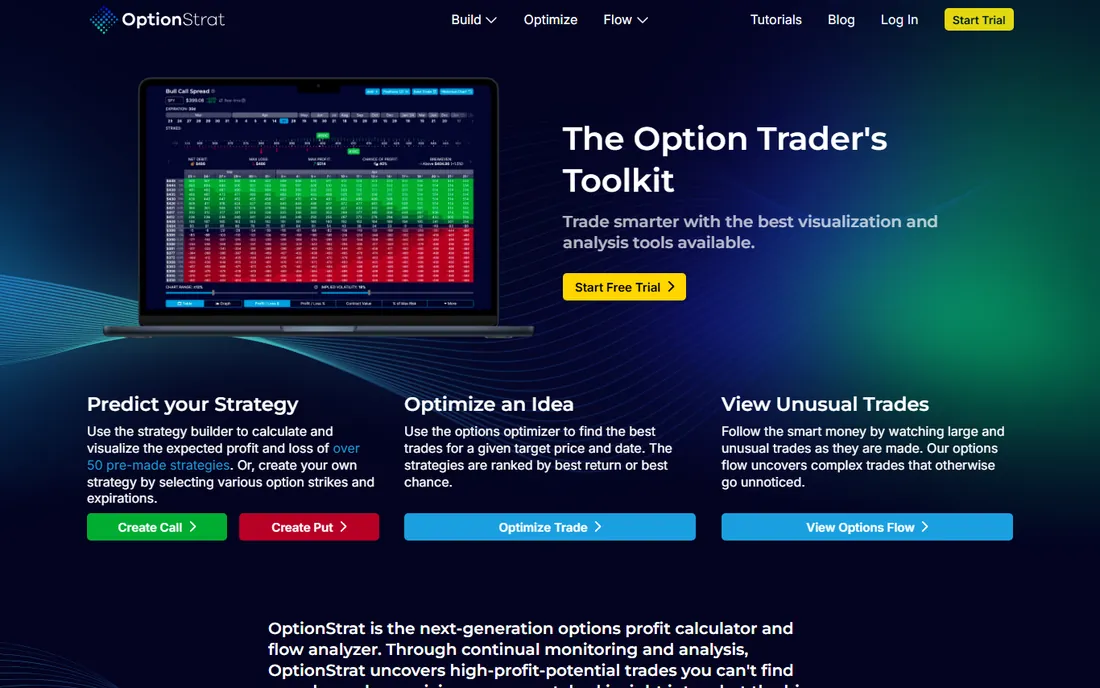
OptionStrat starts where most options traders start: building a strategy visually and seeing the profit-and-loss graph. The free tier includes the strategy builder, optimizer, and more than 50 strategy templates with 15-minute delayed data, which is enough to learn. Paid plans from $25/month add real-time data, live options flow, and probability analytics.
Backtesting comes through saved strategy tracking, which lets you run multi-leg strategies, including iron condors and calendars, against historical data to validate them before trading. It is lighter than the purpose-built backtesters above, but for the price it is an excellent way to sanity-check a trade idea visually. Beginners should start here free, then graduate to OptionNet Explorer or ORATS when their strategies demand deeper historical testing.
What we like- Free tier with strategy builder and 50+ templates
- Visual P/L graphs for any multi-leg trade
- Saved-strategy backtesting against history
Watch out for- Backtesting is lighter than dedicated tools
- Real-time data requires paid plans
- Flow features add cost
What actually matters in an options backtester
Three things separate a real options backtester from a stock backtester with options bolted on. First, historical options chain data: you need the actual bid, ask, and implied volatility of each strike at the time of the trade, not a theoretical price. OptionNet Explorer and ORATS include this; generic platforms may approximate it. Second, early assignment and dividend modeling, which can turn a winning backtest into a losing live trade. Third, realistic fills: options spreads rarely fill at mid-price, so a backtester that assumes mid fills is lying to you. Ask about all three before you pay.
How to choose options backtesting software
Match the tool to how you trade. Manual strategy traders who think in terms of individual trades should start with OptionNet Explorer for depth or OptionStrat for friendliness. Data-driven traders who want to screen hundreds of strategy variations need ORATS. Coders building systematic strategies belong on QuantConnect, while non-coders who want automation should trial OptionStack. If you already trade with TradeStation or Schwab, their built-in backtesting may be enough, and it costs you nothing extra.
Budget matters more here than in most categories because options data is expensive. Dedicated tools run $99/month and up, while broker platforms bundle backtesting free with the account. Trial every candidate with the exact strategy type you trade: a backtester that excels at iron condors may be weak on volatility plays, and the difference only shows up in your own testing.
How we chose
We evaluated options backtesting tools using vendor pricing pages, official documentation, and feature lists, alongside public reviews on G2, Capterra, Slashdot, and Reddit. We prioritized genuine options-chain backtesting with historical data, strategy modeling depth, pricing transparency, and fit for different trader types. We did not perform hands-on testing.
Frequently asked questions
Can you really backtest options strategies accurately?
More accurately than stocks in some ways and less in others. Real options backtesting uses actual historical chain data with bid, ask, and implied volatility, which dedicated tools like OptionNet Explorer and ORATS include. The hard part is modeling fills, early assignment, and volatility regime changes, which is why results should be treated as estimates, not promises.
What is the cheapest way to backtest options?
thinkorswim is free with a Schwab account and includes thinkScript backtesting plus paperMoney simulation. QuantConnect's free tier offers unlimited research backtests if you can code in Python or C#. OptionStrat has a free tier for visual strategy testing with delayed data.
Do I need historical options data, or can I use stock data?
You need options data. Backtesting an options strategy against stock prices alone misses implied volatility changes, which drive most options P/L. Theoretical pricing models can approximate it, but real chain data from tools like OptionNet Explorer or ORATS is far more reliable.
What is the difference between manual and automated options backtesting?
Manual backtesting, as in OptionNet Explorer, means you set up each trade and replay history step by step, which builds intuition. Automated backtesting, as in OptionStack or QuantConnect, runs strategy rules across years of data at once, which is better for systematic strategies. Serious traders often use both.
Is OptionNet Explorer worth the price?
For traders who manually backtest multi-leg options strategies regularly, yes. The included historical data alone would cost more purchased separately, and the backtest-to-live-trade workflow is genuinely useful. Casual traders will be fine with thinkorswim or OptionStrat's free tier.
Can I backtest options on TradingView?
TradingView's backtesting is built for stocks, forex, and crypto, not options chains. It lacks the historical options data and Greeks modeling that true options backtesting requires. Use one of the dedicated tools in this article for options work.
Sources we checked (9)
- https://www.optionnetexplorer.com/PaymentONEDISC_Trial_vks92oe92lj93msjwoqw9291k2l1m2k0.aspx
- https://orats.com/backtester
- https://orats.com/trading-tools
- https://www.tradestation.com/platforms-and-tools/desktop/
- https://www.tradestation.com/pricing/
- https://www.schwab.com/trading/thinkorswim/web
- https://www.quantconnect.com/pricing
- https://www.optionstack.com/intraday-backtesting/
- https://optionstrat.com/pricing
Is your product missing or out of date?
We review this list regularly. Vendors can request a listing, send updated pricing or ask about featured placement.

Shihab Mia · Founder, Rankite
Shihab has spent more than a decade helping SaaS and e-commerce brands grow through search. He writes Rankite's software buying guides from pricing pages, documentation and public user reviews. More about Shihab.