How we make this list: we compare pricing pages, product documentation and public user reviews. Ratings come from G2, Capterra or Trustpilot, with the date we checked them.
Wan 2.1 is the best open source AI video generation tool in 2026 for most buyers, because it pairs strong 720p text-to-video and image-to-video output with an Apache 2.0 license and a light 1.3B model that runs on 8GB of VRAM. LTX Video suits buyers who need sound with video, while CogVideoX suits research teams that need strong prompt control.
Key takeaways
- Wan 2.1 is the best all-round pick, with Apache 2.0 licensing, 1.3B and 14B models, and wide ComfyUI support.
- Every tool here is free to download, but the real cost is a GPU, cloud GPU time, storage and setup time.
- LTX Video is the only pick here that generates video and matching audio in one pass.
- HunyuanVideo has strong quality, but its community license excludes the EU, UK and South Korea, so read it first.
- AnimateDiff and Stable Video Diffusion are the lightest options, and both work best inside a wider image-to-video workflow.
The model weights are free to download, so the software cost is zero. The real cost is hardware. A buyer who already owns a GPU with 16GB or more of VRAM can run Wan 2.1, CogVideoX and AnimateDiff at home for the cost of electricity. A buyer who rents a cloud GPU pays by the hour, based on the card and the render length. Storage also adds up, because several models need 20GB to 66GB of disk space for weights alone.
Wan 2.1 in its 1.3B form is the best choice for a low end GPU, because its README lists 8.19GB of VRAM as the need for that model. AnimateDiff is the next best choice, because it runs on 8GB to 12GB of VRAM with a Stable Diffusion 1.5 base model. CogVideoX-2B is also worth a look, because its memory optimisations bring its need down to about 4GB in some setups. Buyers with only 8GB of VRAM should avoid Mochi 1, Open-Sora 2.0 at 768px and the full HunyuanVideo 13B model.
What hardware do you need to self-host an AI video generation model?
You need a Linux system in most cases, an NVIDIA GPU with CUDA support, Python 3.10 or newer, PyTorch, and disk space for the model weights. You also need a fast internet link for the first download, because weights range from a few gigabytes for AnimateDiff motion modules to about 66GB for LTX-2.5.
Open source tools give you full control over the model, the data and the output, with no per-clip fee and no vendor lock-in. Closed platforms give you a polished web app and faster setup, but they charge per credit or per month and keep the model behind an API. Open source tools also lag closed platforms on clip length, resolution and ease of use. Most open models here make clips of 5 to 10 seconds at 480p or 720p.
We picked tools with public code and weights, a working GitHub repo, and a clear license a buyer can read before use. We checked each repo and its license on 11 Nov 2026. Prices below are Free (open source) where the code and weights cost nothing to download. We flag any price that comes from a third-party source rather than the vendor.
| Tool |
Model size |
License |
Min VRAM |
Max resolution |
Clip length |
Best for |
| Wan 2.1 |
1.3B and 14B |
Apache 2.0 |
8.19GB |
720p |
About 5 seconds |
Best all-round pick |
| CogVideoX |
2B and 5B |
Apache 2.0 for 2B, own license for 5B |
About 4GB with optimisations |
720p, 1360 by 768 for 1.5-5B |
6 to 10 seconds |
Prompt control and research |
| HunyuanVideo |
13B, 1.5 is 8.3B |
Tencent Community License |
14GB for 1.5 with offloading |
720p, 1080p for 1.5 |
Up to 10 seconds for 1.5 |
High quality text-to-video |
| Mochi 1 |
10B |
Apache 2.0 |
About 60GB on one GPU |
480p |
5.4 seconds |
Realistic motion and fine-tuning |
| LTX Video |
22B for LTX-2.5 |
LTX-2.x Community License |
32GB with FP8 |
Up to 4K |
About 5 seconds per run |
Video with native audio |
| Stable Video Diffusion |
SVD and SVD-XT |
Stability AI Community License |
8GB or more in practice |
576 by 1024 |
14 to 25 frames |
Animating a still image |
| AnimateDiff |
Motion module for SD 1.5 and SDXL |
Apache 2.0 for code |
8 to 12GB |
Up to 1024 by 1024 |
About 2 seconds per clip |
Animating Stable Diffusion styles |
| Open-Sora 2.0 |
11B |
Apache 2.0 |
About 60GB at 768px |
768px |
About 5 seconds, 129 frames |
Research and retraining |
Worked cost example: one month of testing at home and in the cloud
Take a small team that makes 100 short test clips in a month. At home on a card they already own, the software cost is zero, and the extra cost is electricity. At 0.30 dollars per clip in power, the month costs about 30 dollars. On a rented cloud GPU at about 1 dollar per hour, with each clip taking 3 minutes, 100 clips take 5 hours and cost about 5 dollars. On an H100 class card at about 3 dollars per hour, the same 100 clips cost about 15 dollars. Cloud rental is cheap for a short test, while a local GPU wins for daily rendering.
Step 1: check your GPU memory first. Step 2: check the license, and skip HunyuanVideo if you work in the EU, UK or South Korea. Step 3: decide if you need text-to-video, image-to-video or both. Step 4: decide if you need audio, and if so, pick LTX Video. Step 5: run one short clip on the smallest model, check the output, and only then move to the larger model.
Quick comparison
| Tool | Best for | Starting price | Free plan |
|---|
 Wan 2.1 | Most buyers who want a strong, permissive open source video model with low hardware needs | Free (open source), checked 11 Nov 2026 | Free, the code and weights are free to download under Apache 2.0 |
 CogVideoX | Research teams and developers who need strong prompt control and a clean codebase | Free (open source), checked 11 Nov 2026 | Free, code and CogVideoX-2B are Apache 2.0, CogVideoX-5B uses its own license |
 HunyuanVideo | Teams that want high quality open video generation and can meet the license terms | Free (open source), checked 11 Nov 2026 | Free, code and weights are free to download under the Tencent Hunyuan Community License |
 Mochi 1 | Developers who want realistic human motion, an Apache 2.0 model and LoRA fine-tuning | Free (open source), checked 11 Nov 2026 | Free, the model is Apache 2.0, and the Genmo Playground is free to try after sign-in |
 LTX Video | Teams that need video and matching audio in one pass, plus multi-shot control | Free (open source), checked 11 Nov 2026 | Free, open weights under the LTX-2.x Community License for companies under 10 million dollars in annual revenue |
 Stable Video Diffusion | Creators who want to animate a single still image into a short clip | Free (open source), checked 11 Nov 2026 | Free, code on GitHub and weights on Hugging Face under the Stability AI Community License |
 AnimateDiff | Stable Diffusion users who want to animate a checkpoint or LoRA they already own | Free (open source), checked 11 Nov 2026 | Free, code is Apache 2.0, used through ComfyUI or AUTOMATIC1111 |
 Open-Sora 2.0 | Researchers who want a full open pipeline, with training code and data tools included | Free (open source), checked 11 Nov 2026 | Free, code, weights, training code and data pipeline are Apache 2.0 |
Is your product missing or out of date?
We review this list regularly. Vendors can request a listing, send updated pricing or ask about featured placement.
#1
Wan 2.1
Best for: Most buyers who want a strong, permissive open source video model with low hardware needs
Visit github.com
Starting priceFree (open source), checked 11 Nov 2026
Free planFree, the code and weights are free to download under Apache 2.0
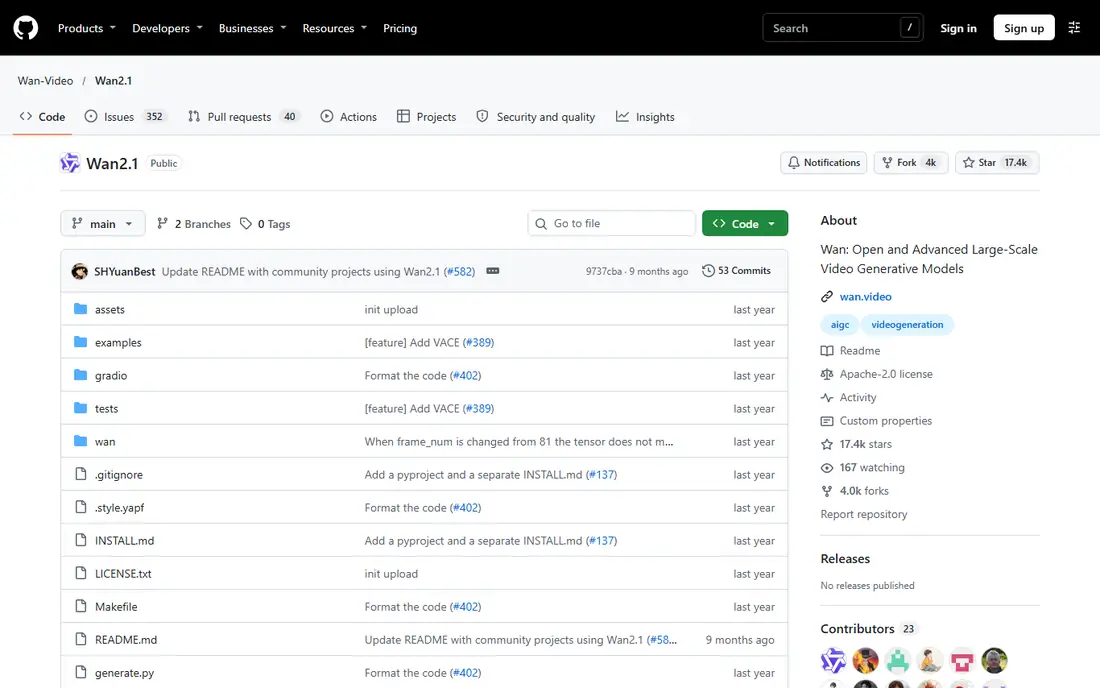
Wan 2.1 comes from Alibaba and was released in Feb 2025. The 1.3B model is the easy start point for a home GPU, while the 14B model gives higher quality for teams with a stronger card. Both support text-to-video and image-to-video, and the family also covers first-and-last-frame video and VACE editing. ComfyUI support is strong. The open line stops at Wan 2.2.
What we like- Apache 2.0 license permits commercial use, light 1.3B model runs on 8.19GB of VRAM, text-to-video and image-to-video in one family, wide ComfyUI support
Watch out for- The 14B model needs 16GB or more of VRAM, clips are short at about 5 seconds, and newer Wan versions from 2.5 onward are API only
#2
CogVideoX
Best for: Research teams and developers who need strong prompt control and a clean codebase
Visit github.com
Starting priceFree (open source), checked 11 Nov 2026
Free planFree, code and CogVideoX-2B are Apache 2.0, CogVideoX-5B uses its own license
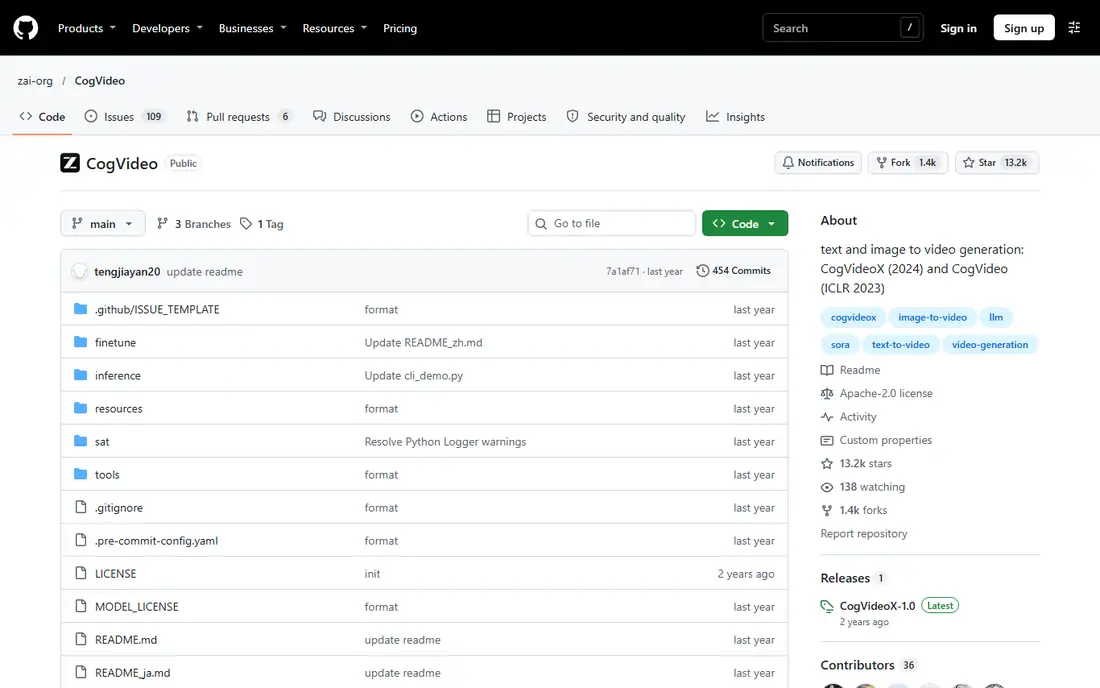
CogVideoX comes from Zhipu AI and Tsinghua University, and it uses a diffusion transformer with a 3D causal VAE. The 2B model is the light option, while the 5B model gives better quality at a higher hardware cost. The 1.5-5B variant lifts resolution to 1360 by 768 and length to 10 seconds. Prompt control is the main strength, because the model follows multi-clause prompts on pose, light and camera angle with care. The code and the 2B model are Apache 2.0, while the 5B weights use a separate license that needs a free sign-up for commercial use.
What we like- Strong prompt adherence for complex scenes, CogVideoX-2B runs with about 4GB of VRAM when memory optimisations are on, Diffusers support, text-to-video and image-to-video support
Watch out for- Clips top out at 6 seconds at 720 by 480 for the main models, CogVideoX-5B needs a free commercial sign-up for commercial use, and old THUDM links now redirect to zai-org
#3
HunyuanVideo
Best for: Teams that want high quality open video generation and can meet the license terms
Visit github.com
Starting priceFree (open source), checked 11 Nov 2026
Free planFree, code and weights are free to download under the Tencent Hunyuan Community License
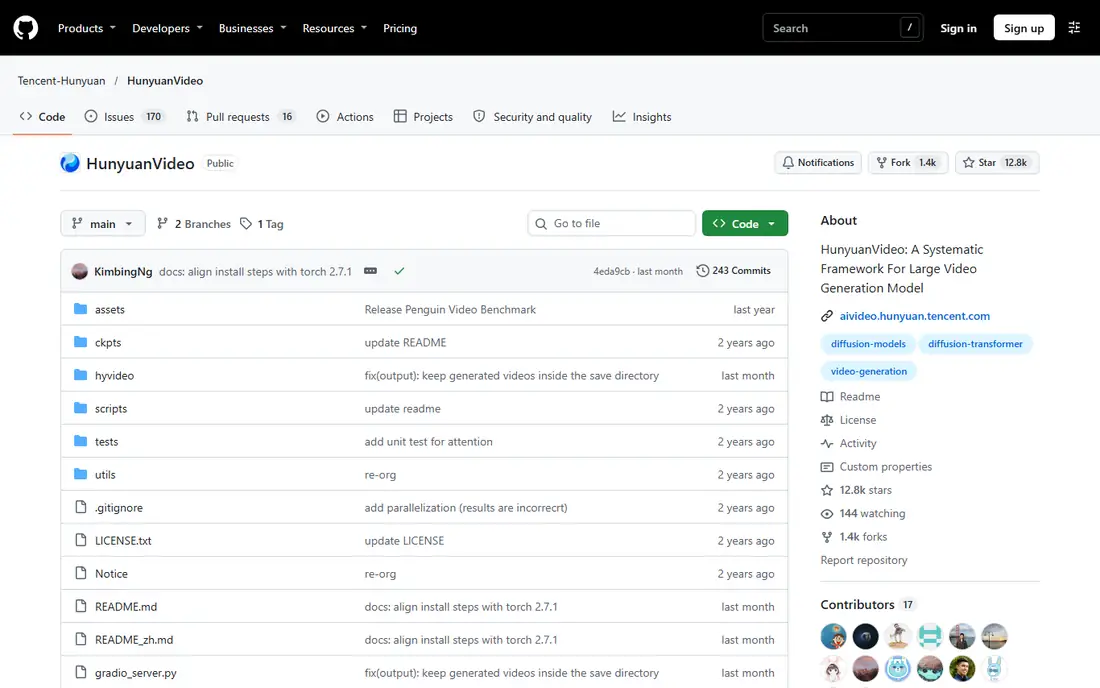
HunyuanVideo comes from Tencent and was released in Dec 2024 as a 13B video foundation model. It scored well on VBench at launch, with strong marks for motion quality. The newer HunyuanVideo-1.5, released in Nov 2025, drops the size to 8.3B parameters, needs a minimum of 14GB of VRAM with offloading, and can make clips of up to 10 seconds. That makes 1.5 the practical pick. The license is the key check, because it bars use in the EU, UK and South Korea.
What we like- 13B model topped VBench at launch, strong motion quality and text alignment, text-to-video and image-to-video support, newer 1.5 version cuts the model to 8.3B
Watch out for- The community license excludes the EU, UK and South Korea, the original 13B model needs a large GPU, and setup is Linux only with CUDA and Python 3.10 or newer
#4
Mochi 1
Best for: Developers who want realistic human motion, an Apache 2.0 model and LoRA fine-tuning
Visit github.com
Starting priceFree (open source), checked 11 Nov 2026
Free planFree, the model is Apache 2.0, and the Genmo Playground is free to try after sign-in
Mochi 1 comes from Genmo and is a 10B parameter diffusion transformer trained from scratch. It stands out for motion, because it handles human movement and physical scenes with care. The repo includes a Gradio demo, a command line tool and a LoRA trainer for fine-tuning on a team's own video style. The hardware need is the main limit. A single GPU needs about 60GB of VRAM, and the README points to an H100 class card. Buyers with a smaller card should test it through the Genmo Playground first. The hosted Turbo plan price is third-party reported at about 10 dollars per month.
What we like- Apache 2.0 license permits commercial use, strong motion quality for people and physical scenes, LoRA trainer included, Gradio UI and Python CLI included
Watch out for- A single GPU needs about 60GB of VRAM, so an H100 or A100 80GB card is the practical need, output is limited to 480p and 5.4 seconds
#5
LTX Video
Best for: Teams that need video and matching audio in one pass, plus multi-shot control
Visit github.com
Starting priceFree (open source), checked 11 Nov 2026
Free planFree, open weights under the LTX-2.x Community License for companies under 10 million dollars in annual revenue
LTX Video comes from Lightricks, and the current open line is LTX-2.5 in the Lightricks LTX-2 repo. It is a 22B parameter model that makes video and sound together, so dialogue, ambience and music arrive in sync with the picture. That is rare in open source, and it suits ads and product clips where sound matters. The model also supports text, image and video input, multi-shot output and up to 4K resolution. The license is free under 10 million dollars in revenue, while larger firms need a paid deal.
What we like- Video and audio are generated together in one pass, up to 4K output, native multi-shot sequences, first-party ComfyUI support
Watch out for- LTX-2.5 needs about 32GB of VRAM with FP8, the quick-start weights are about 66GB to download, and companies above 10 million dollars in revenue need a paid license
#6
Stable Video Diffusion
Best for: Creators who want to animate a single still image into a short clip
Visit github.com
Starting priceFree (open source), checked 11 Nov 2026
Free planFree, code on GitHub and weights on Hugging Face under the Stability AI Community License
Stable Video Diffusion comes from Stability AI and turns a still image into a short video clip. The SVD model makes 14 frames, while SVD-XT makes 25 frames, so clips are short and best used for product shots and storyboards. The code lives in the Stability AI generative-models repo, and weights are on Hugging Face. The hosted API is gone, so buyers must self-host it with a local GPU, Python and the sampling script in the repo. It cannot take a text prompt to steer the scene, it can warp faces, and it cannot render text in the frame with care.
What we like- Free to download and self-host, simple image-to-video workflow, SVD and SVD-XT variants cover short and longer clips, wide community guides
Watch out for- The hosted API was deprecated on 24 July 2025, so self-hosting is now the only route, the model has no text control and it struggles with faces and legible text
#7
AnimateDiff
Best for: Stable Diffusion users who want to animate a checkpoint or LoRA they already own
Visit github.com
Starting priceFree (open source), checked 11 Nov 2026
Free planFree, code is Apache 2.0, used through ComfyUI or AUTOMATIC1111
AnimateDiff is a motion module, not a full video model. It adds temporal layers to a Stable Diffusion checkpoint, so the style and art direction of that checkpoint carry into a short animated clip. That makes it the best pick for buyers who already have a Stable Diffusion setup and LoRAs they like. Setup runs through ComfyUI-AnimateDiff-Evolved or the AUTOMATIC1111 extension, plus a motion module file. The base SD 1.5 path needs 8GB to 12GB of VRAM, while SDXL needs about 13GB or more. Longer output needs a sliding window method, which can show seams.
What we like- Animates any Stable Diffusion 1.5 or SDXL checkpoint with no retraining, works with LoRAs and community fine-tunes, runs on 8GB to 12GB of VRAM, Apache 2.0 code license
Watch out for- The default output is a short 16-frame clip of about 2 seconds, the upstream repo has had no major code update since July 2024, and quality lags behind dedicated video models
#8
Open-Sora 2.0
Best for: Researchers who want a full open pipeline, with training code and data tools included
Visit github.com
Starting priceFree (open source), checked 11 Nov 2026
Free planFree, code, weights, training code and data pipeline are Apache 2.0
Open-Sora 2.0 comes from HPC-AI Tech and was released in March 2025 as an 11B parameter model. It is the most complete research pick here, because the team released the weights, the training code and the data pipeline together. That lets a research team study, retrain or fine-tune the full system. The model handles text-to-video and image-to-video in one network, and it makes clips of up to 129 frames. The headline training cost of about 200,000 dollars is a compute cost claim, not a full project cost.
What we like- Full open pipeline with weights, training code and data tools, 11B model covers text-to-video and image-to-video in one network, reported VBench gap to OpenAI Sora fell to 0.69 percent
Watch out for- Needs about 60GB of VRAM at 768px on one GPU, resolution tops out at 768px, clips top out at about 5 seconds, and retraining needs strong Python skills
Frequently asked questions
Is open source AI video generation really free?
Yes, the code and weights here are free to download, and most use Apache 2.0 or a community license that charges no fee. The real cost is the GPU, the electricity, the disk space and the setup time. A buyer without a suitable GPU can rent a cloud GPU by the hour.
Can I use open source AI video tools for commercial work?
It depends on the license for each model, so check it before you sell any output. Wan 2.1, Mochi 1 and Open-Sora 2.0 use Apache 2.0, which permits commercial use under its terms. CogVideoX-5B, HunyuanVideo and LTX Video use community licenses with extra conditions, such as region limits or revenue caps.
How long are clips from open source AI video tools?
Most clips here run from 2 to 10 seconds in a single generation. AnimateDiff makes about 2 seconds by default, Mochi 1 makes 5.4 seconds, Wan 2.1 makes about 5 seconds, and CogVideoX and HunyuanVideo-1.5 reach 6 to 10 seconds. Longer videos need several clips joined in an editor.
What GPU do I need for open source AI video generation?
It depends on the model you pick. Wan 2.1 in 1.3B form needs 8.19GB of VRAM, AnimateDiff needs 8GB to 12GB, and CogVideoX-2B can run with about 4GB when memory optimisations are on. HunyuanVideo-1.5 needs at least 14GB, and Mochi 1 and Open-Sora 2.0 need about 60GB at full quality.
Do open source AI video tools generate audio too?
Most do not, and they make silent clips that need music, voice or sound added in an editor. LTX Video is the exception here, because LTX-2.5 generates video and matching audio in one pass. Plan for a separate audio step unless you pick LTX Video.
Sources we checked (8)
- https://github.com/Wan-Video/Wan2.1
- https://github.com/zai-org/CogVideo
- https://github.com/Tencent-Hunyuan/HunyuanVideo
- https://github.com/genmoai/mochi
- https://github.com/Lightricks/LTX-2
- https://github.com/Stability-AI/generative-models
- https://github.com/guoyww/AnimateDiff
- https://github.com/hpcaitech/Open-Sora
Is your product missing or out of date?
We review this list regularly. Vendors can request a listing, send updated pricing or ask about featured placement.

Shihab Mia · Founder, Rankite
Shihab has 5+ years in B2B and SaaS SEO. He writes Rankite's software buying guides from pricing pages, documentation and public user reviews. More about Shihab.