How we make this list: we compare pricing pages, product documentation and public user reviews. Ratings come from G2, Capterra or Trustpilot, with the date we checked them.
Key takeaways
- Business apps split into two jobs: internal tools and portals your staff and clients use, and products you publish. Glide and Softr win the first job; Bubble and FlutterFlow win the second.
- Pricing in this category changed repeatedly through 2026 and the vendors' own comparison pages disagree with each other, so every figure here carries its billing basis and the live pricing page remains the authority.
- The hidden costs are the meters: workload units, row limits, app user counts and AI credits sit behind the headline plan at most of these companies.
- Exit is a feature. FlutterFlow exports real code; Bubble, Glide and Softr keep your app on their platform for life, which is fine until it is not.
Quick comparison
| Tool | Best for | Starting price | Free plan |
|---|
 Bubble | Full custom web and mobile apps | $32 per month | Yes |
 Glide | Internal apps from your data, fast | $25 per month | Yes |
 Softr | Client portals on existing data | $19 per month | Yes |
 Adalo | Simple native mobile apps | $52 per month | Yes |
 FlutterFlow | Native apps with code export | $39 per month | Yes |
 AppSheet | Data apps inside Google Workspace | $5 per user per month | Yes |
 Microsoft Power Apps | Businesses on Microsoft 365 | $20 per user per month | No |
 Retool | Internal tools with developer depth | See website | Yes |
Is your product missing or out of date?
We review this list regularly. Vendors can request a listing, send updated pricing or ask about featured placement.
The best no-code business app builders
#1Bubble
Best for: Full custom web and mobile apps4.4/5 on
G2 (166 reviews, checked Oct 2026)
Visit bubble.io
Starting price$32 per month
Free planYes
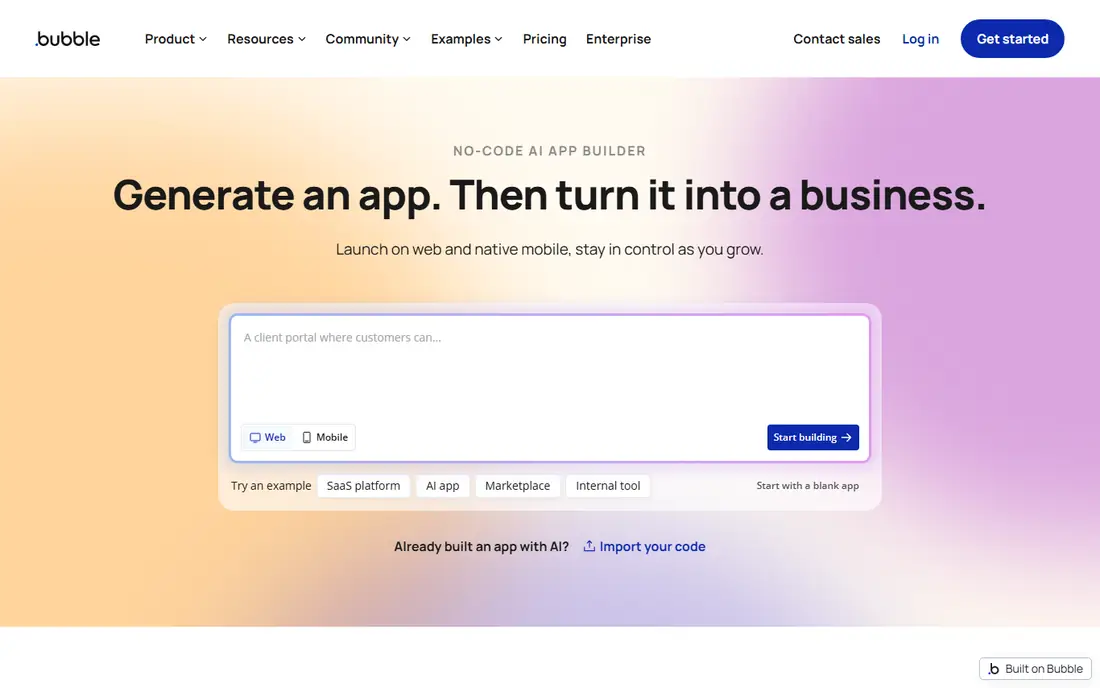
Bubble is the founder and operations team's power tool: the closest thing to a full development team in a browser, priced like software and metered like a utility.
Choose it for an app that is the business, or a core part of it, and budget a learning month or a freelance Bubble developer to set it up properly.
What we like- Bubble is the deepest no-code builder: a visual editor, a real database, workflows that handle complex business logic, user accounts, payments and an API connector to almost anything, plus a plugin and template market built over a decade. Its newer native mobile support extends builds into the app stores. If a business process can be drawn as screens and rules, Bubble can usually run it. The free plan lets you build and learn before paying
- Starter runs about 32 dollars a month billed annually for web apps.
Watch out for- Depth means a learning curve measured in weeks, and the bill runs on workload units, usage based pricing that comparison writers repeatedly flag as hard to forecast and capable of spiking with success. There is no source code export: your app lives on Bubble for its whole life. Performance of complex pages needs skill to keep snappy. Mobile pricing sits above the web starter tier.
#2Glide
Best for: Internal apps from your data, fast4.7/5 on
G2 (796 reviews, checked Oct 2026)
Visit glideapps.com
Starting price$25 per month
Free planYes
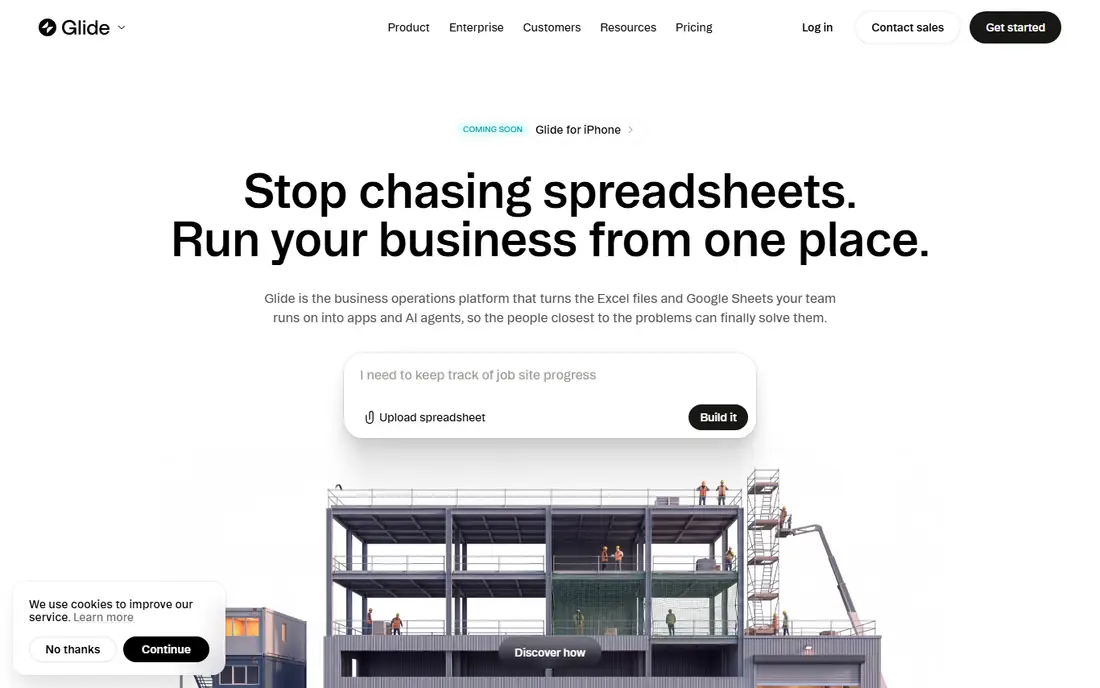
Glide is the fastest route from a spreadsheet that runs your business to an app that runs it better, and for internal tools that speed is the whole game.
Count your rows before committing. Glide's economics are kind to tidy data and unkind to a business that treats the app as an archive of everything forever.
What we like- Glide turns data you already have, spreadsheets, Airtable, SQL sources, plus AI generation from a prompt or document, into polished internal apps and portals in hours: field inspections, inventory, directories, order tracking, the operational greatest hits. Its interface is famously kind to non technical builders. Paid plans start around 25 dollars a month. Apps run as progressive web apps, installed from a link with no app store gatekeeping, which suits internal distribution perfectly.
Watch out for- Progressive web apps are the whole story: Glide does not publish native apps to the Apple or Google stores, which rules it out for consumer products. Row and update limits meter busy apps, and costs scale with data activity. Deep custom logic runs into its guardrails sooner than Bubble. Code export does not exist.
#3Softr
Best for: Client portals on existing data4.7/5 on
Capterra (64 reviews, checked Oct 2026)
Visit softr.io
Starting price$19 per month
Free planYes
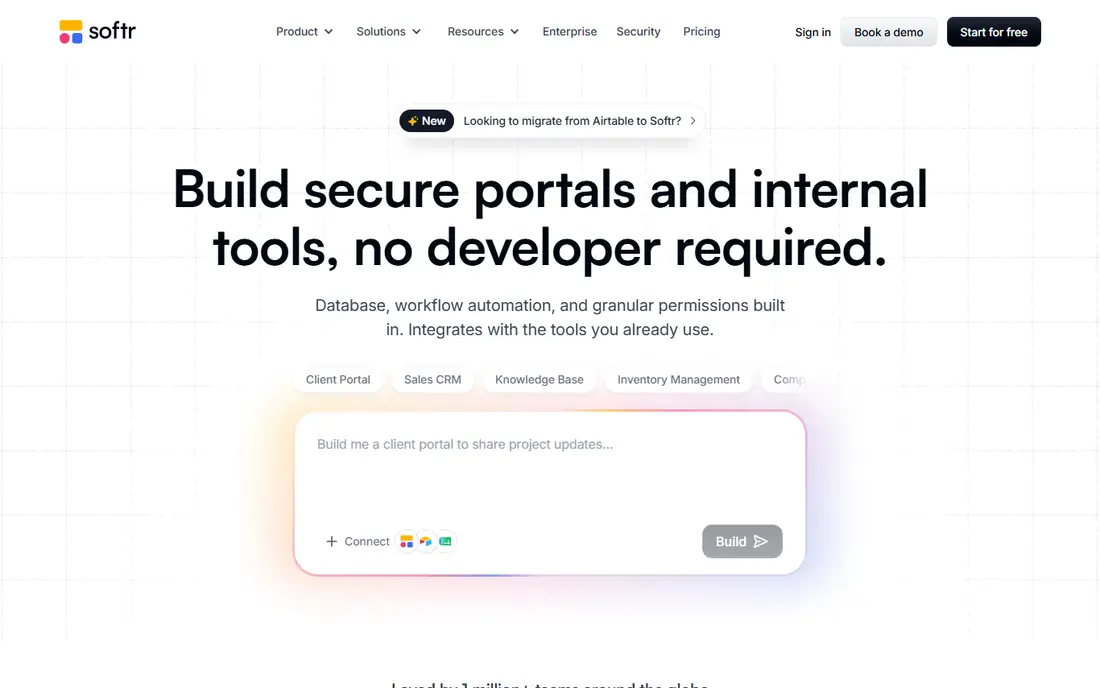
Softr is the portal specialist: clients checking their projects, members browsing a directory, staff approving requests, all on data you already maintain elsewhere.
Its free plan is a genuine pilot, which makes it the lowest risk start in this list for a business testing whether a portal earns its keep.
What we like- Softr builds portals, directories, dashboards and internal tools on top of data living in Airtable, Google Sheets, Notion and its own database, with logins, permissions and payments handled in blocks a non developer arranges like furniture. It starts around 19 dollars a month billed annually, with a free plan carrying a handful of app users for a real pilot. For a business whose data already sits in Airtable, the first useful portal can be live the same day.
Watch out for- It builds web portals, not app store products. Record and user limits scale the bill as the portal succeeds, and heavy custom logic exceeds the block model. Advanced builders eventually want the code level control Softr deliberately hides. Design freedom is real but bounded by its block system.
#4Adalo
Best for: Simple native mobile apps4.4/5 on
G2 (7 reviews, checked Oct 2026)
Visit adalo.com
Starting price$52 per month
Free planYes
Adalo is the small team's app store shortcut: a real native app, predictable billing, no developer, accepting a complexity ceiling as the trade.
If the app is a product with ambitions beyond that ceiling, start on Bubble or FlutterFlow instead and skip the rebuild.
What we like- Adalo builds one design and publishes it as a web app and native iOS and Android apps in the stores, with a built in database, and its paid plans run flat, with unlimited database records and no usage charges, a pricing philosophy it markets hard against metered rivals. Paid plans start around 52 dollars a month billed annually in the vendors' own comparison material, with lower figures in some listings, so confirm the live page. For a small business that needs a real store listed app, booking, loyalty, community, it is the simplest path.
Watch out for- Flat pricing buys simplicity, and complex apps strain its performance and logic depth sooner than Bubble or FlutterFlow. Design polish depends on the builder's eye. No code export. Its own marketing comparisons attack rivals' prices with numbers those rivals dispute, a reminder to verify every figure in this category on the checkout page.
#5FlutterFlow
Best for: Native apps with code export4.5/5 on
G2 (30 reviews, checked Oct 2026)
Visit flutterflow.io
Starting price$39 per month
Free planYes
FlutterFlow is the exit friendly product builder, the choice when the app might outgrow no-code and you refuse to start over when it does.
The honest buyer profile is a business with a technical friend on call. Pure no-code purists will find its backend homework heavier than Glide's one click world.
What we like- FlutterFlow builds native mobile and web apps visually on Google's Flutter framework, and its decisive feature is ownership: it exports clean Flutter code, so a developer can take the app anywhere, forever. It connects to Firebase and external APIs for real backends, and its AI app generation speeds the first draft. Paid plans start around 39 dollars a month. For a business building an asset, not renting one, that export changes the entire risk profile.
Watch out for- It is low code leaning: the more serious the app, the more you will meet Firebase configuration, API setup and eventually code, so a completely non technical owner will hire help at some point. The bill has layers, FlutterFlow plan plus Firebase usage plus store fees. Its free plan limits projects and blocks code export. Business internal tools are doable but not its home turf.
#6AppSheet
Best for: Data apps inside Google Workspace4.8/5 on
G2 (405 reviews, checked Oct 2026)
Visit appsheet.com
Starting price$5 per user per month
Free planYes
AppSheet is the field operations workhorse of the Google world: unglamorous, cheap, offline tough, and exactly right for the forms and checks that run physical businesses.
If your data lives in Sheets and your team carries Android phones, it is the fastest legitimate app your business will ever deploy.
What we like- AppSheet, owned by Google, builds apps directly from spreadsheets and databases your business already keeps, with offline capable mobile apps for field work, barcode scanning, forms, approvals and automation, priced from about 5 dollars per user per month at the entry tier and bundled into many Google Workspace plans. For inspections, asset tracking, delivery logs and site reports, it is in its element and nearly free if your company already pays for Workspace.
Watch out for- Its design language is functional data entry, not consumer beauty, and customer facing products do not belong here. Capability depth depends on expression formulas that take learning. Outside the Google ecosystem its charm fades, though it connects to other sources. App store publishing is not its model
- Apps distribute inside the organisation.
#7Microsoft Power Apps
Best for: Businesses on Microsoft 3654.3/5 on
G2 (569 reviews, checked Oct 2026)
Visit microsoft.com
Starting price$20 per user per month
Free planNo
Power Apps is the enterprise sanctioned answer: if your company runs on Microsoft and IT must bless the tool, this is the blessing that exists.
Get the licensing modelled by someone who has survived it before rollout. The platform is strong; the price list is the hazard.
What we like- Power Apps gives Microsoft shops the same trick inside their own estate: canvas apps from SharePoint, Excel, Dataverse and hundreds of connectors, distributed through Teams and the Power Apps player, with premium licensing at 20 dollars per user per month billed annually. Seeded rights inside many Microsoft 365 plans cover standard connectors at no extra line item. Governance, environments and data loss policies satisfy IT departments that would veto the startups above.
Watch out for- The licensing maze, seeded versus premium, connectors classified by tier, per app versus per user plans, is the most confusing in business software, and a wrong guess re-prices your rollout. Apps live inside Microsoft's world and its visual language. Citizen developers still need training to build well. There is no free plan, only trials through organisational accounts.
#8Retool
Best for: Internal tools with developer depth4.6/5 on
G2 (359 reviews, checked Oct 2026)
Visit retool.com
Starting priceSee website
Free planYes
Retool is the internal tools choice for companies with data in real databases and at least one technical builder. It builds in an afternoon what IT departments queue for a quarter.
For the non technical business owner, Glide and Softr remain the kinder doors into the same room. Retool rewards the skills it assumes.
What we like- Retool builds internal tools, admin panels, dashboards, approval queues, by dragging components onto real SQL and API connections, with JavaScript available everywhere for the logic no-code cannot express. Engineering led companies standardise on it because the tools it builds sit directly on production data with permissions and audit trails. A free tier covers small teams. It has expanded toward business users, but its soul is the developer adjacent builder.
Watch out for- It is low code, not no-code: a completely non technical owner will stall on queries and logic. Pricing is per user with tiers and has changed structure, so the field says See website. Public customer facing apps are a higher tier speciality, not the core. Design aims at utility
- Your staff will not mistake its panels for consumer products.
How we chose
We selected no-code and low code builders a business can actually run on in 2026, split by the two real jobs, internal tools and portals versus published products, and weighted data sources, pricing model clarity and exit options. Prices are starting paid tiers from the vendors' pages and current comparisons as of October 2026; the category's prices conflict between sources, including the vendors' attacks on each other, so billing basis is stated and live pages should be confirmed before purchase. No platform was hands on tested for this guide.
How to pick without a rebuild in year two
Name the app's audience first. Staff only: Glide, Softr, AppSheet or Retool, chosen by where your data already lives. Customers in an app store: Adalo for simple, FlutterFlow for serious, Bubble for web first products.
Follow your data. Every builder is happiest with its native sources: Sheets points to Glide or AppSheet, Airtable to Softr, SQL to Retool, Microsoft to Power Apps. Fighting the data layer is where no-code projects go to die.
Write the exit paragraph before you build. What leaves with you: the data export, the design, anything? On FlutterFlow the code leaves too. On the hosted builders, your asset is the data and the process knowledge, so keep both documented outside the tool from day one.
Frequently asked questions
What is the difference between no-code and low code here?
No-code means building entirely with visual tools: Glide, Softr and Adalo qualify for most business apps. Low code adds optional code for power: FlutterFlow exposes Flutter and Firebase, Retool expects JavaScript and SQL, and Power Apps uses formulas that become programming quickly. Low code goes further and lasts longer; no code starts faster and stays friendlier. Most businesses should start no-code and accept a rebuild only when success forces it.
How much does a business app really cost on these platforms?
The plan price plus the meters. A small internal app commonly runs 19 to 60 dollars a month in plan fees. Costs grow through per user pricing, Power Apps and AppSheet charge per head, row and record limits, and usage meters like Bubble's workload units. A realistic planning figure from current comparisons puts a small live app between about 30 and 100 dollars a month all in, scaling with traffic and team size.
Can a no-code app handle thousands of users?
The portals and internal tools here comfortably serve teams and client bases in the thousands. Consumer scale, hundreds of thousands of users with heavy logic, is where Bubble and FlutterFlow get chosen, and where metered bills and performance tuning become real work. The honest answer is that no-code scales further than its reputation and less far than its marketing; a successful app that outgrows it has the revenue to fund a rebuild, which is the right order of problems.
Who owns the app and its data?
Your data is yours on all eight, exportable in standard formats. The app itself differs: FlutterFlow exports source code you own outright. On Bubble, Glide, Softr and Adalo the running app exists only on the platform; stop paying and it stops. Contracts and exports are your protection, so schedule data exports like backups, automatically and from the first month.
Can I build an app for my business without any technical help?
Yes, for the internal and portal class: thousands of operations managers run Glide, Softr and AppSheet apps they built themselves. The skills needed are spreadsheet comfort and process clarity, not code. Published consumer apps are where help pays: store policies, performance and polish separate amateur from professional, and even there, Adalo and Bubble freelancers are a mature market if the app proves itself.
Sources we checked (0)
Is your product missing or out of date?
We review this list regularly. Vendors can request a listing, send updated pricing or ask about featured placement.

Shihab Mia · Founder, Rankite
Shihab has 5+ years in B2B and SaaS SEO. He writes Rankite's software buying guides from pricing pages, documentation and public user reviews. More about Shihab.