How we make this list: we compare pricing pages, product documentation and public user reviews. Ratings come from G2, Capterra or Trustpilot, with the date we checked them.
Key takeaways
- This category splits into two tribes: visual no-code builders (Bubble, Softr, Glide, Adalo, FlutterFlow) and prompt-to-code AI builders (Lovable, Bolt, v0, Replit, Builder.ai). Pick the tribe that matches how you want to maintain the app.
- Every tool here has a free tier, but free tiers are for learning and prototypes; going live almost always means a paid plan.
- Usage-based pricing (credits, tokens, workload units) is the norm now, so budget for your iteration habits, not just the headline plan price.
- If you ever want to leave, code export matters: FlutterFlow, Lovable, Bolt, v0 and Replit give you code; Bubble and Glide keep you on their platform.
Quick comparison
| Tool | Best for | Starting price | Free plan |
|---|
 Bubble Bubble | full-stack web apps, visual | From $59/month | Yes |
 Softr Softr | portals on existing data | From $19/month | Yes |
 Glide Glide | spreadsheet-to-app internal tools | From $19/month | Yes |
 Adalo Adalo | native mobile apps, flat pricing | From $36/month | Yes |
 FlutterFlow FlutterFlow | apps with code export | From $39/month | Yes |
 Builder.ai Builder.ai | done-for-you custom builds | See website | See website |
 Lovable Lovable | prompt-to-full-stack web apps | From $25/month | Yes |
 Bolt Bolt | browser-based AI building | From $25/month | Yes |
 v0 v0 | Vercel-native UI generation | From $30/month | Yes |
 Replit Replit | AI agent plus full IDE | From $20/month | Yes |
Is your product missing or out of date?
We review this list regularly. Vendors can request a listing, send updated pricing or ask about featured placement.
The best no-code AI app builders for startups
Starting priceFrom $59/month
Free planYes
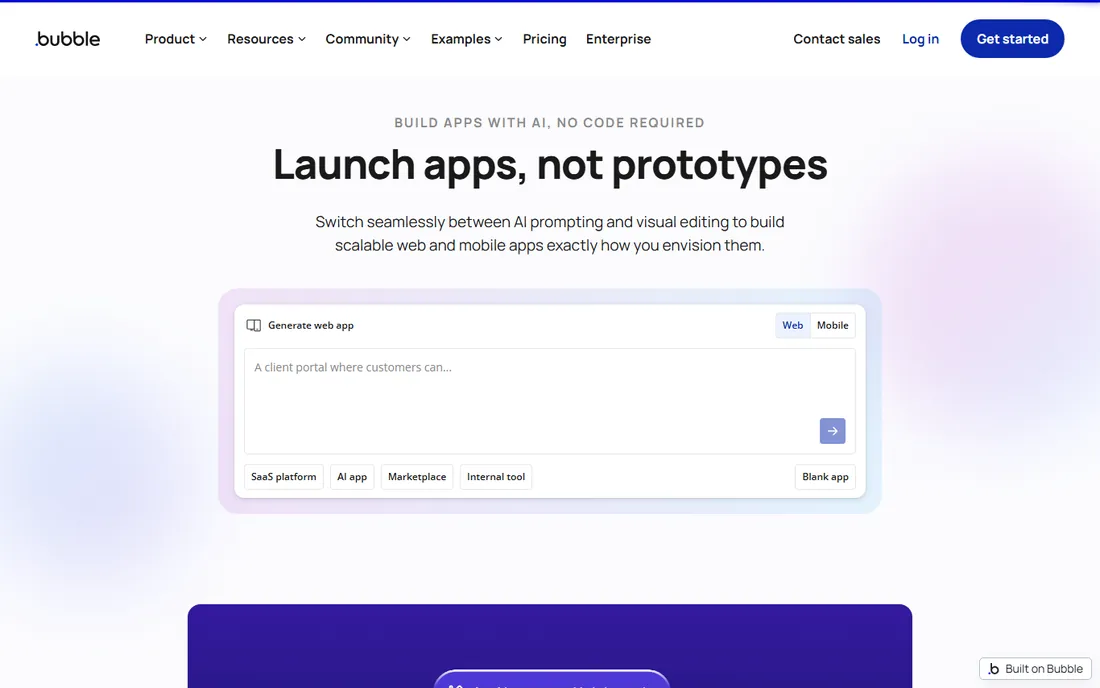
Bubble is the heavyweight of visual no-code: a drag-and-drop page designer, a real database you define yourself, and a workflow engine expressive enough for multi-role SaaS apps and marketplaces. The newer AI layer generates a first version of your app, database and workflows from a plain-language description, and everything it creates stays editable in the visual editor, which is the key difference from prompt-to-code tools: you never inherit code you cannot read.
The pricing to understand is workload units, Bubble's meter for server processing. Plans run Free ($0, no live deployment), Starter from $59 per month for web and mobile billed annually, Growth at $209 and Team at $549, with Enterprise custom. Inefficient workflows burn units fast, so build with pagination and narrow searches, or the meter becomes your most expensive feature.
What we like- Deepest visual logic of any no-code tool
- Built-in database and hosting
- AI generation plus full visual editing
Watch out for- Usage-based workload units can surprise
- No code export, so you stay on Bubble
Starting priceFrom $19/month
Free planYes
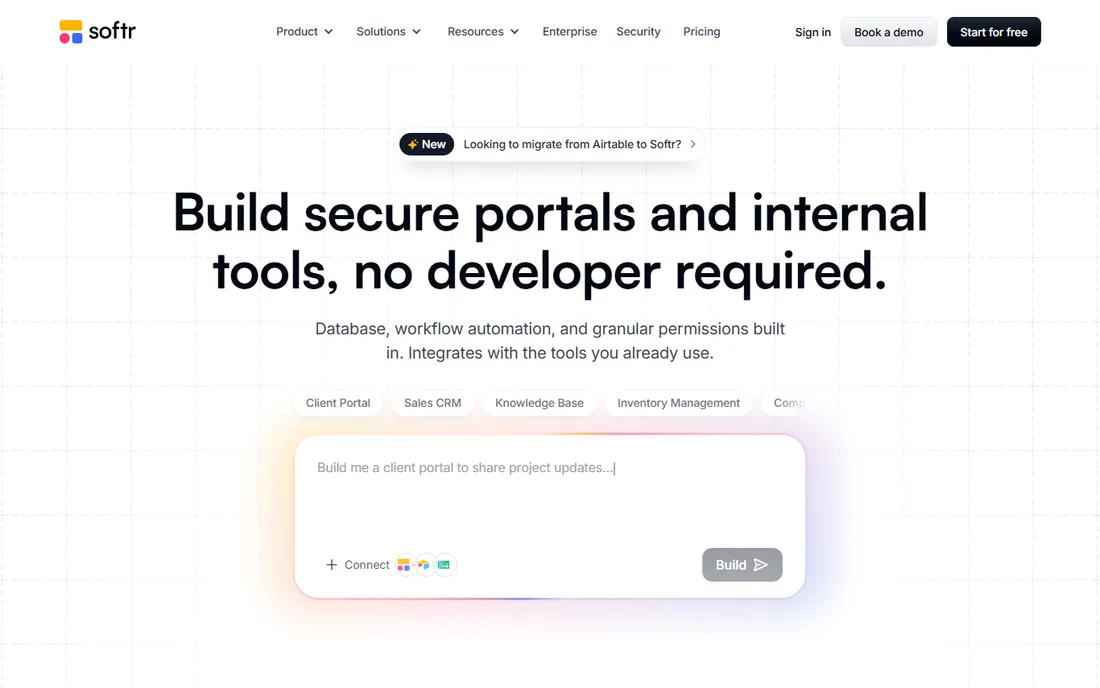
Softr starts where your data already lives. Connect Airtable, Google Sheets, Notion, HubSpot or its own native database, and the AI Co-Builder assembles pages, user roles and workflows into a client portal, internal tool or dashboard, often in hours. User groups control which pages and records each person sees, which is exactly the permission model portals need, and the company is SOC 2 Type II compliant with data hosted in Germany.
Pricing is flat and published on the homepage: Free ($0, unlimited apps with usage caps), Basic $19 per month, Pro $99 and Business $329 on annual billing. The honest limitation is scope: Softr builds web apps, not native mobile apps, and it is optimized for business operations rather than consumer SaaS. For a startup whose product is a portal on structured data, that focus is a feature.
What we like- Turns Airtable, Sheets and Notion into gated apps fast
- Flat predictable pricing
- Generous free tier
Watch out for- Web apps only, no app-store publishing
- Complex custom logic eventually needs a developer
Starting priceFrom $19/month
Free planYes
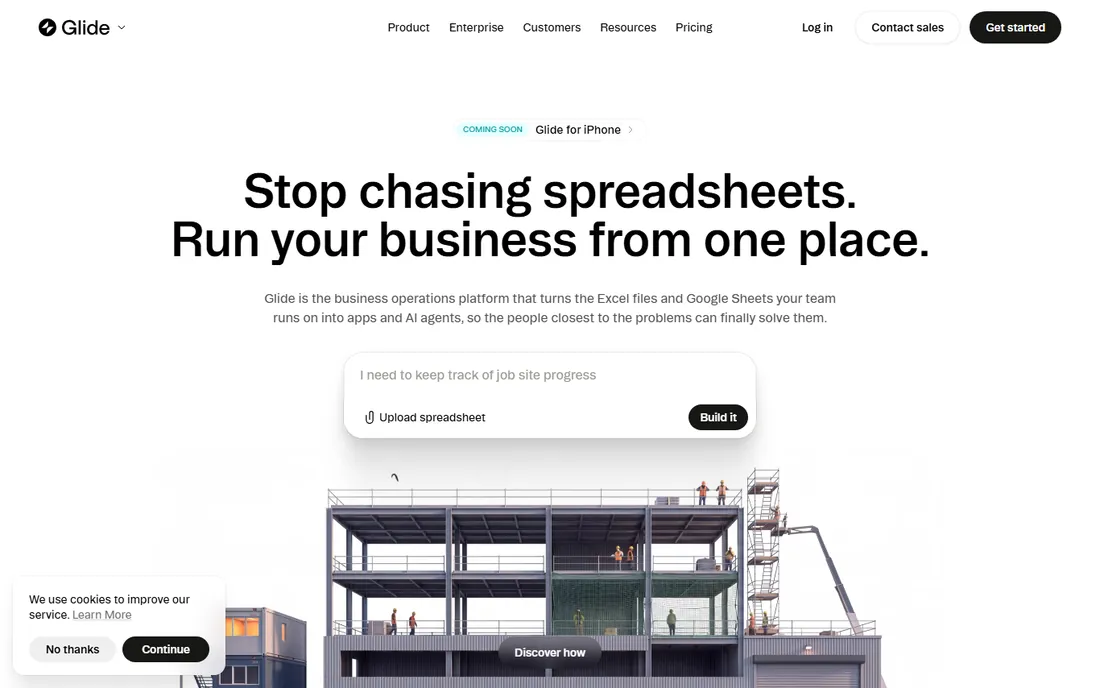
Glide's pitch is speed: connect a Google Sheet, Excel file or Airtable base and get a working app in minutes, published as a progressive web app that users install from a link. The template marketplace (400+ options) covers CRMs, inventory trackers, scheduling apps and portals, and built-in workflows replace Zapier-style glue for common automations. For internal tools where the team already maintains the data in a spreadsheet, nothing here ships faster.
The tradeoffs are architectural. Glide apps are PWAs, so there is no App Store or Play Store distribution, and pricing scales on users and data updates: Free ($0), Explorer $19 per month billed annually, Maker $49 and Business $199, with Enterprise custom, per Glide's own help center. High-activity apps with frequent data changes can push costs up, so model your update volume before committing.
What we like- Fastest path from a spreadsheet to a working app
- 400+ templates
- Built-in workflow automation
Watch out for- Progressive web apps only, no app-store publishing
- Pricing scales with users and data updates
Starting priceFrom $36/month
Free planYes
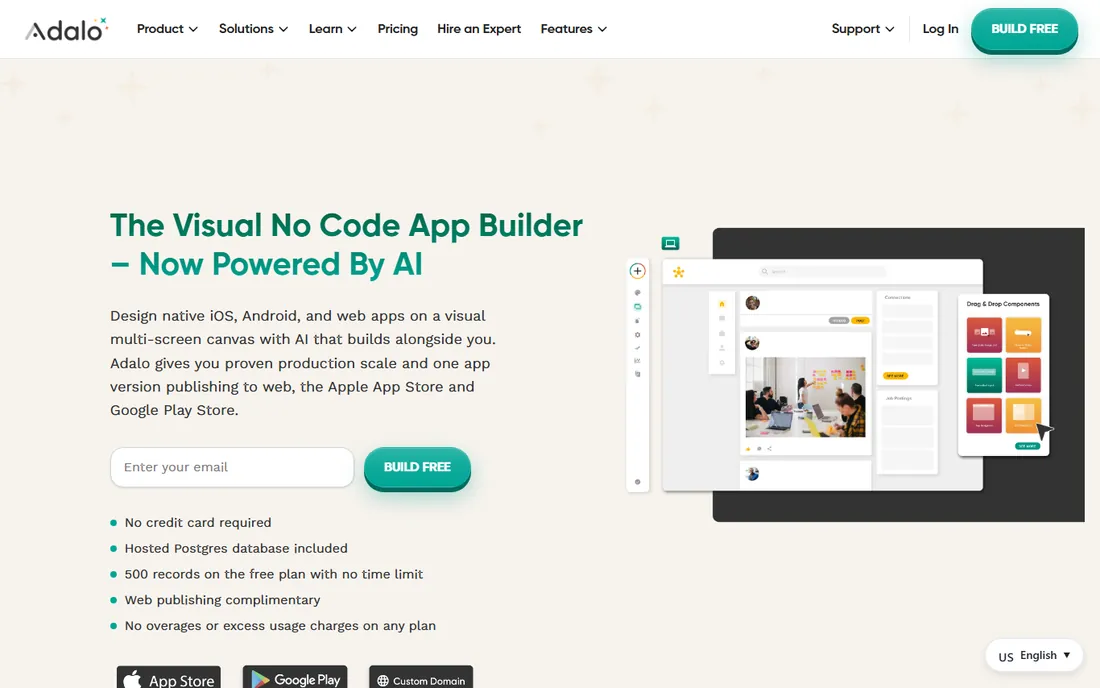
Adalo occupies a specific and valuable niche: it is one of the few no-code platforms where a non-technical founder can go from idea to a published App Store listing. The visual multi-screen canvas designs web, iOS and Android from one project, the AI builder (Ada) generates database structure, screens and logic from a description, and publishing produces native builds rather than web wrappers. The free plan includes 500 records with no time limit, and web publishing is complimentary.
Pricing is the quiet differentiator: flat-rate with zero usage-based fees. Starter is $36 per month billed annually with native publishing and unlimited database records, Professional $52, Team from $160, per Adalo's own site. A viral spike costs you nothing extra, which is the opposite of the metered models elsewhere on this list. The ceiling is lower than Bubble's for complex apps, but for a mobile MVP, predictability wins.
What we like- Publishes real native iOS and Android apps
- Flat-rate pricing with no usage meters
- AI builder generates app foundations
Watch out for- Less expressive than Bubble for complex logic
- Design flexibility has limits
Starting priceFrom $39/month
Free planYes
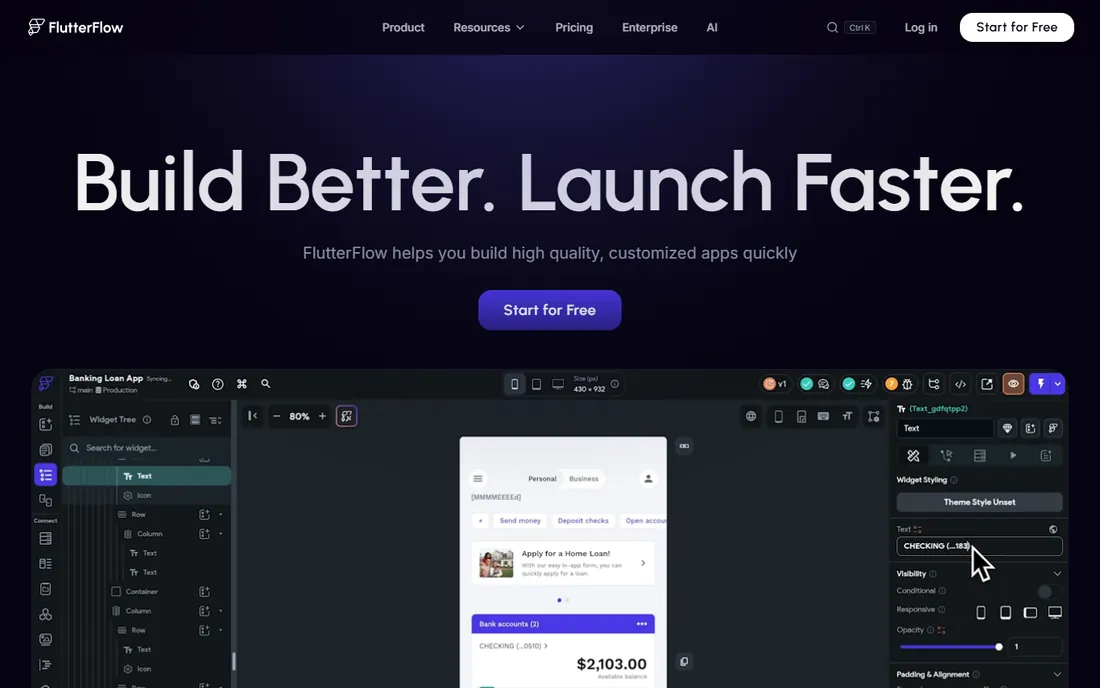
FlutterFlow is the visual builder for teams that want an exit strategy. You design visually on top of Flutter, connect Firebase or Supabase as the backend, and can export the generated code at any point, which means the app can outlive the platform. AI features generate page layouts from descriptions, and when the visual builder is not enough, custom Dart code provides the escape hatch.
Plans run Free ($0, no code export or store deployment), Basic $39 per month, Growth $80 for the first seat and Business $150 for the first seat, with Enterprise custom. Remember the total cost: Firebase or Supabase usage and the Apple ($99/year) and Google ($25 one-time) developer fees sit outside FlutterFlow's bill. For startups that want no-code speed today and code ownership tomorrow, this is the most honest deal here.
What we like- Export clean Flutter code, no vendor lock-in
- Deploys to app stores and web
- AI-assisted design plus custom Dart code
Watch out for- You still need Firebase or Supabase for the backend
- Per-seat pricing on team plans
Starting priceSee website
Free planSee website
Builder.ai is the odd one out: less a builder you operate, more a service that builds for you. You describe the idea to its AI, get a fixed price and timeline guaranteed upfront, and its system assembles the app from a library of pre-built features with human specialists customizing the rest. A dedicated product expert manages the project through launch, and you keep the code.
There is no public price list; pricing is custom per project, and third-party estimates put typical builds in the tens of thousands of dollars. That makes Builder.ai a different budget conversation from everything else here. It fits founders who want a custom app without managing the build themselves and have the budget for it. If you want to iterate daily with your own hands, the DIY tools above are the better fit.
What we like- AI plus human experts assemble your app
- Fixed guaranteed price upfront
- You keep the code
Watch out for- Custom-quote pricing, no self-serve plans
- Slower and pricier than DIY builders
Starting priceFrom $25/month
Free planYes
Lovable is the purest expression of the prompt-to-app idea: type what you want in plain language and get a working web app with screens, logins, database and payments, hosted and deployed. Iteration happens in chat, Figma imports turn designs into apps, and Supabase provides the backend. For a founder who wants a clickable, shareable product this week, the speed is genuinely startling.
The pricing model is credits, and credits are where the arguments happen. The free tier gives 5 daily credits (capped monthly), Pro is $25 per month for 100 credits, Business $50, Enterprise custom. Complex prompts burn more credits than simple ones, and debugging loops can consume a month's allowance fast, so the real cost depends on how cleanly you prompt. Start on free, watch the credit meter for a week, then decide if Pro covers your pace.
What we like- Describe the app, get frontend, backend and hosting
- GitHub sync and custom domains
- Fast iteration by chat
Watch out for- Credit burn is unpredictable on complex builds
- Design polish sometimes needs manual fixes
Starting priceFrom $25/month
Free planYes
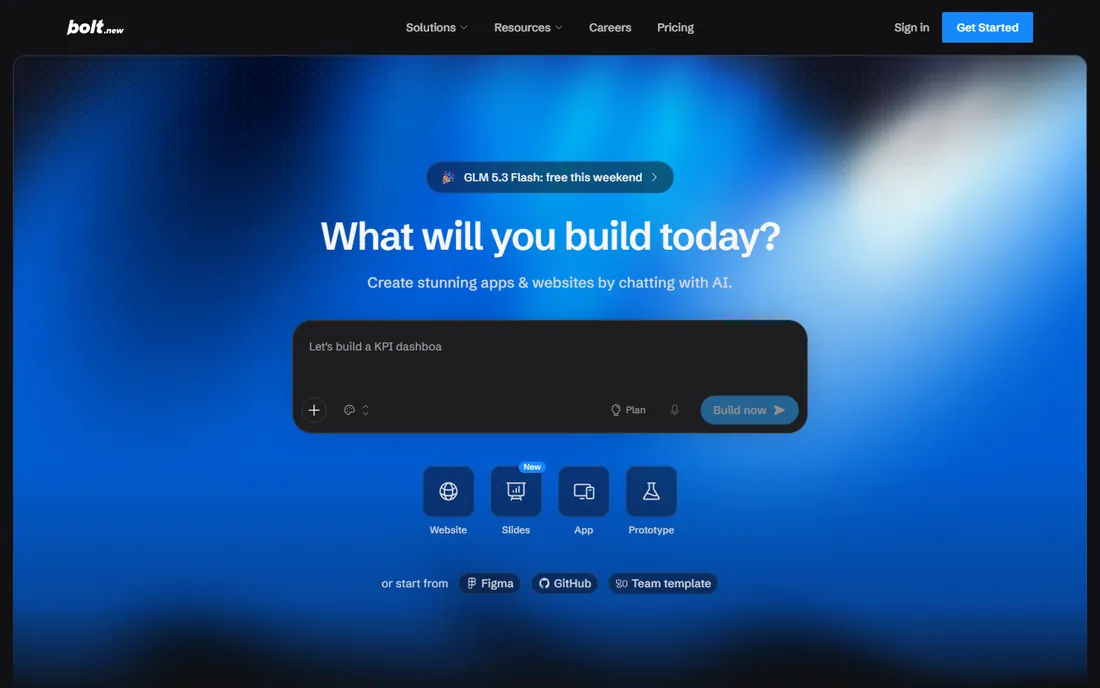
Bolt.new, from the StackBlitz team, runs a complete development environment in your browser: you prompt, it writes and runs the code, and you deploy with hosting and databases included. There is no local setup, the code is fully visible and editable, and the free tier's 1M monthly tokens (300K daily cap) is the most generous free allowance in this category. Pro at $25 per month brings 10M tokens with no daily cap, custom domains and token rollover, with Teams at $30 per member.
The catch is structural: token consumption scales with codebase size because each request re-reads project context, so long iteration sessions on large projects burn tokens faster than you expect. Bolt is optimized for the zero-to-one phase, prototypes and MVPs, rather than the one-to-a-thousand phase of scaling a production app. For getting something real in front of users fast, few tools match it.
What we like- Full dev environment in the browser, no setup
- Generous free token allowance
- Unused Pro tokens roll over
Watch out for- Token burn scales with project size
- Optimized for prototypes more than long-lived products
Starting priceFrom $30/month
Free planYes
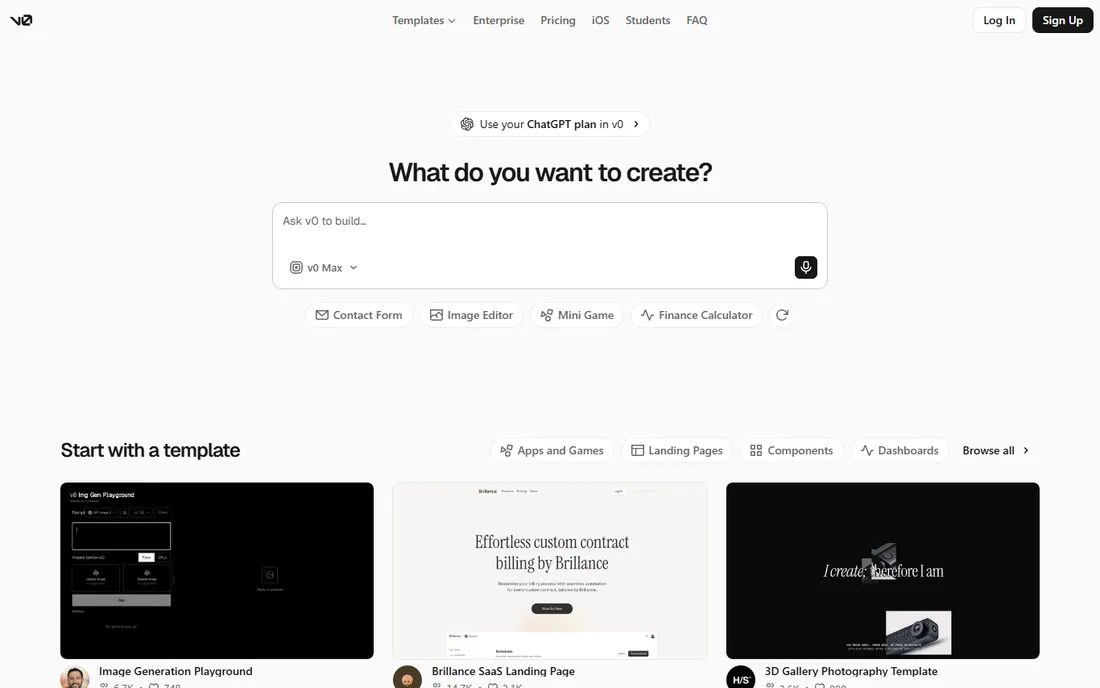
v0 is Vercel's AI builder, and it shows in the output quality: generate interfaces from prompts with genuinely good React, Tailwind and design taste, refine with a visual design mode, sync to GitHub and deploy to Vercel in one click. It has grown from UI components toward full-stack apps with database connections, but its heart remains interface generation, and it is the best tool here if your bottleneck is frontend quality.
Pricing is credit-based: Free ($0, $5 in monthly credits, 7 messages a day), Plus $30 per user per month with $30 in credits, Business $100 per user, Enterprise custom. Note the separate bill: hosting runs through Vercel (Hobby free, Pro from $20/month), so factor that into the total. For startups already on Vercel, v0 is the natural extension of the stack.
What we like- Exceptional React and UI component quality
- One-click deploy to Vercel
- Design mode for visual fine-tuning
Watch out for- Frontend-focused, backend needs separate work
- Hosting billed separately through Vercel
Starting priceFrom $20/month
Free planYes
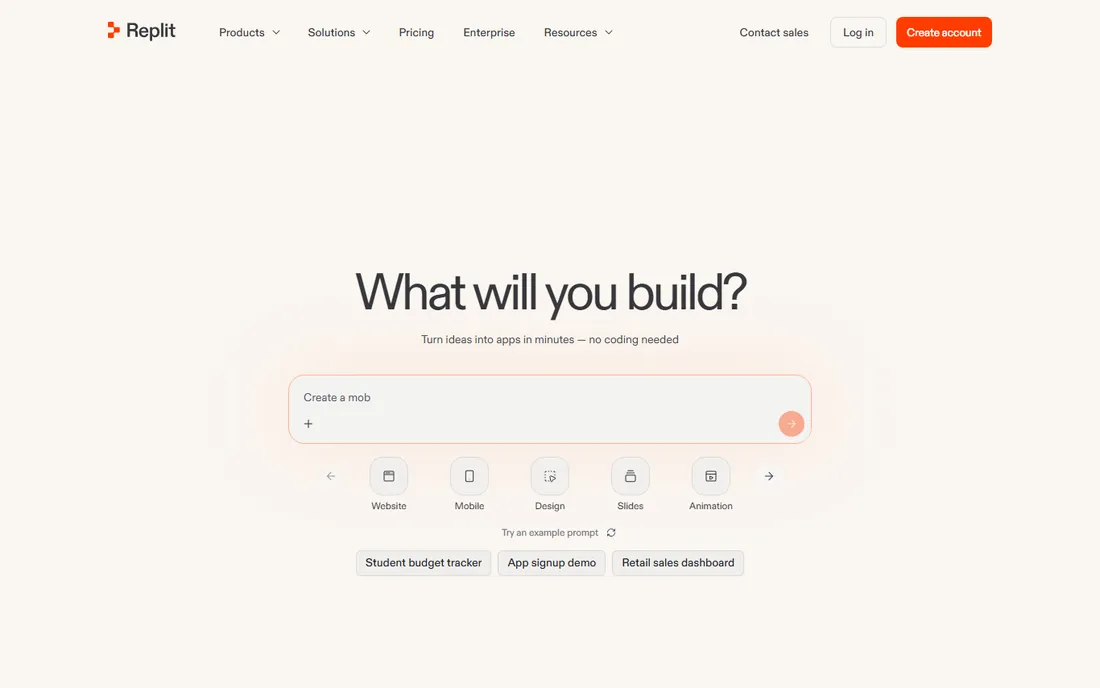
Replit pairs its AI Agent with a full browser-based IDE: describe the app and the agent scaffolds the project, writes code, installs packages and publishes to a live URL, with database, authentication, hosting and monitoring provisioned in the same account. When the agent gets stuck, you can drop into the actual code and fix it yourself, which neither pure chat tools nor pure visual builders offer.
Pricing runs on effort-based credits: Starter is free with daily agent credits, Core $20 per month ($18 billed annually) with $20 in monthly credits, Pro $100 per month with $100 in credits, Enterprise custom. The honest warning is that heavy agent use, deployments and storage all draw from the same credit pool, and users report overages pushing real costs well above the base plan. It is fair value for building one product; it demands monitoring once that product gets traffic.
What we like- AI agent plus a real IDE in one place
- Built-in hosting, database and auth
- Long autonomous build runs
Watch out for- Effort-based credit pricing is hard to predict
- Overages can dwarf the base subscription
The two tribes: visual builders vs prompt-to-code
Every tool here falls into one of two philosophies, and the choice matters more than any feature list. Visual builders (Bubble, Softr, Glide, Adalo, FlutterFlow) give you an editor where the app's logic stays visible and editable; AI assists, but the visual model is the source of truth. That makes them easier to maintain, hand over and reason about six months later. Prompt-to-code tools (Lovable, Bolt, v0, Replit) generate code from conversation; you move faster at the start, but you inherit a codebase whose quality depends on how well you prompted, and debugging means reading generated code.
Neither tribe is better in the abstract. Choose visual if the app will live for years and change hands; the editor is your documentation. Choose prompt-to-code if speed to a working demo is the priority and you are comfortable reading code when the AI gets confused. Builder.ai sits outside both: it is a service, not a tool you operate. Founders who pick the wrong tribe usually discover it at month three, when iteration speed collapses, so decide based on who maintains the app, not who builds the demo.
How we chose
We defined no-code AI app builders as platforms where a non-technical founder can produce a working application using visual tools, AI generation or both. We verified each product is active and maintained, opened the vendor's own site to confirm the URL, and read current pricing pages plus recent user discussions for known limitations. Pricing comes only from vendor-published pages and figures corroborated across multiple current sources; where vendors sell custom quotes, we say so. We excluded pure code editors, website-only builders and discontinued products. No vendor paid for placement, and we ran no hands-on tests; the ordering reflects startup fit, pricing transparency and how honestly each tool handles the path from prototype to production.
What to check before you commit
Four questions separate a good choice from an expensive lesson. First, what does going live require? Free tiers across this list are for learning; confirm the paid plan that includes custom domains, app-store publishing or private projects, and price that plan, not the free one. Second, how is usage metered? Credits, tokens and workload units all punish different behaviors: chatty iteration, large codebases and inefficient workflows respectively. Watch the meter during your trial week and extrapolate honestly.
Third, can you leave? Code export (FlutterFlow, Lovable, Bolt, v0, Replit) means the app can outlive the platform; visual-only platforms mean rebuilding if you outgrow them. Fourth, what is the real monthly total? Add the backend (Firebase, Supabase, Vercel hosting), the app-store developer fees and the credit overages to the plan price. The cheapest headline price rarely survives that math, and the tool with the honest total is usually the right one.
Frequently asked questions
Can I really build a startup on no-code?
Yes, for the right kind of product. Marketplaces, directories, internal tools, client portals and mobile MVPs ship successfully on these platforms every week. The failure mode is not the tools but the fit: highly custom logic, novel algorithms or massive scale eventually want traditional engineering. Start on no-code to validate, and migrate the parts that earn it.
Which is better for a mobile app: Adalo or FlutterFlow?
Adalo is simpler and cheaper for a straightforward native mobile MVP with flat-rate pricing. FlutterFlow is more powerful and gives you code export, which matters if the app will grow into something a development team maintains. Choose Adalo for speed and simplicity, FlutterFlow for the long game.
How do AI credits and tokens actually work?
They are meters for AI work. Each prompt, edit or generation consumes some amount based on its complexity, and complex projects consume more per action than simple ones. The practical advice is the same everywhere: prompt carefully, batch your changes instead of iterating one tweak at a time, and watch the usage dashboard during your first week to learn your burn rate.
Will AI-generated code be good enough for real users?
For prototypes, demos and early products, usually yes, with review. For production, treat AI output like a junior developer's first draft: it works, but it needs testing, security review and cleanup before real users and real data touch it. The tools that let you see and edit the code (Bolt, Replit, v0, FlutterFlow) make that review possible.
What does it cost to run an app after building it?
Beyond the builder's subscription, budget for hosting and backend usage (Firebase, Supabase or Vercel), app-store developer accounts ($99/year Apple, $25 one-time Google), and usage overages on metered plans. A realistic floor for a small live app is typically $30 to $100 per month all-in, scaling with traffic and AI usage.
Sources we checked (10)
- https://bubble.io
- https://www.softr.io
- https://glideapps.com/
- https://adalo.com/
- https://flutterflow.io/
- https://builder.ai/
- https://lovable.dev/
- https://bolt.new/
- https://v0.dev/
- https://replit.com/
Is your product missing or out of date?
We review this list regularly. Vendors can request a listing, send updated pricing or ask about featured placement.

Shihab Mia · Founder, Rankite
Shihab has 5+ years in B2B and SaaS SEO. He writes Rankite's software buying guides from pricing pages, documentation and public user reviews. More about Shihab.