How we make this list: we compare pricing pages, product documentation and public user reviews. Ratings come from G2, Capterra or Trustpilot, with the date we checked them.
Key takeaways
- Ansible is the best open source network automation tool, free for self-managed use, with a managed service from $412.50 per month for 50 nodes in guides.
- SolarWinds Network Configuration Manager at about $2,895 per year suits multi-vendor config tracking, while ManageEngine NCM at about $595 per year suits smaller budgets.
- NetBox is the best open source source of truth, free self-hosted, with NetBox Labs editions from $7,500 per year in guides.
- Cisco DNA Center, Juniper Apstra, NetBrain, and Itential are quote-only enterprise tools, so budget with a sales quote, not a price card.
- The right tool depends on your vendor mix: Cisco-heavy shops, multi-vendor shops, and data-center shops each have a different best pick.
Quick comparison
| Tool | Best for | Starting price | Free plan |
|---|
 Ansible | Open source multi-vendor automation | Free | Yes |
 SolarWinds NCM | Multi-vendor config tracking | $2,895 per year | Trial |
 Cisco DNA Center | Cisco-heavy enterprise networks | See website | No |
 Juniper Apstra | Intent-based data centers | See website | No |
 NetBox | Open source source of truth | Free | Yes |
 ManageEngine NCM | Budget config management | $595 per year | Trial |
 NetBrain | Dynamic mapping and troubleshooting | See website | No |
 Itential | Low-code orchestration | See website | No |
Is your product missing or out of date?
We review this list regularly. Vendors can request a listing, send updated pricing or ask about featured placement.
#1Ansible
Best for: Open source multi-vendor automation4.6/5 on
G2 (377 reviews, checked Oct 2026)
Visit ansible.com
Starting priceFree
Free planYes
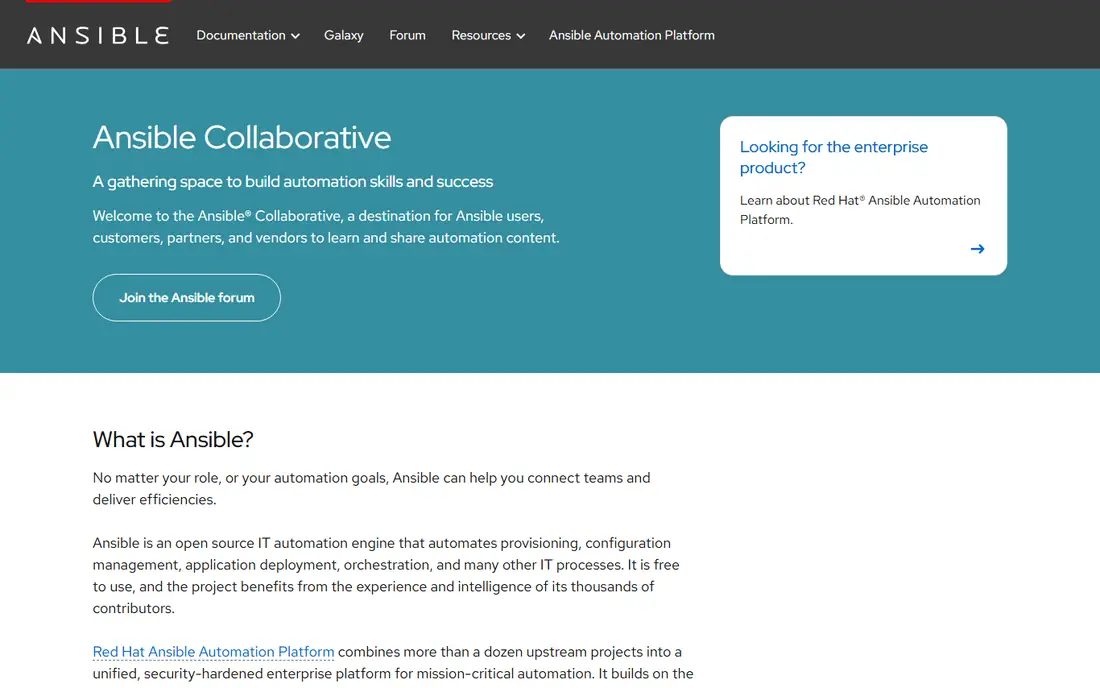
Ansible is the best open source network automation tool for DevOps and multi-vendor environments, using an agentless design that connects over SSH and APIs without installing agents on every device. Its playbooks automate configuration, provisioning, and compliance checks across vendors, and Ansible Vault encrypts sensitive values such as passwords, tokens, and keys used in automation.
The open source engine is free, while the managed service starts at $412.50 per month for 50 nodes in guides, scaling to $70,125 per month for 10,000 nodes, with usage add-ons near $8.25 per managed node per month plus a control-plane fee. A 60-day free trial is available in guides. For teams that want open, multi-vendor automation, Ansible is the standard.
What we like- Free open source automation for DevOps and multi-vendor environments
- Agentless design
- Ansible Vault for secrets protection
Watch out for- Managed service pricing scales by nodes, from $412.50 per month for 50 nodes in guides
- Usage add-ons near $8.25 per managed node per month
- Playbook writing needs skill
Starting price$2,895 per year
Free planTrial
SolarWinds Network Configuration Manager suits multi-vendor config tracking, backing up device configurations, detecting changes, and reporting compliance across routers, switches, and firewalls from many vendors. It fits Orion-based network shops that already run SolarWinds monitoring, since config data joins performance data in one console.
Pricing starts near $2,895 per year in guides, with no free tier, only a trial. For teams whose main automation need is reliable config management rather than intent-based networking, SolarWinds NCM is the most proven pick.
What we like- Multi-vendor config tracking and backup
- Change detection and compliance reporting
- Fits Orion-based network shops
Watch out for- Starting price near $2,895 per year in guides
- No free tier, only a trial
- Enterprise depth trails intent-based platforms
#3
Cisco DNA Center
Best for: Cisco-heavy enterprise networks
Visit cisco.com
Starting priceSee website
Free planNo
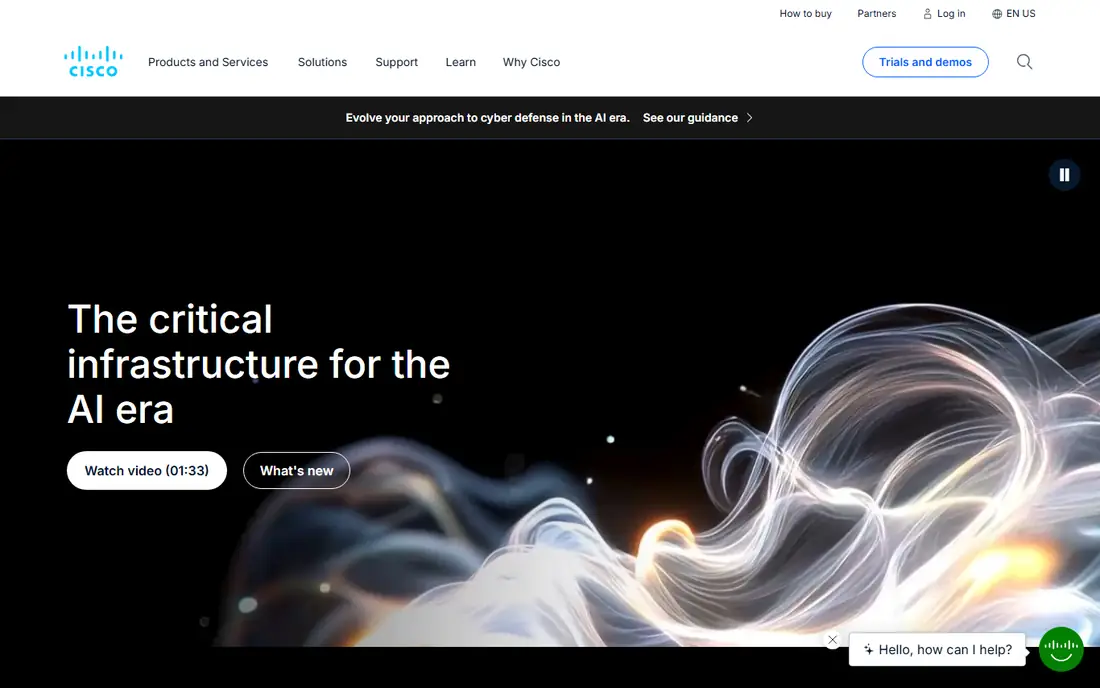
Cisco DNA Center is the enterprise network automation platform for Cisco-heavy networks, offering policy-based management, automation, and assurance across switches, routers, and wireless controllers from Cisco. Its assurance analytics help enterprise teams spot issues before users report them.
Pricing is quote-only, and value drops sharply for multi-vendor networks, where open tools such as Ansible fit better. For Cisco estates at enterprise scale, DNA Center is the natural platform choice.
What we like- Enterprise network automation purpose-built for Cisco networks
- Policy-based management
- Assurance and analytics for Cisco estates
Watch out for- Quote-only pricing
- Best value only for Cisco-heavy networks
- Multi-vendor support trails open tools
Starting priceSee website
Free planNo
Juniper Apstra suits data center operations that want intent-based networking: operators declare the intended network state, and Apstra builds, validates, and continuously checks that the real network matches it. That closed-loop validation catches drift that manual config management misses.
Pricing is quote-only, and the data-center focus means less value for campus and branch networks. For data centers that need intent guarantees, Apstra is the best intent-based pick.
What we like- Intent-based networking for data center operations
- Closed-loop validation that the network matches intent
- Multi-vendor data center support
Watch out for- Quote-only pricing
- Data-center focus means less for campus and branch networks
- Intent modeling needs planning
#5NetBox
Best for: Open source source of truth3.6/5 on
G2 (5 reviews, checked Oct 2026)
Visit netbox.dev
Starting priceFree
Free planYes
NetBox Labs presents an extensive array of tools intended to serve as the primary authoritative resource for managing and automating networks, supporting configuration management, network visibility, and automation alongside smooth integrations. Its comprehensive API and integration framework let network teams use automation for device provisioning, monitoring, and reporting, all managed through a unified database.
The open source edition self-hosts free, while NetBox Cloud and NetBox Enterprise start near $7,500 per year in guides. Self-hosting needs admin effort, and a source of truth only works if teams keep it accurate. For networks that need one authoritative database, NetBox is the best open foundation.
What we like- Free self-hosted source of truth for networks
- Comprehensive API and integration framework
- Device provisioning, monitoring, and reporting from one database
Watch out for- NetBox Labs editions from $7,500 per year in guides
- Self-hosting needs admin effort
- Source of truth needs discipline to stay accurate
Starting price$595 per year
Free planTrial
ManageEngine Network Configuration Manager suits SME IT teams on a budget, offering config backup, change tracking, and compliance basics at about $595 per year in guides, far below SolarWinds NCM. Its trial lets small teams test config management before committing.
Scale and feature depth trail enterprise platforms, and intent-based networking is out of scope. For small and mid-size networks that need affordable config management, ManageEngine NCM is the best budget pick.
What we like- Config management for SME IT teams on a budget
- Starting price near $595 per year in guides
- Trial available
Watch out for- Smaller scale than SolarWinds or enterprise platforms
- Feature depth trails intent-based tools
- Best for smaller networks
#7NetBrain
Best for: Dynamic mapping and troubleshooting4.4/5 on
G2 (17 reviews, checked Oct 2026)
Visit netbraintech.com
Starting priceSee website
Free planNo
NetBrain suits teams whose biggest pain is visibility and troubleshooting, building dynamic maps of the network that update as the network changes, then running automated diagnostics across those maps. That approach speeds root-cause analysis on large, complex networks where static diagrams go stale within weeks.
Pricing is quote-only, and the mapping-first design means less config automation than Ansible or NCM tools. For large networks where troubleshooting speed matters most, NetBrain is the best visibility pick.
What we like- Dynamic network mapping for visibility and troubleshooting
- Automated diagnostics that speed root-cause analysis
- Strong for large, complex networks
Watch out for- Quote-only pricing
- Mapping-first design means less config automation than Ansible or NCM tools
- Enterprise focus
Starting priceSee website
Free planNo
Itential suits hybrid and multi-cloud teams that want low-code orchestration, letting network engineers design automation workflows visually rather than writing playbooks for every integration. Its orchestration layer connects multi-vendor devices, clouds, and IT systems into end-to-end workflows.
Pricing is quote-only, and low-code still needs network knowledge to design safe workflows. For enterprise teams that want orchestration without a full development team, Itential is the best low-code pick.
What we like- Low-code orchestration for hybrid and multi-cloud automation
- Workflow design without deep coding
- Strong for multi-vendor orchestration
Watch out for- Quote-only pricing
- Low-code still needs network knowledge
- Enterprise focus means less for small networks
How we chose
We started from what network automation tools must do well: automate configuration reliably, keep an accurate source of truth, and work across the vendors a team actually runs. We compared vendor pages and current 2026 guides, and we favored tools with clear pricing, real free tiers or trials, and honest limits. We left out dead tools, single-vendor utilities with no automation depth, and tools whose pricing could not be traced. Prices here come from 2026 guides and vendor pages, and enterprise tools are quote-only, so treat figures as starting points for a sales conversation. Automation changes live networks, so test every workflow in a lab or maintenance window before running it in production.
Start with your vendor mix and your automation goal, not the feature list. Config backup, intent-based networking, source-of-truth management, and orchestration are different jobs, and no single tool wins all four.
Match the tool to the job
Config backup and compliance suit SolarWinds NCM or ManageEngine NCM. Multi-vendor automation suits Ansible. Source-of-truth management suits NetBox. Cisco estates suit DNA Center, data centers suit Apstra, visibility suits NetBrain, and orchestration suits Itential. Most mature networks run two tools together, such as NetBox plus Ansible, rather than forcing one tool to cover every job.
Start with a source of truth
Automation built on stale data creates outages faster than manual work. Establish NetBox or an equivalent as the authoritative database first, keep it accurate with discovery and change processes, and only then automate provisioning and changes from it. Teams that skip this step automate their own errors at scale. Schedule regular reconciliation between the database and the live network, since undocumented changes by hand are the most common source of drift.
Pilot in a lab, then a branch
Test every workflow in a lab or a low-risk branch before running it on core devices, and keep a rollback plan for every change. Run the rollback itself at least once in the lab, since an untested rollback is barely better than no rollback, and schedule production changes inside approved maintenance windows with a second engineer available. Measure time saved, change errors, and mean time to repair before expanding, since automation that engineers do not trust will be bypassed, leaving the network half-automated and harder to manage than before. Document each workflow owner clearly.
Frequently asked questions
What is the best network automation tool overall?
Ansible for open, multi-vendor automation, NetBox for a source of truth, and SolarWinds NCM for config tracking. Cisco estates should check DNA Center, and data centers should check Juniper Apstra.
Is there a free network automation tool?
Yes. Ansible open source and NetBox self-hosted are both free, with paid managed editions for teams that want support and hosting. ManageEngine and SolarWinds offer trials but no free tiers.
How much do network automation tools cost?
Free for Ansible and NetBox self-hosted, about $595 per year for ManageEngine NCM, about $2,895 per year for SolarWinds NCM, and $7,500 per year for NetBox Labs editions in guides. Enterprise tools such as DNA Center, Apstra, NetBrain, and Itential are quote-only.
What is intent-based networking?
Intent-based networking lets operators declare the intended network state, such as which devices should connect and which policies apply, and the platform builds and continuously validates that the real network matches the intent. Juniper Apstra is the clearest example here.
Do I need coding skills for network automation?
For Ansible playbooks, basic YAML and scripting help, while Itential low-code workflows need less code but still need network knowledge. Config tools such as SolarWinds and ManageEngine need little coding, since they focus on backup and compliance rather than custom workflows.
Sources we checked (8)
- https://www.ansible.com
- https://www.solarwinds.com
- https://www.cisco.com
- https://www.juniper.net
- https://netbox.dev
- https://www.manageengine.com
- https://www.netbraintech.com
- https://www.itential.com
Is your product missing or out of date?
We review this list regularly. Vendors can request a listing, send updated pricing or ask about featured placement.

Shihab Mia · Founder, Rankite
Shihab has 5+ years in B2B and SaaS SEO. He writes Rankite's software buying guides from pricing pages, documentation and public user reviews. More about Shihab.