How we make this list: we compare pricing pages, product documentation and public user reviews. Rankite is independent; if a vendor ever pays for a featured spot, that listing is clearly labeled Partner.
Key takeaways
- Cloud APIs from AWS, Google, Microsoft and IBM are the fastest path to production text analysis when you have no in-house ML team.
- spaCy, NLTK and Hugging Face are the best NLP tools for teams that want full control, data privacy and no per-call fees.
- Lexalytics stands out for on-premise deployment and native-language text analysis across 29 languages.
- Start with a free tier or open-source library to validate accuracy on your own documents before committing to a paid API.
Quick comparison
| Tool | Best for | Starting price | Free plan |
|---|
 Amazon Comprehend Amazon Comprehend | AWS teams processing documents at scale | See website (pay per use) | Free tier (12 months) |
 Google Cloud Natural Language Google Cloud Natural Language | Prebuilt sentiment and entity analysis | See website (pay per use) | Free trial ($300 credits) |
 Azure AI Language Azure AI Language | Microsoft shops needing chatbot NLU | See website (pay per use) | Free trial (Azure free credits) |
 IBM Watson Natural Language Understanding IBM Watson Natural Language Understanding | Emotion and concept analysis in regulated industries | From $0.003 per NLU item | Yes |
 spaCy spaCy | Production Python pipelines | Free | Yes (open source) |
 Hugging Face Hugging Face | Transformer models and the model hub | See website | Yes |
 NLTK NLTK | Learning and prototyping in Python | Free | Yes (open source) |
 Lexalytics Lexalytics | On-premise enterprise text analytics | See website | No |
Is your product missing or out of date?
We review this list regularly. Vendors can request a listing, send updated pricing or ask about featured placement.
The best natural language processing software
Starting priceSee website (pay per use)
Free planFree tier (12 months)
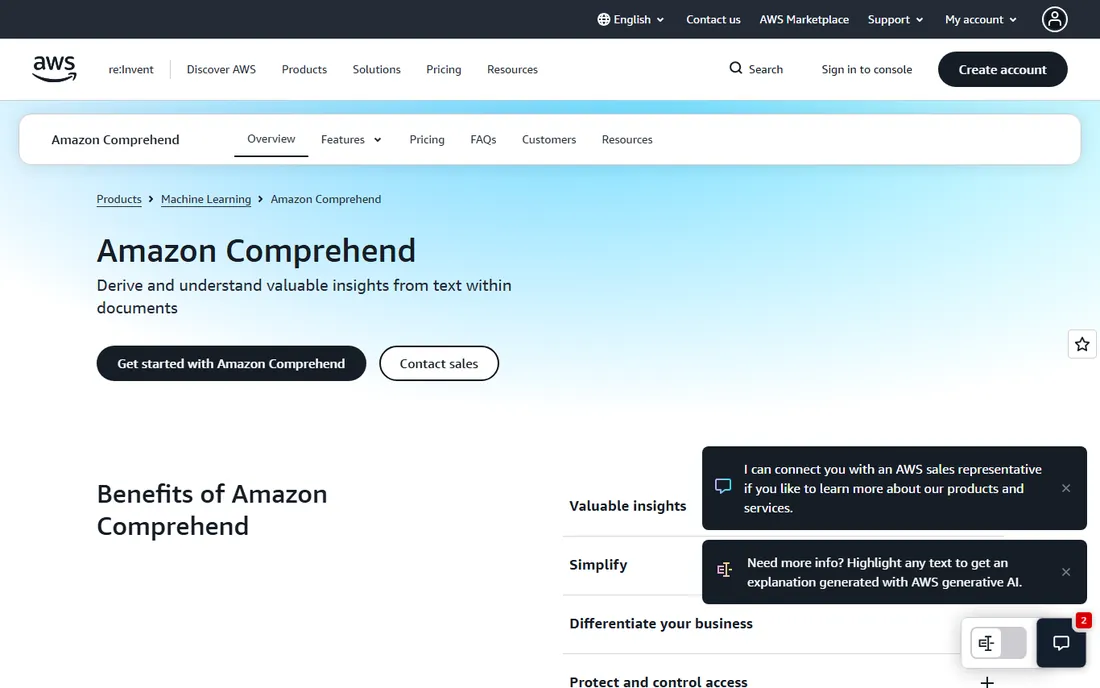
Amazon Comprehend fits teams already living inside AWS. It reads documents, support tickets, product reviews, emails and social media feeds, then returns sentiment, key phrases, entities, topics and language, all through pre-trained models that need no training data. When the pre-trained models miss your domain vocabulary, you can train custom classifiers and custom entity recognizers with your own labeled documents. The PII detection API finds social security numbers, credit card numbers and email addresses and can mask them, which matters for legal and healthcare documents.
The pricing is pure pay-per-use with a 12-month free tier that starts on your first request, so small pilots are cheap. Heavy document volumes get expensive, and the API is opinionated about AWS regions and IAM roles, so non-AWS teams carry integration overhead. Comprehend is a safe default when the question is "analyze this mountain of text" and the answer needs to be running by Friday.
What we like- No ML experience required
- Custom classification and entity recognition
- PII detection and redaction
Watch out for- Usage pricing adds up fast on large volumes
- Tied to the AWS ecosystem
Starting priceSee website (pay per use)
Free planFree trial ($300 credits)
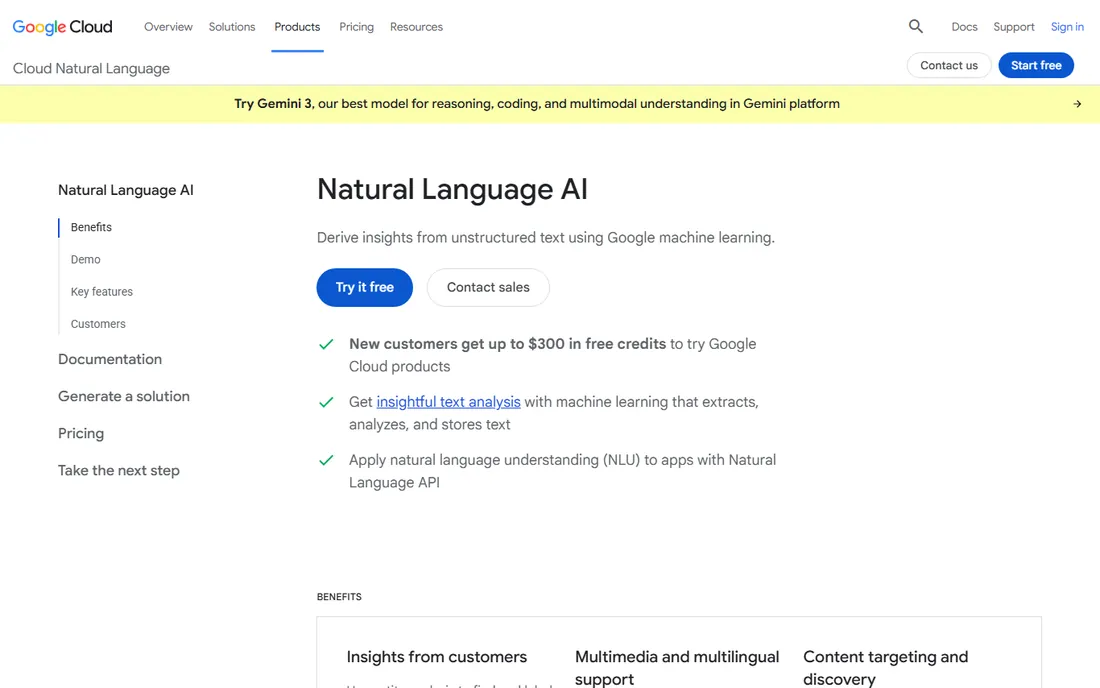
Google Cloud Natural Language is the API you reach for when you want one REST call that returns sentiment, entities, entity-level sentiment, content classification and syntax analysis. The entity sentiment feature is genuinely useful: it tells you not just that a review is negative, but which product feature the negativity targets. Pre-trained models are built on Google's language research, and new customers get up to $300 in free credits to experiment. Pricing is per-unit usage, and Google's pricing page lists the rates per feature.
The catch is architectural. Google is steering developers toward Gemini and Vertex AI for generative use cases, while this API remains the home for classical NLU tasks. That split is fine if your need is clear, but confusing if you are trying to decide where a new project belongs. For teams already on Google Cloud, this is the path of least resistance to entity extraction and sentiment at scale.
What we like- Strong entity and entity-sentiment analysis
- Content classification out of the box
- $300 in free credits for new customers
Watch out for- Usage-based pricing is opaque until you run real volume
- Multilingual support varies by feature
Starting priceSee website (pay per use)
Free planFree trial (Azure free credits)
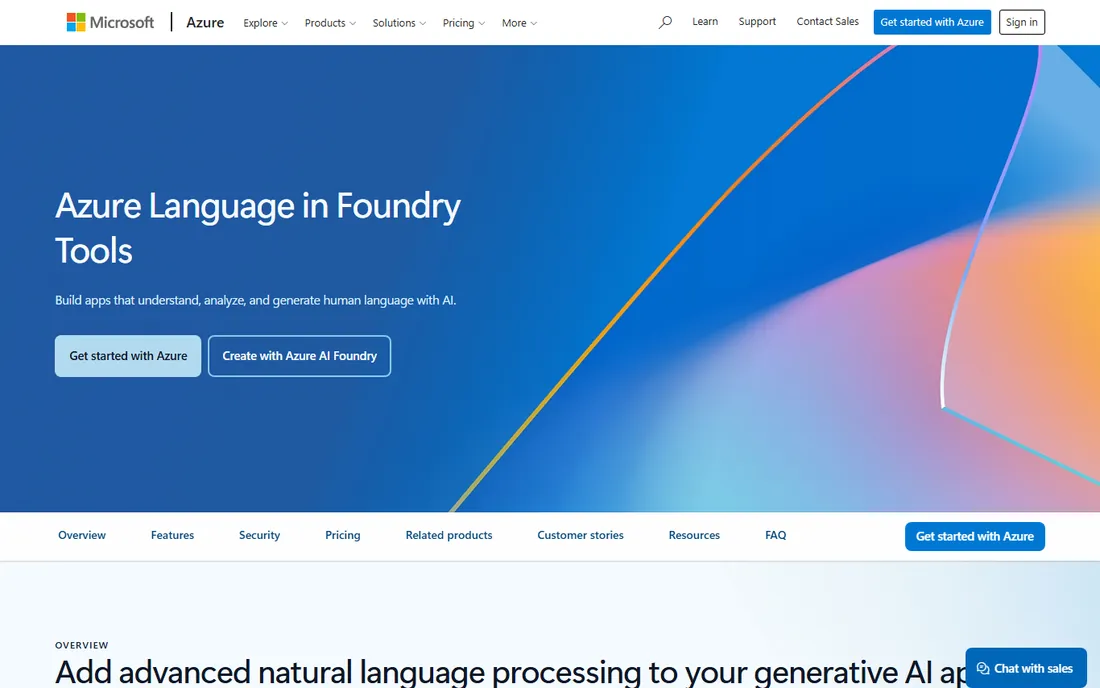
Azure AI Language, now branded as Azure Language in Foundry Tools, unifies what used to be Text Analytics, QnA Maker and LUIS. That history matters: conversational language understanding (CLU) for intent classification and custom question answering make it the strongest choice on this list for chatbot and virtual-assistant projects. Preconfigured features like named entity recognition, sentiment with opinion mining, PII detection and summarization work with no training, while customizable features let you train models on your own data.
Be aware of the retirement timeline baked into the docs: QnA Maker was retired October 31, 2025, and LUIS portal access ended the same day with full LUIS shutdown by March 31, 2026. Migrating projects need to move to custom question answering and CLU. If your stack is already Microsoft-centric, the SDKs for Python, C#, Java and JavaScript make adoption smooth.
What we like- Conversational language understanding for bots
- Custom question answering
- PII redaction and text analytics for health
Watch out for- Rebrand to "Azure Language in Foundry Tools" confuses the docs
- QnA Maker and LUIS retirements force migrations
#4
IBM Watson Natural Language Understanding
Best for: Emotion and concept analysis in regulated industries
Visit ibm.com
Starting priceFrom $0.003 per NLU item
Free planYes
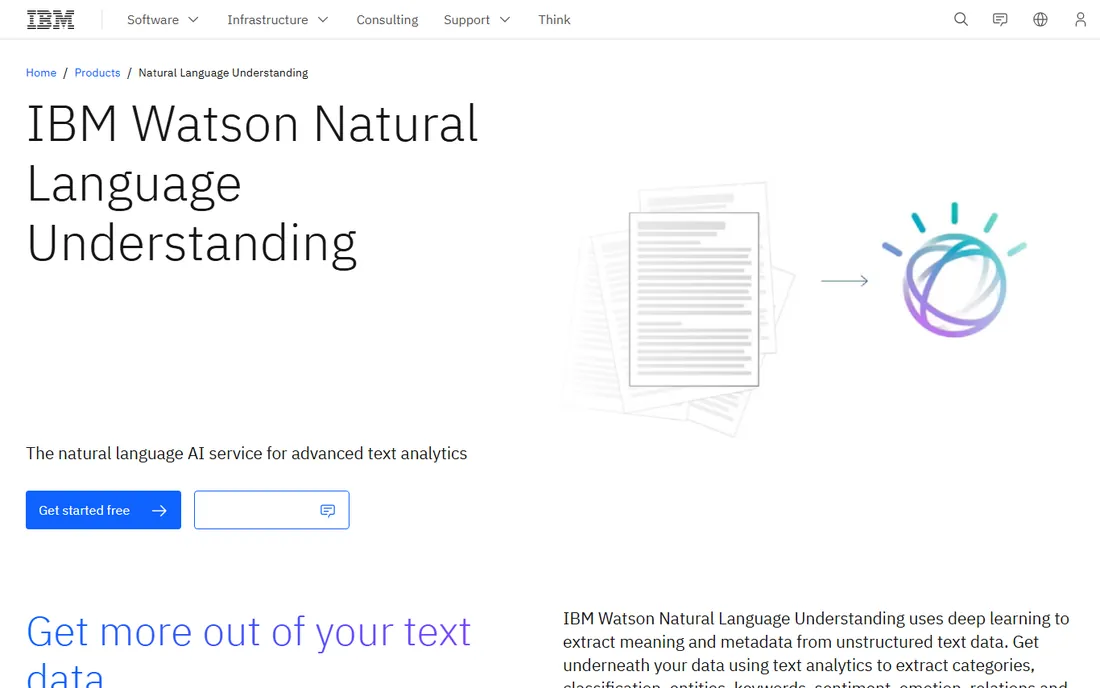
Watson Natural Language Understanding goes further than sentiment. It extracts entities, keywords, categories, concepts, relations, semantic roles and emotions such as joy, anger, sadness and fear, which makes it a fit for voice-of-customer programs and regulated industries that need on-premise deployment behind a firewall. Custom models trained with Watson Knowledge Studio let it learn your industry's vocabulary. The Lite plan is generous for a proof of concept: 30,000 NLU items and one custom model per calendar month, perpetually free, while the Standard plan starts at $0.003 per item above 5 million items per month.
Forecasting cost is the weak point. "NLU items" is its own unit of measurement, and custom classification models carry extra fees, so the bill depends on feature mix in a way the other cloud APIs mostly avoid. For teams that need emotion analysis, native-language nuance or hybrid deployment, the extra complexity is often worth it.
What we like- Emotion and concept extraction most APIs skip
- Lite plan with 30,000 NLU items per month free
- Deploy behind your own firewall
Watch out for- Item-based pricing is hard to forecast
- Custom model pricing adds up
Starting priceFree
Free planYes (open source)
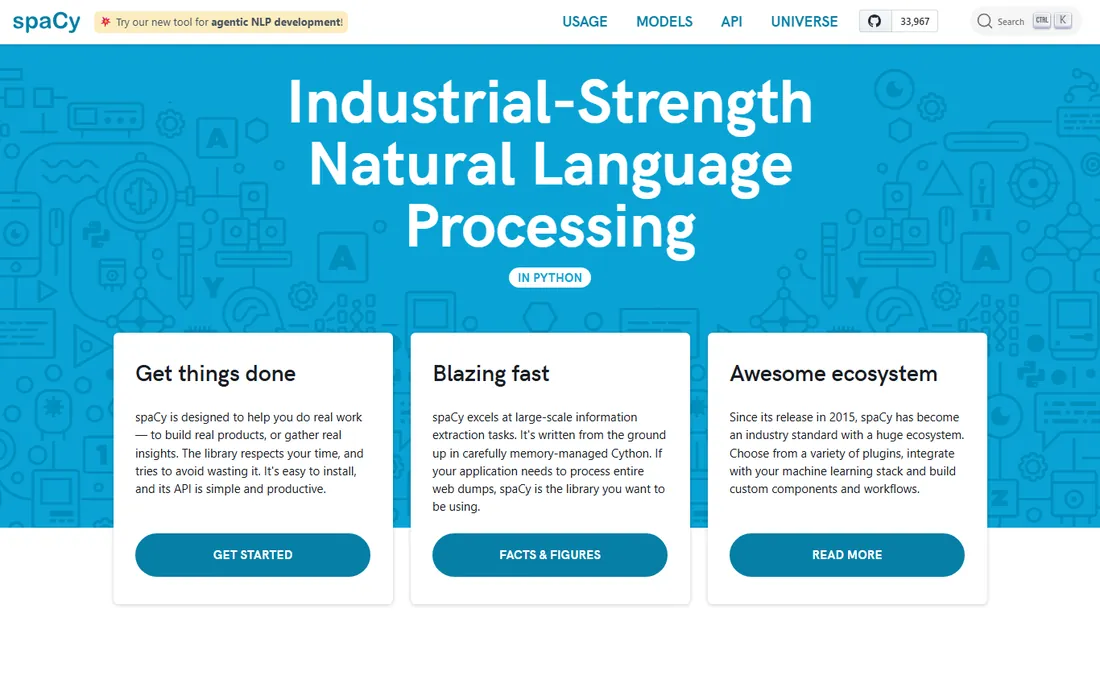
spaCy is the open-source library that most production NLP pipelines in Python are built on. It ships with 84 trained pipelines across 25 languages, supports 75+ languages overall, and offers transformer-based pipelines such as en_core_web_trf that bring accuracy close to the state of the art, plus CPU-optimized pipelines that trade accuracy for cheap inference. Tokenization, named entity recognition, part-of-speech tagging, dependency parsing, text classification, lemmatization and entity linking are all included, and the training system is designed for reproducible experiments you can version and deploy.
The price is zero and the license is MIT, which means no per-call fees and no data leaving your network. The tradeoff is that you own everything: training data, GPU or CPU costs, model updates and monitoring. spaCy is the right call when document volumes are huge, latency matters or compliance forbids sending text to a third-party API. Pair it with Hugging Face models for tasks like sentiment that spaCy does not ship out of the box.
What we like- Fast, production-ready pipelines in 75+ languages
- Transformer-based models with near state-of-the-art accuracy
- MIT license with a huge plugin ecosystem
Watch out for- You build and maintain the infrastructure
- No sentiment or entity-sentiment model out of the box
Starting priceSee website
Free planYes
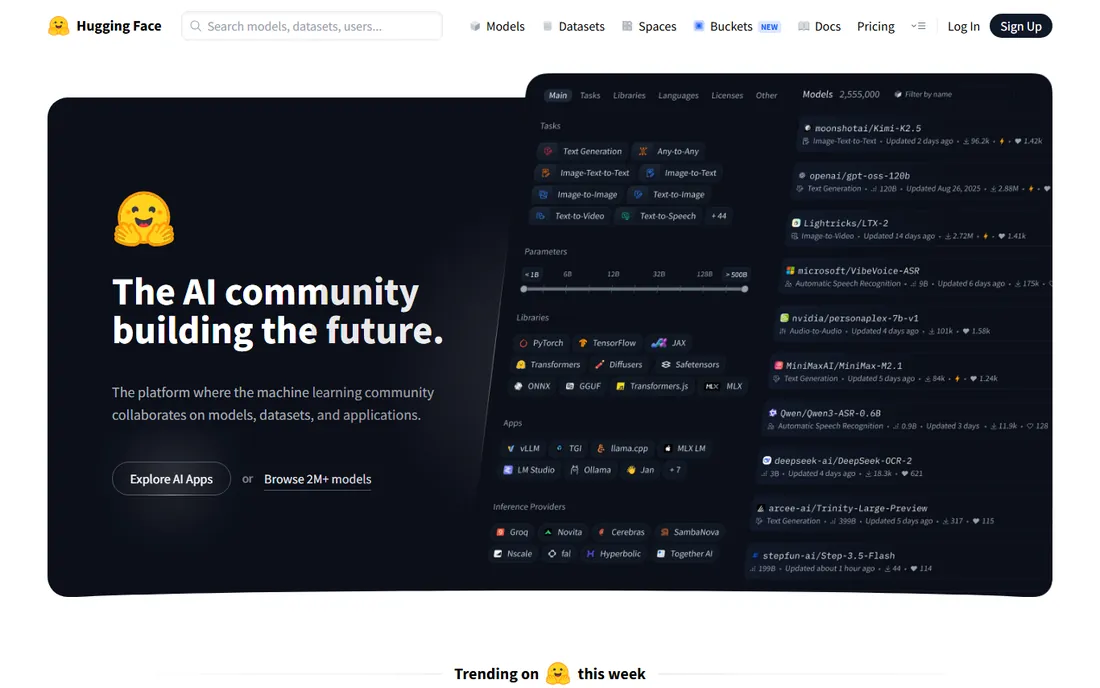
Hugging Face is the platform where modern NLP happens. The Transformers library gives you pre-trained models like BERT, GPT and T5 in a few lines of code for text classification, sentiment analysis, question answering, summarization and translation, and the Hub hosts hundreds of thousands of community and vendor models you can download, fine-tune and share. Sharing and using public models is free, and Inference Providers let you call 45,000+ models through one unified API. Paid Compute and Enterprise tiers add security, access controls and dedicated support.
The hub's scale is both the appeal and the risk: model cards vary in quality and documentation, so you still need to evaluate candidates on your own data. Hugging Face is the best NLP tool ecosystem for teams that want to fine-tune open models rather than pay per API call, and it pairs naturally with spaCy pipelines in production systems.
What we like- The largest library of open transformer models
- Transformers library makes state-of-the-art models one pip install away
- Hosted Inference API for quick tests
Watch out for- Production deployment and enterprise security are paid
- Model quality varies across the public hub
Starting priceFree
Free planYes (open source)
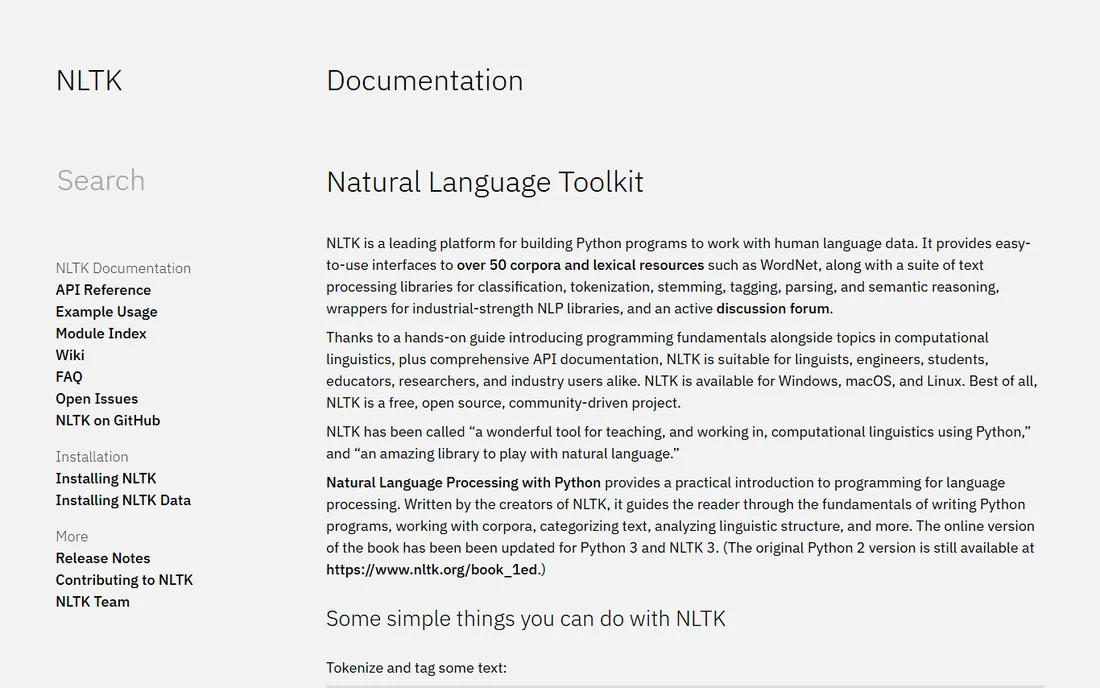
The Natural Language Toolkit has been the standard way to learn NLP in Python since 2001. It wraps classification, tokenization, stemming, tagging, parsing and semantic reasoning in easy interfaces, ships with access to more than 50 corpora and lexical resources including WordNet, and is backed by the free book Natural Language Processing with Python. It runs on Windows, macOS and Linux and costs nothing.
NLTK is not a production engine. It is slower than spaCy and organized around teaching concepts rather than throughput. Use it to prototype, to learn what tokenization or named entity recognition actually does before committing to a platform, and to build one-off research scripts. When the prototype proves the value, graduate to spaCy or a cloud API.
What we like- Free and open source
- Interfaces to 50+ corpora and lexical resources like WordNet
- Gentle on-ramp for learning NLP
Watch out for- Slower than spaCy on large volumes
- Designed for teaching and research, not production
Starting priceSee website
Free planNo
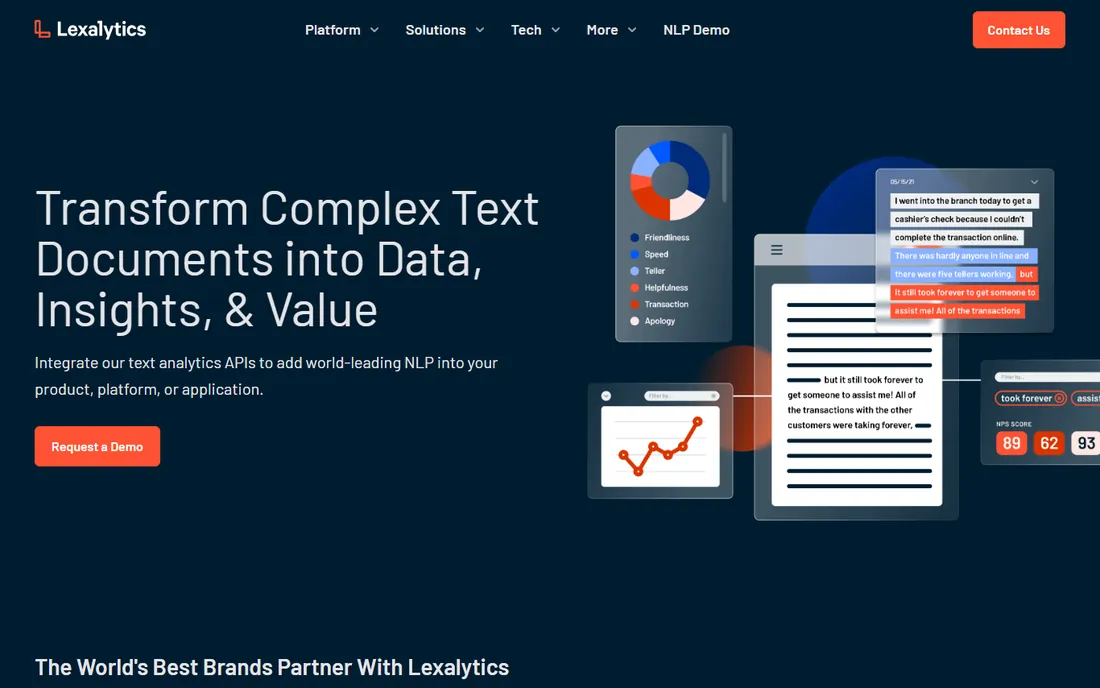
Lexalytics, now an InMoment company, sells the Salience text analytics engine for teams that cannot or will not send text to a public cloud API. Deployment options span on-premise, private cloud, hybrid and public cloud, and the platform covers sentiment analysis, categorization, entity extraction, intention detection, themes and summarization with native-language support for 29 languages, which avoids the accuracy loss of machine translation before analysis. Industry packs pre-tune the models for verticals, and Semantria wraps the same engine in a RESTful API for cloud-based delivery.
This is an enterprise buy with quote-based pricing and no free tier, so it fits data analytics companies and enterprise analyst teams rather than startups. The honest catch is process overhead: expect demos, scoping calls and procurement timelines. In exchange you get one of the most configurable text analytics stacks on the market, tuned to your taxonomy instead of a vendor's generic one.
What we like- Deploy on-premise, private cloud or hybrid
- Native-language analysis in 29 languages
- Tunable with custom entities and taxonomies
Watch out for- Enterprise sales process
- No self-serve pricing or free tier
How we chose
We started from the vendor pricing pages and documentation for every tool on this list, checking which products are actively maintained and which have been folded into something else. MonkeyLearn, once a popular no-code text analysis platform, now redirects to Medallia after its acquisition, so it was removed rather than listed as a living product. Public review sources including G2, Capterra and Slashdot comparisons confirmed which tools buyers actually evaluate side by side, and Reddit threads helped surface the practical split between teams that want an API and teams that want a library. We weighted documentation quality, deployment flexibility, language coverage and fit for small to mid-size company budgets, and we excluded any tool whose homepage could not be verified. Nothing here reflects hands-on testing; it reflects what vendors publish and what users report.
The loudest divide in this market is not between vendors but between renting and building. Cloud APIs from AWS, Google, Microsoft and IBM get you from zero to working text analysis in an afternoon, and that speed is worth the per-unit pricing when your document volume is moderate or your team has no ML engineers. The open-source trio on this list changes the math. spaCy handles the pipeline, Hugging Face supplies the models, and NLTK teaches the concepts. Together they cover almost everything the cloud APIs do, with two advantages the APIs cannot match: your text never leaves your infrastructure, and your marginal cost per document trends toward zero as volume grows.
That is why the decision usually comes down to volume and compliance. A support team classifying 10,000 tickets a month should almost certainly start with a cloud API free tier. A company processing millions of documents a year with regulatory constraints on data residency should build on spaCy and Hugging Face from the start. Many teams land in the middle: prototype with a cloud API, then move the steady-state workload to open source once the patterns are stable and the monthly API bill is visible.
Start by naming the task, because NLP is a bundle of different jobs. Sentiment analysis for reviews and surveys is the most commoditized task and every tool here does it, though entity-level sentiment on Google Cloud and emotion detection on Watson add useful depth. Named entity recognition, pulling people, places, companies and products out of text, is where spaCy and the cloud APIs shine. Topic modeling, classification and summarization push you toward trainable models, either custom models on a cloud API or fine-tuned transformers from Hugging Face. Content classification with predefined taxonomies is a strength of Google Cloud NL and Lexalytics.
Language coverage deserves its own line item. Most tools handle English well, but accuracy drops in other languages. Lexalytics processes 31 languages natively without machine translation, and spaCy ships trained pipelines for 25 languages with tokenization support for 75+. If your documents are multilingual, test your actual languages on your actual documents before signing anything.
Then weigh the operational questions. Who maintains the models when language drifts, as it always does. Where does the text live, and can it legally cross borders or sit on a vendor's servers. Whether per-unit pricing stays sane at your volume: back-of-envelope math with the free tiers is worth an afternoon. Finally, check integrations. The cloud APIs plug into their respective ecosystems, spaCy and Hugging Face plug into any Python stack, and Lexalytics offers both libraries and a REST API. Pick the deployment shape that matches the team you have, not the team you wish you had.
Frequently asked questions
What is the best NLP software for a small business with no data science team?
A cloud API with pre-trained models is the safest start. Amazon Comprehend, Google Cloud Natural Language and Azure AI Language all work with no ML experience, and each offers a free tier or credits to validate accuracy. Pick the one inside the cloud you already use, since billing and identity management stay simple.
Are open-source NLP tools actually free?
Yes in license cost, no in total cost. spaCy, NLTK and Hugging Face models cost nothing to download and use, but you pay in engineering time, compute and maintenance. At high document volumes they are usually far cheaper than per-call APIs, which is why large-scale pipelines almost always end up open source.
How is NLP software different from a chatbot platform?
NLP software analyzes and extracts structure from text: sentiment, entities, topics, categories. Chatbot platforms generate responses and manage conversations. There is overlap, since Azure's conversational language understanding and modern LLM platforms do both, but if your goal is to understand documents rather than hold conversations, start with the NLP tools on this list.
What happened to MonkeyLearn?
MonkeyLearn was acquired by Medallia, and its domain now redirects to Medallia's experience management platform. The standalone no-code text analysis product is no longer sold separately, which is why it does not appear on this list. Teams that liked its approach should look at cloud NLP APIs or MeaningCloud-style alternatives.
Which tool handles languages other than English best?
Lexalytics offers native analysis in 29 languages without machine translation, and spaCy provides trained pipelines for 25 languages. The big cloud APIs support many languages too, but feature parity varies by language, so verify that the specific feature you need works in the languages your documents use.
How much does NLP API pricing typically cost?
Pricing is usage-based everywhere except the open-source options. IBM Watson NLU publishes $0.003 per NLU item on its Standard plan with a free Lite tier of 30,000 items per month, and Google Cloud offers $300 in new-customer credits. AWS and Azure charge per request with free tiers. Always estimate with your real monthly document volume before committing.
Sources we checked (8)
- https://aws.amazon.com/comprehend/
- https://cloud.google.com/natural-language
- https://azure.microsoft.com/en-gb/products/ai-foundry/tools/language
- https://www.ibm.com/cloud/watson-natural-language-understanding
- https://spacy.io/
- https://huggingface.co
- https://nltk.org/
- https://lexalytics.com/
Is your product missing or out of date?
We review this list regularly. Vendors can request a listing, send updated pricing or ask about featured placement.

Shihab Mia · Founder, Rankite
Shihab has spent more than a decade helping SaaS and e-commerce brands grow through search. He writes Rankite's software buying guides from pricing pages, documentation and public user reviews. More about Shihab.