How we make this list: we compare pricing pages, product documentation and public user reviews. Rankite is independent; if a vendor ever pays for a featured spot, that listing is clearly labeled Partner.
Key takeaways
- LogicGate leads for flexible no-code risk workflows, while Optro (formerly AuditBoard) suits audit-connected risk teams.
- Archer, MetricStream, and Riskonnect are the enterprise heavyweights for global, multi-framework GRC programs.
- ServiceNow IRM fits organizations already on the Now Platform who want risk embedded in daily workflows.
- LogicManager and StandardFusion offer more accessible on-ramps for mid-market teams.
Quick comparison
| Tool | Best for | Starting price | Free plan |
|---|
 LogicGate LogicGate | flexible no-code risk workflows | See website | No |
 Optro Optro | audit-connected risk and compliance | See website | No |
 MetricStream MetricStream | global multi-domain GRC programs | See website | No |
 Archer Archer | regulated enterprises needing depth | See website | No |
 ServiceNow IRM ServiceNow IRM | existing ServiceNow customers | See website | No |
 Riskonnect Riskonnect | integrated risk across the enterprise | See website | No |
 LogicManager LogicManager | mid-market teams with advisory support | See website | No |
 StandardFusion StandardFusion | smaller GRC teams needing a faster start | See website | No |
Is your product missing or out of date?
We review this list regularly. Vendors can request a listing, send updated pricing or ask about featured placement.
The best enterprise risk management software
Who actually owns risk in your organization? The honest answer in most companies is "everyone and no one": the board wants a unified risk picture, compliance teams reconcile overlapping frameworks in spreadsheets, and IT security runs its own program. The best ERM software, and the best risk management software more broadly, replaces that fragmentation with one connected view. Here are the eight platforms worth evaluating in 2026.
Starting priceSee website
Free planNo
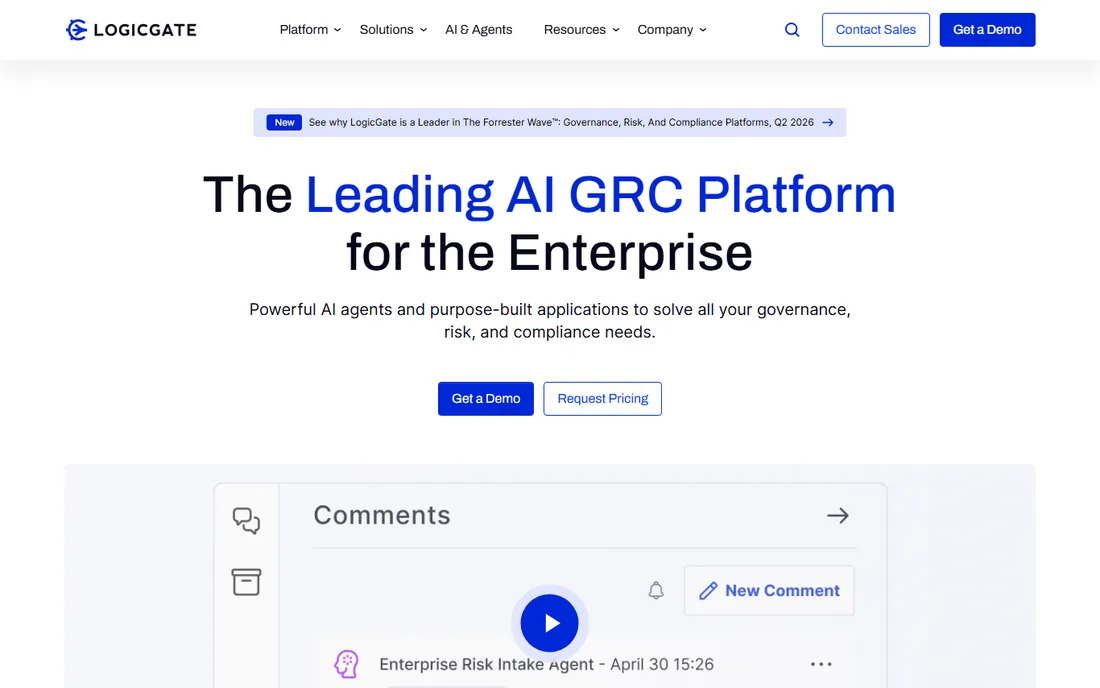
LogicGate is the flexible option in this list. Its Risk Cloud platform lets risk teams design assessment workflows, control mappings, and reporting with drag-and-drop configuration instead of consultants and code, a difference that showed up in its Forrester Wave Leader recognition. The company has leaned hard into AI GRC: its 2026 releases added agentic capabilities, and it moved its public site to logicgate.ai to reflect the direction.
The Chicago-based vendor, backed by PSG since 2021, partners closely with firms like PwC on AI-powered GRC delivery. For risk teams that know their process will change and want a platform that changes with it, LogicGate is the most adaptable choice among the leaders.
What we like- No-code drag-and-drop risk workflow builder
- Leading AI GRC platform with agentic capabilities
- Pre-built applications for common GRC processes
Watch out for- Less suited to teams wanting rigid out-of-the-box content
- Pricing requires a sales conversation
Starting priceSee website
Free planNo
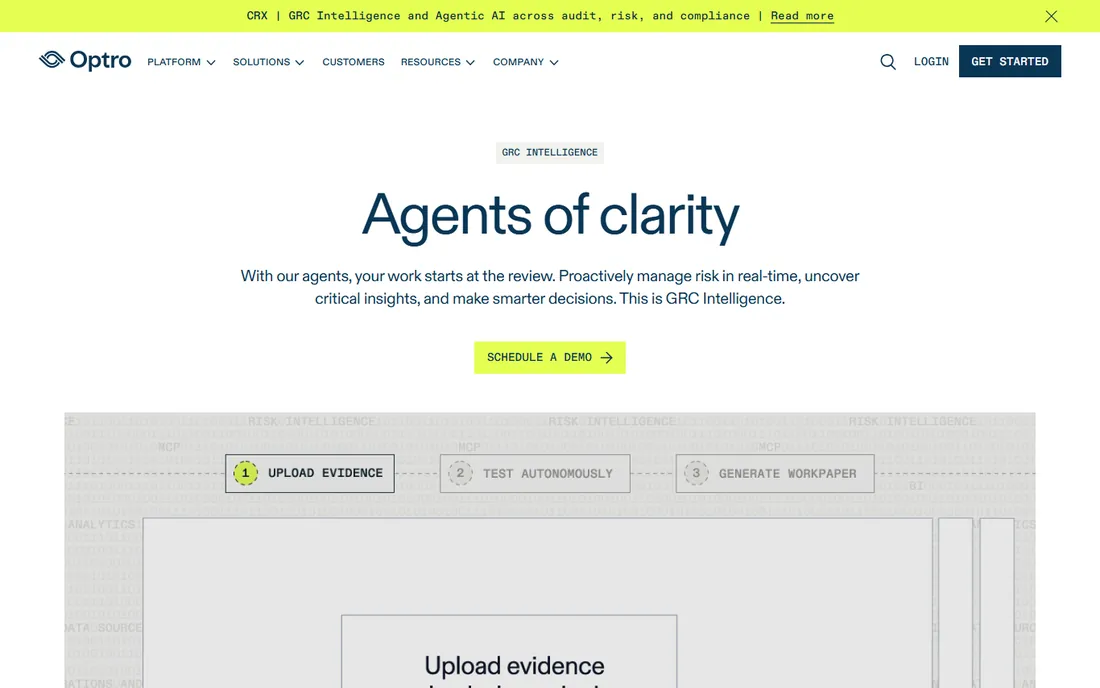
Optro is the new name for AuditBoard, which rebranded in 2026 as AI reshaped the GRC category. The platform unifies audit, risk, and compliance on a GRC Intelligence Platform, and its customer base of more than half the Fortune 500 gives it the deepest reference network in this comparison. Analyst recognition includes the 2025 Gartner Magic Quadrant Leader placement and a seventh consecutive Deloitte Technology Fast 500 listing.
Partnerships with EY, Crowe, and A-LIGN extend it into regulatory change management and CMMC readiness. Its 2026 Risk Intelligence Report found that 85 percent of enterprises have deployed AI while only a quarter have full visibility into it, a theme its agentic governance features address directly. Teams whose risk program grows out of internal audit will find Optro the most natural fit.
What we like- Trusted by more than 50% of the Fortune 500
- Leader in the 2025 Gartner Magic Quadrant for GRC Tools
- Strong audit-to-risk connection
Watch out for- Enterprise pricing
- Newer Optro branding may confuse long-time AuditBoard users
Starting priceSee website
Free planNo
MetricStream describes itself as the world's largest independent GRC provider, and the numbers back the claim: over a million GRC professionals across 35+ countries use its products, with headquarters in San Jose. The platform covers risk, compliance, audit, CyberGRC, third-party risk, and resilience on a single low-code/no-code cloud, with industry-specific products and AI agents layered on top.
For global organizations juggling SOX, ISO, GDPR, and dozens of regional frameworks, the appeal is cross-framework coverage with a single control taxonomy. Pricing is custom and typically runs into the hundreds of thousands per year for global rollouts. If your risk program spans continents and business units, short-list MetricStream.
What we like- AI-first GRC across risk, compliance, audit, and cyber on one low-code platform
- 1 million+ GRC professionals in 35+ countries
- Deep financial services footprint
Watch out for- Large implementations need serious resourcing
- Best value at enterprise scale
Starting priceSee website
Free planNo
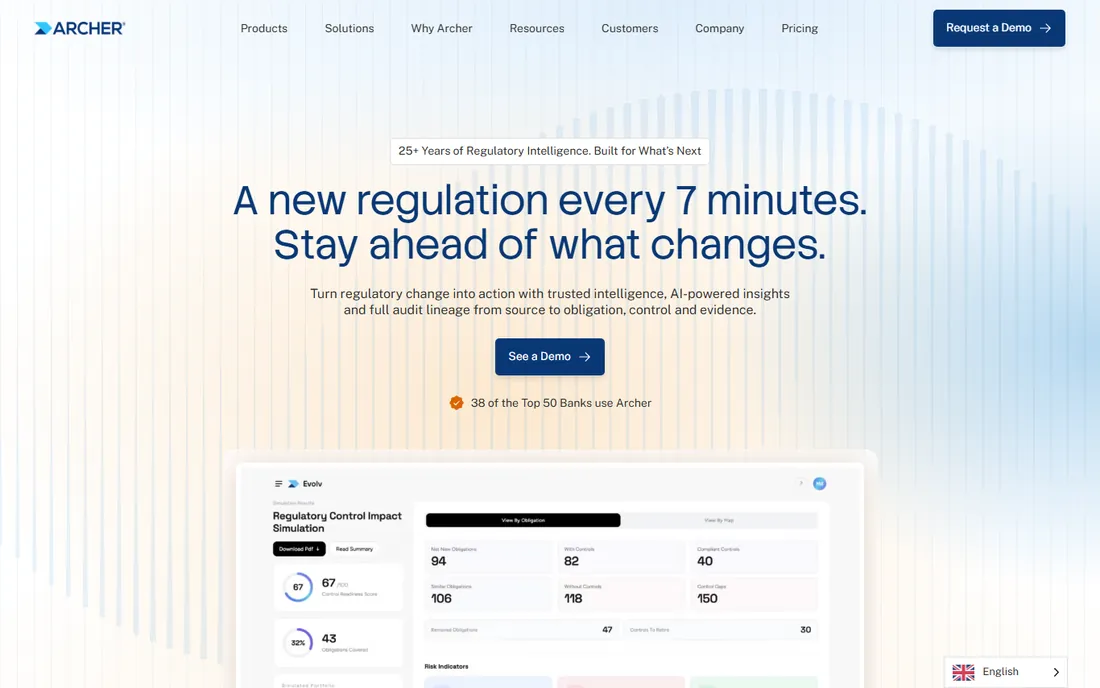
Archer, long known as RSA Archer and now an independent company, is the veteran of enterprise GRC. Its strengths are depth and flexibility: 80 percent of its customers manage multiple risk domains on the platform, the Archer Exchange provides prebuilt regulatory content from authoritative sources, and risk quantification tools tie exposure to dollar-value impact for board reporting.
It remains one of the few enterprise options supporting full on-premises installation alongside SaaS, which matters for data sovereignty requirements and public sector agencies. The catch is resourcing: reviewers consistently note that Archer needs dedicated administrators and implementation partners. For regulated industries with mature, multi-domain programs, nothing beats its coverage.
What we like- One of the few enterprise platforms supporting full on-premises deployment
- Prebuilt content for ISO 27001, NIST, PCI DSS, GDPR, DORA
- Financial risk quantification
Watch out for- Implementation complexity exceeds what small teams need
- Needs dedicated platform administrators
Starting priceSee website
Free planNo
ServiceNow Integrated Risk Management takes a different position than the standalone platforms: instead of pulling risk work into a separate system, it embeds controls, assessments, and remediation into the Now Platform workflows your teams already use for IT service, HR, and security operations. The result is a common risk language across the enterprise and real-time visibility without a parallel bureaucracy.
For organizations already standardized on ServiceNow, the marginal cost and friction of adding IRM is far lower than adopting a standalone platform. For everyone else, it is an expensive reason to adopt the Now Platform. Choose it when your ServiceNow footprint is large and growing.
What we like- Risk embedded in the workflows employees already use
- Deep integration with IT, HR, and security
- Real-time visibility on one platform
Watch out for- Full value requires being on the Now Platform
- Enterprise pricing
Starting priceSee website
Free planNo
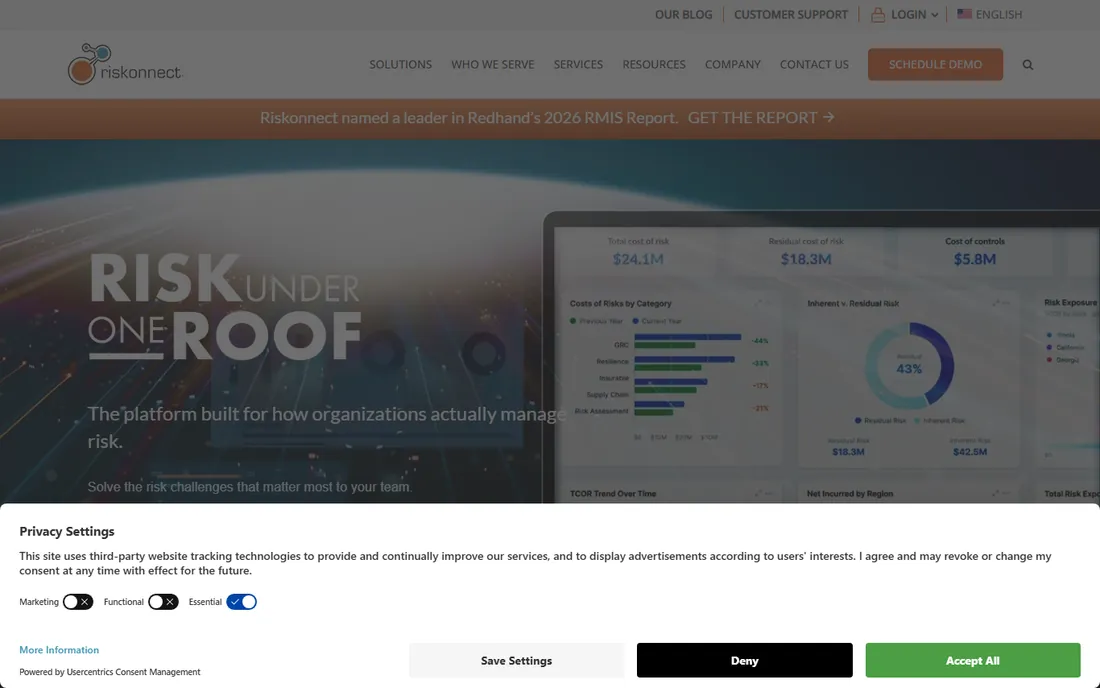
Riskonnect has built one of the broadest integrated risk management platforms in the industry, serving more than 2,500 customers from its Atlanta headquarters. Its distinctive technology correlates risk data across domains, so an incident in health and safety, a third-party event, and a compliance finding show up as one picture rather than three reports. The 2022 Sword GRC acquisition added project risk management to the suite.
The platform covers enterprise risk, audit, compliance, claims, business continuity, health and safety, and ESG. That breadth makes it a strong single-vendor answer for large organizations that currently run risk data in silos, as Southwest Airlines discovered when it consolidated injury, illness, and incident reporting on the platform in 2026.
What we like- 2,500+ customers across six continents
- Risk-correlation technology connecting disparate risk data
- Strong in health and safety, claims, and resilience
Watch out for- Broad suite can feel large for single-domain buyers
- Custom pricing
Starting priceSee website
Free planNo
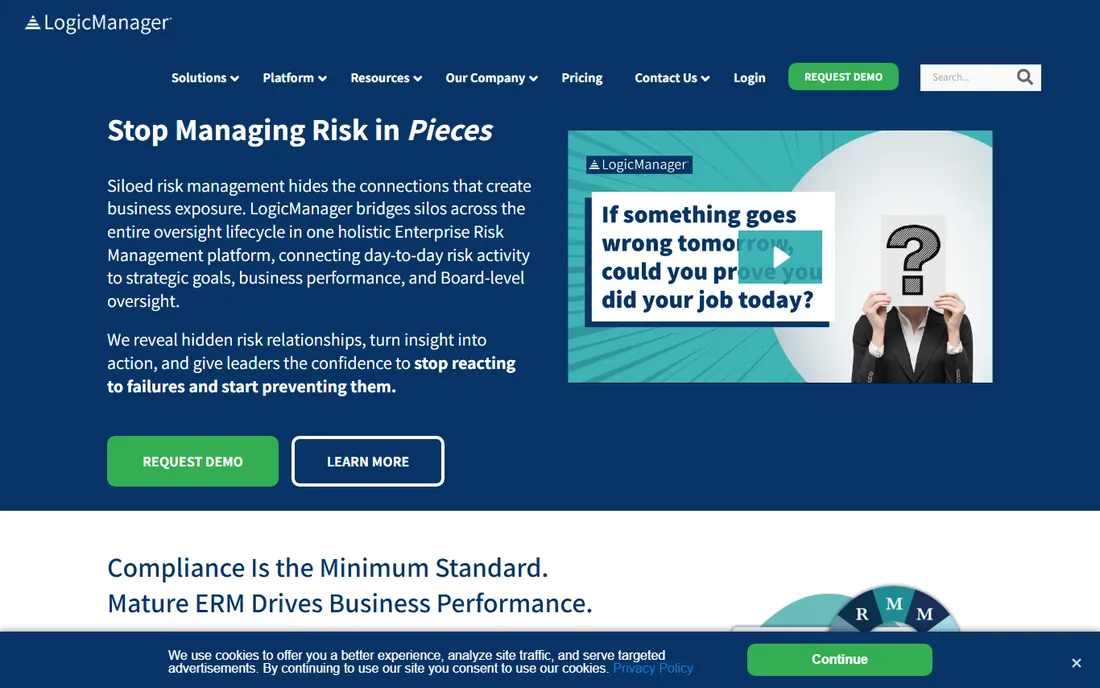
LogicManager has focused on enterprise risk management since 2005 from its Boston base, and its differentiator is service: unlimited advisory analyst support comes included, which is why the company earned a perfect 5.0 in customer feedback from Forrester. The platform connects risks, controls, policies, and incidents through a patented taxonomy so one control update ripples everywhere it applies.
For mid-market companies and heavily regulated smaller organizations like banks and healthcare providers, LogicManager offers a connected risk program without the implementation army the enterprise suites require. If you want a partner as much as a platform, it belongs on your short list.
What we like- Advisory analyst support included at no extra cost
- No-code integrations with 50+ applications
- Patent-pending taxonomy connecting all risk areas
Watch out for- Smaller vendor footprint than MetricStream or Archer
- Fewer prebuilt regulatory content packs
Starting priceSee website
Free planNo
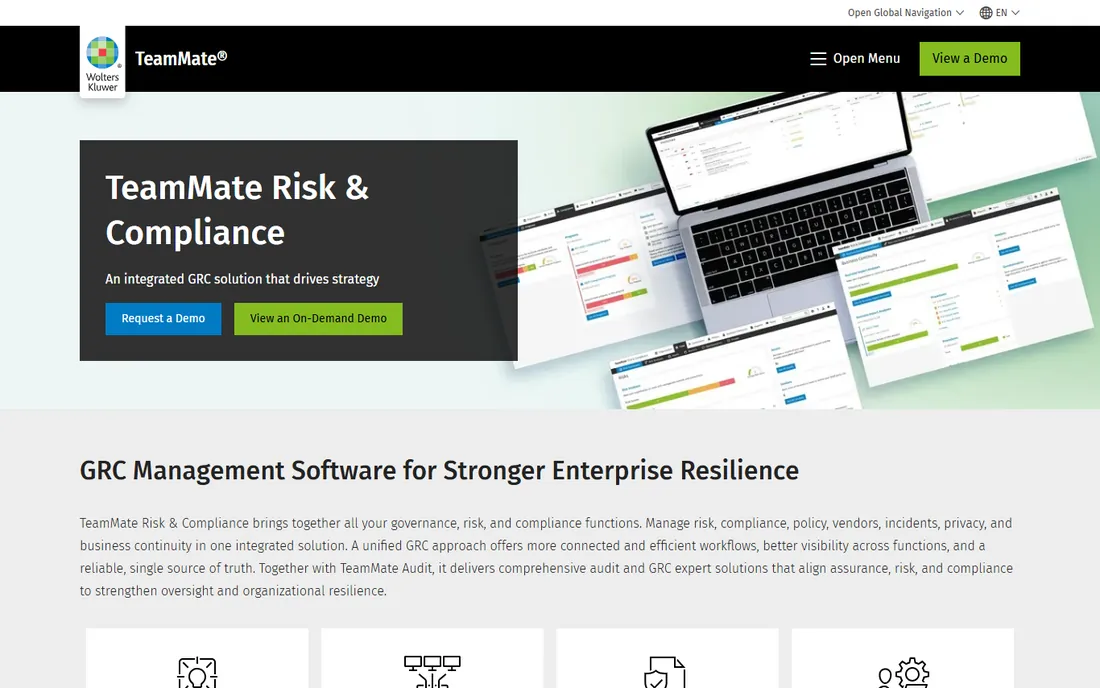
StandardFusion is the smaller, friendlier face of GRC on this list. The Canadian vendor's cloud and on-premises platform covers risk management, audit, compliance, and ISO frameworks with a unified view aimed at teams that need real GRC without enterprise-suite overhead. Third-party listings place it around $1,800 per month, a fraction of what the enterprise platforms charge.
One caveat worth knowing: StandardFusion is now TeamMate, part of Wolters Kluwer, and the standardfusion.com homepage reflects that transition. Expect integration into the TeamMate family over time. For smaller GRC teams that want to start structured risk management quickly, it remains one of the most approachable options available.
What we like- Accessible all-in-one GRC for risk, audit, and compliance
- Cloud and on-premises deployment options
- Strong value for the feature set
Watch out for- Now part of Wolters Kluwer TeamMate, so expect platform changes
- Less suited to massive global rollouts
How much does ERM software cost?
Expect custom quotes, because pricing scales with frameworks, entities, modules, and users. Industry analysis puts mid-market deployments at roughly $75,000 to $250,000 per year, while enterprise suites from ServiceNow, Archer, and MetricStream routinely run $300,000 to over $1.5 million for global rollouts, with implementation often equaling the first-year license. Smaller tools like StandardFusion run in the low thousands per month. Budget for implementation separately: it is frequently as large as the subscription.
How to choose ERM software
Match the tool to your risk program's maturity, not your ambitions. A team running its first enterprise risk register needs a configurable platform it can actually staff, not the deepest regulatory content library on earth. Larger programs need the opposite: audit-committee-ready reporting and multi-framework mapping without manual rework.
Ask who will administer it
The biggest implementation risk is staffing. Archer and MetricStream need dedicated administrators; LogicGate and LogicManager were built to reduce that burden; ServiceNow IRM needs your existing platform team. Be honest about what your team can run before you buy.
Check board-reporting output natively
Every vendor promises dashboards. Ask to see the actual board and audit-committee reports the product generates without manual reformatting in Excel or PowerPoint. The difference between native output and exported raw data is worth weeks of work per quarter.
Map your frameworks once, use them everywhere
If your compliance team juggles SOX, HIPAA, NIST, and ISO, insist on a live demo of cross-framework control mapping where one test satisfies multiple requirements. This single feature determines whether the platform reduces work or just moves it.
How we chose
We compared ERM and GRC platforms against the needs of mid-size and enterprise US companies, weighing risk register and scoring depth, board-ready reporting, multi-framework compliance mapping, AI capabilities, integration ecosystems, and analyst and user reviews from Gartner, Forrester, G2, and industry publications. We included both enterprise suites and more accessible mid-market options. Pricing was confirmed on vendor sites or reputable industry sources; most ERM vendors quote custom pricing. We did not test any of these tools hands-on.
Frequently asked questions
What is ERM software?
Enterprise risk management software helps organizations identify, assess, quantify, and monitor risks across operations, IT, third parties, and compliance, turning scattered data into risk registers, heat maps, scoring, and board-level dashboards.
What is the difference between ERM and GRC software?
The categories overlap heavily. GRC is the broader discipline covering governance, risk, and compliance, including audit and policy. ERM specifically emphasizes enterprise-wide risk identification and consolidation. Most platforms here serve both, but ERM-focused tools prioritize risk registers and board reporting over compliance certification.
What is the best ERM software?
It depends on your needs. LogicGate is best for flexible no-code workflows, Optro for audit-connected risk, ServiceNow IRM for ServiceNow shops, Archer for complex regulated environments, and MetricStream for global multi-domain programs.
How much does ERM software cost?
Mid-market deployments typically run $75,000 to $250,000 per year, while enterprise suites can exceed $1.5 million annually for global rollouts. Smaller tools like StandardFusion cost a few thousand dollars per month. Implementation is usually billed separately.
Can ERM software automate regulatory compliance?
Yes. Modern platforms automate evidence collection, policy management, control testing, compliance reporting, audit preparation, and regulatory monitoring, often mapping one control test to multiple frameworks.
Do we need a dedicated administrator for ERM software?
For enterprise suites like Archer and MetricStream, usually yes. Lighter platforms like LogicGate and LogicManager are designed to run with smaller teams, and LogicManager includes advisory support in the package.
Sources we checked (10)
- https://logicgate.ai/
- https://optro.ai/
- https://metricstream.com
- https://archerirm.com/
- https://www.servicenow.com
- https://riskonnect.com/
- https://logicmanager.com/
- https://standardfusion.com/
- https://optro.ai/blog/best-enterprise-risk-management-software
- https://kurums.com/best-enterprise-risk-management-software-2026-comparison/
Is your product missing or out of date?
We review this list regularly. Vendors can request a listing, send updated pricing or ask about featured placement.

Shihab Mia · Founder, Rankite
Shihab has spent more than a decade helping SaaS and e-commerce brands grow through search. He writes Rankite's software buying guides from pricing pages, documentation and public user reviews. More about Shihab.