How we make this list: we compare pricing pages, product documentation and public user reviews. Rankite is independent; if a vendor ever pays for a featured spot, that listing is clearly labeled Partner.
Key takeaways
- From April 2026, sole traders and landlords with income over £50,000 must file quarterly updates through HMRC-recognised software; the threshold drops to £30,000 from April 2027.
- FreeAgent, Clear Books, and QuickFile are the strongest picks for sole traders, with free or low-cost routes to full MTD for Income Tax compliance.
- Xero, QuickBooks, and Sage suit growing businesses and those who want payroll, multi-currency, or accountant collaboration in the same package.
- Crunch and TaxCalc serve different buyers: Crunch pairs software with real accountants, while TaxCalc is built for accountancy practices filing on clients' behalf.
Quick comparison
| Tool | Best for | Starting price | Free plan |
|---|
 FreeAgent FreeAgent | freelancers and contractors who want Self Assessment filed in-app | £33/month (billed monthly; £27.50/month billed annually) | Free trial (30 days) |
 Xero Xero | growing businesses that work closely with an accountant | See website | No |
 QuickBooks QuickBooks | small businesses wanting UK-specific tax tooling | See website | No |
 Sage Sage | established small businesses that want payroll in the same bill | See website | No |
 Clear Books Clear Books | sole traders who want MTD compliance for nothing | Free (sole-trader MTD plan) | Yes |
 Crunch Crunch | self-employed people who want accountants doing the work | See website | No |
 KashFlow KashFlow | sole traders and small firms that want simple UK bookkeeping | £13.50/month (Starter) | Free trial |
 Zoho Books Zoho Books | micro businesses that want to start free and scale up | Free (paid plans from £12/month) | Yes |
 QuickFile QuickFile | small accounts that want free bookkeeping with MTD filing | Free | Yes |
 TaxCalc TaxCalc | accountants and practices filing for many clients | See website | No |
Is your product missing or out of date?
We review this list regularly. Vendors can request a listing, send updated pricing or ask about featured placement.
The best Making Tax Digital software
#1
FreeAgent
Best for: freelancers and contractors who want Self Assessment filed in-app
Visit freeagent.com
Starting price£33/month (billed monthly; £27.50/month billed annually)
Free planFree trial (30 days)
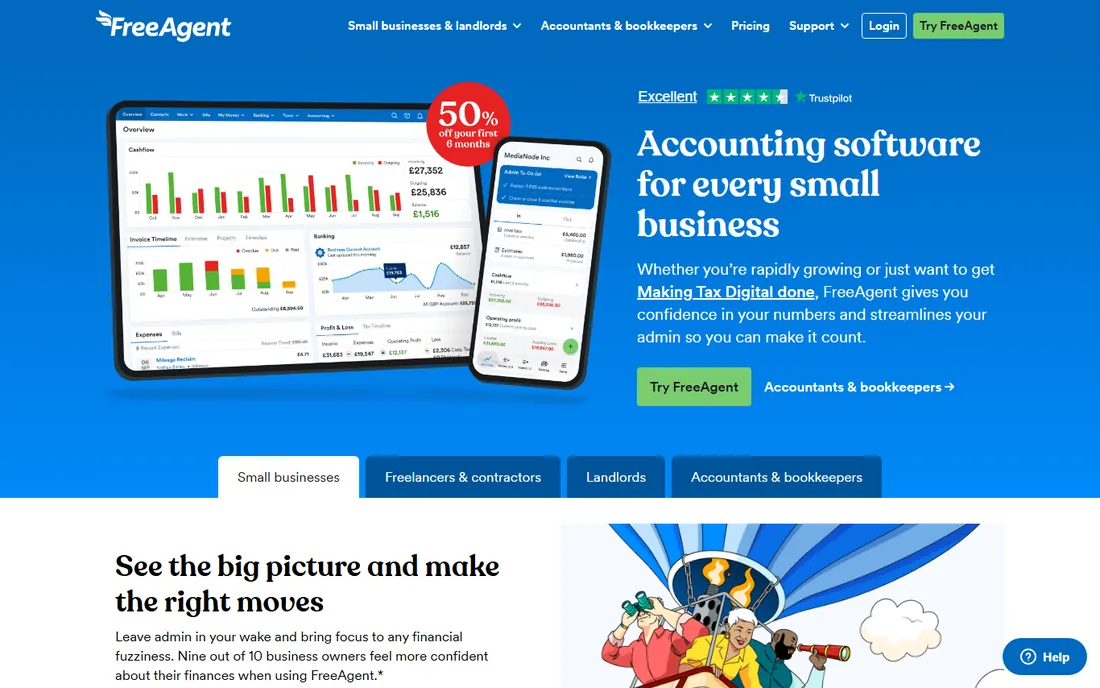
FreeAgent leans harder into tax than most of its rivals: quarterly MTD updates, VAT returns, and your Self Assessment all file directly to HMRC from inside the app, with live tax calculations showing what you owe and when. For a freelancer, that removes the traditional year-end scramble almost entirely.
The standard price is £33 a month billed monthly, or £330 a year billed annually, both excluding VAT, with a 30-day free trial. But check your bank first: holders of NatWest, Royal Bank of Scotland, Ulster Bank, and Mettle business accounts get FreeAgent free, which makes it the cheapest compliant option for a large slice of the self-employed. The trade-off is scope: growing firms with stock, multi-currency, or complex payroll eventually outgrow it.
What we like- Direct Self Assessment and VAT filing to HMRC
- Up-to-date tax calculations and deadline views
- Free for NatWest, RBS, Ulster Bank, and Mettle business customers
Watch out for- Full price is higher than some rivals
- Built for micro-businesses rather than complex operations
- Receipt capture beyond 10 a month costs extra
#2
Xero
Best for: growing businesses that work closely with an accountant
Visit xero.com
Starting priceSee website
Free planNo
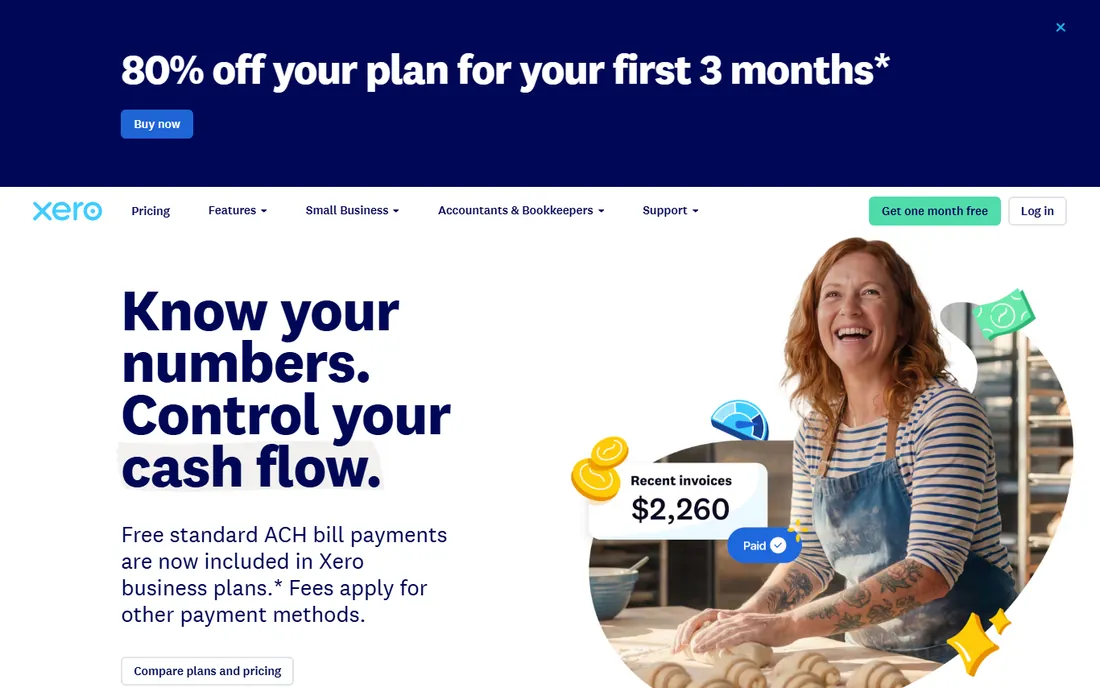
Xero is the safe default for a business that is growing: bank feeds that reconcile themselves, reporting that an accountant can actually work with, and more than a thousand connected apps for payroll, stock, and payments. If your accountant already runs Xero for other clients, onboarding is painless.
The catch is that Xero behaves like accounting software with MTD compliance included, not like tax software. It keeps your records and submits your quarterly updates, but the experience is less hand-holding than FreeAgent or Clear Books for a nervous first-time filer. UK pricing sits across five tiers from Simple to Ultimate, with prices unpublished in plain text on the current page, so expect a sales conversation or a promo code to get started.
What we like- Deep bank feeds and reconciliation
- Huge app marketplace for add-ons
- Accountants know it inside out
Watch out for- Pricing is quote-driven on the current UK page
- Payroll is an add-on
- Entry tiers cap invoices and bills
Starting priceSee website
Free planNo
QuickBooks is the other global giant in this list, and its UK edition carries genuinely local features: Construction Industry Scheme handling, VAT filing to HMRC, and Self Assessment preparation aimed at sole traders and small limited companies. The mobile app is one of the better ones for snapping receipts and logging mileage.
Two caveats. First, the vendor homepage would not load during our research, so treat the URL above as best-evidence rather than address-bar verified. Second, matching the right plan to your filing obligations needs care: entry tiers suit simple sole traders, but VAT-registered businesses often need a step up. Watch for the deep introductory discounts, which revert to full price after six months.
What we like- Strong UK tax features including CIS handling
- Receipt capture and mileage tracking on mobile
- Frequent new-customer discounts
Watch out for- Homepage could not be verified during research
- Plan tiers can push VAT filers upward
- Interface has more upsells than rivals
#4
Sage
Best for: established small businesses that want payroll in the same bill
Visit sage.com
Starting priceSee website
Free planNo

Sage is the veteran UK option, and its pitch is completeness: accounting, VAT, and payroll for at least one employee in a single subscription, with support teams that know HMRC processes cold. For a small employer that wants one vendor and one bill, that bundling has real appeal.
The trade-off is weight. A sole trader with simple income will find Sage more complex than FreeAgent or Clear Books, and the interesting features, like advanced stock control and multi-currency, sit on higher tiers. Pricing is quote-based on the current site, which makes quick comparison shopping harder than it should be.
What we like- Payroll included from the start
- Long-established UK support operation
- Dedicated MTD for VAT handling
Watch out for- Pricing is not published in plain text
- Advanced stock and multi-currency need higher tiers
- Can feel heavy for a one-person business
Starting priceFree (sole-trader MTD plan)
Free planYes
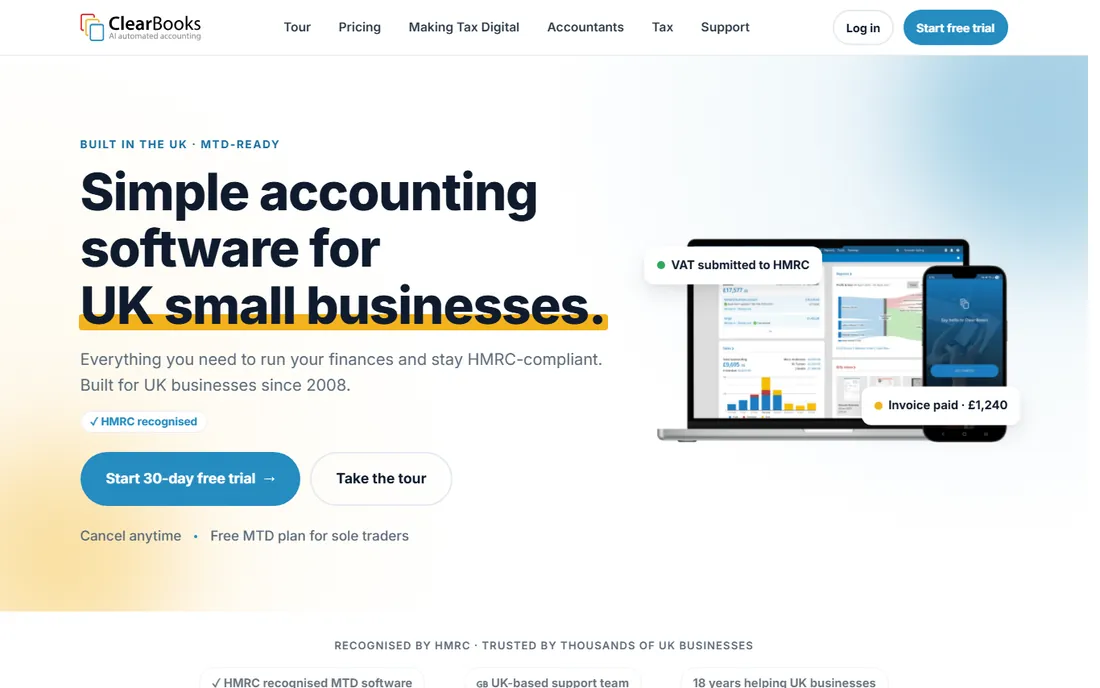
Clear Books deserves attention for one reason: it offers a genuinely free plan built for sole traders facing MTD for Income Tax, including quarterly updates to HMRC, rather than a trial that expires. Paid plans exist for businesses that need more, but the free tier is a real compliance route, not a demo.
The company has been building UK accounting software since 2008, is HMRC-recognised, and walks you through each quarterly update with a step-by-step wizard and a live deadline tracker. The honest limits are brand scale and integrations: fewer connected apps than Xero or QuickBooks, and support that reflects a smaller team. For a straightforward sole trader, though, free and compliant is hard to beat.
What we like- Genuinely free MTD plan for sole traders
- HMRC-recognised with a quarterly update wizard
- UK-based support team
Watch out for- Free plan is aimed at the simplest cases
- Smaller brand than the big three
- Fewer third-party integrations
#6
Crunch
Best for: self-employed people who want accountants doing the work
Visit crunch.co.uk
Starting priceSee website
Free planNo
Crunch is the odd one out here, and deliberately so: it is an online accountancy service with software attached, rather than software with support attached. Your Self Assessment gets checked by a qualified accountant before filing, and you can ask real tax questions year-round, all for a fixed monthly fee.
That human layer costs more than a self-serve subscription, and pricing is quote-based rather than published. But for contractors and freelancers who would rather never think about tax, it removes the risk of misfiling quarterly updates under MTD. If you want software only, pick one of the others; if you want someone accountable for the numbers, Crunch is the category leader in this model.
What we like- Qualified accountants included, not just software
- Fixed-fee pricing with no hourly billing
- MTD for ITSA compatible and HMRC-recognised
Watch out for- Costs more than self-serve software
- Pricing is quote-based
- Less appealing if you enjoy doing your own books
#7
KashFlow
Best for: sole traders and small firms that want simple UK bookkeeping
Visit kashflow.com
Starting price£13.50/month (Starter)
Free planFree trial
IRIS KashFlow is one of the longest-running UK options, and its pricing is refreshingly transparent: Starter at £13.50 a month for sole traders, contractors, and small businesses, or £97 a year plus VAT on the annual plan, with a Business tier at £27.50 a month for growing firms. New customers get deep introductory discounts, and everyone gets a free trial with no credit card required.
The software covers the MTD essentials: VAT submitted directly to HMRC, MTD for Income Tax support, bank feeds, and payroll-adjacent features like mileage tracking. The Starter limits bite if you invoice heavily (10 invoices a month), and the IRIS ownership means you will see the wider product suite promoted. For straightforward UK bookkeeping at a fair published price, it remains a solid pick.
What we like- Published UK pricing with a cheap Starter tier
- VAT filed directly to HMRC
- Free trial and demo with no credit card
Watch out for- Starter caps invoices and bank transactions
- Owned by IRIS, so upsells to the wider suite appear
- Smaller app ecosystem than Xero
#8
Zoho Books
Best for: micro businesses that want to start free and scale up
Visit zoho.com
Starting priceFree (paid plans from £12/month)
Free planYes
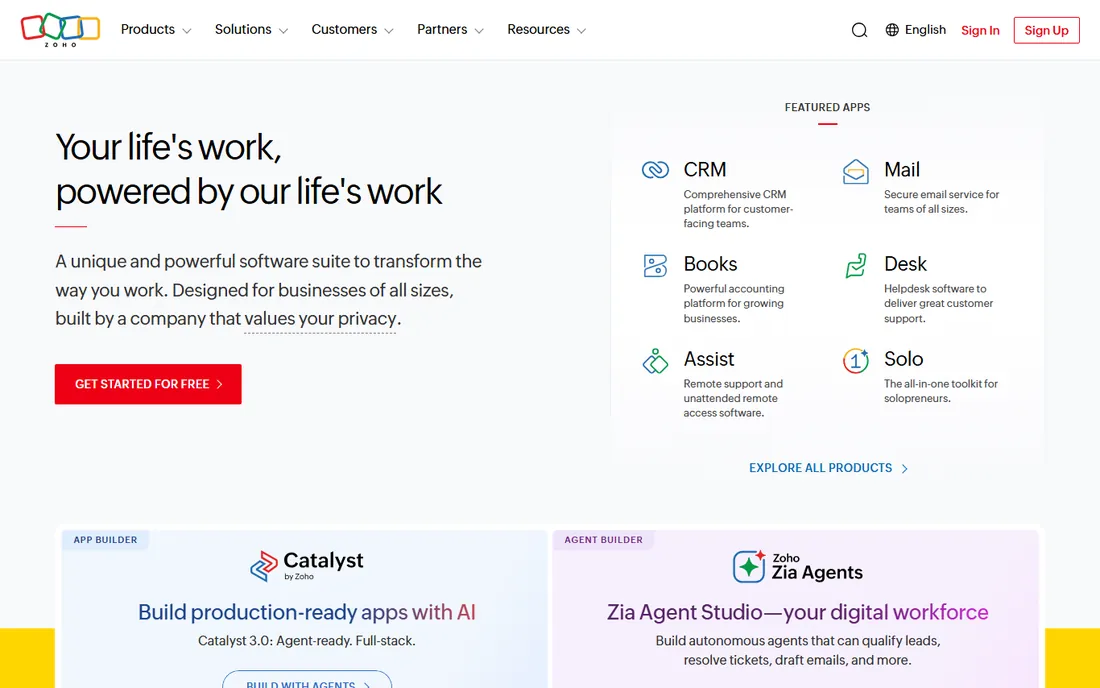
Zoho Books is the value play: a genuinely free plan covering invoicing, expenses, and MTD VAT filing for one user plus your accountant, with paid tiers starting at £12 a month for Standard. UK pricing is published on the vendor's own page, which is more than some bigger names manage.
The catch is local depth. Zoho is a global platform with a UK edition, not a UK-first product, so the MTD for Income Tax experience is less hand-holding than FreeAgent or Clear Books, and some UK-specific workflows feel thinner. For a micro business that wants to start on £0 and grow into inventory, projects, or multi-currency without switching systems, it is the most capable free route available.
What we like- Real free plan with invoicing and MTD VAT filing
- UK pricing published clearly
- Scales to inventory and multi-currency on higher tiers
Watch out for- UK-specific tax depth trails the local specialists
- Support quality varies by plan
- MTD for Income Tax workflows are less guided than FreeAgent
Starting priceFree
Free planYes
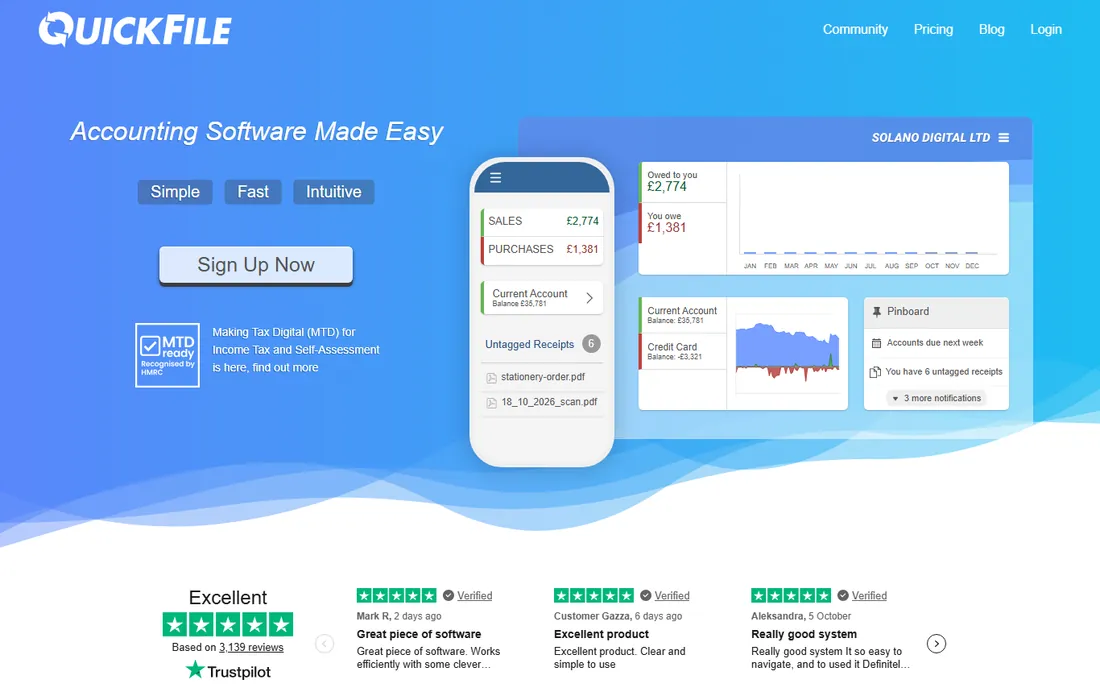
QuickFile's model is simple: it is completely free as long as your 12-month nominal ledger count stays under 1,000 entries, which covers a large number of sole traders and side businesses. It is MTD ITSA compliant, files VAT and quarterly updates directly to HMRC, and connects to all major UK banks through Open Banking.
The honest trade-off is polish. The interface looks its age next to FreeAgent or Xero, and growing past the free threshold means moving to paid packages. But for a small account that just needs compliant records and filings without a monthly bill, it is the most generous free option on this list, backed by a proper API and hundreds of integrations.
What we like- Free while your ledger stays under 1,000 entries a year
- MTD ITSA compliant with direct HMRC filing
- Open API and 300+ integrations
Watch out for- Free threshold can be outgrown quickly
- Interface looks dated
- Bank feeds and extras cost on larger accounts
#10
TaxCalc
Best for: accountants and practices filing for many clients
Visit taxcalc.com
Starting priceSee website
Free planNo
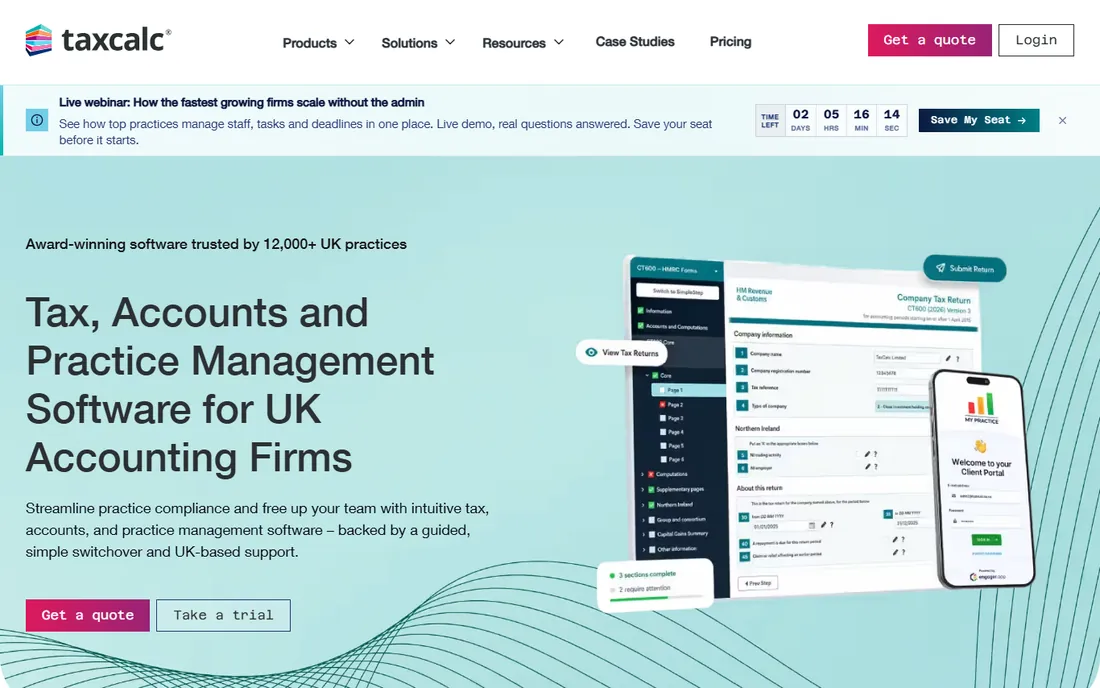
TaxCalc plays a different role from everything else here: it is software for accountants, not for business owners. Practices use its MTD Quarterly Filer, tax return production, and accounts production modules to file on behalf of dozens or hundreds of clients, pulling data in from Xero, QuickBooks, or FreeAgent rather than replacing them.
If you are a sole trader reading this list, TaxCalc is not for you. If you run an accountancy practice facing a wave of clients newly in scope for MTD for Income Tax, it is one of the most established UK compliance suites, used by thousands of practices. Pricing is modular and quote-based, which suits firms buying for a team but frustrates anyone wanting a quick number.
What we like- HMRC-recognised modular suite with MTD Quarterly Filer
- Integrates with Xero, QuickBooks, and FreeAgent
- UK-based support
Watch out for- Built for practices, not for doing your own books
- Pricing is quote-based
- No bookkeeping module of its own
Who needs MTD for Income Tax and when
The timeline matters more than the software. From April 2026, sole traders and landlords with qualifying income over £50,000 must keep digital records and submit quarterly updates to HMRC through recognised software, plus a final declaration each year. From April 2027, the threshold drops to £30,000, pulling in a much larger group.
MTD for VAT is already mandatory for VAT-registered businesses, so if you file VAT returns, you are likely using compatible software already; the Income Tax expansion is the new obligation for most readers. Note that quarterly updates are cumulative, so each submission builds on the last rather than starting from scratch. The practical advice: get compliant software running a few months before your start date, not the week your first update is due.
How we chose
We verified each product exists today and is genuinely positioned for UK Making Tax Digital compliance, checking homepages and pricing pages directly. We prioritised HMRC recognition, real quarterly-update filing for Income Tax (not just VAT), and suitability for the newly in-scope audience of sole traders and landlords. Prices come only from each vendor's own site; where pricing was not published in readable form, we say so. We excluded Bokio, which closed to UK users in July 2026, and we did not test-drive each product hands-on.
Checklist before you subscribe
Start by confirming the software appears on HMRC's list of recognised software for the taxes you actually file; several products handle MTD for VAT but not MTD for Income Tax, and the distinction matters from April 2026. Check whether your business type is covered: some free and entry tiers target sole traders only, while limited companies need higher plans.
Then look at the edges that cause regret. Confirm bank feed coverage for your bank, check invoice and transaction limits on cheap tiers, and ask how Self Assessment filing works if you currently rely on an accountant for it. If you bank with NatWest, RBS, Ulster Bank, or Mettle, check the free-FreeAgent route before paying for anything. Finally, model the real year-two price: introductory discounts of 50 to 90 percent are common, and the number that matters is what you pay when the promo ends.
Frequently asked questions
What is Making Tax Digital?
Making Tax Digital is HMRC's programme to move tax administration online. Instead of one annual return built from paper records or spreadsheets, you keep digital records in compatible software and submit updates electronically. MTD for VAT is already in force for VAT-registered businesses; MTD for Income Tax Self Assessment extends the approach to sole traders and landlords.
Who must comply with MTD for Income Tax?
From April 2026, sole traders and landlords with qualifying income over £50,000 must use MTD-compatible software for quarterly updates and a final declaration. From April 2027 the threshold falls to £30,000. Limited companies are not in scope for MTD for Income Tax, though they already face MTD for VAT and corporation tax digitisation plans.
Can I use a spreadsheet for MTD?
Not on its own. HMRC requires digital records kept in compatible software, and quarterly updates must be submitted through recognised software. You can keep working in a spreadsheet only if it connects to bridging software that files to HMRC, which defeats the purpose for most small businesses.
What is the cheapest compliant option?
Clear Books and QuickFile both offer genuinely free routes: Clear Books has a free MTD plan for sole traders, and QuickFile is free for accounts under 1,000 ledger entries a year. Zoho Books has a capable free plan too. FreeAgent is free if you hold a qualifying NatWest, RBS, Ulster Bank, or Mettle business account. Check each free tier covers MTD for Income Tax, not just VAT.
Do I still need an accountant?
Not necessarily. MTD software handles the quarterly mechanics, and products like FreeAgent and Crunch file your Self Assessment too. But an accountant still earns their fee on tax planning, complex affairs, and limited company accounts. Crunch's model splits the difference: software plus real accountants for a fixed monthly fee.
What happens if I miss a quarterly update?
HMRC applies a points-based penalty system: late submissions earn penalty points, and financial penalties kick in once points accumulate past a threshold. There is a 12-month soft-landing period for those joining from April 2026, but the sensible approach is to set calendar reminders or use software with a deadline tracker, like Clear Books, rather than relying on the grace period.
Sources we checked (14)
- https://freeagent.com/
- https://xero.com
- https://quickbooks.co.uk
- https://sage.com/
- https://clearbooks.co.uk/
- https://crunch.co.uk/
- https://kashflow.com/
- https://zoho.com
- https://zoho.com/uk/books/pricing/
- https://quickfile.co.uk/
- https://taxcalc.com/
- https://www.bytestart.co.uk/self-employed-accounts/business-accounting-software/
- https://www.businessadvice.co.uk/risk/finance/what-is-the-best-accounting-software-for-small-business/
- https://www.capitalise.com/gb/insights/business-banking/best-small-business-accounting-software
Is your product missing or out of date?
We review this list regularly. Vendors can request a listing, send updated pricing or ask about featured placement.

Shihab Mia · Founder, Rankite
Shihab has spent more than a decade helping SaaS and e-commerce brands grow through search. He writes Rankite's software buying guides from pricing pages, documentation and public user reviews. More about Shihab.