How we make this list: we compare pricing pages, product documentation and public user reviews. Rankite is independent; if a vendor ever pays for a featured spot, that listing is clearly labeled Partner.
Key takeaways
- OneSignal is the easiest entry point for most teams: a real free tier with unlimited mobile push sends, and Growth starting at $19 per month.
- Firebase Cloud Messaging costs nothing at any volume, but you build the targeting, automation and reporting layers yourself.
- Amazon SNS is the cheapest way to deliver transactional pushes at serious scale, with a free tier and pay-as-you-go billing after it.
- MagicBell and Novu are developer-led options with clear per-use pricing; both include generous free tiers and full channel coverage.
- Braze and Airship are enterprise platforms with quote-only pricing; buy them when mobile is central to your revenue, not for your first 10,000 users.
Most teams pick a notification tool twice. The first time, they want the cheapest way to send a push when an order ships. The second time, a year later, they want segmentation, journeys, and delivery analytics, and they realize the cheap tool charges in a way that punishes growth. This guide compares both kinds of platforms, so you can see where the costs land before you wire up the SDK.
Quick comparison
| Tool | Best for | Starting price | Free plan |
|---|
 OneSignal OneSignal | All-in-one push, email and in-app for growing teams | $19 per month (Growth, plus usage) | Yes |
 Pushwoosh Pushwoosh | Omnichannel lifecycle campaigns without enterprise pricing | Free up to 1,000 MAU; Push only from $7 per 1,000 MAU | Yes |
 Firebase Cloud Messaging Firebase Cloud Messaging | Free, unlimited push for apps already on Firebase | Free | Yes |
 Amazon SNS Amazon SNS | Transactional push at AWS scale | Pay as you go, free tier included | Yes |
 Airship Airship | Enterprise mobile-first customer engagement | See website | No (demo available) |
 Pusher Beams Pusher Beams | Developer teams sending transactional push | See website | Yes (sandbox, 1,000 subscribers) |
 Braze Braze | Cross-channel lifecycle programs at enterprise scale | See website | Free trial |
 MagicBell MagicBell | Developers who want one API for every notification channel | $249 per month (Startup) | Yes (Builder, 1,000 deliveries per month) |
 Novu Novu | Open-source notification workflows for product teams | From $30 per month (Novu Cloud) | Yes (10,000 workflow runs per month) |
Is your product missing or out of date?
We review this list regularly. Vendors can request a listing, send updated pricing or ask about featured placement.
The best mobile-friendly notification software
Starting price$19 per month (Growth, plus usage)
Free planYes
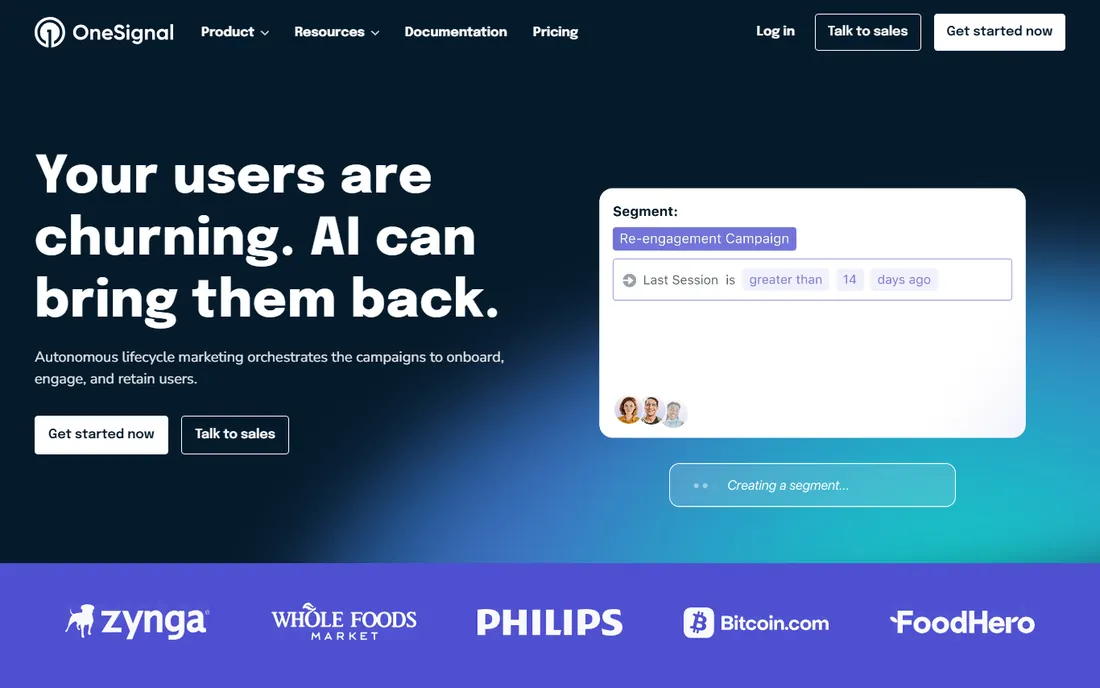
OneSignal is the default choice for small and mid-size teams that want marketing-grade push without an enterprise contract. The free tier is genuinely useful: unlimited mobile push sends, 10,000 web push subscribers per send and 10,000 email sends a month. Most startups run on it for months before paying anything.
The Growth plan starts at $19 a month and adds usage on top, priced per monthly active user for mobile push and per subscriber for web push. Professional and Enterprise are annual and quote-based. One catch buyers miss: the MAU count includes devices that never opted in to push, because in-app messages can reach all active app users. If your app has a large install base with low opt-in, check the calculator on the pricing page before committing.
What we like- Unlimited mobile push sends even on the free plan
- SDKs for iOS, Android, Flutter, React Native, Unity and web
- Built-in journeys, A/B testing and AI-assisted sending
Watch out for- Free plan limited to 1,000 monthly active users
- Usage-based charges ($0.012 per MAU for mobile push, $0.004 per web subscriber) can add up faster than expected
#2
Pushwoosh
Best for: Omnichannel lifecycle campaigns without enterprise pricing
Visit pushwoosh.com
Starting priceFree up to 1,000 MAU; Push only from $7 per 1,000 MAU
Free planYes
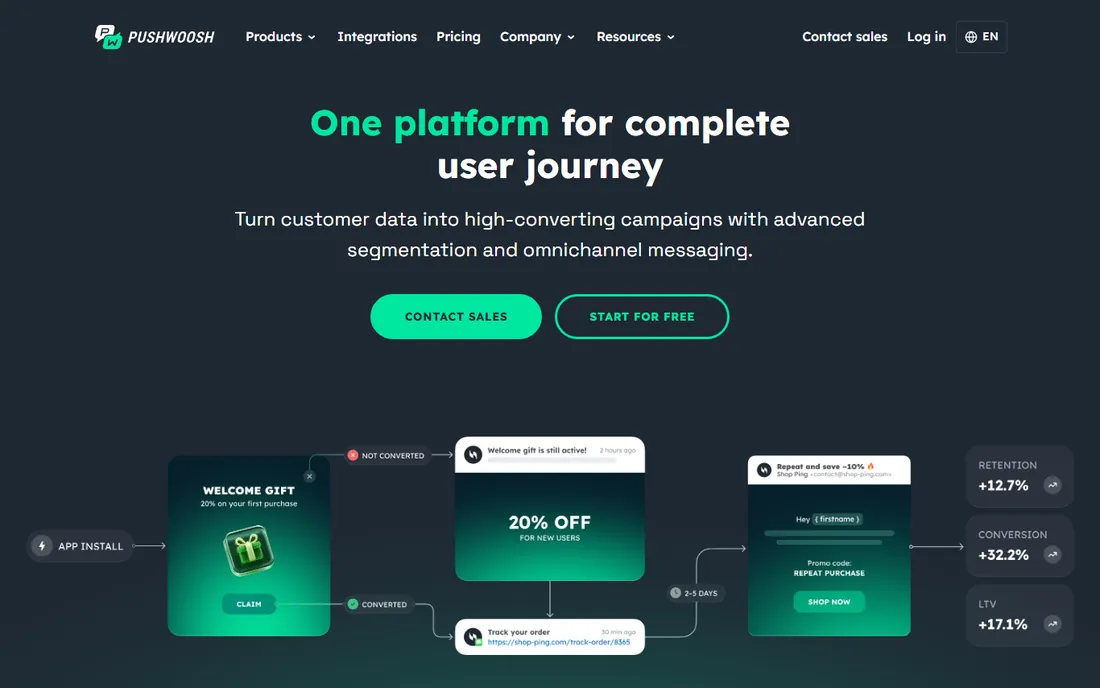
Pushwoosh rebuilt its pricing around a simple idea: pay per thousand monthly active users, with no feature gating between plans. Your subscription stays free while a project sits under 1,000 MAU. Above that, Push only runs $7 per 1,000 MAU, Email only $5 per 1,000 recipients, and Omnichannel $13 per 1,000 MAU.
The platform covers mobile push, web push, email, SMS and WhatsApp, plus a visual journey builder and an AI copilot called ManyMoney AI that adjusts send time and content. Integration takes an estimated 2 to 10 days for the SDK plus subscriber import. Custom pricing with SLA and dedicated support kicks in above roughly $3,000 a month.
What we like- Every plan includes the full feature set with no enterprise-only gates
- AI copilot that optimizes content, timing and channel
- GDPR and HIPAA compliance included
Watch out for- MAU-based billing counts anyone who receives a message on any channel
- Push only plan is a limited-time offer with a price lock ending December 31
Starting priceFree
Free planYes
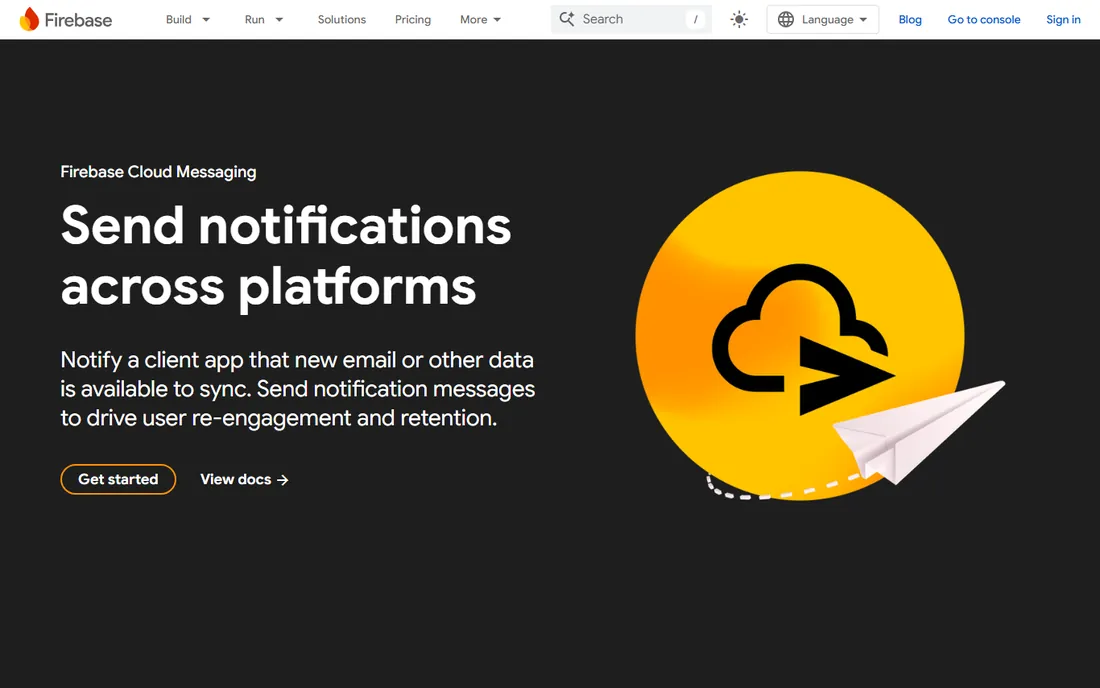
FCM is the free delivery pipe underneath a huge share of the world's app notifications. Google's own pricing page states there is no cost to using Cloud Messaging, and there are no per-message or per-device caps. If your app already uses Firebase Auth or Firestore, this is the path of least resistance.
The tradeoff is that everything above raw delivery is your job. Targeting exists through topics, device groups and Analytics audiences, and the Notifications composer lets non-technical staff send messages, but multi-step automated journeys mean writing Cloud Functions. Teams that need marketing automation on FCM usually pair it with a layer like OneSignal or build one in-house.
What we like- No cost at any volume on both Spark and Blaze plans
- Native integration with Firebase Analytics, Remote Config and A/B testing
- One console sends to iOS, Android and web
Watch out for- No built-in journey builder or advanced automation
- Complex campaigns require Cloud Functions or your own backend code
- Depends on Google Play Services on Android
Starting pricePay as you go, free tier included
Free planYes
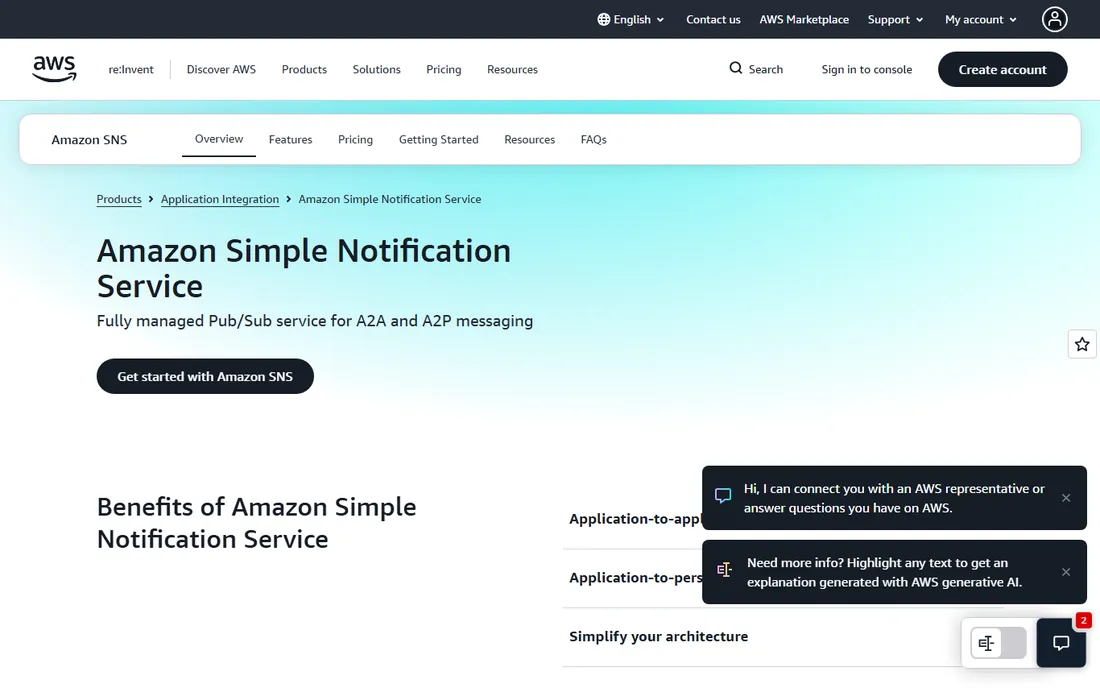
Amazon SNS treats push as infrastructure, not marketing. You publish to topics, and SNS handles delivery to APNs, FCM, SMS and email endpoints, with filtering, batching, ordering and deduplication. For transactional alerts at high volume, it is hard to beat on unit cost.
Buyer details matter here: there are no upfront fees or minimums, and billing is per API request plus per delivery, with 64KB chunks billed as one unit. If your pushes are tiny JSON payloads, costs stay low. If you need a dashboard your marketing team can use, this is not the tool. Pair it with something else, or keep it strictly for system messages.
What we like- First 1 million push notifications a month are free
- Roughly $1 per million after that
- One API fans out to iOS, Android, SMS and email with message filtering and FIFO ordering
Watch out for- No marketer dashboard, no templates and no journey builder
- Pricing per request and delivery takes real effort to model
- Support beyond docs means paying for an AWS support plan
Starting priceSee website
Free planNo (demo available)
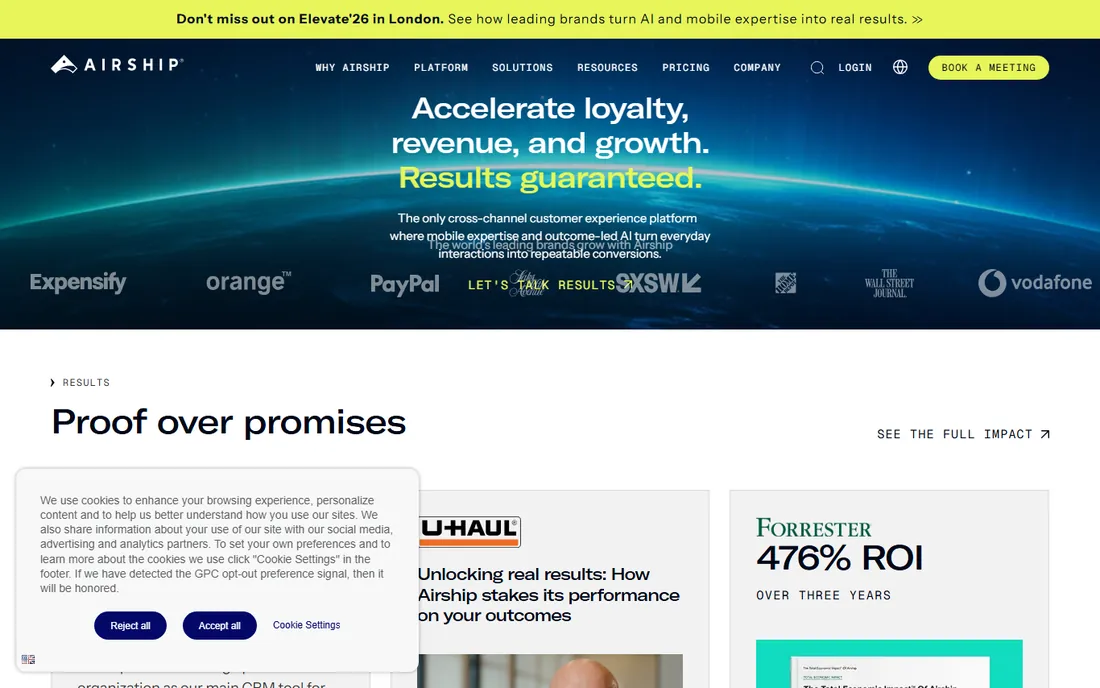
Airship is the veteran of mobile push, now positioned as a full cross-channel customer experience platform with push, in-app, email, SMS, RCS and mobile wallet. Its AI agents generate native app experiences, recommend actions from behavioral data and explain dashboard results in plain language.
The company is public about its enterprise focus: onboarding starts with a live demo, and pricing plans are sold, not self-served. Buy it when mobile drives your revenue and you need a marketing team to run sophisticated journeys. For a simple push API, it is far more platform than you need.
What we like- Invented commercial push and keeps shipping firsts (Live Activities, wallet passes)
- AI agents for scenes, experimentation and dashboard insight
- Strong predictive segmentation
Watch out for- Quote-only pricing aimed at five-figure annual commitments
- Marketing-led platform, so developers get less control than with an API-first tool
- Heavier implementation
#6
Pusher Beams
Best for: Developer teams sending transactional push
Visit pusher.com
Starting priceSee website
Free planYes (sandbox, 1,000 subscribers)
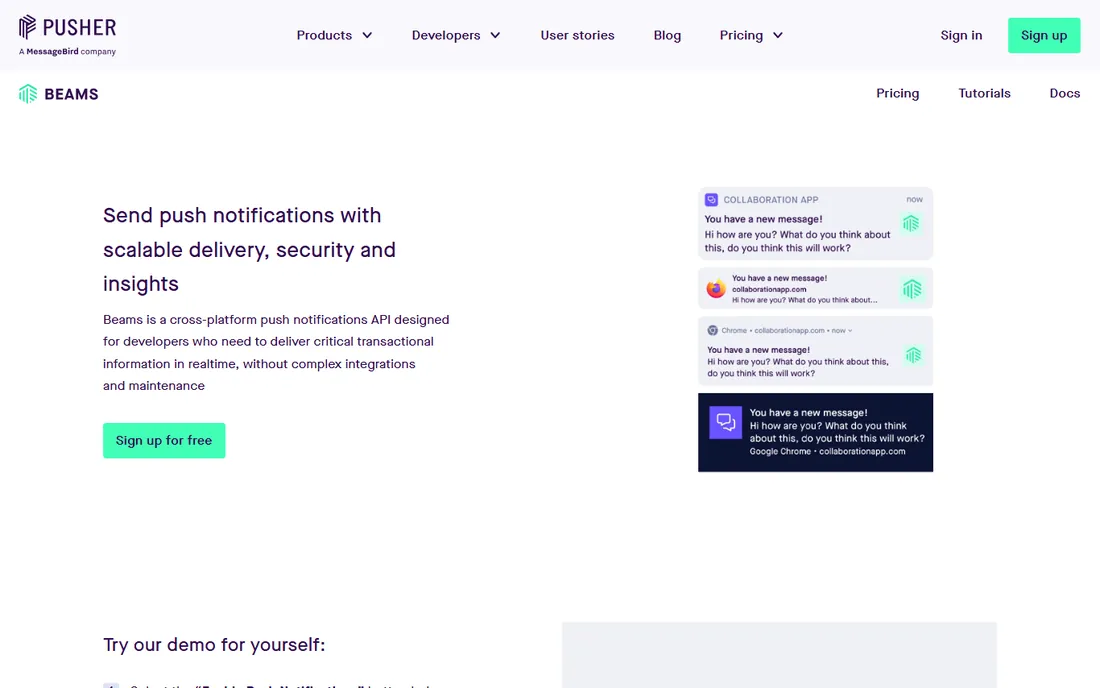
Pusher Beams is built for engineers who need to deliver critical transactional notifications without babysitting token databases. The sandbox plan is free with 1,000 subscribers, and the company advertises simple self-serve packages above that, with custom enterprise options for larger needs.
Delivery throughput is a stated strength: 1 million plus messages per minute on every platform. Where Beams falls short is marketer tooling. There is no journey builder here and no built-in preference center. It fits teams where notifications are owned by engineering and triggered by application events.
What we like- Clean, well-documented push API with native iOS, Android and web SDKs
- Managed device token lifecycle with automatic retries
- Delivery insights and debug console
Watch out for- Pricing details sit behind the self-serve flow rather than on a public table
- Interests-based targeting is simpler than marketing-grade segmentation
- Pusher is now part of MessageBird, so the roadmap follows that group
#7
Braze
Best for: Cross-channel lifecycle programs at enterprise scale
Visit braze.com
Starting priceSee website
Free planFree trial
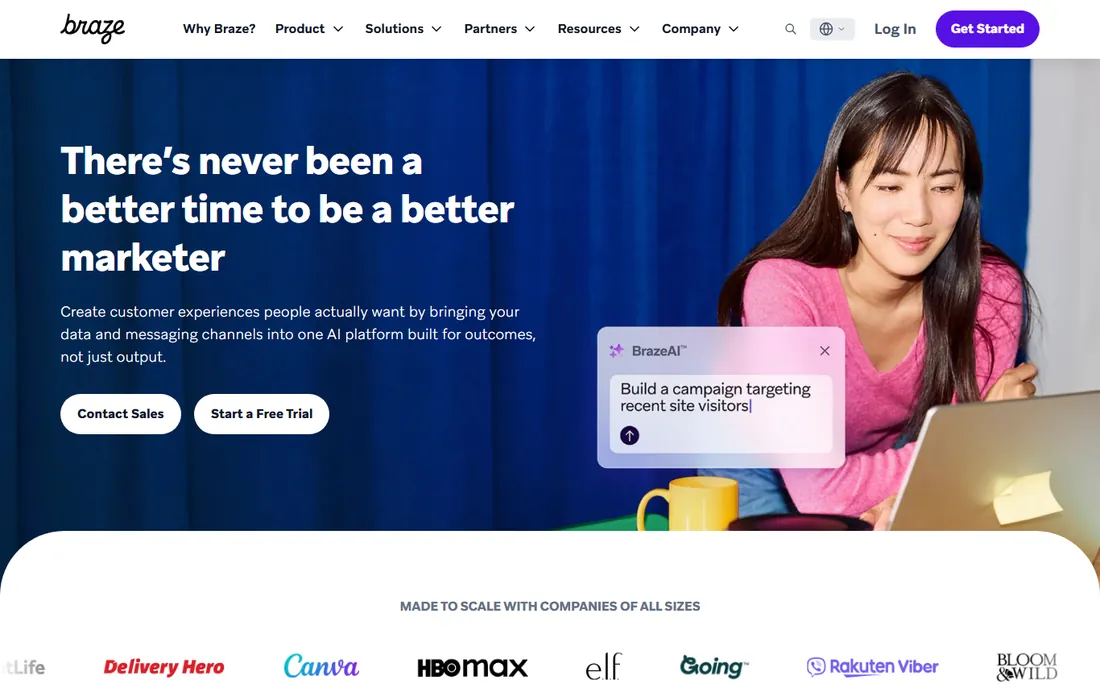
Braze sits at the top end of this list. It combines a customer data platform, cross-channel messaging and AI-driven optimization, with push as one channel among email, SMS, in-app and more. Large retail, media and finance brands run their lifecycle programs on it.
The pricing page offers a free trial and a contact-sales path rather than numbers. Expect annual contracts priced on data points or monthly active users. The honest test is whether you need real-time orchestration across channels. If push is one spoke of a bigger engagement strategy, Braze earns its price. If you just need to tell users their order shipped, start elsewhere.
What we like- Real-time data ingestion with cross-channel orchestration in one platform
- BrazeAI for content, experimentation and decisioning
- Consistently ranked a Leader by Gartner
Watch out for- No published pricing, so budgeting requires a sales conversation
- Implementation and onboarding take weeks, not hours
- Overkill for teams that only need push
#8
MagicBell
Best for: Developers who want one API for every notification channel
Visit magicbell.com
Starting price$249 per month (Startup)
Free planYes (Builder, 1,000 deliveries per month)
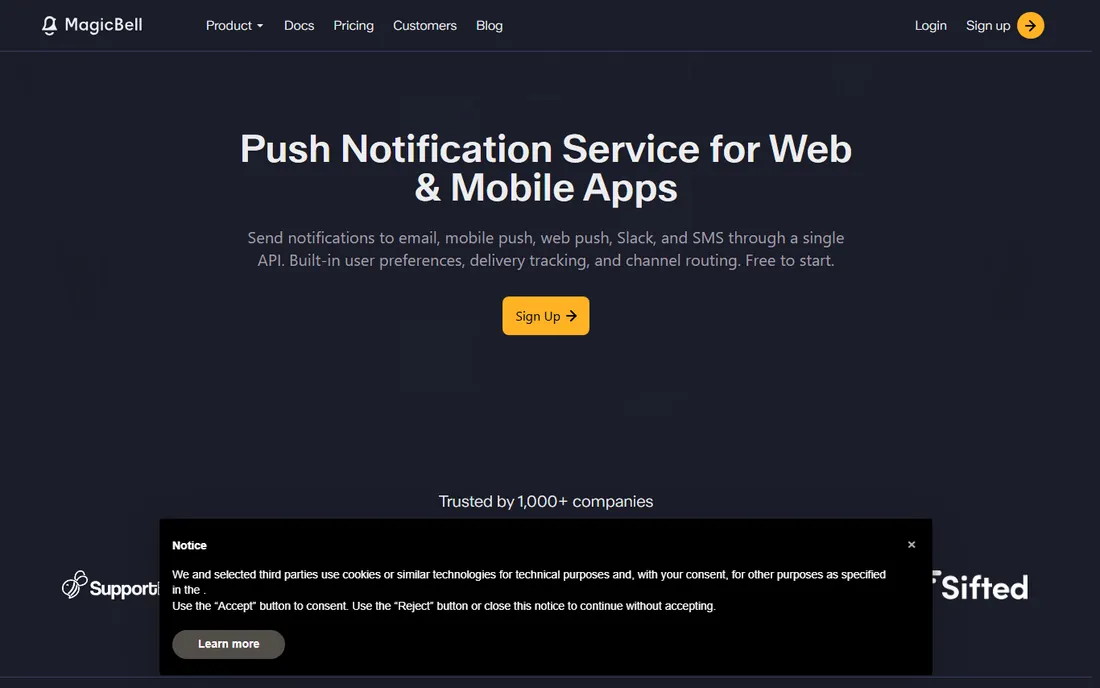
MagicBell takes the infrastructure view of notifications: one broadcast, and the platform routes it to the right channels based on each user's preferences and your delivery rules. The Builder plan is free with 1,000 deliveries a month, all integrations included and no credit card required. Startup is $249 a month for 50,000 deliveries, with $0.0025 per additional delivery, and Enterprise is custom.
The standout feature is debuggability. Every delivery attempt is logged with raw request and response payloads, so when a push fails you can see exactly why. End users get preference controls out of the box, which saves you from building a notification settings screen. Watch the delivery counting, though: one message to 100 users on two channels counts as 200 deliveries.
What we like- Single API routes to push, email, Slack, SMS and in-app with per-user preferences built in
- Full delivery observability with raw payload inspection
- Bring your own providers (APNs, FCM, SendGrid, Twilio)
Watch out for- Startup plan jumps to $249 a month, a steep step from free
- Deliveries are counted per channel per user, so multichannel sends burn quota fast
- Smaller community than OneSignal
#9
Novu
Best for: Open-source notification workflows for product teams
Visit novu.co
Starting priceFrom $30 per month (Novu Cloud)
Free planYes (10,000 workflow runs per month)
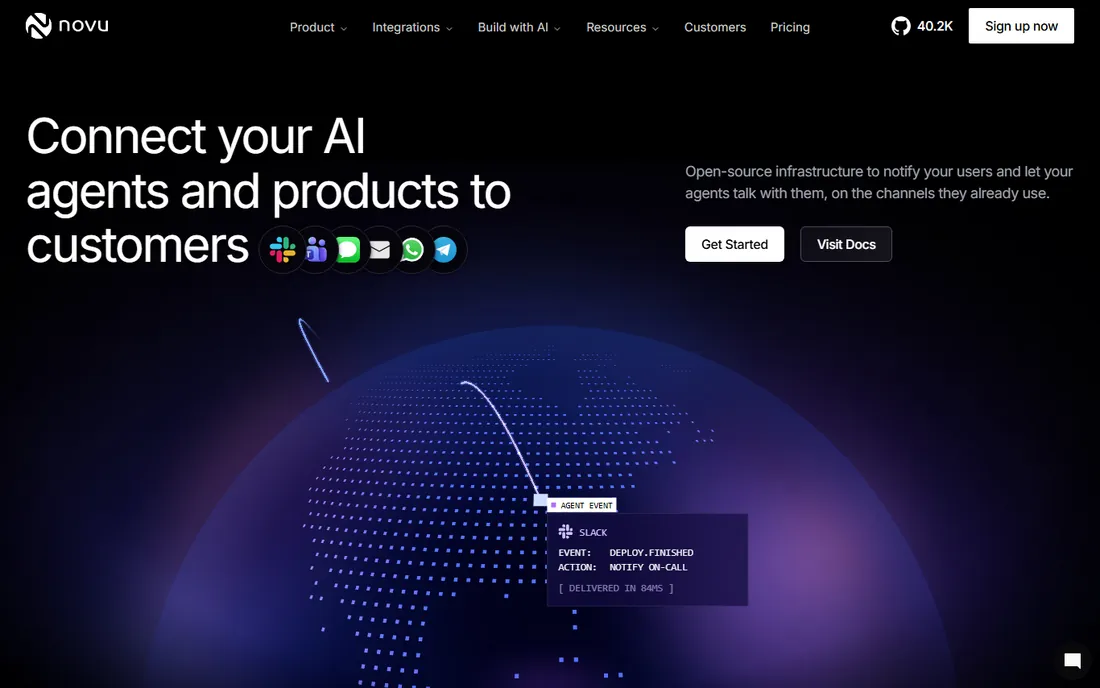
Novu is open-source notification infrastructure with a managed cloud. You define workflows once, and Novu handles routing, delays, digests and fallbacks across inbox, email, SMS, push and chat. The cloud free tier covers 10,000 workflow runs a month, paid plans start at $30 for 30,000 runs, and self-hosting is free for the community edition.
For teams that want control, the open codebase is the point: inspect it, extend it, run it in your own infrastructure. The prebuilt Inbox and Preferences components save real frontend time, including quiet hours, snooze and digest bundling. The main planning question is volume modeling, since one workflow trigger fanning out to 100 subscribers counts as 100 runs.
What we like- Open-source core you can self-host
- Billing per workflow run with unlimited subscribers on paid plans
- Prebuilt inbox and preference components with quiet hours and digests
Watch out for- Pricing is per workflow run, a unit that takes effort to forecast
- Enterprise features like SSO, audit logs and HIPAA BAA sit on higher tiers
- Newer platform with a shifting product surface
How we chose
We started from platforms that actively support mobile push on both iOS and Android in 2026, then checked each vendor's own pricing page and documentation for current plans, free tiers and limits. We read public reviews on G2 and Capterra plus engineering writeups on Reddit and vendor blogs to confirm where each tool actually shines and where buyers complain. We excluded products that shut down, products with no mobile push support, and platforms whose pricing could not be verified anywhere. No hands-on testing was involved; the comparisons reflect published features, documented limits and reported buyer experience.
The billing unit decides your real cost, and every vendor uses a different one. OneSignal bills per monthly active user, Pushwoosh per thousand MAU, MagicBell per delivery, Novu per workflow run, and Amazon SNS per request and delivery. Before you choose, estimate your current audience and your 12-month projection, then run each vendor's calculator. A platform that looks cheap at 5,000 users can become the most expensive at 200,000.
Next, decide who owns notifications in your company. If marketing owns them, you want journeys, templates, A/B testing and a preference center, which points to OneSignal, Pushwoosh, Braze or Airship. If engineering owns them, you want a clean API, webhooks, token management and delivery logs, which points to FCM, SNS, Pusher Beams, MagicBell or Novu. Buying a marketer tool for an engineering use case, or the reverse, is the most common regret we see in reviews.
Finally, check the boring details that cause migrations later. Confirm whether unsubscribed devices count toward your quota, whether data export is available on your plan, how long message history is retained, and whether the vendor supports the regions you operate in. Ask about support hours and response times on the plan you will actually buy, not the enterprise plan in the brochure.
Pricing models, decoded
Free tiers in this category are real but shaped differently. OneSignal gives unlimited mobile push sends on free, capped by 1,000 MAU. FCM and SNS are free by volume, with SNS adding a pay-as-you-go meter after the first million. MagicBell and Novu cap free usage by deliveries and workflow runs. None of these are trials in disguise; they are workable for small production apps.
The step from free to paid is where the sticker shock lives. MagicBell jumps from $0 to $249 a month. OneSignal starts at $19 plus usage. Pushwoosh scales smoothly with MAU, which many mid-market teams prefer. Annual contracts at Braze, Airship and OneSignal Professional bring volume discounts but lock you in, so negotiate the overage rates, not just the headline price.
Frequently asked questions
How much does push notification software cost?
Free tiers cover most apps under a few thousand users. Paid plans start around $19 a month for tools like OneSignal and scale with your audience, deliveries or workflow runs. Enterprise platforms like Braze and Airship are quote-only and typically run into five figures a year.
Do I need a paid plan to send mobile push?
No. Firebase Cloud Messaging is free at any volume, OneSignal offers unlimited mobile push sends on its free plan, and Novu and MagicBell both include generous free tiers. You need a paid plan when you want advanced targeting, automation, higher volume or support SLAs.
What is the difference between a push API and a push marketing platform?
A push API (FCM, SNS, Pusher Beams, MagicBell, Novu) delivers messages your code triggers. A marketing platform (OneSignal, Pushwoosh, Braze, Airship) adds segmentation, journeys, templates, A/B testing and analytics so non-technical teams can run campaigns. Many companies use both: an API for transactional alerts and a platform for marketing.
Which tool is best for transactional notifications like order updates?
Developer-first options win here. Pusher Beams and MagicBell give you reliable APIs with delivery tracking, Amazon SNS is the cheapest at high volume, and Novu adds workflow logic like digests and quiet hours. Pick based on your stack and whether you want to self-host.
Can I migrate between push providers later?
Yes, but it takes planning. You need to migrate device tokens and reconfigure SDKs, and users may need to re-opt-in on web push. Vendors like Pushwoosh advertise migration help. Export your token data early and keep a backup, even on a free plan.
Do these tools support web push too?
Most do. OneSignal, Pushwoosh, Pusher Beams, MagicBell and Novu all support web push alongside mobile. FCM supports web through its JavaScript SDK. SNS does not do browser push; it covers mobile, SMS and email.
Sources we checked (14)
- https://onesignal.com/pricing
- https://www.pushwoosh.com/pricing
- https://firebase.google.com/products/cloud-messaging
- https://firebase.google.com/pricing
- https://aws.amazon.com/sns/
- https://aws.amazon.com/sns/pricing/
- https://airship.com
- https://pusher.com/beams
- https://pusher.com/beams/pricing
- https://braze.com
- https://magicbell.com
- https://magicbell.com/pricing
- https://novu.co
- https://novu.co/pricing
Is your product missing or out of date?
We review this list regularly. Vendors can request a listing, send updated pricing or ask about featured placement.

Shihab Mia · Founder, Rankite
Shihab has spent more than a decade helping SaaS and e-commerce brands grow through search. He writes Rankite's software buying guides from pricing pages, documentation and public user reviews. More about Shihab.