How we make this list: we compare pricing pages, product documentation and public user reviews. Rankite is independent; if a vendor ever pays for a featured spot, that listing is clearly labeled Partner.
Key takeaways
- AdMob and Unity Ads dominate mobile ad supply, reaching users inside thousands of apps.
- AppLovin and Liftoff are the performance networks mobile gaming advertisers swear by.
- Moloco and InMobi bring machine learning optimization for advertisers with serious budgets.
- Chartboost and Mintegral fill useful niches in gaming and global reach.
Quick comparison
| Tool | Best for | Starting price | Free plan |
|---|
 AdMob AdMob | Google's in-app ad network | Pay per click/impression | No |
 Unity Ads Unity Ads | ads inside mobile games | Pay per install/impression | No |
 AppLovin AppLovin | mobile game user acquisition | Pay per install | No |
 Liftoff Liftoff | performance mobile campaigns | Pay per install/action | No |
 InMobi InMobi | global mobile advertising | Pay per click/impression | No |
 Moloco Moloco | ML-driven user acquisition | Pay per install/action | No |
 Chartboost Chartboost | in-app gaming ads | Pay per install/impression | No |
 Mintegral Mintegral | global programmatic mobile ads | Pay per install/impression | No |
Is your product missing or out of date?
We review this list regularly. Vendors can request a listing, send updated pricing or ask about featured placement.
Starting pricePay per click/impression
Free planNo
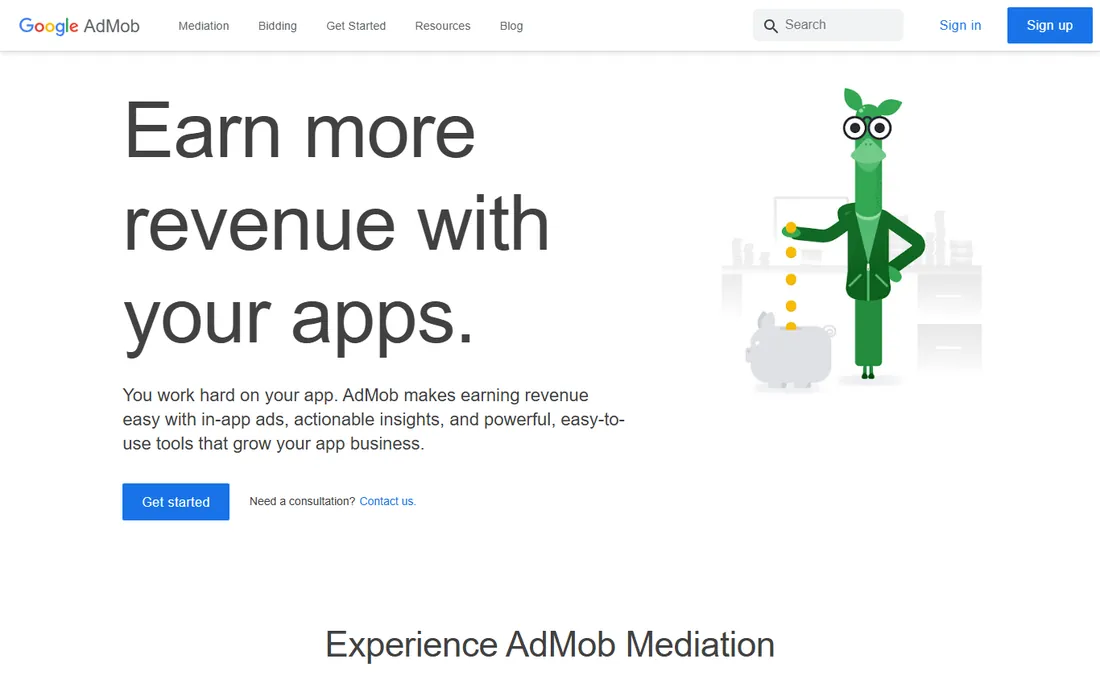
AdMob is Google's mobile advertising network, and its scale is unmatched: ads served inside millions of apps, with Google's targeting and machine learning behind them. For app publishers, it is the default monetization choice; for advertisers, it is the default in-app reach.
Mediation lets publishers combine AdMob with other networks to maximize revenue, and Google's tools for that are the industry standard. Advertisers get the targeting depth they expect from Google, applied to in-app audiences.
The trade is dependence on Google's ecosystem and policies. Policy enforcement can feel arbitrary, and the revenue split favors the house. But for reach inside mobile apps at global scale, no independent network matches AdMob.
What we like- Massive in-app inventory
- Google's targeting and measurement
- Easy mediation
Watch out for- Revenue shares favor Google
- Policy enforcement can be strict
Starting pricePay per install/impression
Free planNo
Unity Ads reaches players inside games built with the Unity engine, which is a large share of mobile gaming. Rewarded video, where players watch an ad for in-game currency, generates engagement rates that other formats envy.
For mobile game advertisers, the audience fit is perfect: gamers seeing ads for other games, in context, at natural break points. The ironSource merger (now part of Unity Grow) consolidated supply further, making Unity the center of gravity for gaming user acquisition.
Non-gaming brands find the audience less relevant, and the gaming concentration means creative needs to fit the context. But in mobile gaming, Unity Ads is infrastructure, not just another network.
What we like- Huge gaming inventory
- Rewarded video performs well
- Strong for game advertisers
Watch out for- Gaming-heavy audience
- Less suited to non-gaming brands
Starting pricePay per install
Free planNo
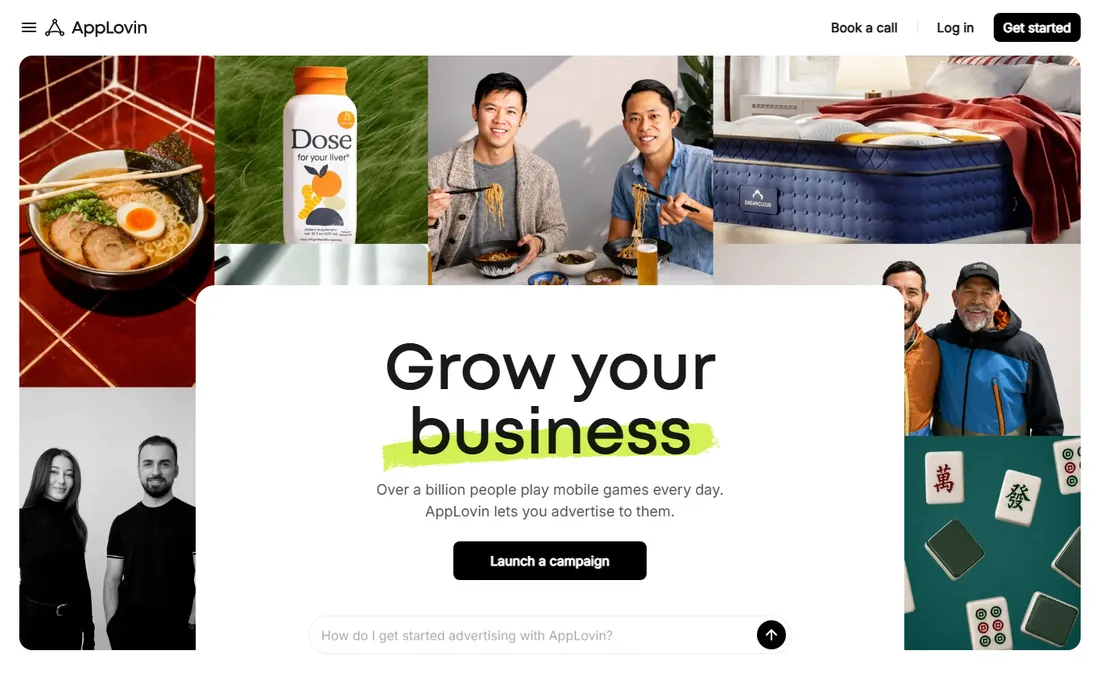
AppLovin has become the performance network mobile game studios mention first. Its machine learning optimization finds high-value users efficiently, and its owned-and-operated app portfolio provides premium supply alongside network inventory.
The AXON engine's targeting improved markedly in recent years, and advertisers report strong ROAS for gaming campaigns. The platform suits studios spending seriously on user acquisition, with the tools and support to match.
Smaller advertisers and non-gaming apps get less attention, and the gaming concentration limits audience diversity. But for mobile games with real acquisition budgets, AppLovin belongs in every media plan.
What we like- Top performance for game advertisers
- Strong ML optimization
- Large owned inventory
Watch out for- Gaming focus
- Minimums suit serious spenders
Starting pricePay per install/action
Free planNo
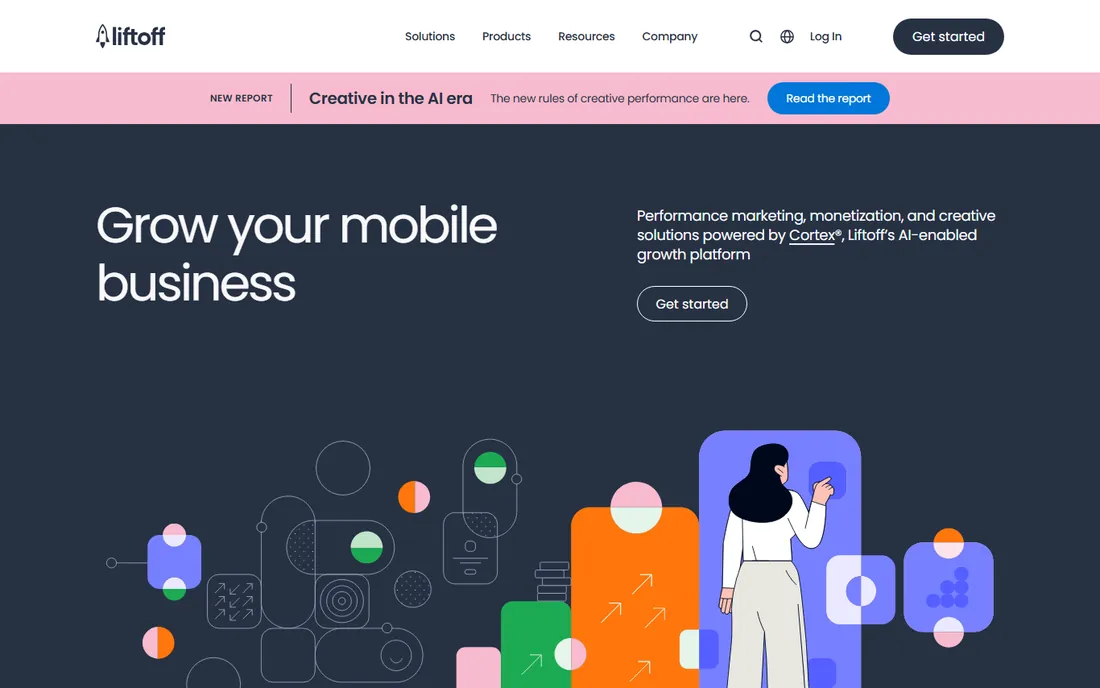
Liftoff (formerly Vungle, now at liftoff.ai) runs performance campaigns optimized for post-install actions, not just installs. That focus on what users do after downloading aligns spending with actual business value.
Creative testing is a strength. The platform's tools for iterating on ad creative help advertisers find winning concepts faster, which matters enormously in mobile where creative fatigue is constant. Support for both gaming and non-gaming verticals broadens its usefulness.
Like all ML-driven platforms, Liftoff performs best with meaningful budgets that give the algorithms data to learn from. Small tests can underwhelm. But advertisers with scale and patience report some of the best post-install ROAS in the industry.
What we like- Performance-focused optimization
- Good creative testing tools
- Strong in gaming and non-gaming
Watch out for- Best results need scale
- Platform complexity
Starting pricePay per click/impression
Free planNo
InMobi is one of the largest independent mobile ad platforms, with particular strength outside the United States. Its exchange and network reach users across Asia, the Middle East, and other growth markets where Western networks are thinner.
For global advertisers, that coverage fills real gaps. Brand campaigns get verified, brand-safe supply, and performance advertisers get programmatic access to inventory that is hard to reach otherwise. The company's longevity means stable technology and relationships.
US-focused advertisers may find domestic specialists stronger, and the product lineup takes effort to navigate. But for campaigns that need to work across continents, InMobi's global footprint is a genuine asset.
What we like- Strong international reach
- Exchange plus network
- Good brand safety
Watch out for- Less dominant in the US
- Complex product lineup
Starting pricePay per install/action
Free planNo
Moloco brings machine learning rigor to mobile user acquisition, bidding in real-time across exchanges to find users likely to take valuable actions. Advertisers praise the transparency: you see where ads ran and what they cost, unlike black-box networks.
The performance reputation is strong among sophisticated mobile marketers, particularly for apps with clear post-install value events. Retail, fintech, and gaming advertisers with serious budgets use Moloco as a core channel.
This is not a beginner platform. It rewards advertisers who understand programmatic, feed it good data, and spend enough for the models to learn. Smaller budgets struggle. But at scale, Moloco's ML-driven approach competes with anyone.
What we like- Excellent machine learning
- Transparent programmatic buying
- Strong ROAS reports
Watch out for- Needs significant budget
- Technical to manage well
Starting pricePay per install/impression
Free planNo
Chartboost has served mobile game advertising for over a decade, connecting game developers with players through interstitials, rewarded video, and playable ads. Direct publisher relationships give advertisers access to quality gaming inventory.
The network suits indie and mid-size game studios that want gaming-specific expertise without the minimums of the biggest platforms. Playable ads, which let users try gameplay before installing, perform well for the right titles.
Scale trails the leaders, and the audience is entirely gamers. But as a focused gaming network with reasonable entry points, Chartboost earns its place in many user acquisition mixes.
What we like- Gaming-focused network
- Direct deals with publishers
- Good interstitial formats
Watch out for- Smaller than leaders
- Gaming-only audience
Starting pricePay per install/impression
Free planNo
Mintegral is a programmatic mobile ad platform with particular strength in Asia-Pacific markets. Its AI-driven targeting and transparent reporting appeal to advertisers running global campaigns who need supply beyond the usual Western networks.
The platform aggregates inventory across exchanges with algorithmic optimization, and its creative tools help adapt campaigns for diverse markets. Advertisers expanding into APAC find it a useful complement to global networks.
Brand recognition in Western markets is lower, and support quality varies by region. But for the specific job of reaching mobile users in Asia-Pacific programmatically, Mintegral is a legitimate option.
What we like- Strong in Asia-Pacific
- Programmatic transparency
- AI-based targeting
Watch out for- Less known in Western markets
- Support varies by region
The post-ATT reality
Apple's App Tracking Transparency changed mobile advertising permanently. With most users opting out of tracking, the deterministic attribution mobile marketers relied on is largely gone. Every platform on this list now optimizes on modeled and aggregated data.
The practical response is creative-led growth. When targeting precision drops, the ad itself does more work. Successful mobile advertisers test creative relentlessly, build for broad audiences, and measure with modeled attribution and incrementality tests rather than last-click precision.
Budgets also consolidated toward the biggest platforms, whose scale produces the most signal. Diversification still matters, but the long tail of small networks suffered most from the signal loss.
Creative is the new targeting
With signal loss from ATT, creative quality determines mobile campaign performance more than ever. The best mobile advertisers operate like content studios: producing dozens of creative variants monthly, testing hooks in the first three seconds, and killing losers fast.
Build a creative testing system, not just ads. Every campaign should test multiple concepts, formats, and messages simultaneously, with clear rules for scaling winners and cutting losers. The networks' algorithms need creative diversity to find audiences; starving them of variants starves performance.
User-generated content styles outperform polished commercials on most networks. Authentic phone-filmed creative, real gameplay footage, and genuine testimonials convert better than studio productions. Match the creative to the feed it appears in.
Budgeting for mobile user acquisition
Start with test budgets that give algorithms room to learn: typically a few thousand dollars per network over two to three weeks. Smaller tests produce noise that leads to wrong conclusions about a network's potential.
Measure paybacks, not just CPIs. A cheap install that never opens the app again is expensive; a pricier install that subscribes is cheap. Define your target cost per action from lifetime value, and optimize networks against that number.
Expect the first month to lose money while the system learns. Profitable mobile acquisition is built through iteration: creative testing, audience refinement, and bid adjustments compound over time. Advertisers who quit after one bad week never see the learning curve pay off.
How we chose
We compared mobile advertising platforms used for app install and in-app campaigns, based on industry reports, platform documentation, and practitioner discussion. We covered the major supply sources (AdMob, Unity), performance networks (AppLovin, Liftoff, Moloco), and global and niche options (InMobi, Chartboost, Mintegral). We noted that ironSource is now part of Unity and that Liftoff's current site is liftoff.ai. Pricing is performance-based and varies, so we describe models rather than rates.
Frequently asked questions
What is the difference between CPI and CPA pricing?
CPI (cost per install) charges when someone installs your app. CPA (cost per action) charges when they do something valuable inside it, like registering or purchasing. CPA aligns cost with value but requires enough volume for the platform to optimize.
How much should we spend to test a new network?
Enough to give the algorithms meaningful data, typically thousands of dollars over a couple of weeks for most networks. Tiny tests produce noise, not learning. Set a test budget you can afford to lose and judge on early efficiency signals.
Do we still need an MMP?
Yes. Mobile measurement partners (like AppsFlyer or Adjust) remain essential for aggregating attribution across networks in the post-ATT world. Platform-reported numbers alone will mislead you.
What creative works best for mobile ads?
Short, native-feeling video that shows the product in the first seconds. Playable ads for games, UGC-style content for consumer apps. Refresh creative constantly; fatigue is the top killer of mobile campaign performance.
Should small apps bother with paid acquisition?
Only with realistic expectations. Paid acquisition favors apps with strong retention and monetization, because costs are high. Small apps often do better with ASO, content, and partnerships until the economics support paid spend.
Measuring what matters in mobile
Install counts flatter; retention and revenue tell the truth. Track D1, D7, and D30 retention by network and creative, and you will quickly see which spend produces real users. The networks that look expensive on CPI often win on retained users.
Build cohort analysis into your routine. Users acquired in the same week from the same network behave similarly; comparing cohorts reveals which channels deliver lasting value. The MMP dashboards support this; the discipline is reviewing them regularly.
Do small budgets work on these networks?
They can test, but rarely scale profitably. The machine learning needs volume to optimize, and small budgets produce slow learning. Start with focused tests on one or two networks rather than spreading thin.
How do we attribute installs accurately?
Use an MMP (AppsFlyer, Adjust, or similar) as the source of truth, with SKAdNetwork for iOS. Platform-reported numbers overclaim; triangulate across sources and run incrementality tests periodically.
Sources we checked (8)
- https://admob.google.com/home/
- https://unity.com/
- https://www.applovin.com/
- https://liftoff.ai/
- https://www.inmobi.com/
- https://www.moloco.com/
- https://www.chartboost.com/
- https://www.mintegral.com/en
Is your product missing or out of date?
We review this list regularly. Vendors can request a listing, send updated pricing or ask about featured placement.

Shihab Mia · Founder, Rankite
Shihab has spent more than a decade helping SaaS and e-commerce brands grow through search. He writes Rankite's software buying guides from pricing pages, documentation and public user reviews. More about Shihab.