How we make this list: we compare pricing pages, product documentation and public user reviews. Rankite is independent; if a vendor ever pays for a featured spot, that listing is clearly labeled Partner.
Key takeaways
- A marketing CRM combines contact management with email, automation and lead scoring: the CRM is the database, the marketing tools act on it.
- HubSpot (free CRM, Marketing Hub Starter $15/seat/month) is the best all-in-one; ActiveCampaign (Starter $15/month) has the deepest automation for the money.
- Brevo (free plan, Starter $9/month) is the cheapest way to email a large list: pricing follows send volume, not contacts.
- Klaviyo (free to 250 contacts, from $20/month) owns ecommerce; Salesforce Marketing Cloud is quote-based and only makes sense at enterprise scale.
Quick comparison
| Tool | Best for | Starting price | Free plan |
|---|
 HubSpot HubSpot | Teams that want CRM and marketing in one system | Free CRM; Marketing Hub Starter $15/seat/month (annual) | Yes |
 ActiveCampaign ActiveCampaign | Small businesses that want the deepest automation for the money | $15/month (Starter, annual) | Free trial (14 days) |
 Brevo Brevo | Businesses with large lists and small budgets | Free; Starter $9/month | Yes |
 Klaviyo Klaviyo | Ecommerce brands that live on email and SMS revenue | Free (250 contacts); from $20/month | Yes |
 Mailchimp Mailchimp | Beginners, newsletters and small audiences | Free (500 contacts); Essentials $13/month | Yes |
 Keap Keap | Small businesses that want sales pipeline plus marketing automation | See website | Free trial |
 GetResponse GetResponse | Marketers who also run webinars | From $19/month | Free trial |
 Constant Contact Constant Contact | Local businesses and nonprofits that want simple email | From $12/month | Free trial |
 Drip Drip | Ecommerce brands wanting Klaviyo-style automation with flexibility | See website | Free trial |
 Salesforce Marketing Cloud Salesforce Marketing Cloud | Enterprises personalizing at massive scale | See website (quote-based) | No |
Is your product missing or out of date?
We review this list regularly. Vendors can request a listing, send updated pricing or ask about featured placement.
The best marketing CRM software
Marketing CRM is the category where the contact database and the marketing engine live together: every email open, site visit and purchase lands on the contact record, and automations act on that history. Pure email tools bolt on a contact list; these ten put the CRM first. Prices mostly scale with contacts or sends, so model your list size at 2x before comparing: the entry price is never the real price.
#1
HubSpot
Best for: Teams that want CRM and marketing in one system
Visit hubspot.com
Starting priceFree CRM; Marketing Hub Starter $15/seat/month (annual)
Free planYes
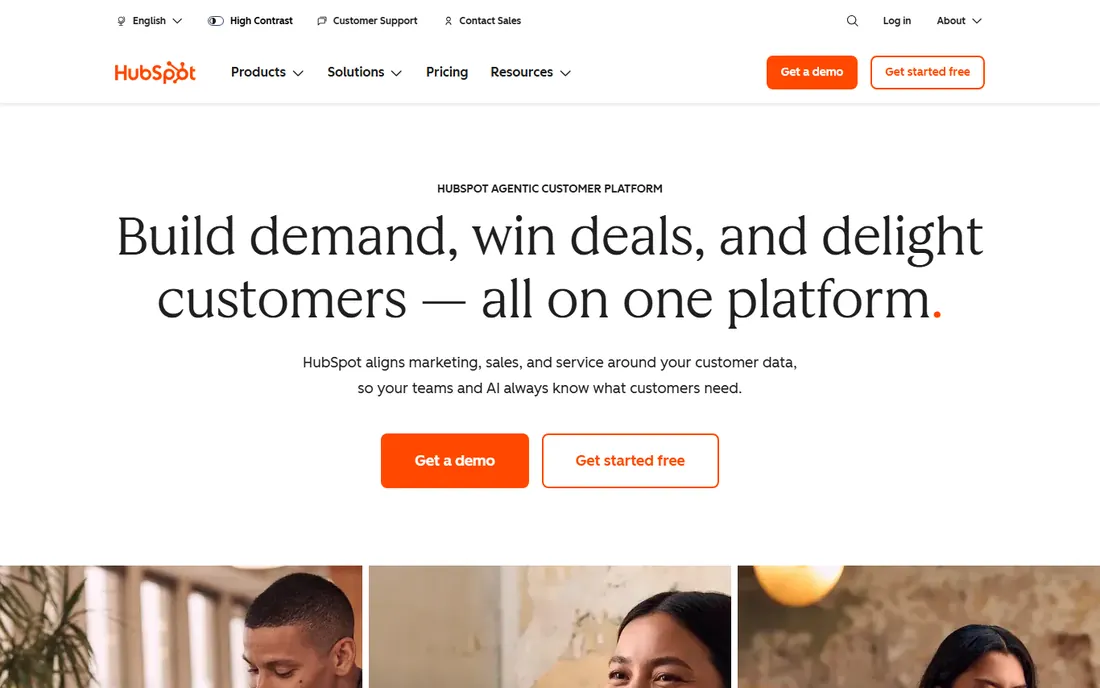
HubSpot's strategy is the free CRM as a wedge: unlimited contacts with deal pipelines, basic marketing tools and reporting at no cost. Marketing Hub Starter at $15 per seat per month annually adds email automation, landing pages and lead scoring for small teams. It is the easiest all-in-one to adopt, and the integration marketplace covers everything.
The bills arrive later. Marketing Hub Professional at roughly $890 a month, contact-tier pricing that punishes list growth, and AI credits that cost extra all add up. HubSpot is the right choice when marketing and sales must share one system and the budget allows growth; it is the wrong choice when you only need email.
What we like- The free CRM is genuinely useful: contacts, deals, tickets and basic email
- Marketing Hub Starter at $15 a seat adds automation and landing pages
- The ecosystem of integrations is unmatched
Watch out for- Costs escalate brutally: Marketing Hub Professional starts around $890 a month
- Pricing is contact-based, so growing lists get expensive
- Onboarding fees run $1,500 to $3,000 on Pro
Starting price$15/month (Starter, annual)
Free planFree trial (14 days)
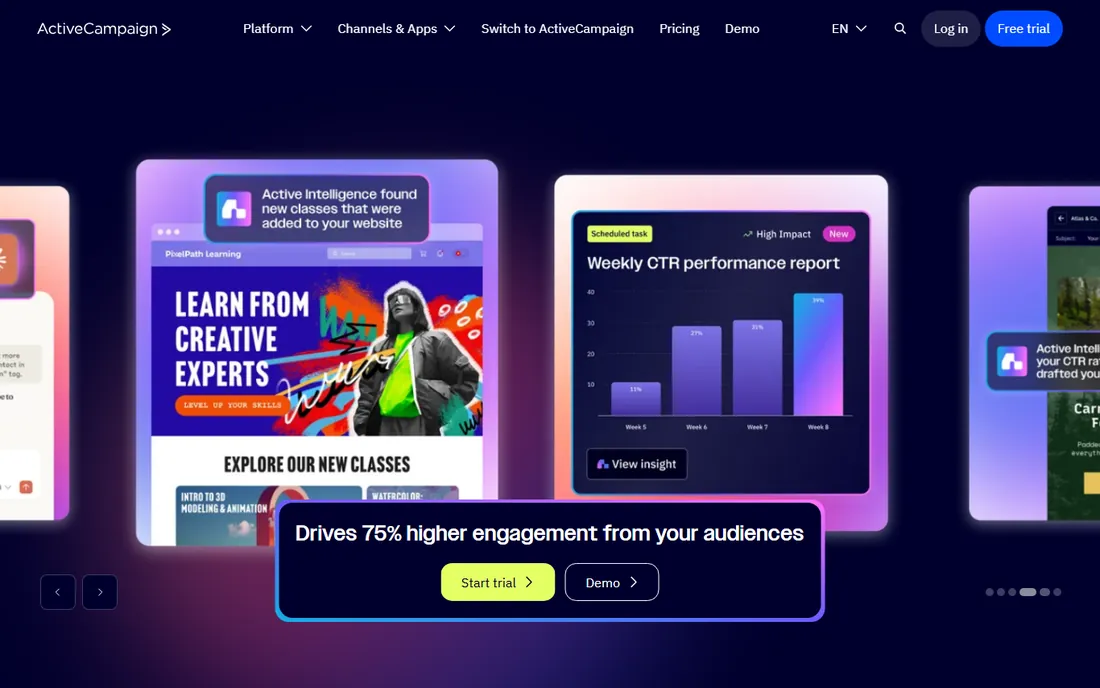
ActiveCampaign's automation builder is the reason it survives against HubSpot: conditional branches, goal tracking, lead scoring, SMS and site messaging, all on plans starting at $15 a month for 1,000 contacts. Plus at $49 and Pro at $79 add CRM depth, attribution and predictive content. For a marketer who lives in workflows, nothing cheaper competes.
The contact-based pricing is the catch: the bill grows with your list, and there is no free tier to hide on. Beginners face a real learning curve. But for small businesses whose marketing runs on sophisticated sequences, ActiveCampaign is the value king: HubSpot-level automation at a fraction of the price.
What we like- The best automation builder under $50 a month: branching, scoring, site tracking and predictive sending
- Built-in CRM with pipelines and lead scoring
- Starter at $15 a month is remarkable value
Watch out for- No free plan, only a 14-day trial
- Pricing rises quickly with contact count
- The depth that experts love overwhelms beginners
#3
Brevo
Best for: Businesses with large lists and small budgets
Visit brevo.com
Starting priceFree; Starter $9/month
Free planYes
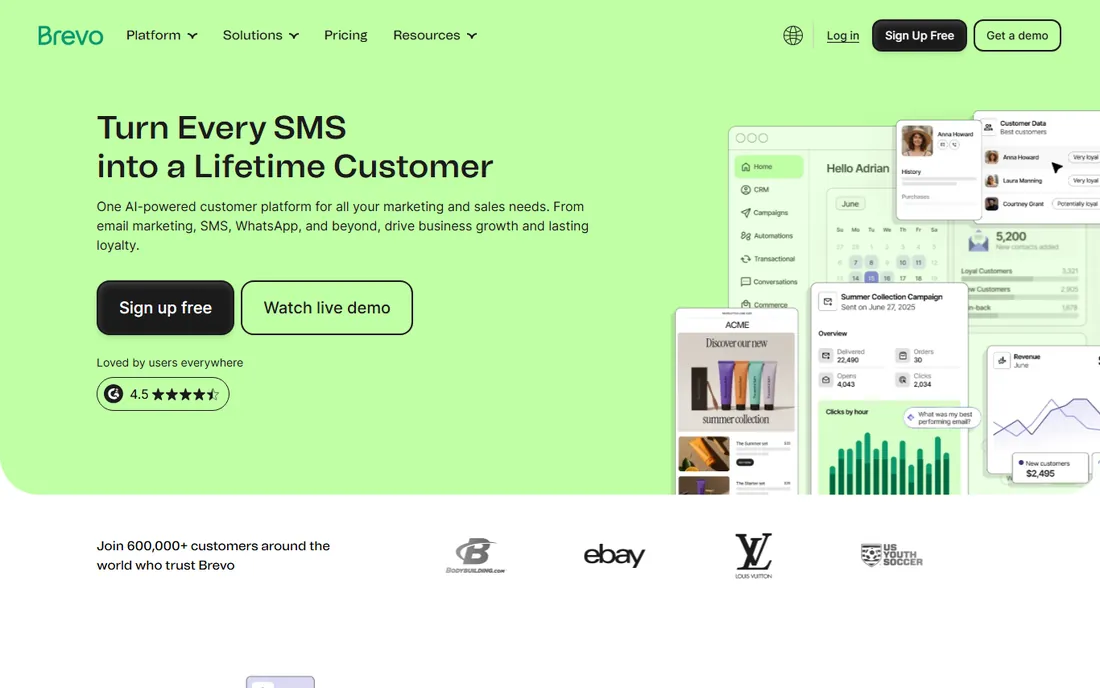
Brevo (formerly Sendinblue) wins on arithmetic: where rivals charge per contact, Brevo charges per email sent, with unlimited contacts. A 50,000-contact list that emails monthly costs a fraction of the contact-priced alternatives. Starter at $9 a month covers 5,000 emails; the free plan handles 300 a day with multi-step automation.
The trade-off is CRM depth: pipelines and deal management exist but are simpler than HubSpot's. High-volume senders should verify deliverability for their use case. For newsletters, announcements and straightforward automation to big lists, Brevo is usually the cheapest credible option.
What we like- The pricing model is the feature: unlimited contacts on every plan, priced by emails sent
- The free plan covers 300 emails a day with automation included
- SMS, WhatsApp and CRM in the same account
Watch out for- The sales CRM is basic compared with HubSpot or ActiveCampaign
- Deliverability tools trail the specialists at high volume
- The interface prioritizes function over polish
#4
Klaviyo
Best for: Ecommerce brands that live on email and SMS revenue
Visit klaviyo.com
Starting priceFree (250 contacts); from $20/month
Free planYes
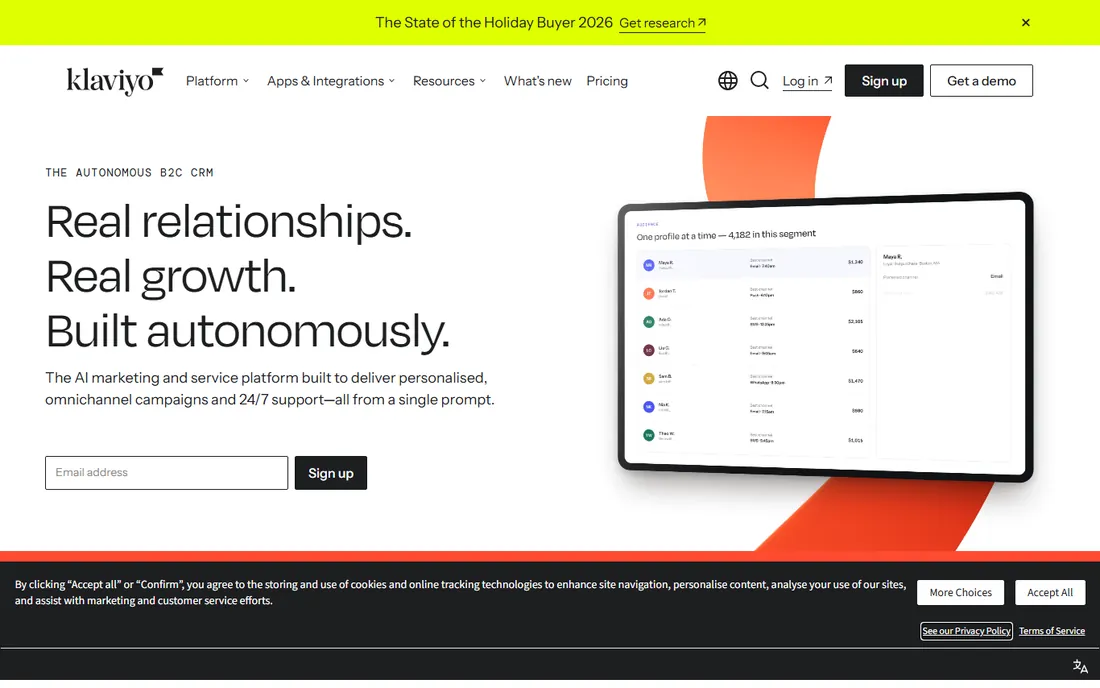
Klaviyo is the ecommerce default for a reason: it knows what your customers bought, browsed and abandoned, and turns that into automated flows that print money. Abandoned cart, browse abandonment, win-back and post-purchase sequences come pre-built and tuned. The free tier covers 250 contacts, and paid starts at $20 a month.
The bills scale with success: at 10,000 contacts you are paying $150 or more a month, plus SMS. Non-ecommerce businesses get little of the value. But for Shopify and DTC brands, the revenue attribution usually justifies the cost: Klaviyo customers can see exactly which flow earned what.
What we like- The deepest ecommerce integrations: Shopify, purchase behavior, browse abandonment and predictive analytics
- Flows for every revenue moment: welcome, abandoned cart, post-purchase
- Free to 250 contacts
Watch out for- Pricing climbs fast: sellers report $150-plus a month at 10,000 contacts
- It is ecommerce-only in practice: poor fit for B2B services
- SMS costs add up on top of email
Starting priceFree (500 contacts); Essentials $13/month
Free planYes
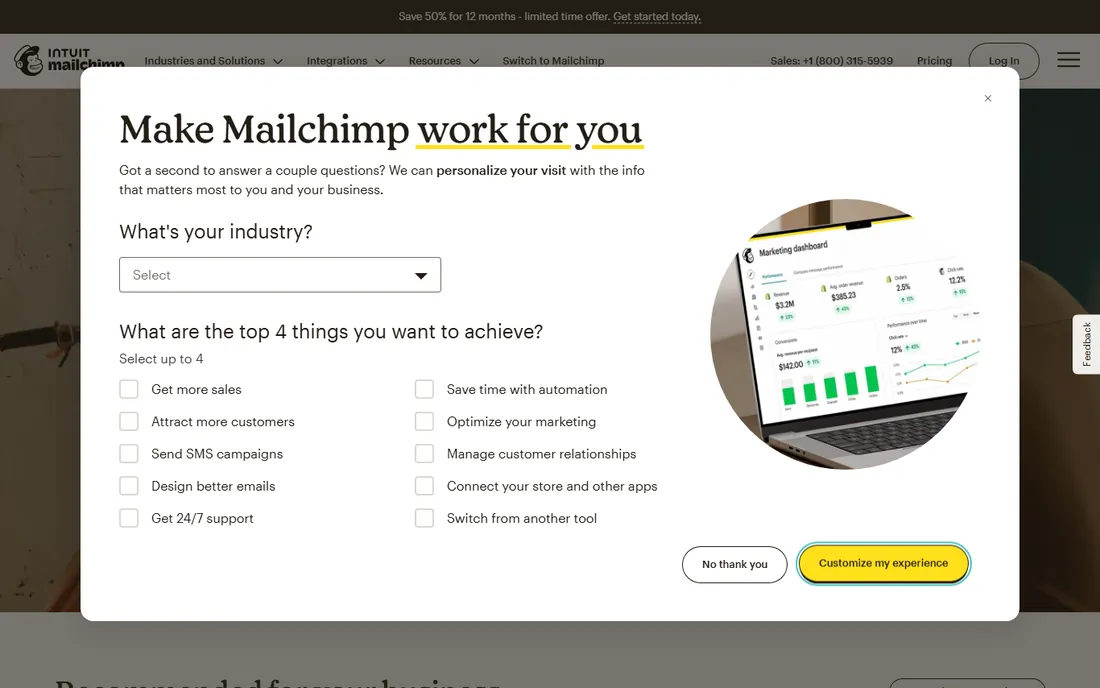
Mailchimp remains the starting point for email marketing: free for 500 contacts, dead-simple campaign building, and templates that look good without design skills. Essentials at $13 a month adds more sends and support; Standard at $20 adds behavioral targeting and advanced journeys. The CRM features cover basic contact management and tagging.
Growth is where Mailchimp stings: the price ladder climbs steeply, and sophisticated automation never matches ActiveCampaign. It is the right tool for newsletters and simple campaigns, the wrong one for complex lifecycle marketing. Start here, graduate when the bill or the feature ceiling says so.
What we like- The easiest onboarding in the category: templates, AI content help and simple journeys
- Free plan covers 500 contacts
- The brand and integration ecosystem are ubiquitous
Watch out for- Pricing surges as lists grow: Standard from $20, Premium from $350 a month
- Advanced automation lags ActiveCampaign
- The contact-based pricing punishes large lists
#6
Keap
Best for: Small businesses that want sales pipeline plus marketing automation
Visit keap.com
Starting priceSee website
Free planFree trial
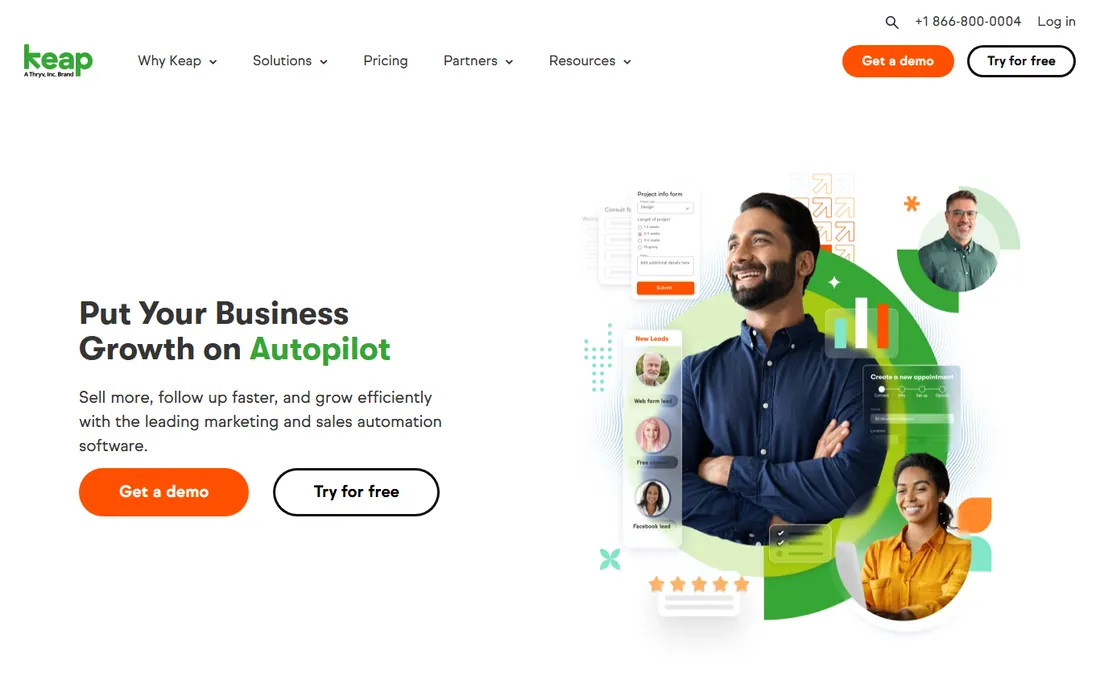
Keap (the artist formerly known as Infusionsoft) targets the small business that sells actively: pipelines for deals, automated follow-up by email and text, invoicing and payments in one system. The contact-block pricing means you know what the next tier costs before you hit it. Service businesses, coaches and appointment-based sellers are the core audience.
The published pricing is vague, which complicates comparison shopping, and the platform's depth can overwhelm. It sits between a pure CRM and a pure marketing tool: choose it when the business needs both selling and marketing automation without enterprise software.
What we like- Combines CRM pipelines with email and text automation in one small-business package
- Stairstep contact pricing is predictable
- Strong for appointment-based and service businesses
Watch out for- Pricing is not prominently published
- The interface carries the Infusionsoft legacy complexity
- Automation depth trails ActiveCampaign at similar scale
Starting priceFrom $19/month
Free planFree trial
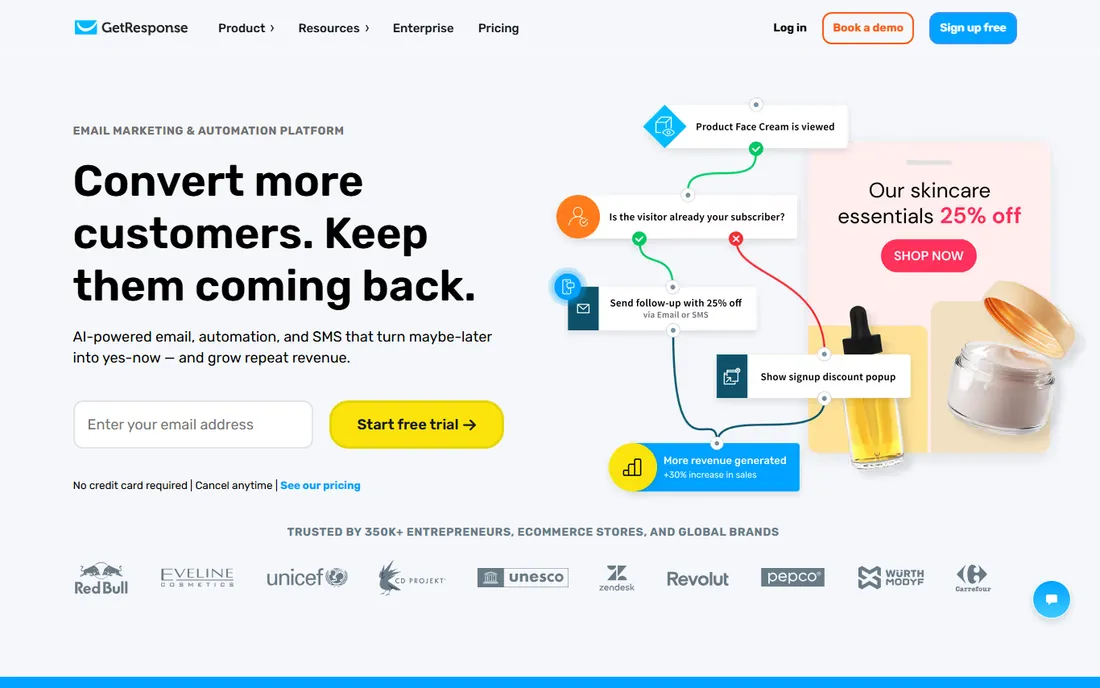
GetResponse's differentiator is webinars: host them natively, then run the follow-up sequences in the same system. For course creators, coaches and B2B marketers who sell through webinars, that integration removes a tool and a Zapier bill. Email automation, landing pages and funnels round out the package from $19 a month.
As a pure CRM it is thinner than the leaders, and the webinar tool suits audiences in the hundreds, not thousands. Buy GetResponse when webinars are central to the marketing: otherwise, the specialists do email or CRM better.
What we like- The only tool here with built-in webinar hosting: run and follow up on webinars in the same platform
- Solid automation builder and conversion funnels
- From $19 a month
Watch out for- The CRM features are lighter than HubSpot or ActiveCampaign
- Webinar quality suits small events, not productions
- The all-in-one breadth means less depth per feature
Starting priceFrom $12/month
Free planFree trial
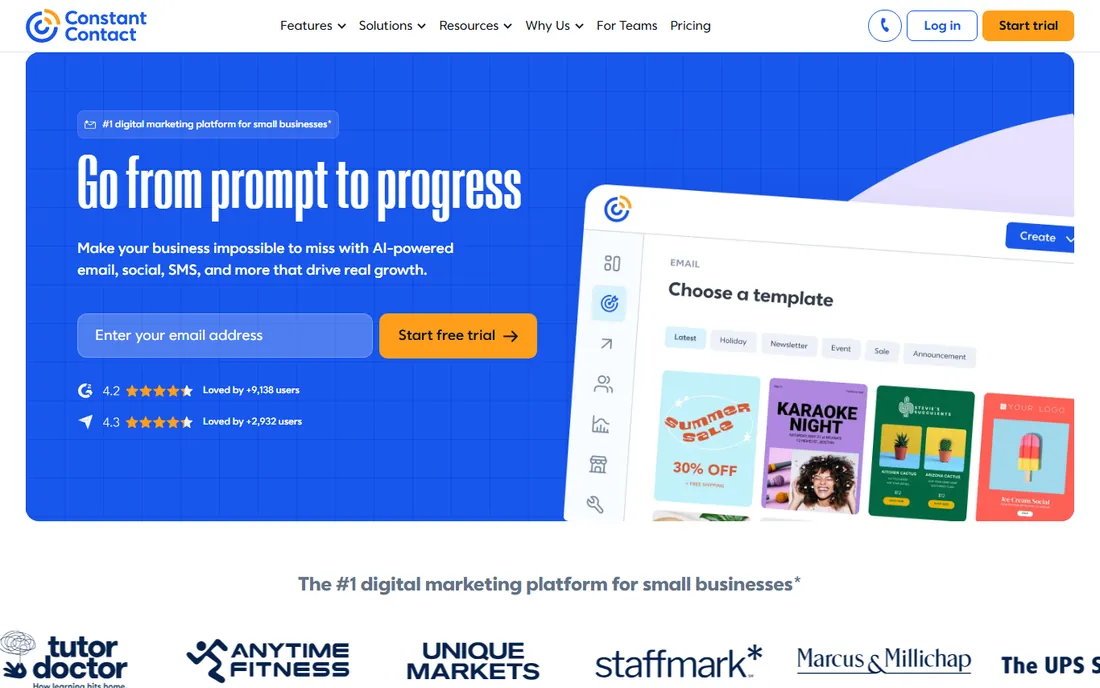
Constant Contact is the anti-complexity option: email campaigns, event invitations, surveys and simple automation, from $12 a month, with support humans answer. Local businesses, nonprofits and associations that send newsletters and event invites get everything they need without a learning curve.
Sophisticated marketers will chafe: branching automation, lead scoring and deep integrations are thin. The contact-based pricing with no free plan also ages poorly as lists grow. It is the right tool for simple, consistent communication; the wrong one for lifecycle marketing.
What we like- The simplest serious email tool: templates, event marketing and surveys
- From $12 a month
- Strong nonprofit discounting
- Phone support that small businesses actually use
Watch out for- Automation is basic next to ActiveCampaign or Klaviyo
- The CRM is minimal
- Pricing scales by contacts with no free tier
#9
Drip
Best for: Ecommerce brands wanting Klaviyo-style automation with flexibility
Visit drip.com
Starting priceSee website
Free planFree trial
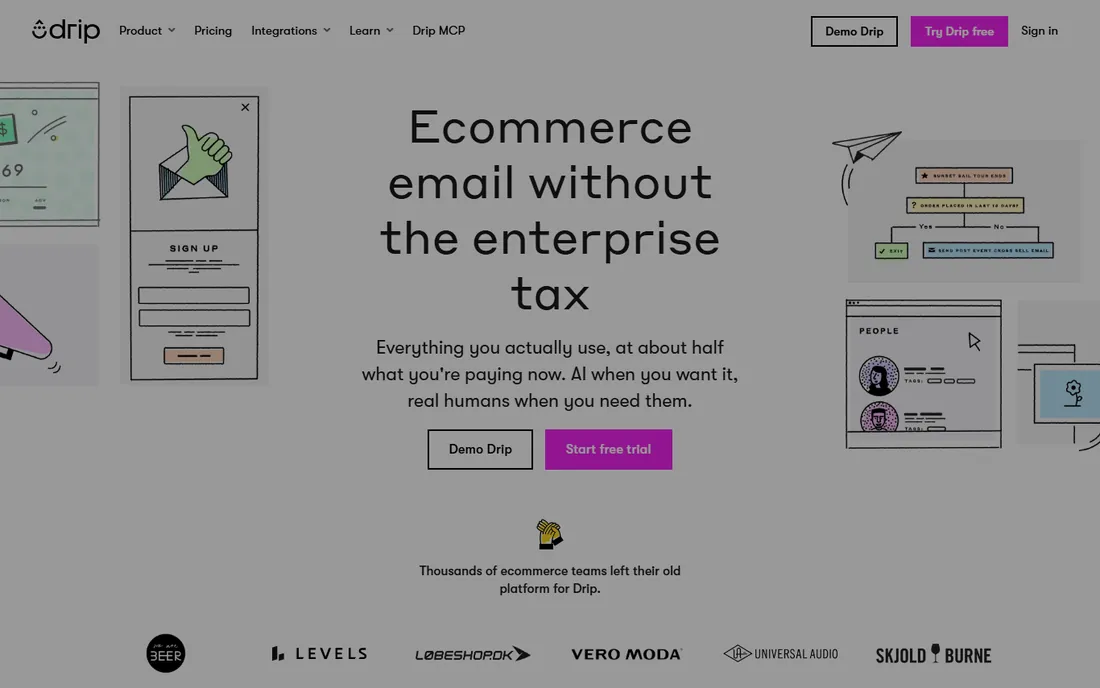
Drip is the Klaviyo alternative for ecommerce brands that want sophisticated automation: behavior-based workflows, deep store integrations, segmentation on purchase history, and revenue attribution per campaign. The visual builder handles multi-path customer journeys well, and the platform scales from startup stores to serious DTC operations.
Pricing requires checking the site for your contact count, and the integration ecosystem is smaller than Klaviyo's. Choose Drip when Klaviyo's pricing or constraints grate: it is the credible second option in ecommerce marketing automation, with a workflow builder some marketers prefer.
What we like- Ecommerce-focused automation with deep Shopify and WooCommerce integrations
- Visual workflow builder handles complex customer journeys
- Strong segmentation and revenue attribution
Watch out for- Pricing is contact-based and not prominently published
- Smaller ecosystem than Klaviyo
- The learning curve is real for complex workflows
#10
Salesforce Marketing Cloud
Best for: Enterprises personalizing at massive scale
Visit salesforce.com
Starting priceSee website (quote-based)
Free planNo
Salesforce Marketing Cloud is the enterprise answer: cross-channel journeys across email, SMS, push, advertising and web, powered by the Salesforce data platform and Einstein AI. For companies with millions of contacts and dedicated marketing ops teams, the personalization depth is unmatched.
Everyone else should stop reading. Pricing is quote-based and enterprise-scale, implementation is a project requiring specialists, and the platform assumes Salesforce CRM underneath. It belongs on this list because "marketing CRM" at enterprise scale means Salesforce; it does not belong on your shortlist unless your contact database has seven figures.
What we like- The deepest personalization engine in the business: journey builder, Einstein AI, and cross-channel orchestration
- Native integration with the Salesforce platform
- Built for millions of contacts
Watch out for- Quote-based pricing that starts in the thousands per month
- Implementation needs specialists or agencies
- Absurd overkill for small and mid-sized businesses
Most of these tools charge by contacts: HubSpot, ActiveCampaign, Mailchimp, Klaviyo and Constant Contact all raise the bill as your list grows. Brevo charges by emails sent, with unlimited contacts. That difference decides the winner for many businesses.
Do the arithmetic for your actual sending pattern. A 40,000-contact list emailed twice a month is 80,000 sends: on Brevo's send-based pricing that is cheap, while contact-based tools charge for all 40,000 contacts regardless. A 3,000-contact list emailed weekly flips the other way. Model your list at double its current size, because these tools profit from your growth: the one that is cheap today should still be sane at 2x.
The free CRM trap: when free stops being free
HubSpot, Brevo, Mailchimp and Klaviyo all offer free tiers, and they are genuinely useful for starting out. The trap is architectural: you build your lists, automations and integrations on the free platform, and switching costs grow with every workflow. By the time the bill arrives, migration feels impossible.
That is not a reason to avoid free tiers: it is a reason to choose with open eyes. Pick the free tier of the platform you would pay for at scale, not the one with the most generous free limits. The cheapest long-term choice is the tool you never have to migrate away from. Read the paid pricing before you invest months in the free plan.
Frequently asked questions
What is the difference between a CRM and a marketing CRM?
A CRM manages relationships: contacts, deals, conversations. A marketing CRM adds the marketing engine: email campaigns, automation, lead scoring and attribution, all acting on the CRM data. HubSpot and ActiveCampaign are marketing CRMs; a pure sales CRM like Pipedrive needs a separate email tool.
What is the best marketing CRM for a small business?
ActiveCampaign at $15 a month for deep automation, or HubSpot's free CRM plus Marketing Hub Starter at $15 a seat for the all-in-one path. Budget-first businesses should look at Brevo: free plan, $9 a month Starter, and unlimited contacts. Ecommerce stores should start with Klaviyo.
How much does marketing CRM software cost?
Entry points run $9 to $20 a month: Brevo $9, Constant Contact $12, Mailchimp $13, ActiveCampaign $15, HubSpot Starter $15, GetResponse $19, Klaviyo $20. Real costs rise with contacts: expect $50 to $200 a month for an established small-business list, and $890-plus for HubSpot Professional. Salesforce is quote-based at enterprise scale.
Is HubSpot really free?
The CRM is free: contacts, deals, tickets and basic marketing tools at no cost. Marketing automation beyond the basics needs Marketing Hub: Starter at $15 per seat per month, Professional around $890 a month. Most growing businesses end up paying; the free tier is the on-ramp, not the destination.
Which is better: HubSpot or ActiveCampaign?
HubSpot wins for all-in-one simplicity and sales-marketing alignment; ActiveCampaign wins for automation depth per dollar. A team that needs CRM, CMS and service tools picks HubSpot. A marketer who lives in complex workflows picks ActiveCampaign at a third of the price. Both scale expensively with contacts.
Can I switch marketing CRMs later?
Yes, but it hurts: lists, automations, templates, integrations and historical data all need migration, and deliverability resets on new sending infrastructure. Plan a month for the move and run both systems in parallel. The best migration strategy is choosing well the first time: trial seriously before committing.
How we chose
We started with the searches SMB marketers run: best marketing CRM, HubSpot vs ActiveCampaign, Klaviyo vs Mailchimp and Brevo review. For each candidate we verified it combines CRM contact management with marketing automation in 2026, confirmed entry pricing from vendor pages and recent comparisons, and weighed the true cost at realistic list sizes rather than the sticker price. Unverifiable prices are marked "See website."
Sources we checked (5)
- https://editorialge.com/best-marketing-automation-tools/
- https://www.brevo.com/blog/best-newsletter-software/
- https://tajo.io/blog/the-15-best-email-marketing-platforms/
- https://nethunt.com/blog/blog-top-hubspot-crm-alternatives/amp/
- https://Chatim.app/en/blog/hubspot-alternatives/
Is your product missing or out of date?
We review this list regularly. Vendors can request a listing, send updated pricing or ask about featured placement.

Shihab Mia · Founder, Rankite
Shihab has spent more than a decade helping SaaS and e-commerce brands grow through search. He writes Rankite's software buying guides from pricing pages, documentation and public user reviews. More about Shihab.