How we make this list: we compare pricing pages, product documentation and public user reviews. Rankite is independent; if a vendor ever pays for a featured spot, that listing is clearly labeled Partner.
Key takeaways
- Google Analytics 4 and Looker Studio are free and cover most small businesses' needs: traffic, conversions and custom dashboards at zero cost.
- Mixpanel (usage-based, first 1M events/month free) and Amplitude (from $49/month billed annually) are the picks for product-led teams that need funnels, retention and cohort analysis.
- For agency-style client reporting, Databox (from $64/month) and DashThis (from $44/month billed annually) pull ad, social and web data into dashboards you can send to clients.
- Triple Whale (free tier, Foundation from $219/month) is built for Shopify stores that need to see which ad dollar produced which order.
- Funnel (from $200/month billed annually) is a data pipeline for teams that already have a BI tool, not a reporting tool on its own.
Quick comparison
| Tool | Best for | Starting price | Free plan |
|---|
 Google Analytics 4 Google Analytics 4 | Free website and campaign analytics | Free (Analytics 360 by quote) | Yes |
 Looker Studio Looker Studio | Free custom dashboards | Free | Yes |
 HubSpot Marketing Hub HubSpot Marketing Hub | CRM-tied marketing reporting | From $20/seat/month (Starter) | Yes |
 Mixpanel Mixpanel | Product and funnel analytics | From $0 (usage-based, first 1M events/mo free) | Yes (up to 1M events/mo) |
 Amplitude Amplitude | Behavioral analytics at scale | From $49/month (Plus, billed annually) | Yes (Starter) |
 Databox Databox | Multi-source KPI dashboards | From $64/month (Analyst) | Yes |
 DashThis DashThis | Simple client reporting | From $44/month (Individual, billed annually) | No (14-day free trial) |
 Triple Whale Triple Whale | Ecommerce attribution for Shopify | From $219/month (Foundation) | Yes |
 Funnel Funnel | Marketing data pipelines | From $200/month (Starter, billed annually) | No |
Is your product missing or out of date?
We review this list regularly. Vendors can request a listing, send updated pricing or ask about featured placement.
Most marketing teams do not lack data. They lack a single place where ad spend, web traffic, email and CRM results agree with each other. The tools below solve different halves of that problem: some measure what happens on your website and in your product, some report across every channel for clients and executives, and some just move the data into your warehouse. Nine platforms, with the pricing traps marked.
Starting priceFree (Analytics 360 by quote)
Free planYes
GA4 is the default marketing analytics tool for a reason: it costs nothing, integrates with Google Ads and Search Console, and answers the core questions of what brought visitors, what they did and whether they converted. For small and mid-size businesses, the free tier plus Looker Studio for dashboards is genuinely enough.
The honest limits show up with scale. High-traffic properties hit sampling in Explorations and the "(other)" row in reports, and consent banners make a meaningful share of visitors invisible in regions with strict privacy rules. Google sells Analytics 360 for unsampled data, BigQuery export and SLAs, but pricing is behind sales calls, with resellers suggesting roughly $50,000 a year to start. Most teams should run GA4 free and only consider 360 when sampling is actually hurting decisions.
What we like- Free with no event cap for most businesses
- Deep integration with Google Ads for campaign reporting
- Event-based model that matches how modern sites work
Watch out for- The interface buries common reports and the learning curve is real
- Data sampling and the "(other)" row frustrate high-traffic sites
- Analytics 360 pricing is quote-only and starts around $50,000 a year
Starting priceFree
Free planYes
Looker Studio turns your GA4, Google Ads and Search Console data into dashboards your team and clients can actually read. For agencies and in-house teams that live mostly in the Google stack, it replaces a paid reporting tool entirely: unlimited dashboards, unlimited viewers, scheduled email delivery and embedded reports, all free.
The catch is everything outside Google. Facebook Ads, TikTok, HubSpot and most email tools need third-party connectors, which typically run $37 to $200 or more a month. At that point the "free" dashboard costs as much as DashThis or Databox while requiring more setup and maintenance. If your stack is mostly Google, Looker Studio is the obvious answer. If it is multi-channel, price the connectors before committing.
What we like- Completely free with unlimited dashboards and viewers
- Google-native sources connect at no cost
- Sharing links and scheduled email delivery built in
Watch out for- Non-Google data needs paid third-party connectors that can cost more than an all-in-one reporting tool
- Performance slows with heavy data blending
Starting priceFrom $20/seat/month (Starter)
Free planYes
HubSpot's advantage is that marketing data lives in the same database as sales. When a lead becomes a customer, the revenue flows back into the campaign report without exports or matching. Email, forms, landing pages, ads management and campaign analytics all report against one contact record, and attribution ties spend to closed deals rather than to clicks.
Pricing starts friendly and climbs fast. The free tier covers core email, forms and chat with HubSpot branding. Starter lists at $20 per seat per month with 1,000 marketing contacts included (intro promos run lower for new customers, then step up at renewal). Professional starts at $800 to $890 a month with a mandatory $3,000 onboarding fee, and Enterprise at $3,600 with a $7,000 fee. Buy HubSpot for the CRM-plus-marketing combination, not as a standalone analytics tool: its reporting depth only pays off if sales works in the same system.
What we like- Reporting sits on the same CRM as sales, so attribution ties to real revenue
- Free tools cover email, forms and basic reporting
- Contact-based pricing keeps small lists cheap
Watch out for- The price ladder is steep: Professional starts around $890/month plus a $3,000 onboarding fee
- Advanced attribution needs Professional or higher
Starting priceFrom $0 (usage-based, first 1M events/mo free)
Free planYes (up to 1M events/mo)
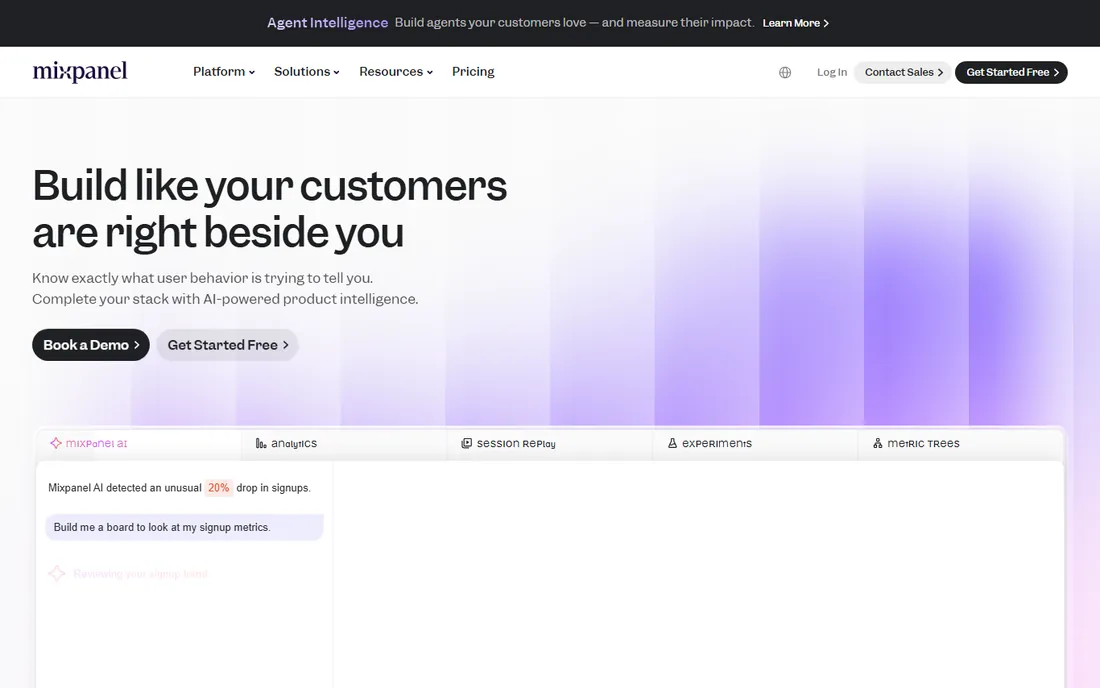
Mixpanel answers product questions: where do users drop off in onboarding, which cohort retains, which feature drives conversion. The free plan covers up to 1 million events a month with core funnels, flows and retention curves, which makes it one of the best free tools in this category. Seats are unlimited, so the whole team can self-serve.
The pricing model is event-volume based, and that is where the math turns. Growth starts at $0 for the first million events, then Mixpanel's own calculator prices it from $140 a month at 1.5 million events to $2,289 a month at 20 million on monthly billing ($120 to $1,635 billed annually). Group Analytics for account-level analysis and automated data pipelines are paid extras. Track event volume carefully before you scale, or the renewal will surprise you.
What we like- The most generous free tier in product analytics at 1M events a month
- Funnels, retention curves and flows are excellent out of the box
- Unlimited seats on every plan
Watch out for- Costs scale hard with event volume ($140/month at 1.5M events, $2,289 at 20M)
- Group analytics and data pipelines are paid add-ons
Starting priceFrom $49/month (Plus, billed annually)
Free planYes (Starter)
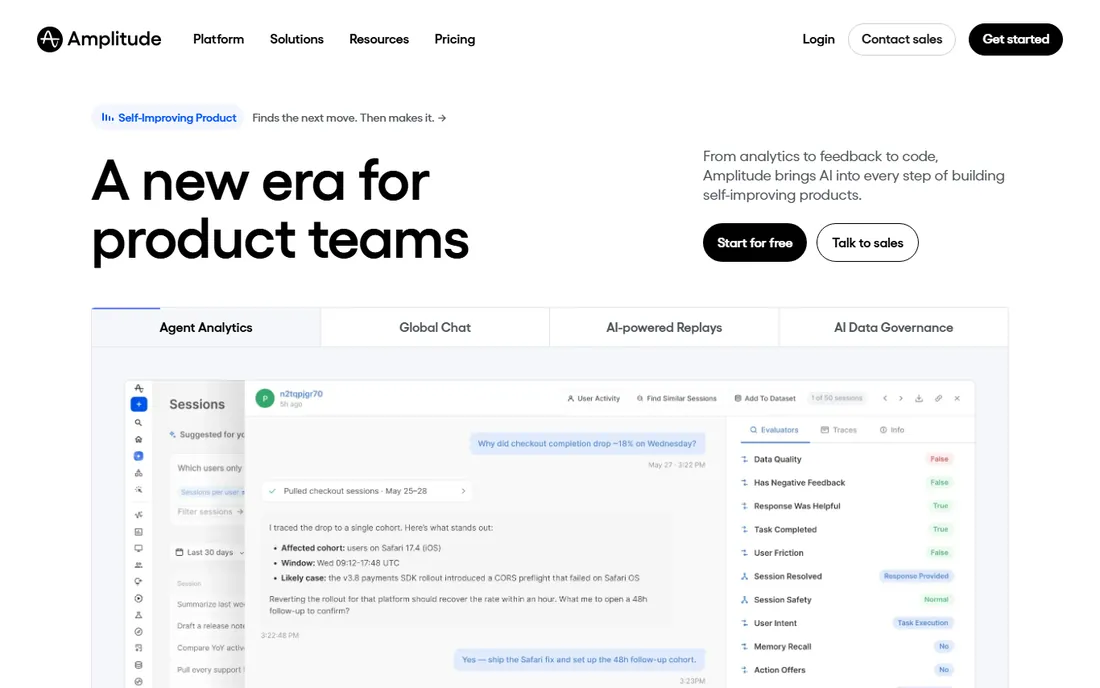
Amplitude competes directly with Mixpanel for product analytics, with a broader platform: analytics, session replay, feature experimentation, guides and surveys, and AI agents that monitor dashboards and summarize sessions. The free Starter plan covers 10,000 monthly tracked users and up to 2 million events a month, which is generous.
Plus starts at $49 per month billed annually, scaling with usage up to 300,000 MTUs or 25 million events. Growth and Enterprise are custom quotes; third-party deal data puts the median Amplitude buyer around $65,000 a year, so the entry number is not the story for larger companies. Choose Amplitude over Mixpanel when you want experimentation and in-app messaging in the same platform as analytics; choose Mixpanel when you want the simplest event-based pricing and the biggest free tier.
What we like- Deep behavioral analysis with cohorts, journeys and experimentation in one platform
- Session replay and feature flags included even on Starter
- Generous 2M events a month free
Watch out for- Plus starts at $49/month but real costs scale with usage
- Growth and Enterprise are quote-only with median deals around $65,000 a year
Starting priceFrom $64/month (Analyst)
Free planYes
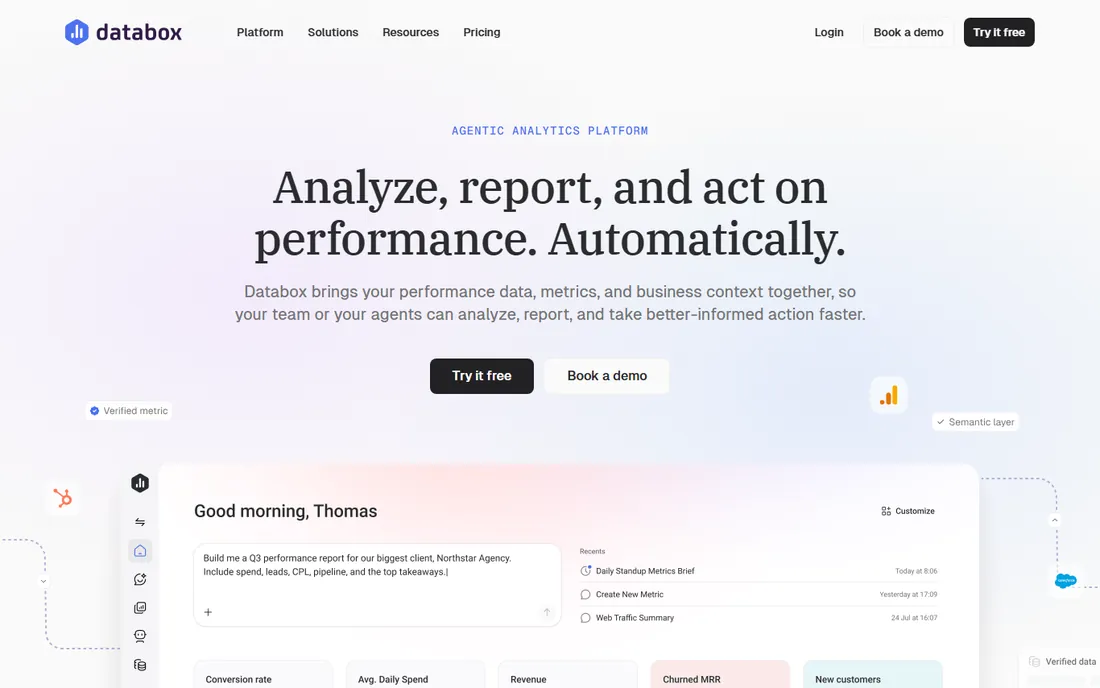
Databox pulls metrics from Google Ads, Facebook, HubSpot, Shopify and dozens more sources into live KPI dashboards, scorecards and scheduled reports. The 1,000-plus pre-built metrics mean you connect a source and the dashboards start filling themselves in. Genie, the AI analyst, answers questions about your data in plain language and can build dashboards on request.
The Business track starts with Analyst at $64 a month, Pro at $159 with unlimited users. The free plan covers 3 data sources. Agencies use a separate track: Agency Starter at $79 a month for 5 client accounts with per-client overage rates. The watch-out is source-based pricing: extra data sources cost per source per month, so count your ad accounts, GA4 properties and social profiles before signing. For internal KPI monitoring across many sources, Databox is strong; for per-client agency reporting, compare it against DashThis and AgencyAnalytics on your real client count.
What we like- 100-plus native connectors with pre-built metrics that surface on connection
- AI analyst that answers questions in plain language
- Free plan covers 3 data sources
Watch out for- Data source limits and overage fees complicate the bill as you scale
- The agency track prices per client, which changes the math for client reporting
Starting priceFrom $44/month (Individual, billed annually)
Free planNo (14-day free trial)
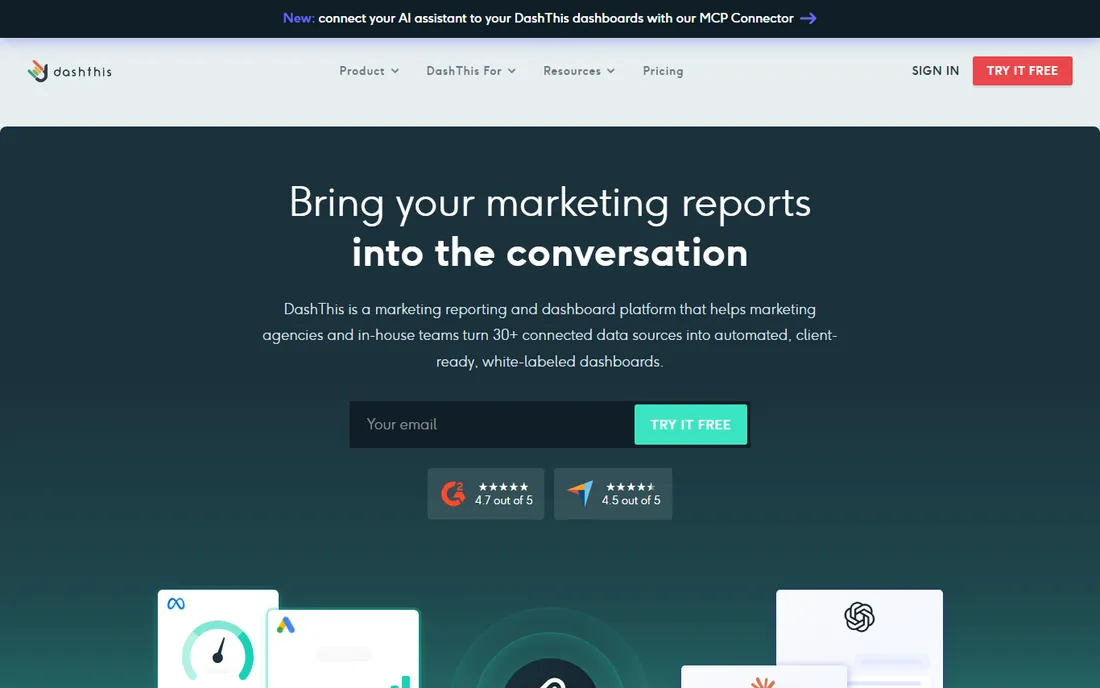
DashThis is built for one job: turning marketing data into client-facing reports with minimal effort. Connect your sources, pick a template, and the dashboard builds itself. Reviewers consistently call it one of the easiest tools to onboard, and the support team gets standout marks. Automated email reports, PDF export and dashboard comments cover the standard agency workflow.
Pricing is dashboard-based: Individual at $44 per month billed annually ($54 month to month) with 3 dashboards and 15 data sources, Professional at $139 with 10 dashboards, Business at $279 with 25, Standard at $429 with 50. Users are unlimited on every plan. The model is simple until you grow: if each client needs two or three dashboards, a 20-client agency lands on the higher tiers fast. It fits agencies and freelancers with a small, stable set of reports that want speed over depth.
What we like- The fastest setup of the reporting tools, with preset templates reviewers consistently praise
- Standout customer support
- AI Insights included on every plan
Watch out for- Dashboard-based pricing forces upgrades as clients multiply
- Data source caps per plan
- White-labeling starts at the $139/month Professional tier
Starting priceFrom $219/month (Foundation)
Free planYes
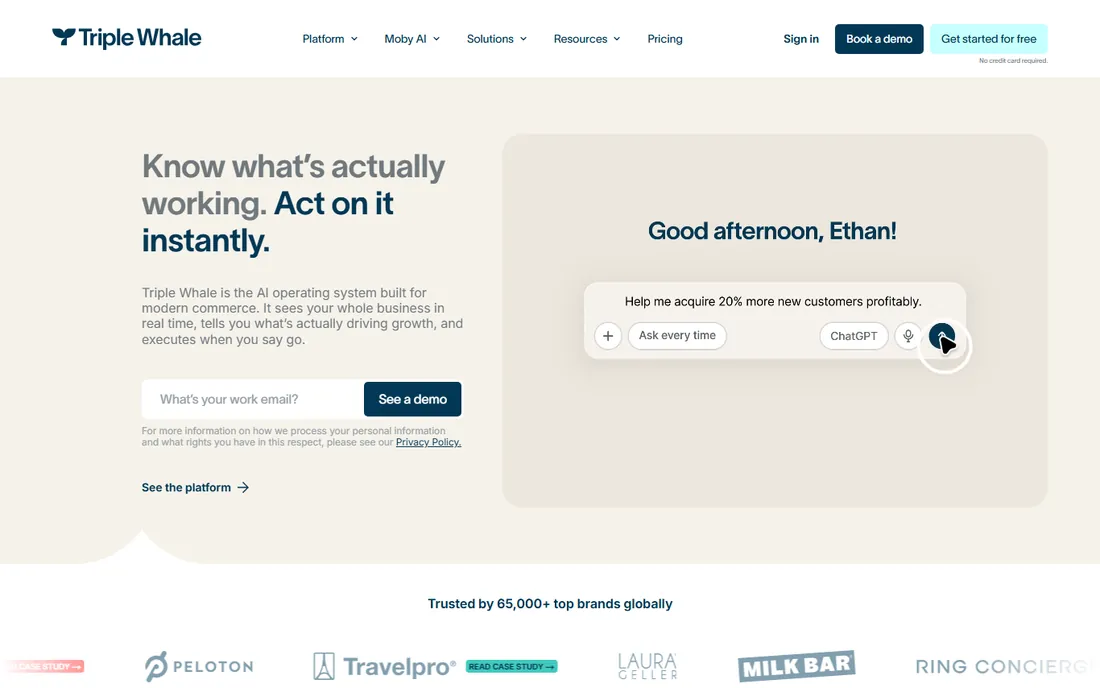
Triple Whale answers the question Shopify stores actually ask: which ad dollar produced which order. The Triple Pixel tracks Meta, Google, TikTok, Snapchat and Pinterest spend alongside Shopify orders, and the attribution models blend that into one view of ROAS. Creative Cockpit scores ad creative, and Moby, the AI layer, forecasts performance. Post-purchase surveys add a self-reported attribution signal that pixel tracking misses.
The free tier covers the pixel and basic attribution, which is genuinely useful. Paid plans scale with annual GMV: Foundation from $219 a month, Automate from $749, Enterprise custom. Annual billing includes two months free and locks your tier for the year. Add-ons like Retention, Conversion and Data Warehouse Sync cost extra. It is worth the money for stores spending across multiple channels; for a single-channel store under $20,000 a month in revenue, GA4 and native ad reporting usually suffice.
What we like- Attribution built for Shopify stores, tying ad spend to orders across channels
- Real free tier with the Triple Pixel and basic attribution
- Moby AI forecasting included
Watch out for- Pricing scales with your GMV band, so growth raises the bill automatically
- Add-ons like data warehouse sync stack on top
- Overkill for stores under $20K monthly revenue
Starting priceFrom $200/month (Starter, billed annually)
Free planNo
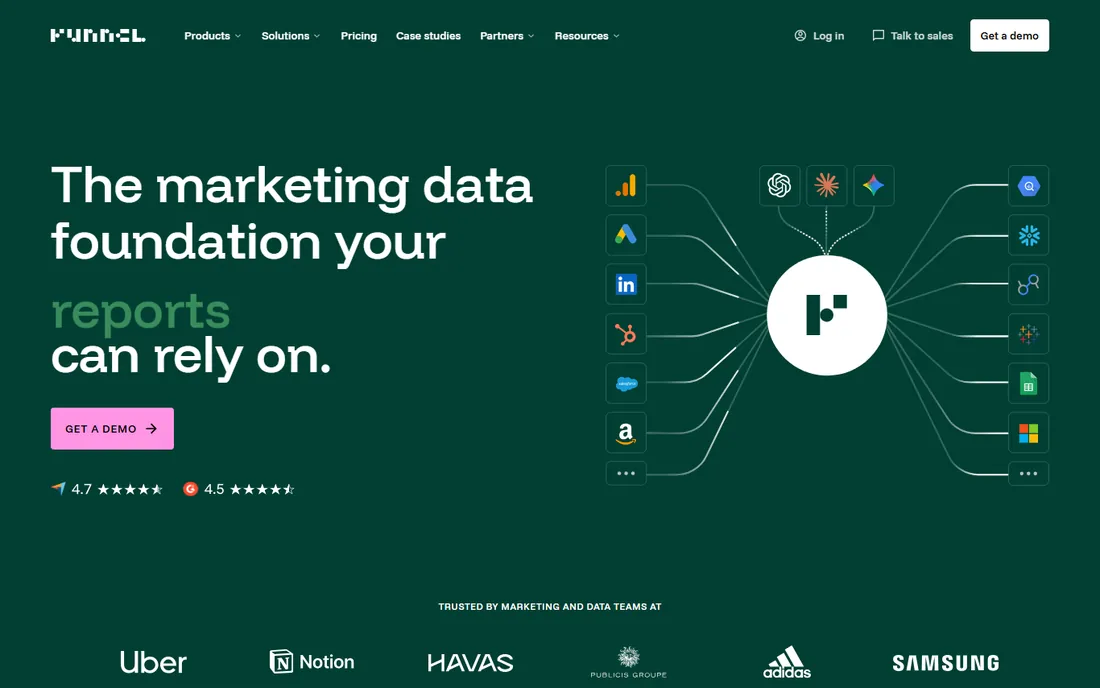
Funnel is not a reporting tool in the DashThis sense. It is a marketing ETL platform: it pulls data from ad platforms, normalizes field names and currencies, and loads clean data into your warehouse or BI tool. Teams that already love Tableau, Power BI or Looker Studio use Funnel as the plumbing underneath.
The pricing reality is steep and volatile. Starter runs $200 a month billed annually with 121 connectors, reporting only to Looker Studio, Sheets or Excel, and no warehouse export. Business at $800 a month adds 579 connectors and export destinations. Everything runs on Flexpoints credits that scale with connectors, accounts and refresh frequency, so the headline price is the floor; third-party deal data puts the average contract around $73,500 a year. Buy Funnel when you have a data team and a BI tool and need clean marketing data at scale. Everyone else should start with Databox, DashThis or Supermetrics-style connectors.
What we like- 600-plus connectors with strong data cleaning and normalization
- Built for data teams that already have a BI tool
- Managed data warehouse included
Watch out for- No free plan since December 2025 and no self-serve signup (demo required)
- Flexpoints credit pricing makes the real cost hard to predict
- Dashboards are basic
Attribution is the part everyone gets wrong
Every platform here claims to show which marketing works, and every platform answers a slightly different question. Last-click attribution in GA4 tells you which channel closed the deal. Mixpanel tells you which behavior predicts retention. Triple Whale's models try to split credit across the whole journey. These numbers will disagree with each other, and that is normal, not a bug.
The mistake is treating any single dashboard as the truth. Use GA4 for directional channel trends, your ad platforms for in-platform optimization, and a tool like Triple Whale or Northbeam for the cross-channel read. And before spending on attribution software, check the cheap wins: UTM discipline, consistent naming conventions and server-side tracking will improve every number you see, in every tool, for free.
How we chose
We read the current pricing page of every vendor with published prices, including the usage-based models (Mixpanel, Amplitude) where the number on the homepage tells you almost nothing. Quote-only tools are marked "See website" rather than repeating estimates. We compared on the features that decide purchases: connector breadth and depth, data freshness, white-labeling, export options, attribution methodology and the real scaling costs (per-event, per-contact, per-dashboard, per-GMV). We read recent reviews on G2, Capterra and Reddit for the post-purchase complaints: overage surprises, connector maintenance and onboarding quality.
What to look for before you buy
Start with the question you need answered, not the tool category. "Which ads drive revenue" is a Triple Whale or HubSpot question. "Where do users drop off in onboarding" is a Mixpanel or Amplitude question. "What do I send the client on the first of the month" is a DashThis or Databox question. Buying product analytics to do marketing reporting, or vice versa, is the most common misfire in this category.
Model your bill at twice your current size. Event-based pricing (Mixpanel, Amplitude), contact-based pricing (HubSpot) and GMV-based pricing (Triple Whale) all grow with your business, which is fair but means the entry price is not the budget. Per-dashboard pricing (DashThis) grows with your client list. Run the numbers for where you will be in 18 months, not where you are today.
Finally, check who maintains it. Dashboards die when nobody owns them: broken connectors, stale credentials and renamed campaigns silently poison the numbers. The best platform is the one someone on your team will open weekly and fix when it breaks.
Frequently asked questions
What is the best marketing analytics platform for a small business?
For most small businesses, Google Analytics 4 plus Looker Studio is enough: free, integrated with Google Ads, and capable of real dashboards. Add HubSpot if you need marketing tied to a CRM, or Mixpanel if you sell a product and need funnel analysis.
How much do marketing analytics platforms cost?
Free for GA4 and Looker Studio. Dashboards tools run $44 to $159 a month to start (DashThis, Databox). Product analytics start around $49 a month (Amplitude) and scale with event volume. Ecommerce attribution starts at $219 a month (Triple Whale). Data pipelines start at $200 a month (Funnel) and scale steeply.
What is the difference between web analytics and marketing analytics?
Web analytics (GA4) measures what happens on your website: traffic, behavior, conversions. Marketing analytics platforms connect that with ad spend, email, CRM and revenue across channels, so you can see which marketing produced which result. Many teams need both.
Do I need attribution software like Triple Whale?
If you run paid ads on two or more channels for a Shopify store doing over $20,000 a month, attribution software usually pays for itself by finding wasted spend. Below that scale, GA4 plus disciplined UTMs and native ad reporting are enough.
Can I get marketing reports without paying for software?
Yes. GA4 and Looker Studio are free, and Triple Whale, Mixpanel, Amplitude and Databox all have free tiers. The free options cover one business well; you pay when you need many data sources, white-labeled client reports, or warehouse exports.
Sources we checked (12)
- https://analytics.google.com
- https://lookerstudio.google.com
- https://www.hubspot.com/pricing/marketing
- https://mixpanel.com/pricing/
- https://amplitude.com/pricing
- https://www.databox.com/pricing
- https://dashthis.com/pricing/
- https://www.triplewhale.com/pricing
- https://www.funnel.io/pricing
- https://rybbit.com/blog/mixpanel-pricing
- https://userpilot.com/blog/amplitude-pricing/
- https://www.swydo.com/blog/swydo-vs-dashthis/
Is your product missing or out of date?
We review this list regularly. Vendors can request a listing, send updated pricing or ask about featured placement.

Shihab Mia · Founder, Rankite
Shihab has spent more than a decade helping SaaS and e-commerce brands grow through search. He writes Rankite's software buying guides from pricing pages, documentation and public user reviews. More about Shihab.