How we make this list: we compare pricing pages, product documentation and public user reviews. Rankite is independent; if a vendor ever pays for a featured spot, that listing is clearly labeled Partner.
Key takeaways
- BrightLocal is the best value for agencies and small businesses, with published pricing from $31 a month and strong reporting.
- Birdeye, Reputation, and SOCi target multi-location brands that need review volume handled at scale, all with quote-based enterprise pricing.
- Yext and Uberall lead on listing distribution networks, which matters most for brands with hundreds of locations.
- Whitespark and Semrush Local suit local SEO specialists who want rank tracking and citation tools without an enterprise platform.
Quick comparison
| Tool | Best for | Starting price | Free plan |
|---|
 BrightLocal BrightLocal | Agencies and SMBs that live on client reports | $31/month | No |
 Birdeye Birdeye | Brands drowning in reviews across locations | See website | No |
 Yext Yext | Enterprise brands needing maximum listing coverage | See website | No |
 SOCi SOCi | Franchises running local search, social, and reviews together | See website | No |
 Podium Podium | Local businesses that win customers by text | See website | No |
 Reputation Reputation | Multi-location brands tying reputation to revenue | See website | No |
 Synup Synup | Agencies that resell local SEO under their own brand | See website | Free trial |
 Uberall Uberall | Global brands managing locations across countries | See website | No |
 Whitespark Whitespark | Local SEO specialists who want precision tools | See website | No |
 Semrush Local Semrush Local | Marketing teams already paying for Semrush | See website | No |
Is your product missing or out of date?
We review this list regularly. Vendors can request a listing, send updated pricing or ask about featured placement.
The best local marketing software
Starting price$31/month
Free planNo
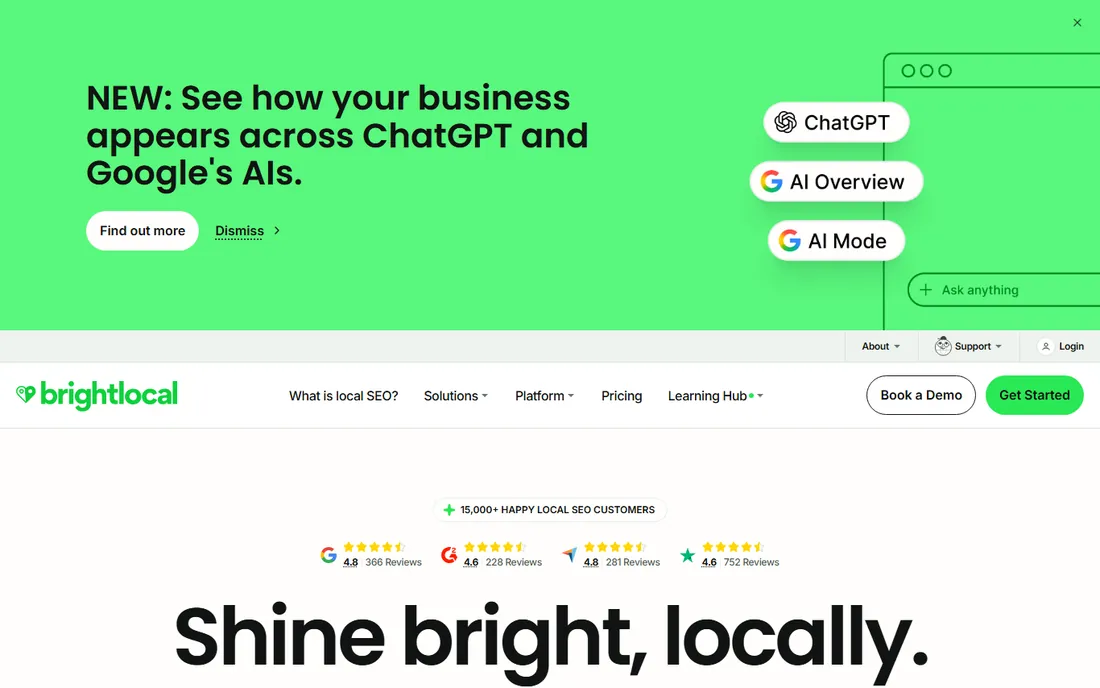
Here is the blunt version: most local marketing platforms sell listings, reviews, rankings, and reports in different packaging. BrightLocal wins by being honest about who it serves. Agencies managing a handful of clients and local businesses with a few locations get rank tracking, citation management, review monitoring, and GBP insights from $31 a month, with a free 14-day trial to prove it fits. The white-label client reports are the feature agencies actually stay for.
The platform covers the core jobs: local search grid rank tracking, citation building from $2 per citation, review monitoring, and Google Business Profile management. A free toolkit with a local SERP checker and review link generator is genuinely useful. The honest limits: listing sync runs on fewer publishers than Yext's 200-plus network, and review generation features sit on higher tiers. If you run hundreds of locations or need deep reputation workflows, the enterprise tools below fit better. For everyone else, start here.
What we like- Published pricing from $31 a month
- Strong white-label reporting
- Citation builder and rank tracking included
Watch out for- Listing sync covers fewer publishers than Yext
- Review generation only on higher tiers
Starting priceSee website
Free planNo
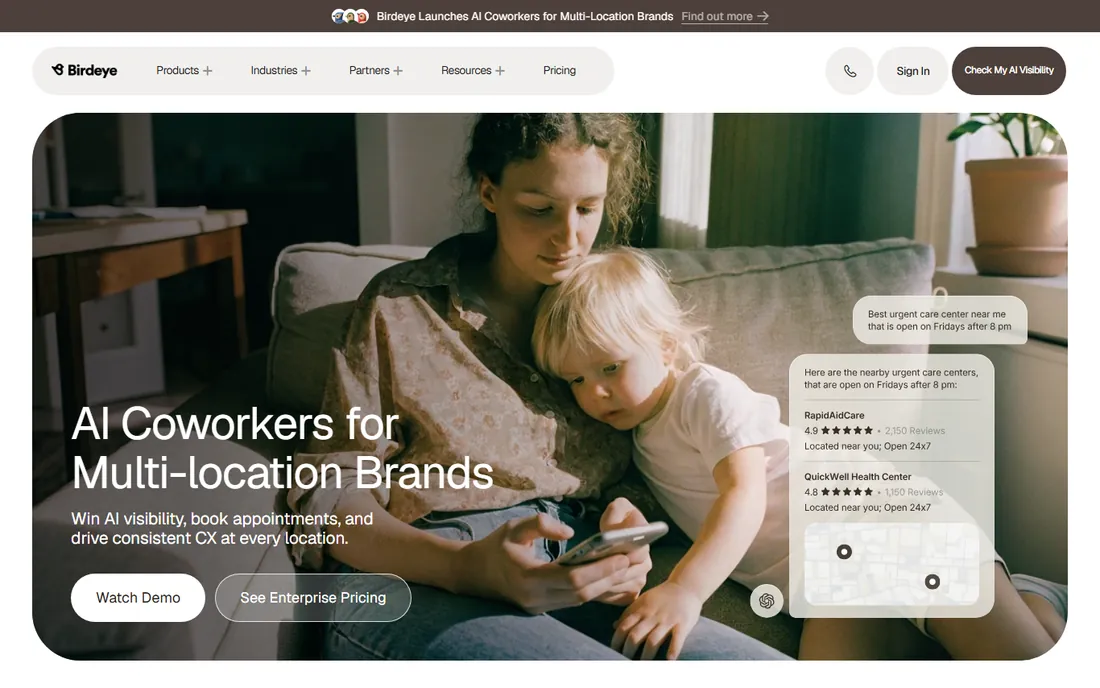
Birdeye built its name on review generation and has grown into a full customer experience platform for multi-location brands. The system pushes review requests by text and email, monitors reviews across sites, and now fields AI agents that handle listings optimization, review responses, social publishing, and messaging. Industry-specific setups for healthcare, dental, legal, and auto mean the workflows match how those businesses actually operate.
The scale argument is real: brands with dozens or hundreds of locations use it to keep response rates high without hiring an army. Social publishing across locations from one calendar and centralized messaging round out the package. The downside is the buying process. Pricing is quote-based, implementation is a project, and a single-location business will pay for capacity it never uses. Get a demo, ask for per-location pricing in writing, and compare the total against BrightLocal or Synup before you sign.
What we like- Review generation at serious scale
- AI agents for listings, social, and messaging
- Strong healthcare and dental footprint
Watch out for- Quote-based pricing
- Can be more platform than a small business needs
#3
Yext
Best for: Enterprise brands needing maximum listing coverage
Visit yext.com
Starting priceSee website
Free planNo
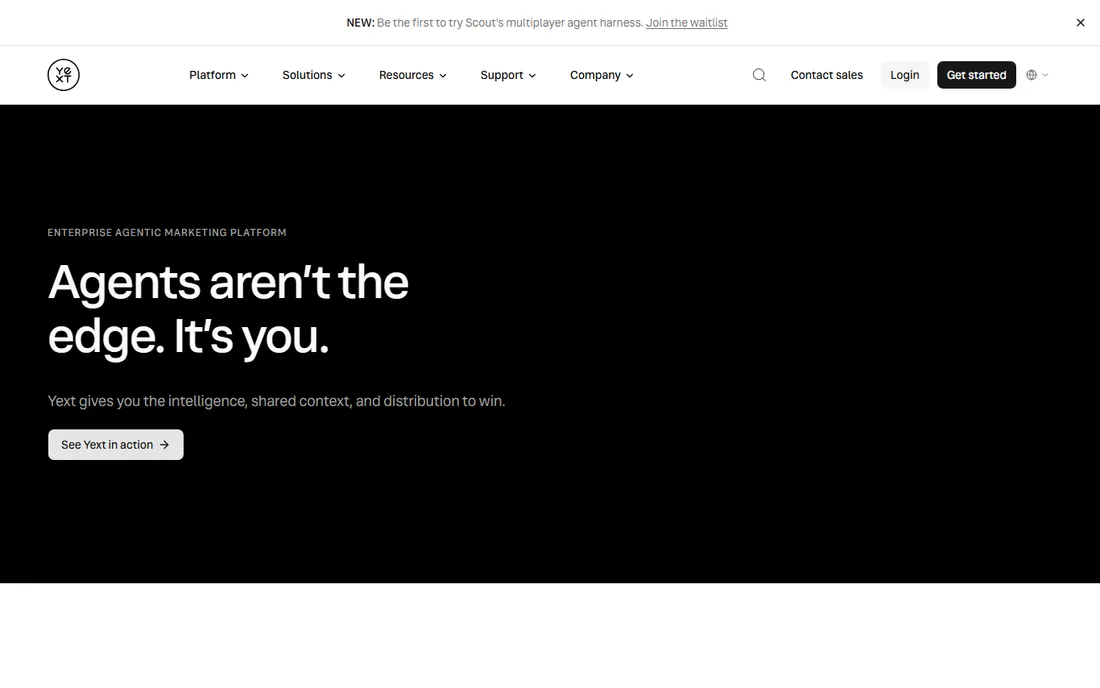
Yext is the enterprise default for a reason: its listing network reaches more than 200 publishers including Apple Maps, Bing, and Yelp, and its Knowledge Graph gives large organizations one place to manage business facts across every location. When a national brand changes holiday hours, Yext pushes that change everywhere at once. The platform has expanded into reviews, local pages, social, and AI search visibility, positioning itself as an agentic marketing platform for big teams.
The catch has always been price and lock-in. Plans are quote-based and historically came with annual commitments, so negotiate term length and get the per-location cost in writing. Smaller businesses get similar listing accuracy from cheaper tools, and Yext's review and social features, while improved, are not the reason to buy it. Buy Yext when listing scale and data governance across hundreds of locations is the job. For anything smaller, you are paying for network you do not need.
What we like- 200-plus publisher listing network
- Knowledge Graph as a single source of truth
- Strong analytics
Watch out for- Expensive
- Historically rigid contracts, check current terms
#4
SOCi
Best for: Franchises running local search, social, and reviews together
Visit meetsoci.com
Starting priceSee website
Free planNo
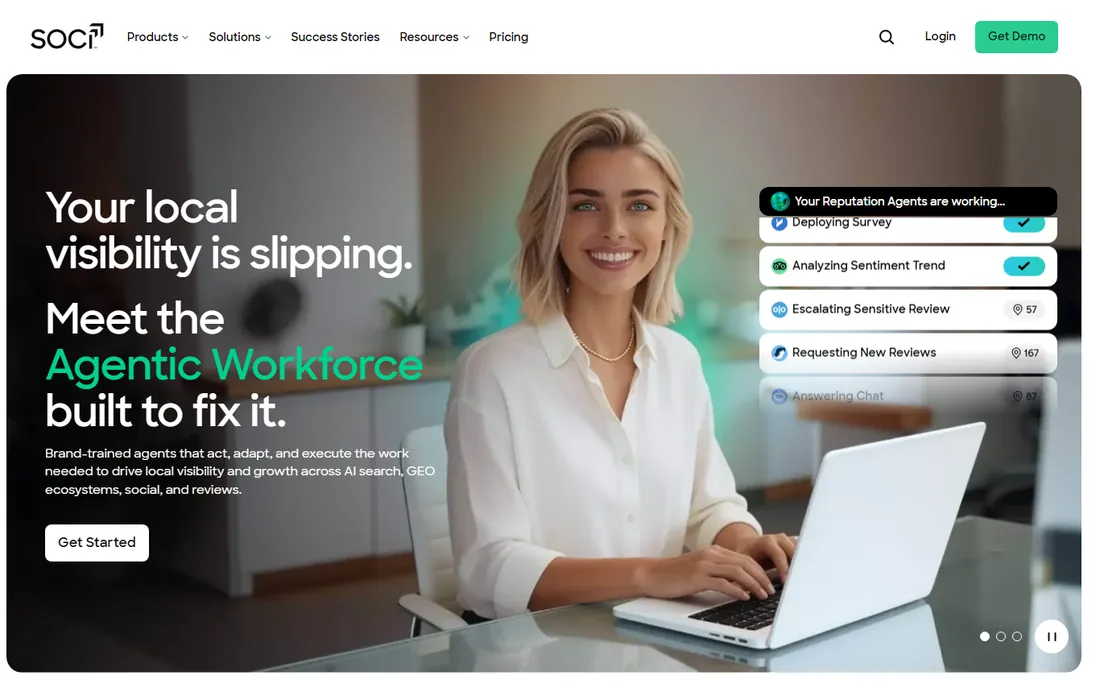
SOCi targets the messy middle of local marketing: franchise systems and multi-location brands where corporate needs control and local operators need freedom. The platform covers listings, local pages, reviews, social publishing, and ads, with workflow approvals so a franchisee's post goes out on-brand. Its Genius AI agents now handle local search optimization, review responses, and social content across locations.
The franchise DNA shows in the details: permission tiers, brand compliance guardrails, and reporting that rolls up from location to region to brand. Customer stories from restaurant and retail chains show the pattern working at scale. The trade-off is the enterprise buying motion. Pricing is custom, onboarding is a project, and the platform assumes you have a marketing team to run it. Single-location businesses and small agencies should look at BrightLocal or Synup instead.
What we like- Strong franchise feature set
- Genius AI agents for search, reputation, and social
- Good compliance controls
Watch out for- Quote-based enterprise pricing
- Onboarding takes real effort
Starting priceSee website
Free planNo
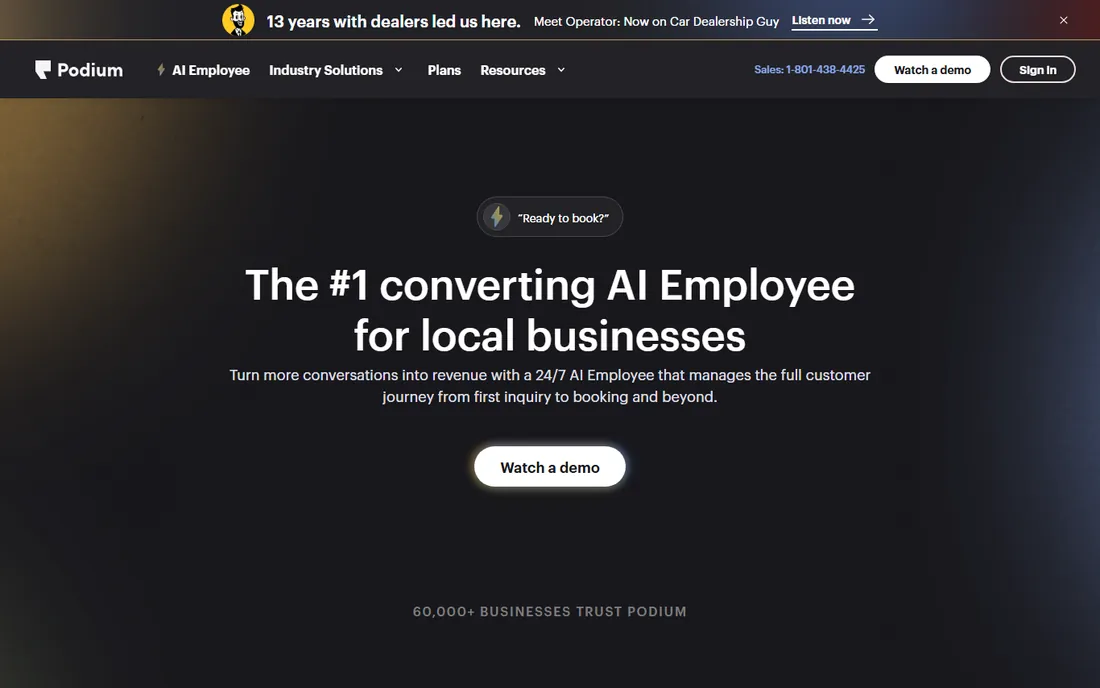
Podium comes at local marketing from the conversation, not the directory. The platform centers on texting: review requests by SMS, two-way messaging with customers, webchat that converts to text, and an AI employee that responds to leads in seconds, qualifies them, and books appointments around the clock. For auto dealers, home service companies, and retailers, where speed to lead decides who gets the job, that focus pays.
The company reports over 60,000 businesses on the platform, with deep roots in automotive and home services. Review volume follows naturally from the texting workflow, since asking right after a job is when customers say yes. The honest gap: Podium is not a listings management platform. If your business details are wrong across directories, you need Yext, Uberall, or BrightLocal alongside it. Pricing is quote-based, so ask for the per-location number and what the AI features actually cost.
What we like- Text-first communication customers actually answer
- AI employee for lead response
- Strong in auto and home services
Watch out for- Not a listings platform
- Pricing is quote-based
Starting priceSee website
Free planNo

Reputation positions itself as the platform for turning customer feedback into business results. The Rep Score gives every location a single number built from review volume, sentiment, and spread, which executives use to benchmark locations against each other and competitors. Reviews, surveys, listings, and social feed into one system, with AI summarizing sentiment and suggesting actions. Industry setups cover healthcare, automotive, property management, retail, and financial services.
The strength is accountability at scale. Regional managers see which locations drag the score and what to fix, and the survey tools connect feedback to operations. The weakness is accessibility. This is enterprise software with enterprise pricing and an enterprise sales cycle, and a ten-location business will find the platform heavy. If your board asks how reputation drives revenue, Reputation has the dashboards to answer. If you just need more reviews, start cheaper.
What we like- Rep Score benchmarking across locations
- Strong survey and sentiment analytics
- Deep industry templates
Watch out for- Enterprise pricing and sales process
- Overkill for small operations
#7
Synup
Best for: Agencies that resell local SEO under their own brand
Visit synup.com
Starting priceSee website
Free planFree trial
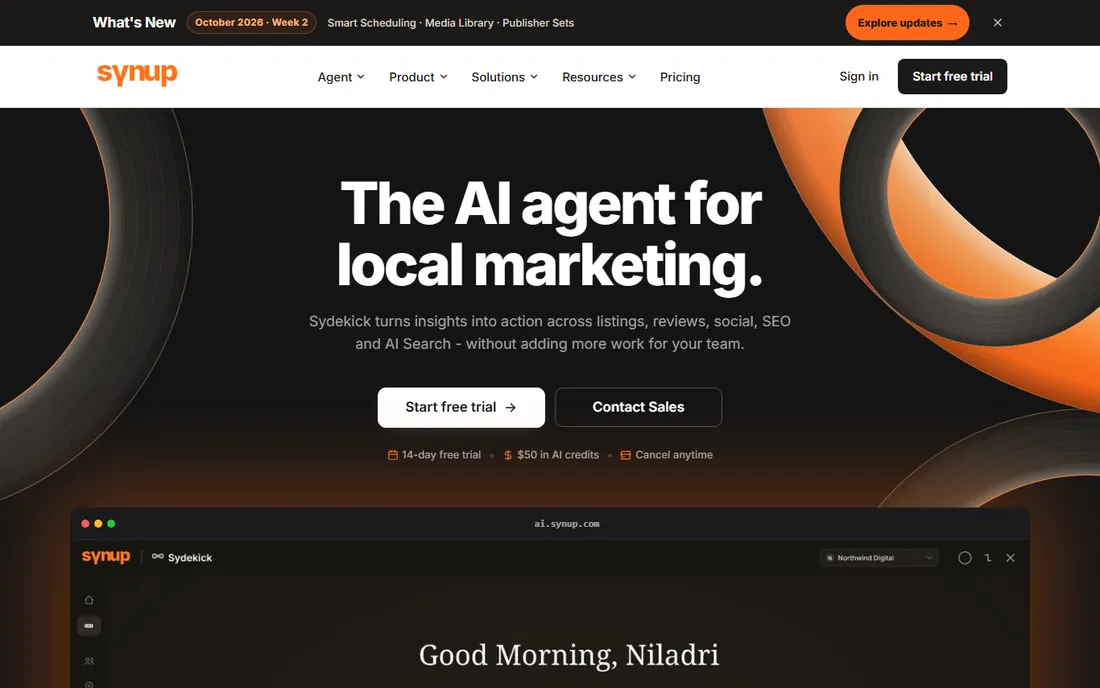
Synup is built for agencies first. The platform white-labels completely: your logo, your colors, your domain, and a client portal that looks like your product. Under the hood it handles listings sync across Google, Apple, Bing, Facebook, and 100-plus publishers, review monitoring and responses, local rank tracking, social publishing, and AI search visibility checks. An AI agent called Sydekick can run listing fixes and marketing tasks with guardrails you set.
Every plan starts with a 14-day free trial including AI credits and one location, with no sales call required to start, which is refreshing in this category. Pricing scales with locations and features, and stays transparent before you talk to sales. The trade-off against the enterprise players is depth in reviews and analytics: Birdeye and Reputation go further on sentiment and benchmarking. For agencies that need to look professional to clients from day one, Synup is the pragmatic pick.
What we like- White-label everything including client portal
- 14-day free trial
- API and AI agent features
Watch out for- Pricing scales with locations
- Smaller review feature set than Birdeye
#8
Uberall
Best for: Global brands managing locations across countries
Visit uberall.com
Starting priceSee website
Free planNo
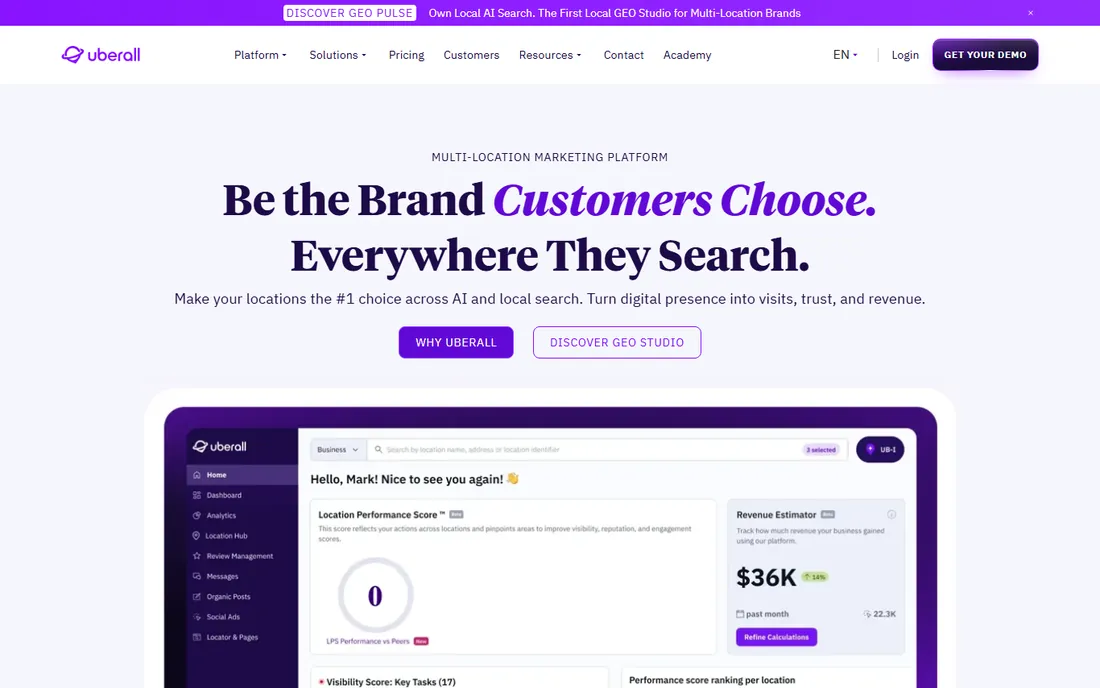
Uberall is the European answer to Yext and a strong pick for brands operating across countries. The platform manages listings across 150-plus directories, builds SEO-optimized local pages and store locators, handles reviews with AI-assisted responses, and runs local social publishing. An AI agent called UB-I monitors location performance and prioritizes actions by expected impact.
The international footprint is the differentiator. Brands like KFC, Shell, and Adidas use it across markets, and directory coverage outside the US is stronger than most American competitors. For a US-only business with a few dozen locations, that global strength matters less, so verify the directory list matches your markets before buying. Pricing is quote-based and the sales process is enterprise-grade. If you operate in Europe or across many countries, Uberall belongs on the shortlist next to Yext.
What we like- 150-plus directory network with strong European coverage
- Local pages and store locator
- AI agent for location performance
Watch out for- Quote-based pricing
- US buyers should verify directory relevance
Starting priceSee website
Free planNo
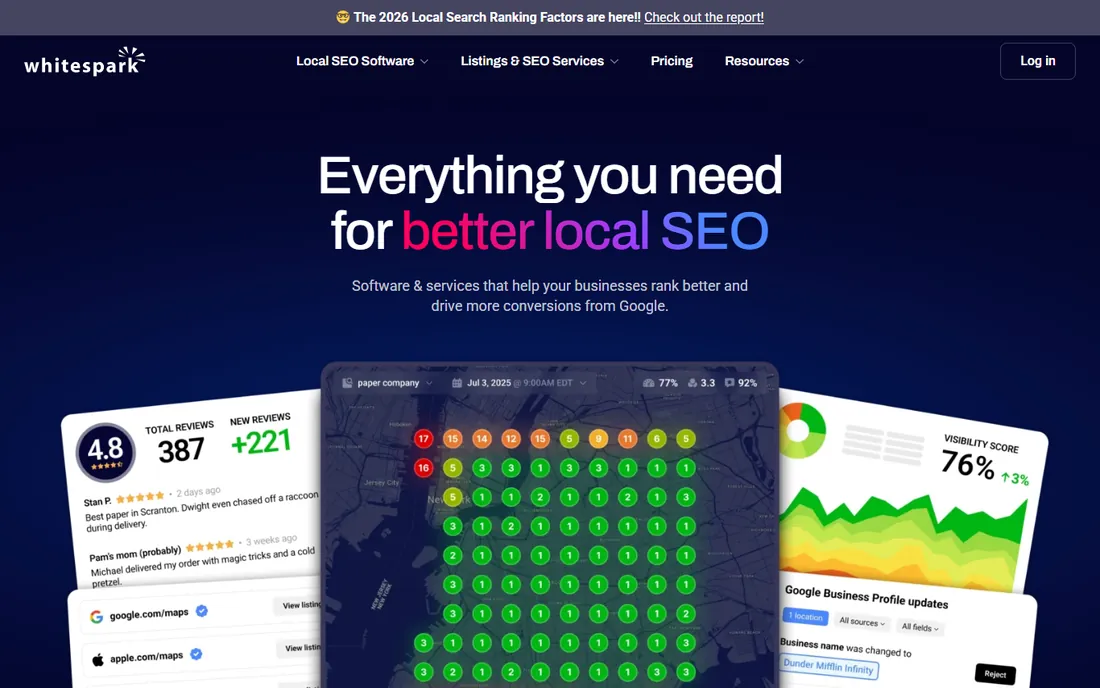
Whitespark is the specialist's toolbox. Instead of an all-in-one platform, it sells sharp individual tools: Local Citation Finder for citation research, Local Ranking Grids for geo-grid rank tracking across up to 225 points, Local Rank Tracker, Reputation Builder for review generation, and a Local Platform for bulk Google Business Profile management. Pricing is a la carte, so you pay for the tools you use.
The company, based in Edmonton, Canada, has deep roots in the local SEO community and publishes respected industry research. Citation building services are available done-for-you, plus a Yext replacement service for businesses leaving expensive contracts. The honest framing: this is a set of instruments, not an orchestra. You will not get the unified dashboards or automated workflows of Birdeye or SOCi. For agencies and consultants who know local SEO and want the best data at a fair price, that is exactly the point.
What we like- Best-in-class citation research tools
- Local ranking grids
- Affordable a la carte pricing
Watch out for- Toolset, not a full platform
- Services upsell alongside software
#10
Semrush Local
Best for: Marketing teams already paying for Semrush
Visit semrush.com
Starting priceSee website
Free planNo
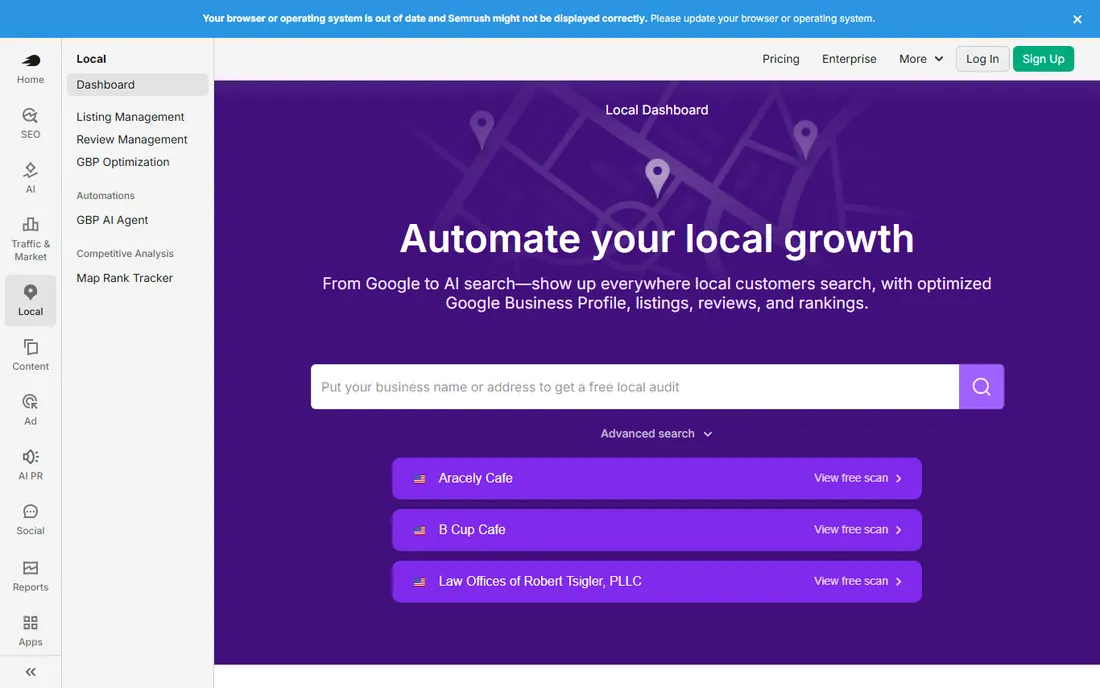
Semrush Local bolts local marketing onto the SEO suite many teams already use. You get listing management with partner-network syndication, review monitoring and management, a map rank tracker with geo-grid views, and local keyword tracking, all inside the familiar Semrush interface. For a marketing team that already pays for Semrush, adding local keeps reporting in one place.
The catch is the stack math. Semrush Local is an add-on to a Semrush subscription, and per-location pricing means a 50-location brand pays meaningfully more than the sticker suggests. The listing network is partner-based rather than direct, so check coverage for your markets. If your team lives in Semrush and manages a modest location count, the convenience is real. If local is your whole job, a dedicated platform like BrightLocal or Yext gives you more for the money.
What we like- Lives inside the Semrush suite
- Map rank tracker with geo-grid
- Listing management included
Watch out for- Requires a Semrush subscription
- Per-location costs add up
Count your locations first, because pricing models punish guessing. Per-location pricing looks cheap at five locations and brutal at five hundred. Get the per-location price in writing, ask what counts as a location, and model your actual count. Then ask about contracts. Some enterprise platforms still push annual terms with auto-renewal, while BrightLocal, Synup, and Whitespark let you pay monthly or by tool.
Next, match the platform to the job. Listing accuracy across hundreds of locations points to Yext or Uberall. Review volume and response workflows point to Birdeye, Podium, or Reputation. Agency client work points to BrightLocal or Synup for white-label reporting. Rank tracking and citation research point to Whitespark or Semrush Local.
Check the integrations you will actually use. Google Business Profile bulk management, review platform coverage, CRM connections, and API access for reporting all vary. Ask for the integration list, not the logo wall. And test support before you buy: submit a ticket during the trial and time the response. You will need them when a listing goes wrong on a Friday afternoon.
Why AI search changed the brief
Customers now find local businesses through AI answers, not just the map pack. ChatGPT, Google AI Overviews, and voice assistants cite business information from listings, reviews, and local pages, which means accuracy and structured data matter more than ever. Most platforms on this list now include some form of AI visibility tracking: BrightLocal has an AI visibility checker, Synup checks ChatGPT and Perplexity presence, and Yext, Birdeye, SOCi, and Uberall all market AI search features.
Treat these features as early but directionally important. Ask vendors exactly which AI platforms they track and how often the data refreshes, because marketing pages overpromise here. The fundamentals have not changed: accurate listings, real reviews with responses, and complete Google Business Profiles are what AI systems cite. A platform that nails the basics and adds AI tracking is worth more than one selling AI magic on shaky data.
How we chose
We started with the platforms multi-location brands and agencies actually buy, then verified each one on its own website in October 2026. Pricing comes from published vendor pages; most enterprise platforms do not publish prices, so we say so instead of guessing. We weighed public reviews on G2 and Capterra, checked feature lists and documentation, and matched each tool to a buyer type: agencies, franchises, enterprise brands, and local service businesses. We did not run trial accounts or manage listings on any platform.
Frequently asked questions
How much does local marketing software cost?
It ranges widely. BrightLocal starts at $31 a month, Whitespark sells tools a la carte, and Semrush Local adds per-location fees on top of a Semrush subscription. Enterprise platforms like Yext, Birdeye, SOCi, Reputation, and Uberall are quote-based and typically run into the hundreds per location per month at scale. Always model your real location count before comparing.
What is the difference between Yext and BrightLocal?
Yext offers a 200-plus publisher listing network and enterprise data governance for large brands, with quote-based pricing. BrightLocal offers rank tracking, citations, reviews, and white-label reporting from $31 a month for agencies and smaller businesses. Choose Yext for listing scale across hundreds of locations, BrightLocal for value and reporting flexibility.
Do I need this if I only have one location?
Probably not the enterprise platforms. A single location can manage its Google Business Profile directly, use BrightLocal's free tools, or buy one Whitespark tool for rank tracking. The paid platforms earn their keep when location count, review volume, or client reporting makes manual work impossible.
What is AI search visibility and should I care?
It measures whether AI systems like ChatGPT and Google AI Overviews mention or recommend your business. The underlying drivers are the same as local SEO: accurate listings, strong reviews, and complete profiles. The tracking features are new, so ask vendors which platforms they monitor before paying extra for them.
Can agencies white-label these tools?
BrightLocal and Synup offer full white-labeling including client-facing reports and portals, which is why agencies favor them. Vendasta also targets agency resellers. The enterprise platforms generally do not white-label; they sell direct to brands.
Sources we checked (12)
- https://www.brightlocal.com/
- https://birdeye.com/
- https://www.yext.com/
- https://meetsoci.com/
- https://www.podium.com/
- https://reputation.com/
- https://synup.com/
- https://uberall.com/en/
- https://whitespark.ca/
- https://www.semrush.com/local/
- https://www.socialpilot.co/reviews/alternatives/yext-alternatives
- https://www.g2.com/products/brightlocal/competitors/alternatives
Is your product missing or out of date?
We review this list regularly. Vendors can request a listing, send updated pricing or ask about featured placement.

Shihab Mia · Founder, Rankite
Shihab has spent more than a decade helping SaaS and e-commerce brands grow through search. He writes Rankite's software buying guides from pricing pages, documentation and public user reviews. More about Shihab.