How we make this list: we compare pricing pages, product documentation and public user reviews. Rankite is independent; if a vendor ever pays for a featured spot, that listing is clearly labeled Partner.
Key takeaways
- Research cited by the American Bar Association finds lawyers who delay time entries lose between 10% and 70% of billable revenue, which makes the capture method the most important feature on this list.
- TimeSolv is the strongest pure billing pick for firms that invoice corporate clients, with native LEDES 1998B export, UTBMS codes and trust accounting at a mid-market price.
- Clio is the default for firms that want practice management, time tracking and billing in one system, while PracticePanther and MyCase suit smaller firms that want the same combination for less money.
- Smokeball is the only option here with passive, automatic time capture built in, which directly attacks the unbilled-hours problem.
- Bill4Time and Rocket Matter are the value plays: full legal billing with trust accounting at lower per-user prices than the big platforms.
Quick comparison
| Tool | Best for | Starting price | Free plan |
|---|
 Clio Clio | Firms wanting practice management plus billing | See website | No |
 TimeSolv TimeSolv | LEDES-native legal billing | See website | Free trial |
 PracticePanther PracticePanther | Small firms wanting an all-in-one | See website | Free trial (7 days) |
 MyCase MyCase | Small firms wanting PM plus billing | See website | Free trial |
 Smokeball Smokeball | Automatic, passive time capture | See website | No |
 Bill4Time Bill4Time | Solos wanting simple billing | See website | Free trial |
 CosmoLex CosmoLex | Built-in legal accounting | See website | Free trial |
 Rocket Matter Rocket Matter | Kanban-style matter workflows | See website | Free trial |
Is your product missing or out of date?
We review this list regularly. Vendors can request a listing, send updated pricing or ask about featured placement.
The best legal time tracking software
#1
Clio
Best for: Firms wanting practice management plus billing
Visit clio.com
Starting priceSee website
Free planNo
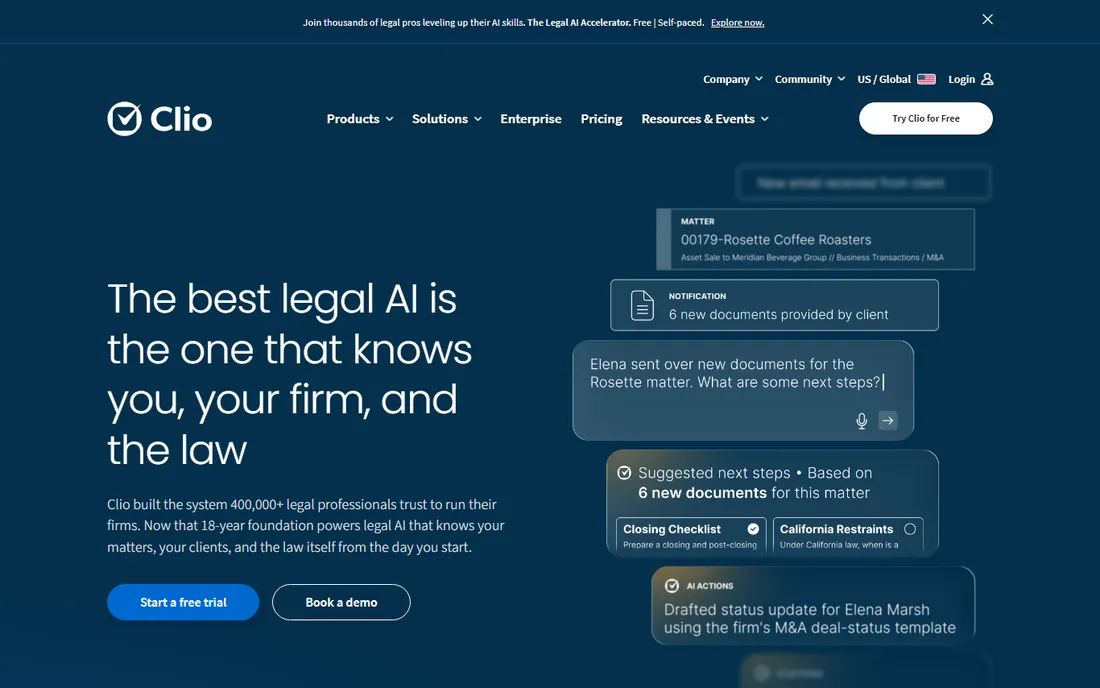
Clio is the reference point every other legal billing product gets measured against. More than 400,000 legal professionals run their firms on it, and the platform now pairs that 18-year practice management foundation with AI built on the firm's own matters, clients and documents. For time tracking specifically, Clio gives you matter-based timers, desktop time capture, native LEDES export for corporate clients and trust accounting that satisfies bar requirements in all 50 states.
The reason Clio leads this list is the billing pipeline. Captured time flows into invoices, invoices flow into Clio Payments, and payments reconcile against trust accounts without re-entry. That is the whole point of legal time tracking: not the timer, but the money the timer produces. The honest catch is cost and weight. Per-user pricing adds up for larger teams, and a solo who just needs hours and invoices will learn simpler tools faster.
What we like- Native LEDES export and trust accounting
- 300+ integrations
- 100+ bar approvals including all 50 states
Watch out for- Per-user pricing adds up fast for larger teams
- The full platform can feel heavy for solos who only need billing
Starting priceSee website
Free planFree trial
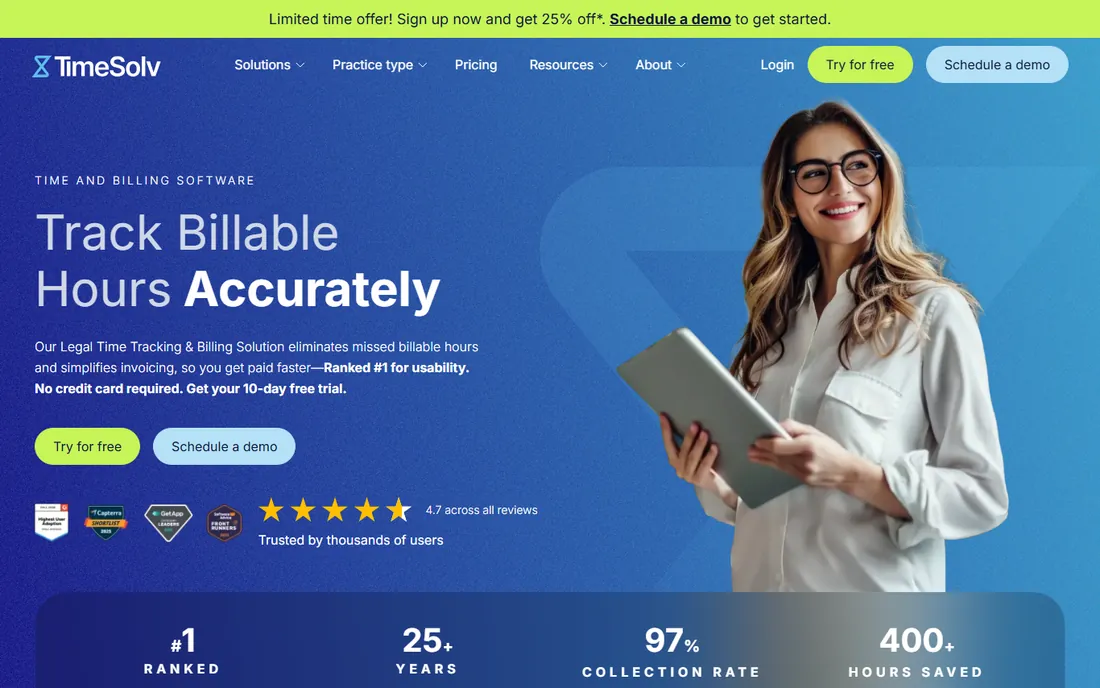
TimeSolv has been doing legal time and billing since 1999, and it shows in the details corporate clients demand. The LEDES 1998B export is native rather than bolted on, UTBMS task and activity codes are built into time entry, and the trust accounting module handles three-way reconciliations that meet bar requirements. For a firm whose clients require electronic invoices in LEDES format, that native support is the difference between billing smoothly and fighting with a converter every month.
The reporting is the quiet strength. More than 30 built-in reports cover revenue, risk, retention and real-time firm performance, which gives partners the numbers they need without exporting to a spreadsheet. TimeSolv also bundles project management and a lightweight CRM, though neither replaces a real practice management system. The honest catch is the look and feel. The interface is functional rather than modern, and firms that want matter management, document automation and client intake will need a second system. But for pure legal billing accuracy at a fair price, TimeSolv is hard to beat.
What we like- Native LEDES 1998B export with UTBMS codes
- Built-in trust accounting with three-way reconciliation
- More than 30 revenue and performance reports
Watch out for- Interface looks dated next to newer rivals
- No practice management depth beyond billing and projects
Starting priceSee website
Free planFree trial (7 days)
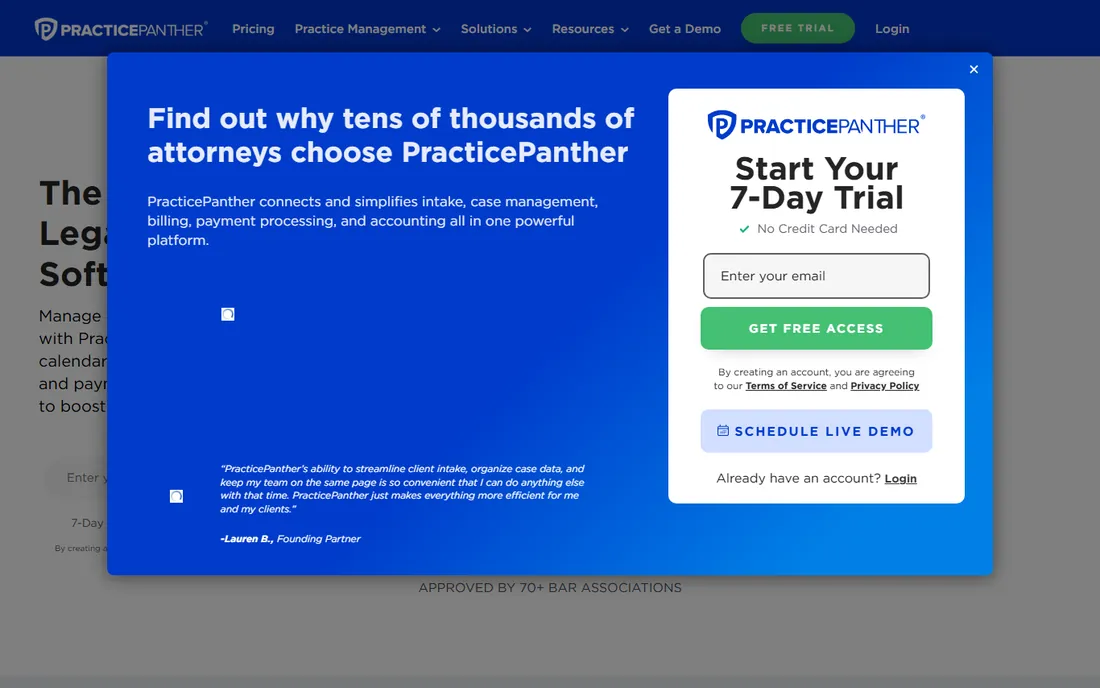
PracticePanther is the all-in-one that small firms actually adopt, because it does not ask them to change how they work. Client intake forms, case management, calendaring, time and expense tracking, billing, PantherPayments and embedded accounting all live in one dashboard, and multiple timers plus calendar-to-time-entry conversion mean billable hours get captured where the work happens. The company claims its automated workflows save firms more than 8 hours of admin per week.
For time tracking, the practical win is the billing loop. Timers feed matters, matters feed invoices, and clients can pay from the invoice itself, with the firm reportedly getting paid 70% faster than the industry average. Trust accounting is compliant and the platform carries approvals from more than 70 bar associations. The honest catch is tiering. Four plans (Solo, Essential, Business, Business Pro) with feature gates mean the LEDES export and advanced billing features smaller firms want often sit a tier above the entry price. Start the 7-day trial with your real matters and check which plan your billing actually requires.
What we like- Intake, cases, billing, payments and accounting in one platform
- 7-day free trial with no credit card
- Approved by 70+ bar associations
Watch out for- LEDES export only on higher tiers
- Per-user pricing across four plans gets complicated to compare
Starting priceSee website
Free planFree trial
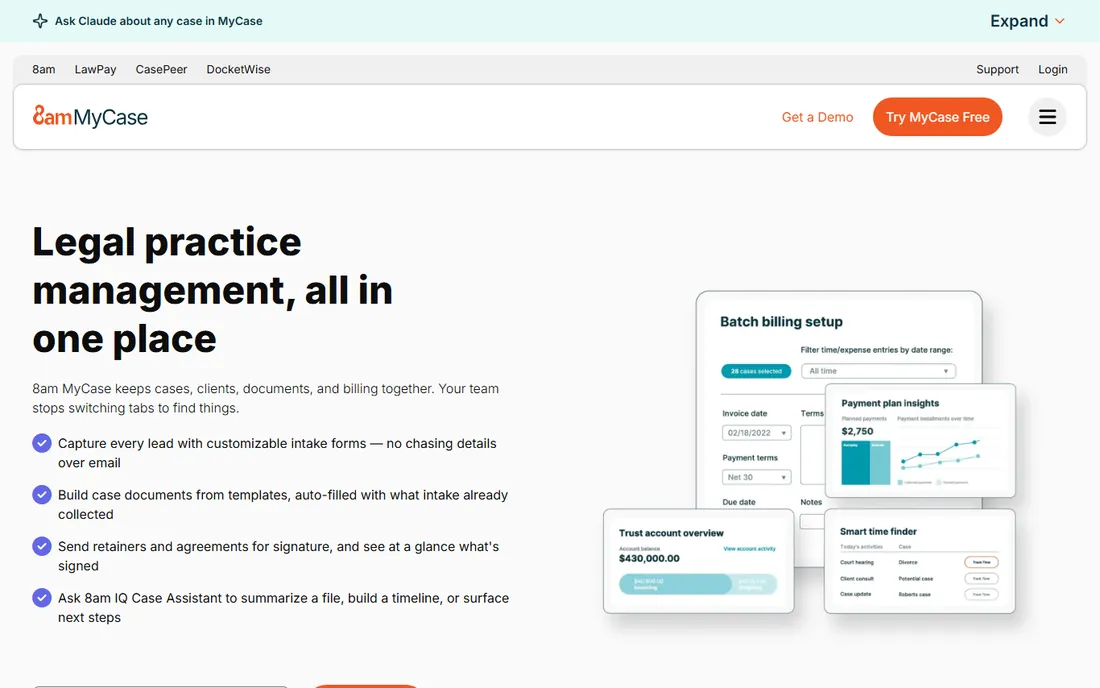
MyCase spent years as the friendly alternative to Clio, and it still reads that way: 19,000+ firms use it, reviews consistently praise the easy interface, and the price has historically undercut the big platform. Cases, clients, documents, calendaring, time tracking, billing and a secure client portal all live together, so a small firm can run its entire practice without stitching tools. Payments run through 8am LawPay (the AffiniPay family rebranded MyCase, LawPay and Docketwise under the 8am name), with IOLTA-compliant credit card, eCheck and mobile wallet processing.
The built-in case assistant summarizes files, builds timelines and runs OCR on scanned documents, which suits litigation-heavy practices. Time entry supports multiple billing rates and invoices generate automatically from tracked time. The honest catch is a ceiling on advanced billing: firms with complex LEDES requirements will find Clio or TimeSolv deeper. For solos and small firms wanting one approachable system, MyCase remains one of the best values in legal software.
What we like- Case management, billing and client portal in one login
- Built-in AI case assistant for summaries and timelines
- Payments powered by LawPay with IOLTA-compliant processing
Watch out for- Now folded into the 8am brand, which confuses some buyers
- Advanced billing features trail Clio at the top end
Starting priceSee website
Free planNo

Smokeball attacks the core problem in legal billing from a different direction. Instead of asking lawyers to start timers, it passively records what they work on and turns that activity into time entries. Given the ABA-cited research showing delayed time entries cost firms 10% to 70% of billable revenue, that passive capture is the single most valuable feature on this list for firms that chronically under-bill. The platform wraps that capture in full practice management: matter management, document automation with an extensive library of legal forms, billing, trust accounting and business reporting.
The Microsoft integration is the other reason firms choose Smokeball. Document work happens in Word and email happens in Outlook, and Smokeball lives inside both rather than asking lawyers to visit a separate app. The honest catch is pricing opacity: plans are personalized by firm size and needs, so you cannot budget without a sales conversation. And passive capture is not magic; someone still has to review the auto-generated entries before they become invoices, which is a workflow the firm has to adopt.
What we like- Passive automatic time tracking captures work without timers
- 34,000+ legal professionals on the platform
- Deep Microsoft Word and Outlook integration
Watch out for- Personalized, quote-based pricing with no public numbers
- Automatic capture needs review before billing, which adds a workflow step
Starting priceSee website
Free planFree trial
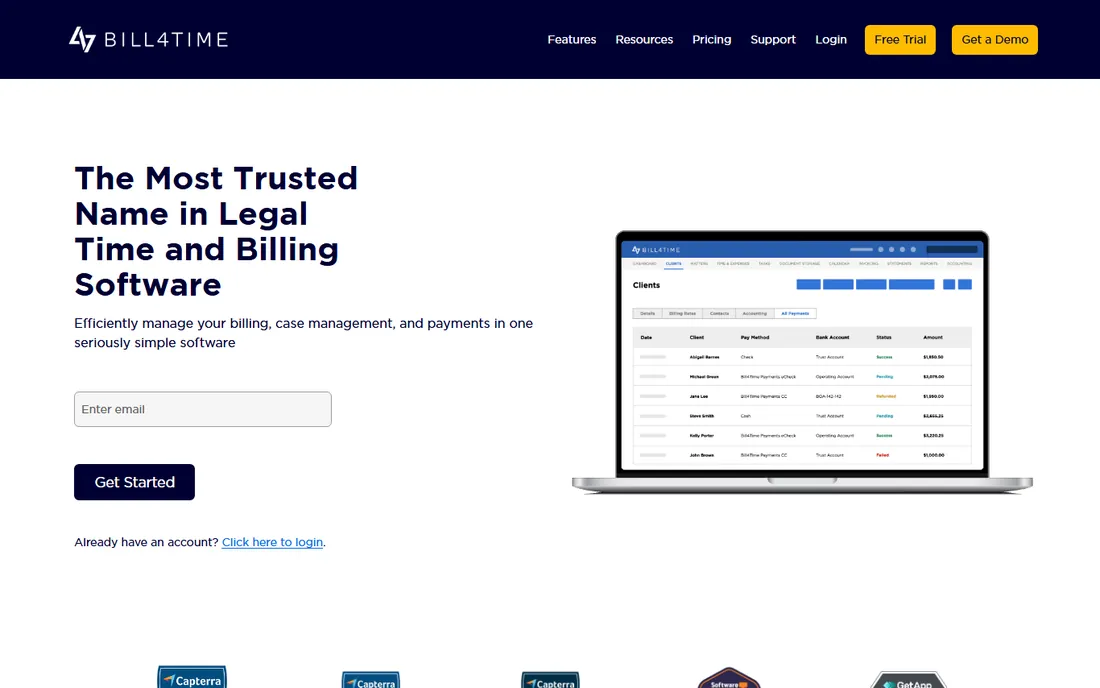
Bill4Time is the anti-bloat option. It does time tracking, billing, case management and payments, and it does them in an interface a new hire can learn in an afternoon. Real-time timers run on desktop and mobile, custom rates and billing codes align with client requirements, and branded invoices go out in minutes with batch invoicing for firms that bill dozens of clients at once. LEDES invoicing is included rather than gated behind the top tier, which is generous at this price level.
The payments story is strong for a budget tool. Natively built ePayments with payment plans and secure payment links claim to get firms paid 70% faster than the industry average, and transaction rates are positioned as industry-low. Trust accounting carries IOLTA and ABA safeguards. The honest catch is scope: the case management module covers files, deadlines and documents, but it is not a PracticePanther or Clio. Firms that want deep matter automation will outgrow it. For solos and small firms whose priority is accurate billing without a learning curve, Bill4Time is the value leader on this list.
What we like- Simple setup with real-time desktop and mobile timers
- LEDES invoicing and trust accounting included
- Industry-low payment processing rates
Watch out for- Case management is basic compared with full practice platforms
- Reporting depth trails TimeSolv and Clio
Starting priceSee website
Free planFree trial
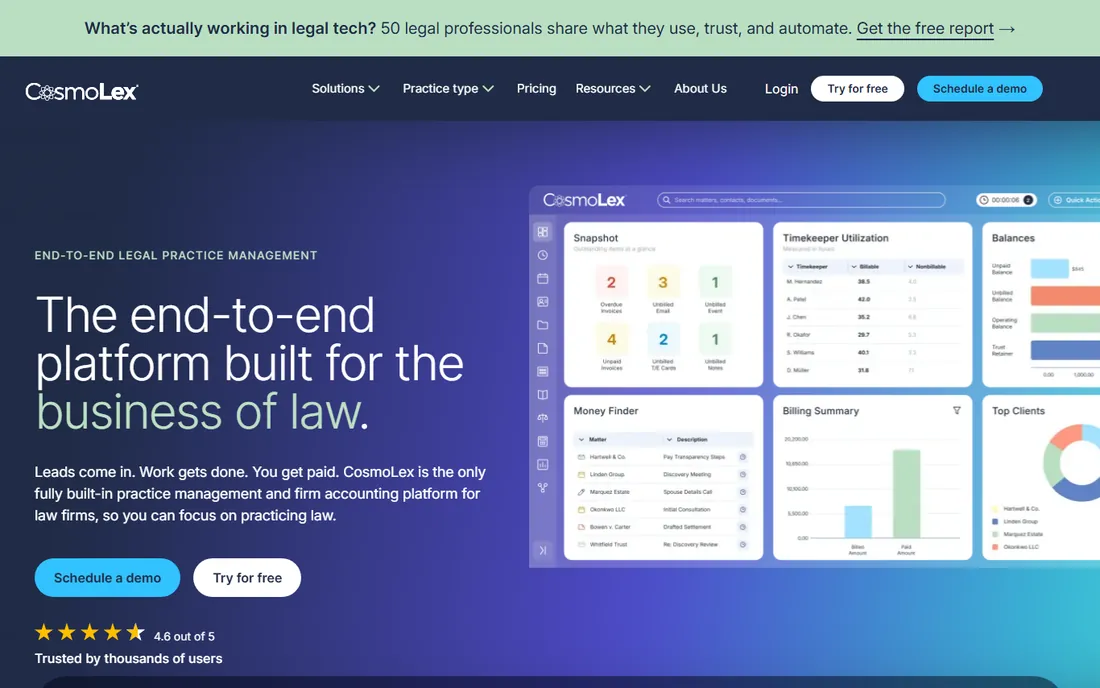
CosmoLex makes a claim no other tool on this list can: it is the only cloud-based legal practice management software with firm accounting fully built in. That means no QuickBooks subscription, no sync connector breaking at month end, no duplicate entry between the billing system and the books. Time tracking, billing, trust accounting, matter management and client communications all draw from the same ledger, and three-way trust reconciliations run inside the platform.
For time tracking, the accounting integration is the point. Every time entry lands in a system that already knows the firm's finances, so write-offs, collections and profitability reporting stay consistent without reconciliation work. The company offers a free trial so firms can test real workflows before committing, and support gets consistently strong marks in G2 reviews. The honest catch is price opacity and perception: pricing is quote-based, and at least one verified reviewer called it expensive relative to what their firm used. Firms already happy with QuickBooks may not value the built-in accounting enough to justify the switch.
What we like- Only cloud option here with fully built-in firm accounting, no QuickBooks needed
- Three-way trust reconciliation
- Matter-centric design for small and mid-size firms
Watch out for- Quote-based pricing with no public numbers
- Some reviewers call it expensive for what smaller firms use
Starting priceSee website
Free planFree trial
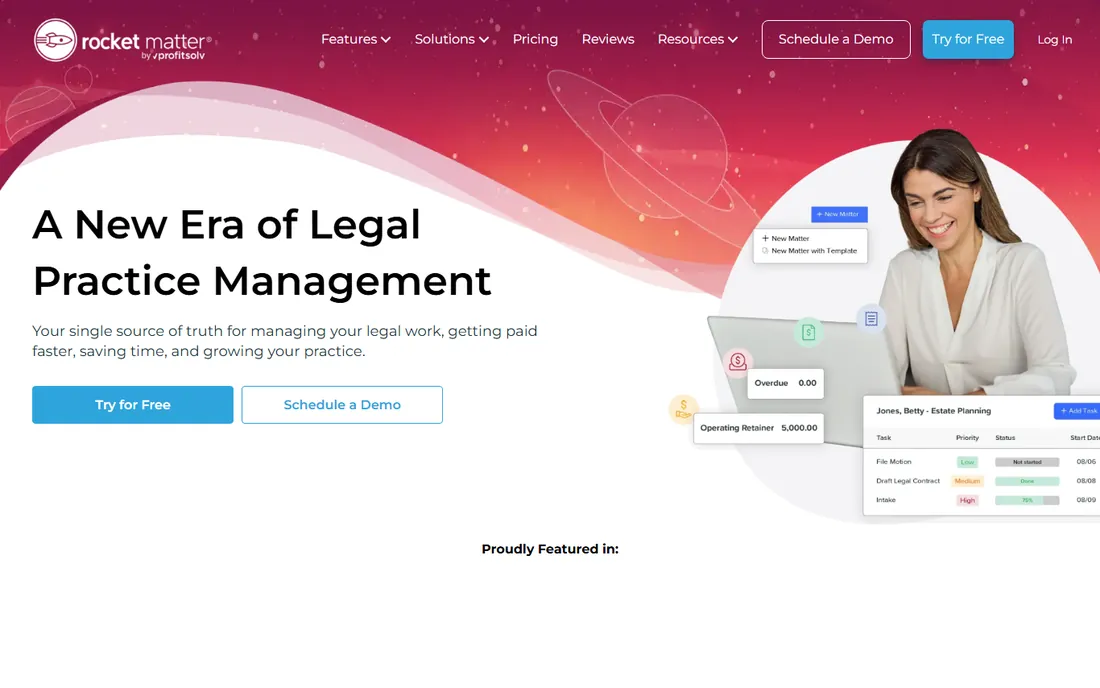
Rocket Matter has been in legal practice management since 2008, and its pitch is flexibility: workflows, reports and templates adapt to how the firm already works rather than forcing a standard process. Time tracking feeds billing directly, payments are built in, and the QuickBooks integration is genuinely best in class for firms that want to keep QuickBooks as the accounting system of record. That integration alone makes Rocket Matter the right answer for firms whose accountant insists on QuickBooks.
Support is the other differentiator, with Stevie awards for sales and customer support every year since 2015 and a dedicated success manager for every firm. For a small firm migrating off spreadsheets, that hand-holding matters more than any feature. The honest catch is ecosystem size. With 300+ integrations, Clio's app marketplace dwarfs Rocket Matter's, and the interface, while functional, does not feel as modern as PracticePanther or Smokeball. But for firms that want proven software with human support behind it, Rocket Matter holds its own.
What we like- Flexible workflows, reports and templates tailored per firm
- Strong QuickBooks integration
- Award-winning support with a dedicated success manager
Watch out for- Smaller ecosystem than Clio
- Interface updates have lagged the newest competitors
How we chose
We compared legal time tracking tools against the features that actually determine billing accuracy: capture method (manual timer, desktop capture or passive automatic), LEDES and UTBMS support for corporate clients, trust and IOLTA accounting, and how cleanly tracked time converts to invoices and payments. We used vendor pricing pages and documentation, G2 and Capterra reviews, and legal-tech comparisons from 2026, including the ABA-cited research on lost billable revenue. We did not claim hands-on testing. Tools without legal-specific billing features were excluded, since generic timers miss the compliance requirements law firms face.
What actually matters when you buy
Start with your clients, not the feature list. If any client requires LEDES electronic invoices, your shortlist is TimeSolv, Clio, Bill4Time and CosmoLex, because native LEDES support is non-negotiable and converters introduce errors. If no client requires it, you can choose on usability and price, which opens up PracticePanther, MyCase and Rocket Matter.
Next, decide how much practice management you need. Pure billing tools like TimeSolv and Bill4Time are cheaper and faster to learn, but they leave you running a second system for cases and documents. All-in-one platforms like Clio, PracticePanther, MyCase, Smokeball and CosmoLex cost more per user but eliminate the second system and the double entry that comes with it. Firms under five people usually do better with the all-in-one; larger firms with established systems can sometimes save with best-of-breed billing.
Then check the trust accounting requirements for your state. Every tool here except the generic timers handles IOLTA, but three-way reconciliation depth varies, and your state bar may have specific rules about how trust ledgers are maintained. Ask each vendor how their reconciliation works and whether they have customers in your state. Finally, run the trial with real matters and real rates. Time entry that feels fine in a demo can become friction when a lawyer is logging 40 entries a day, and that friction is exactly what the ABA research says costs firms revenue.
LEDES, UTBMS and trust accounting, explained
Corporate legal departments rarely accept a PDF invoice. They require LEDES, the Legal Electronic Data Exchange Standard, usually the 1998B format, which encodes every time entry with UTBMS codes: standardized task, activity and expense codes that let the client analyze legal spend. If your firm bills any in-house legal department, LEDES support is a requirement, not a nice-to-have. TimeSolv and Clio handle it natively; Bill4Time includes LEDES invoicing; PracticePanther gates it to higher plans.
Trust accounting is the other compliance pillar. Client funds must sit in segregated IOLTA accounts, and most states require regular three-way reconciliation between the trust ledger, the client ledgers and the bank statement. TimeSolv, CosmoLex and Clio all build this in; the generic time trackers on the broader market do not. When a vendor says "trust accounting," ask whether three-way reconciliation is automated or manual. The answer tells you how seriously they take it.
One more practical note: automatic time capture, like Smokeball's, changes the economics of billing, but the entries it generates are drafts until a human reviews them. Build that review step into the workflow from day one. Firms that skip it end up billing for entries nobody vetted, which creates write-downs and client disputes that erase the gains.
Frequently asked questions
What is the best legal time tracking software for solo attorneys?
Bill4Time and PracticePanther's Solo plan are the strongest fits for solos. Bill4Time is simpler and cheaper if you mainly need time tracking, invoicing and payments; PracticePanther makes more sense if you also want case management and intake in the same system. Both include trust accounting, which a generic timer will not give you.
Do lawyers really lose billable hours to bad time tracking?
Yes, and the numbers are stark. Research cited by the American Bar Association finds that lawyers who delay time entries lose between 10% and 70% of billable revenue. Short calls, quick research and email exchanges are the entries that slip through. Automatic capture tools like Smokeball exist specifically to close that gap.
What is LEDES billing?
LEDES (Legal Electronic Data Exchange Standard) is the electronic invoice format corporate legal departments require, most commonly the 1998B format. Each time entry carries UTBMS task, activity and expense codes so the client can analyze spend. TimeSolv, Clio, Bill4Time and CosmoLex support LEDES; if your clients require it, confirm native support rather than relying on a converter.
Can I use a generic time tracker like Toggl for legal billing?
You can track hours with one, but you will miss the legal-specific pieces: trust accounting, IOLTA compliance, LEDES export and matter-based billing. Generic tools work for solos who bill simple hourly invoices and handle trust accounting elsewhere. The moment a client requires LEDES or your state bar audits your trust ledger, you need legal-specific software.
How much does legal time tracking software cost?
Entry points vary widely. PracticePanther, MyCase and Bill4Time target solos and small firms with lower per-user pricing, while Clio, Smokeball and CosmoLex price higher for deeper platforms. Most vendors here use quote-based or tiered per-user pricing, so expect to talk to sales for exact numbers. Factor in payment processing fees separately, since those sit on top of the subscription.
Sources we checked (10)
- https://clio.com/
- https://www.timesolv.com
- https://practicepanther.com/
- https://mycase.com/
- https://www.smokeball.com
- https://bill4time.com/
- https://cosmolex.com/
- https://www.rocketmatter.com
- https://timingapp.com/blog/lawyer-time-tracking-software/
- https://agiled.app/blog/best-time-tracking-software-for-legal-professionals
Is your product missing or out of date?
We review this list regularly. Vendors can request a listing, send updated pricing or ask about featured placement.

Shihab Mia · Founder, Rankite
Shihab has spent more than a decade helping SaaS and e-commerce brands grow through search. He writes Rankite's software buying guides from pricing pages, documentation and public user reviews. More about Shihab.