How we make this list: we compare pricing pages, product documentation and public user reviews. Rankite is independent; if a vendor ever pays for a featured spot, that listing is clearly labeled Partner.
Key takeaways
- Service Autopilot ($47/month Startup) is the most complete lawn-industry platform, with recurring route automation, chemical tracking, and job costing built for the trade.
- Yardbook is genuinely free and covers scheduling, estimates, and invoicing, but the 1% payment surcharge and ads mean growing businesses eventually outgrow it.
- Jobber ($49/month) and Housecall Pro ($79/month) are the simpler generalist picks for small lawn operations that do not need lawn-specific features.
- Arborgold and SingleOps serve the bigger end of the market: tree care and landscape companies with crews, complex jobs, and commercial contracts.
Quick comparison
| Tool | Best for | Starting price | Free plan |
|---|
 Service Autopilot Service Autopilot | Full-service lawn and landscape companies | $47 per month (Startup); Pro $79.97 per month | No |
 Yardbook Yardbook | Small operations starting free | $0 (free plan, ad-supported); paid from $34.99 per month | Yes |
 Jobber Jobber | Small lawn businesses that want simplicity | $49 per month (Core, month-to-month); $29 per month billed annually | Free trial (14 days) |
 Housecall Pro Housecall Pro | Small crews that want built-in marketing | $79 per month (Basic, month-to-month) | Free trial (14 days) |
 Arborgold Arborgold | Tree care and larger landscape companies | See website | No |
 SingleOps SingleOps | Tree and landscape companies with field crews | See website | No |
 RealGreen RealGreen | Lawn care companies that market aggressively | See website | No |
 LawnPro Software LawnPro Software | Simple lawn business management | See website | Free trial |
 FieldRoutes FieldRoutes | Pest and lawn companies operating at scale | See website | No |
Is your product missing or out of date?
We review this list regularly. Vendors can request a listing, send updated pricing or ask about featured placement.
The best lawn care software
A lawn care company in Georgia was servicing 200 recurring accounts with a whiteboard, a stack of route sheets, and a filing cabinet of customer cards. Every spring, rebooking the season took three weeks of phone calls. Crews got their routes on paper each morning, and if a customer called to skip a week, the message sometimes never reached the truck. They moved to lawn-specific software over one winter, and the next spring's rebooking happened by email in four days. The whiteboard went in the dumpster.
Lawn care is a recurring-revenue business wearing a service uniform, and the software has to match that reality. Weekly and biweekly routes, seasonal upsells, chemical application records, and per-visit billing are the daily work. The best lawn care software automates the recurring schedule, keeps crews on efficient routes, and makes invoicing happen without office heroics. The best landscape business software goes further, handling estimates, job costing, and commercial contracts for bigger operations.
The nine tools below cover the realistic options for US lawn and landscape companies in 2026. Pricing reflects published plans as of October 2026.
Starting price$47 per month (Startup); Pro $79.97 per month
Free planNo
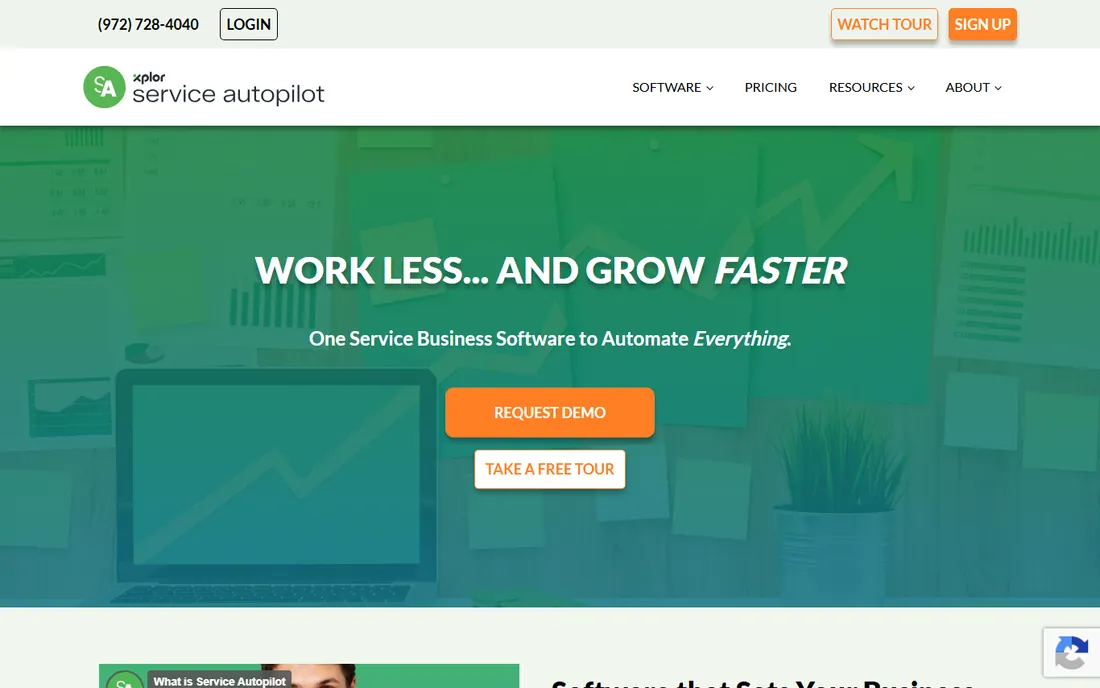
Service Autopilot is the platform most serious lawn care companies end up on, because it was built for the way the business actually runs. Recurring scheduling automates the weekly and biweekly routes that are the industry's backbone, the optimizer orders stops efficiently, and time tracking ties crew hours to each job for real job costing. Chemical application tracking keeps licensed applicators compliant, and the CRM handles the upsell campaigns that grow revenue per account.
The commitment is real. There is no free trial, only a demo, and setup takes longer than the one-click tools because the platform does more. Add-ons push the monthly cost up as you grow. But for a company running dozens of recurring routes with crews, the automation pays for itself in the first season. It is the best landscaping management software for operations that have outgrown simple scheduling.
What we like- Recurring route automation is the best in the category
- Chemical tracking for licensed applicators
- Job costing ties labor to each account
Watch out for- No free trial
- Setup is heavier than the simple tools
- Costs climb with add-ons
Starting price$0 (free plan, ad-supported); paid from $34.99 per month
Free planYes
Yardbook is the most recommended free option in lawn care, and the free plan is not a trial: it includes customer management, scheduling, estimates, invoicing, and basic routing at no cost. For a new lawn business or a solo operator, it covers the essentials without a monthly bill, which is why it dominates the startup end of the market.
The catches are the ads and the payment surcharge. The free plan shows advertising while you work, and Yardbook adds a 1% processing fee on top of Stripe's standard fees for non-premium accounts, which quietly adds up as revenue grows. Paid plans at $34.99 and $49.99 a month remove both. Yardbook is the right start for a new operation; plan the upgrade for when monthly card volume makes the surcharge exceed the paid plan's price.
What we like- Genuinely free plan with scheduling, estimates, and invoicing
- Quick to set up
- Built specifically for lawn and landscape
Watch out for- Ad-supported interface
- 1% surcharge on online payments for free accounts
- Outgrown quickly past a handful of employees
Starting price$49 per month (Core, month-to-month); $29 per month billed annually
Free planFree trial (14 days)
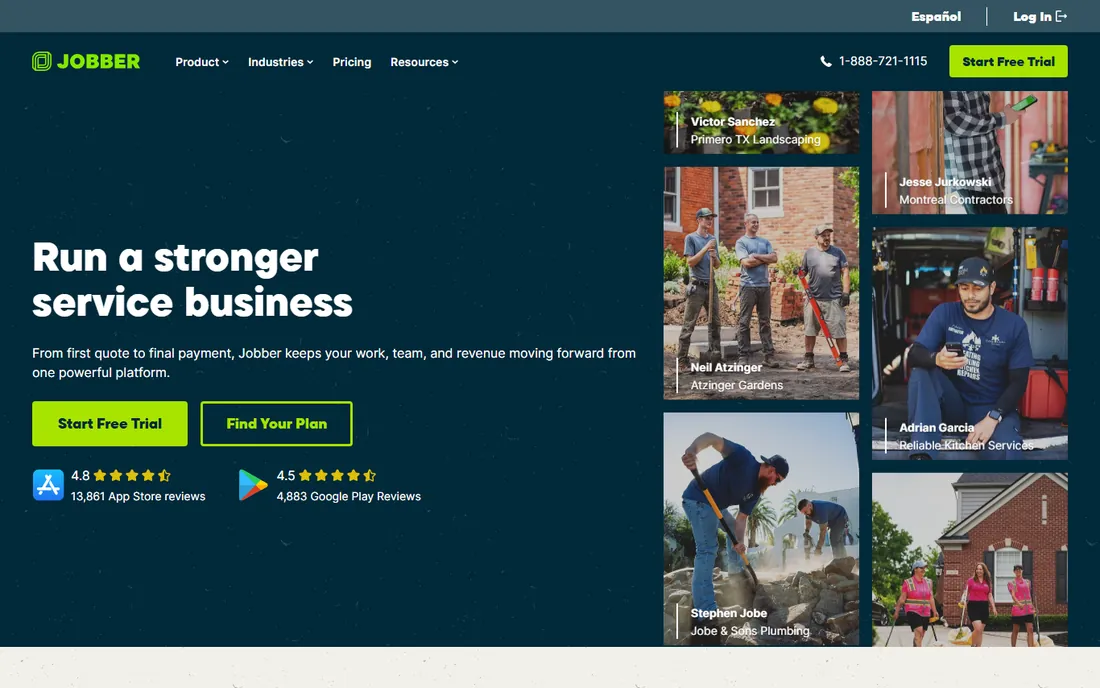
Jobber is the generalist alternative for lawn businesses that do not need industry-specific features. At $49 a month month-to-month, or $29 with annual billing, it handles the operational core: online booking, quotes, scheduling, invoices, and payments. The interface is clean enough that crews adopt it without training, and the per-user pricing stays predictable as the team grows.
What it lacks is everything lawn-specific. There is no chemical application tracking, no lawn-industry reporting, and the routing is simpler than the specialists'. A mow-and-blow operation with straightforward recurring routes will never miss those features. A full-service company doing fertilizing, weed control, and aeration will. Choose Jobber when the business is simple; choose Service Autopilot when it is not.
What we like- Lowest entry price of the name-brand tools
- Clean scheduling, quoting, and invoicing
- Predictable $29 per extra user
Watch out for- Not lawn-specific, so no chemical tracking or lawn-industry workflows
- Route optimization is basic
Starting price$79 per month (Basic, month-to-month)
Free planFree trial (14 days)
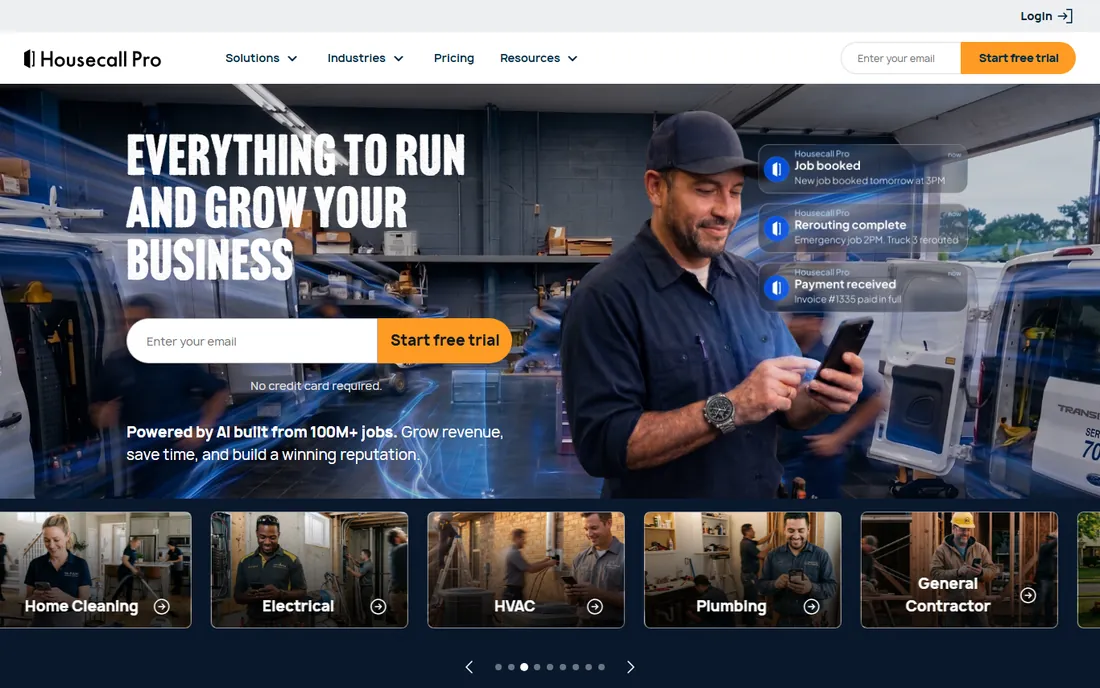
Housecall Pro earns its place in lawn care the same way it does in other home services: the marketing automation. Review requests, appointment reminders, and follow-up sequences fire without setup, which matters for lawn businesses where reviews drive new accounts and missed visits waste crew time. The mobile app is one of the best in field service, and the QuickBooks integration runs cleanly.
The pricing structure needs a careful read. Basic at $79 covers one user, and adding a second person forces a jump to a much pricier tier. Like Jobber, it has no lawn-specific features: no chemical tracking, no lawn-industry job costing. It suits the small lawn company that values customer communication and ease of use over industry depth, and that can live with the tier pricing as it hires.
What we like- Automated review requests and reminders work from day one
- Strong mobile app
- Clean QuickBooks sync
Watch out for- Expensive jump from one user to two
- No lawn-specific features
- Several useful tools are paid add-ons
Starting priceSee website
Free planNo

Arborgold serves the segment where lawn care shades into tree care and full landscape contracting: bigger jobs, crews, equipment, and commercial clients. The estimating handles complex multi-day projects, job management tracks crews and materials, and the customer portal keeps commercial clients informed. Companies that do tree work alongside lawn care get both in one system.
It is priced and built for that bigger operation, which means a simple mowing business pays for capacity it will not use. Pricing runs through sales with no published tiers. Arborgold is the right call when the company has crews doing varied, complex work. For route-based recurring lawn care, the specialists above fit better and cost less.
What we like- Built for tree care and landscape workflows
- Strong estimating and job management for complex projects
- Good customer portal
Watch out for- Pricing not published
- More system than a simple mowing operation needs
Starting priceSee website
Free planNo
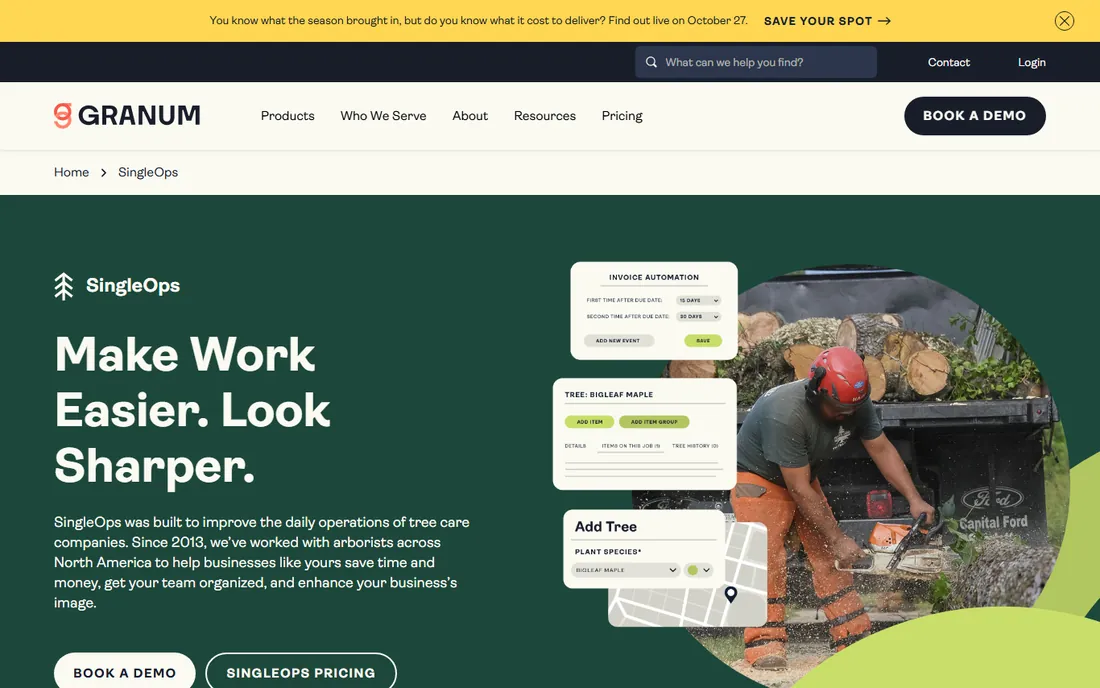
SingleOps focuses on green-industry companies running crews: tree care, landscape maintenance, and lawn care operations with real operational complexity. Proposals, scheduling, job tracking, and invoicing are built for how these companies sell and deliver work, and the mobile app keeps crews connected to the day's plan. It competes directly with Arborgold for the same customer.
Like its rival, pricing is quote-based and the platform assumes a real operation, not a solo mower. Companies choosing between the two should trial both with their actual workflow, since the difference comes down to fit rather than feature checklists. Residential route businesses should look at Service Autopilot or Jobber instead.
What we like- Designed around tree care and landscape operations
- Strong proposal and job tracking
- Good mobile experience for crews
Watch out for- Quote-based pricing with no public tiers
- Overkill for residential mowing routes
Starting priceSee website
Free planNo
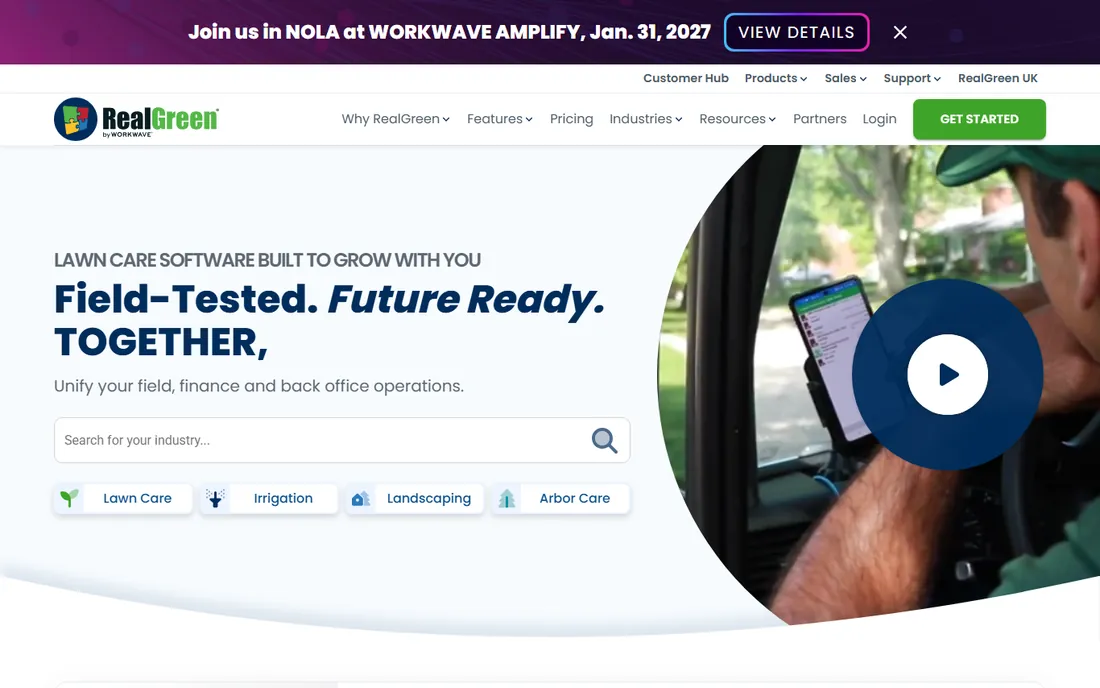
RealGreen has served lawn care companies for decades, and its distinguishing feature is marketing: direct mail, email campaigns, and customer communication tools built specifically for selling lawn services. For companies that grow by marketing to neighborhoods, that built-in capability matters more than another scheduling feature. The operations side covers routing, scheduling, and billing competently.
The platform is older than most competitors, and it shows in the interface. Pricing runs through sales. RealGreen suits the established lawn care company whose growth engine is marketing and that wants operations and campaigns in one system. Younger companies that market through digital channels may find the marketing tools less relevant than they sound.
What we like- Marketing automation built for the lawn industry
- Long track record with lawn care companies
- Direct mail and campaign tools included
Watch out for- Pricing not published
- The platform shows its age in places
- Heavier than pure operations tools
Starting priceSee website
Free planFree trial
LawnPro Software is the focused alternative: lawn care only, without the pest control, tree care, and general field service features that bulk up the bigger platforms. Scheduling, routing, invoicing, and customer management follow the lawn business workflow directly, and setup is quick for small teams. Companies that find Service Autopilot overwhelming but Yardbook too basic land here.
The trade-off is vendor size. Integrations are fewer, development is slower, and the feature depth does not match the category leaders. Pricing is not published. It is a reasonable pick for the small lawn company that wants lawn-specific software without enterprise complexity, provided the trial confirms it handles the actual workflow.
What we like- Built only for lawn care, so the workflow matches
- Simpler than the big platforms
- Quick setup for small teams
Watch out for- Smaller vendor with fewer integrations
- Feature depth trails Service Autopilot
- Pricing not published
Starting priceSee website
Free planNo

FieldRoutes, part of the WorkWave family, serves pest control and lawn companies running serious route density. The automation around recurring services, route optimization, and customer communication is built for operations with hundreds or thousands of stops a week. Being backed by a large field service software company means stability and continued investment.
Everything about the buying process assumes scale: quote-based pricing, a sales-led evaluation, and implementation support. Small operators should not bother. FieldRoutes belongs on the shortlist when the operation has outgrown the mid-market tools and needs enterprise-grade route operations with the support to match.
What we like- Built for high-volume route operations
- Strong automation for recurring services
- Backed by a large field service company
Watch out for- Enterprise-oriented pricing and sales process
- More than small operators need
We compared software that US lawn care and landscape companies actually buy, identified through industry publications, vendor documentation, and reviews on Capterra, G2, and lawn care forums. Every tool had to handle the category's core work, recurring scheduling, routing, and invoicing, as a shipping product in 2026. Pricing reflects published plans checked in October 2026, including Service Autopilot's provider-supplied tiers and Yardbook's published free and paid plans. Where vendors do not publish prices, the tables say "See website". This is a research-based comparison, not hands-on testing.
What to check before you sign up
Start with your service mix, because it splits this list cleanly. Mow-and-blow operations with simple recurring routes do well on Jobber, Housecall Pro, or Yardbook. Full-service companies doing fertilization, weed control, aeration, and overseeding need chemical tracking and lawn-specific workflows, which points to Service Autopilot. Tree care and landscape contracting point to Arborgold or SingleOps. Buying the wrong category costs more in workarounds than the price difference between tiers.
Then check the payment economics. Yardbook's free plan adds a 1% surcharge on card payments, which at $10,000 a month in card volume is $100 a month, more than some paid plans. Every platform takes standard card processing fees on top. Model the total monthly cost including processing at your actual revenue before comparing sticker prices.
Finally, trial during the off-season with real routes. Import last season's accounts, build the actual weekly routes, and put the crew app in your best crew leader's hands. The trial verdict that matters is not the feature list but whether the crew uses it without complaining. Every tool here offers a trial or demo; the ones worth buying survive contact with your real operation.
The recurring-revenue engine
The feature that separates lawn care software from generic field service tools is recurring scheduling automation, and buyers should test it specifically. The right system rebooks the season, handles skip weeks and reschedules without breaking the route pattern, and bills per visit automatically. The wrong system treats every visit as a new job and turns the office into a data-entry department. During any trial, run this scenario: take a 50-account weekly route, skip three accounts for a vacation week, add two new accounts mid-season, and generate the month's invoices. The tools built for this industry do it in minutes. The generalists take noticeably longer, and that time repeats every single week.
Frequently asked questions
What is the best free lawn care software?
Yardbook's free plan is the best genuinely free option, with scheduling, estimates, invoicing, and routing at no cost. The trade-offs are in-app ads and a 1% surcharge on online payments. For a new or solo operation, it is enough to run the business; growing companies usually upgrade to a paid plan within a year or two.
How much does lawn care software cost?
Solo and small operations run $0 to $79 a month on Yardbook, Jobber, or Housecall Pro. Service Autopilot starts at $47 a month for its Startup plan. Larger landscape and tree care platforms like Arborgold and SingleOps use quote-based pricing that runs higher. Most established lawn care companies land between $50 and $300 a month before payment processing fees.
Do I need lawn-specific software or will Jobber work?
Jobber works fine for simple mowing operations with straightforward recurring routes. You need lawn-specific software when the business includes chemical applications (which require tracking for compliance), seasonal service packages, or per-visit billing complexity. The test is whether you are building workarounds weekly; if so, switch.
How long does it take to set up lawn care software?
Simple tools like Yardbook and Jobber go live in a day or two with a clean customer list. Service Autopilot typically takes a few weeks including training. Enterprise platforms like FieldRoutes take longer. Do the migration in the off-season and run the old system in parallel for the first billing cycle.
Can the software handle recurring billing automatically?
The lawn-specific tools can: Service Autopilot, Yardbook, Arborgold, and SingleOps all support recurring schedules with per-visit invoicing. Jobber and Housecall Pro handle recurring jobs but with less lawn-specific billing logic. Confirm the exact billing behavior during the trial, because "recurring" means different things to different vendors.
What about routing? Do I really need route optimization?
For a handful of nearby accounts, probably not; a good driver beats software. Past 30 to 40 stops a day across a service area, optimization starts paying for itself in fuel and labor hours. The bigger win is usually not the optimized order but the ability to re-optimize instantly when a crew calls in sick or a customer reschedules.
Sources we checked (6)
- https://www.itechguides.com/best/lawn-care-software/
- https://www.tradifyhq.com/blog/best-landscaping-apps-2026
- https://www.ontheclock.com/blog/best-time-clock-software-for-lawn-care
- https://www.softwareworld.co/software/service-autopilot-reviews/
- https://www.g2.com/products/service-autopilot/pricing
- https://allbetterapp.com/lawn-care-software/
Is your product missing or out of date?
We review this list regularly. Vendors can request a listing, send updated pricing or ask about featured placement.

Shihab Mia · Founder, Rankite
Shihab has spent more than a decade helping SaaS and e-commerce brands grow through search. He writes Rankite's software buying guides from pricing pages, documentation and public user reviews. More about Shihab.